Best Climbing Plants for UK Gardens
A practical guide to the best climbing plants for UK gardens, covering walls, fences, pergolas, and small spaces. Includes planting advice, aspect guidance, and care tips for British conditions.
Key takeaways
- Climbers increase usable planting area by up to 30%, ideal for UK gardens where space is limited
- Match the climber to your wall's aspect: south-facing suits wisteria and roses, north-facing suits climbing hydrangea and ivy
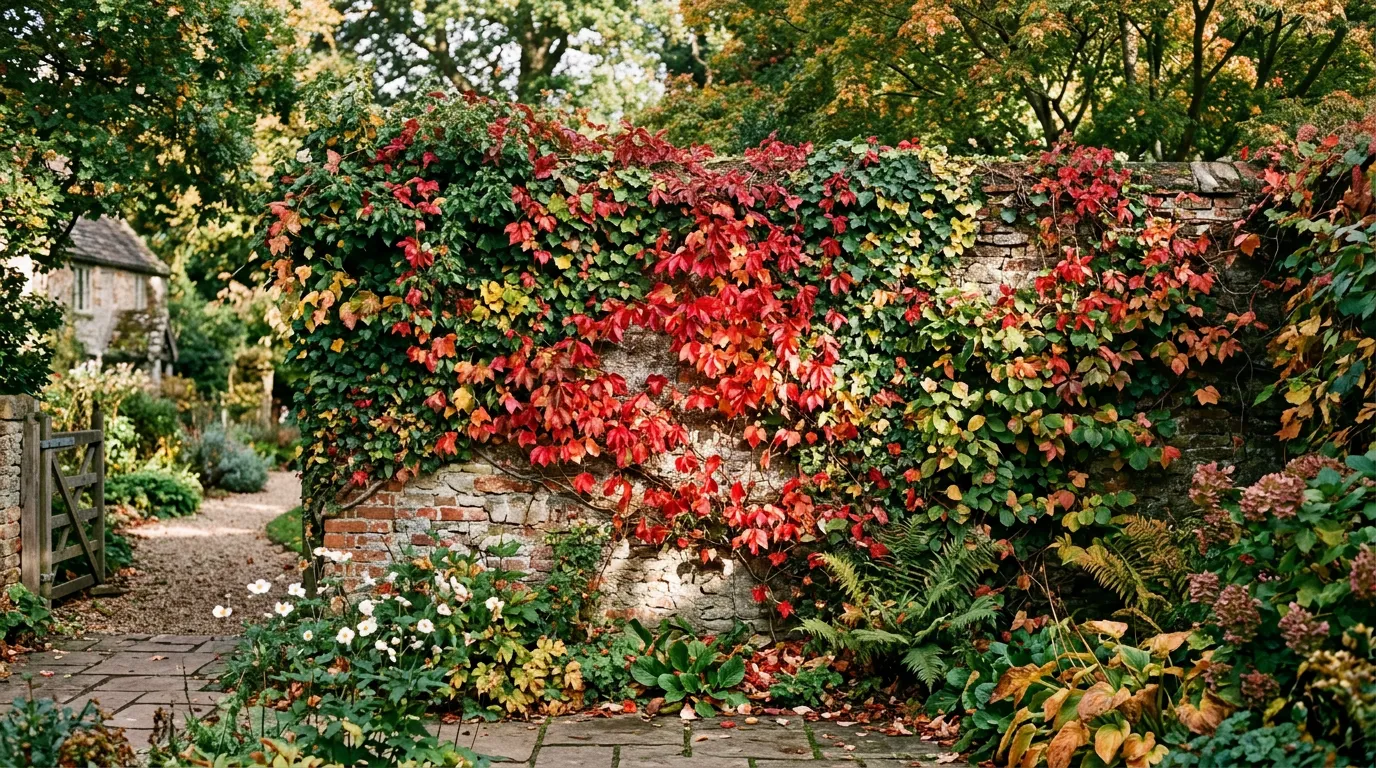
- Self-clinging climbers like Virginia creeper need no support but can damage old mortar on period properties
- Plant climbers 30-45cm away from the wall base where soil stays driest, and angle the root ball inward
- Clematis and honeysuckle are the best choices for wildlife value, supporting bees, moths, and nesting birds
- Most climbers establish faster with a planting hole twice the width of the root ball and a generous mulch of garden compost
Climbing plants are some of the hardest-working plants in any UK garden. They turn bare fences into green screens, disguise ugly walls, shade hot patios, and provide food and shelter for wildlife. In a country where average garden sizes have been shrinking for decades, climbers offer the simplest way to add planting without using any ground space at all.
Whether you have a tiny courtyard, a suburban fence line, or a large pergola to cover, there is a climbing plant that will thrive in your conditions. This guide covers the best options for every aspect and situation, with practical planting and care advice specific to British gardens. For more ideas on making the most of limited space, see our guide to small garden design ideas.
How climbing plants climb
Not all climbers work the same way, and understanding their method matters when choosing support structures.
Self-clinging climbers like ivy and Virginia creeper attach directly to surfaces using aerial roots or adhesive pads. They need no support framework but can be difficult to remove.
Twining climbers like honeysuckle and wisteria wrap their stems around supports. They need wires, trellis, or a pergola to grip.
Tendril climbers like clematis and sweet peas use thin, curling tendrils or leaf stalks to grip. They need fine supports such as mesh, netting, or thin wires.
Scramblers like climbing roses have no natural attachment method. They rely on thorns to hook onto neighbouring plants and need tying in to supports.
Best climbers for south and west-facing walls
South and west-facing walls receive the most sun and radiate stored warmth overnight. These positions suit tender and sun-loving climbers that would struggle on a cold wall.
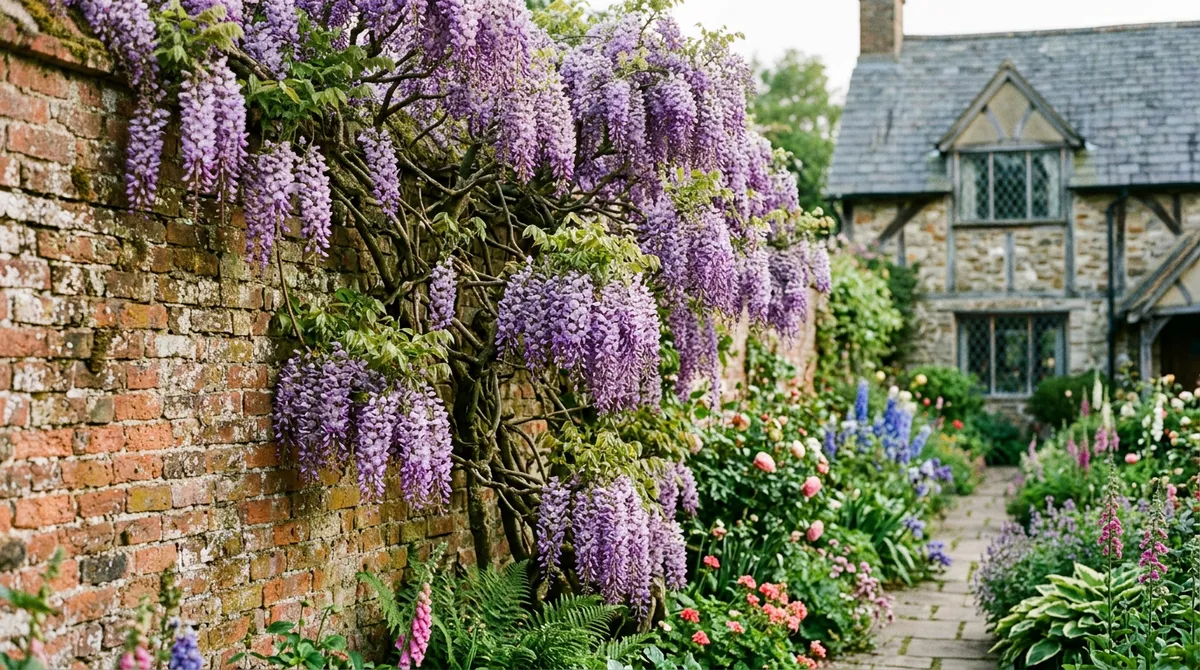
Wisteria (Wisteria sinensis and W. floribunda)
Wisteria is the most dramatic of all British garden climbers. Long racemes of scented purple or white flowers hang in May and June, and the gnarled woody stems develop real character with age. Chinese wisteria (W. sinensis) twines anticlockwise; Japanese wisteria (W. floribunda) twines clockwise. Always buy grafted plants, as seed-grown wisteria may take 15-20 years to flower. The Royal Horticultural Society has detailed pruning guides for wisteria, which needs cutting back twice a year in July and February.
Tip: When buying wisteria, choose a plant that is already flowering in its pot. This confirms it is a grafted specimen and gives you certainty about the flower colour and form.
Climbing roses
Few plants match a climbing rose for romance and scent. For south and west walls, choose repeat-flowering varieties that bloom from June to October. ‘New Dawn’ (pale pink, disease-resistant), ‘Gertrude Jekyll’ (rich pink, outstanding scent), and ‘Madame Alfred Carriere’ (white, shade-tolerant enough for west walls) are proven performers across the UK. For more on pairing roses with complementary planting, see our cottage garden planting plan.
Star jasmine (Trachelospermum jasminoides)
This evergreen twiner has become increasingly popular as UK winters have grown milder. White, intensely fragrant flowers appear from June to August. It needs a warm, sheltered wall, ideally south-facing, and protection from cold easterly winds. In the Midlands and further north, grow it in a large pot and bring under cover for winter. On suitable walls in the south of England, it is reliable and virtually trouble-free.
Passionflower (Passiflora caerulea)
The hardiest passionflower species, surviving to around minus 10 degrees C in well-drained soil at the base of a warm wall. The exotic blue and white flowers appear from July to September. Growth is vigorous, reaching 5m or more. It can be cut to the ground by a hard winter but usually regenerates from the base. In milder regions, it is semi-evergreen.
Best climbers for north and east-facing walls
North and east-facing walls receive little direct sun and can be cold and dry at the base. The plants below are proven in these conditions.
Climbing hydrangea (Hydrangea anomala subsp. petiolaris)
The finest climber for deep shade. Self-clinging aerial roots attach to any surface, and large lace-cap white flowers appear in June and July even on a sunless north wall. Growth is slow for the first two to three years while the root system establishes, then the plant accelerates and can cover a large wall. Be patient with this one. It is well worth the wait. For more shade-tolerant planting ideas, see our guide to the best plants for shade.
Ivy (Hedera helix and cultivars)
Ivy has an undeserved bad reputation. It is one of the most ecologically valuable plants in any UK garden, providing nesting sites for birds, autumn nectar for bees, and winter berries. The Woodland Trust notes that ivy flowers are a critical late-season food source for pollinators when little else is in bloom. For north walls, choose large-leaved Hedera colchica ‘Dentata Variegata’ for a brighter effect, or stick with the native H. helix for maximum wildlife value.
Winter jasmine (Jasminum nudiflorum)
Bright yellow flowers on bare green stems from November to February, a time when nothing else is flowering. Technically a scrambler rather than a true climber, it needs tying in to trellis or wires. Extremely tough, tolerating cold, shade, and poor soil. It flowers on the previous year’s growth, so prune immediately after flowering in March.
Best climbers for pergolas and arches
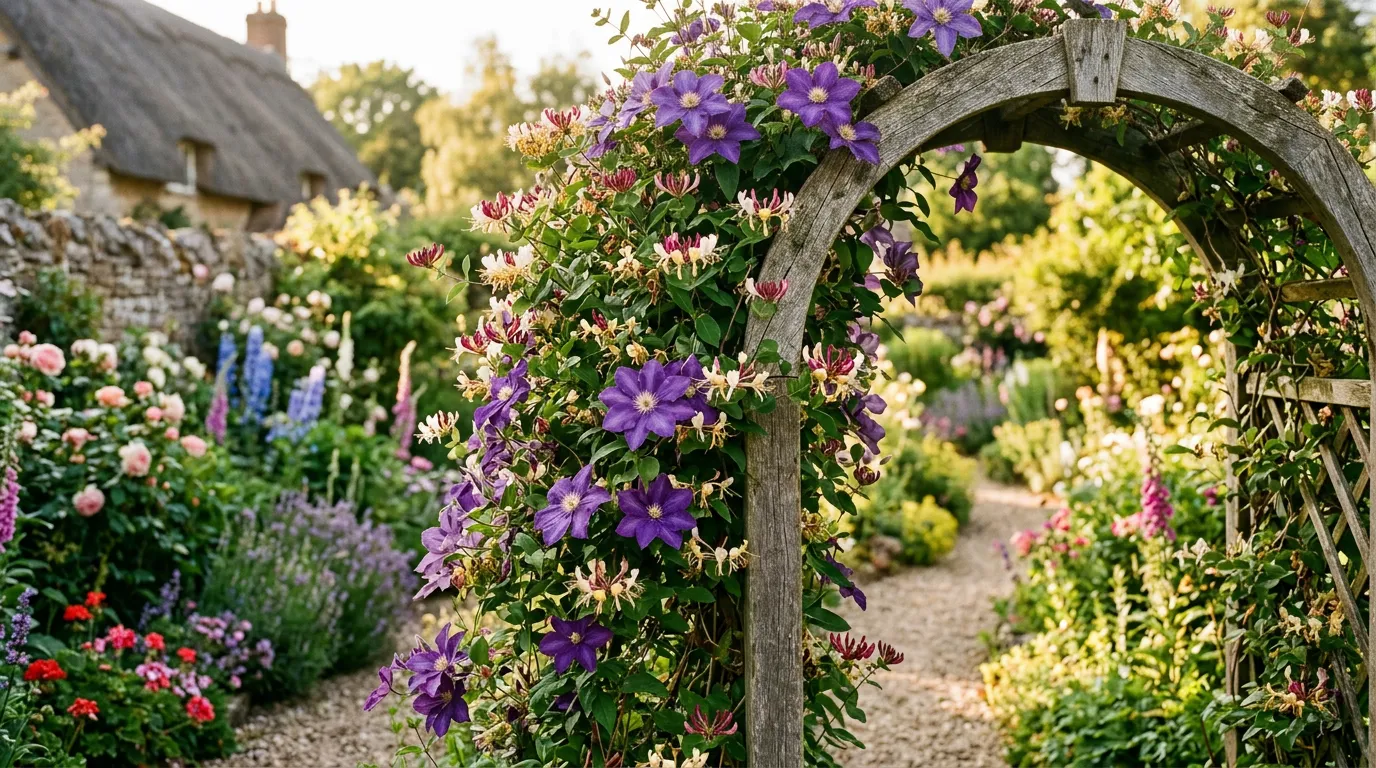
Pergolas and arches need climbers that produce overhead interest, whether flowers, fragrance, or attractive foliage.
Honeysuckle (Lonicera periclymenum)
The native honeysuckle is arguably the most evocative scented plant in British gardens. Creamy yellow and pink flowers from June to September, strongest in the evening when they attract pollinating moths. ‘Graham Thomas’ and ‘Belgica’ are excellent named varieties. Honeysuckle prefers its roots in shade and its top growth in sun, making it ideal for a pergola where the base is shaded by other planting. It is a superb choice for bee-friendly gardens and supports a wide range of other pollinators.
Clematis
The largest genus of garden climbers, with species and varieties flowering in every month from January to November. For pergolas, the large-flowered summer varieties work well. ‘Nelly Moser’ (pink and mauve stripes), ‘Jackmanii’ (deep purple), and ‘Niobe’ (dark red) are all reliable and widely available. Clematis need their roots kept cool and shaded, so plant low-growing perennials or use a layer of stone slabs around the base.
Grape vine (Vitis vinifera)
Ornamental grape vines provide dappled shade, attractive lobed foliage, and autumn colour. In warm years, they produce edible fruit as well. ‘Purpurea’ has deep purple leaves and is purely decorative. For fruit, choose ‘Solaris’ or ‘Phoenix’, which are bred for the UK climate and ripen reliably in southern and central England.
Climbers for quick coverage
Sometimes you need fast results, whether to screen an eyesore, cover a new fence, or fill a gap while slower plants establish.
| Climber | Growth rate per year | Evergreen? | Flowers | Best aspect |
|---|---|---|---|---|
| Russian vine (Fallopia) | 4-5m | No | White, late summer | Any |
| Summer jasmine (Jasminum) | 2-3m | Semi | White, fragrant | South, west |
| Clematis montana | 2-3m | No | Pink or white, spring | Any |
| Mile-a-minute (Persicaria) | 3-4m | No | Red berries, autumn | Any |
| Chocolate vine (Akebia) | 2-3m | Semi | Purple, fragrant | South, west |
| Honeysuckle (Lonicera) | 1.5-2m | Semi | Cream, scented | Any |
Russian vine is the fastest of all but quickly becomes invasive and is difficult to remove. For most situations, summer jasmine or Clematis montana give rapid coverage without the management headaches.
How to plant a climber
Good planting technique makes the difference between a climber that thrives and one that struggles for years.
Prepare the planting hole
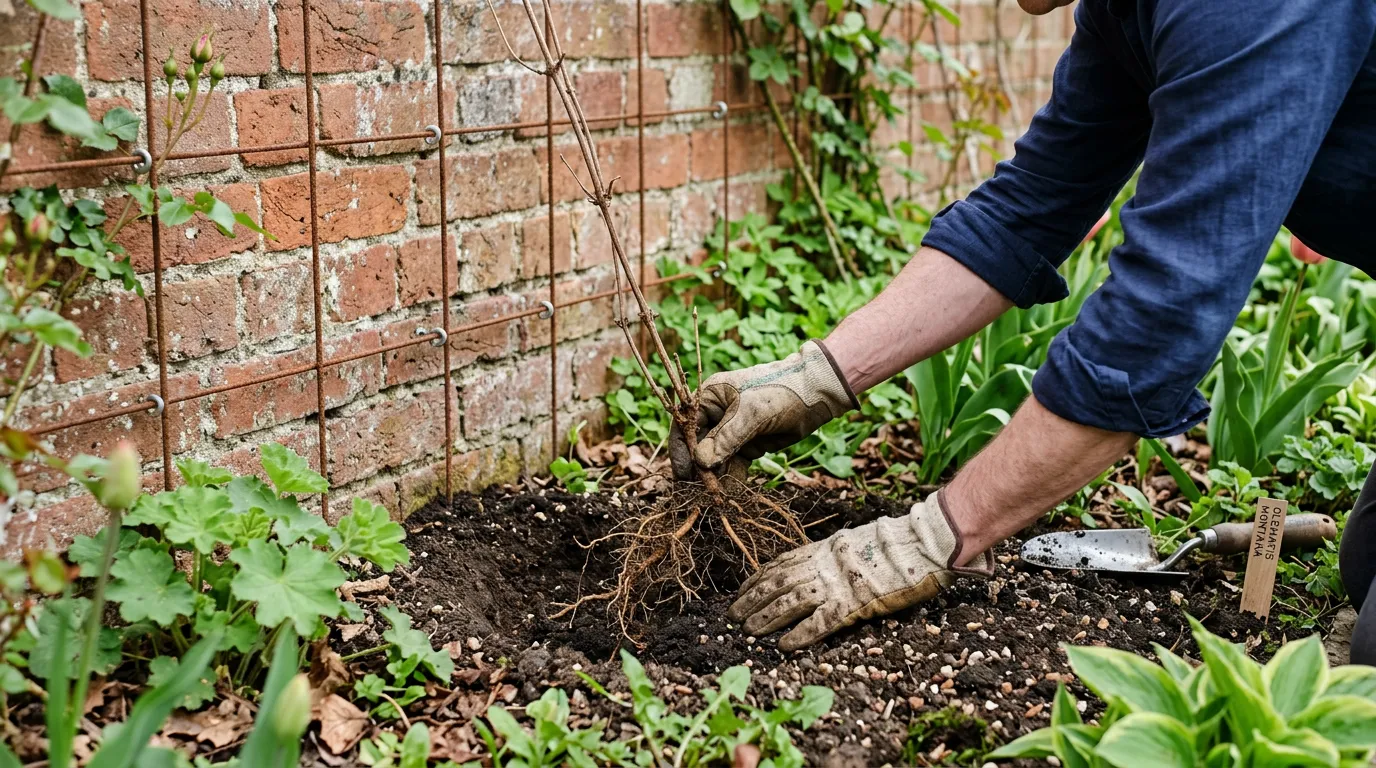
Dig a hole at least 30-45cm away from the wall or fence base. Soil directly against a structure is often dry, compacted, and full of rubble. Make the hole twice the width of the root ball and the same depth. Fork over the base to break up any compaction.
Improve the soil
Mix the excavated soil with generous amounts of garden compost or well-rotted manure. If you need to make your own compost, it is one of the simplest and most valuable things you can do for your garden. For clematis, add a handful of bonemeal to the planting hole.
Position and backfill
Angle the root ball towards the wall or fence so the stems lean naturally towards their support. For clematis, plant 10-15cm deeper than the nursery pot level to protect against clematis wilt. Backfill with the improved soil, firm gently, and water deeply. Apply a 5-7cm layer of mulch around the base, keeping it clear of the stems.
Aftercare
Water regularly through the first two growing seasons, especially during dry spells from May to September. Even established climbers against walls may need supplemental watering because the wall creates a “rain shadow” that keeps the soil dry at the base.
Climbing plants for wildlife
Climbers provide far more than decoration. They create vertical habitat that supports birds, insects, and other wildlife. In a low-maintenance garden, established climbers are among the easiest plants to manage once they are growing well.
For bees and pollinators: Honeysuckle, clematis, wisteria, and ivy all produce nectar-rich flowers. Ivy is particularly important because it flowers in autumn (September to November) when few other plants provide forage.
For nesting birds: Dense evergreen climbers like ivy, pyracantha, and climbing hydrangea provide sheltered nesting sites. Avoid pruning these plants between March and August to protect nesting birds.
For berries and fruit: Pyracantha produces masses of orange, red, or yellow berries from October onwards, feeding thrushes, blackbirds, and waxwings. Honeysuckle berries are eaten by warblers in late summer.
Pruning basics
Incorrect pruning is the most common reason climbers fail to flower. The general rules are straightforward.
Spring-flowering climbers (wisteria, Clematis montana, winter jasmine) flower on growth produced the previous year. Prune immediately after flowering to allow new growth time to mature before next year’s display.
Summer-flowering climbers (large-flowered clematis, summer jasmine) flower on the current season’s growth. Prune in late winter or early spring, cutting back to strong buds before new growth begins. For clematis, check the pruning group before cutting. Group 1 needs minimal pruning, Group 2 needs light tidying, and Group 3 gets cut hard to 30cm in February.
Climbing roses are trained differently from other climbers. Bend the main stems as close to horizontal as possible, securing them to wires. This encourages flowering shoots to break along the full length of the stem rather than only at the top. Prune side shoots back to 2-3 buds in late winter.
Choosing the right climber for your garden
If your garden faces north and you want something low-maintenance and wildlife-friendly, climbing hydrangea or ivy will perform reliably year after year. If you have a warm south-facing wall and want drama, invest in a grafted wisteria. For fragrance, honeysuckle and summer jasmine are hard to beat. And for March planting, container-grown climbers can go in straight away as long as the ground is not frozen or waterlogged.
The best approach is to match the plant to the position. Check the aspect, measure the available space, and be realistic about how much pruning you are willing to do. A well-chosen climber planted in the right spot will give decades of pleasure with relatively little effort.
Lawrie has been gardening in the West Midlands for over 30 years. He grows his own veg using no-dig methods, keeps a wildlife-friendly garden, and writes practical advice based on real UK growing conditions.