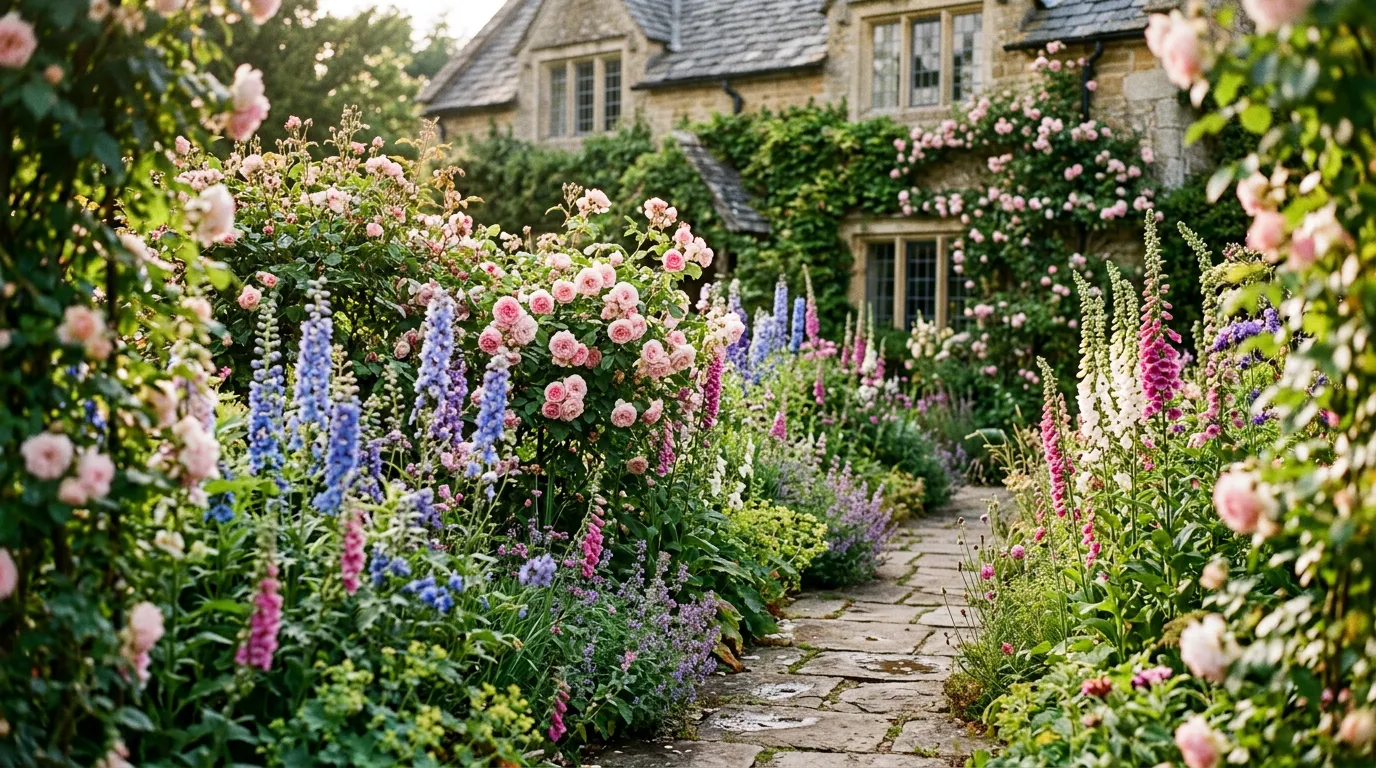
Small Garden Design Ideas for UK Gardens
Practical design ideas for small UK gardens. Layout principles, planting for structure, vertical growing, and how to make a 4m x 6m plot feel twice its size.
Last updated: 6 March 2026
Key takeaways
- Break sight lines with planting and level changes to make small spaces feel larger
- Use every vertical surface: a 1.8m fence panel is growing space for climbers
- Split even a 4m x 6m plot into 2-3 zones for a more purposeful feel
- Limit hard landscaping to two materials maximum to avoid a busy look
- Lay paths and patios at 45 degrees to exploit the diagonal, the widest dimension
- Dwarf fruit trees on M27 rootstock produce 10-15kg from a 1.5m tree
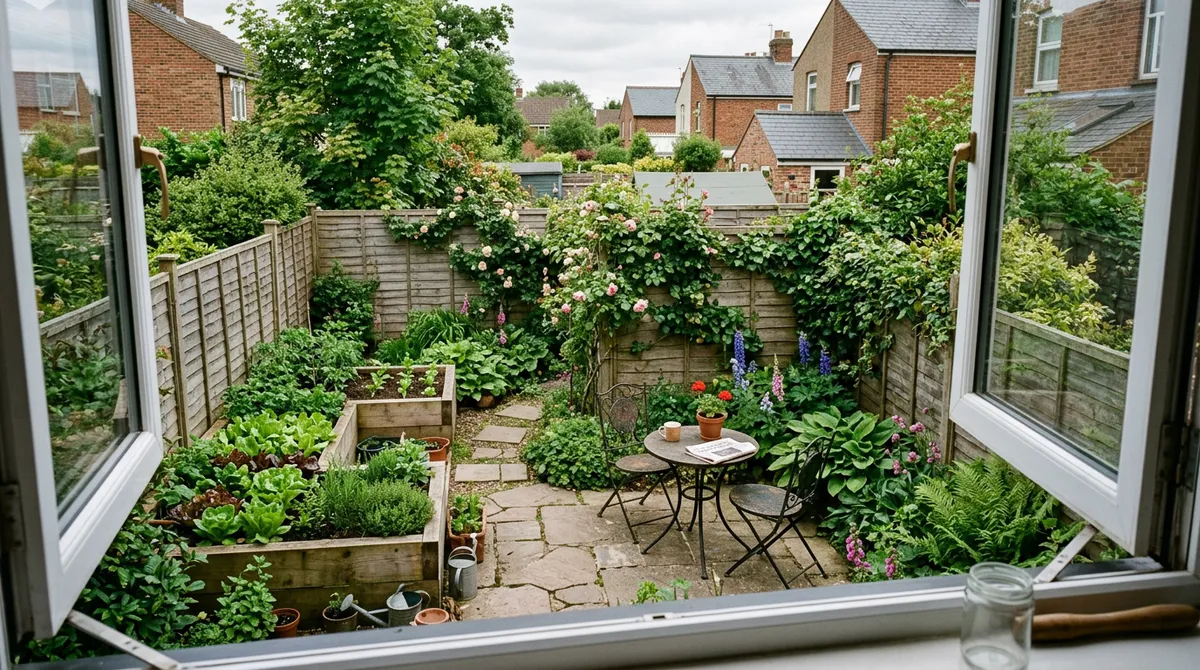
The average UK garden measures just 14m x 12m. Terraced houses and new-builds often have plots half that size, sometimes as small as 4m x 6m. That does not mean you are stuck with a forgettable patch of paving and a couple of pots.
A well-designed small garden can feel spacious, productive, and private. The RHS small garden ideas page has additional inspiration. The key is making deliberate choices about layout, materials, and planting rather than filling the space with whatever is on sale at the garden centre. This guide covers the principles that professional garden designers use when working with tight plots, along with specific plant suggestions and layout ideas for common UK plot sizes. For more layout and planting inspiration, browse our garden design guides.
Three principles of small garden design
Every successful small garden follows these three rules. They apply whether you have a 4m x 6m terrace or a 10m x 8m Victorian back garden.
1. Do not reveal everything at once
The biggest mistake in small gardens is making the whole space visible from one viewpoint. When you can see every corner from the back door, the brain registers the boundaries and the space feels small.
Break the sight lines with planting, screens, or changes in level. Even a single raised bed placed at an angle creates a partial screen. A trellis panel with a climber divides the garden without the weight of a solid fence. An arch over a path forces the eye to focus on what is beyond rather than the boundaries.
The goal is to create the impression that there is more garden around the corner. This works even in tiny plots. A 4m x 6m garden with one diagonal screen feels larger than a 6m x 8m garden designed as an open rectangle.
2. Use every vertical surface
Fences, walls, and trellis panels are growing space. A 1.8m fence panel running the full length of a small garden offers 7-10 square metres of planting area, more than most flower beds in the same garden.
Vertical planting options:
- Climbing plants like roses, jasmine, or clematis on trellis or wires
- Espaliered fruit trees trained flat against a wall
- Green walls or vertical pallet planters for herbs
- Hanging baskets along a south-facing fence
A south-facing fence is particularly valuable. It absorbs and radiates heat, creating a microclimate 2-3C warmer than the open garden. Use this for tender plants, trained fruit trees, or heat-loving crops like tomatoes.
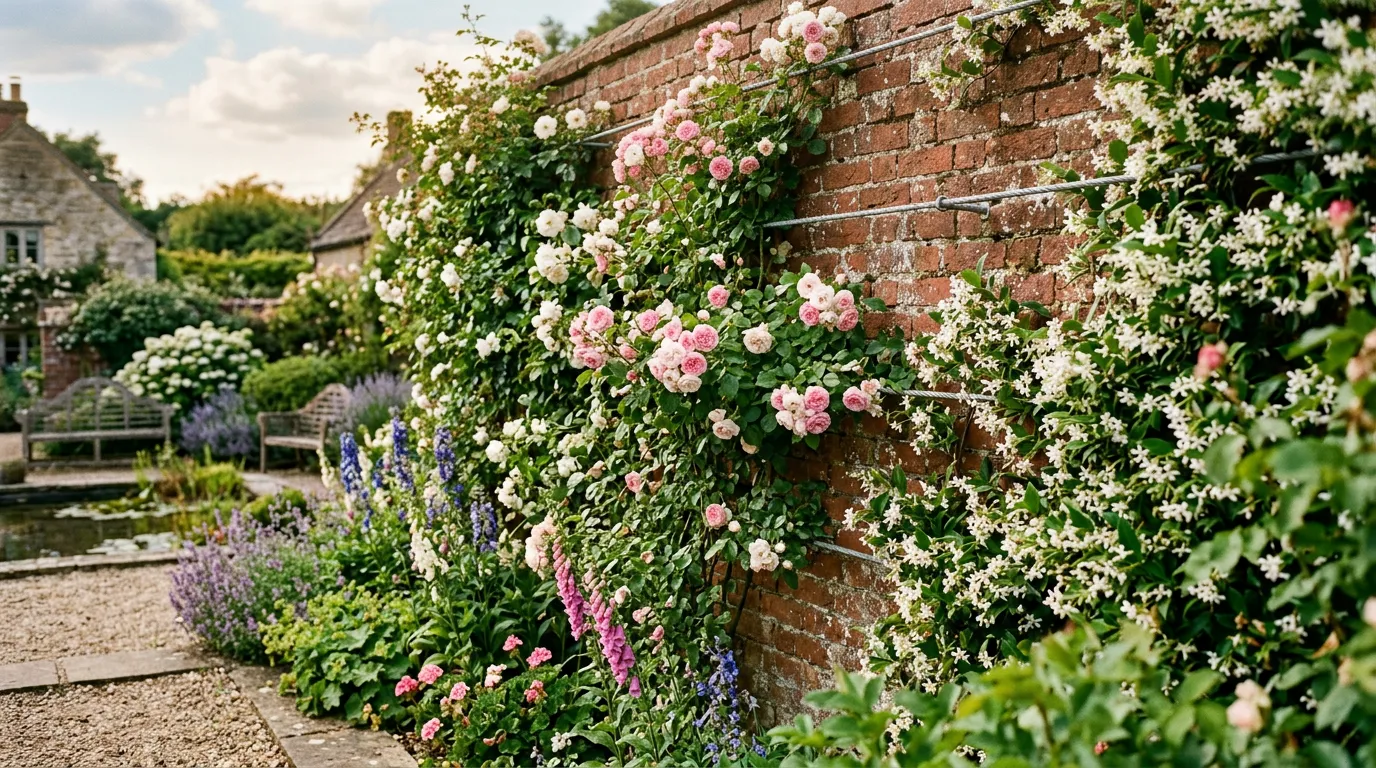 Climbing roses and jasmine on a brick wall. Vertical planting adds 7-10 square metres of growing space to a small garden.
3. Define separate areas
A small garden that functions as one undivided rectangle feels small. Split it into two or three zones and it immediately feels purposeful and considered.
Zone ideas for small gardens:
- Seating and dining area (closest to the house)
- Planting beds or productive growing space
- A container corner or water feature focal point
- A children’s area or lawn section
The zones do not need physical walls between them. A change in surface material (paving to gravel), a change in level (a single step up), or a change in planting height is enough to signal the transition.
Gardener’s tip: Stand at your back door and look at your garden. If you can see all four corners, the space needs at least one visual break. A single trellis panel at an angle will transform the feel.
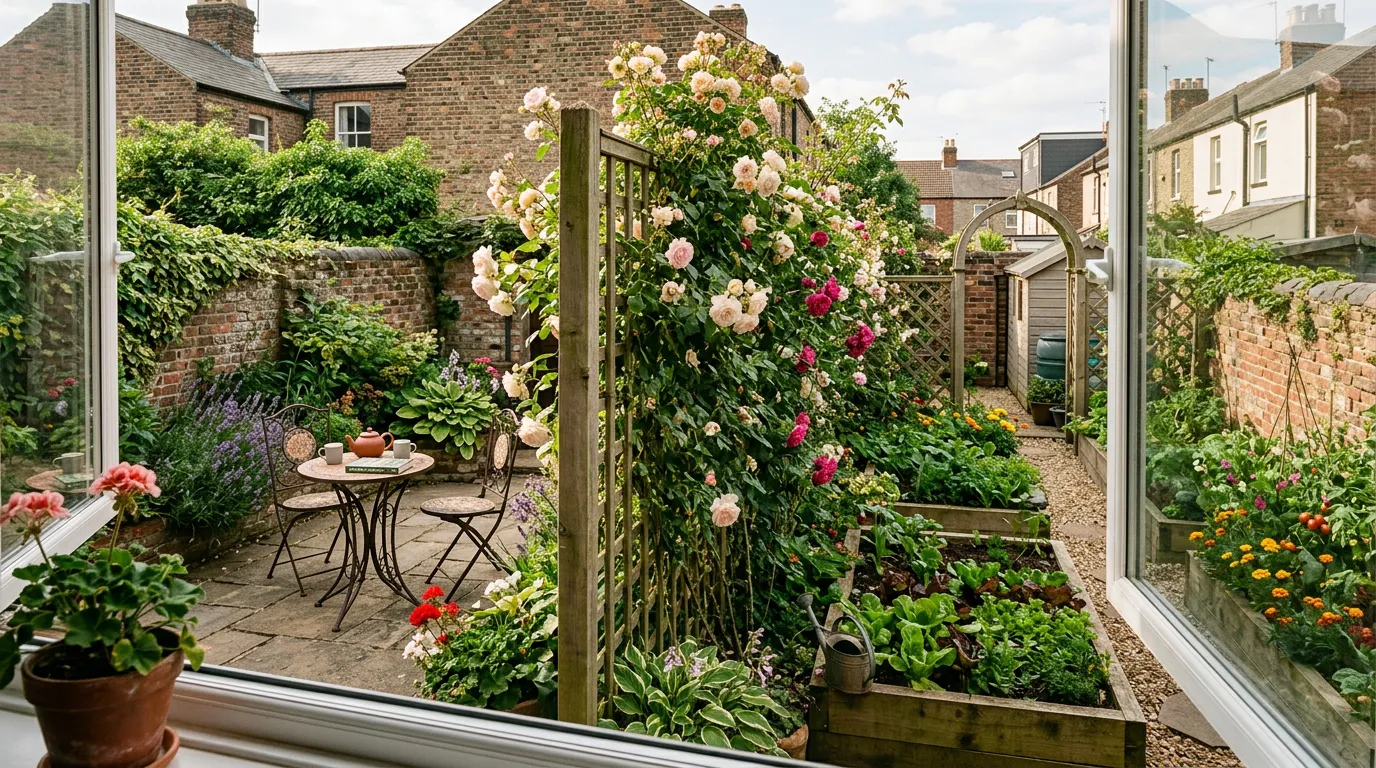 A trellis screen with climbing roses divides this small garden into two zones. The partial screen creates the impression of a larger space beyond.
Layout ideas for common plot sizes
4m x 6m: the typical new-build terrace
This is the smallest common garden size. Every centimetre counts.
Layout:
- Front zone (2m deep): paved seating area with a small bistro table. Planters along both side fences. Keep furniture compact. Folding chairs store flat against the wall when not in use.
- Back zone (4m deep): central stepping-stone path with raised beds on each side, 60cm wide and 40cm tall. Climbers on the rear fence. One small tree in a corner (Japanese maple or multi-stem amelanchier).
- Materials: pale stone paving (buff or grey porcelain) expands the space visually. Avoid dark decking in tight plots as it absorbs light.
6m x 8m: the typical Victorian terrace
More room to play with. A diagonal design works well at this size.
Layout:
- Diagonal design: lay the patio and main path at 45 degrees to the house. This forces the eye diagonally across the widest dimension of the garden (10m on the diagonal vs 8m along the length).
- Three zones: paved dining area near the house, central gravel garden or small lawn, planted border at the rear.
- Focal point: a small water feature, specimen tree, or large pot at the far end draws the eye and adds depth.
8m x 10m: the semi-detached standard
A generous plot by modern standards. Enough room for distinct rooms.
Layout:
- Near the house: large patio for dining, 3m x 4m minimum for a table and four chairs.
- Middle section: lawn or gravel garden, bordered by mixed planting beds 1m wide on each side.
- Far end: screened area with a bench, a shed, or a productive kitchen garden. Use a hedge, trellis, or tall grasses as the divider.
Layout comparison
| Plot size | Zones | Paving area | Planting area | Recommended tree |
|---|---|---|---|---|
| 4m x 6m | 2 | 6-8 sq m | 10-14 sq m | Japanese maple (pot) |
| 6m x 8m | 3 | 10-15 sq m | 20-30 sq m | Amelanchier lamarckii |
| 8m x 10m | 3-4 | 15-20 sq m | 40-55 sq m | Betula utilis jacquemontii |
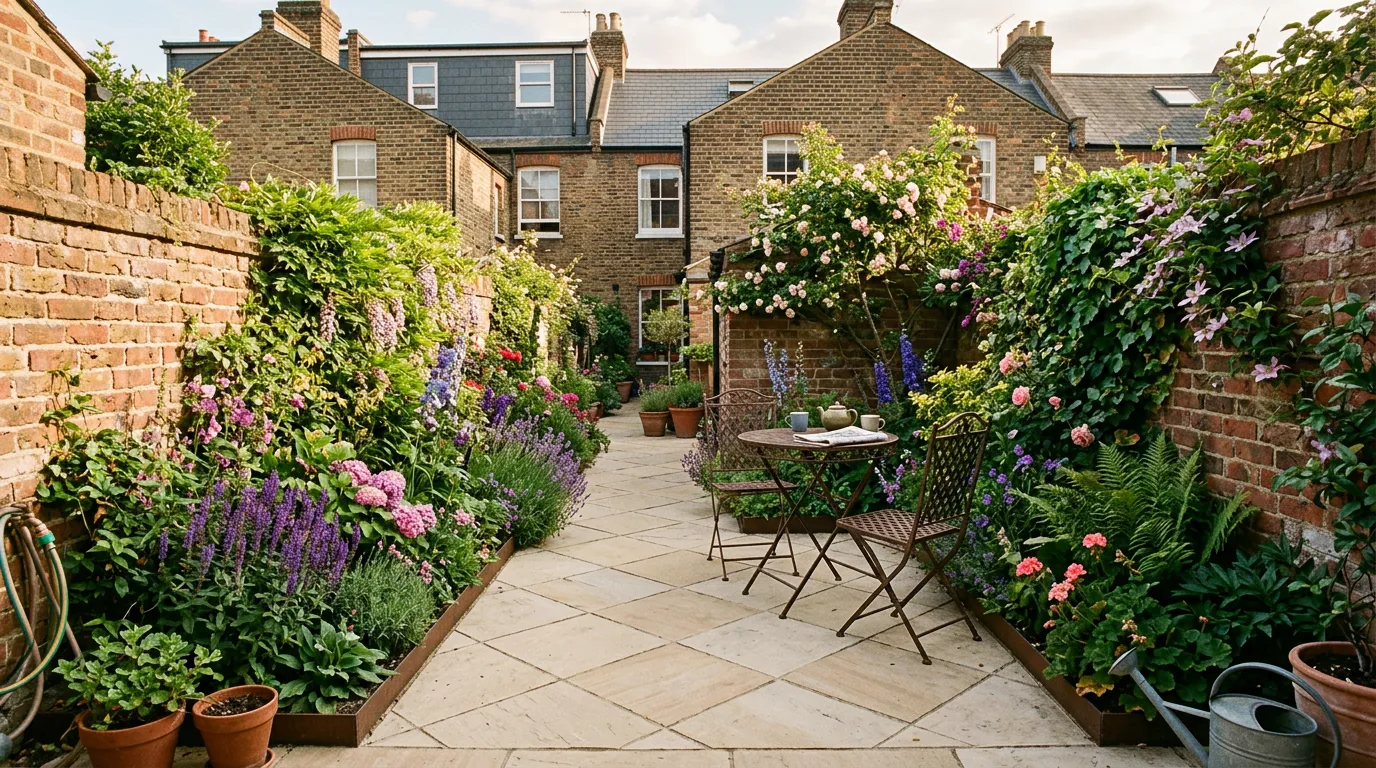 Diagonal paving in a small Victorian terrace garden. Laying at 45 degrees exploits the widest dimension of the plot.
Materials and hard landscaping
The materials you choose affect how large the garden feels. Two rules apply.
Limit materials to two
More than two hard landscaping materials in a small garden looks busy and fragmented. Choose one for the main paving (natural stone, porcelain, or concrete slabs) and one for secondary surfaces (gravel, timber, or brick). That is enough.
Good combinations:
- Buff porcelain paving + pale gravel
- Sawn sandstone + timber raised beds
- Grey slate paving + red brick edging
Use pale colours
Pale materials reflect more light. In a small garden, this makes the space feel brighter and more open. Save dark colours for the boundaries (fence paint, trellis stain), where they push the edges back visually.
Fence colour: painting fences a dark colour like Cuprinol ‘Urban Slate’ or ‘Black Ash’ makes them recede into the background. The green foliage planted against them stands out more. This single change makes a noticeable difference in tight spaces.
Warning: Avoid mixing more than two types of paving. A common mistake is combining Indian sandstone, brick edging, gravel, decking, and stepping stones in one small plot. The result looks cluttered and makes the garden feel smaller.
Plants for small gardens
Choose plants that earn their space with multiple seasons of interest or dual purpose. In a small garden, every plant needs to justify its position.
Structural plants
These form the backbone of the design. They provide year-round shape.
- Japanese maple (Acer palmatum) - 2-3m height in a large pot. Autumn colour in orange and red. Elegant, arching form. Needs shelter from wind. Choose ‘Dissectum’ for a lower, mounding form (1-1.5m).
- Box balls (Buxus sempervirens) - evergreen spheres that anchor borders and doorways. Compact, shade tolerant, clip twice a year (May and August). Use box blight-resistant alternatives like Ilex crenata if blight is a problem in your area.
- Fatsia japonica - architectural, glossy leaves that thrive in shade. Evergreen, reaches 2-3m. One of the best plants for dark corners where nothing else looks good.
- Amelanchier lamarckii - multi-stem small tree. White spring blossom, autumn colour, edible berries. Reaches 4-5m. One of the best trees for small UK gardens.
Climbers
Vertical interest without floor space. Essential in small gardens. See our full guide to the best climbing plants for UK gardens for variety recommendations.
- Star jasmine (Trachelospermum jasminoides) - evergreen, intensely fragrant white flowers June to August. Needs a south or west wall. Grows to 6m on wires or trellis.
- Clematis ‘Nelly Moser’ - large pink striped flowers May to June. Grows on trellis or obelisk. 2-3m. Likes roots in shade, head in sun.
- Climbing hydrangea (Hydrangea anomala petiolaris) - the best climber for north-facing walls. Self-clinging, white lace-cap flowers in summer. Slow to establish but reliable once going. See our full guide to shade-tolerant plants for more options.
- Espaliered apple or pear - trained flat against a sunny fence. Takes 30cm of depth but produces 10-15kg of fruit. Buy pre-trained espaliers on M26 (apple) or Quince A (pear) rootstock.
Productive plants for small spaces
Growing food in a small garden is entirely practical with the right approach. See our guide to starting a vegetable garden for a full beginner’s walkthrough.
- Dwarf apple trees on M27 rootstock - just 1.5-2m height. Produces 10-15kg of fruit per tree. Grow in a large pot (50 litres minimum) or plant in the ground.
- Herbs in a vertical pallet planter - rosemary, thyme, sage, mint (mint in its own pot to stop it spreading). Fix a recycled pallet to a sunny fence and plant into the gaps. Flowering herbs also attract bees and other pollinators.
- Tumbling tomatoes in hanging baskets - Tumbling Tom varieties trail down from baskets hung along a south-facing fence. Each basket produces 2kg of cherry tomatoes.
- Salad leaves in window boxes - cut-and-come-again lettuce, rocket, and radish grow in any container with 15cm of compost. Sow every 3 weeks from April to August for continuous picking.
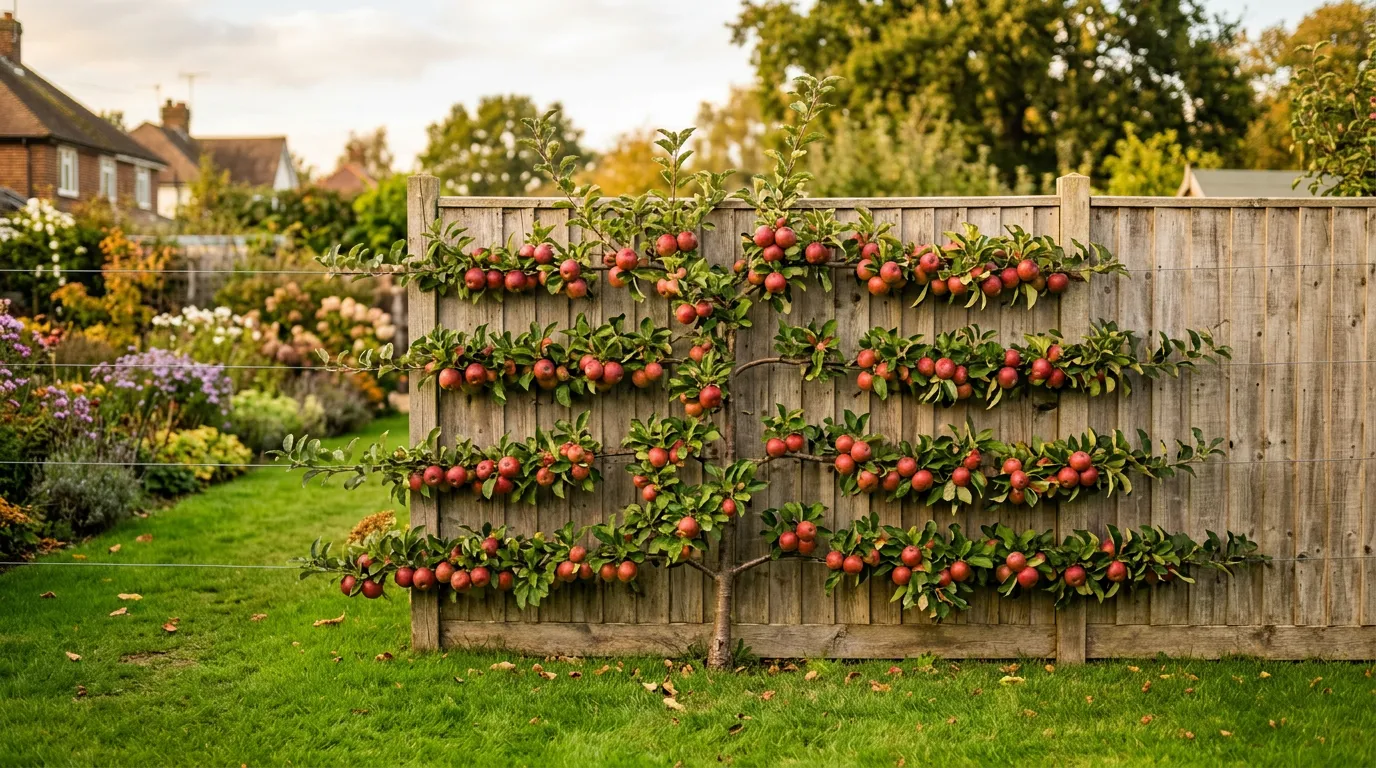 An espaliered apple tree on a fence. Takes just 30cm of depth but produces 10-15kg of fruit per year.
| Plant | Type | Height | Floor space needed | Season of interest |
|---|---|---|---|---|
| Japanese maple | Structural | 2-3m | 1m pot | Apr-Nov |
| Amelanchier | Tree | 4-5m | 2m canopy | Mar-Nov |
| Star jasmine | Climber | 6m | 0 (on wall) | Jun-Aug + evergreen |
| Dwarf apple (M27) | Productive | 1.5-2m | 1m | Apr-Oct |
| Box ball | Structural | 40-60cm | 50cm | Year-round |
Lighting
Good lighting transforms a small garden. It extends the usable hours from spring through autumn and makes the space feel larger after dark by drawing the eye to highlighted features rather than boundaries.
Uplighting
Place a single spotlight at the base of a tree or large shrub. The shadows cast upward create depth and drama. One well-placed uplight does more than six poorly placed ones. Use warm white LED (2700-3000K) and angle it into the canopy, not at the sky.
Festoon lights
String across the seating area at 2.5m height. Warm white (2700K), not cool white. Cool white makes any outdoor space feel clinical. Use solar-powered or low-voltage LED festoons. Drape them in a gentle curve rather than pulling them taut.
Path lights
Low-level solar stakes along the main route. Functional and atmospheric. Space them 1.5-2m apart and stagger them left and right rather than placing them in rigid lines. Spike lights that spread a soft pool of light work better than tall bollard styles.
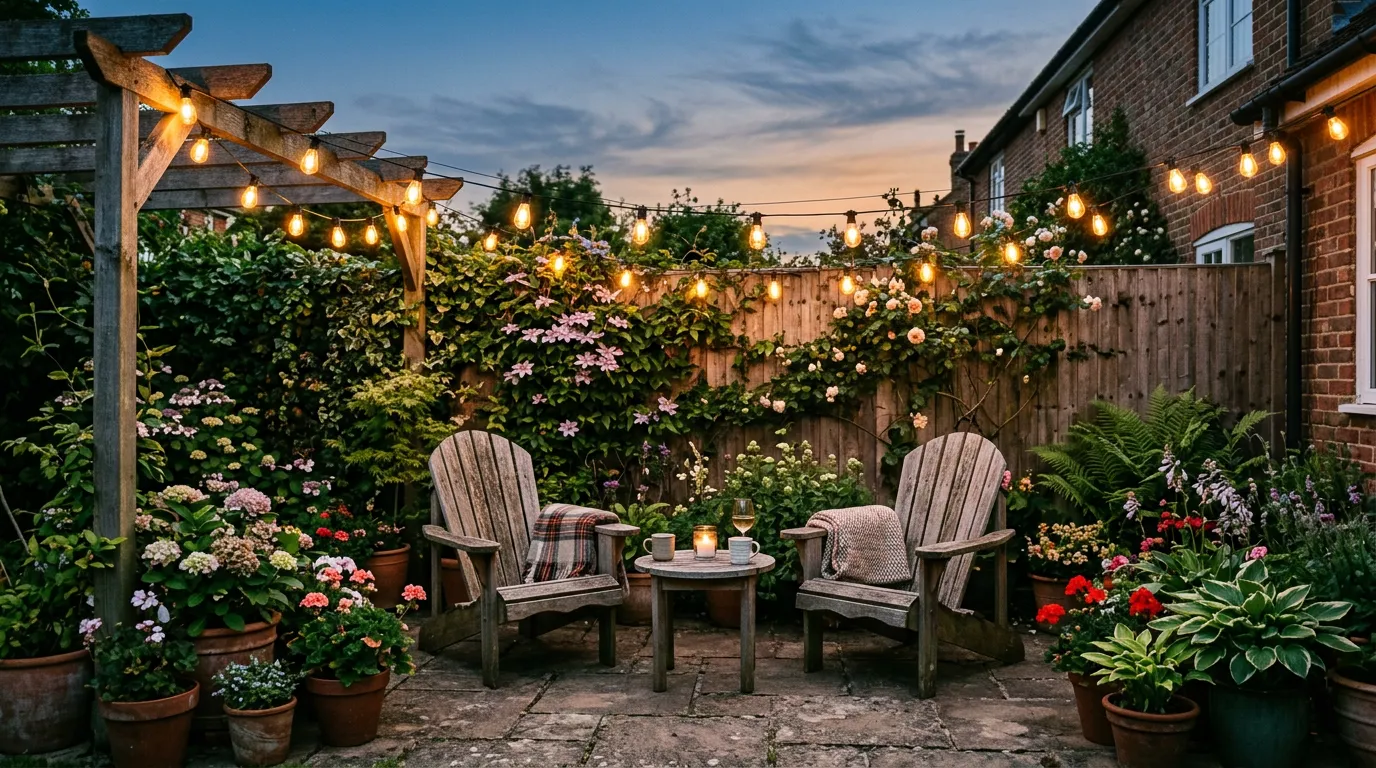 Festoon lights transform a small patio at dusk. Warm white (2700K) bulbs create an atmospheric glow without flattening the space.
What to avoid
Floodlights flatten everything. They illuminate the boundaries and make a small garden feel like a car park. Security lights with motion sensors are fine for safety but should not be your main garden lighting.
Blue or colour-changing LEDs date a garden quickly. Stick with warm white throughout.
Common mistakes in small garden design
1. Too many materials
Limit hard landscaping to two materials maximum. Stone paving and timber raised beds. Gravel and brick edging. More than two looks busy and makes a small space feel cluttered.
2. Centred rectangular lawns
A small rectangular lawn in the middle of a small rectangular garden emphasises the constraints. It draws attention to the shape and size of the plot. Replace with an off-centre circular lawn, gravel, or paving. If you want grass, make the shape irregular.
3. Ignoring the boundaries
Bare fences make a garden feel like a box. They are the largest vertical surfaces in most gardens and leaving them empty wastes space. Plant climbers, attach trellis panels, or paint fences a dark colour to push them back visually.
4. Planting too much
A small garden crammed with 50 different plant species looks chaotic. Choose 8-12 varieties and repeat them, favouring low maintenance plants that earn their space. Repetition creates rhythm and makes a small space feel cohesive rather than cluttered. Three of the same plant looks intentional. One of thirty different plants looks confused.
5. Forgetting winter
Many small garden designs look good in July and bare in January. Include at least 30% evergreen planting to maintain structure through winter. Box balls, fatsia, heuchera, and evergreen grasses all hold their form year-round.
Month-by-month small garden tasks
| Month | Task |
|---|---|
| January | Plan changes on paper. Order seeds and bare-root plants. |
| February | Prune climbing roses. Cut back ornamental grasses. |
| March | Plant container shrubs. Sow hardy annuals for summer colour. See what to plant in March. |
| April | Plant climbers. Start feeding containers with liquid fertiliser. |
| May | Plant tender bedding after last frost. Clip box balls (first cut). |
| June | Deadhead roses and perennials. Water containers daily in hot spells. |
| July | Cut back catmint and hardy geraniums for a second flush. |
| August | Clip box balls (second cut). Take semi-ripe cuttings of shrubs. |
| September | Plant spring bulbs. Move tender plants under cover before frost. |
| October | Plant bare-root trees and hedging. Clear fallen leaves from paving. |
| November | Plant tulip bulbs. Clean and store garden furniture. |
| December | Review what worked and plan next year’s changes. |
Frequently asked questions
How do I make a small garden look bigger?
Break the sight lines so you cannot see everything at once. Use planting, trellis panels, or changes in level to create partially hidden areas. Pale-coloured paving reflects light and makes the ground plane feel larger. Laying paths at a 45-degree diagonal exploits the widest dimension of the plot.
What is the best paving for a small garden?
Pale natural stone or porcelain pavers work best. Light colours reflect more light and make the space feel open. Avoid dark decking in tight plots because it absorbs light. Buff or grey tones are versatile. Limit yourself to one type of paving plus one secondary material.
Can I grow fruit trees in a small garden?
Yes, dwarf fruit trees on M27 rootstock grow to just 1.5-2m tall and produce 10-15kg of fruit. They grow well in 50-litre pots. Espaliered trees trained flat against a fence take just 30cm of depth. A sunny south or west-facing wall is ideal for trained fruit.
What climbers work best on a north-facing wall?
Climbing hydrangea is the best option. It is self-clinging, tolerates full shade, and produces white flowers in summer. Virginia creeper gives spectacular autumn colour on north walls. Ivy is the most reliable option if nothing else grows. All three are low maintenance once established.
How do I light a small garden?
Use one or two uplights at the base of trees to create depth. String warm white festoon lights (2700K) across seating areas at 2.5m height. Add low solar path lights along the main route. Avoid floodlights, which flatten everything and highlight the boundaries.
Should I have a lawn in a small garden?
A small rectangular lawn emphasises a small rectangular space. If you want grass, make it an irregular shape offset from the boundaries. For plots under 4m x 6m, consider replacing the lawn with gravel or paving. Artificial grass removes habitat for ground-nesting bees and heats up in summer.
Lawrie has been gardening in the West Midlands for over 30 years. He grows his own veg using no-dig methods, keeps a wildlife-friendly garden, and writes practical advice based on real UK growing conditions.