How to Prune Roses in the UK
A practical guide to pruning roses in the UK. Covers when to prune, techniques for hybrid teas, floribundas, climbers, shrub roses, and ramblers, plus common mistakes to avoid.
Key takeaways
- Prune most roses between late February and mid-March in the UK, adjusting for your region and local conditions
- Always cut to an outward-facing bud at a 45-degree angle, about 5mm above the bud
- Hybrid tea roses need harder pruning than floribundas, cutting stems to 15-20cm from the base
- Climbing roses are pruned differently to ramblers. Climbers flower on old and new wood, ramblers mainly on new growth
- Remove dead, diseased, and crossing stems first before shaping the plant
- Clean secateurs between plants with a disinfectant solution to prevent spreading disease
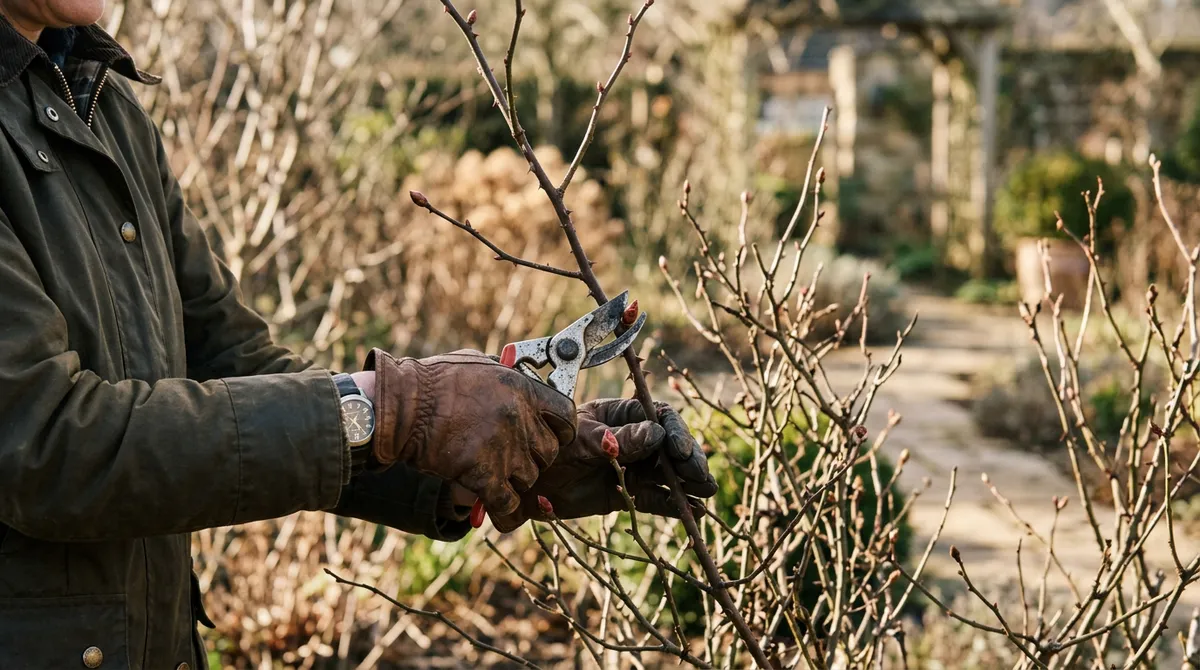
Pruning roses is one of those jobs that worries new gardeners more than it should. Roses are tough, forgiving plants. Prune too hard and they bounce back. Prune too lightly and you simply get a leggier bush. The real damage comes from not pruning at all, which leads to congested, disease-prone plants that flower less each year.
This guide covers the practical technique for every common rose type grown in UK gardens. Whether you are shaping a hybrid tea, training a climber up a wall, or taming an old rambler, the principles are straightforward. For more spring tasks to pair with your rose pruning, see our guide on what to plant in March.
When to prune roses in the UK
Timing matters more than technique. Prune too early and a late frost damages the fresh growth you have encouraged. Prune too late and the plant wastes energy on growth you then cut away.
The traditional rule is to prune when the forsythia blooms. In practice, this means:
- Southern England and Wales: late February to early March
- Midlands and northern England: early to mid-March
- Scotland and higher ground: mid to late March
Watch your local conditions rather than following a fixed calendar date. If a cold snap is forecast, wait a week. The RHS pruning calendar provides regional guidance updated each season.
Tip: If buds are already swelling and showing red growth, you are in the right window. If new shoots are already 5cm or longer, you have left it slightly late, but it is still better to prune than to skip it entirely.
Autumn tidying
In November, reduce very tall stems by roughly a third. This prevents wind rock during winter storms, where the plant is loosened at the roots by stems catching the wind. This is not the main prune, just housekeeping. Save the structural cut for spring.
Essential tools
You do not need much, but what you use must be sharp and clean.
- Bypass secateurs for stems up to 15mm diameter. Bypass types cut cleanly. Avoid anvil secateurs, which crush the stem.
- Loppers for stems 15-30mm. The extra leverage makes thicker cuts easier.
- Pruning saw for anything over 30mm, particularly on old, woody climbers and neglected shrub roses.
- Thornproof gauntlets that cover to the elbow. Rose thorns can cause infections, and ordinary garden gloves offer little protection.
- Disinfectant solution (diluted Dettol or a garden-specific product) for cleaning blades between plants. This prevents spreading diseases like rose black spot and canker.
The basic pruning cut
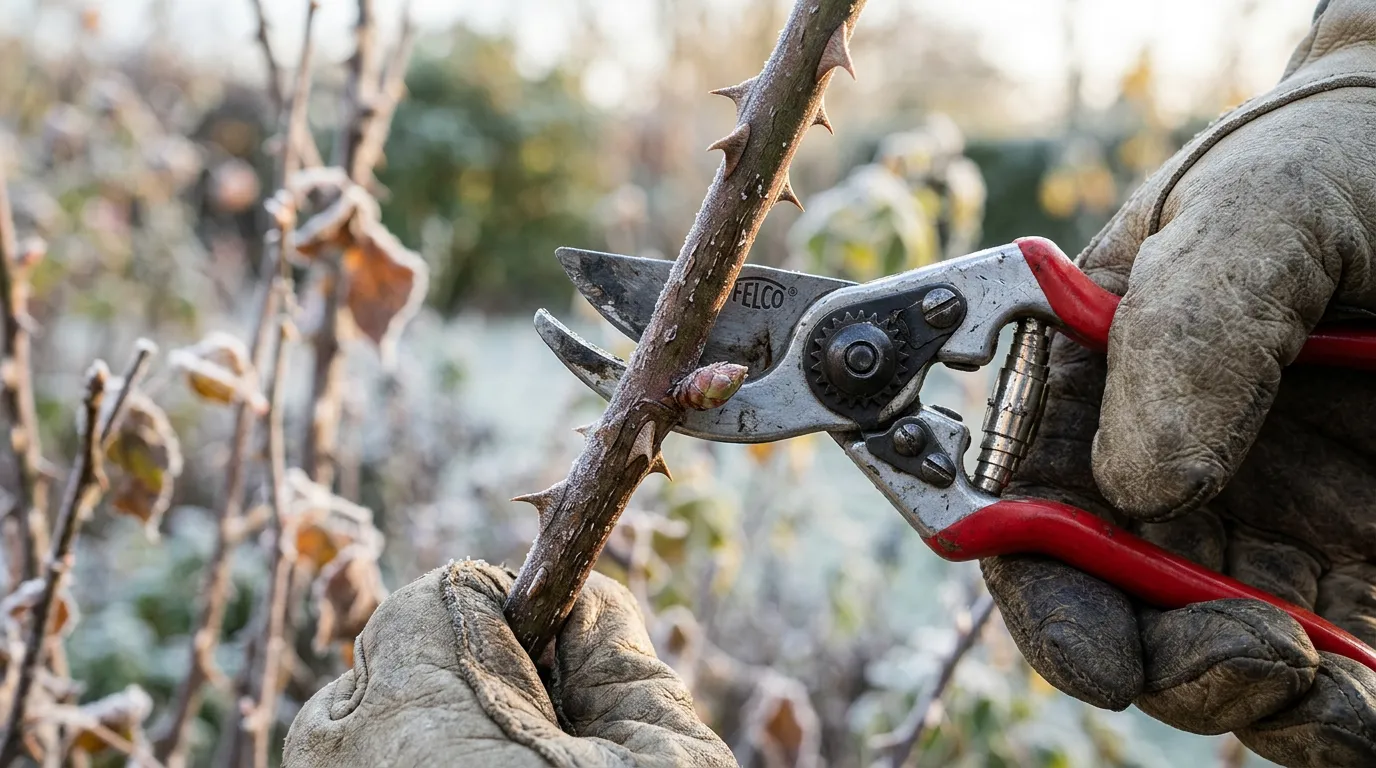
Every rose type uses the same fundamental cut. Get this right and the rest is just deciding where and how much to remove.
- Find an outward-facing bud. These are the small red or green bumps on the stem. Outward-facing buds produce shoots that grow away from the centre, keeping the bush open.
- Cut at a 45-degree angle sloping away from the bud. This sheds rainwater away from the bud and reduces the risk of rot.
- Position the cut 5mm above the bud. Too close and you damage it. Too far and the stub dies back, inviting disease.
- Make the cut clean in one motion. Ragged cuts from blunt secateurs heal slowly and let in pathogens.
Pruning by rose type
Different roses grow in different ways, and that determines how you prune them. The table below summarises the key differences before we look at each type in detail.
| Rose type | When to prune | How hard | Flowers on | Key technique |
|---|---|---|---|---|
| Hybrid tea | Late Feb - mid Mar | Hard (15-20cm) | New wood | Cut to outward bud, open centre |
| Floribunda | Late Feb - mid Mar | Moderate (25-30cm) | New wood | Stagger heights for succession |
| Climbing | Late Feb - mid Mar | Light on framework | Old and new wood | Tie in horizontally, spur prune |
| Rambler | After flowering (Jul-Aug) | Remove old flowered stems | Previous year’s wood | Cut old canes to base |
| Shrub / English | Late Feb - mid Mar | Light (remove one third) | Varies | Reduce by one third, shape |
| Ground cover | Early spring | Light trim | New wood | Shear or trim to shape |
Hybrid tea roses
These are the classic, large-flowered roses seen in formal beds. They flower on new season’s growth, so hard spring pruning encourages strong flowering stems.
- Remove all dead, diseased, and damaged wood first. Cut back to healthy white pith.
- Remove any stems that cross through the centre of the bush. The goal is a goblet shape, open in the middle to allow air circulation.
- Cut remaining stems to 15-20cm from the base, always to an outward-facing bud.
- If the plant is weak, prune harder (to 10-15cm) to stimulate vigorous new growth. Strong, healthy plants tolerate lighter pruning.
Hybrid teas respond well to hard pruning. If you are nervous, remember that even stumps of 15cm will produce 60-90cm of new growth by midsummer.
Floribunda roses
Floribundas produce clusters of smaller flowers rather than single blooms. They are pruned less severely than hybrid teas.
- Remove dead, diseased, and crossing stems as above.
- Cut the strongest stems to about 25-30cm from the base.
- Cut weaker or older stems harder, to about 15-20cm.
- This staggered approach creates flowering at different heights and extends the display period.
Floribundas grown as hedging can be pruned with hedging shears for speed. Research by the RHS at Wisley found that rough-pruned floribundas performed just as well as carefully hand-pruned ones, though the plants looked less tidy during the dormant months.
Climbing roses
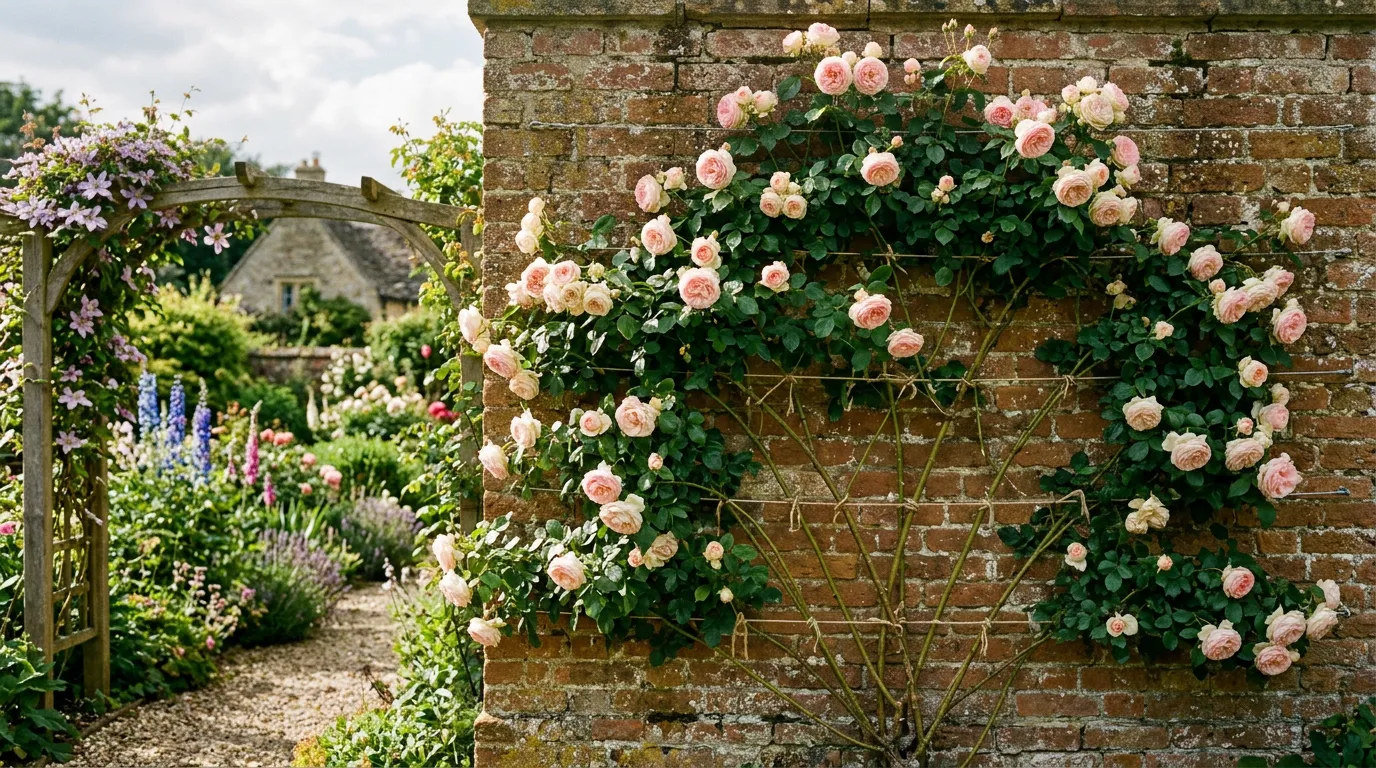
Climbers have a permanent framework of main stems with shorter side shoots (laterals) that carry the flowers. The framework stays, the laterals get pruned.
- Untie the main stems from their support if possible, or at least loosen them enough to work.
- Remove any dead or diseased wood entirely.
- Cut back the laterals (side shoots) to 2-3 buds from the main stem. These short spurs produce the flowering shoots.
- If a main stem is very old and unproductive, cut it to the base to encourage a replacement from lower down.
- Re-tie the main stems as close to horizontal as possible. Horizontal stems produce more flowering laterals along their length than vertical ones.
Training climbing roses along horizontal wires or a trellis maximises flowering. A climber grown vertically tends to flower only at the top. This is the same principle used in training fruit trees, and it works because horizontal stems distribute the plant’s hormones more evenly. Climbers work beautifully in a cottage garden planting plan trained along walls and fences.
Rambler roses
Ramblers are fundamentally different from climbers. They flower once, in early to midsummer, on stems produced the previous year. Pruning them in spring removes the flowering wood.
- Prune immediately after flowering, typically July or August.
- Cut the stems that have just flowered right back to the base or to a strong new shoot lower down.
- Tie in the new season’s long, flexible canes. These will carry next year’s flowers.
- If the plant is very congested, remove up to one third of the oldest stems at ground level.
Ramblers are vigorous enough to grow through trees and over large structures. If yours has become unmanageable, a hard renovation prune to 30cm from the base in late winter will sacrifice one season of flowers but usually regenerates well.
Shrub and English roses
David Austin English roses and other shrub roses need lighter pruning. They form large, arching bushes and their natural shape is part of their appeal.
- Remove dead, diseased, and very thin, twiggy growth.
- Reduce the overall size by about one third, cutting to outward-facing buds.
- Remove one or two of the oldest, woodiest stems at the base each year to encourage fresh basal growth.
- Aim for a rounded, slightly open shape rather than the goblet form used for hybrid teas.
Many shrub roses produce hips in autumn, which provide food for birds and other wildlife. If you grow roses alongside bee-friendly plants, the combination supports pollinators through summer and birds through winter.
Dealing with common problems
Rose black spot
Black spot overwinters on fallen leaves and on infected stems. Pruning removes infected wood and improves air circulation, which reduces the humidity that the fungus needs to spread.
- Cut out any stems with dark purple or black lesions.
- Clear all fallen leaves from beneath the bush and compost them in a hot composting system, or bin them. Do not leave them on the ground. Our composting guide explains which materials are safe to add.
- Avoid overhead watering, which splashes spores onto new leaves.
Dieback
Brown, dead stem tips that extend downwards are dieback, often caused by pruning into dead wood or by frost damage after pruning. Cut back further until you reach healthy white pith. If the pith is brown, keep cutting.
Blind shoots
Strong, healthy shoots that do not produce a flower bud are called blind shoots. Cut these back by half to a good outward-facing bud. This usually triggers a flowering shoot to develop.
Suckers
Growth from below the graft union (the knobby joint at the base) comes from the rootstock, not your chosen variety. Suckers have different leaf shape, usually with seven leaflets instead of five, and lighter green colour. Pull them off at the base rather than cutting, as cutting encourages more suckers.
Renovating a neglected rose
Old, unpruned roses become woody, leggy, and flower poorly. Rather than replacing them, try a staged renovation over three years.
Year one: Remove one third of the oldest, thickest stems at the base. Prune remaining stems moderately. Year two: Remove another third of the old stems. The plant should now be producing strong new basal shoots. Year three: Remove the final third of old wood. The bush is now renewed with younger, productive stems.
This gradual approach avoids the shock of cutting the entire plant hard in one go. Most roses recover well from even drastic pruning, but the staged method keeps some flowers each year.
For roses in a small garden, renovation pruning is particularly worthwhile. A single well-maintained rose bush gives far better value in a tight space than a neglected one that takes up room without flowering properly.
After pruning: feeding and mulching
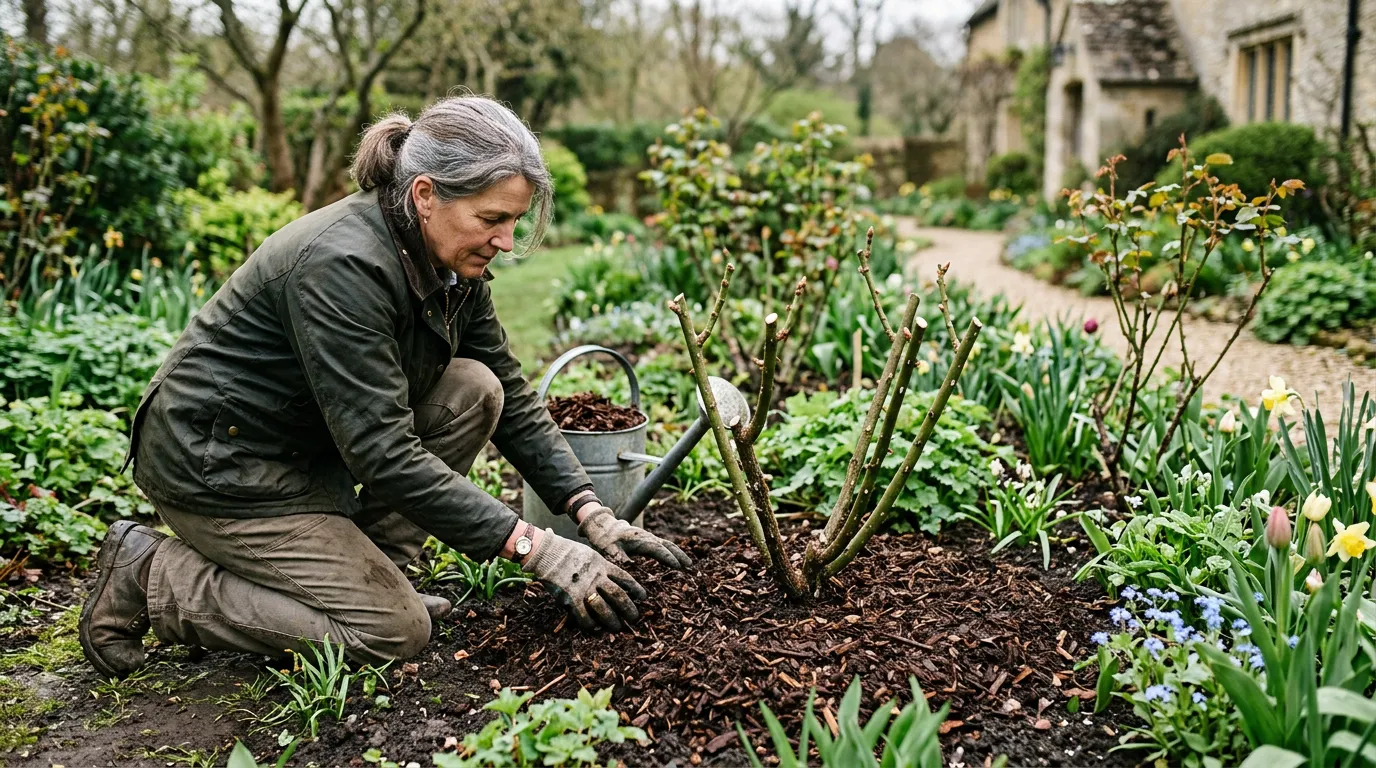
Pruning creates wounds and stimulates growth, so the plant needs support.
- Feed with a specialist rose fertiliser (such as Toprose or David Austin’s own feed) in mid-March after pruning. Apply a second feed in mid-June after the first flush of flowers.
- Mulch with a 5-8cm layer of garden compost, well-rotted manure, or composted bark. Keep the mulch a few centimetres away from the stems to prevent stem rot.
- Water newly pruned roses during dry spells in spring. Established roses are fairly drought-tolerant, but consistent moisture produces better flowers.
Mulching also suppresses weeds around the base. If slugs are a problem among your underplanting, see our guide on how to get rid of slugs.
Month-by-month rose care calendar
Good pruning is just one part of the picture. Here is what else your roses need through the year:
- January-February: Order bare-root roses for planting. Plan where new roses will go.
- March: Main pruning window. Feed and mulch after pruning.
- April-May: Watch for aphid infestations. Encourage natural predators like ladybirds.
- June: Deadhead repeat-flowering varieties to encourage further flushes. Apply second feed.
- July-August: Prune ramblers after flowering. Continue deadheading other types.
- September: Stop deadheading to allow hips to form. Reduce feeding.
- October: Take hardwood cuttings from favourite varieties.
- November: Autumn tidy. Reduce tall stems by one third to prevent wind rock. Clear fallen leaves.
- December: Plant bare-root roses in mild weather when the soil is workable.
Roses pair well with low-maintenance companion plants like hardy geraniums, lavender, and nepeta, which fill gaps at the base while the roses establish.
Final thoughts
Pruning roses is a skill you improve with practice, but you cannot really get it badly wrong. The plant will forgive mistakes and try again next year. The single most important thing is to prune at the right time for your type of rose, use clean, sharp tools, and cut to an outward-facing bud.
Start with the dead, diseased, and crossing stems. Once those are gone, the shape you want usually becomes obvious. If you are still unsure, attend a pruning demonstration at your local RHS partner garden or gardening club. Watching someone prune a real bush teaches more in ten minutes than any amount of reading.
If you are planning a wider spring planting alongside your roses, our guide to starting a vegetable garden covers the basics of getting productive beds established at the same time of year.
Lawrie has been gardening in the West Midlands for over 30 years. He grows his own veg using no-dig methods, keeps a wildlife-friendly garden, and writes practical advice based on real UK growing conditions.