How to Grow Strawberries in the UK
Complete guide to growing strawberries in UK gardens. Covers varieties, planting times, container growing, feeding, runner propagation, and protecting fruit from pests.
Key takeaways
- Grow early, mid, and late varieties together for harvests from June to October
- Each plant produces 400-600g of fruit per season in good UK growing conditions
- Bare-root plants set in March give the best first-year harvest
- Straw mulch beneath plants keeps fruit clean and reduces grey mould by 60%
- Net against birds from first colour change, they take 30-40% of unprotected fruit
- Replace plants every 3-4 years as yields decline with age
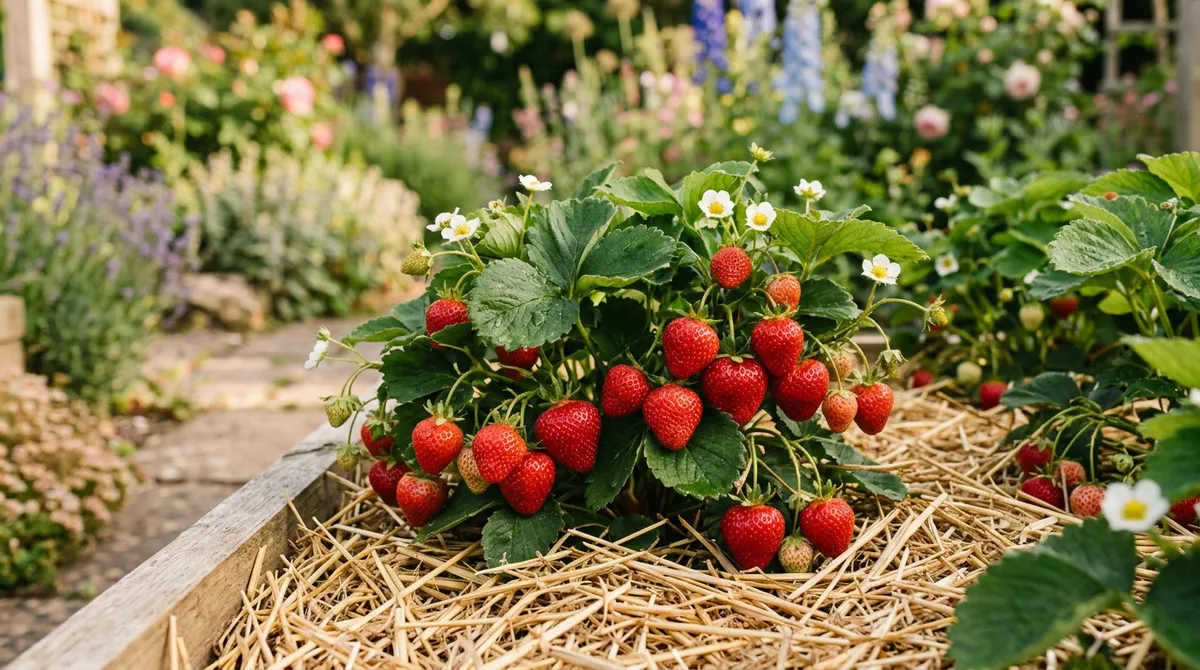
Strawberries are the most rewarding soft fruit for UK gardeners. They produce a crop within months of planting, grow in almost any container or garden bed, and fresh-picked strawberries taste nothing like the supermarket versions wrapped in plastic. A single plant produces 400-600g of fruit per season. Twenty plants supply a family of four with enough for eating fresh, making jam, and freezing.
The UK climate suits strawberries well. They need cold winters to trigger flowering (which we reliably provide), bees and pollinators for fruit set, and warm summers to ripen fruit. This guide covers variety selection, planting, growing in containers and beds, feeding, pest protection, and propagation from runners. Browse our growing guides for more fruit and vegetable advice.
Choosing strawberry varieties
Plant a mix of early, mid, and late-season varieties to spread the harvest from June to October. Growing just one variety gives you a glut followed by nothing.
Early season (June)
- Honeoye - large, glossy fruit. Strong flavour. Vigorous grower. The best early variety for UK conditions. Crops 7-10 days before mid-season types.
- Christine - very early, sweet fruit. Good disease resistance. Ideal for southern gardens.
Mid-season (late June to July)
- Elsanta - the UK’s commercial standard for good reason. Large, firm fruit with excellent flavour. High yields. The variety against which all others are measured.
- Cambridge Favourite - reliable in cooler northern conditions. Medium-sized fruit, good flavour. Less prone to disease than Elsanta. The safe choice for beginners.
- Malling Centenary - exceptional flavour, considered the best-tasting UK variety. Large fruit. Bred at East Malling Research in Kent.
Late season (August to October)
- Florence - heavy cropper, firm fruit, good disease resistance. Extends the season by 3-4 weeks beyond mid-season varieties.
- Flamenco (everbearing) - produces fruit continuously from July to October. Smaller fruit but longer season. Excellent in hanging baskets and containers.
- Mara des Bois - French alpine-strawberry hybrid. Small, intensely flavoured fruit. Produces from June to first frost. Outstanding flavour.
Variety comparison
| Variety | Season | Fruit size | Flavour | Yield per plant | Best for |
|---|---|---|---|---|---|
| Honeoye | Early | Large | Good | 500g | First fruit of the year |
| Elsanta | Mid | Large | Very good | 600g | Main crop, reliable |
| Cambridge Favourite | Mid | Medium | Good | 450g | Northern gardens, beginners |
| Malling Centenary | Mid | Large | Excellent | 550g | Best flavour |
| Florence | Late | Large | Good | 500g | Extending the season |
| Flamenco | July-Oct | Medium | Good | 400g | Containers, long season |
Gardener’s tip: Plant 5 plants per person. For a family of four, that is 20 plants. Split between early, mid, and late varieties for a 4-month harvest window rather than a 3-week glut.
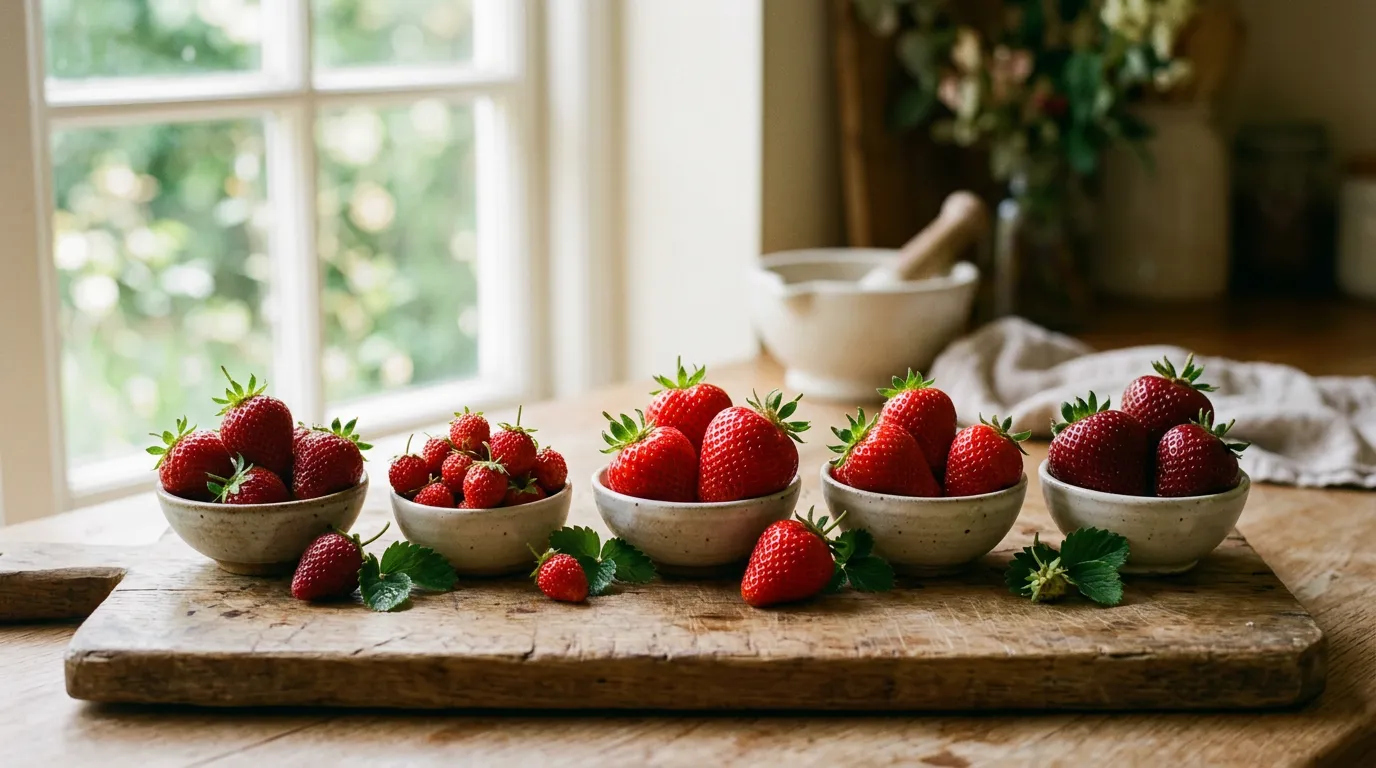 Early, mid, and late strawberry varieties. Growing a mix spreads the harvest from June through October.
When and how to plant
Planting time
March is the best month to plant bare-root strawberries. See our full guide to what to plant in March for everything else you can sow this month. The soil is warming, rainfall keeps plants watered naturally, and the roots establish before the plant puts energy into fruiting.
- Bare-root plants: plant March to April. Cheapest option (one to two pounds each). Available from specialist nurseries. Establish fast.
- Container-grown plants: plant March to September. More expensive (three to five pounds each). Useful for filling gaps mid-season.
- Runners from friends: pot up in August-September, plant the following March.
Planting in open ground
Choose a sunny, sheltered spot with well-drained soil. Strawberries need 6+ hours of direct sun for good fruit production. Avoid frost pockets where cold air settles, as late frost damages flowers in April-May. The RHS strawberry growing guide covers soil preparation and site selection in more detail.
- Dig in plenty of garden compost the autumn before planting
- Space plants 35cm apart in rows 75cm apart
- Dig a hole wide enough to spread the roots without bunching
- Set the crown (the point where roots meet leaves) at soil level. Too deep and it rots. Too high and it dries out.
- Water well after planting. Water weekly for the first month.
Planting in raised beds
Raised beds are excellent for strawberries. The improved drainage prevents crown rot. The elevated position makes picking, weeding, and netting easier. A 1.2m x 2.4m bed holds 18-20 plants in three rows.
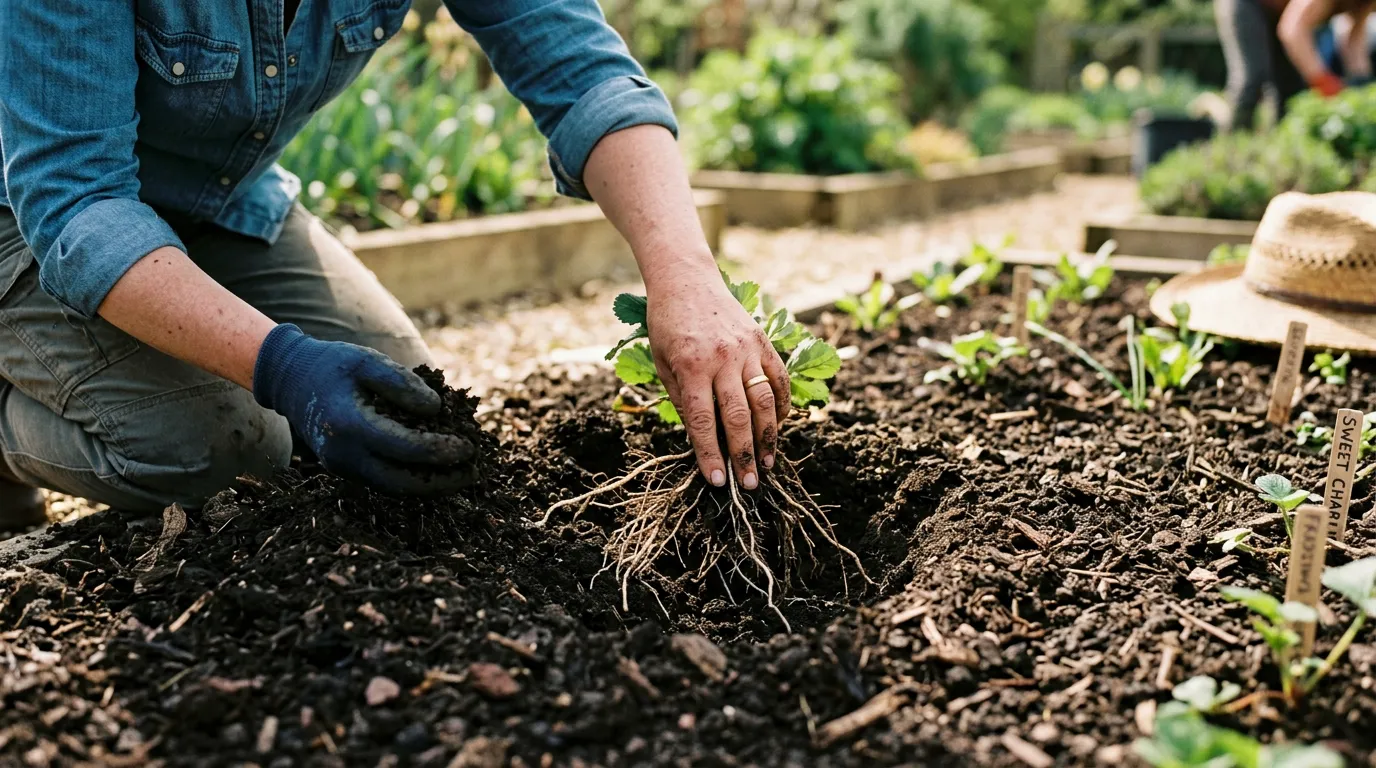 Planting bare-root strawberries. Spread roots wide and set the crown level with the soil surface.
Growing in containers
Strawberries grow brilliantly in containers. Any pot, grow bag, window box, or hanging basket works if it has drainage and holds enough compost.
Container options
- Individual pots - 25cm diameter minimum per plant. Terracotta looks attractive and keeps roots cool.
- Grow bags - standard grow bags hold 3 plants each. Cut large holes in the top and plant through.
- Hanging baskets - trailing varieties like Flamenco cascade over the edges. Use a 35cm basket with 3 plants. Water daily in summer.
- Strawberry towers - stacked pots or purpose-built towers grow 20+ plants in a tiny footprint. Good for small gardens.
- Window boxes - 60cm window box holds 3 plants. Ideal for balconies and patios.
Container growing tips
- Use peat-free multipurpose compost. Do not use garden soil, which compacts in pots.
- Feed weekly with tomato feed (high-potash) from first flower onwards.
- Water daily in summer. Containers dry out fast.
- Replace compost annually. Nutrients deplete within one season.
- Move to a sheltered spot in winter to protect from hard frost.
Feeding and watering
Feeding schedule
| Stage | Feed | Frequency |
|---|---|---|
| Planting to first flower | None (compost nutrients sufficient) | N/A |
| First flower to fruit set | High-potash liquid feed (tomato feed) | Weekly |
| During fruiting | High-potash liquid feed | Weekly |
| After harvest | General-purpose granular fertiliser | Once |
| Winter | None | N/A |
Avoid high-nitrogen feeds during flowering and fruiting. Nitrogen promotes leaf growth at the expense of fruit. Tomato feed is ideal because it is high in potassium (potash), which drives fruit production. The same feeding approach works for growing tomatoes.
Watering
Water consistently during fruiting. Irregular watering causes misshapen fruit with hard, white patches where seeds sit on dry tissue. Aim for evenly moist (not waterlogged) soil.
- In the ground: water twice weekly during fruiting if rainfall is less than 25mm per week
- In pots: water daily. Check twice daily in hot weather above 25C
- Hanging baskets: water daily, twice in hot spells. They dry out fastest of all
Warning: Never water strawberry plants from above during fruiting. Wet fruit develops grey mould (botrytis) rapidly. Water at the base. Drip irrigation is ideal for strawberry beds.
Protecting the crop
Straw mulch
Lay clean straw under the plants when the first fruits begin to form (usually late May). Straw serves three purposes:
- Keeps fruit off the soil, preventing mud splash and rot
- Reduces grey mould by improving air circulation around fruit
- Suppresses weeds
Barley straw is the best choice. Spread it 5cm deep, tucking it gently under the developing fruit trusses. Replace annually.
Bird protection
Birds take 30-40% of unprotected strawberry crops. While attracting birds to your garden is generally a good thing, blackbirds and thrushes are the main culprits when it comes to strawberries. They peck fruit from first colour change, not waiting for full ripeness.
Net the entire bed with 15mm mesh bird netting as soon as fruit starts to colour. Support the net on hoops or a frame so it sits 15-20cm above the plants. Netting resting directly on fruit causes damage and traps birds.
Check netting daily. Hedgehogs, frogs, and small birds occasionally get tangled. Remove netting after the last harvest.
Slug control
Slugs feed on ripe fruit at ground level, especially during damp evenings. The straw mulch helps by creating a drier surface. Additional controls:
- Copper tape around raised bed frames
- Nematode biological control applied to surrounding soil in spring
- Evening hand-picking during peak fruiting
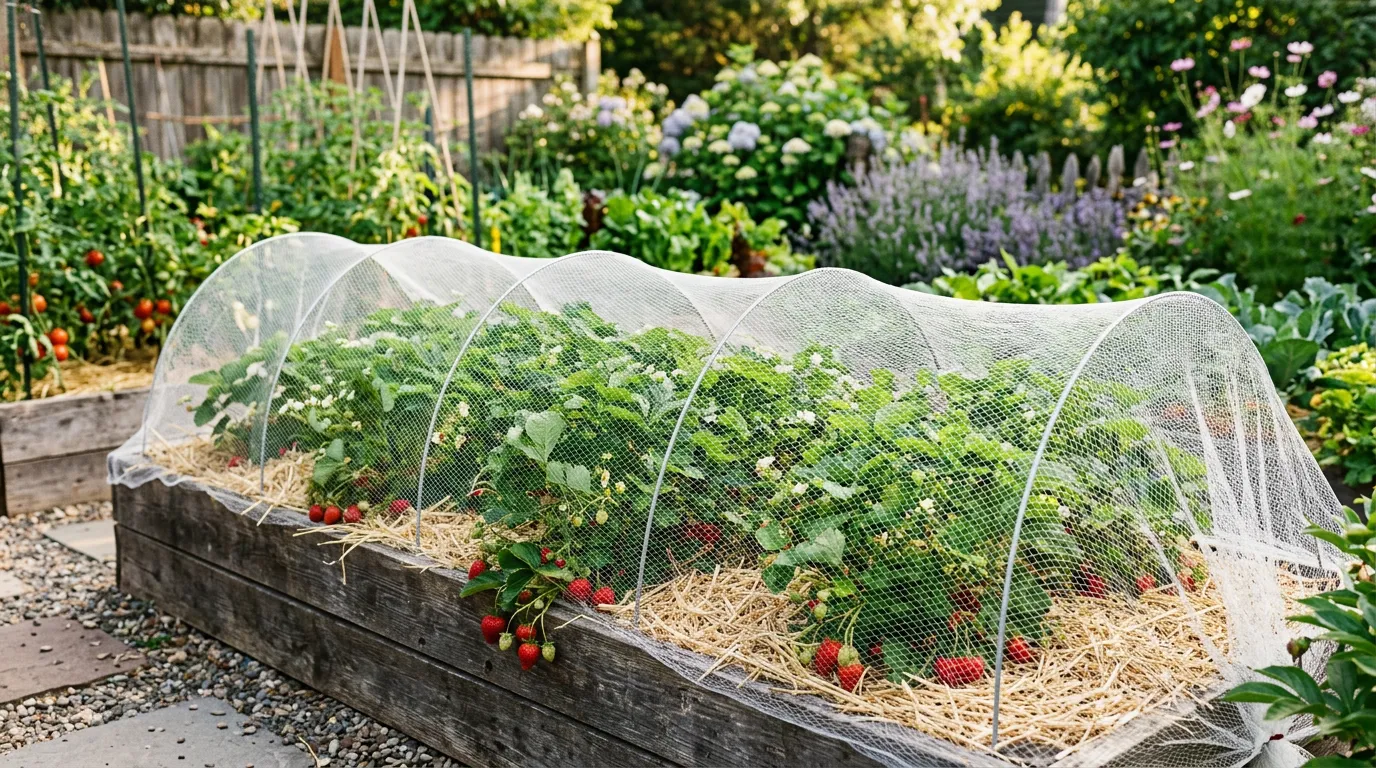 Bird netting on hoops protecting a strawberry bed. Straw mulch keeps fruit clean and reduces grey mould.
Runners and propagation
Strawberry plants produce runners from June onwards. These are horizontal stems that grow out from the mother plant, producing a small plantlet at their tip.
During fruiting season
Cut off all runners during fruiting (June-August). They divert energy from fruit production. Check weekly and remove with scissors.
After harvest
Allow 4-5 strong runners per plant from August onwards. These replace old plants.
How to root runners:
- Fill 9cm pots with multipurpose compost
- Pin the runner plantlet into the pot using a wire staple or small stone
- Keep the runner connected to the parent plant
- Water the pot regularly
- After 4-6 weeks, roots will have formed. Cut the runner stem connecting it to the parent
- Grow the new plant on for 2-3 weeks, then plant out in its permanent position
This gives you free replacement plants every year. Strawberry yields decline after 3-4 years, so rotating with new runner-propagated plants keeps production high.
Month-by-month strawberry calendar
| Month | Task |
|---|---|
| January | Order bare-root plants from nurseries. Browse variety catalogues. |
| February | Prepare planting area. Dig in compost. |
| March | Plant bare-root strawberries. Water well after planting. |
| April | Watch for late frost. Cover flowers with fleece on cold nights. |
| May | Lay straw under plants. Begin feeding with tomato feed. Remove runners. |
| June | Net against birds. Pick early varieties. Water consistently. Remove runners. |
| July | Main harvest period. Pick every 2-3 days. Continue feeding containers. |
| August | Late varieties still cropping. Allow 4-5 runners per plant for propagation. |
| September | Root runners in pots. Clear straw from finished plants. |
| October | Plant out rooted runners in prepared beds. Autumn tidy. |
| November | Remove old, yellow leaves. Leave crowns exposed. |
| December | Check containers are sheltered from hard frost. Plan next year’s varieties. |
Common mistakes
Planting the crown too deep
The most common mistake with strawberries. If the crown (where roots meet stem) is buried, it rots. Set it exactly at soil surface level. When in doubt, plant slightly high rather than deep.
Growing plants for too long
Strawberry yields decline sharply after year 3. By year 5, plants produce small, sparse fruit. Replace with fresh runners every 3-4 years. Rotate to a new bed position to avoid soil-borne disease build-up.
Watering from above
Overhead watering soaks the fruit and promotes grey mould, the biggest strawberry disease in UK gardens. Water at the base. Use drip irrigation or a watering can without a rose, directing water at the soil.
Not removing runners during fruiting
Every runner a plant produces reduces fruit yield. A plant cannot produce strong fruit and vigorous runners simultaneously. Remove all runners from first flower until harvest ends. Save propagation for after the crop is picked.
Ignoring bird netting
It takes one blackbird an afternoon to strip a row of ripe strawberries. Net before fruit colours, not after you notice damage. By the time you see pecked fruit, the birds have found your crop and will return daily.
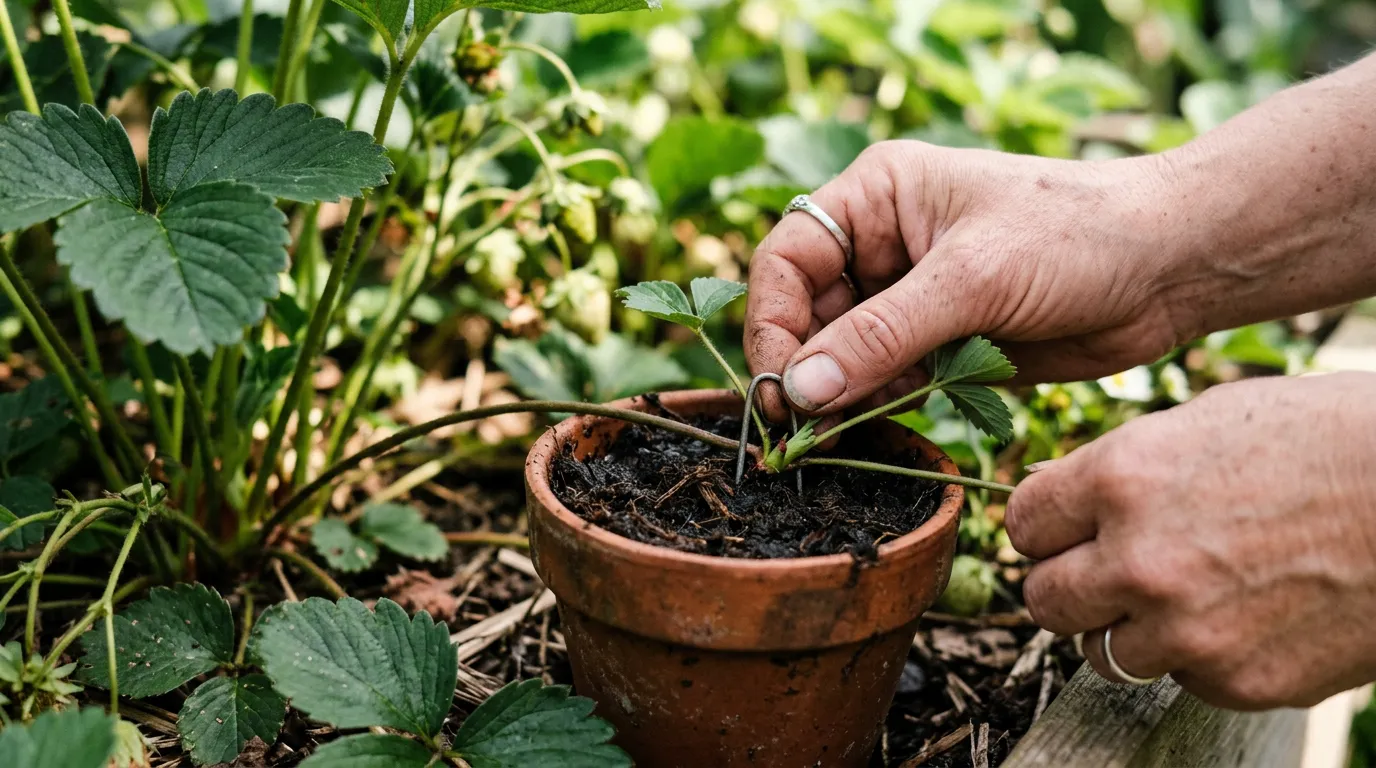 Pinning a strawberry runner into a pot for propagation. Sever the stem after 4-6 weeks once roots have formed.
Frequently asked questions
When should I plant strawberries in the UK?
Plant bare-root strawberries in March for the best first-year crop. Container-grown plants go in any time from March to September, though earlier is better. March planting gives roots 8-10 weeks to establish before the plant needs to support developing fruit.
How many strawberry plants do I need?
Allow 5 plants per person for a good supply of fresh fruit. A family of four needs 20 plants, ideally split across early, mid, and late varieties. Each healthy plant produces 400-600g per season, giving you around 10kg total from 20 plants.
Can I grow strawberries in pots?
Yes, strawberries are one of the best container fruits. Use pots at least 25cm diameter, hanging baskets at least 35cm across, or standard grow bags with 3 plants each. Feed weekly with tomato feed from first flowering. Water daily in summer. Replace compost annually.
Why are my strawberries small?
Small fruit signals old, exhausted plants or overcrowding. Replace strawberry plants every 3-4 years with fresh runners. Space 35cm apart to prevent competition. Feed with high-potash fertiliser from flowering. Water consistently during fruit development. Erratic watering causes small, misshapen fruit.
How do I protect strawberries from birds?
Cover the entire bed with 15mm mesh bird netting from first colour change. Support netting on hoops or a framework so it sits 15-20cm above the plants. Check netting daily for trapped wildlife. Remove after the last harvest. Without netting, birds take 30-40% of the crop.
Should I remove strawberry runners?
Yes, during the fruiting season. Runners divert energy from fruit production and reduce yield. Remove all runners from first flower until harvest finishes. After picking ends, allow 4-5 strong runners per plant for propagation. Root them in pots and plant out in autumn or the following spring.
What is the best strawberry variety for the UK?
Elsanta is the most widely grown and reliable UK variety, producing large, flavourful mid-season fruit. Cambridge Favourite suits northern gardens and beginners due to its hardiness. Malling Centenary offers the best flavour of any modern variety. For the longest season, add Honeoye (early) and Florence (late).
Lawrie has been gardening in the West Midlands for over 30 years. He grows his own veg using no-dig methods, keeps a wildlife-friendly garden, and writes practical advice based on real UK growing conditions.