Allotment Layout Ideas and Plans UK
Allotment layout plans for 5-rod to full UK plots. Exact bed dimensions, path widths, crop rotation zones, and shed placement from an experienced grower.
Key takeaways
- Beds no wider than 1.2 metres — reach the centre without stepping on the soil and compacting it
- Main paths 60-90 cm wide, side paths 45 cm minimum — wheelbarrow clearance prevents crop damage
- A 5-rod plot (62.5 sq m) suits a solo grower and yields 80-150 kg of veg per season with good management
- Position the shed or compost bays at the north end so they cast shadow away from growing beds
- Four-bed rotation on a four-year cycle is the minimum — brassicas, legumes, roots, and potatoes
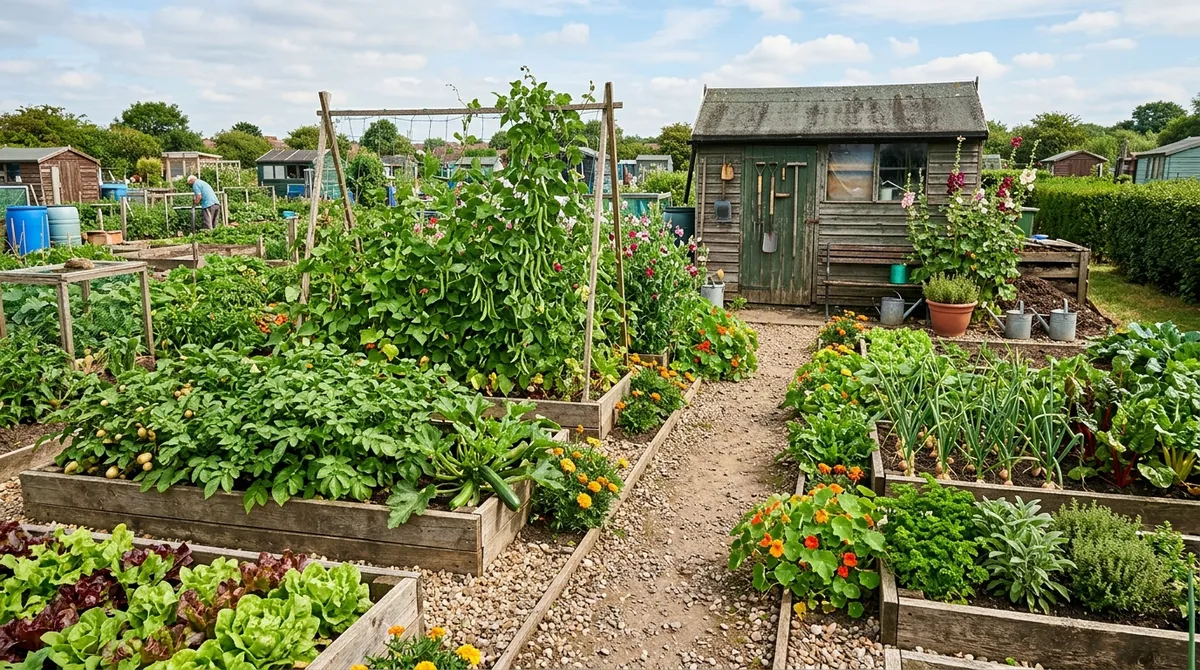
Allotment layout planning determines whether a plot produces bumper harvests or constant frustration. Get the bed widths, path widths, and crop rotation zones right at the start. The rest of allotment growing becomes far simpler.
This guide covers layout plans for every standard UK plot size — 5-rod to full 10-rod. It includes specific measurements, crop rotation zone planning, and shed placement. Still applying for a plot? Our guide on how to start an allotment covers the waiting list process. For rules around structures and plot maintenance, see allotment rules in the UK.
Understanding UK allotment plot sizes
UK allotment sizes are measured in rods, an old surveying unit. One rod equals 5.03 metres. Plot sizes vary by council, but the standard breakdown looks like this:
| Plot Size | Rods | Approx. Dimensions | Sq Metres | Who It Suits |
|---|---|---|---|---|
| Starter strip | 5 rods | 5 m x 12.5 m | 62.5 sq m | Solo grower, first plot |
| Half plot | 10 rods | 10 m x 12.5 m | 125 sq m | Couple or family with 1-2 days/week |
| Three-quarter plot | 15 rods | 15 m x 12.5 m | 187.5 sq m | Experienced grower, part-time |
| Full plot | 20 rods | 10 m x 25 m | 250 sq m | Experienced grower, high commitment |
Note: the National Allotment Society uses “5-rod” and “10-rod” to mean half and full plots respectively. Local councils use both naming conventions. A “full plot” on most UK council sites is 10 rods = 250 sq m.
Yields vary significantly with experience and soil quality, but as a general guide:
| Plot Size | Beds Possible | Estimated Annual Yield | Approximate Value |
|---|---|---|---|
| 5-rod (62.5 sq m) | 6-8 beds | 80-150 kg | £200-400 |
| Half plot (125 sq m) | 10-14 beds | 200-350 kg | £500-900 |
| 3/4 plot (187.5 sq m) | 14-18 beds | 300-500 kg | £750-1,200 |
| Full plot (250 sq m) | 18-24 beds | 400-700 kg | £1,000-1,800 |
5-rod starter plot layout plan
A 5-rod plot (roughly 5 m x 12.5 m) is the right size for a first allotment. It produces enough food to make a real difference to your shopping bill without overwhelming a beginner with maintenance.
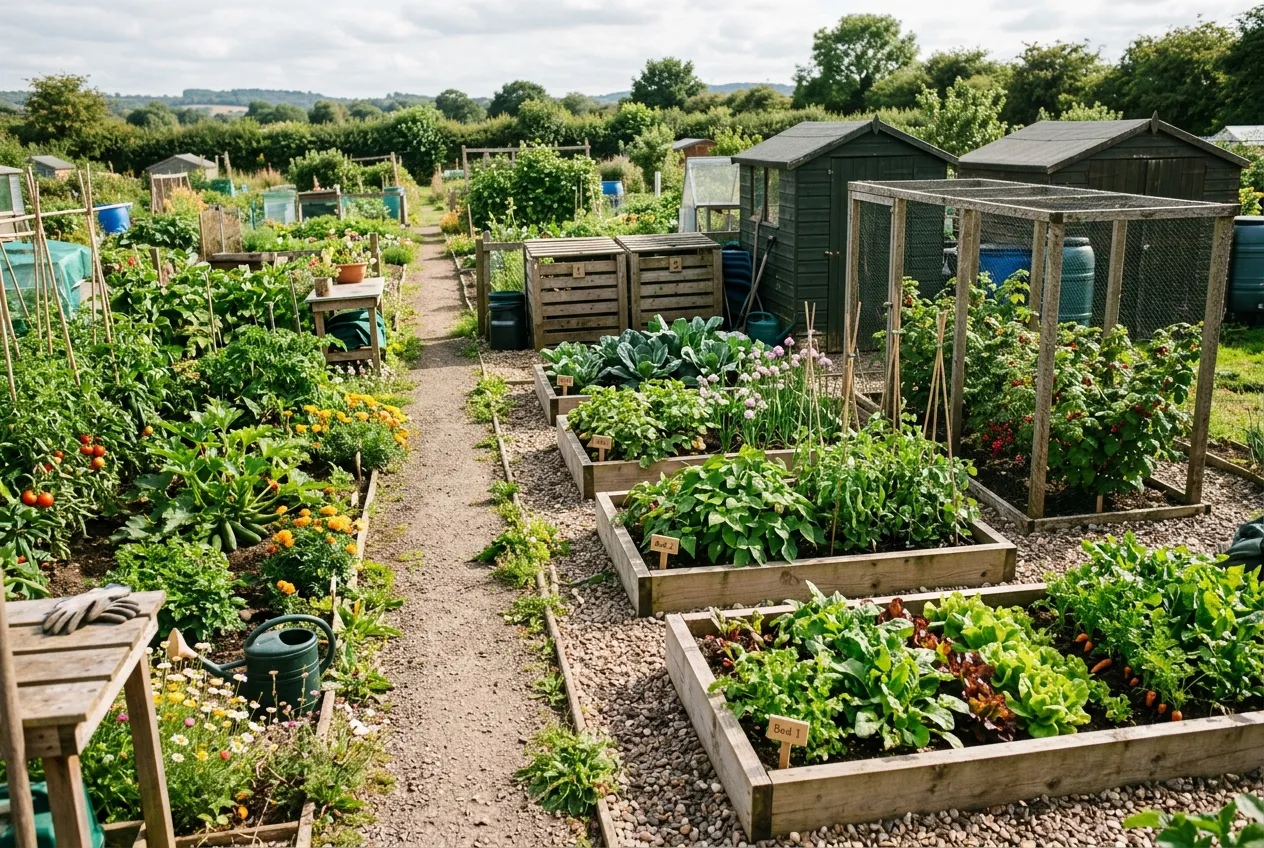
A 5-rod starter plot laid out with six 1.2 m x 2.4 m beds, a central access path, and compost bay in the north corner
Recommended layout for 5 m x 12.5 m:
- 6 growing beds at 1.2 m wide x 2.4 m long
- Central path: 75 cm wide running the full length
- Side paths between beds: 45 cm wide
- North corner: 1.2 m x 1.2 m compost bay (one bin)
- South end: water butt on a stand (roof catchment or tap connection)
This layout gives you 17.28 sq m of growing space. Modest, but enough for a productive four-bed rotation. The two additional beds suit perennials, herbs, or a small polytunnel.
Crop allocation for a 5-rod plot:
- Beds 1-4: Four-bed rotation (brassicas, legumes, roots, potatoes)
- Bed 5: Permanent herbs, strawberries, or overwintering crops
- Bed 6: Salad leaves, radishes, and fast-succession crops
The raised bed gardening guide for beginners covers bed construction in detail. It includes timber choices and no-dig setup methods that suit this scale of plot.
Half-plot layout plan (10 rods / 125 sq m)
A half plot at 125 square metres is the most common council allotment size. It is enough space for a complete growing system — crop rotation, fruit area, composting, and a small shed. It is not unmanageable.
Recommended layout for 10 m x 12.5 m:
- 12 growing beds at 1.2 m x 3 m (14.4 sq m each, 172.8 sq m total growing surface)
- Central main path: 90 cm wide, full length
- Cross path at midpoint: 75 cm wide
- Side paths between beds: 45 cm wide
- North end: shed (1.8 m x 1.2 m) plus two compost bays
- Water butt: adjacent to shed, fed from guttering
Zone allocation:
Divide the 12 beds into three zones of four beds each:
- Zone A (south, best light): Four-bed rotation — the primary food-growing area
- Zone B (centre): Salad crops, herbs, squash, and courgettes
- Zone C (north, partial shade from shed): Compost bays, rhubarb, mint, and overwintering crops
The RHS allotment planning guidance recommends keeping permanent crops like rhubarb and soft fruit away from the annual rotation to avoid disrupting the cycle.
Full-plot layout plan (20 rods / 250 sq m)
A full plot at 250 square metres demands serious commitment — expect 8-12 hours per week during the growing season. The reward is near-self-sufficiency in vegetables through summer and significant winter cropping if planned properly.
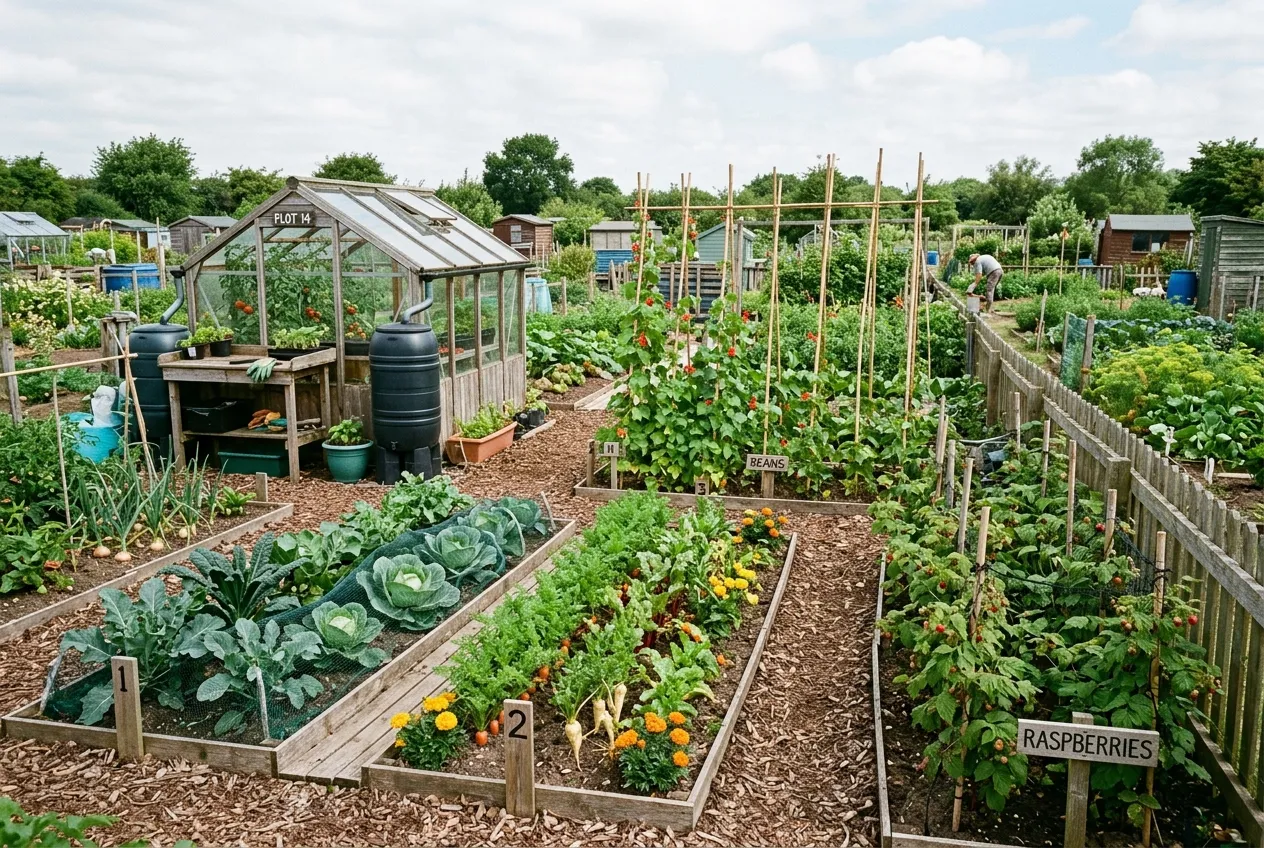
A full 10 m x 25 m plot with 20 growing beds, fruit area, twin compost system, and full-size shed
Recommended layout for 10 m x 25 m:
- 20 growing beds at 1.2 m x 3.6 m
- Central main path: 90 cm wide, full length
- Three cross paths: 75 cm wide at 6 m, 12 m, and 18 m intervals
- Side paths: 45 cm
- North end: full shed (2.4 m x 1.8 m), twin compost bays, water storage tank
- South end: soft fruit area (3 m x 6 m) — strawberries, raspberry canes, gooseberries
Zone allocation for a full plot:
| Zone | Area | Purpose |
|---|---|---|
| South fruit zone | 18 sq m | Permanent soft fruit — strawberries, raspberries, currants |
| Growing zone A | 12 beds | Four-bed rotation, main crops |
| Growing zone B | 8 beds | Salad, herbs, brassicas, squash |
| North service zone | 20 sq m | Shed, compost bays, potting area |
Managing a full plot means managing soil across a large area consistently. Our crop rotation planner helps you track which family went where. Essential once you have more than eight growing beds.
Bed dimensions: the numbers that matter
Bed width is the single most important measurement in any allotment layout. Get this wrong and you will compact your soil every time you weed, water, or harvest.
1.2 metres is the optimum bed width. This lets a person of average height reach the centre comfortably from either side without stepping onto the growing surface. If you are shorter or have limited reach, make beds 90 cm wide.
Never make beds wider than 1.5 metres. Beyond this width, most people cannot reach the centre without stepping in, which destroys soil structure in the middle of the bed — exactly where roots need loose, well-aerated conditions.
Bed length is flexible. Most allotment beds run 2.4-3.6 m long. Shorter beds are easier to manage and make crop separation cleaner. Longer beds maximise growing space but become unwieldy to work around. A 1.2 m x 3 m bed gives 3.6 sq m of growing space and fits comfortably on any half-plot layout.
Path widths: the measurements most growers get wrong
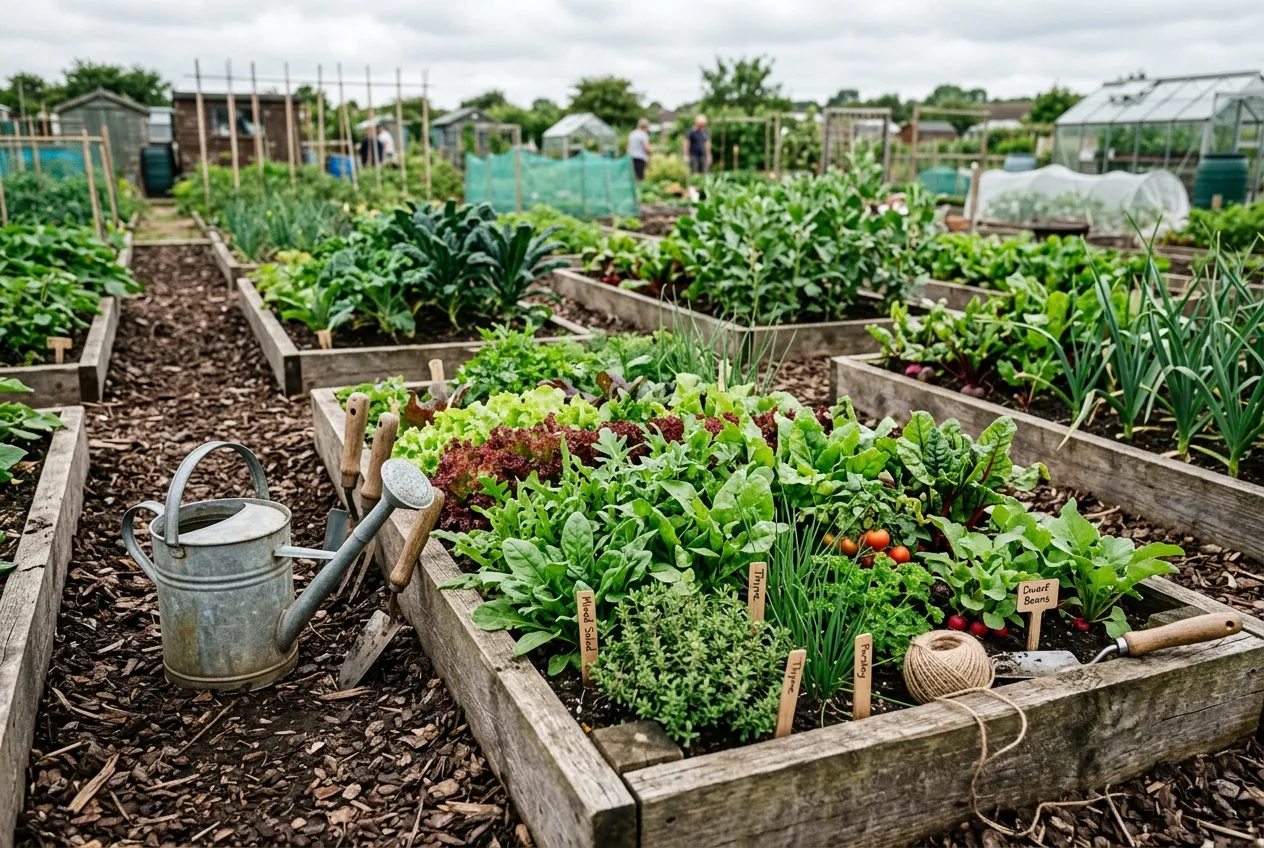
Wide bark chip paths between raised beds prevent compaction and make harvesting manageable in any weather
Path width is where most new allotment holders underestimate. Narrow paths that look fine in early spring become impassable by midsummer when crops are at full height.
| Path Type | Minimum Width | Recommended Width | Why |
|---|---|---|---|
| Main central path | 60 cm | 75-90 cm | Wheelbarrow clearance, carrying harvests |
| Cross paths | 45 cm | 60-75 cm | Kneeling, bucket access |
| Side paths (between beds) | 30 cm | 45 cm | Foot access, kneeling space |
| Path under climbing frames | 60 cm | 90 cm | Clearance under bean poles and squash |
Surfacing your paths makes a significant difference to how usable they remain year-round. On heavy clay (the most common allotment soil type in the UK), bare soil paths become compacted, rutted, and waterlogged. Options:
- Wood chip — free from tree surgeons, suppresses weeds, improves over time as it breaks down
- Weed-suppressing membrane with gravel — clean, long-lasting, good for main paths
- Cardboard topped with wood chip — temporary but effective, decomposes in 12-18 months
- Slabs or stepping stones — permanent, expensive, suits main cross paths only
See our raised bed garden design ideas for further guidance on path surfacing and bed edging materials.
Crop rotation zones: the four-bed system
Crop rotation prevents soil-borne diseases building up. It balances the nutrient demands placed on soil and reduces pest populations that overwinter in the ground. A four-bed system divides the allotment into four growing zones, each assigned to one crop family, rotating clockwise each year.
The four rotation groups:
| Group | Crops | Soil Need | Follow With |
|---|---|---|---|
| Brassicas | Cabbage, kale, broccoli, Brussels sprouts, cauliflower, swede | Firm, slightly alkaline — lime if pH below 6.5 | Roots |
| Legumes | Runner beans, French beans, peas, broad beans | Fix nitrogen — leave roots in soil | Brassicas |
| Roots | Carrots, parsnips, beetroot, celery, celeriac | Loose, low nitrogen — no fresh manure | Potatoes/Alliums |
| Potatoes/Alliums | Potatoes, tomatoes, onions, garlic, leeks | Rich, well-manured — heavy feeders | Legumes |
Four-year rotation schedule:
| Year | Bed 1 | Bed 2 | Bed 3 | Bed 4 |
|---|---|---|---|---|
| Year 1 | Brassicas | Legumes | Roots | Potatoes |
| Year 2 | Potatoes | Brassicas | Legumes | Roots |
| Year 3 | Roots | Potatoes | Brassicas | Legumes |
| Year 4 | Legumes | Roots | Potatoes | Brassicas |
This four-year cycle ensures no crop family returns to the same ground for three seasons. Brassica club root is the most damaging allotment disease. It needs four years of absence before the fungal spores decline significantly.
Our crop rotation planner covers this system in full detail. It includes guidance on permanent crops, awkward plot shapes, and how to integrate companion planting into each rotation zone.
Shed and compost placement
Shed placement: Always position the shed at the north end of the plot. A shed at the north creates shadow northwards, away from the growing beds. A shed at the south casts shadow over your most productive beds during the low-sun months of September to April, when light is already the limiting factor.
Most council allotment sites have shed size restrictions — typically no larger than 1.8 m x 2.4 m, and some require planning consent for anything over 2.5 m high. Check your tenancy agreement before purchasing a shed.
Compost bay placement: Place compost bays adjacent to the shed, also at the north end. Two bays are the minimum for a half-plot — one active bay being filled, one bay from the previous season breaking down. A full plot benefits from three bays. Our guide on how to make compost covers compost bay construction, turning schedules, and what to add for fast, rich results.
Water storage: Position at least one water butt (210 litres minimum) at the highest accessible point of the shed roof. A 3 m x 2 m shed roof collects approximately 300 litres per 10 mm of rainfall. In a typical UK growing season, roof catchment alone can supply significant irrigation needs from May to September. Use succession planting to stagger your watering demands rather than planting everything at once and needing large volumes simultaneously.
Designing for productivity: practical layout decisions
Orient beds north-to-south where possible so all plants receive even light throughout the day. East-west beds create north-facing and south-facing sides, leaving one side in shade. On a 10 m x 25 m plot with north-to-south orientation, most beds run along the length of the plot with cross paths at intervals.
Group tall crops together. Sweetcorn, Jerusalem artichokes, and climbing beans should go on the north side of the plot so they do not shade shorter crops. A row of sweetcorn at the south end of your plot will shade every bed behind it from late June onwards.
Reserve south-facing beds for heat-lovers. Tomatoes, aubergines, cucumbers, and courgettes perform best in the warmest, most sheltered spot. Beds near the south boundary with a wall or fence behind them trap heat and provide wind protection.
Plan for the whole year. An allotment layout that only works in summer is half a layout. Incorporate beds for winter crops — kale, leeks, parsnips, and garlic — and plan overwintering areas for onion sets and broad bean sowings from October. Our vegetable growing guide covers year-round crop planning in detail.
Related reading
- How to Start an Allotment in the UK — application process, waiting lists, first costs
- Allotment Rules UK — what your tenancy agreement covers
- Crop Rotation Planner UK — four-bed rotation in full detail
- Raised Bed Gardening for Beginners — bed construction, soil mixes, no-dig setup
- Succession Planting Guide UK — how to stagger sowings for continuous harvests
Lawrie has been gardening in the West Midlands for over 30 years. He grows his own veg using no-dig methods, keeps a wildlife-friendly garden, and writes practical advice based on real UK growing conditions.