Balcony Gardening Ideas for the UK
Practical balcony gardening ideas for UK flats and apartments. Container choices, weight limits, wind protection, and the best plants for exposed spaces.
Key takeaways
- Most UK balconies support 150-250kg per sq m, enough for 8-12 containers
- Fibreglass pots weigh 60-70% less than terracotta and resist frost damage
- Wind speed increases 20-30% per floor above ground level. Shelter is essential
- Self-watering pots cut summer watering from twice daily to every 3-4 days
- A 2m x 4m balcony grows herbs, tomatoes, salad, and flowers year-round
- Always check your lease or building regulations before adding heavy containers
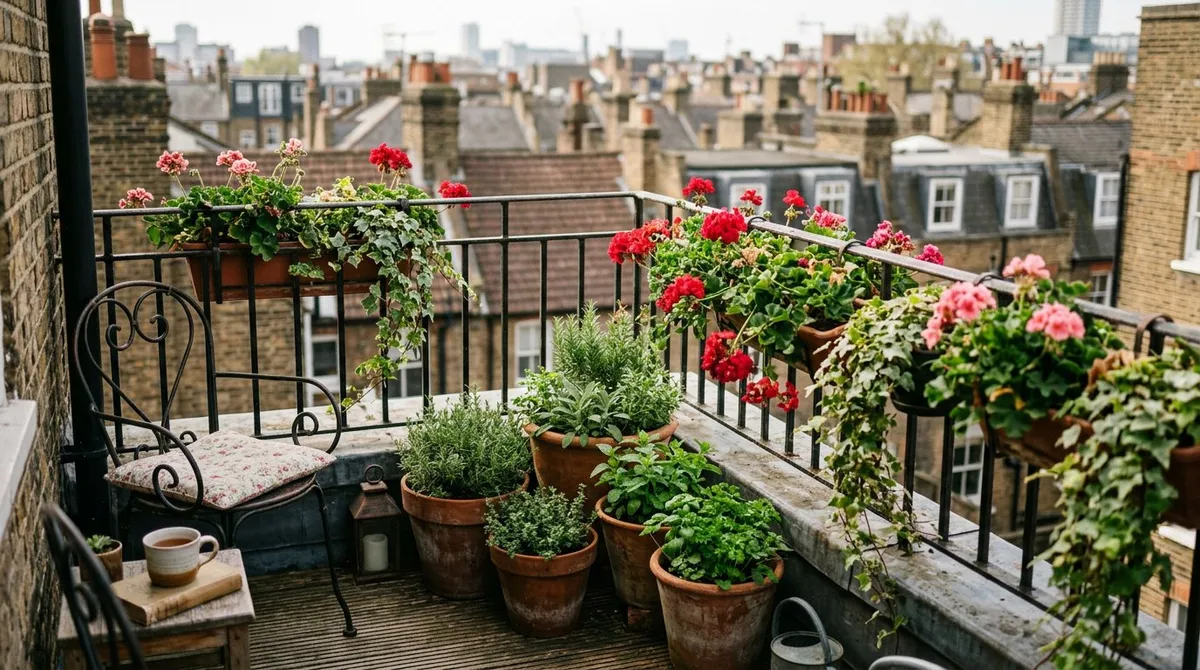
Balcony gardening in the UK is growing fast. Over 4 million UK households live in flats, and most have a balcony or terrace that sits empty apart from a drying rack. That is wasted space. A balcony measuring just 2m x 4m holds enough containers for herbs, salad crops, tomatoes, strawberries, and flowering plants through the full growing season.
The challenge is that balconies are not ordinary gardens. They have weight limits. They catch more wind. They dry out faster. The rules for ground-level gardening do not translate directly. This guide covers the practical side of balcony growing in UK conditions: structural safety, container choices, wind protection, watering, and the best plants for exposed spaces above ground level. If you have a ground-level city garden instead, see our guide to city garden ideas. If you have a patio, see our guide to patio garden ideas.
Weight limits and structural safety
This comes first because it matters most. Overloading a balcony is a structural risk, not just a gardening problem.
Know your balcony’s load rating
Most UK balconies built after 2000 support 150-250kg per square metre. A 2m x 4m balcony therefore holds 1,200-2,000kg in total. That sounds generous, but wet compost is heavy. A single 50-litre terracotta pot filled with damp compost weighs 40-45kg.
How to find your load rating:
- Check the building’s structural specification (available from the management company)
- Check your lease or tenancy agreement for balcony restrictions
- Ask the freeholder or building management
- As a last resort, a structural engineer survey costs £200-£400
Distribute weight sensibly
Place the heaviest containers against the building wall, not the balcony edge. The wall end sits on the building slab and carries more load. The cantilevered outer edge is the weakest point. Spread pots across the full area rather than clustering them in one corner.
Tiered staging and shelving is tempting because it doubles your growing space, but it concentrates weight onto two or four legs. A 3-tier metal staging unit loaded with pots puts 80-120kg on an area of less than half a square metre. That focused load stresses the slab far more than the same weight spread across the floor. If you use staging, place it against the building wall and keep heavy pots on the bottom shelf only.
Watch out for large ceramic and stone pots. A single 60cm glazed ceramic planter weighs 15-20kg empty. Fill it with 80 litres of wet compost and you are looking at 55-65kg from one pot. Four of those grouped in a corner exceed 240kg in under one square metre. Always calculate the wet weight, not the dry weight, because compost absorbs 30-40% of its volume in water after rain.
Warning: Never assume a balcony can hold unlimited weight. Older buildings (pre-1990) may have lower load ratings. If you cannot confirm the rating, limit yourself to 100kg per square metre as a conservative rule. That still allows 6-8 medium containers on a standard balcony.
What to check before starting
- Lease or tenancy agreement: some restrict container sizes, ban trailing plants, or prohibit railing-mounted planters
- Building insurance: check whether balcony garden damage is covered
- Drainage: confirm that water runoff does not pour onto the balcony below. Use saucers under every pot
- Fixings: drilling into balcony walls, floors, or railings may need written permission
Choosing lightweight containers
Container weight matters more on a balcony than anywhere else. Every kilogram of pot is a kilogram you cannot spend on compost and plants.
Container material comparison
| Material | Weight (45cm pot) | Frost-proof | Cost | Best for |
|---|---|---|---|---|
| Terracotta | 8-12kg | No (cracks) | £15-£30 | Ground-level only |
| Glazed ceramic | 6-10kg | Partial | £20-£40 | Sheltered spots |
| Fibreglass | 2-4kg | Yes | £25-£50 | Balconies (best option) |
| Plastic | 1-3kg | Yes | £5-£15 | Budget, frequent moves |
| Fabric grow bags | Under 1kg | N/A | £3-£8 | Seasonal vegetables |
| Galvanised metal | 3-5kg | Yes | £15-£30 | Troughs and railing boxes |
Fibreglass is the standout material for balcony gardening. A 45cm fibreglass pot weighs 2-4kg versus 8-12kg for terracotta. It does not crack in frost. It looks like stone, metal, or concrete depending on the finish. The only downside is higher cost. The RHS container gardening guide has additional advice on pot sizing and compost choice.
Fabric grow bags from brands like Root Pouch and Smart Pot weigh almost nothing, fold flat for storage, and let air reach the roots. They look more functional than decorative, but they are unmatched for seasonal vegetable growing on balconies.
Railing planters
Railing-mounted planters hook over the top rail and sit on the outer edge of the balcony, using no floor space at all. Standard sizes are 40-60cm long and hold 8-15 litres of compost. Cost is £8-£20 each.
Check that the planter has a secure locking mechanism. A loose railing planter falling from any height is dangerous. Choose designs with adjustable brackets that clamp to different railing widths (typical UK railing widths are 40-80mm).
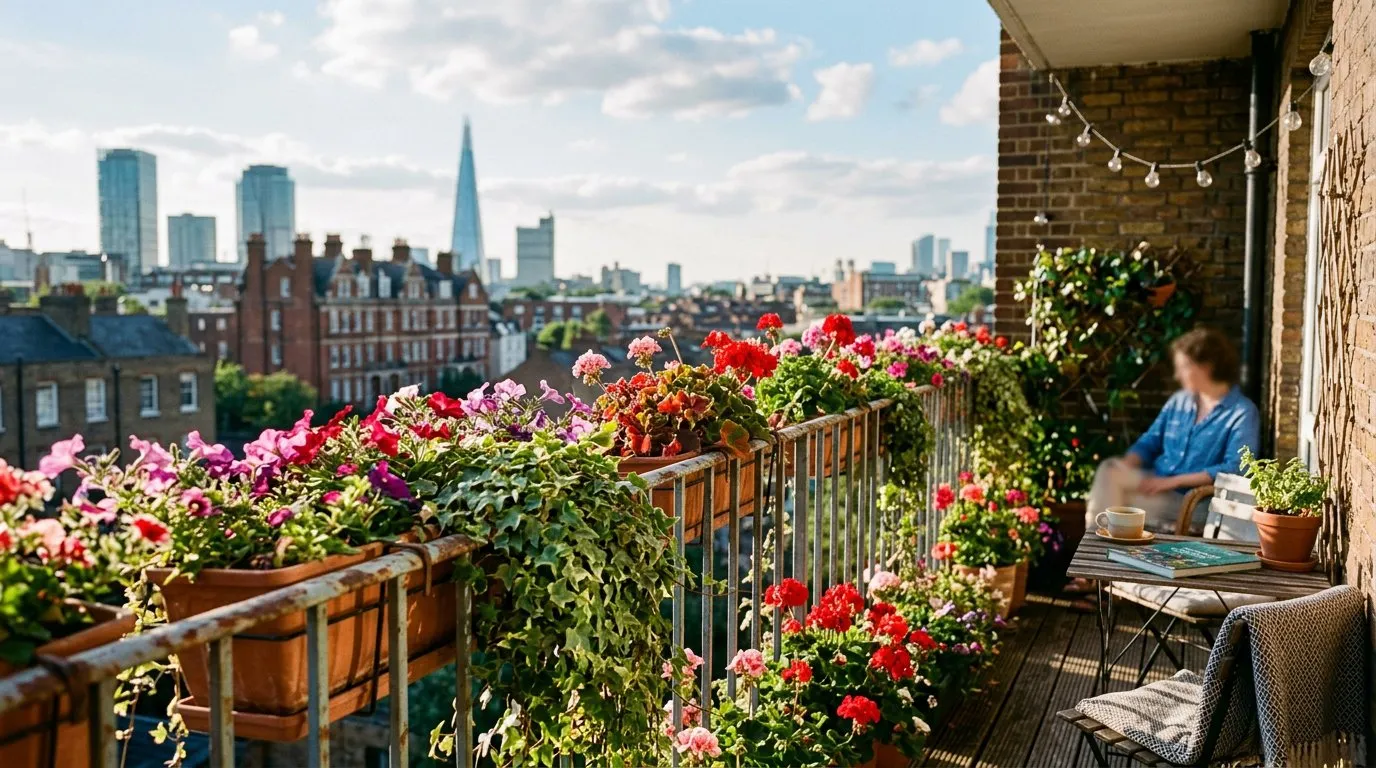
Best plants for railing planters: trailing petunias, geraniums, lobelia, herbs (thyme, oregano, trailing rosemary), small lettuce, and strawberries.
Wind protection for balcony gardens
Wind is the biggest environmental challenge on a balcony. Speed increases by 20-30% for every floor above ground level. A gentle breeze at street level becomes a battering gale on the sixth floor.
Windbreak options
| Windbreak | Cost | Wind reduction | Light reduction | Installation |
|---|---|---|---|---|
| Perspex panels | £30-£80 | 80-90% | None | Bolt to railings |
| Bamboo roll screen | £10-£25 | 40-60% | 20-30% | Cable ties to railings |
| Woven willow panels | £15-£30 | 50-70% | 30-40% | Cable ties or wire |
| Reed screening | £8-£20 | 40-50% | 20-30% | Cable ties |
| Living screen (climbers) | £15-£40 | 50-70% | 30-50% | Trellis + planting |
Perspex screens offer the best combination of wind protection and light transmission. A 1m-tall clear Perspex panel bolted inside the railing cuts wind by 80-90% without blocking any sunlight. This is the single most effective upgrade for an exposed balcony.
However, solid screens create a serious risk on high-rise balconies. A 1m x 1.5m Perspex panel acts as a sail in strong gusts. Wind pressure on a flat surface at 60mph is roughly 70kg per square metre. If the fixings fail, that panel becomes a projectile. Bolt Perspex to the railing frame using stainless steel bolts at 30cm intervals, not cable ties or plastic clips. Pre-drill the panel to avoid cracking. On balconies above the fourth floor, use 6mm acrylic rather than 4mm — the extra thickness resists flexing in gusts that would bow and eventually snap thinner sheets.
Bamboo and reed screens are cheaper and safer in high winds because they are permeable. Wind passes through the gaps rather than building pressure against a solid barrier. They are the better choice above the sixth floor where sustained wind speeds are highest. Use them on the windward side only and leave the sunniest side open.
Wind-resistant plants
Some plants handle exposure far better than others. Choosing the right species avoids the frustration of broken stems and shredded leaves.
Wind-tolerant choices: lavender, rosemary, box, Carex grasses, heuchera, sedum, thyme, and santolina. These have low, compact growth or flexible stems that bend rather than snap. They are all excellent for balcony growing.
Avoid on exposed balconies: tall delphiniums, standard roses, large-leafed hostas, Japanese acers in exposed positions, and any top-heavy plant in a lightweight pot. The leaves catch wind like a sail and the pot topples.
Securing containers against wind
Wind does not just damage plants. It moves pots. A 20-litre plastic pot with dry compost weighs 8-10kg. A sustained 40mph gust generates enough force to slide it across a smooth balcony floor and over the edge. This is a genuine safety issue above the second floor.
Anchor lightweight pots by threading galvanised wire through the drainage holes and fixing it to the railing base. Group pots in clusters so they brace each other. Place the heaviest pot on the windward side of each group. On very exposed balconies (eighth floor and above), use pot stabilisers — weighted rings that sit around the base and add 3-5kg of ballast without taking up space.
Never leave empty pots on a balcony. An empty plastic or fabric pot weighs almost nothing and will blow off in the first storm. Store empties inside or fill them with compost even if unplanted.
Gardener’s tip: Group containers in clusters of 3-5. The pots shelter each other and create a microclimate in the centre of the group. Place the tallest, toughest plants on the windward side and smaller specimens behind them.
Best plants for balconies by purpose
Flowering plants for colour
- Geraniums (Pelargonium) flower from May to October with minimal care. Drought-tolerant, heat-loving, and compact. Perfect for railing planters and sunny balconies.
- Lavender handles wind, drought, and poor soil. Flowers June to August. Attracts bees. Clip after flowering to keep compact.
- Trailing petunias (‘Surfinia’ types) cascade 60-90cm from railing planters and hanging baskets. Feed weekly for continuous flowering.
- Cyclamen provides winter colour from October to March when everything else is dormant. Hardy varieties survive outdoors in containers.
- Heuchera offers year-round coloured foliage in shades of purple, bronze, lime, and silver. Tolerates shade and wind.
Herbs for a balcony kitchen garden
Balconies are arguably better for herbs than ground-level gardens. The extra warmth, sharp drainage, and shelter from a building wall suit Mediterranean species perfectly.
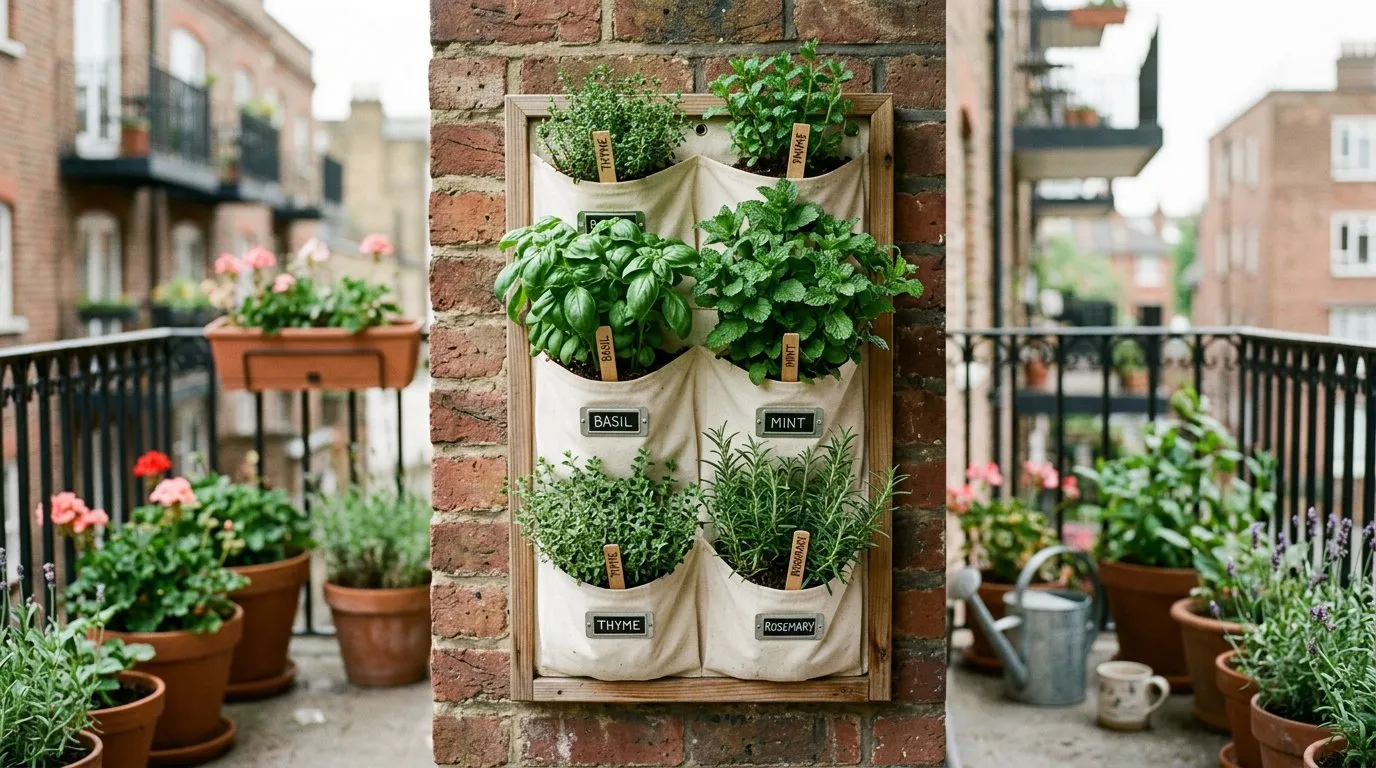
Essential balcony herbs: rosemary (evergreen, grows year-round), thyme (compact, drought-tolerant), sage (needs 30cm pot), basil (summer only, needs warmth), mint (grow in its own pot to stop it spreading), chives (hardy, flowers attract pollinators). Garden Organic recommends peat-free compost for all container herb growing.
A single 60cm railing trough holds 5-6 herb plants and provides fresh picking from April to November. Place it on the sunniest railing within arm’s reach of the kitchen door or window.
Vegetables for balcony growing
Growing food on a balcony is entirely practical with the right containers and varieties. Choose compact or dwarf cultivars bred for container growing.
| Vegetable | Container size | Sun needed | Sowing to harvest | Yield per pot |
|---|---|---|---|---|
| Tomato (bush types) | 40-50 litres | Full sun | 12-16 weeks | 3-4kg |
| Chilli peppers | 20-30 litres | Full sun | 16-20 weeks | 0.5-1kg |
| Salad leaves | 15-20 litres | Partial shade OK | 4-6 weeks | Cut repeatedly |
| Radishes | 15-20 litres | Partial shade OK | 4-5 weeks | 20-30 per pot |
| Runner beans | 40-50 litres | Full sun | 12-14 weeks | 2-3kg |
| Strawberries | 25-30 litres | Full sun | Perennial | 0.5-1kg per plant |
| Courgettes | 40-50 litres | Full sun | 8-10 weeks | 4-6 fruits |
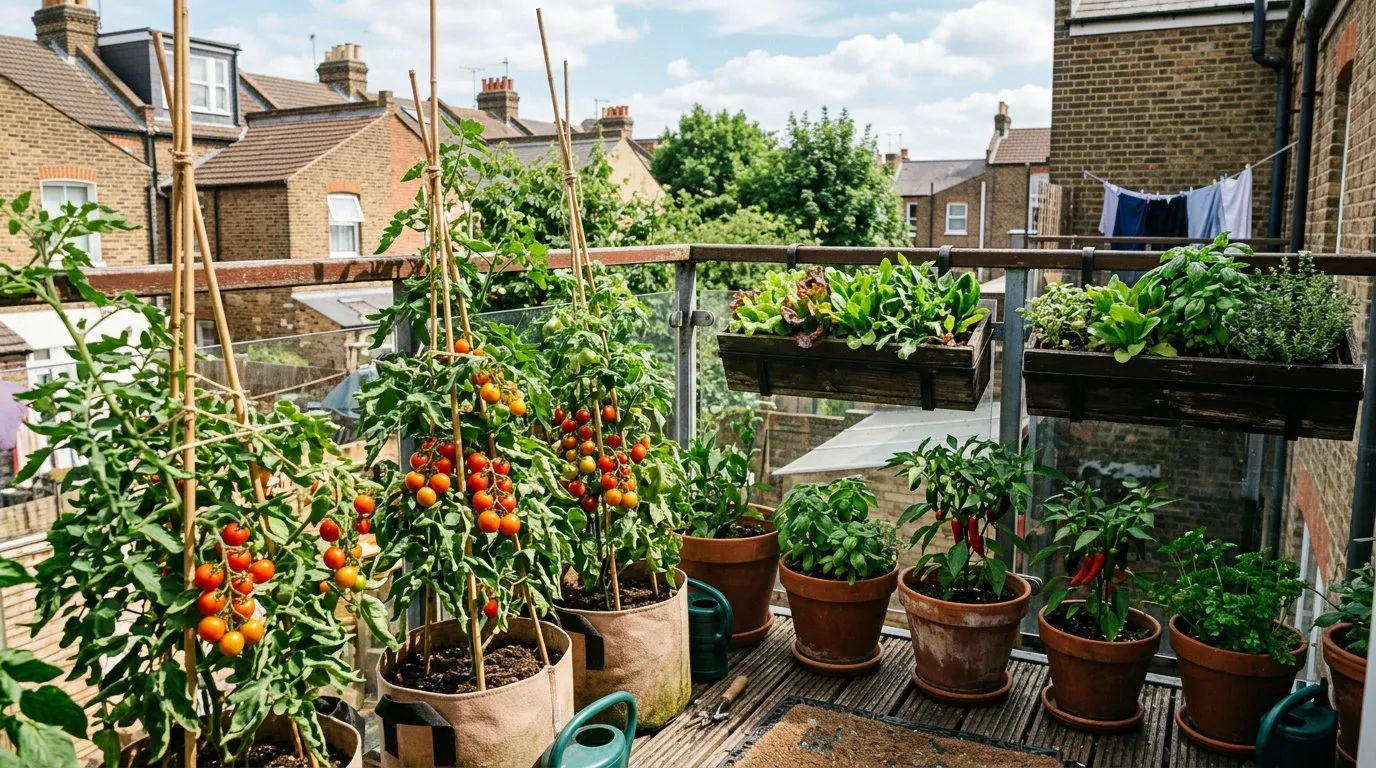
Tomatoes are the most rewarding balcony crop. Bush varieties like ‘Tumbling Tom’, ‘Totem’, and ‘Losetto’ stay compact without pinching out. A single 50-litre pot produces 3-4kg of fruit. Feed weekly with tomato fertiliser from first flowering. For full growing instructions, see our beginner’s guide to tomatoes.
Salad leaves grow in any container with 15cm of compost. Sow cut-and-come-again mixes every 3 weeks from April to August for continuous picking. A single trough produces fresh lettuce for salads all summer.
Watering balcony containers
Balcony containers dry out faster than ground-level pots for three reasons: more wind, more reflected heat from building surfaces, and no contact with moist ground. Plan your watering strategy before planting.
Watering frequency guide
| Season | Standard pots | Self-watering pots | Hanging baskets |
|---|---|---|---|
| Spring (Mar-May) | Every 2-3 days | Weekly | Every 2 days |
| Summer (Jun-Aug) | Daily, twice in heat | Every 3-4 days | Twice daily |
| Autumn (Sep-Nov) | Every 3-4 days | Weekly | Every 2-3 days |
| Winter (Dec-Feb) | When dry (weekly) | Fortnightly | Monthly |
Drainage etiquette: the neighbour factor
This is the part most balcony gardening guides skip. When you water 10 pots on a third-floor balcony, the runoff goes somewhere. Without saucers, dirty brown water streams across the floor, through the drainage gap, and onto the balcony below. That neighbour is now drying laundry under a cascade of compost tea. Management companies receive more complaints about balcony water runoff than any other gardening issue.
Every pot needs a saucer or drip tray. No exceptions. Choose saucers 5-8cm wider than the pot base so they catch overflow during heavy rain as well as normal watering. Empty saucers after prolonged rain to prevent waterlogging.
Internal reservoir pots solve the problem entirely. Self-watering containers with a sealed base hold all excess water inside the pot. Nothing drips. Nothing stains. They cost more but they eliminate the single biggest source of neighbour disputes in flatted buildings.
If you use drip irrigation, run it for shorter bursts (3-5 minutes) rather than one long session. Slow, frequent watering soaks into the compost without pooling and overflowing. Point emitters into the centre of the pot, not near the rim where water tracks down the outside.
On tiled or composite balcony floors, water follows the slope towards the drainage channel. Check where that channel empties. If it drains onto the balcony below rather than into a downpipe, raise all pots on feet and use saucers to contain every drop.
Self-watering containers
Self-watering pots have a built-in reservoir that wicks moisture up to the roots. They cost £10-£30 more than standard pots but cut watering frequency dramatically. On a balcony where you might be out all day in a July heatwave, this prevents catastrophic wilting.
Brands like Lechuza, Cole & Mason, and Elho all make self-watering models in sizes suited to balcony growing. The reservoir holds 2-5 days of water depending on the pot size and plant demands.
DIY drip irrigation
For larger balcony gardens with 10+ containers, a drip irrigation system saves hours per week. A Hozelock or Claber micro-irrigation kit costs £25-£50 and connects to an outdoor tap or indoor tap via a window connector.
Set a battery timer to water for 5-10 minutes twice daily in summer. Each pot gets a drip emitter on a 4mm feed tube. The system waters while you are at work, on holiday, or simply asleep.
Privacy screening with plants
Balconies often overlook neighbours or busy streets. Plants provide screening that feels natural rather than fortress-like. For dedicated vertical planting techniques, see our full guide.
Climbers on balcony trellis
Fix a trellis panel (1.2m-1.5m tall) to the inside of the railing. Plant a climber in a 45cm pot at the base. Within one season, you have a living screen.
Best balcony screening climbers:
- Star jasmine is evergreen with fragrant flowers. Grows well in pots. Needs a south or west aspect.
- Clematis ‘Nelly Moser’ or ‘The President’ flower at railing height in 45cm pots. Not evergreen.
- Ivy is the most reliable evergreen screen for any aspect, including north-facing. Fast growing in pots.
Tall grasses for screening
Ornamental grasses in tall pots create a naturalistic screen. Miscanthus sinensis ‘Gracillimus’ reaches 1.5m in a 45cm pot and sways elegantly in wind. Calamagrostis ‘Karl Foerster’ grows 1.2m upright and holds its form through winter. Both are hardy to minus 15C.
Place grasses along the railing edge in a row. The feathery stems filter wind while obscuring the view from outside.
Balcony garden lighting
Good lighting extends the season for outdoor sitting from early spring to late autumn. On a balcony, safety and lease restrictions limit the options.
Battery-powered festoon lights are the simplest option. Warm white (2700K) LEDs strung at head height create atmosphere without any wiring. Solar-powered models charge during the day and run for 6-8 hours after dark.
Solar stake lights in large containers add soft pools of light at floor level. Place one in each corner container to define the space after dark.
LED strip lights fixed under railing caps or shelf edges provide subtle uplighting. Battery-powered strips cost £8-£15 and last 2-3 seasons.
Avoid: mains-powered lights unless a qualified electrician installs a weatherproof outdoor socket. Extension leads through windows are a fire risk and an insurance issue.
Budget breakdown for balcony gardens
| Setup level | Containers | Plants | Compost and feed | Accessories | Total |
|---|---|---|---|---|---|
| Starter (4 pots) | £20-£40 | £15-£25 | £10-£15 | £10 (saucers) | £55-£90 |
| Intermediate (8 pots + railing planters) | £60-£120 | £40-£60 | £20-£30 | £30 (windbreak, lights) | £150-£240 |
| Full balcony (12+ pots, irrigation) | £100-£200 | £60-£100 | £30-£50 | £60 (irrigation, screening) | £250-£400 |
Fibreglass pots cost more upfront but last 10+ years and weigh significantly less than terracotta. Fabric grow bags are the cheapest option for seasonal vegetable growing.
Seasonal balcony planting plan
Spring (March to May)
Plant herb pots (rosemary, thyme, chives). Start tomato and chilli seedlings on a sunny windowsill for planting out in May. Add spring bulbs in layers: crocus at 8cm, daffodils at 15cm, tulips at 20cm depth. Trailing violas and primroses provide early colour while the weather is still cool.
Summer (June to August)
The peak season. Move tomatoes, peppers, and courgettes outside after the last frost (mid-May in most of England). Plant trailing petunias and geraniums in railing planters. Sow salad leaves every 3 weeks. Harvest herbs continuously. Water daily, feed weekly with liquid fertiliser.
Autumn (September to November)
Replace spent summer bedding with cyclamen, ornamental cabbages, and winter pansies. Plant spring bulbs in October for next year’s display. Cut back herbs except rosemary and thyme, which stay evergreen. Reduce watering as temperatures drop.
Winter (December to February)
Evergreen structure plants (box, heuchera, carex grasses) carry the display. Add fairy lights for atmosphere. Protect tender pots by grouping them against the building wall and wrapping in bubble wrap or fleece. Water only when the top 3cm of compost is dry.
Why we recommend fibreglass pots over terracotta on balconies: After 30 years of gardening in confined spaces, fibreglass is the material I always recommend first for balcony use. A 45cm fibreglass pot weighs 2-3kg against 10-12kg for an equivalent terracotta. On a 6m² balcony, switching from terracotta to fibreglass frees up 60-80kg of load capacity — enough to add four more large containers without exceeding safe limits. Fibreglass also survives frost without cracking, saving the cost of replacing pots every two or three winters.
Common mistakes with balcony gardens
1. Ignoring weight limits
Four large terracotta pots full of wet compost can weigh 160-200kg. That is a serious load on a cantilevered balcony. Always calculate total weight including pots, compost (wet), plants, and furniture. Switch to fibreglass or plastic if you are near the limit.
2. Forgetting about wind
Plants that thrive at ground level may be shredded on a fourth-floor balcony. Test your wind exposure before buying plants. Hang a lightweight flag or ribbon at railing height for a week. If it streams out horizontally most days, you need windbreaks and wind-tolerant species.
3. Choosing pots that are too small
Small pots (under 20cm) dry out in hours during summer. They also restrict root growth, leading to stunted plants. Use 30-45cm pots as the minimum for anything other than small herbs. Fewer, larger containers always outperform many small ones.
4. Neglecting drainage
Waterlogged compost kills roots and creates heavy, stagnant pots. Every container needs drainage holes. Every container needs a saucer underneath to stop runoff staining the balcony floor or dripping onto the neighbour below. Raise pots 1-2cm on pot feet for better airflow.
5. Planting without checking the lease
Some building leases restrict balcony use. Railing planters may be banned on safety grounds. Climbing plants that stain brickwork may breach maintenance clauses. Trailing plants that obscure the building’s facade may need approval. Always check before investing in containers and plants.
Now you have mastered balcony gardening, read our guide on vertical gardening ideas to make the most of every centimetre of wall and railing space.
Frequently asked questions
What are the best plants for a balcony UK?
Lavender, box, grasses, and heuchera handle wind and sun well. For food, tomatoes, herbs, salad leaves, and strawberries all grow in balcony containers. Trailing plants like ivy and lobelia soften railing edges and cope with exposed conditions. Choose compact varieties bred for container growing.
How much weight can a balcony hold?
Most UK balconies support 150-250kg per square metre. A 2m x 4m balcony holds 1,200-2,000kg total. Check your lease or building management company for the specific rating. Place heavy pots against the building wall, not the railing edge, and spread weight evenly across the full floor area.
Can I grow vegetables on a balcony?
Yes, tomatoes, peppers, chillies, salad leaves, radishes, runner beans, and herbs all grow well in balcony containers. A south-facing balcony with 6+ hours of sun suits most vegetables. Use 40-50 litre pots for tomatoes and beans, 20-30 litre for salad and herbs.
How do I protect balcony plants from wind?
Use Perspex screens, bamboo roll, or woven willow panels fixed to railings. Group tall plants behind shorter ones. Choose wind-resistant species like lavender, grasses, and box. Avoid tall, top-heavy plants that catch wind. A 1m-tall Perspex panel cuts wind speed by 80-90% without blocking light.
Do I need permission for a balcony garden?
Check your lease or tenancy agreement first. Most allow containers but restrict permanent fixings, trailing plants that stain walls, or heavy structures. Some buildings ban railing-mounted planters for safety reasons. Always check before drilling into any surface or mounting anything to the railings.
How often should I water balcony plants?
Daily in summer for standard pots, twice daily in heatwaves for small pots and baskets. Self-watering containers extend this to every 3-4 days. Wind dries balcony containers faster than ground-level pots. Check moisture by pushing a finger 3cm below the compost surface. If dry, water thoroughly.
What size pots work best on a balcony?
Use 30-45cm diameter for most plants. Larger pots retain moisture longer and resist tipping in wind. Avoid pots under 20cm as they dry out within hours in summer and restrict root growth. Use lightweight fibreglass or plastic to reduce weight loading on the balcony structure.
Can I grow a herb garden on a balcony?
Balconies are ideal for herbs. Rosemary, thyme, sage, mint, basil, and chives thrive in 20-30cm pots on a sunny ledge. A single 60cm railing trough holds 5-6 herb plants. Most Mediterranean herbs prefer the sharp drainage and extra warmth that balconies provide compared to ground-level beds.
Lawrie has been gardening in the West Midlands for over 30 years. He grows his own veg using no-dig methods, keeps a wildlife-friendly garden, and writes practical advice based on real UK growing conditions.