Children's Garden Design Ideas
Design a children's garden in the UK with safe plants, play areas, growing projects, wildlife zones, and age-appropriate features for toddlers to teens.
Key takeaways
- Rubber safety matting reduces play area injuries by up to 90% versus hard surfaces
- RoSPA recommends a 2m clear safety zone around all play equipment
- Sunflowers germinate in 7-14 days and grow up to 5cm per day at peak growth
- Avoid 20+ common toxic garden plants including foxglove, laburnum, and yew berries
- A 2m x 1m raised bed produces enough salad and strawberries for weekly family picking
- Mud kitchens cost £30-£80 DIY or £100-£300 for ready-made units
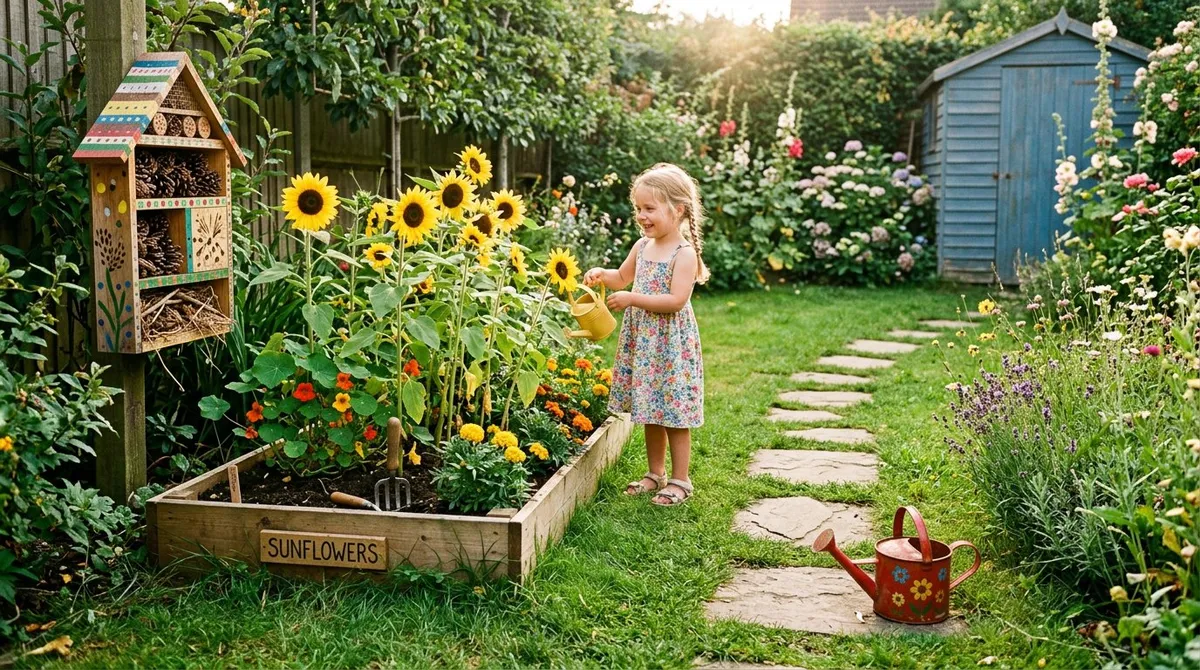
A garden with children in it looks different from an adult’s garden. Mud on the path. A ball in the border. Sunflower seedlings in yoghurt pots on the windowsill. This is not a problem to solve. It is a garden doing its job.
The best family gardens do three things at once. They provide space to play, space to grow things, and space to discover wildlife. The balance shifts as children grow. A toddler needs safe surfaces and fenced water. An eight-year-old needs a den, a digging patch, and something to climb. A teenager needs somewhere to sit with friends. Designing with this progression in mind saves money and avoids ripping everything out every three years.
This guide covers safe plants, play areas, growing projects, wildlife zones, and budget breakdowns for UK family gardens. For design principles that work in smaller plots, see our small garden design ideas.
Zoning a family garden
Divide the garden into zones rather than treating it as one open space. This prevents play equipment dominating the entire plot and preserves areas for adults.
Play zone
Place the main play area where you can see it from the kitchen window. This is the most-used sightline in any family home. Use a level area with soft surfacing. Keep it away from fences and boundaries where neighbours might object to noise.
A 4m x 6m play zone holds a swing, a small sandpit, and a grass area for running. Larger gardens can add a climbing frame or playhouse. The RoSPA home safety guidance recommends a 2m clear safety zone around every piece of play equipment.
Growing zone
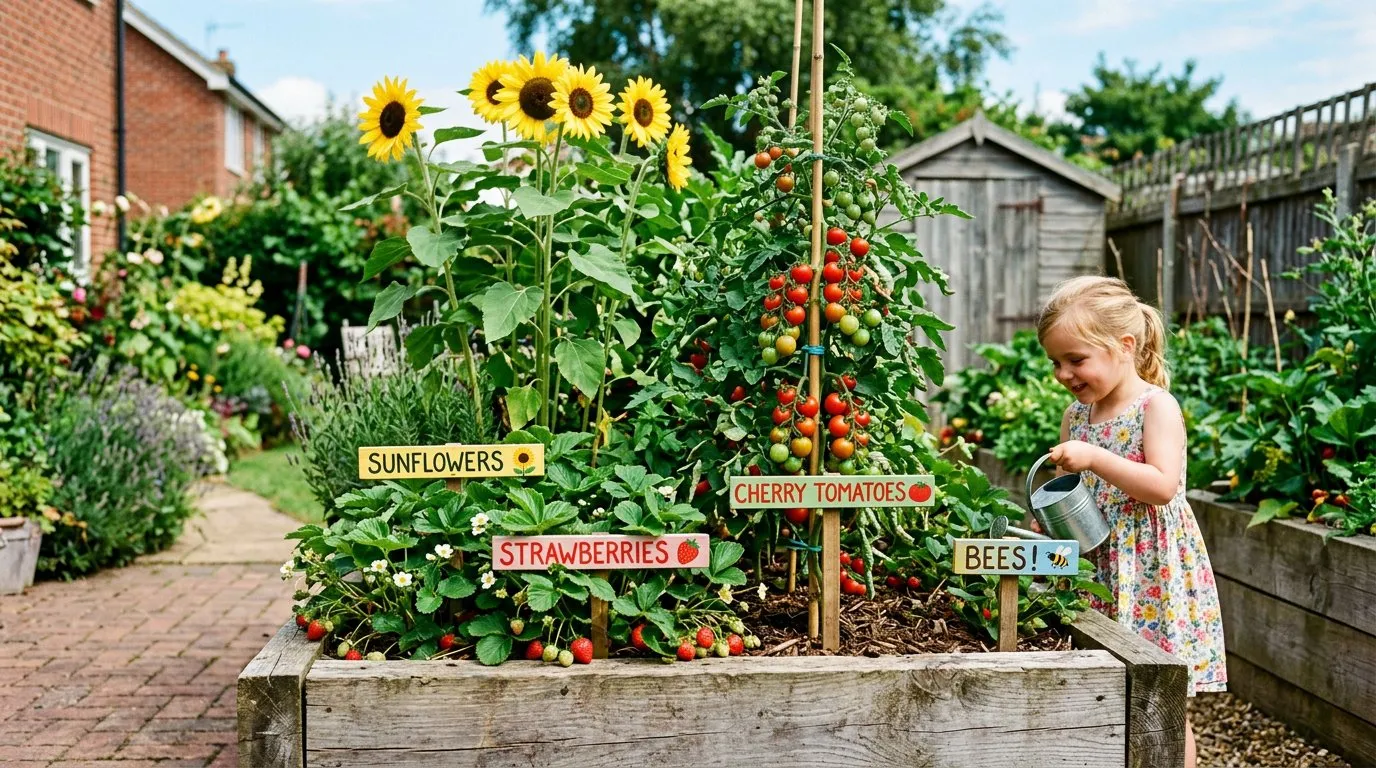
A child-height raised bed packed with sunflowers, strawberries, and cherry tomatoes keeps young growers engaged all summer.
A raised bed of 2m x 1m is large enough for a child’s growing projects. Place it in full sun, near a water source. Raise it 30-40cm off the ground so children can reach without bending. This height also deters toddlers from trampling seedlings.
Build from untreated timber sleepers or scaffold boards. Avoid reclaimed railway sleepers, which leach creosote. Fill with a 50/50 mix of topsoil and peat-free compost. Total cost: £40-£80 for the bed, £20-£30 for the growing media.
Wildlife zone
Dedicate a corner to nature. A log pile, a shallow dish of water, native wildflowers, and a bug hotel attract hedgehogs, frogs, bees, and beetles. Children who observe wildlife in their own garden develop curiosity that classroom biology cannot replicate. For a full guide, see our article on creating a wildlife garden.
Adult zone
Protect at least one seating area from the play zone. A screened patio or decking area with climbers on a trellis provides a visual break. Adults need a space that feels like theirs, even in a family garden.
Safe plants for family gardens
Plant safety matters most when children are under five. Toddlers put everything in their mouths. By age six, most children understand “do not eat that.”
Plants to avoid
| Plant | Toxic part | Risk level |
|---|---|---|
| Foxglove (Digitalis) | All parts, especially seeds | Potentially fatal |
| Laburnum | Seeds and pods | Potentially fatal |
| Yew (Taxus) | Berries and foliage | Potentially fatal |
| Monkshood (Aconitum) | All parts | Potentially fatal |
| Lily of the valley | All parts | Serious poisoning |
| Ricinus (castor oil plant) | Seeds | Potentially fatal |
| Daphne | Berries | Serious poisoning |
| Euphorbia | Milky sap | Skin and eye irritation |
| Rhubarb | Leaves (not stalks) | Poisoning if eaten |
| Oleander | All parts | Potentially fatal |
The RHS maintains a full list of potentially harmful plants. Check it before planting anything new in a family garden.
Safe plants for children’s areas
Choose plants that are non-toxic, tactile, scented, or produce edible rewards.
| Plant | Why children enjoy it | Growing conditions |
|---|---|---|
| Sunflower | Fast growth, height competitions | Full sun, any soil |
| Strawberry | Pick and eat fruit from June | Sun, containers or beds |
| Lavender | Scented, attracts butterflies | Full sun, well-drained |
| Lamb’s ears (Stachys) | Soft, furry leaves to touch | Sun, any soil |
| Snapdragon | Squeeze to open flower mouths | Sun, any soil |
| Nasturtium | Edible flowers, easy from seed | Sun, poor soil (grows anywhere) |
| Sweet pea | Scented cut flowers | Sun, rich soil, supports |
| Marigold | Bright colour, easy from seed | Sun, any soil |
| Mint | Strong scent, grows in pots | Any position (contain in a pot) |
| Apple tree | Fruit, blossom, climbing branches | Sun, any soil |
Play features by age group
Different ages need different features. Plan for progression so the garden evolves rather than being demolished and rebuilt.
Ages 1-3: toddler garden
Priorities: Safe surfaces, enclosed space, sensory experiences, visible from indoors.
- Rubber matting or artificial grass across the main play area. Rubber tiles at 40mm depth cost £25-£40 per sqm installed. They cushion falls and dry quickly.
- Sandpit with a lid to keep cats out. Minimum 1.5m x 1.5m. Use washed play sand (not builders’ sand). Replace sand annually. Cost: £50-£80 DIY for a timber-framed sandpit.
- Water table (not a pond). A shallow tray on legs at child height. Empty after each use.
- Sensory planting within reach: lavender, rosemary, lamb’s ears, ornamental grasses they can run hands through.
- Fenced boundaries with childproof gate latches at adult height.
Ages 4-7: explorer garden
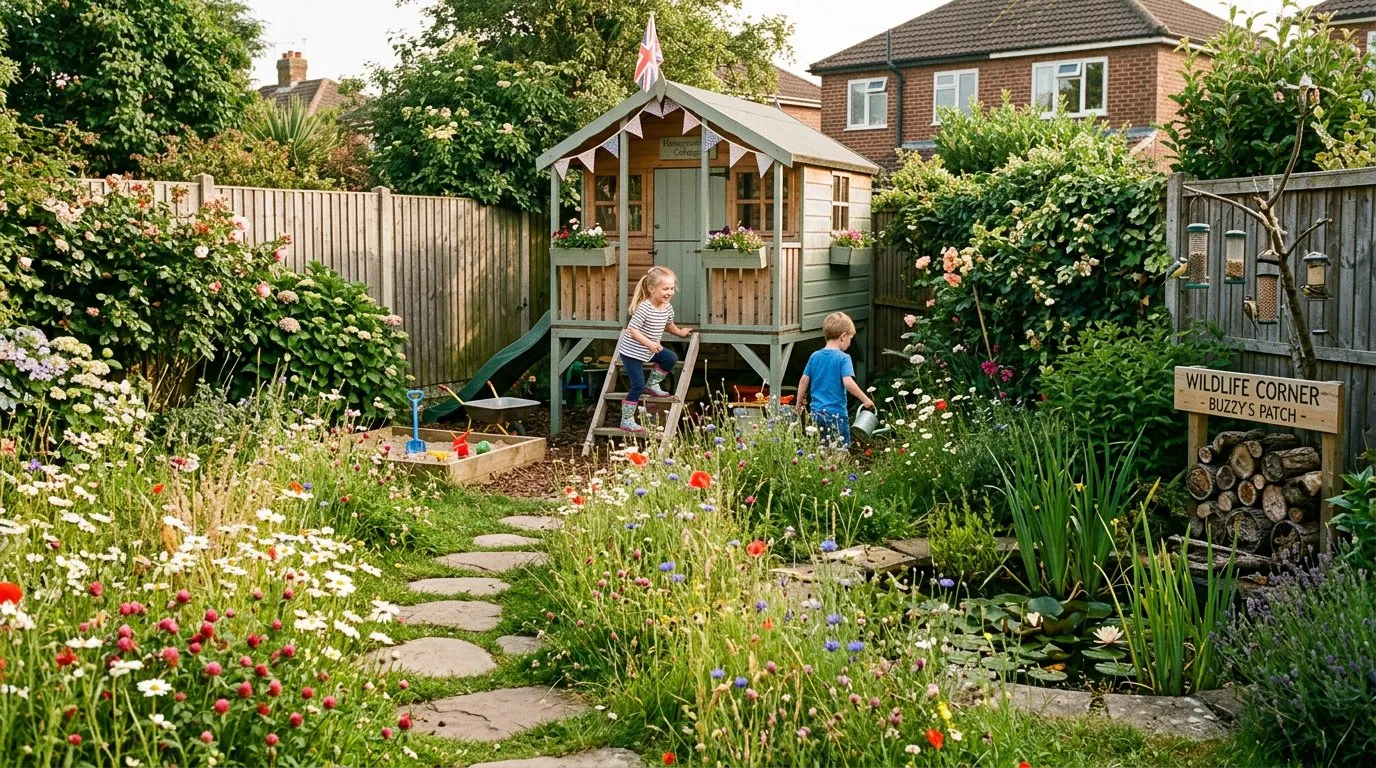
A wooden playhouse, stepping stone path, and wildlife corner create the perfect children’s garden play zone.
Priorities: Active play, growing projects, nature discovery, imaginative play.
- Swing on a solid frame. A single timber A-frame swing costs £80-£200. Requires 4m x 5m including safety zone.
- Playhouse or den. A simple timber playhouse costs £150-£400. Position it under a tree for shade. Add curtains, a small table, and potted plants for imaginative play.
- Mud kitchen. An outdoor cooking station using old pots, pans, and a wooden shelf or pallet. Total DIY cost: £30-£80. Place on bark chip for drainage.
- Growing beds. Start with sunflowers, radishes, and strawberries. Give each child their own labelled section.
- Bug hotel from stacked pallets, bamboo canes, and pine cones. Place in a sheltered, south-facing spot.
Ages 8-12: growing independence
Priorities: Physical challenge, responsibility, nature projects, social space.
- Climbing frame or rope swing. Budget £200-£600 for a timber climbing frame. Check weight limits match children’s ages.
- Vegetable patch. Graduate to longer-term crops: potatoes, runner beans, pumpkins, sweetcorn. A 2m x 3m bed gives enough space for meaningful harvests.
- Wildlife pond. From age 8, with supervision, a small sunken pond (1m x 1.5m, 40cm deep) attracts frogs, newts, and dragonflies. Add a gently sloping edge for wildlife access.
- Campfire circle. A simple fire pit ring (£30-£60) with log seating teaches fire skills and provides evening family gatherings.
- Greenhouse or cold frame. A small cold frame (£30-£60) lets children start seeds early and grow tomatoes or cucumbers.
Ages 13+: teen space
- Seating area with festoon lights for socialising.
- Growing space for specialist interests: chillies, exotic plants, or competition vegetables.
- Hammock or swing seat for reading and relaxing.
- Remove play equipment they have outgrown. Repurpose the area for a patio or planting.
Growing projects for children
Growing food gives children a direct connection between soil, effort, and plate. Choose crops with fast results and high rewards.
Quick-win crops (results in 4-8 weeks)
| Crop | Sow | Harvest | Why children enjoy it |
|---|---|---|---|
| Cress | Any time (indoors) | 7-10 days | Instant results, egg-and-cress sandwiches |
| Radish | March-September | 4-5 weeks | Pull from soil like a magic trick |
| Lettuce (cut-and-come-again) | April-August | 6-8 weeks | Pick leaves repeatedly, eat in minutes |
| Spring onion | March-July | 8 weeks | Easy to sow, satisfying to pull |
Show-off crops (impressive results)
| Crop | Sow | Harvest | Why children enjoy it |
|---|---|---|---|
| Sunflower | April-May | August (height) | Grows 5cm per day at peak; height competitions |
| Pumpkin | May (indoors) | October | Huge fruit, carving at Halloween |
| Runner bean | May | July-September | Climbs 2-3m up cane wigwams, bright red flowers |
| Sweetcorn | May | August-September | Cobs straight from the stalk, eaten within minutes |
| Strawberry | Plant spring | June-September | Pick and eat warm from the sun |
For a full sunflower growing guide, see our how to grow sunflowers article. Pumpkin growers should read our pumpkin and squash growing guide. Strawberry tips are in our growing strawberries guide.
The bean wigwam project
This is the single best growing project for children aged 4-10. It combines construction, planting, growing, harvesting, and a den.
- Push 6-8 bamboo canes (2.4m tall) into the ground in a circle of 1.2m diameter.
- Tie the tops together with garden twine.
- Leave a gap between two canes for a doorway.
- Sow two runner bean seeds at the base of each cane in mid-May.
- Water weekly. Beans climb the canes and cover the wigwam in leaves by July.
- Harvest beans from July to September. Regular picking extends the crop.
Total cost: £5-£10 for canes and seeds. The wigwam becomes a shaded den with dangling beans. Children sit inside and pick their own snack.
Sensory garden features
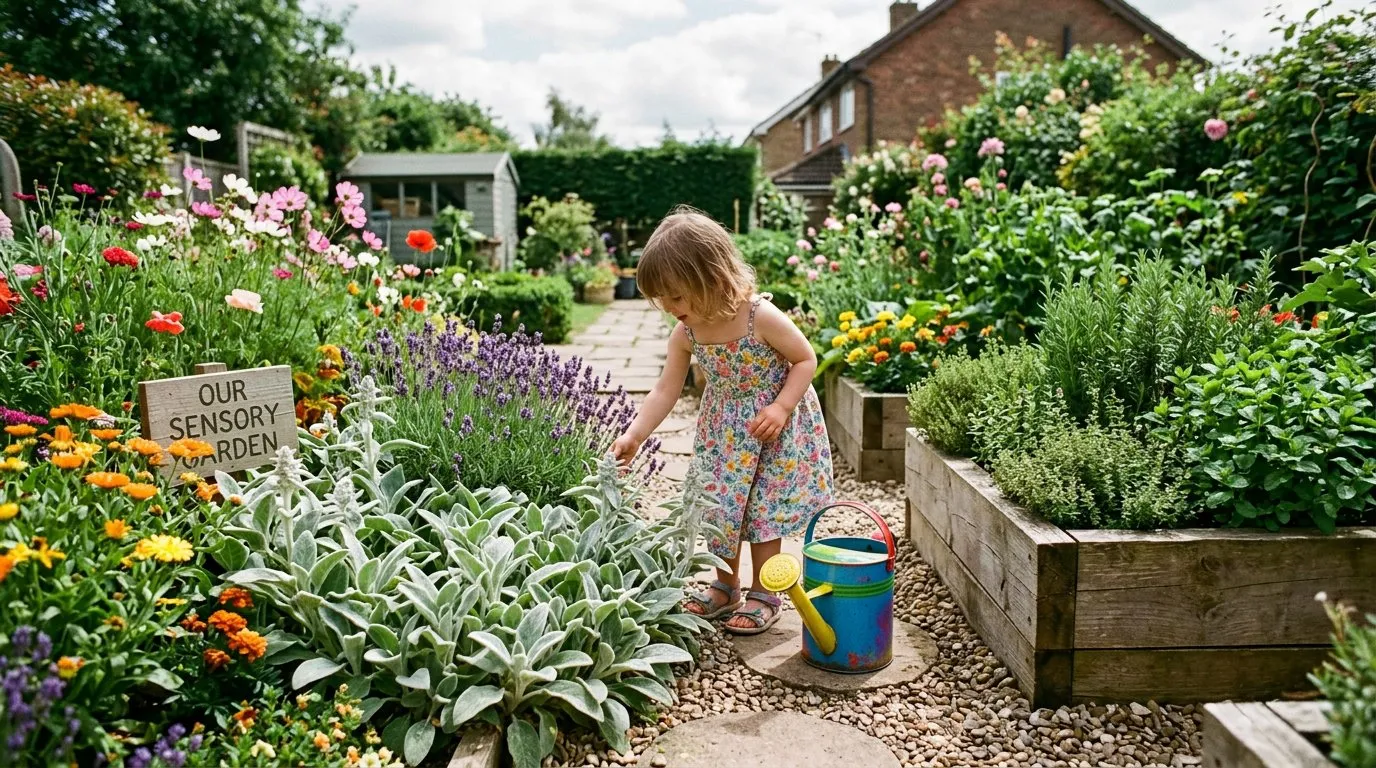
Colourful flowers, fuzzy lamb’s ear, and fragrant herbs make this children’s garden sensory area irresistible to little hands.
Sensory gardens engage all five senses and benefit every child, including those with additional needs.
Touch: Lamb’s ears (soft woolly leaves), ornamental grasses (run fingers through), tree bark (rough textures), smooth pebbles in a dish, water trickling over hands.
Smell: Lavender, rosemary, mint, chocolate cosmos (smells like chocolate), lemon balm (crush a leaf), sweet peas (cut for indoor vases).
Sound: Bamboo rustling in wind, water trickling from a small spout into a basin, wind chimes, ornamental grasses swishing, bird song attracted by feeders and nest boxes.
Taste: Strawberries, herbs (mint, basil, chives), nasturtium flowers (peppery), cherry tomatoes, peas straight from the pod.
Sight: Bright flowers at child height, butterflies on buddleia, pond life, changing seasons, sunflower heads tracking the sun.
Gardener’s tip: Place sensory plants along the edge of paths where children walk past daily. A rosemary bush beside the back door gets touched and sniffed ten times more often than one tucked in a far border. Position plants at the child’s nose height, not adult height.
Water safety in family gardens
Water is the biggest safety risk in a family garden. A toddler can drown in 5cm of water in under two minutes. This is not an exaggeration. It is the reality cited by RoSPA water safety guidance.
Ponds: Fill in or fence off any pond while children are under five. Use rigid mesh covers if fencing is not practical. Re-introduce a pond from age 8 onwards with a sloping beach edge for escape.
Water features: Choose self-contained features where water runs over pebbles into a concealed reservoir below ground. The surface stays dry. Children get the sound and sight of water without the drowning risk.
Water butts: Fit a secure lid. Position out of reach or behind a locked gate. An uncovered water butt is as dangerous as an open pond to a climbing toddler.
Paddling pools: Supervise constantly. Empty after every use. Store upside down so they cannot collect rainwater.
Play surfaces compared
| Surface | Cost per sqm | Cushioning | Drainage | Maintenance | Lifespan |
|---|---|---|---|---|---|
| Rubber safety tiles | £25-£40 installed | Excellent (falls up to 1.2m at 40mm) | Good | Sweep, occasional pressure wash | 10-15 years |
| Bark chip (play grade) | £5-£8 laid 300mm deep | Good (falls up to 1.5m) | Excellent | Top up annually, replace every 3-4 years | 3-4 years |
| Artificial grass | £20-£35 installed | Moderate (add shock pad for £5-£8) | Good | Brush, rinse occasionally | 8-12 years |
| Natural grass | £3-£5 (turf) | Poor | Fair | Mow weekly, repair bare patches | Ongoing (wears thin under equipment) |
| Concrete/paving | £15-£30 | None | Variable | Minimal | 20+ years (unsafe under play equipment) |
Recommendation: Rubber tiles under fixed equipment (swings, climbing frames). Bark chip for larger play areas on a budget. Artificial grass for general family lawn areas that see heavy foot traffic.
Budget breakdown for family garden features
| Feature | DIY cost | Professional install | Notes |
|---|---|---|---|
| Timber sandpit (1.5m x 1.5m) | £50-£80 | £150-£250 | Add a hinged lid for £20-£40 extra |
| Single A-frame swing | £80-£200 | £200-£400 | Needs 4m x 5m including safety zone |
| Timber playhouse | £150-£400 | £300-£700 | Add 30% for foundations and surfacing |
| Mud kitchen (pallet-built) | £30-£80 | £100-£300 | Old pots and pans from charity shops |
| Raised growing bed (2m x 1m) | £40-£80 | £100-£200 | Untreated scaffold boards or sleepers |
| Bug hotel (log and pallet) | £0-£20 | N/A | Best as a family project from scrap materials |
| Rubber safety surface (4m x 5m) | N/A | £500-£800 | Professional install recommended for safety |
| Bark chip area (4m x 5m) | £100-£160 | £200-£350 | 300mm depth, play-grade bark |
Total for a basic family garden update: £400-£800 DIY for a sandpit, raised bed, bark chip play area, and a mud kitchen. This covers ages 1-7 without a major garden overhaul.
Educational garden elements
A garden is an outdoor classroom. Every feature can teach something.
Weather station. A rain gauge (£5), max-min thermometer (£8), and wind sock (£3) let children record daily weather. Link to school science projects.
Sundial. A simple vertical sundial on a south-facing wall costs £10-£30. Children learn to tell the time using shadows and understand the earth’s rotation.
Compost bin. Show children how kitchen scraps become soil. A simple bin from pallets costs nothing. Worms and beetles provide entertainment. The process takes 6-12 months, teaching patience along the way.
Bird feeding station. Hang feeders with different foods (sunflower hearts, fat balls, nyjer seed) and record which birds visit. A feeding station costs £15-£30. Use our wildlife garden guide for more ideas.
Plant labels. Children write their own labels for everything they grow. Use wooden lolly sticks or slate offcuts. This reinforces plant names and ownership.
Why we recommend the bean wigwam as the single best children’s garden project: After 30 years of creating family gardens and watching children interact with them, the runner bean wigwam consistently produces the most engagement of any feature I have built. Children who helped construct the wigwam and sow the beans in May were still picking and eating pods in September — a five-month connection between effort and reward that no bought toy achieves. In one garden, an eight-year-old recorded 4.2kg of beans from his wigwam over the season, which he weighed himself.
Common mistakes to avoid
Making the whole garden a play area. Children need boundaries. A garden that is 100% play space has no grown-up areas and no mystery. Keep some zones for adults and some for nature. Children accept “that is the wildlife area, we leave it alone” more readily than you expect.
Choosing artificial over natural. Plastic play equipment degrades in UV light and becomes landfill. Timber swings, rope ladders, and log-round stepping stones last longer, look better, and teach children to value natural materials.
Underestimating mess. Mud kitchens generate mud. Sandpits scatter sand. Bean wigwams need watering. Build features where mess is contained or drains away, not against the house wall or above the patio.
Planting for looks, not safety. A garden can be beautiful and safe. Replace foxgloves with hollyhocks. Swap laburnum for a crab apple. You do not need to sacrifice colour or structure to remove toxic plants. Just make informed swaps.
Forgetting the future. A swing that serves a five-year-old will bore a twelve-year-old. Build features that can evolve. A sandpit with a removable lid becomes a raised bed. A playhouse becomes a garden store. Plan one transition ahead at every stage.
Now you’ve designed your children’s garden, read our guide on creating a wildlife garden for the next step in making your garden educational and nature-rich.
Frequently asked questions
What are the best plants for children to grow?
Sunflowers, strawberries, pumpkins, and cress are the best starter plants. Sunflowers germinate in 7-14 days and grow fast enough to hold a child’s attention with visible daily progress. Strawberries produce fruit children can pick and eat straight from the plant from June onwards.
Which garden plants are poisonous to children?
Foxglove, laburnum, yew berries, monkshood, and lily of the valley are the most dangerous. Ricinus (castor oil plant) seeds are highly toxic and must be removed from any family garden. The RHS publishes a full list of potentially harmful plants. Check it before planting anything new near play areas.
How do I make a garden safe for toddlers?
Fence or cover all water features, including ponds and water butts. Use rubber matting or bark chip under play equipment. Check for poisonous plants and remove them. Secure gates with childproof latches at adult height. Store tools and chemicals in a locked shed or high cabinet.
What surface is safest under a swing or climbing frame?
Rubber safety tiles are the safest option for domestic play areas. They need 40mm depth for falls up to 1.2m. Bark chip at 300mm depth is a cheaper alternative that still provides good cushioning. Grass wears thin under heavy use and offers poor fall protection on hard ground beneath.
How do I build a mud kitchen for children?
Use an old wooden pallet or scaffold board shelf at 50-60cm height. Add bowls, pots, a washing-up bowl for water, wooden spoons, and plastic containers. Total DIY cost is £30-£80 from reclaimed materials. Place on bark chip or rubber mat to manage mess and keep feet dry.
What vegetables are easiest for children to grow?
Radishes are ready in just 4 weeks from sowing. Lettuce takes 6-8 weeks for cut-and-come-again leaves. Courgettes produce impressive large fruit from 8-10 weeks after transplanting. Peas are easy to sow directly and children enjoy eating them raw straight from the pod.
How much space do I need for a children’s play area?
A single swing needs 4m x 5m including the 2m safety zone on all sides. A sandpit needs 1.5m x 1.5m minimum. A mud kitchen fits in 1m x 1m. A 4m x 6m dedicated play area holds a swing, sandpit, and small grass strip. Plan the layout before buying equipment.
Further reading
- Small garden design ideas - making the most of limited family space
- How to grow sunflowers - the best first plant for children
- Growing strawberries in the UK - pick-and-eat rewards for young growers
- Front garden ideas - family-friendly front garden designs
- Garden ideas for every budget - making play areas affordable
Lawrie has been gardening in the West Midlands for over 30 years. He grows his own veg using no-dig methods, keeps a wildlife-friendly garden, and writes practical advice based on real UK growing conditions.