Container Pond Ideas for Small Gardens
Container pond ideas for small UK gardens. Covers best containers, aquatic plants, wildlife benefits, setup costs from fifteen pounds, and seasonal care.
Key takeaways
- A half barrel container pond costs fifteen to forty pounds and takes under an hour to set up
- Containers of 40 litres or more support 3-5 aquatic plant species and attract wildlife within weeks
- Miniature waterlilies like Nymphaea pygmaea 'Helvola' flower in pots as small as 45cm diameter
- No pump, filter, or electricity required — submerged oxygenators keep water clear naturally
- Position in 4-6 hours of sunlight for the best plant growth and wildlife activity
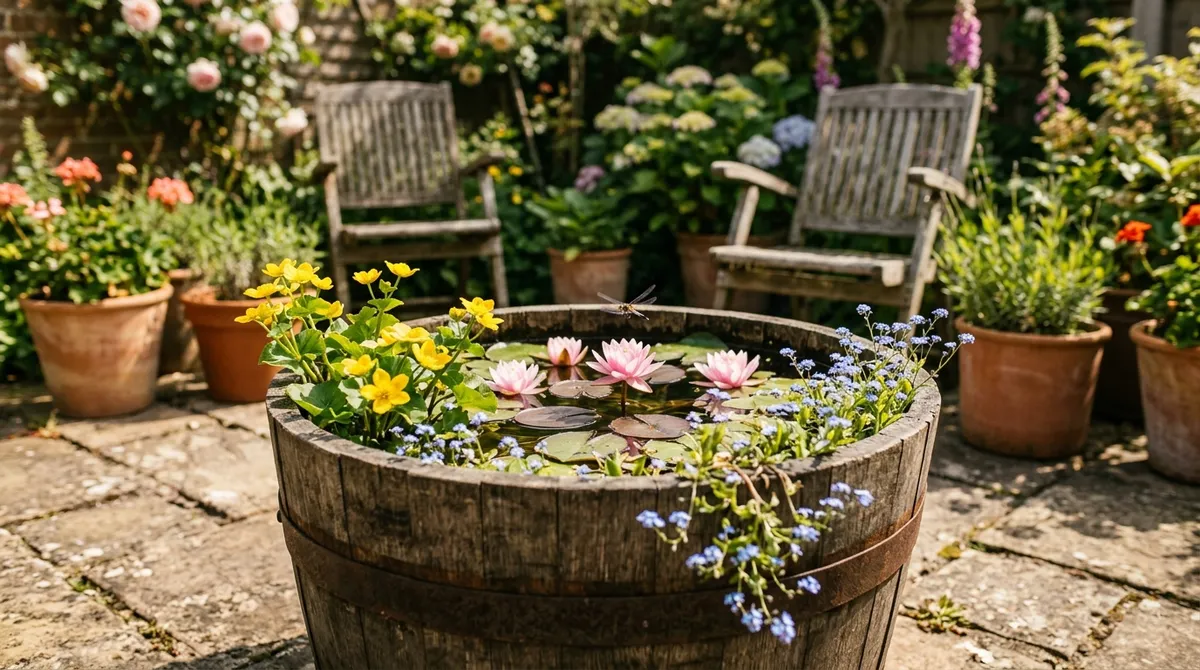
Container pond ideas are the fastest way to bring water and wildlife into a small UK garden. You do not need to dig, lay a liner, or run electricity. A single half barrel on a patio holds enough water for flowering plants, visiting frogs, and bathing birds. Setup takes under an hour. Costs start from fifteen pounds.
The Freshwater Habitats Trust ranks garden ponds as the single most important habitat feature for UK biodiversity. Container ponds deliver the same benefits in a fraction of the space. A 50-litre barrel supports 3-5 aquatic plant species and attracts wildlife within weeks. Whether you have a courtyard, a balcony, or a strip of patio, there is a container pond that fits.
What are the best containers for a pond?
The container you choose determines the depth, volume, and planting options available. Bigger is always better for water stability, but even a 25-litre washing up bowl supports a few plants.
| Container | Volume | Depth | Cost | Best For |
|---|---|---|---|---|
| Half oak barrel | 50-80 litres | 35-40cm | £20-£40 | All-round planting with waterlily |
| Galvanised trough | 40-120 litres | 25-35cm | £25-£60 | Long, narrow spaces and patios |
| Belfast sink | 35-55 litres | 25-30cm | £15-£40 (reclaimed) | Cottage and courtyard gardens |
| Large glazed pot | 20-50 litres | 25-40cm | £15-£35 | Decorative focal point |
| Washing up bowl | 10-25 litres | 15-20cm | £3-£8 | Starter or children’s project |
| Zinc bath | 60-100 litres | 30-40cm | £30-£70 | Vintage or farmhouse style |
Half barrels are the most popular choice for good reason. They hold enough water for stable temperatures, are deep enough for a miniature waterlily, and look natural in both traditional and modern gardens. If you are working with a small garden, a single barrel tucked into a corner adds a water feature without sacrificing floor space.
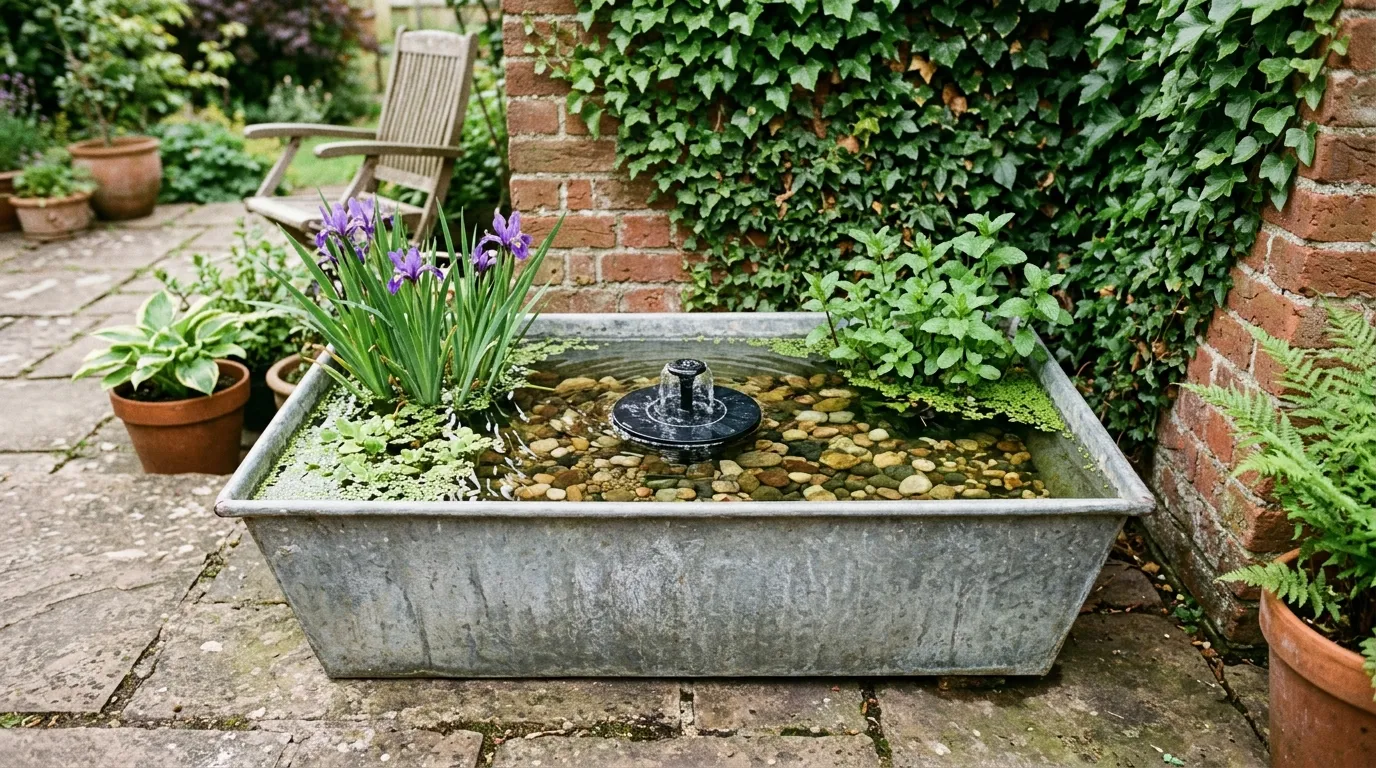 A galvanised trough pond planted with marsh marigold and water forget-me-not. Troughs suit narrow patios and balconies.
Galvanised troughs heat up faster than wooden barrels in direct sun. Line the inside with pond liner offcuts or paint with a non-toxic sealant to prevent zinc leaching into the water, which is harmful to plants and invertebrates.
How do you set up a container pond step by step?
Setting up a container pond takes under an hour. No specialist tools or experience needed.
1. Choose your position. Place the container where it will get 4-6 hours of sunlight. Fill it before adding anything heavy as moving 50kg of water is difficult. Level ground is important because water shows every slope.
2. Prepare the container. If using a half barrel, line it with butyl rubber or a heavy-duty pond liner to prevent leaks. Galvanised containers need lining to stop zinc leaching. Belfast sinks are watertight as they are. Plug any drainage holes with silicone sealant.
3. Add substrate. Place 5cm of washed aquatic gravel or heavy loam in the bottom. Avoid garden compost as it releases nutrients that fuel algae. Specialist aquatic compost from a garden centre costs two to four pounds per bag.
4. Plant in stages. Set submerged oxygenators (hornwort, water starwort) on the bottom first. Add marginal plants in mesh baskets on bricks to adjust height. Position the waterlily last, in the deepest section.
5. Fill slowly. Use rainwater if possible. Tap water works fine but contains chlorine and chloramine. Leave tap water to stand for 48 hours before adding plants, or use a dechlorinator for one to two pounds. Rainwater from a water butt is the best option.
6. Wait before expecting wildlife. Resist the urge to add anything from wild ponds. Frogs, dragonflies, and pond skaters find new water sources naturally. Most container ponds see their first visitors within 2-4 weeks.
What are the best plants for a container pond?
Choose plants that stay compact and suit the shallow depth of a container. A good combination includes one waterlily, two marginals, and one submerged oxygenator. For a full planting guide covering deeper water features, see our list of the best pond plants for UK gardens.
Miniature waterlilies are the stars of container ponds. Nymphaea pygmaea ‘Helvola’ produces yellow flowers in just 15-30cm of water and spreads to only 30-60cm. Nymphaea ‘Aurora’ shifts from yellow to orange to deep red over three days. Both flower from June to September in a container as small as 45cm across.
Marsh marigold (Caltha palustris) is one of the first native wildflowers to bloom in spring. Bright yellow flowers appear in March and April. It grows 20-30cm tall and thrives in 0-10cm of water. Excellent for wildlife gardens as it provides early nectar for bees and hoverflies.
Water forget-me-not (Myosotis scorpioides) produces pale blue flowers from May to September and scrambles gently over the container edge. Grows in 0-10cm of water. Attracts hoverflies and bees.
Dwarf iris (Iris versicolor ‘Kermesina’) grows 30-40cm tall with plum-purple flowers in June. Happy in 5-10cm of water. One plant per barrel is enough.
Hornwort (Ceratophyllum demersum) is the best submerged oxygenator for containers. It floats freely, needs no planting, and keeps water clear by competing with algae for nutrients. One bunch per 30 litres is the right density.
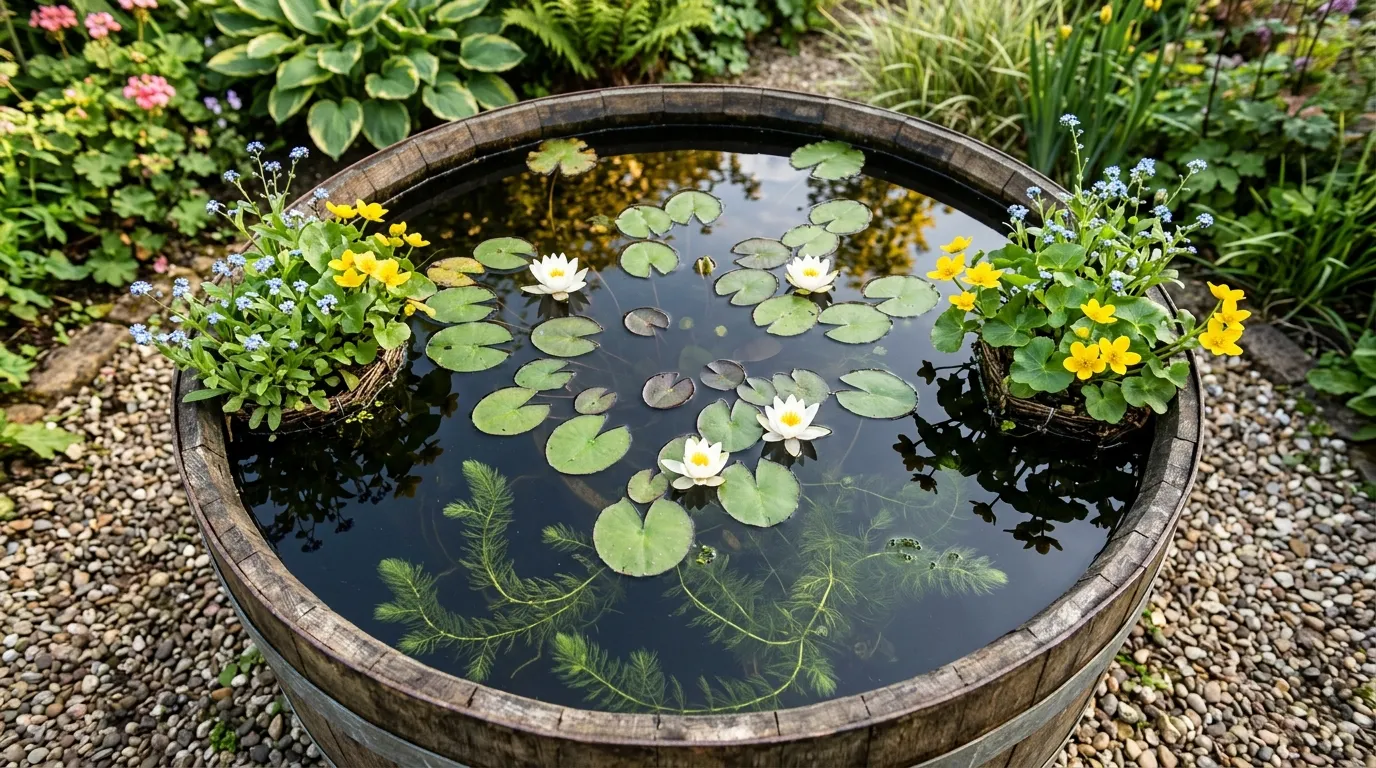 A half barrel pond with Nymphaea ‘Helvola’, dwarf iris, and trailing water forget-me-not. This barrel holds 60 litres and sits in part shade.
What wildlife does a container pond attract?
Even a small container pond attracts a surprising range of wildlife. The Wildlife Trusts recommend container ponds as a simple way to support urban biodiversity.
Frogs and toads find container ponds within the first year. Frogs travel up to 500m overland to reach new water. Provide a ramp (a half-submerged stone or piece of wood) so amphibians can climb in and out. A container pond on its own will not support breeding frogs as they need at least 20cm of water for spawn, but it serves as a drinking and bathing spot. If you have space to dig, a wildlife pond is the best long-term option for amphibian breeding. For a dedicated amphibian habitat, see our guide to frogs and toads in UK gardens.
Dragonflies and damselflies lay eggs in container ponds from June onwards. Common darter and blue-tailed damselfly are the species most likely to visit. Larvae develop in the water for 1-2 years before emerging as adults.
Birds use container ponds for drinking and bathing. Blackbirds, robins, and blue tits visit daily once they find the water source. A flat stone at the water’s edge gives birds a safe landing spot. For more on attracting birds to your garden, food and shelter are just as important as water.
Pond skaters, water boatmen, and water beetles arrive within days of filling. These invertebrates fly between water sources and colonise new ponds remarkably quickly. They form the base of a food web that supports larger visitors.
How much does a container pond cost?
Container ponds are one of the cheapest garden projects. Here is a realistic breakdown for three different setups.
| Item | Budget Setup | Mid-Range Setup | Premium Setup |
|---|---|---|---|
| Container | Washing up bowl: £5 | Half barrel: £25 | Glazed ceramic: £60 |
| Liner (if needed) | Not needed | Pond liner offcut: £5 | Not needed |
| Aquatic compost | £3 | £3 | £6 |
| Oxygenating plant | Hornwort bunch: £4 | Hornwort bunch: £4 | Hornwort x 2: £8 |
| Marginal plants x 2 | £8 | £10 | £14 |
| Miniature waterlily | None | £8 | £12 |
| Solar fountain (optional) | None | None | £10 |
| Gravel mulch | £2 | £3 | £5 |
| Total | £22 | £58 | £115 |
The budget option is a genuine pond. A washing up bowl with hornwort and a couple of marginals attracts invertebrates and provides a bird bath. For another container-based project using miniature plants, see our fairy garden step by step guide. The mid-range half barrel setup is the sweet spot for most people: enough depth for a waterlily, enough volume for stable water quality, and space for 4-5 plant species.
Where should you position a container pond?
Sunlight is the most important factor. Waterlilies need 4-6 hours of direct sun to flower. Marginal plants tolerate more shade, but most flower better with morning sun. A position facing south-east or south-west works well in most UK gardens.
Avoid full south-facing positions against a wall in southern England. Reflected heat pushes water temperatures above 30C on hot days, which stresses plants and reduces oxygen levels. If your only option is a south-facing wall, use the largest container you can fit. An 80-litre trough resists overheating far better than a 25-litre pot. If your patio is mostly shaded, skip the waterlily and use shade-tolerant plants around the container instead.
Shelter from wind matters on balconies and exposed patios. Wind increases evaporation and can topple tall marginal plants. A position against a fence or wall provides shelter without blocking light.
Access to a water source makes topping up easier. Container ponds lose 2-5cm of water per week in summer through evaporation. A nearby water butt or outdoor tap saves carrying watering cans across the garden. For courtyard gardens, placing the pond near a downpipe makes rainwater collection simple.
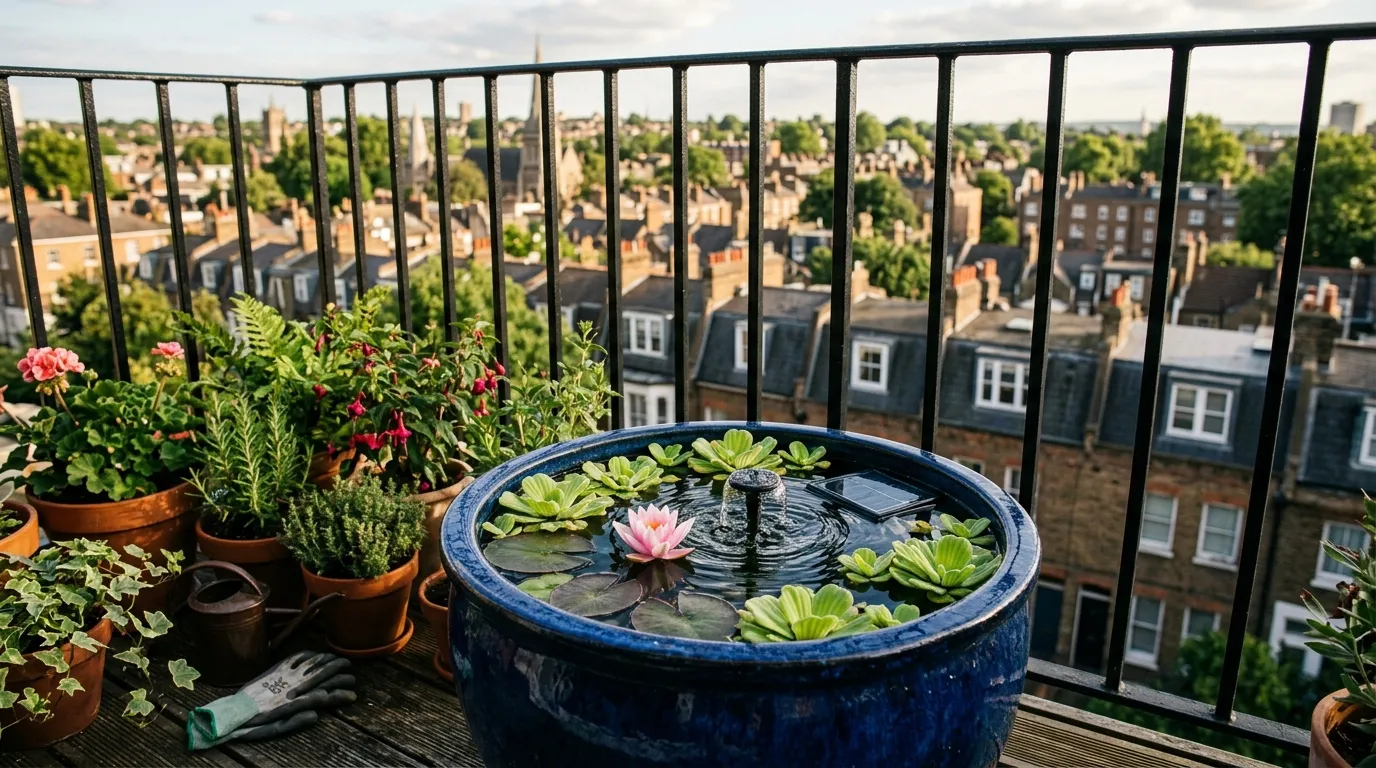 A lightweight resin container pond on a balcony. The solar fountain runs only in direct sunlight, adding gentle movement and sound.
Weight considerations for balconies. A 50-litre barrel weighs approximately 55kg when filled with water, gravel, and plants. A 100-litre zinc bath weighs 110kg. Check your balcony’s load rating before committing to a large container. Most modern balconies support 250-350kg per square metre, but older concrete balconies may have lower limits.
How do you maintain a container pond through the year?
Container ponds need very little attention. Ten minutes per week in summer and almost nothing in winter.
Spring (March to May). Remove any dead plant material that accumulated over winter. Divide overgrown marginals and replant into fresh aquatic compost. Feed waterlilies with a specialist aquatic fertiliser tablet pushed into the soil. Top up water levels with rainwater. Expect green water in April as algae blooms before plants grow strongly. This clears naturally within 3-4 weeks.
Summer (June to August). Top up water 2-3 times per week during hot spells. Remove blanket weed by twisting it around a stick, then leave it on the side overnight so invertebrates can crawl back. Deadhead waterlily flowers as they fade. If water drops below 15cm depth, marginal plants suffer.
Autumn (September to November). Net the surface to catch falling leaves or remove them daily. Decomposing leaves release nutrients that cause algae blooms the following spring. Cut back dead marginal foliage to 5cm above the water line. Stop feeding waterlilies.
Winter (December to February). The biggest risk is the container freezing solid, which kills plant roots and any overwintering invertebrates. Move small pots (under 30 litres) into an unheated shed or garage. For larger containers, float a tennis ball or piece of polystyrene on the surface. This absorbs the expansion pressure of ice and prevents the container cracking. Never smash ice on a container pond, as the shockwave damages plants and wildlife underneath.
Is a container pond safe around children?
Any water feature requires supervision around young children. A child can drown in as little as 5cm of water. Container ponds are safer than ground-level ponds because they are raised and harder for toddlers to fall into, but they are not risk-proof.
For families with children under five, place the container at adult waist height on a sturdy table or raised platform. Alternatively, fit a rigid mesh grille just below the water surface. This allows plants to grow through while preventing a child from submerging their face. Galvanised mesh cut to size costs three to five pounds from any hardware shop.
The RHS water safety advice recommends fencing off any open water in gardens with young children. A container pond with a mesh cover is a practical compromise that preserves the wildlife and planting benefits.
How do you stop mosquitoes breeding in a container pond?
Mosquito larvae need still, undisturbed water with no predators. A well-managed container pond does not provide those conditions.
Add a solar fountain. A small solar-powered pump costs eight to twelve pounds and creates enough surface disturbance to prevent egg-laying. It runs only in sunlight, which is exactly when mosquitoes are least active, but the ripple effect lasts into dusk.
Stock with predators. Backswimmers, water boatmen, and water beetles eat mosquito larvae. These arrive naturally within days of filling the pond. Frogs and dragonfly larvae also consume larvae in large numbers.
Keep plants healthy. Dense plant cover shades the water and limits the open surface area where mosquitoes lay eggs. Hornwort grows just below the surface and physically blocks egg-laying.
Avoid stagnation. Remove fallen leaves, top up regularly, and ensure the water does not become nutrient-rich sludge. A healthy container pond with 3-5 plant species and natural predators has no mosquito problem.
Frequently asked questions
What is the best container for a pond?
A half oak barrel is the best all-round container pond. It holds 50-80 litres, is deep enough for a miniature waterlily at 35-40cm, and looks natural in any garden setting. Galvanised troughs and Belfast sinks also work well. Avoid terracotta unless it is glazed inside, as unglazed clay absorbs water and cracks in frost.
Do container ponds attract mosquitoes?
Not if you keep the water moving or stocked with the right plants. Mosquito larvae need still, stagnant water with no predators. Adding a small solar fountain or stocking the pond with backswimmers and water boatmen controls larvae naturally. Frogs and newts eat mosquito larvae too. A well-planted container pond is not a mosquito risk.
Can I keep fish in a container pond?
No, container ponds are too small for fish. Even a large barrel holds only 50-80 litres, which is far below the minimum 200 litres per goldfish. Fish produce ammonia that overwhelms small volumes and kills plants. Container ponds work best as plant-and-wildlife features without fish.
How deep does a container pond need to be?
At least 30cm deep for a basic plant pond, 40cm for a miniature waterlily. Deeper containers maintain more stable temperatures in summer heat and resist freezing solid in winter. Half barrels at 35-40cm depth are ideal. Shallow containers under 20cm overheat in summer and freeze too fast in winter.
Do I need a pump for a container pond?
No, container ponds work without any pump or filter. Submerged oxygenating plants like hornwort and water starwort keep the water clear naturally. A solar-powered mini fountain adds gentle movement and sound for under ten pounds, but it is optional. Let the plants do the filtration work.
Where should I put a container pond?
Position it where it gets 4-6 hours of sunlight per day. Waterlilies and most marginal plants need direct sun to flower. Full south-facing positions overheat in summer unless the container is large (60 litres plus). Part shade from a wall or fence during afternoon is ideal in southern England.
Can I have a container pond on a balcony?
Yes, container ponds work on balconies, roof terraces, and patios. Check that your balcony can support the weight: a 50-litre barrel weighs approximately 55kg when filled. Use a lightweight resin or fibreglass container if weight is a concern. Position near a railing for sunlight access and shelter from wind.
Lawrie has been gardening in the West Midlands for over 30 years. He grows his own veg using no-dig methods, keeps a wildlife-friendly garden, and writes practical advice based on real UK growing conditions.