Courtyard Garden Ideas for the UK
Courtyard garden ideas for enclosed UK spaces. Flooring, lighting, shade planting, water features, wall colours, and budget plans for walled gardens.
Key takeaways
- White or pale walls increase reflected light by up to 70% in enclosed courtyards
- Porcelain paving (£30-£60 per sq m) resists frost, moss, and shade staining
- Mirrors on courtyard walls double perceived depth in spaces under 4m wide
- Self-contained water features start at £80 and need no plumbing or drainage
- Shade-tolerant ferns, hostas, and fatsia thrive where sunlight reaches just 2-3 hours daily
- LED uplights at 2700K turn a courtyard into a usable evening space year-round
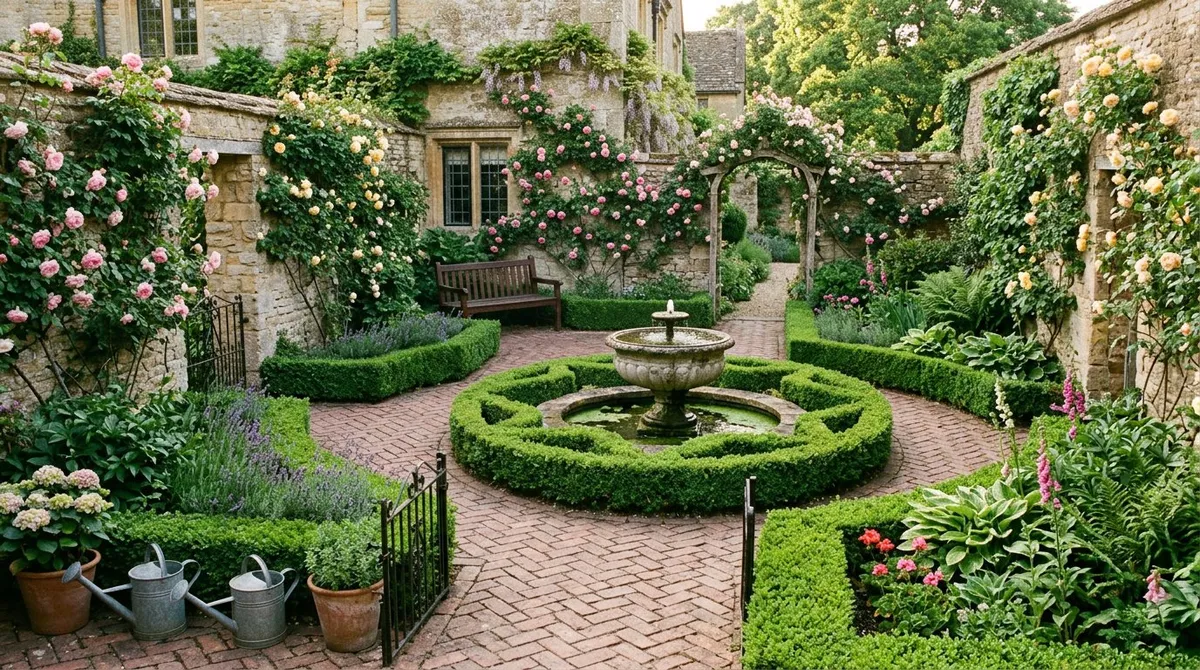
A courtyard garden is one of the most rewarding spaces to design. Enclosed by walls on three or four sides, it creates a private, sheltered room that feels separate from the rest of the house and garden. The walls block wind, trap warmth, and provide surfaces for climbing plants, mirrors, and lighting.
The challenge is light. Most UK courtyards receive direct sun for only 2-4 hours per day. Walls cast long shadows, especially in winter. Ground moisture lingers. Moss colonises shady paving. But these conditions suit many beautiful plants, and the design techniques for maximising light in a courtyard are well established. This guide covers flooring, wall treatments, shade planting, water features, furniture, lighting, and budget breakdowns for UK courtyard gardens of all sizes.
Assessing your courtyard
Before buying materials or plants, spend a week watching how your courtyard behaves. Note the following:
Sun path: track where direct sunlight falls at 9am, noon, and 3pm. In summer, a south-facing courtyard may get 4-6 hours of sun. In winter, it may get none. This dictates plant choice and where to place seating.
Wind patterns: courtyards are sheltered but can channel wind through doorways and gaps between buildings. A sudden gust through a narrow passage is stronger than open-garden wind.
Drainage: check where rainwater goes. Courtyards surrounded by buildings collect runoff from multiple roof slopes. Standing water after rain indicates poor drainage that needs addressing before you lay new flooring.
Existing surfaces: assess the condition of walls and floors. Crumbling mortar, rising damp, and unstable paving all need fixing before decorative work starts.
Flooring options for courtyard gardens
The floor is the largest single surface in a courtyard. It sets the tone for everything else.
Flooring comparison
| Material | Cost per sq m | Frost-proof | Moss resistance | Maintenance | Best for |
|---|---|---|---|---|---|
| Porcelain paving | £30-£60 | Excellent | Excellent | Annual wash | All-round best |
| Natural stone (sandstone) | £40-£80 | Good | Low (sealing needed) | Annual seal + wash | Traditional look |
| Natural stone (slate) | £35-£70 | Good | Medium | Annual wash | Contemporary |
| Limestone | £50-£90 | Good (avoid light frosts) | Low | Annual seal | Formal courtyards |
| Gravel (10-20mm) | £3-£8 | N/A | N/A | Top up yearly | Budget, informal |
| Brick pavers | £30-£50 | Good | Medium | Pressure wash | Period properties |
| Decking (composite) | £40-£80 | Good | Medium | Annual clean | Raised areas |
Porcelain paving
Porcelain is the best all-round choice for courtyard flooring. It absorbs almost no water (under 0.5%), which means no frost damage, no moss growth, and no staining in shady conditions. It comes in finishes that replicate natural stone, concrete, and wood at a fraction of the maintenance.
Lay porcelain on a full mortar bed over compacted sub-base. Use a priming slurry on the back of each slab before fixing, as the low porosity means adhesive does not grip without it. Budget £30-£60 per square metre for materials. Garden Organic recommends permeable surfaces where possible to reduce water runoff.
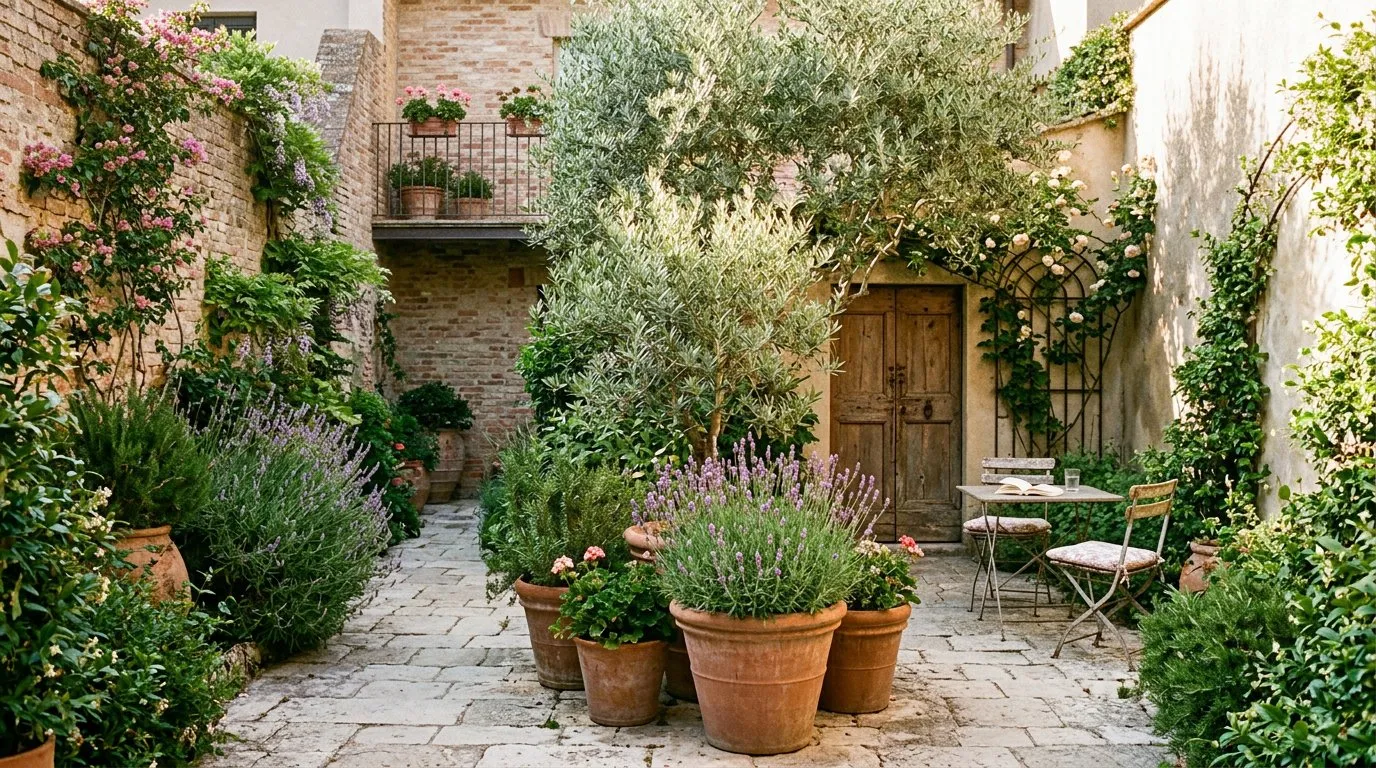
Mediterranean-style courtyard with pale stone paving and terracotta pots of olive trees and lavender
Natural stone
Sandstone and slate suit period and traditional courtyards. Sandstone is warm-toned and beautiful but porous. In a shady courtyard, unsealed sandstone turns green with algae within 12-18 months. Seal it annually with a breathable stone sealer (£15-£25 per 5 litres covers 20 square metres).
Gravel
The cheapest option. Self-draining, easy to lay, and available in dozens of colours. A 50mm layer of 10-20mm angular gravel costs £3-£8 per square metre. Lay over compacted hardcore with a weed membrane underneath.
Gravel works best for the planted areas of a courtyard. For dining areas and main paths, use paving instead. Walking and dragging furniture across gravel is uncomfortable.
Gardener’s tip: Use a single flooring material throughout a small courtyard. Mixing paving and gravel in a 3m x 4m space creates visual clutter. One material, edge to edge, makes the space feel larger and calmer.
Wall treatments to maximise light
Walls define a courtyard’s character and light level. The colour, texture, and treatment of those walls has more impact than any other single design decision.
Painting courtyard walls
White or pale cream reflects up to 70% of available light. In a courtyard that receives only 2-3 hours of direct sun, this makes a visible difference to plant growth and how bright the space feels.
Recommended masonry paints:
- Farrow and Ball ‘All White’ (exterior masonry) for a warm, chalky white
- Dulux Weathershield ‘Jasmine White’ for a budget-friendly option at £25 per 5 litres
- Sandtex ‘Pure Brilliant White’ for the highest light reflection
Dark feature walls work on one wall only. Paint the darkest or most distant wall in charcoal, deep green, or navy. Plant light-coloured foliage (silver birch, white foxgloves, pale ferns) against it for contrast. The dark background makes plants stand out dramatically.
Using mirrors
A large outdoor mirror on the darkest wall doubles the perceived depth of the courtyard. Use a mirror at least 60cm x 90cm for meaningful impact. Larger is better.
Important: use a mirror rated for outdoor use (acrylic or polycarbonate, not glass, which is heavy and dangerous if it falls). Fix it securely to the wall with mirror adhesive plus mechanical fixings. Frame it with climbing plants to make it look like a window into another garden rather than an obvious mirror.
Climbers on courtyard walls
Every courtyard wall is growing space. Climbers add greenery, soften hard surfaces, and provide wildlife habitat. For a detailed guide, see our article on vertical gardening ideas.
Best courtyard wall climbers:
- Climbing hydrangea for shady walls. Self-clinging, white lace-cap flowers in summer, no support needed.
- Star jasmine for south or west-facing walls. Evergreen, scented, grows to 4-6m on wires.
- Ivy for any aspect. Fast, evergreen, self-clinging. Choose variegated forms like ‘Goldchild’ for brightness.
- Trachelospermum asiaticum for a compact alternative to star jasmine. Smaller leaves, same evergreen habit.
See our full list of the best climbing plants for UK gardens for variety recommendations by aspect.
Planting for shade and shelter
Most courtyard positions receive limited direct sun. This is not a problem. Some of the most beautiful garden plants thrive in exactly these conditions.
Shade-tolerant structural plants
These form the backbone of a courtyard planting scheme. They provide year-round form and foliage.
- Fatsia japonica has bold, glossy leaves that reflect light. Evergreen, architectural, reaches 2-3m. The single best structural plant for a shady courtyard.
- Japanese maple (Acer palmatum) gives elegant form and spectacular autumn colour. Grows 2-3m in a large pot. Sheltered courtyards protect the delicate leaves from wind damage.
- Tree ferns (Dicksonia antarctica) bring drama to any courtyard. The 1-2m trunk topped with unfurling fronds creates a tropical feel. Hardy to minus 5C with crown protection in winter.
- Box (Buxus sempervirens) clips into balls, cubes, or hedges. Tolerates deep shade. Evergreen. Use for formal structure in containers.
Shade-tolerant flowering plants
- Foxgloves (Digitalis) produce tall spires of flowers in shade. Biennial, so sow fresh seed each year for continuity. Self-seeds freely once established.
- Astilbe gives feathery plumes of pink, red, or white flowers from June to August. Needs moist soil. Perfect for the damper conditions of a shaded courtyard.
- Brunnera produces clouds of tiny blue forget-me-not flowers in April and May. The heart-shaped leaves (silver-variegated in ‘Jack Frost’) look good all season.
- Hellebores flower from January to March when almost nothing else does. Evergreen foliage. Choose Helleborus x hybridus for the widest colour range.
The RHS shade planting guide has additional species recommendations. For the full range of options, see our guide to the best plants for shade.
Courtyard planting plan (3m x 4m)
| Position | Plant | Height | Purpose |
|---|---|---|---|
| Back wall (shady) | Climbing hydrangea | 3-4m | Wall coverage, flowers |
| Back corner | Fatsia japonica | 2-3m | Structure, evergreen |
| Side wall | Star jasmine (if sunny) or ivy | 3-6m | Screening, scent |
| Centre pot | Japanese maple | 2-3m | Focal point, autumn colour |
| Floor pots (x4) | Hostas, heuchera, ferns | 30-60cm | Foliage texture, colour |
| Railing or wall pots | Trailing ivy, cyclamen | 20-40cm trailing | Softening edges, seasonal |
Water features in courtyard gardens
Water adds sound, movement, and reflected light to a courtyard. Even a small feature turns the atmosphere of an enclosed space. The sound of trickling water masks traffic noise and makes the courtyard feel more secluded.
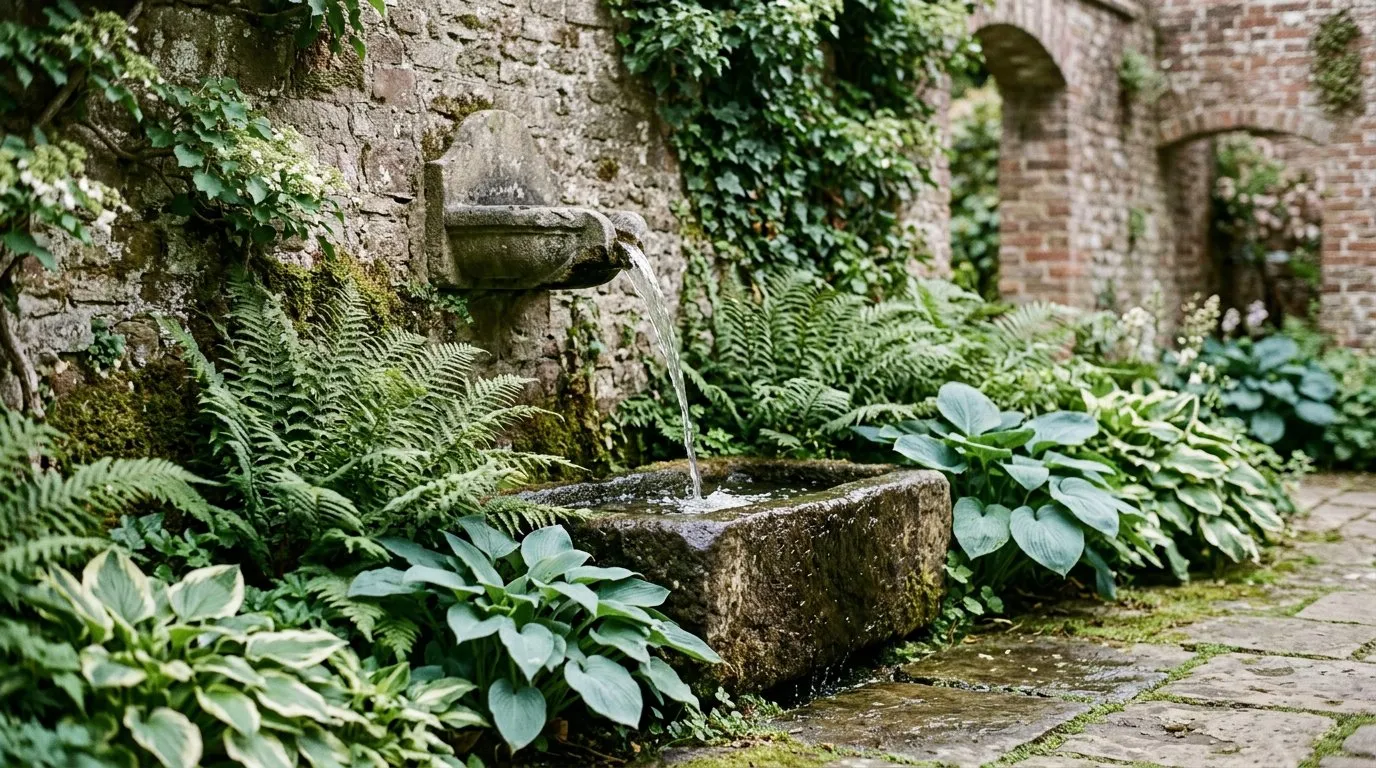
Wall-mounted water feature spilling into a stone trough, surrounded by ferns and hostas
Self-contained features
These need no plumbing or drainage. A submersible pump circulates water from a hidden reservoir. Plug into an outdoor socket or use a solar-powered pump.
Types:
- Wall-mounted spouts: a lion’s head, modern blade, or simple copper spout fixed to a wall, pouring into a basin below. Takes 30cm x 30cm of wall space. £80-£250.
- Bubbling spheres: a drilled stone or ceramic sphere with water rising from the centre. Sits on a gravel-covered reservoir. £100-£400. Safe for households with children because there is no open water.
- Bowl features: a large ceramic or stone bowl with a small fountain. 60-80cm diameter. £60-£200. Plant with miniature waterlilies or floating plants for added interest.
Running costs
A small submersible pump (600-1000 litres per hour) uses 10-15 watts. Running costs are £5-£10 per year on mains electricity. Solar-powered pumps cost nothing to run but only operate in daylight.
Gardener’s tip: Position a water feature where it catches any available sunlight. The light reflecting off moving water bounces onto surrounding walls and plants, bringing extra brightness to the darkest part of the courtyard.
Why we recommend fatsia japonica as the anchor plant for shaded courtyards: After 30 years of specifying plants for enclosed urban spaces, fatsia japonica consistently outperforms every alternative in deep shade. In a north-facing courtyard receiving under two hours of direct sun, a single established fatsia reached 2.5m with glossy leaves 40cm across, reflecting available light back into the space more effectively than any painted surface at ground level.
Container gardening in courtyards
Containers offer more flexibility than planting beds in a courtyard. You can move them with the seasons, replace tired displays, and control soil conditions for each plant. Most patio gardening principles apply equally to courtyards. For a broader overview of urban growing techniques, see our guide to city garden ideas.
Container sizing guide
| Plant type | Minimum pot size | Material | Notes |
|---|---|---|---|
| Small tree (maple, olive) | 50-60cm diameter | Terracotta or fibreglass | Heavy base prevents tipping |
| Shrub (box, fatsia) | 40-50cm | Any | Repot every 3-4 years |
| Perennial (hosta, heuchera) | 30-40cm | Any | Divide every 2-3 years |
| Herbs | 20-30cm | Terracotta (best drainage) | Group in a cluster |
| Seasonal bedding | 25-35cm | Plastic inner, decorative outer | Swap inner pot each season |
Arrange pots in odd-numbered groups (3s and 5s) at varying heights. This creates a natural, layered look. Use pot feet (2cm) under every container to improve drainage and prevent staining on the paving beneath.
Year-round container displays
A courtyard visible from the house needs to look good in every season. Plan a rotation of seasonal colour around permanent structural plants.
Permanent (year-round): Japanese maple, box balls, fatsia, tree fern, evergreen ferns. Spring: tulips, daffodils, primroses, wallflowers. Summer: hostas, astilbe, trailing fuchsia, begonias (for shade). Autumn: cyclamen, ornamental grasses, heathers. Winter: hellebores, snowdrops, winter-flowering violas, skimmia.
Lighting a courtyard garden
Lighting turns a courtyard from a daytime space into an all-evening room. The enclosed walls make lighting particularly effective because light bounces between surfaces.
Lighting types and placement
| Type | Best position | Effect | Cost |
|---|---|---|---|
| LED uplights (2700K) | Base of feature plants or walls | Drama, depth, shadows | £15-£30 each |
| Festoon lights | Strung wall to wall at 2.5m | Atmosphere, warmth | £15-£40 per string |
| Wall wash lights | Mounted at 2m on walls | Even background glow | £20-£50 each |
| Candles and lanterns | Table, shelves, floor | Intimacy, movement | £5-£30 |
| Solar path lights | Edges of paving | Subtle navigation | £10-£25 for 4 |
Two uplights and one string of festoons is enough to change a small courtyard. Place an uplight at the base of your best plant (the Japanese maple or the tree fern) and angle it upward into the canopy. The shadows on the walls create depth. String festoon lights from wall to wall at 2.5m height with warm white (2700K) bulbs.
Gardener’s tip: Never use cool white (4000K+) lights in a courtyard. They make the space feel clinical and harsh. Warm white (2700K) mimics candlelight and makes brick, stone, and foliage look rich and inviting.
Furniture for small courtyard gardens
Choose furniture that fits the scale of the space. A full-size dining table and six chairs overwhelms a 3m x 4m courtyard. Scale down.
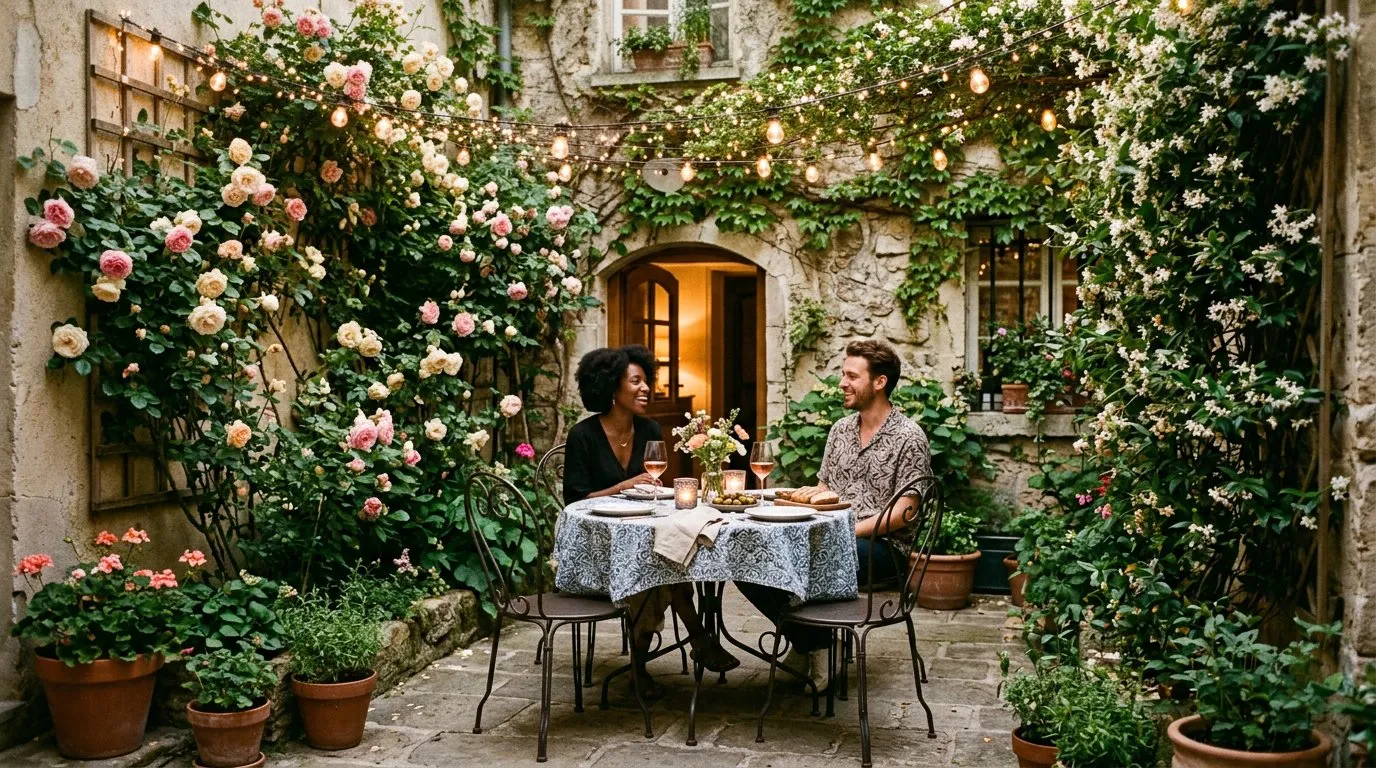
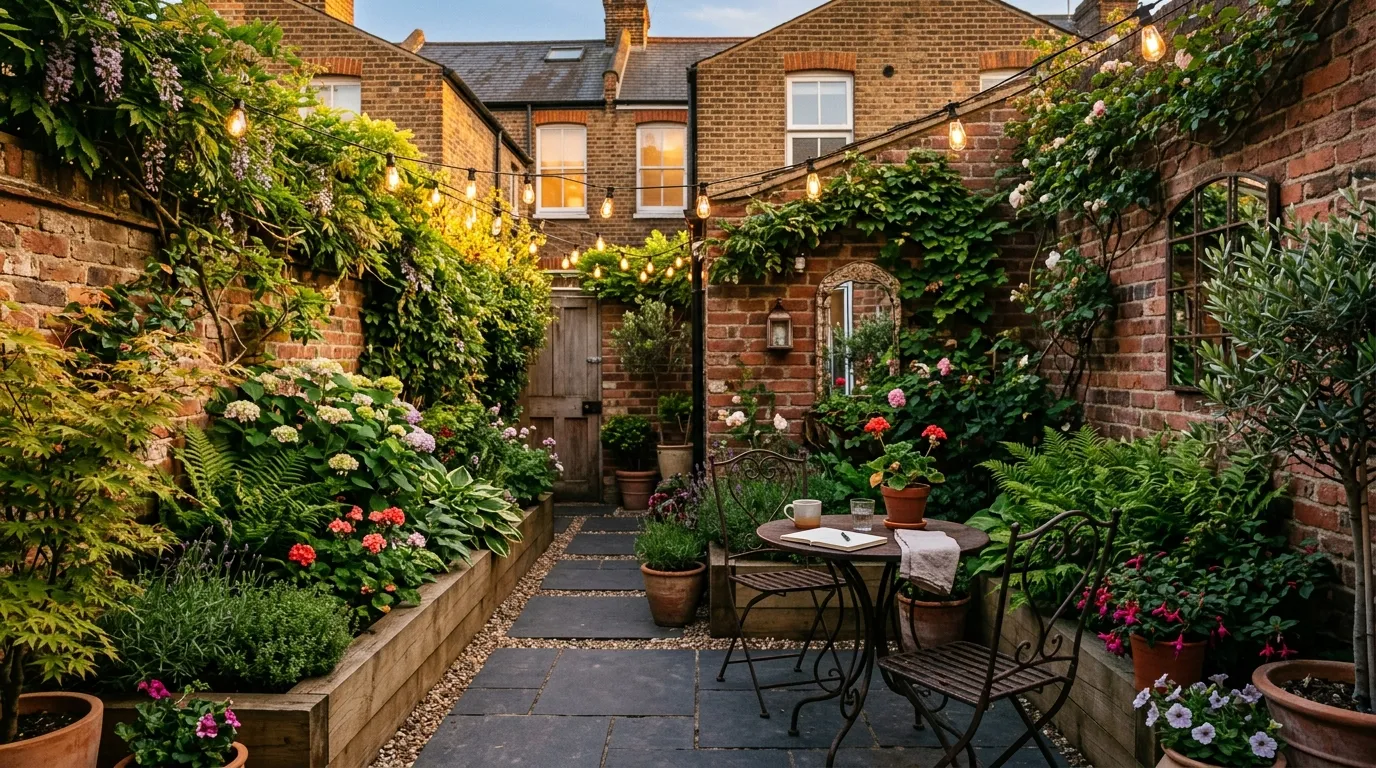
Small courtyard dining area with bistro table and chairs, climbing roses and jasmine on the walls, fairy lights overhead
Bistro sets (a small round table and two chairs) take up about 1m x 1m. They fold flat for storage when the courtyard is used for other purposes. Cast aluminium sets are lightweight, weatherproof, and cost £80-£200.
Built-in bench seating along one wall saves floor space and doubles as a storage box underneath. A 2m bench provides seating for three without any loose furniture to move around.
Wall-mounted fold-down tables hinge flat against the wall when not in use. They provide a surface for drinks or dining without permanent floor occupation. Cost is £40-£100.
For garden room ideas that extend indoor living into a courtyard, see our dedicated guide.
Budget breakdown for courtyard garden projects
| Level | Flooring | Walls | Planting | Water feature | Lighting | Furniture | Total |
|---|---|---|---|---|---|---|---|
| Budget | Gravel (£50-£100) | Paint (£30-£60) | £50-£100 | None | Solar (£20) | Existing | £150-£280 |
| Mid-range | Porcelain (£400-£800) | Paint + mirror (£100-£200) | £150-£300 | Self-contained (£100-£250) | LED (£60-£120) | Bistro set (£100-£200) | £910-£1,870 |
| High-end | Natural stone (£600-£1,200) | Render + paint (£300-£600) | £300-£600 | Bespoke (£500-£1,000) | Professional (£200-£500) | Built-in (£300-£600) | £2,200-£4,500 |
Costs based on a 3m x 4m (12 square metre) courtyard. Professional design and labour adds £1,000-£3,000 depending on scope.
Common mistakes with courtyard gardens
1. Using dark flooring in a shaded space
Dark paving absorbs the limited light in a courtyard and makes the space feel smaller and gloomier. Choose pale porcelain, buff sandstone, or light gravel. Save dark materials for accents and wall features where they add contrast rather than absorbing light.
2. Planting sun-loving species
A courtyard that gets 2-3 hours of sun per day will not support lavender, roses, or Mediterranean herbs. They will stretch towards the light, flower poorly, and look unhappy. Choose shade-tolerant plants and accept the beauty of ferns, hostas, and evergreen foliage rather than fighting the conditions.
3. Overcrowding the floor
A 3m x 4m courtyard with a table, four chairs, six large pots, and a water feature has no breathing room. Leave at least 40% of the floor area clear. The empty space is what makes the planted areas look generous rather than cramped. Consider ideas from garden design on every budget for maximising impact with fewer items.
4. Ignoring drainage
Enclosed courtyards collect rainwater from every surrounding roof and wall. Without proper drainage, water pools against foundations and causes damp problems inside the house. All hard surfaces need a 1:80 fall (12mm per metre) towards a drain, channel, or soakaway. Install drainage before laying any flooring.
5. Skipping winter planning
A courtyard visible from the kitchen or living room window needs to look good 12 months a year. A summer-only planting scheme leaves five months of bare pots and brown stems. Include at least 50% evergreen planting and add winter-flowering plants like hellebores, cyclamen, and skimmia for December to March interest.
Now you’ve mastered courtyard garden design, read our guide on the best plants for shade to build a planting scheme that thrives in your enclosed space.
Frequently asked questions
What plants grow best in a shaded courtyard?
Ferns, hostas, fatsia, and climbing hydrangea thrive in shade. Heuchera provides year-round coloured foliage in purple, bronze, lime, and silver. Japanese acers tolerate dappled light. For flowers, foxgloves, astilbe, and brunnera bloom reliably with just 2-3 hours of direct sun per day.
How do I make a small courtyard feel bigger?
Paint walls white or pale cream to reflect available light. Use a single flooring material from edge to edge. Place a mirror on the darkest wall to double the perceived depth. Keep furniture low-profile and choose foldable or stackable pieces. Clear 40% of the floor area for visual breathing room.
What is the best flooring for a courtyard garden?
Porcelain paving is the best all-round choice for UK courtyards. It resists frost, does not stain or grow moss in shade, and cleans with a pressure washer or soapy water. Budget £30-£60 per square metre for materials. Natural stone looks beautiful but needs annual sealing in shady conditions. Gravel is cheapest at £3-£8 per square metre.
Can I have a water feature in a small courtyard?
Yes, self-contained features need no plumbing or drainage pipe. A wall-mounted spout, bubbling sphere, or bowl feature adds sound and movement in under 1 square metre. Costs start at £80. Use a mains-powered submersible pump (running cost £5-£10 per year) or a solar pump for zero running cost.
How do I light a courtyard garden?
Use warm white LED uplights (2700K) at the base of feature plants or walls to create depth. String festoon lights wall to wall at 2.5m height for atmosphere. Add candles or lanterns on tables. Two uplights and one festoon string is enough for most small courtyards. Avoid floodlights entirely.
What colour should I paint courtyard walls?
White or pale cream reflects the most light. This is critical in shaded courtyards where direct sun is limited. Farrow and Ball ‘All White’ and Dulux ‘Jasmine White’ are reliable choices. Use one dark feature wall (charcoal, deep green, or navy) as a backdrop for pale foliage, but paint the remaining walls pale.
How much does it cost to design a courtyard garden?
A budget DIY makeover costs £150-£280 for gravel, paint, and a few containers. A mid-range courtyard with porcelain paving, water feature, and lighting runs £900-£1,900. Professional design and installation for a high-end courtyard costs £2,200-£4,500. All figures based on a standard 3m x 4m space.
Do courtyard gardens need drainage?
Yes, enclosed courtyards collect runoff from surrounding walls and roofs. All hard paving needs a fall of 1:80 (12mm per metre) towards a drain or soakaway. Without proper drainage, water pools against foundations and causes damp inside the house. A linear channel drain costs £50-£100 and handles most courtyard drainage needs.
Lawrie has been gardening in the West Midlands for over 30 years. He grows his own veg using no-dig methods, keeps a wildlife-friendly garden, and writes practical advice based on real UK growing conditions.