How to Create a Dog-Friendly Garden
Dog-friendly garden ideas for UK homes. Covers safe plants, zoning, fencing, surfaces, lawn care, and budget breakdowns for pet-safe outdoor spaces.
Key takeaways
- Fencing must be 1.8m minimum with no gaps at ground level to keep dogs secure
- Over 50 common UK garden plants are toxic to dogs, including foxgloves, lilies, and yew
- Zone the garden into play, toilet, planting, and rest areas to reduce lawn damage
- Avoid cocoa shell mulch, sharp gravel, and dark paving that overheats in summer
- Raised beds at 45cm or higher protect planting from digging and trampling
- A basic dog-friendly garden conversion costs two hundred to five hundred pounds
Twelve million dogs live in UK homes, and most of them spend hours in the garden every day. Yet the typical UK garden is full of hazards: toxic plants, unsecured boundaries, sharp surfaces, and deep water features. A dog-friendly garden is not about stripping out everything interesting. It is about smart choices that work for dogs and gardeners alike.
This guide covers practical changes you can make to any UK garden, from a simple boundary fix costing under fifty pounds to a full zoned redesign. The RSPCA has additional guidance on garden safety for dogs.
How to zone a dog-friendly garden
Zoning is the most important principle in dog-friendly garden design. Without clear zones, dogs run through borders, dig up beds, trample seedlings, and turn the whole lawn into a mud bath. Dividing the space into four distinct areas solves most problems.
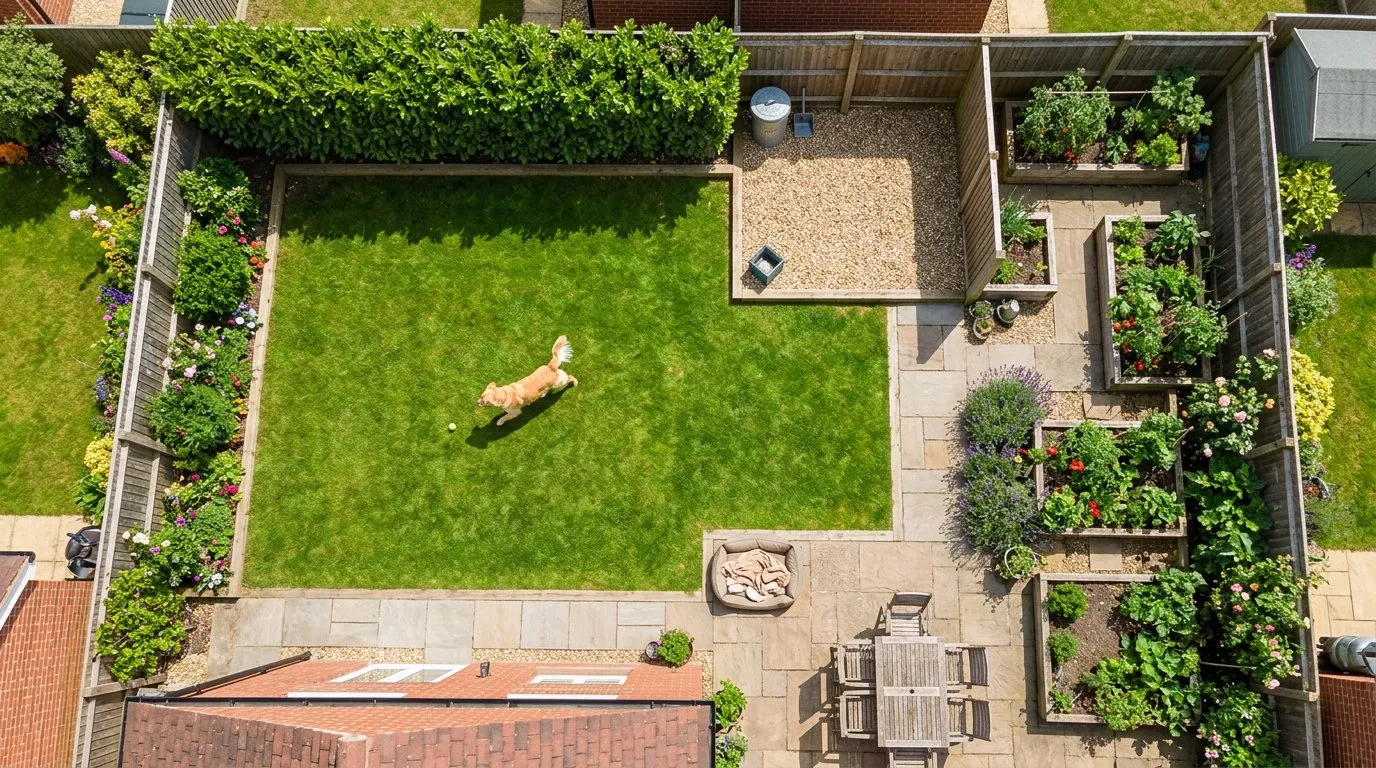 Zone your garden into play, toilet, planting and rest areas for a dog-friendly layout.
The four zones:
Zone your garden into play, toilet, planting and rest areas for a dog-friendly layout.
The four zones:
- Play zone — the largest open area, typically the lawn or a section of artificial grass. Keep this clear of obstacles and fragile plants.
- Toilet zone — a designated corner with bark chip or pea gravel over a membrane. Position away from seating areas and downwind of prevailing breezes.
- Planting zone — raised beds, borders behind low fencing, or elevated planters that dogs cannot reach. See our guide to pet-safe garden plants for varieties that will not harm your dog.
- Rest zone — a shaded spot with a waterproof dog bed or raised platform. Dogs need shelter from sun and rain. A pergola, tree canopy, or covered area works well.
Even in a small garden, you can create basic zones. A 4m x 6m plot fits a small play lawn, a 1m x 1m bark chip toilet corner, a single raised bed, and a sheltered rest spot against the house wall.
Dog-proof fencing and boundaries
Secure fencing is non-negotiable. A dog that escapes the garden is at risk from traffic, other animals, and getting lost. The Kennel Club recommends checking boundaries before letting any dog into the garden unsupervised.
Fence height by breed size
| Breed size | Examples | Minimum fence height | Notes |
|---|---|---|---|
| Small (under 10kg) | Jack Russell, Dachshund, Shih Tzu | 1.2m | Check for gaps at ground level |
| Medium (10-25kg) | Cocker Spaniel, Beagle, Border Collie | 1.5m | Border Collies can jump higher than most |
| Large (25-40kg) | Labrador, Golden Retriever, Boxer | 1.8m | Standard UK fence panel height |
| Extra large / athletic | German Shepherd, Husky, Weimaraner | 2.0m | Consider angled toppers or rollers |
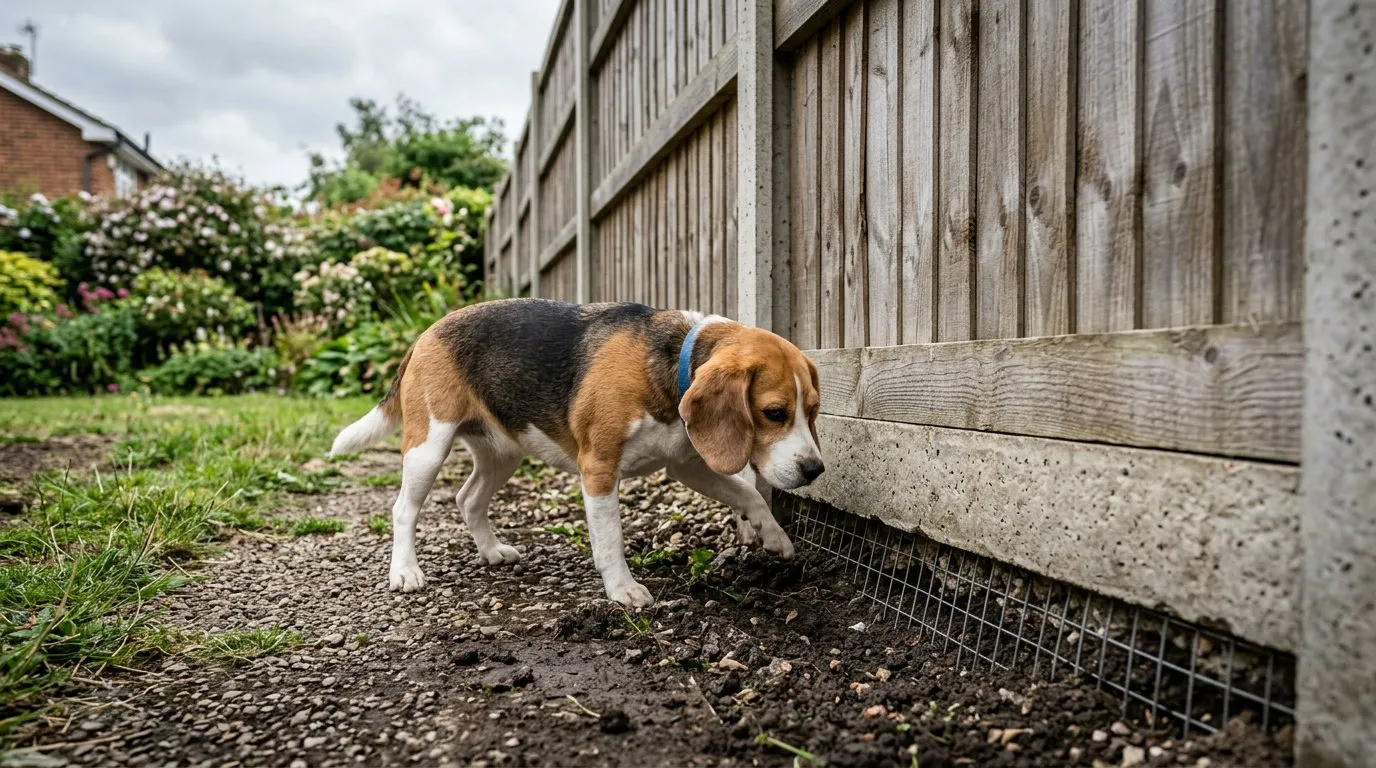 A 1.8m close-board fence with gravel board and buried mesh prevents climbing and digging escapes.
A standard 1.8m close-board fence suits most households. This is the most common panel height in UK gardens and needs no planning permission in rear gardens. For more boundary options, see our guide to garden fence ideas.
A 1.8m close-board fence with gravel board and buried mesh prevents climbing and digging escapes.
A standard 1.8m close-board fence suits most households. This is the most common panel height in UK gardens and needs no planning permission in rear gardens. For more boundary options, see our guide to garden fence ideas.
Securing the base
Dogs escape under fences more often than over them. Terriers and Dachshunds are persistent diggers. Fix the base with:
- Gravel boards — 15cm concrete or treated timber boards along the bottom of the fence. These block digging and protect panels from ground rot.
- Buried mesh — galvanised chicken wire or weld mesh buried 30cm deep and bent outwards in an L-shape. Dogs cannot dig through it.
- Concrete strip — a 15cm concrete footing below the fence line. The most permanent solution. Costs around ten to fifteen pounds per metre.
Gates and access points
Side gates are the most common escape route. Use a self-closing gate spring (under ten pounds) and a bolt at the top that dogs cannot nudge open. Check that the gap beneath the gate is smaller than your dog can squeeze through. For small dogs, this means less than 5cm.
Dog-safe vs unsafe garden materials
Not everything in a typical garden is safe for dogs. Some materials are toxic, others cause injuries, and some simply overheat in summer sun.
| Material / Feature | Dog-safe? | Notes |
|---|---|---|
| Bark chip mulch | Yes | Soft, drains well, cheap to replace. Avoid cocoa shell mulch (toxic) |
| Pea gravel (rounded, 10-20mm) | Yes | Drains well, good for toilet zones. Some dogs eat it, so monitor |
| Sharp gravel / limestone chippings | No | Cuts paw pads and gets lodged between toes |
| Composite decking | Yes | Stays cooler than timber, splinter-free, non-slip when wet |
| Dark stone paving | Caution | Absorbs heat and can burn paws above 35 degrees C. Test with your hand |
| Pale sandstone / porcelain | Yes | Stays cooler, lighter colour reflects heat |
| Cocoa shell mulch | No | Contains theobromine, toxic to dogs. Potentially fatal if eaten |
| Treated timber (modern) | Yes | Modern pressure-treated timber uses copper-based preservatives, not arsenic |
| Artificial grass | Yes | Choose perforated backing for drainage. Rinse weekly |
| Deep pond (vertical walls) | No | Drowning risk. Dogs cannot climb vertical pond walls |
| Shallow splash feature | Yes | Dogs can wade and cool down safely |
Hard surfaces that work with dogs
Dogs are harder on garden surfaces than any other factor. They dig, scratch, skid, and track mud. The surface you choose affects how much cleaning, repair, and replacement you face.
Paths and patios
Pale-coloured porcelain or sandstone paving stays coolest in summer. Dark slate and granite absorb heat and can reach temperatures above 50 degrees C on sunny days. Press the back of your hand to the surface for five seconds. If it is too hot for you, it is too hot for paws.
For paths through the garden, consider path ideas that suit heavy foot traffic. Composite decking boards make excellent dog-friendly paths. They resist scratching, do not splinter, and dry quickly after rain. Our guide to building a raised deck covers composite decking options and construction methods.
Why we recommend composite decking for dog paths and seating areas over timber or stone: After designing and building dog-friendly gardens for 30 years, composite is the clearest winner for surfaces dogs use daily. Unlike softwood, it does not splinter as it ages, which matters once a dog starts chewing corners. Unlike dark stone, it does not absorb heat to dangerous levels. On a 10-metre path tested across three summers, a composite surface stayed 18-22°C cooler than adjacent dark porcelain on the hottest days.
The case for artificial grass
Artificial grass is the most practical surface for dedicated dog play areas. It eliminates mud, bare patches, urine burn marks, and the weekly mowing that real lawns demand. Modern artificial turf drains at 60 litres per square metre per hour when laid on a proper sub-base.
Costs: fifteen to thirty pounds per square metre installed. A 20 square metre play area costs three hundred to six hundred pounds. This is more than turf (five to eight pounds per square metre) but the maintenance savings add up quickly.
Downsides: artificial grass gets hotter than real grass in direct sun, loses its look after 8-10 years, and needs weekly rinsing with a pet-safe enzyme cleaner. It is best used for the play zone rather than the entire garden.
Bark chip and wood chip
Bark chip makes an ideal toilet zone surface. It drains well, absorbs odours naturally, and is soft underfoot. Use a non-toxic softwood bark from a garden centre rather than reclaimed wood chip, which may contain treated timber. Lay it 7-10cm deep over a weed membrane. Top up annually. Cost: around five pounds per bag covering roughly one square metre at 7cm depth.
Dog-safe lawn care
Most UK dog owners want real grass. A healthy lawn handles dogs better than a neglected one. The key is choosing the right grass mix and adjusting your maintenance routine.
Choosing a hard-wearing grass seed
Standard ornamental lawn mixes contain fine fescues that cannot tolerate heavy use. A dog-friendly lawn needs perennial ryegrass varieties bred for sports pitches. These recover quickly from wear and fill in bare patches.
Best grass seed mix for dogs: 80% perennial ryegrass, 20% strong creeping red fescue. Sow at 35-50g per square metre. Overseed thin areas every spring and autumn. Our lawn care calendar covers the full seasonal schedule.
Dealing with urine patches
Dog urine contains concentrated nitrogen. In small doses it greens the grass. In repeated doses on the same spot, it burns and kills it. The classic urine patch is a dead brown circle with a ring of lush green growth around the edge.
Fixes:
- Water the spot within 8 hours of urination to dilute the nitrogen
- Train the dog to use a bark chip toilet zone instead of the lawn
- Overseed bare patches with ryegrass in April or September
- Avoid lawn fertiliser near the toilet zone, as it adds more nitrogen to already saturated soil
If your lawn is already damaged, read our guide to dog-proof lawns for a step-by-step recovery plan. For laying a new dog-friendly lawn from scratch, see our guide to laying turf.
Planting that survives dogs
Dogs and planting coexist when you protect the plants and avoid anything toxic. Raised beds, sturdy species, and strategic placement solve most problems.
Raised beds to protect borders
Raised beds at 45cm or taller keep dogs out of planting. Most dogs will not jump into a bed at this height. Use timber sleepers, brick, or galvanised steel. Fill with good-quality topsoil and compost.
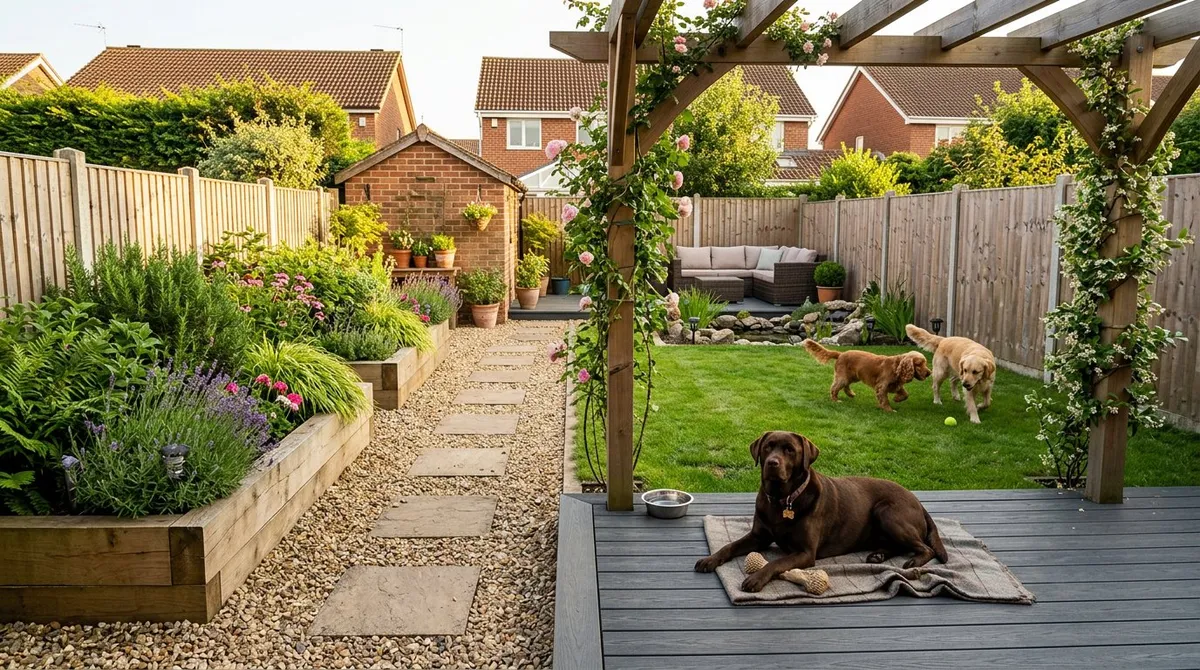
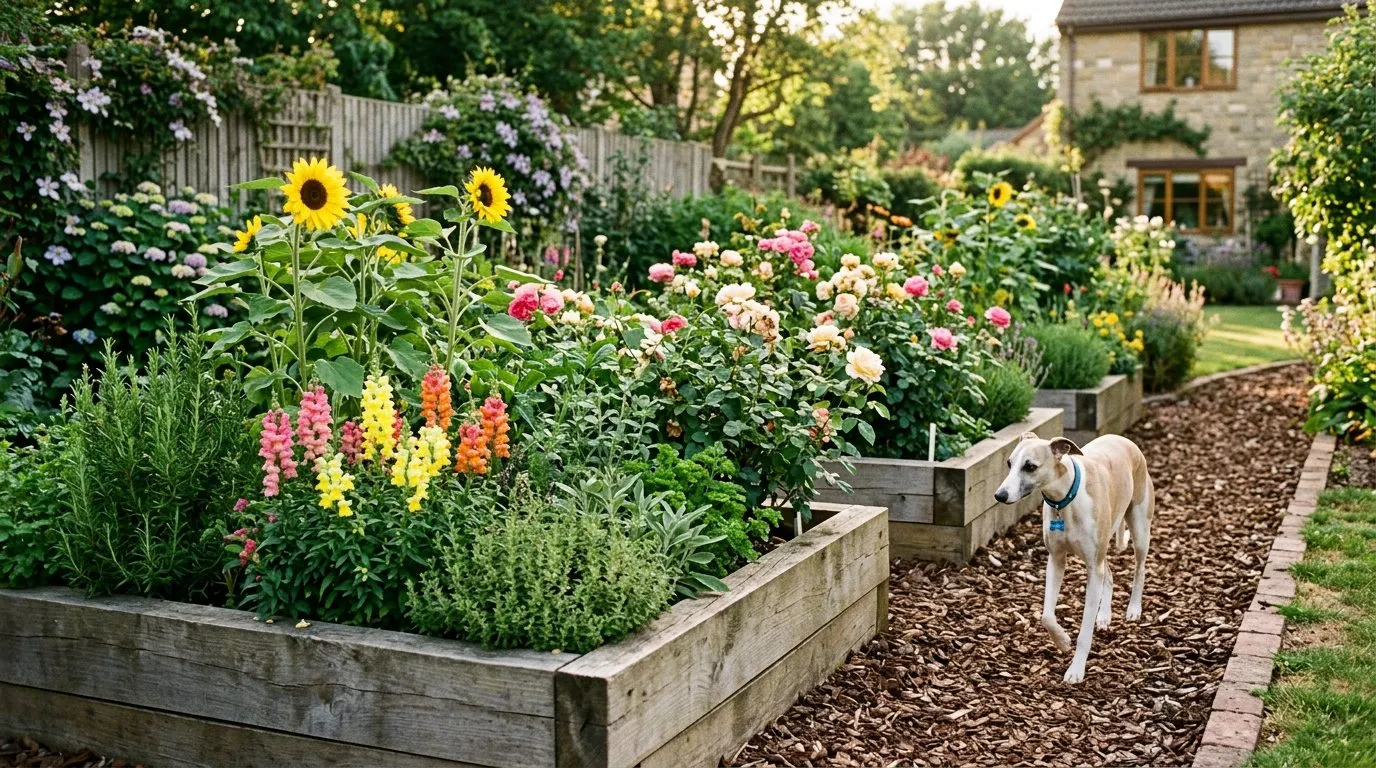 Raised beds protect planting from dogs while bark chip paths are gentle on paws.
Position raised beds around the garden perimeter to protect borders from digging. Leave the central area open for play. In a patio garden, raised beds double as seating edges.
Raised beds protect planting from dogs while bark chip paths are gentle on paws.
Position raised beds around the garden perimeter to protect borders from digging. Leave the central area open for play. In a patio garden, raised beds double as seating edges.
Plants to avoid completely
Over 50 common UK garden plants are toxic to dogs. Some cause mild stomach upset. Others are fatal. Remove these from any garden where dogs have access:
- Foxglove (Digitalis) — causes heart failure. Every part is poisonous.
- Lily (Lilium) — all parts toxic. Pollen alone causes kidney failure in cats and illness in dogs.
- Yew (Taxus) — fatal. Seeds, bark, and leaves are all poisonous.
- Laburnum — seeds are the most dangerous part. Children and dogs are both at risk.
- Azalea / Rhododendron — causes vomiting, diarrhoea, and potentially fatal heart problems.
- Daffodil bulbs — the bulbs contain the highest concentration of toxins. Dogs dig them up.
- Autumn Crocus (Colchicum) — highly toxic. Not to be confused with spring crocus, which is safe.
For a full list of dangerous species, see our guide to plants toxic to dogs. Cat owners should also check our plants toxic to cats guide.
Dog-safe plants that handle rough treatment
Choose tough, non-toxic species that bounce back from being trampled or brushed against:
- Lavender — non-toxic, drought-tolerant, dogs tend to avoid the strong scent
- Rosemary — tough woody shrub, safe for dogs, excellent in raised beds
- Sunflowers — non-toxic, fast-growing, fun for children and dogs
- Ornamental grasses (Miscanthus, Stipa) — flexible stems spring back from contact
- Geranium (Cranesbill, not Pelargonium) — tough ground cover, non-toxic
- Camellia — non-toxic evergreen shrub, sturdy enough for border backs
Water features for dog-friendly gardens
Dogs and water are a natural combination, but deep ponds with vertical sides are a drowning risk. Design water features with dogs in mind.
Safe options:
- Shallow splash pool — a sunken tray or paddling area, 10-15cm deep, with a non-slip base. Dogs can wade and cool down. Drain and refill weekly.
- Bubble fountain — water bubbles up through pebbles. No standing water. Dogs can drink safely.
- Stream or rill — a shallow channel of moving water. Interesting for dogs without the drowning risk.
- Dog drinking station — a self-filling bowl connected to an outdoor tap. Keeps water fresh.
Avoid: deep ponds with vertical walls, uncovered water butts, steep-sided wildlife ponds. If you have an existing pond, add a ramp or beach-style gradual exit so dogs can climb out.
Shade, shelter, and rest areas
Dogs overheat faster than humans. Brachycephalic breeds (Bulldogs, Pugs, French Bulldogs) are especially vulnerable. Every dog-friendly garden needs shaded rest spots.
Shade options:
- Tree canopy — native trees like birch, rowan, or crab apple provide dappled shade without blocking all light. Position south of the rest area.
- Pergola with climbers — a covered structure with wisteria, grape vine, or climbing hydrangea. Provides dense shade in summer and lets light through in winter.
- Sail shade or canopy — a fabric shade sail costs thirty to eighty pounds. Quick to install, effective immediately. Garden lighting beneath a pergola extends the usable hours into the evening.
- Covered kennel area — a waterproof roof over the dog’s outdoor bed. Keep the bed raised off the ground to prevent damp.
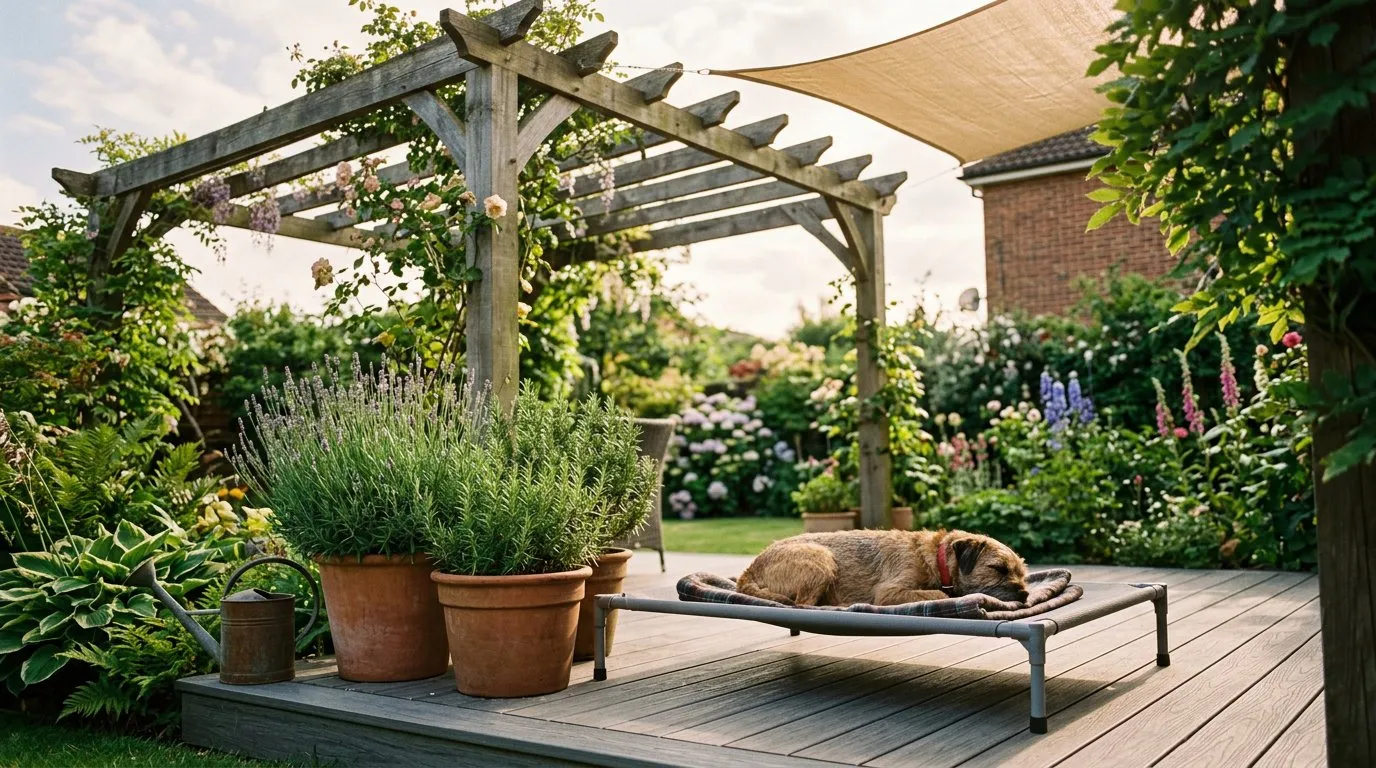 A shaded rest area with raised decking and pergola keeps dogs cool on hot summer days.
Place rest areas on cool surfaces, not south-facing dark paving. A raised wooden platform or composite deck stays more comfortable than stone.
A shaded rest area with raised decking and pergola keeps dogs cool on hot summer days.
Place rest areas on cool surfaces, not south-facing dark paving. A raised wooden platform or composite deck stays more comfortable than stone.
Storage and practical additions
A dog-friendly garden needs practical infrastructure.
Dog waste station: a covered bin near the toilet zone with a supply of bags. Scoop daily and dispose of waste in the general waste bin. Do not compost dog waste, as it contains parasites that survive the composting process.
Outdoor toy storage: a waterproof box or bench with internal storage. Dogs’ toys degrade in sun and rain. Rubber toys last longer than rope or fabric outdoors.
Outdoor tap and hose: essential for rinsing muddy dogs before they come indoors. A warm water mixer tap (connected to both hot and cold supply) makes winter washing less traumatic. Installation costs one hundred to two hundred and fifty pounds.
Dog flap: a large dog flap in the back door or a dedicated side panel gives dogs free access to the garden. Microchip-activated flaps (fifty to one hundred and fifty pounds) prevent neighbourhood cats from entering. This is especially important if your garden backs onto areas where cats roam. See our cat-proof garden guide for more on managing neighbourhood cats.
Budget breakdown for a dog-friendly garden
Dog-friendly garden conversions vary hugely depending on what already exists. Here is what typical projects cost:
| Project | Estimated cost | What it covers |
|---|---|---|
| Quick fixes | Under two hundred pounds | Gate spring, gravel board, toxic plant removal, bark chip toilet area |
| Basic conversion | Two hundred to five hundred pounds | Toilet zone, raised bed for planting, basic fence repairs, grass seed |
| Mid-range redesign | Five hundred to one thousand pounds | Artificial grass play area, new fencing, raised beds, shade sail |
| Full redesign | One thousand to two thousand pounds | Full zoning, composite decking, raised beds, water feature, new fencing, planting |
The biggest single cost is usually fencing. Replacing a 20-metre boundary with 1.8m close-board fencing costs six hundred to one thousand pounds including labour. If your existing fence is sound, the rest of the conversion is relatively affordable.
Where to save money:
- Build raised beds from reclaimed scaffold boards (free from building sites or ten to twenty pounds per board from timber merchants)
- Lay bark chip yourself rather than paying for artificial grass installation
- Overseed the lawn rather than replacing it entirely
- Use a fabric shade sail rather than building a pergola
Five common mistakes in dog-friendly gardens
1. Using cocoa shell mulch
Cocoa shell mulch smells like chocolate. Dogs eat it. It contains theobromine, the same compound that makes chocolate toxic to dogs. Use bark chip or wood chip instead. Never assume a product sold at a garden centre is pet-safe.
2. Leaving gaps under fences
A 10cm gap under a fence is enough for a small dog to squeeze through. Check every boundary panel. Fit gravel boards or bury mesh along the full fence line, not just the sections you think are weak.
3. Planting at ground level without protection
Ground-level borders are an invitation for dogs to dig, roll, and trample. Use raised beds, low hoop edging, or a row of dense shrubs as a buffer between the lawn and planting. Even a 30cm raised edge deters most dogs.
4. Ignoring shade in summer
UK summers now regularly exceed 30 degrees C. Dogs left in direct sun without shade can suffer heatstroke within 15 minutes. Flat, south-facing gardens with no trees, pergolas, or shade structures are dangerous for dogs in July and August.
5. Choosing the wrong grass seed
Ornamental lawn mixes with fine fescues cannot withstand dog traffic. They thin out within a single summer. Always choose a sports-grade ryegrass mix for areas dogs use. It costs the same and recovers far faster.
Now you have designed your dog-friendly garden, read our guide on keeping your lawn alive with dogs for the detailed turf repair and grass seed advice to match your new layout.
Frequently asked questions
What garden surface is best for dogs?
Artificial grass or bark chip are the safest surfaces for dog areas. Both drain quickly, stay relatively cool in summer, and cushion joints during play. Avoid sharp gravel, limestone chippings, and dark-coloured stone paving that absorbs heat and burns paw pads on sunny days. Composite decking is another strong option for paths and seating areas.
How high should a dog-proof fence be?
Most breeds need a 1.8 metre fence as an absolute minimum. Larger athletic breeds like German Shepherds, Huskies, and Weimaraners may clear 1.8 metres and need 2 metre panels or an angled extension at the top. Always secure the base with gravel boards or buried mesh to prevent digging underneath.
Is artificial grass safe for dogs?
Artificial grass is safe and increasingly popular for dog-owning households. Choose a product with built-in drainage perforations and rinse the surface weekly with a pet-safe enzyme cleaner to prevent odour build-up. Modern artificial turf drains at 60 litres per square metre per hour on a proper sub-base.
What plants are poisonous to dogs?
Over 50 common UK garden plants are toxic to dogs. The most dangerous include foxgloves (heart failure), lilies (kidney damage), yew (fatal), laburnum (fatal seeds), azaleas (heart problems), and daffodil bulbs (severe vomiting). Check every plant before adding it to your garden and remove existing toxic species immediately.
How do I stop my dog digging up the garden?
Give them a designated digging pit filled with sand or loose soil. Bury treats in it to encourage use. Protect beds with raised edges at least 45cm high or lay chicken wire just below the soil surface in problem areas. Dogs dig more when bored, so increase exercise, provide puzzle toys, and rotate outdoor enrichment.
How do I fix dog urine patches on the lawn?
Water the spot immediately after the dog urinates to dilute the nitrogen concentration. Overseed bare patches in spring or autumn with a hard-wearing perennial ryegrass mix at 35-50g per square metre. The long-term fix is training the dog to use a bark chip or gravel toilet zone away from the main lawn.
Can I have a pond in a dog-friendly garden?
Shallow water features and splash pools are safe and enjoyable for dogs. Avoid deep ponds with vertical walls, as dogs can fall in and struggle to climb out. If you have an existing deep pond, add a ramp or pebble beach exit. Bubble fountains and rills provide moving water with no standing depth.
Lawrie has been gardening in the West Midlands for over 30 years. He grows his own veg using no-dig methods, keeps a wildlife-friendly garden, and writes practical advice based on real UK growing conditions.