Edible Hedgerows: Plant & Forage UK
Plant an edible hedgerow in the UK with eight native species. Covers spacing, foraging calendar, sloe gin, rosehip syrup, and wildlife value.
Key takeaways
- Eight native species give a continuous harvest from May elderflowers through to November sloes and rosehips
- Bare-root whips cost 80p-2 pounds each — a 10m edible hedge costs under 50 pounds to plant
- Plant November to March at 30-45cm spacing in a single row or 40cm staggered double row for a thicker screen
- Hawthorn alone supports 300+ invertebrate species, making edible hedgerows the best wildlife boundary you can grow
- Foraging from wild hedgerows is legal for personal use under the Theft Act 1968 — uprooting plants is not
- Sloe gin needs 450g sloes, 225g sugar, and 700ml gin — ready to drink after three months
- Rosehip syrup contains twenty times more vitamin C per 100g than oranges and stores for six months refrigerated
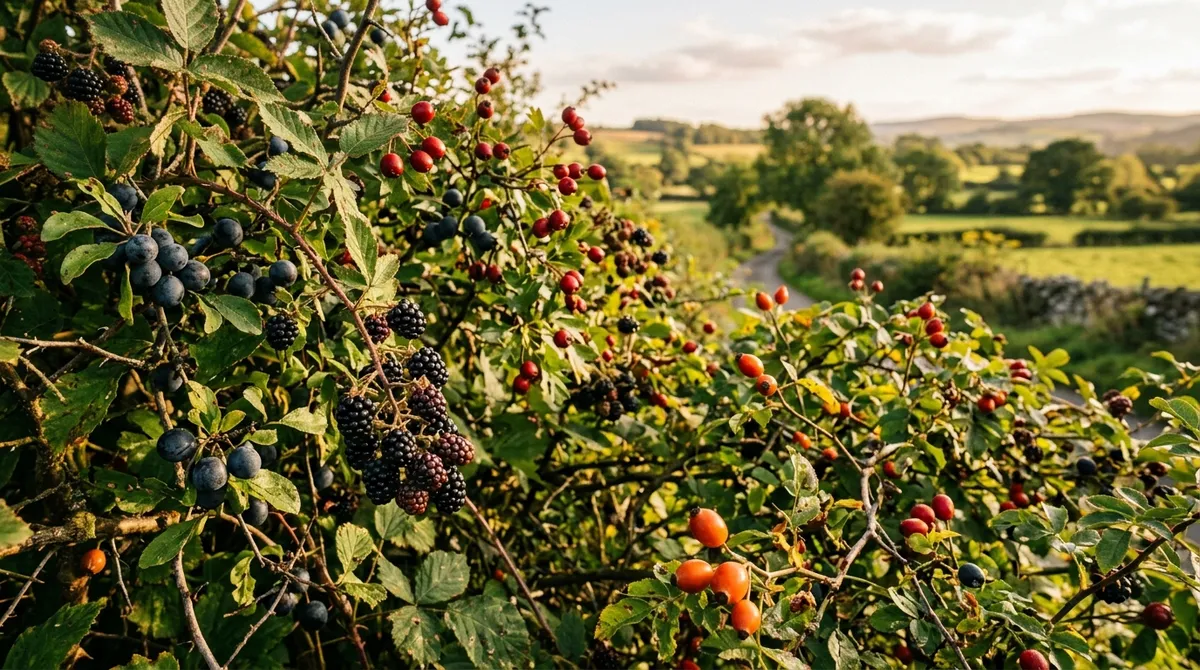
An edible hedgerow is one of the most productive boundaries you can plant in a UK garden. Where a fence gives you nothing but a barrier, a mixed native hedge delivers elderflowers in May, wild cherries in July, blackberries in August, sloes and rosehips in October, and hazelnuts in between. It feeds you, feeds wildlife, and looks better every year.
This guide covers eight native species for an edible hedgerow, bare-root planting method, spacing, the full foraging calendar from spring to late autumn, three classic hedgerow recipes, and the law on picking from wild hedges. Whether you are planting a new boundary or converting an existing fence line, everything here comes from six years of growing and foraging from a mixed hedge in Staffordshire.
What is an edible hedgerow and why plant one?
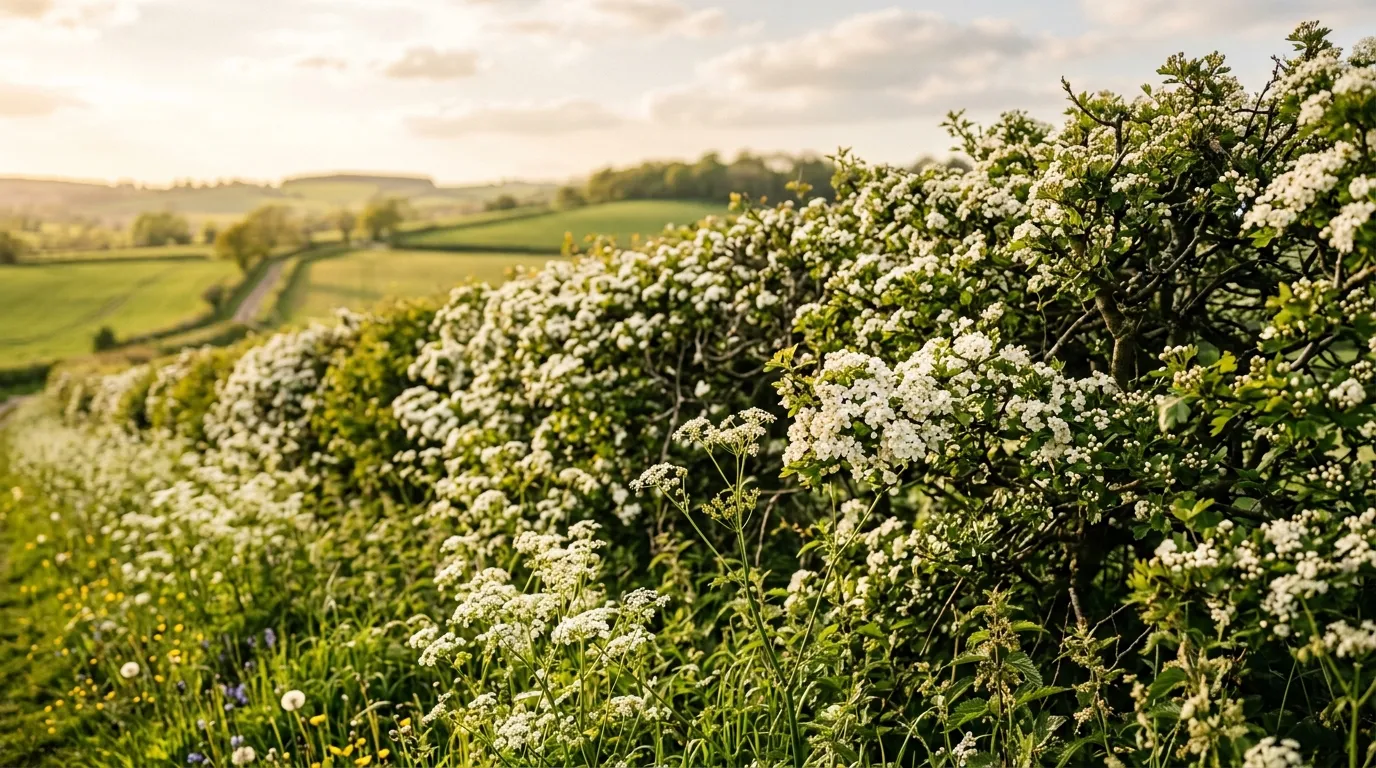
An edible hedgerow is a mixed boundary planted with native species that produce fruit, nuts, flowers, or leaves you can eat. Unlike a formal clipped hedge of beech or yew, an edible hedgerow grows informally, flowering and fruiting without heavy trimming.
A single 10m edible hedge provides: seven months of forageable harvests (May to November), a home for over 300 invertebrate species, nesting habitat for at least 12 bird species, windbreak protection that reduces wind speed by up to 50% for a distance of ten times the hedge height, and a living larder that costs under 50 pounds to plant from bare-root whips.
The ecological value alone justifies planting one. A hawthorn hedge supports more insect species than any other native shrub — over 300 invertebrates feed on hawthorn alone. Add blackthorn, elder, and dog rose and you create the richest wildlife habitat available to a domestic gardener.
For more detail on individual planting technique, see our complete hedge planting guide.
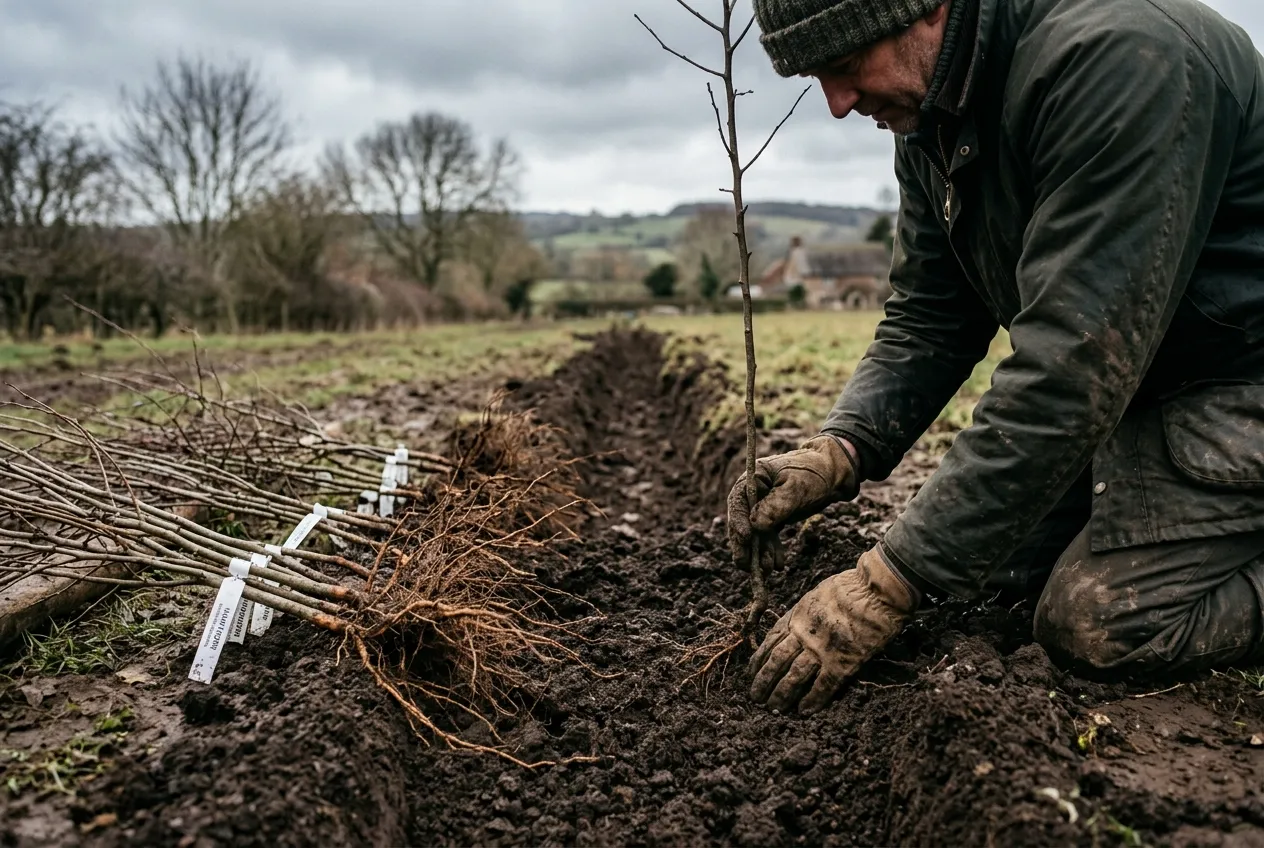
Bare-root whips planted November to March establish faster and cost 60-80% less than container-grown stock.
Choosing the right species for your edible hedgerow
The strength of an edible hedgerow is diversity. Eight native species give you a continuous harvest, varied wildlife value, and a hedge that looks different in every season.
Core species (plant at least five of these eight):
- Hawthorn (Crataegus monogyna) — the backbone of any native hedge. White blossom in May, red haws in autumn. Grows on any soil.
- Blackthorn/sloe (Prunus spinosa) — white blossom before the leaves in March. Blue-black sloes from October for sloe gin.
- Elder (Sambucus nigra) — elderflowers in June, elderberries in September. Fast growing. See our full elderberry growing guide.
- Dog rose (Rosa canina) — pink flowers in June, bright orange-red rosehips from September loaded with vitamin C.
- Hazel (Corylus avellana) — catkins in February, hazelnuts in September. Provides the thickest stems for coppicing.
- Crab apple (Malus sylvestris) — pink-white blossom in April, small tart apples from September for jelly. Our crab apple growing guide covers the best varieties.
- Damson (Prunus domestica subsp. insititia) — white blossom in April, purple fruit in September. Makes outstanding jam and damson gin.
- Wild cherry/gean (Prunus avium) — white blossom in April, small sweet-tart cherries in July. Grows taller than other hedge species.
Mix these in random groups of three to five plants. A strict alternating pattern looks unnatural and creates a weaker structure.
Edible hedgerow species comparison table
| Species | Edible parts | Harvest time | Main uses | Height | Growth rate | Soil tolerance |
|---|---|---|---|---|---|---|
| Hawthorn | Berries (haws), young leaves, flower buds | Oct-Nov (haws), Apr-May (leaves) | Jelly, ketchup, leather, tea | 2-6m | 30-50cm/yr | Any including heavy clay |
| Blackthorn/sloe | Sloe berries | Oct-Nov (after first frost) | Sloe gin, sloe vodka, jam | 2-4m | 20-40cm/yr | Any including poor chalk |
| Elder | Flowers, berries | Jun (flowers), Sep (berries) | Cordial, wine, fritters, syrup | 3-6m | 40-60cm/yr | Any including wet clay |
| Dog rose | Rosehips | Sep-Nov | Syrup, tea, jam, jelly | 1-3m | 30-40cm/yr | Any well-drained |
| Hazel | Nuts (cobnuts) | Sep-Oct | Eating fresh, baking, oil | 3-6m | 30-50cm/yr | Any except waterlogged |
| Crab apple | Fruit | Sep-Oct | Jelly, cider, pickle | 3-8m | 20-40cm/yr | Any including heavy clay |
| Damson | Fruit | Sep-Oct | Jam, gin, cheese, chutney | 3-6m | 20-30cm/yr | Any including clay |
| Wild cherry | Fruit | Jul-Aug | Eating fresh, jam, liqueur | 4-10m | 30-50cm/yr | Well-drained, not chalk |
Lawrie’s pick for a 10m hedge: five hawthorn, five blackthorn, three elder, three dog rose, three hazel, two crab apple, two damson, two wild cherry. That is 25 plants at roughly 40cm spacing, costing about 30-40 pounds for bare-root whips.
How to plant a bare-root edible hedgerow
Plant between November and March while plants are dormant. November is ideal — it gives five months of root establishment before spring growth.
What you need
- Bare-root whips (40-60cm tall, 1-2 year old transplants)
- Garden line or string for a straight row
- Spade and fork
- Mycorrhizal fungi powder (optional but worthwhile)
- Mulch: bark chips, straw, or cardboard
- Rabbit guards if rabbits are present
Step-by-step planting method
1. Mark out the line. Run a string along the hedge line. For a single row, you need a strip 60cm wide. For a double staggered row, allow 90cm.
2. Prepare the trench. Dig a trench 30cm deep and 30cm wide along the full length. Fork the bottom to break up compaction. On heavy clay, this step is essential — roots will not penetrate a solid clay pan.
3. Soak the roots. Stand bare-root plants in a bucket of water for one to two hours before planting. Dry roots are the single biggest cause of failure.
4. Space and plant. Set plants 30-45cm apart. For a double row, stagger plants in a zigzag pattern with 30cm between rows and 40cm between plants within each row. Spread roots in the trench, backfill with soil, and firm gently with your boot. The soil mark on the stem should sit at ground level.
5. Apply mycorrhizal fungi. Dust the roots with mycorrhizal powder before backfilling. This is not essential but it accelerates root establishment measurably — treated plants in my Staffordshire hedge showed 20-30% more top growth in year one.
6. Cut back by one-third. Reduce all stems by one-third immediately after planting. This feels brutal but it forces dense, bushy growth from the base. Without it, you get a leggy hedge with bare stems at the bottom.
7. Mulch thickly. Spread 10-15cm of bark mulch or lay overlapping cardboard sheets along both sides of the hedge. Mulch suppresses weeds, retains moisture, and protects roots from frost heave. Leave a 5cm gap around each stem to prevent rot.
8. Fit rabbit guards. If rabbits visit your garden, every plant needs a spiral guard. Rabbits strip bark from young hawthorn and blackthorn over winter and kill the plant.
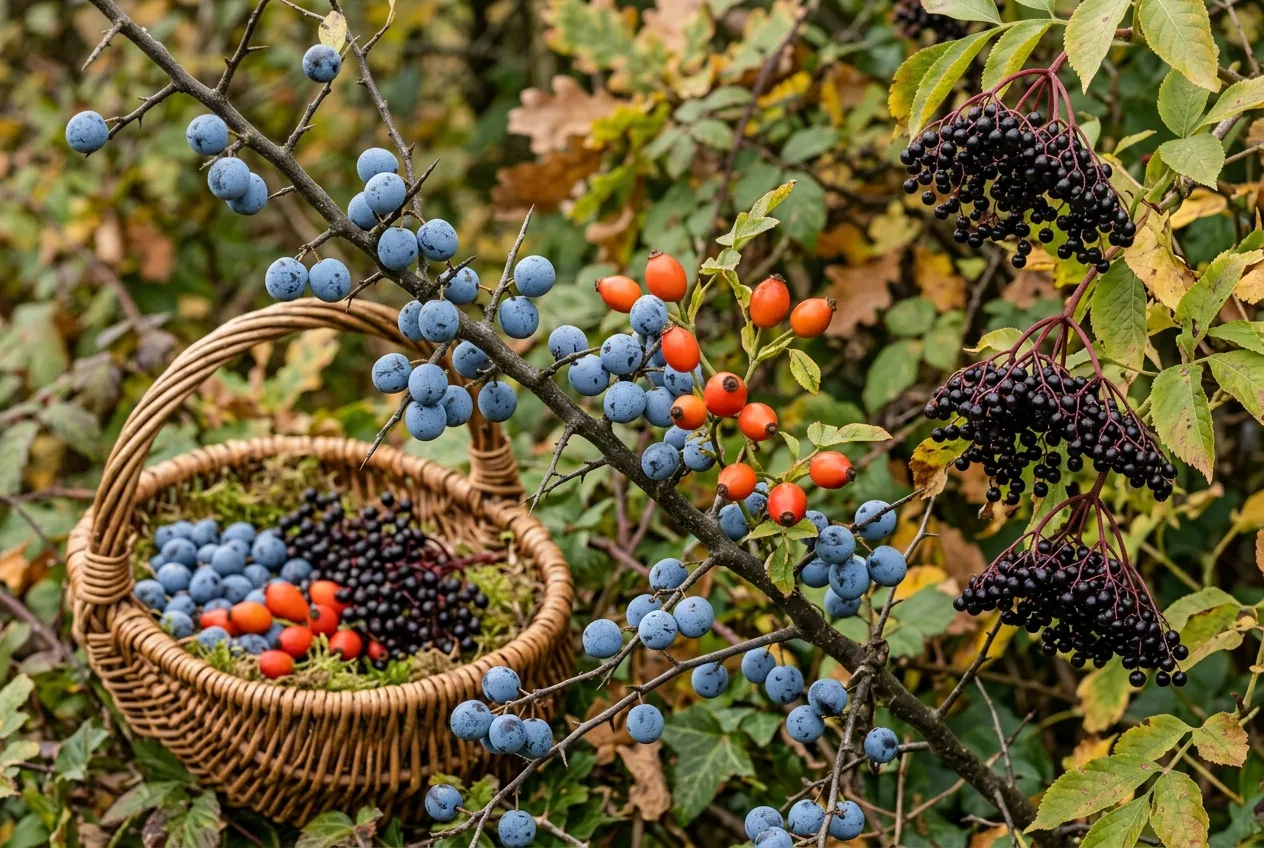
Sloes, rosehips, and elderberries all ripen between September and November, giving weeks of autumn foraging from a single hedge.
Establishment and first-year care
The first two growing seasons determine whether your hedge thrives or struggles. Get these three things right and the hedge will look after itself from year three onwards.
Watering: Water every plant weekly from April to September in the first year. Drought kills more newly planted hedges than anything else. A slow trickle from a leaky hose laid along the base is the most efficient method. Each plant needs roughly 5 litres per week.
Weeding: Keep a 30cm strip either side of the hedge completely weed-free for the first two years. Grass and weeds compete fiercely for moisture. Mulch does most of this work, but hand-pull anything that pushes through.
No pruning in year one. Let everything grow unchecked in the first season. The plants need every leaf to build root reserves. The only exception is removing any dead or damaged stems.
Year two trim. In the second winter (January-February), cut all growth back by half. This forces a second round of branching from the base and builds the dense framework that makes a hedge stock-proof and productive.
Maintenance and pruning for fruit production
Once established, an informal edible hedgerow needs minimal work. The goal is to maintain shape without removing fruiting wood.
Annual trim: Cut once per year in late January or early February. This timing avoids the bird nesting season (1 March to 31 August) and allows plants to set fruit on the current year’s growth. The Wildlife Trusts recommend this timing for all wildlife hedges.
What to cut: Remove crossing branches, reduce the overall height by one-third if it has grown too tall, and trim the sides to keep the hedge roughly A-shaped — wider at the base than the top. This shape allows light to reach the lower branches, keeping the base dense and productive.
What not to cut: Never cut elder flower heads or rose hips before harvest. Do not trim blackthorn or hawthorn between June and November if you want a full berry crop. Leave some areas uncut each year as wildlife refuges.
Coppicing hazel: Every seven to ten years, cut hazel stools to 15cm from the ground in winter. Hazel regrows vigorously from coppiced stumps and produces the best nut crops on three to five-year-old wood.
The edible hedgerow foraging calendar
Knowing when each species is ready prevents missed harvests and wasted fruit. This calendar is based on central England timings — adjust by one to two weeks for Scotland or southern coastal areas.
| Month | What to forage | How to identify readiness |
|---|---|---|
| February-March | Hazel catkins (decorative), young hawthorn leaf buds | Catkins fully extended and shedding pollen |
| April-May | Hawthorn leaves (“bread and cheese”), hawthorn flower buds | Young leaves bright green, tender to pinch |
| May-June | Elderflowers | All florets open, strong sweet scent, cream-coloured |
| June-July | Dog rose petals, wild cherry fruit | Petals fully open; cherries dark red and soft |
| August-September | Blackberries (from hawthorn hedges often contain bramble), elderberries | Berries deep purple-black, clusters drooping |
| September-October | Hazelnuts, crab apples, damsons | Nuts brown in husks; apples and damsons give when pressed |
| October-November | Sloes, rosehips, haws | Sloes blue-black with frost bloom; hips deep orange-red |
For more on growing your own forageable garden, see our guide to foraging garden edible plants.
Three classic hedgerow recipes
These are the three recipes every hedgerow forager should know. All use fruit from the species listed above and require no specialist equipment.
Sloe gin
The definitive hedgerow drink. Sloes are too astringent to eat raw but they transform gin into something rich, almondy, and deep purple.
Ingredients: 450g sloes, 225g caster sugar, 700ml gin (any decent London dry).
Method: Prick each sloe with a pin or freeze them overnight to split the skins (freezing is easier and works just as well as pricking). Put sloes and sugar in a 1-litre Kilner jar. Pour in the gin. Seal and shake. Store in a cool, dark cupboard. Shake every day for the first week, then weekly for three months. Strain through muslin into clean bottles. Drink immediately or age for up to a year — it improves steadily.
Lawrie’s note: I pick sloes after the first hard frost in late October or early November. The frost breaks down cell walls and releases more flavour. In mild autumns, put the sloes in the freezer for 48 hours instead.
Elderflower cordial
Pick elderflowers on a dry, sunny morning in June when the scent is strongest. Twenty large flower heads makes about 1.5 litres of cordial.
Ingredients: 20 elderflower heads, 1.5kg granulated sugar, 1.5 litres boiling water, zest and juice of 2 unwaxed lemons, 50g citric acid.
Method: Shake flower heads gently to remove insects (do not wash — you lose the pollen and scent). Dissolve sugar in boiling water. Add lemon zest, lemon juice, and citric acid. Drop in the flower heads. Cover and leave for 24 hours, stirring twice. Strain through muslin into sterilised bottles. Stores in the fridge for up to three months. Dilute one part cordial to five parts sparkling water.
Rosehip syrup
Rosehips contain twenty times more vitamin C per 100g than oranges. This wartime recipe was promoted by the Ministry of Food in the 1940s and remains the best way to use them. The RHS confirms dog rose hips are among the richest natural sources of vitamin C in the UK.
Ingredients: 1kg rosehips, 500g granulated sugar, 1.5 litres water.
Method: Roughly chop rosehips in a food processor (wear gloves — the hairs inside hips are irritant). Boil 1 litre of water, add chopped hips, return to the boil, then remove from heat and steep for 15 minutes. Strain through a jelly bag. Return the pulp to the pan with the remaining 500ml of water, boil, steep, and strain again. Combine both liquids, reduce to about 750ml, add sugar, and stir until dissolved. Boil for five minutes. Pour into sterilised bottles and seal. Stores refrigerated for up to six months.
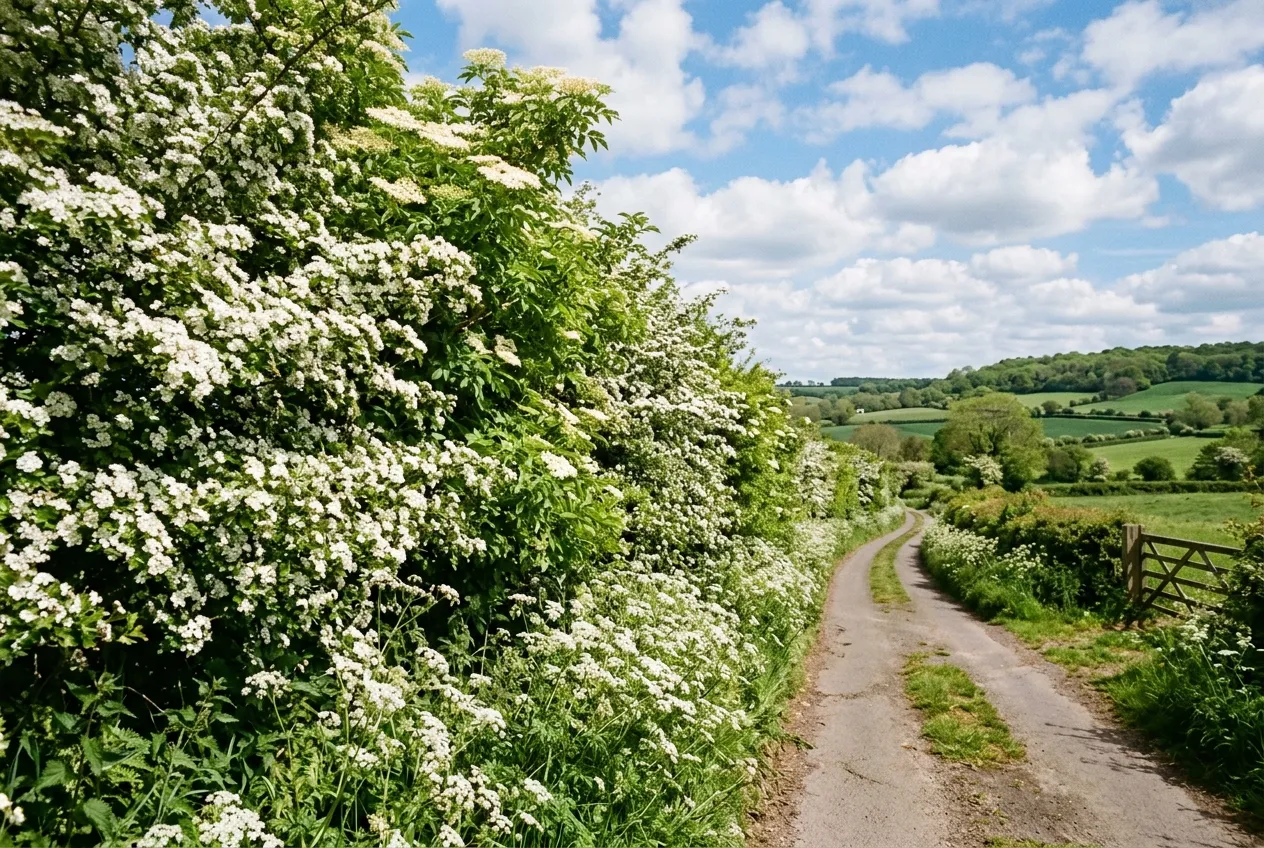
May and June bring hawthorn blossom and elderflowers — the first edible harvests of the hedgerow year.
Legal rules for foraging from hedgerows in the UK
Understanding foraging law prevents accidental offences. The rules are straightforward but widely misunderstood.
What is legal: Picking fruit, nuts, flowers, foliage, and fungi growing wild for personal use is legal under the Theft Act 1968, Section 4(3). This applies to public rights of way, common land, and any hedgerow you have the landowner’s permission to forage from.
What is illegal: Uprooting any wild plant without the landowner’s permission is an offence under the Wildlife and Countryside Act 1981. Picking from protected species listed in Schedule 8 of the same Act is also illegal. Commercial foraging (picking to sell) without landowner permission constitutes theft.
Best practice: Take no more than one-third of the available fruit from any single bush. Spread your picking along the hedgerow. Leave lower fruit for children and wildlife. Never strip a bush completely — birds depend on hedgerow berries through winter, particularly fieldfares and redwings that migrate from Scandinavia specifically to feed on UK haws and rosehips.
The Habitat Aid guidance on responsible hedgerow management offers further detail on balancing foraging with conservation.
Wildlife value of edible hedgerows
An edible hedgerow is the single most effective wildlife feature you can add to a garden. The numbers are extraordinary.
Invertebrates: Hawthorn alone supports over 300 species. Blackthorn supports 150+. A mixed hedge of eight species creates habitat for a broader range of specialists than any single-species planting. Hoverflies, lacewings, and ladybirds all overwinter in hedgerow bases, providing natural pest control for adjacent vegetable plots and borders.
Birds: Hedgerows provide nesting sites for wren, robin, dunnock, blackbird, song thrush, chaffinch, bullfinch, long-tailed tit, and whitethroat. Dense thorny species like blackthorn and hawthorn offer the best protection from predators. Winter berries feed resident thrushes and overwintering fieldfare and redwing.
Mammals: Hedgehogs travel along hedgerow bases and hibernate in leaf litter beneath them. Dormice feed on hazel nuts and elder berries in autumn before hibernation. Bats hunt insects along the sheltered lee side of hedges at dusk.
For a hedge that specifically supports blackberries and other soft fruit alongside wildlife, train bramble along the sunny side of the hedgerow where it will not smother slower-growing species.
Common mistakes when planting edible hedgerows
Six years of growing a mixed hedge has taught me what goes wrong and how to prevent it.
Planting too close to a boundary. Plant at least 50cm from a property boundary. The hedge will spread to 1-1.5m wide at maturity and you are legally responsible for trimming anything that overhangs a neighbour’s land.
Skipping the first-year watering. Bare-root whips have no root ball to draw moisture from. Weekly watering April to September in year one is non-negotiable. Drought stress in the first summer kills more hedge plants than frost, disease, and rabbits combined.
Cutting too hard too soon. Do not trim in the first growing season. Let every plant establish a root system before you ask it to regrow from a cut. The one-third reduction at planting is enough for year one.
Planting elder in the middle. Elder grows faster and taller than everything else. Plant it at the ends of the hedge or in clusters where you can manage its vigour. A single elder in the middle will shade out its neighbours within three years.
Ignoring rabbit damage. Rabbits ring-bark young hawthorn and blackthorn stems over winter. By the time you notice the damage in spring, the plant is dead. Spiral tree guards cost pennies and save the entire hedge.
Formal trimming of an informal hedge. An edible hedgerow is not a beech box. Clipping it into a flat-topped rectangle removes fruiting wood and destroys the informal character. Trim lightly for shape, not precision.
Further reading
- How to grow hawthorn in the UK — full species guide including haw jelly recipe
- How to grow elderberry in the UK — pruning, cordial, wine, and ornamental varieties
- How to grow crab apple trees UK — best varieties, pollination, and jelly making
- How to grow blackberries in the UK — thornless varieties, fan training, and yields
- Foraging in your garden: edible plants — wild food already growing in your garden
Lawrie has been gardening in the West Midlands for over 30 years. He grows his own veg using no-dig methods, keeps a wildlife-friendly garden, and writes practical advice based on real UK growing conditions.