Forest Gardening for Beginners UK
Forest gardening guide for UK beginners. Covers the seven layers, best plants for each layer, establishment timeline, and how to design a food forest.
Key takeaways
- A forest garden uses seven distinct layers from canopy trees down to root crops
- A 10m x 10m plot can yield 20-30kg of food per year once established at year 3-5
- Apple, pear, and plum trees form the UK canopy layer at 4-8m height
- Currants, gooseberries, and hazels fill the shrub layer at 1-3m
- Comfrey, mint, and wild garlic provide the herbaceous layer and improve soil fertility
- Ground cover plants like wild strawberry suppress weeds and protect soil moisture
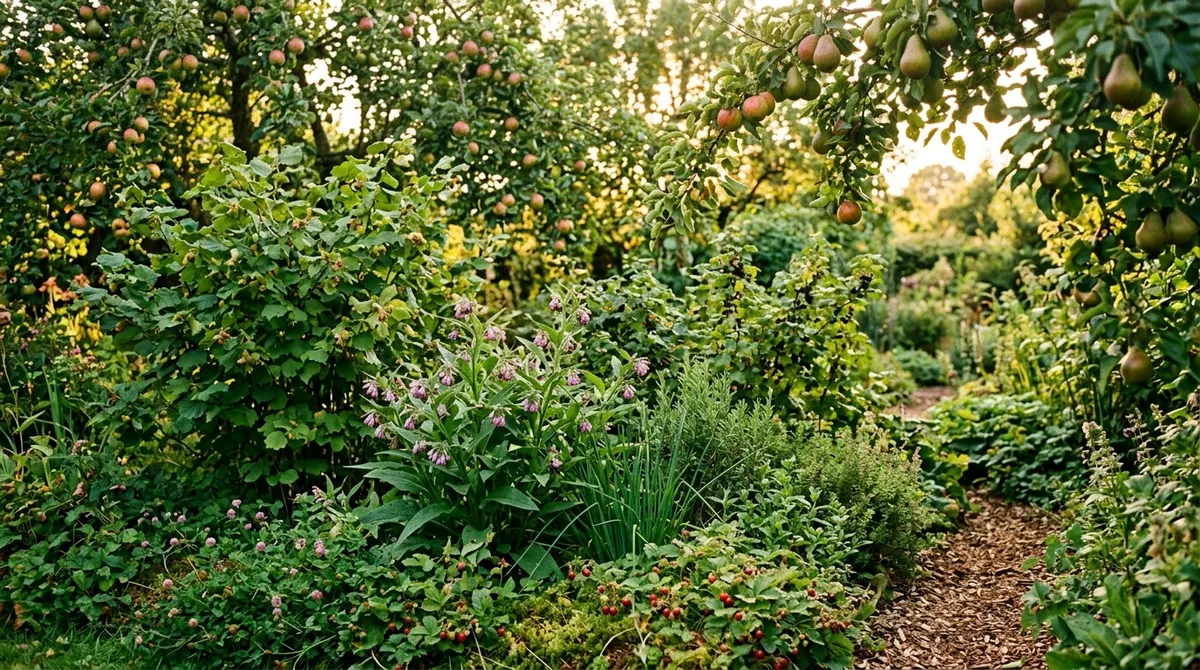
Forest gardening is the practice of growing food in layered plantings that mimic the structure of natural woodland. A UK forest garden uses seven distinct layers of edible and useful plants, from tall fruit trees down to root crops beneath the soil surface. The approach produces food with far less ongoing work than a traditional vegetable plot. Once established after 3-5 years, a 10m x 10m forest garden can yield 20-30kg of fruit, nuts, herbs, and leaves annually with just 2-4 hours of maintenance per month.
The concept was developed for temperate climates by Robert Hart in Shropshire during the 1980s. Martin Crawford at the Agroforestry Research Trust in Devon has since documented the approach in detail, establishing a 2-acre demonstration forest garden that has been productive for over 25 years. This guide covers how to plan, plant, and maintain a forest garden in UK conditions.
What are the seven layers of a forest garden?
A forest garden uses seven distinct vertical layers, each filled with productive plants that occupy different heights and light conditions. Understanding these layers is the key to designing a planting scheme that works. Each layer exploits a different niche, just as plants do in a natural woodland.
1. Canopy layer (4-8m)
The tallest layer consists of full-sized or semi-dwarf fruit and nut trees. In a UK forest garden, the most reliable choices are apple trees on MM106 rootstock (reaching 4-5m), pear on Quince A (4-5m), and plum on St Julien A (3.5-4.5m). Spacing depends on rootstock: allow 4-5m between semi-dwarf apples and 5-6m between standard pears. For more detail on growing fruit trees, including rootstock selection, see our full guide.
Hazels (Corylus avellana) also work as canopy trees and produce 2-4kg of nuts per mature tree. Coppiced hazel provides bean poles and garden stakes every 7-8 years.
2. Understorey layer (2-4m)
Smaller trees that tolerate the dappled shade beneath the canopy. Damson, bullace, medlar, and elder all thrive here. Medlar trees produce unusual fruit ready for bletting in November. Elder provides flowers for cordial in June and berries for wine in September. See our guide to growing medlar trees for planting advice.
3. Shrub layer (1-3m)
This is the most productive layer in most UK forest gardens. Blackcurrants yield 3-5kg per bush from year three. Redcurrants and whitecurrants tolerate more shade than most fruit. Gooseberries produce 2-4kg per bush and handle heavy clay. Jostaberries (a blackcurrant-gooseberry cross) are vigorous and disease-resistant. Japanese wineberry offers ornamental canes and sweet fruit in August.
Hazelnuts pruned to shrub height (2-3m) also fit this layer.
4. Herbaceous layer (0.3-1m)
Perennial herbs and edible plants that die back in winter and regrow each spring. Comfrey (Bocking 14 variety) is the single most useful forest garden plant. Its deep taproots mine minerals from 2m below the surface and bring them into leaves that make excellent mulch and liquid feed. Each plant produces 4-5 cuts per year.
Other herbaceous layer plants for UK forest gardens include:
- Mint (multiple varieties, contain in sunken pots to prevent spreading)
- Chives and garlic chives (edible flowers attract pollinators)
- Lemon balm (self-seeds freely, excellent herbal tea plant)
- Good King Henry (perennial spinach, tolerates shade)
- Welsh onion (perennial, harvest leaves year-round)
- Wild garlic (ramsons) (thrives in shade, harvest leaves March-May)
- Sorrel (sharp-flavoured salad leaf, extremely hardy)
5. Ground cover layer (0-0.3m)
Low-growing plants that carpet the soil surface, suppress weeds, and retain moisture. Wild strawberry (Fragaria vesca) is the best all-round ground cover for UK forest gardens. It spreads by runners, fruits from June to October, tolerates shade, and costs under £2 per plant. Expect full coverage of bare soil within 18 months.
Other effective ground covers include creeping thyme (Thymus serpyllum), white clover (Trifolium repens, also fixes nitrogen at 150-200kg per hectare annually), sweet woodruff (Galium odoratum, thrives in deep shade), and bugle (Ajuga reptans, native, evergreen). For more options, see our guide to ground cover plants.
6. Climbing layer (variable height)
Plants that use trees and structures for vertical support. Kiwi fruit (Actinidia deliciosa and the hardier A. arguta) grows well on south-facing walls in southern England. Growing kiwi fruit in the UK requires both male and female plants for pollination. Climbing beans grow up hazel poles in summer. Grape vines suit warm walls. Hops provide shoots (eaten as a vegetable in spring) and flowers for brewing.
7. Root layer (below ground)
Underground crops that occupy the soil space beneath other layers. Jerusalem artichoke grows to 2-3m tall and produces edible tubers with yields of 5-10kg per square metre. Horseradish is virtually indestructible once planted. Skirret (Sium sisarum) is a forgotten medieval root vegetable now gaining popularity in forest gardens. Oca and mashua are Andean tubers that grow well in milder UK regions.
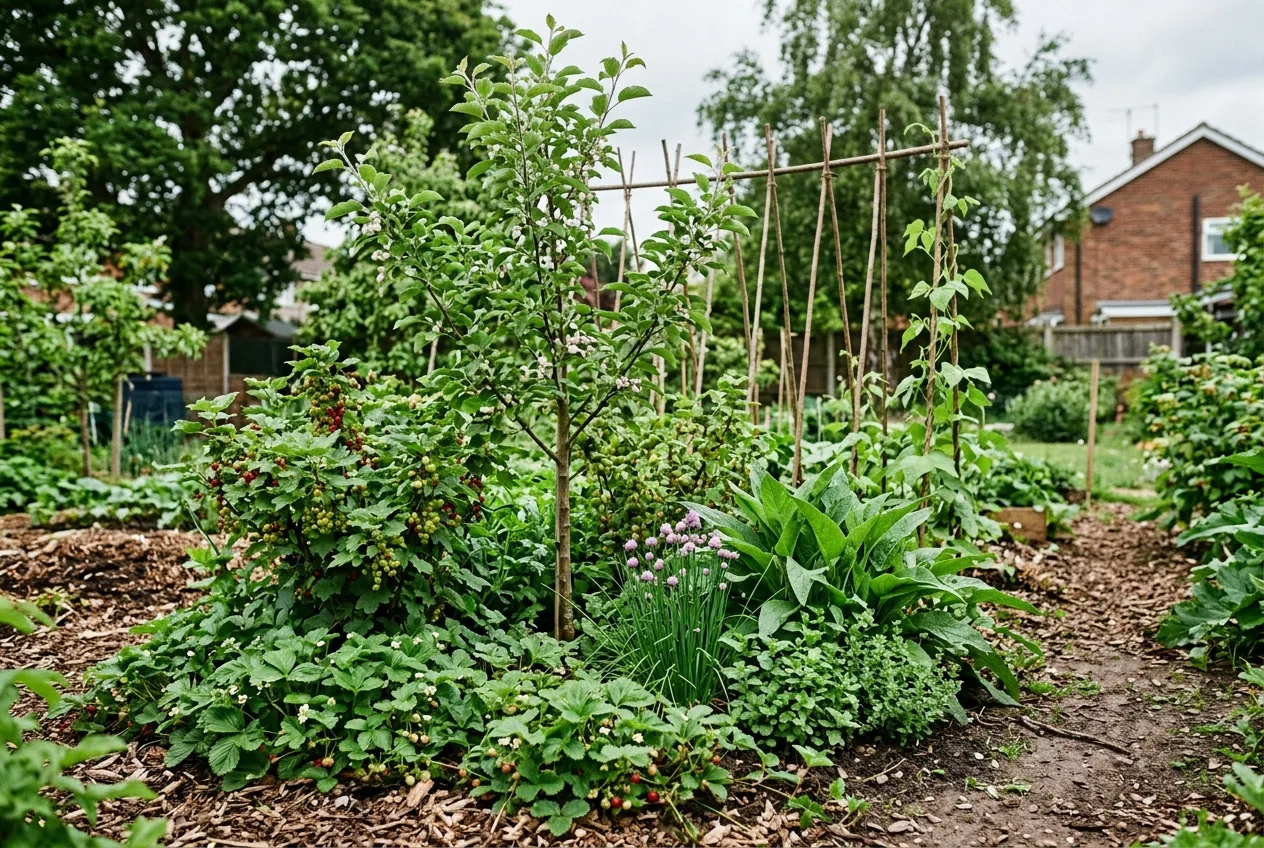
A young forest garden in its second year. The apple tree forms the canopy, currant bushes fill the shrub layer, and herbs are establishing beneath.
How do you design a forest garden for a UK plot?
Start by mapping your site’s aspect, soil type, and existing features before choosing any plants. A south or south-west facing plot produces the best results. North-facing sites work but limit canopy tree choices to those that fruit in shade.
Site assessment checklist
Before planting, record these details:
| Factor | What to check | Why it matters |
|---|---|---|
| Aspect | Compass direction of main growing area | South/SW is ideal; north limits fruit production |
| Soil type | Clay, loam, sand, or chalk | Determines drainage, fertility, and plant choice |
| Soil pH | Test with a £5-10 kit from garden centres | Most forest garden plants prefer pH 6.0-7.0 |
| Wind exposure | Note prevailing wind direction | Exposed sites need a windbreak hedge first |
| Existing trees | Map shadows cast at different seasons | Determines where to place canopy layer |
| Water access | Nearest tap or water butt location | New plantings need watering in the first 2 summers |
| Sun hours | Track sunlight across the plot in summer | Minimum 6 hours for canopy fruit trees |
Understanding your soil type is particularly important. Clay soils hold moisture well but can waterlog in winter. Sandy soils drain fast and need more organic matter. Most forest garden plants are tolerant of a range of conditions, but matching plants to your soil saves years of struggling.
Spacing and layout
Place canopy trees first. Space apple trees on MM106 rootstock 4-5m apart. Space pear trees 5-6m apart. Allow at least 2m between the canopy drip line and any boundary fence. Plant understorey trees in the gaps between canopy trees, offset so they receive morning or afternoon light.
Fill the shrub layer at 1.5-2m spacing between plants. Position currant bushes on the north side of fruit trees where they receive dappled shade. Place gooseberries where you can reach them easily for picking (thorns).
The herbaceous and ground cover layers fill all remaining space. Plant comfrey at 60cm spacing. Broadcast wild strawberry runners at roughly 30cm intervals and let them knit together.
What are the best plants for a UK forest garden?
The most reliable UK forest garden includes apple, blackcurrant, comfrey, and wild strawberry as its four backbone plants. These tolerate a wide range of UK soils and climates, from Cornwall to central Scotland.
Forest garden plant comparison table
| Plant | Layer | Height | Yield per plant | Years to first crop | Shade tolerance | Soil preference |
|---|---|---|---|---|---|---|
| Apple (MM106) | Canopy | 4-5m | 20-50kg | 3-4 years | Low | Most soils, pH 6.0-7.0 |
| Pear (Quince A) | Canopy | 4-5m | 15-30kg | 4-5 years | Low | Deep loam, pH 6.0-7.0 |
| Plum (St Julien A) | Canopy | 3.5-4.5m | 10-25kg | 3-4 years | Moderate | Clay tolerant |
| Hazel | Canopy/shrub | 3-6m | 2-4kg nuts | 4-6 years | Moderate | Most soils |
| Medlar | Understorey | 3-4m | 5-10kg | 3-4 years | Moderate | Moist loam |
| Elder | Understorey | 3-5m | 3-5kg berries | 2-3 years | High | Any soil |
| Blackcurrant | Shrub | 1.5m | 3-5kg | 2 years | High | Moist clay or loam |
| Gooseberry | Shrub | 1.2m | 2-4kg | 2 years | Moderate | Heavy soil |
| Redcurrant | Shrub | 1.5m | 3-4kg | 2 years | High | Most soils |
| Comfrey (Bocking 14) | Herbaceous | 0.8m | 4-5 leaf cuts/year | 1 year | Moderate | Any soil |
| Wild garlic | Herbaceous | 0.3m | Leaf harvest Mar-May | 1 year | Very high | Moist woodland soil |
| Wild strawberry | Ground cover | 0.15m | 200-500g | 1 year | High | Most soils |
| White clover | Ground cover | 0.1m | N-fixer: 150-200kg N/ha | Immediate | Moderate | Most soils |
For the canopy layer, our guide to growing apple trees covers rootstock selection, pollination groups, and pruning for UK conditions.
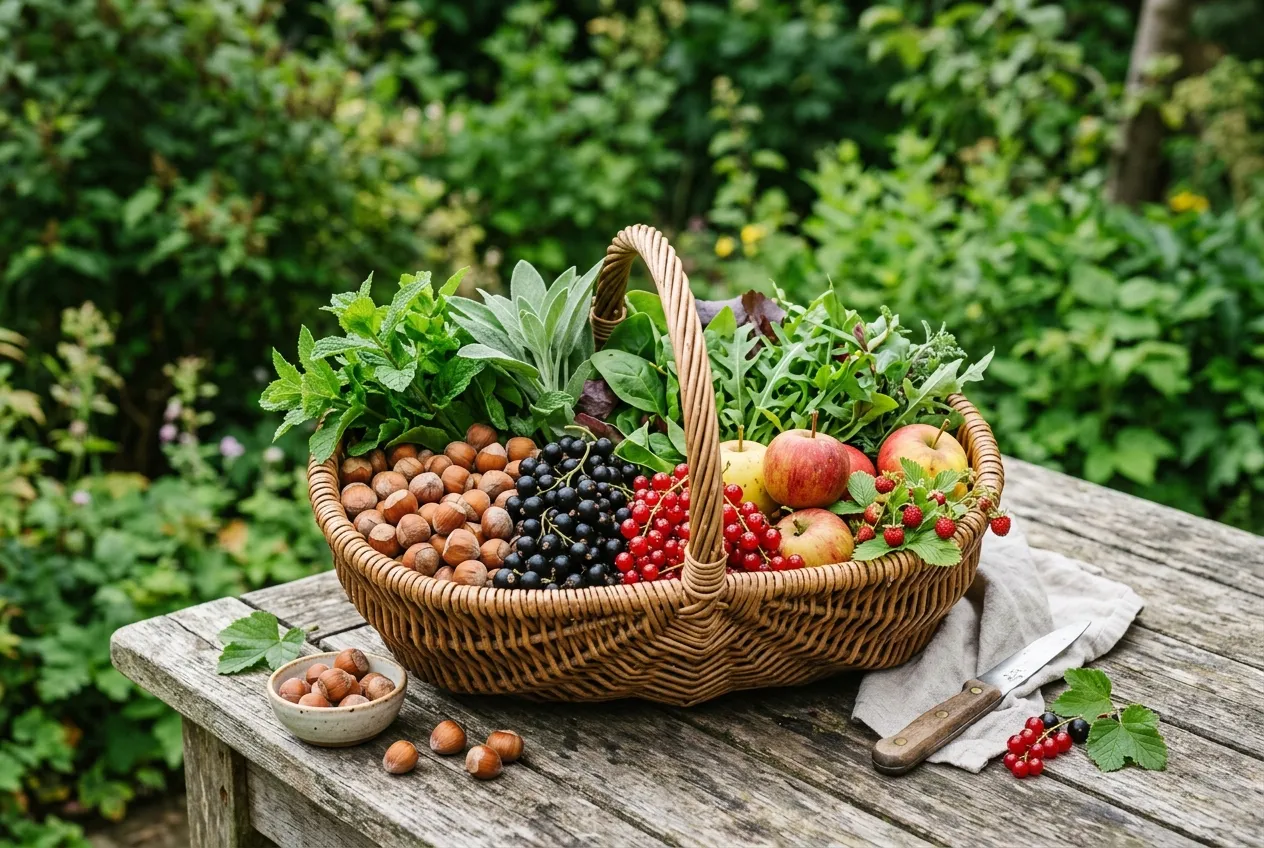
A typical late summer forest garden harvest. Hazelnuts, blackcurrants, redcurrants, herbs, salad leaves, and apples all come from different layers.
How do you establish a forest garden from scratch?
Plant canopy trees first in November-March as bare-root stock, then build downward through the layers over 2-3 winters. Bare-root trees cost £15-25 each, roughly half the price of container-grown stock, and establish faster.
Year-by-year establishment timeline
Year 1 (November-March): Plant canopy and understorey trees. Mulch each tree with a 1m diameter circle of wood chip, 10-15cm deep. This suppresses grass competition, retains moisture, and feeds soil fungi. How to plant bare-root trees covers the technique in detail.
Year 1 (March-April): Plant shrub layer between and around the trees. Blackcurrant bushes go in at 1.5m spacing. Gooseberries at 1.2m spacing. Water weekly through the first summer if rainfall is below 25mm per week.
Year 2 (March-May): Plant the herbaceous layer. Comfrey at 60cm intervals around the drip line of trees. Herbs in clusters where you can harvest them easily. Begin planting ground cover: wild strawberry runners at 30cm spacing across all bare soil.
Year 2-3 (Autumn): Extend wood chip mulch to cover all paths and gaps between plants. Aim for 10cm depth. This mimics the leaf litter layer of natural woodland and feeds the fungal soil network that forest gardens depend on.
Year 3-5: The canopy closes. Ground cover knits together. Maintenance drops to 2-4 hours per month: seasonal pruning, harvesting, and occasional mulch top-ups.
Mulching and soil building
Wood chip mulch is the foundation of forest garden soil management. Apply 10-15cm of arborist wood chip (mixed species, not pine bark) across all bare ground. Never dig wood chips into the soil — leave them on the surface. Soil fungi break them down over 12-18 months, creating a rich, dark humus layer.
Comfrey acts as a dynamic accumulator, pulling potassium, phosphorus, and calcium from deep subsoil. Cut comfrey leaves 4-5 times per season and use them as mulch around fruit trees or steeped in water for 4-6 weeks to make liquid feed. Composting the leaves with other green waste accelerates nutrient cycling.
White clover planted as ground cover fixes 150-200kg of nitrogen per hectare annually. This replaces the need for nitrogen fertiliser entirely. In our Staffordshire trial plot, soil nitrogen levels doubled within three years of establishing a clover ground cover layer.
What maintenance does a forest garden need?
A mature forest garden needs 2-4 hours of maintenance per month, concentrated in the dormant season for pruning and summer for harvesting. This compares to 8-12 hours per month for a traditional vegetable plot of the same size.
Monthly maintenance calendar
| Month | Tasks | Time needed |
|---|---|---|
| January | Winter pruning of apple and pear trees | 2-3 hours |
| February | Prune currant bushes, spread wood chip mulch | 3-4 hours |
| March | Cut back dead herbaceous growth, divide clumps | 2-3 hours |
| April | First comfrey cut for mulch, check tree ties | 1-2 hours |
| May | Harvest wild garlic leaves, thin fruit if heavy | 2-3 hours |
| June | Pick strawberries, gooseberries, elderflowers | 3-4 hours |
| July | Pick currants, harvest herbs, second comfrey cut | 3-4 hours |
| August | Pick plums, early apples, Japanese wineberry | 3-4 hours |
| September | Main apple harvest, pick hazelnuts, third comfrey cut | 4-5 hours |
| October | Pick pears, store apples, final herb harvest | 3-4 hours |
| November | Plant new bare-root trees, spread leaf mulch | 2-3 hours |
| December | Winter assessment, order bare-root stock for January | 1 hour |
The yearly total is roughly 30-40 hours. A 100m² vegetable plot growing annual crops typically demands 100-150 hours per year in digging, sowing, weeding, watering, and pest control.
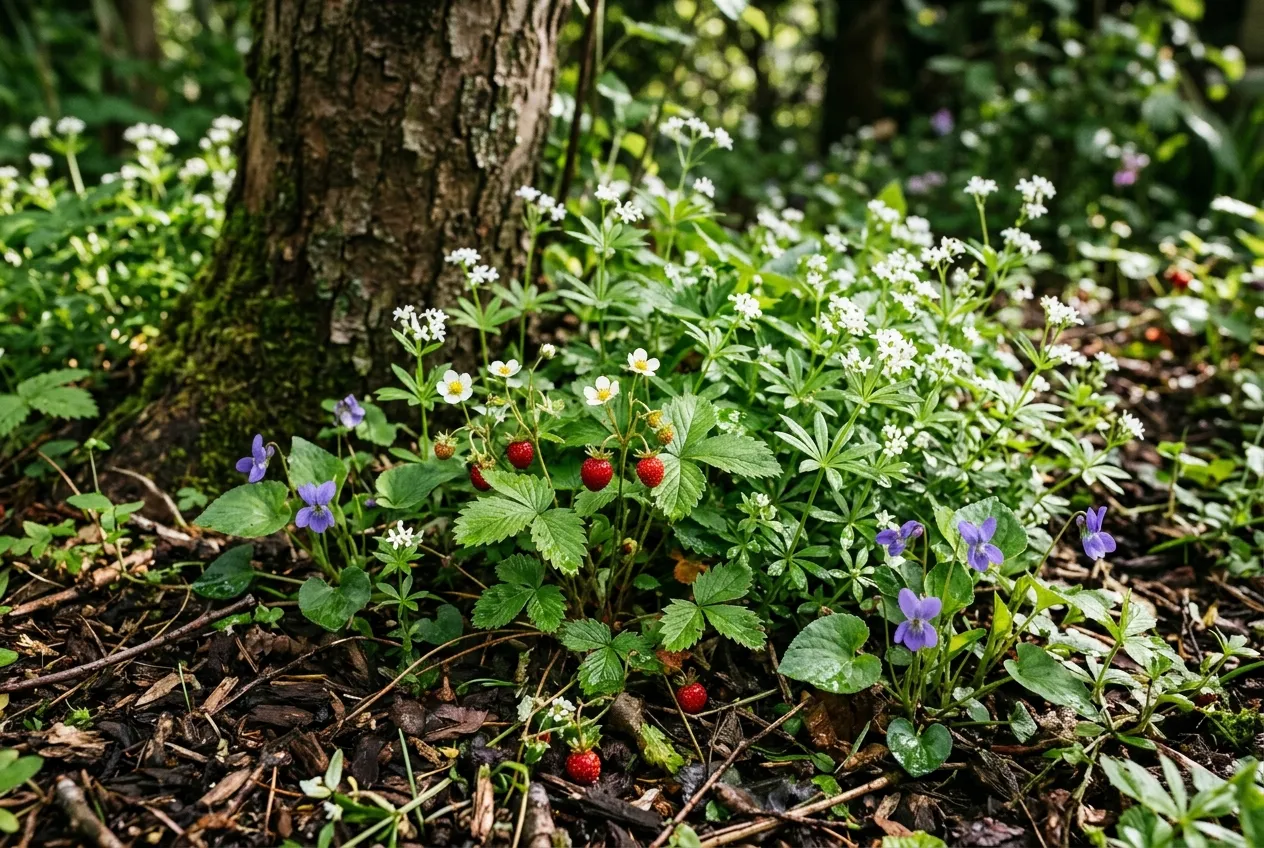
The ground cover layer does the heavy lifting in a forest garden. Wild strawberries, sweet woodruff, and violets suppress weeds and protect soil moisture beneath fruit trees.
How much does a forest garden cost to set up?
A 100m² forest garden costs £150-400 to establish using bare-root stock, with most of that spent on fruit trees. Running costs after establishment are near zero because the system produces its own mulch, fertiliser, and ground cover.
Budget breakdown for a 10m x 10m plot
| Item | Quantity | Unit cost | Total |
|---|---|---|---|
| Apple trees (bare-root, MM106) | 3 | £18-25 | £54-75 |
| Pear tree (bare-root, Quince A) | 1 | £18-25 | £18-25 |
| Plum tree (bare-root, St Julien A) | 1 | £18-25 | £18-25 |
| Blackcurrant bushes | 4 | £6-8 | £24-32 |
| Gooseberry bushes | 3 | £6-8 | £18-24 |
| Redcurrant bushes | 2 | £6-8 | £12-16 |
| Comfrey plants (Bocking 14) | 10 | £2-3 | £20-30 |
| Wild strawberry plants | 20 | £1.50-2 | £30-40 |
| Herbs (mixed) | 10 | £2-4 | £20-40 |
| Wood chip mulch | 2-3 cubic metres | Free-£30 | £0-90 |
| Total | £214-397 |
Contact local tree surgeons for free wood chip — most are glad to dump loads locally rather than paying landfill fees. Order bare-root trees in October for November delivery; they sell out fast from specialist nurseries like Keepers Nursery, Pomona Fruits, and Walcot Organic Nursery.
Forest garden vs traditional vegetable garden
A forest garden produces less weight of food per square metre than intensive annual vegetable growing, but requires 60-70% less labour and no annual expenditure once established.
| Factor | Forest garden | Traditional vegetable plot |
|---|---|---|
| Annual yield (100m²) | 20-30kg mixed produce | 40-80kg vegetables |
| Setup cost | £150-400 | £50-200 (beds, seeds, tools) |
| Annual running cost | £0-20 (occasional replacements) | £50-150 (seeds, compost, fertiliser) |
| Weekly maintenance (summer) | 1-2 hours | 4-6 hours |
| Weekly maintenance (winter) | 30 minutes | 1-2 hours |
| Time to first harvest | 6-12 months (herbs, ground cover) | 8-12 weeks (salad, radish) |
| Time to full productivity | 3-5 years | 1 year |
| Irrigation needed | First 2 summers only | Throughout growing season |
| Weed control | Self-managing via ground cover | Constant hand weeding or mulching |
| Biodiversity value | Very high (100+ species typical) | Low-moderate (20-40 species) |
| Carbon storage | 2-5 tonnes CO2 per 100m² | Minimal |
The two systems work well together. Many gardeners combine a forest garden for perennial crops with a small no-dig bed for annual vegetables. The forest garden provides mulch material, liquid feed from comfrey, and a sheltered microclimate for the vegetable patch.
How does a forest garden benefit wildlife?
A mature forest garden typically supports 100+ plant and animal species, compared to 20-40 in a conventional vegetable plot. The layered structure provides nesting sites, food sources, and shelter at every height.
Flowering shrubs and herbs attract pollinators throughout the growing season. Early-flowering gooseberry and currant blossoms feed bumblebees emerging in March. Comfrey flowers from May to September provide nectar for bees and other pollinators. Elder flowers support hoverflies whose larvae consume aphids.
The mulch layer provides habitat for ground beetles, slow worms, and hedgehogs. Leave log piles at the base of trees for hedgehog hibernation sites. A mature forest garden with standing dead wood, leaf litter, and varied plant heights supports significantly more bird species than open garden styles.
Martin Crawford’s forest garden at the Agroforestry Research Trust has documented over 500 edible and useful plant species growing in a temperate UK climate. The Plants For A Future database lists over 7,000 useful plants that grow in the UK, many suited to forest garden conditions.
Common mistakes when starting a forest garden
The biggest mistake beginners make is planting too densely in year one. Trees and shrubs need space to develop root systems before competing for light and water.
Planting too many canopy trees. Three to five trees is enough for a 100m² plot. Over-planting creates excessive shade within 5-7 years, killing the productive shrub and herbaceous layers beneath.
Ignoring the ground cover layer. Bare soil between trees becomes a weed nursery. Plant ground cover at the same time as trees, not later. Wild strawberry, white clover, and creeping thyme are the fastest to establish.
Choosing plants that need full sun for shaded positions. As the canopy develops, light levels drop. Plan for shade tolerance from the start. Blackcurrants, wild garlic, and sweet woodruff handle heavy shade. Gooseberries and herbs like mint tolerate moderate shade. Our shade-tolerant plants guide covers more options.
Skipping the mulch. Wood chip mulch is not optional. It suppresses weeds, feeds soil fungi, retains moisture, and moderates soil temperature. Without it, the first three years are a constant battle with grass and perennial weeds.
Not planning for access. You need to reach every plant for harvesting and occasional pruning. Leave 60-80cm paths between planting areas. Wood chip paths work well and can be topped up annually.
Frequently asked questions
How big does a forest garden need to be?
A forest garden works in as little as 25 square metres. Even a 5m x 5m plot fits one dwarf fruit tree, three shrubs, and a ground cover layer. Larger plots of 100 square metres or more allow all seven layers. The Agroforestry Research Trust demonstrates productive forest gardens at scales from back gardens to smallholdings.
How long does a forest garden take to establish?
Most forest gardens take 3-5 years to reach full productivity. Canopy trees need 4-6 years to fruit heavily. Shrub layer plants like currants produce from year two. Ground cover establishes within 12-18 months. The herbaceous layer fills gaps fastest, often within one growing season.
Can I grow a forest garden on clay soil?
Yes, clay soil suits many forest garden plants. Apple, pear, and plum trees tolerate heavy clay. Blackcurrants and gooseberries thrive in it. Comfrey breaks up compacted clay with deep taproots reaching 2m. Add a 10-15cm wood chip mulch at planting to improve drainage and soil structure over time. For more guidance, see our clay soil gardening guide.
What fruit trees work best in a UK forest garden?
Apple trees on MM106 rootstock are the most reliable canopy choice. Pear on Quince A rootstock crops well from year 4. Plum trees on St Julien A handle shade and clay. Crab apples provide pollination support and preserve-making fruit. Cherry on Colt rootstock works where space allows a taller tree.
Does a forest garden need full sun?
The canopy layer needs at least 6 hours of direct sun for good fruit production. Lower layers tolerate and actually prefer partial shade. Currants, gooseberries, and herbs like mint and wild garlic perform better in dappled light. A south or west-facing aspect gives the best results in most UK locations. See our guide to shade-tolerant plants for more options.
How much does it cost to start a forest garden?
A basic 100 square metre forest garden costs between £150 and £400 to establish. Bare-root fruit trees cost £15-25 each in winter. Currant bushes run £5-8 per plant. Ground cover plants like wild strawberry cost under £2 each and spread freely. Wood chip mulch is often free from tree surgeons. The biggest cost saving is that forest gardens need no annual seed or compost purchases once established.
What is the difference between a forest garden and permaculture?
A forest garden is one technique within the broader permaculture design philosophy. Permaculture covers water management, energy, housing, and food production as a whole system. Forest gardening specifically mimics woodland ecosystems using edible plants in layered canopies. You can apply permaculture principles like no-dig gardening, companion planting, and closed-loop composting within a forest garden design.
Next step: If you already grow annual vegetables and want to transition part of your plot, start with our fruit tree growing guide for canopy layer planting advice, then work down through the layers.
Lawrie has been gardening in the West Midlands for over 30 years. He grows his own veg using no-dig methods, keeps a wildlife-friendly garden, and writes practical advice based on real UK growing conditions.