Garden Lighting Ideas for Outdoors
Practical guide to garden lighting for UK outdoor spaces. Covers solar, mains, and 12V options with running costs, IP ratings, and placement tips.
Key takeaways
- 12V plug-and-play systems are the best option for DIY installation — no electrician needed
- LED garden lights cost 2-11 pounds per year to run for a typical setup
- Outdoor lights need IP44 minimum (sheltered) or IP65 (exposed to rain)
- Solar lights produce 25-35% of their summer output in UK winters
- Mix uplighting, downlighting, and path lights at different heights for natural results
- Wildlife-friendly lighting means warm colour temperatures (2700K or below) pointed downward
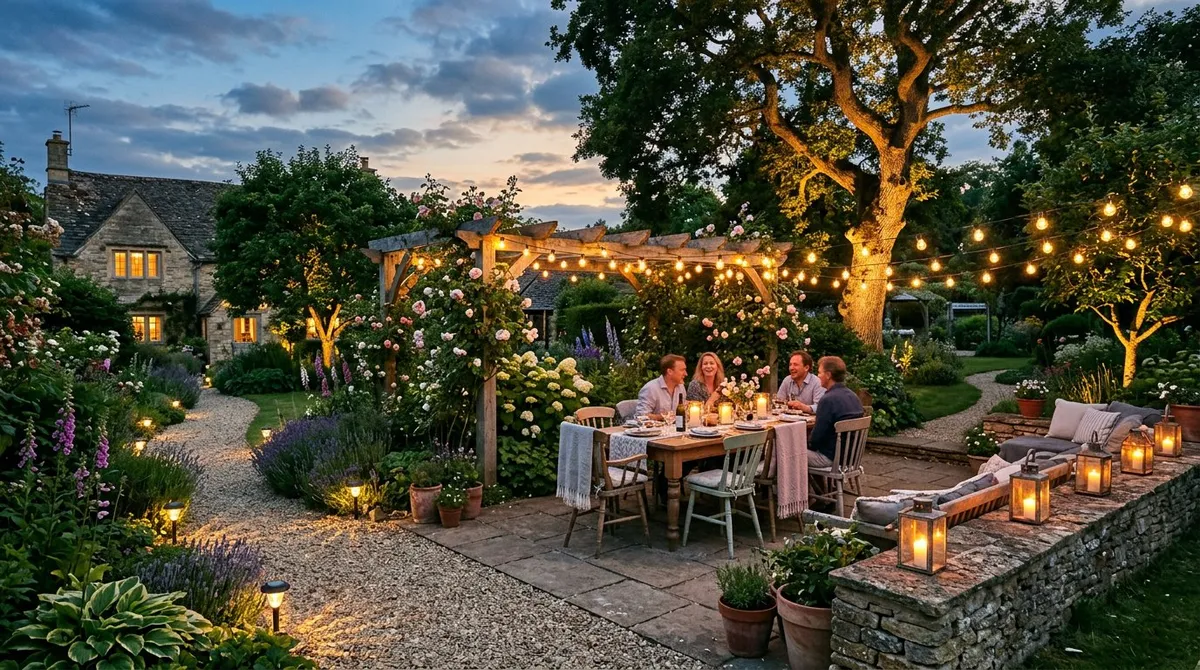
A well-lit garden is usable for twice as many hours per day. From May to September, warm evenings make the most of outdoor spaces. Good lighting extends that season into the darker months. It turns paths and borders into something worth looking at after sunset.
This guide focuses on practical choices rather than inspiration galleries. Which type of lighting suits your garden? What IP rating matters? How much does it cost to run? These are the questions that determine whether your lights last one winter or ten.
Types of garden lighting compared
Four power types cover every UK garden situation. Each has clear strengths and trade-offs.
| Feature | Solar | Mains (230V) | 12V plug-and-play | Battery |
|---|---|---|---|---|
| Brightness | Low-medium | Highest | Medium-high | Low-medium |
| Running cost | Free | 2-11 pounds/year | 2-8 pounds/year | Batteries only |
| Installation | DIY | Electrician required | DIY | No install needed |
| Winter performance | Reduced (25-35%) | Unaffected | Unaffected | Battery life shorter |
| Reliability | Weather-dependent | Most reliable | Very reliable | Requires recharging |
| Upfront cost | Lowest | Highest | Medium | Low |
| Best for | Paths, accents | Security, patios | Feature lighting | Temporary, events |
12V plug-and-play is the sweet spot for most gardens. You plug a transformer into a standard outdoor socket, then run low-voltage cable to your lights. No electrician needed. Bright enough for feature lighting. Reliable in all seasons. The transformer steps mains voltage down to a safe 12V. No shock risk if a cable is accidentally cut. Many professional garden designers now specify 12V systems over mains for this reason.
How many lumens do I need for garden lighting?
Lumens measure brightness. Getting this right prevents both wasted electricity and an uncomfortably bright garden.
| Area | Lumens per fixture | Notes |
|---|---|---|
| Path markers | 50-100 | Just enough to see the edge |
| Step lights | 30-50 | Recessed, angled downward |
| Patio ambient | 100-300 | Warm glow, not floodlit |
| Festoon/string lights | 15-40 per bulb | Decorative, not functional |
| Spotlights (trees/walls) | 300-600 | Focused beam, narrow angle |
| Pond/water features | 200-500 | Submersible, IP68 rated |
| Security floodlights | 700-1500 | Motion-activated, timed |
| Entrance/porch | 300-600 | Welcoming, visible from street |
A common mistake is buying lights that are too bright. Garden lighting should create atmosphere, not replicate daylight. If you can read a book by your path lights, they are too bright. The Energy Saving Trust confirms that LED replacements at lower wattage produce equivalent brightness to older halogen bulbs.
What IP rating do outdoor lights need?
IP (Ingress Protection) ratings tell you how well a light resists dust and water. The two digits matter: the first covers dust, the second covers water.
| Rating | Protection level | Garden use |
|---|---|---|
| IP33 | Rain-resistant only | Legal minimum for UK outdoor use |
| IP44 | Splash-proof from all angles | Sheltered positions: porches, covered patios |
| IP55 | Protected against water jets | Open areas with some shelter |
| IP65 | Fully dust-tight, water jet resistant | Exposed positions: paths, borders, open patios |
| IP67 | Submersible to 1m for 30 minutes | Ground-level recessed lights |
| IP68 | Continuous submersion | Pond and water feature lights |
For most UK gardens, IP65 is the safe default. British weather throws horizontal rain and standing water at garden fixtures. Buying IP44-rated lights for exposed positions leads to early failure and wasted money. Check the IP rating before buying, not after the light stops working in its first winter.
Solar versus mains lighting for UK gardens
Solar lights have improved a lot in the past five years, but they still have limits in a UK climate.
Solar works well for: Path markers, decorative stake lights, string lights for occasional use, and accent lighting in summer. Modern solar panels charge even on overcast days, though output drops. Position panels facing south and keep them clear of shadows from fences and trees.
Solar struggles with: Winter performance (25-35% of summer output), security lighting (not bright enough), and feature spotlighting (inconsistent brightness). A solar path light that runs for 8 hours in July may manage 2-3 hours in December.
Mains or 12V is better for: Consistent year-round use, security, high-brightness feature lighting, and anything you rely on nightly. The initial cost is higher, but you get predictable performance regardless of the season.
A good approach is to use solar lights for decorative accents and 12V or mains for the functional backbone. This keeps costs down while ensuring your paths and patio are always lit.
How to position garden lights
Placement matters more than the fixtures you buy. The same light looks natural or harsh depending on where you point it.
Uplighting: Place a spotlight at the base of a tree, wall, or architectural feature, angled upward. This creates dramatic shadows and highlights texture. Use narrow beam angles (15-25 degrees) for tall trees and wider beams (40-60 degrees) for walls. Uplighting works particularly well on garden paths with flanking hedges or specimen plants.
Downlighting: Mount lights high in trees, on walls, or under pergola beams pointing downward. This mimics moonlight and produces the most natural-looking illumination. It also reduces light pollution by directing light where it is needed. Good for dining areas and seating.
Path lighting: Space bollard or stake lights 2-3m apart along one side of a path. Alternating sides creates a more natural feel than marching them in a straight line. Keep fixtures low (30-50cm) to avoid glare at eye level.
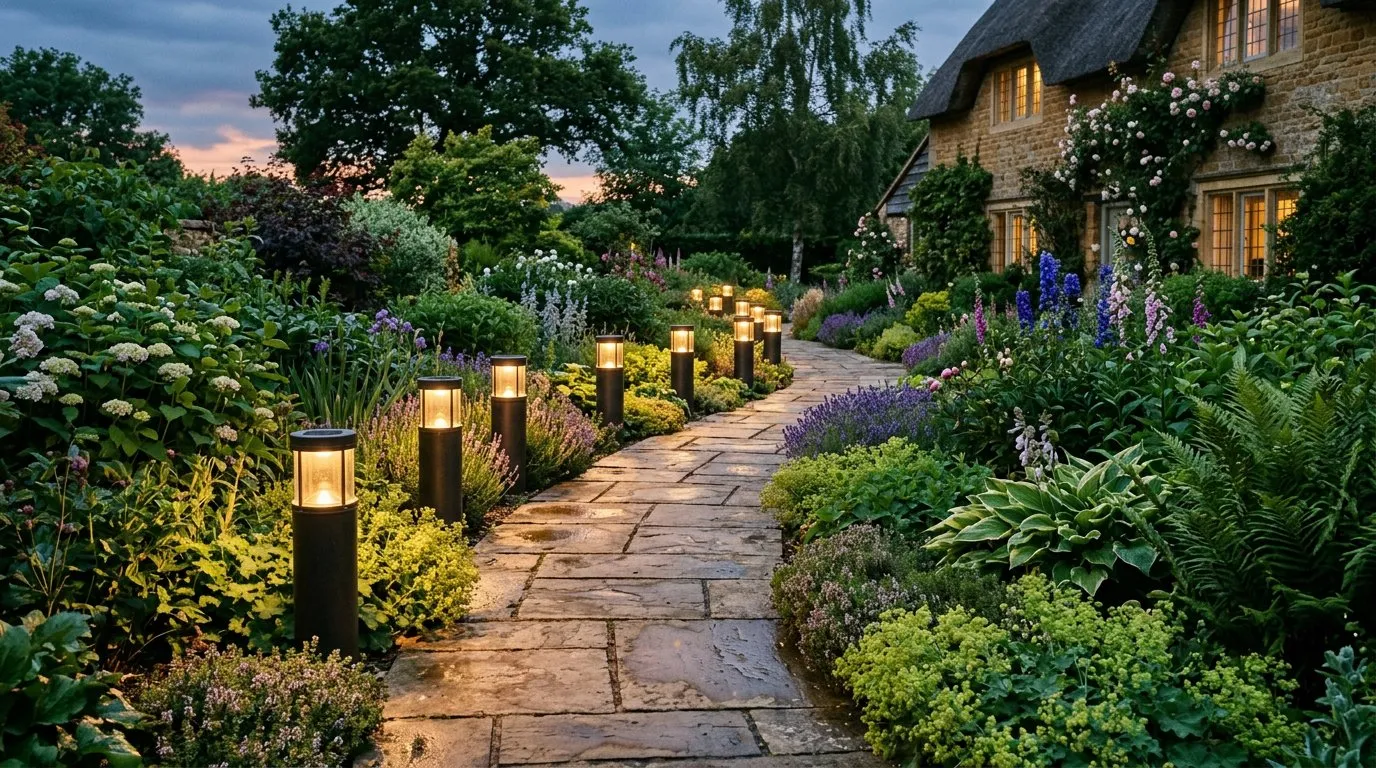
Solar-powered bollard lights guide the way along a curved stone path through a cottage garden at dusk.
Cross-lighting: Use two lights from different angles on a single feature. This eliminates the flat look of single-source lighting and adds depth. Effective on water features, statues, and specimen trees.
Silhouetting: Place a light behind a plant, pointing at a wall. The plant appears as a dark shape against a lit background. Architectural plants with strong outlines (bamboo, palm, ornamental grasses) work best.
Gardener’s tip: Before buying anything, walk your garden after dark with a torch. Hold it at different angles against trees and walls. Take photos. This 10-minute exercise shows you exactly where lights will have the most impact.
Running costs for garden lighting
LED technology has made outdoor lighting cheap to run. The old halogen spotlights that cost 30-40 pounds a year to run are obsolete.
Typical annual running costs (4 hours nightly, 25p/kWh):
| Setup | Wattage | Annual cost |
|---|---|---|
| 6 solar path lights | 0W (solar) | Free |
| 10 LED spotlights (5W each) | 50W | 18 pounds |
| 6 LED bollard lights (3W each) | 18W | 7 pounds |
| 20m festoon string (LED) | 8W | 3 pounds |
| 1 LED security floodlight (30W) | 30W | 11 pounds |
| Complete 12V system (20 fixtures) | 80-100W | 30-37 pounds |
Replace old halogen bulbs with LED equivalents and the energy saving pays for the new bulbs within 6-12 months. A 50W halogen spotlight produces similar brightness to a 5W LED at one-tenth the running cost. For a small garden design, even a full 12V system costs less per year than a monthly streaming subscription.
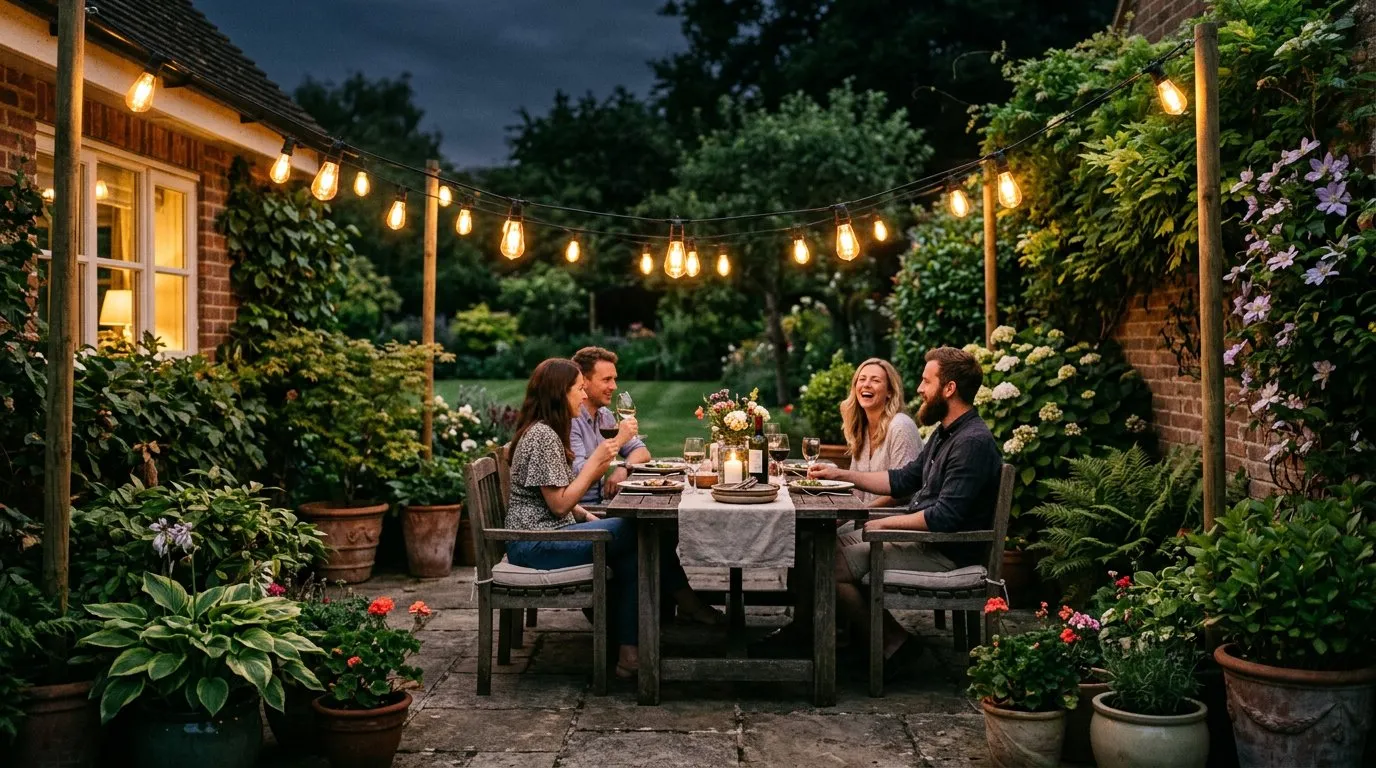
Festoon string lights create a warm, inviting glow over an outdoor dining area on a summer evening.
Wildlife-friendly garden lighting
Artificial light at night affects moths, bats, hedgehogs, and nesting birds. Getting the lighting right protects wildlife while still making your garden usable after dark.
The Bat Conservation Trust reports that light pollution contributes to bat population decline across the UK. Their guidance for garden lighting is clear:
- Use warm white LEDs at 2700K or below. Cool white (4000K+) disrupts insect behaviour most.
- Point all lights downward. Avoid upward-facing or unshielded fixtures near boundaries.
- Keep hedgerows, mature trees, and pond margins dark. These are wildlife corridors.
- Use timers or motion sensors rather than leaving lights on all night.
- Switch off garden lights by 11pm. This gives nocturnal animals undisturbed feeding hours.
Moths navigate by moonlight. Bright garden lights disorient them, pulling them away from feeding and breeding. Buglife estimates that moth populations in the UK have declined by 33% since 1968, with light pollution a contributing factor. Warm, downward-facing, low-brightness lighting does the least harm.
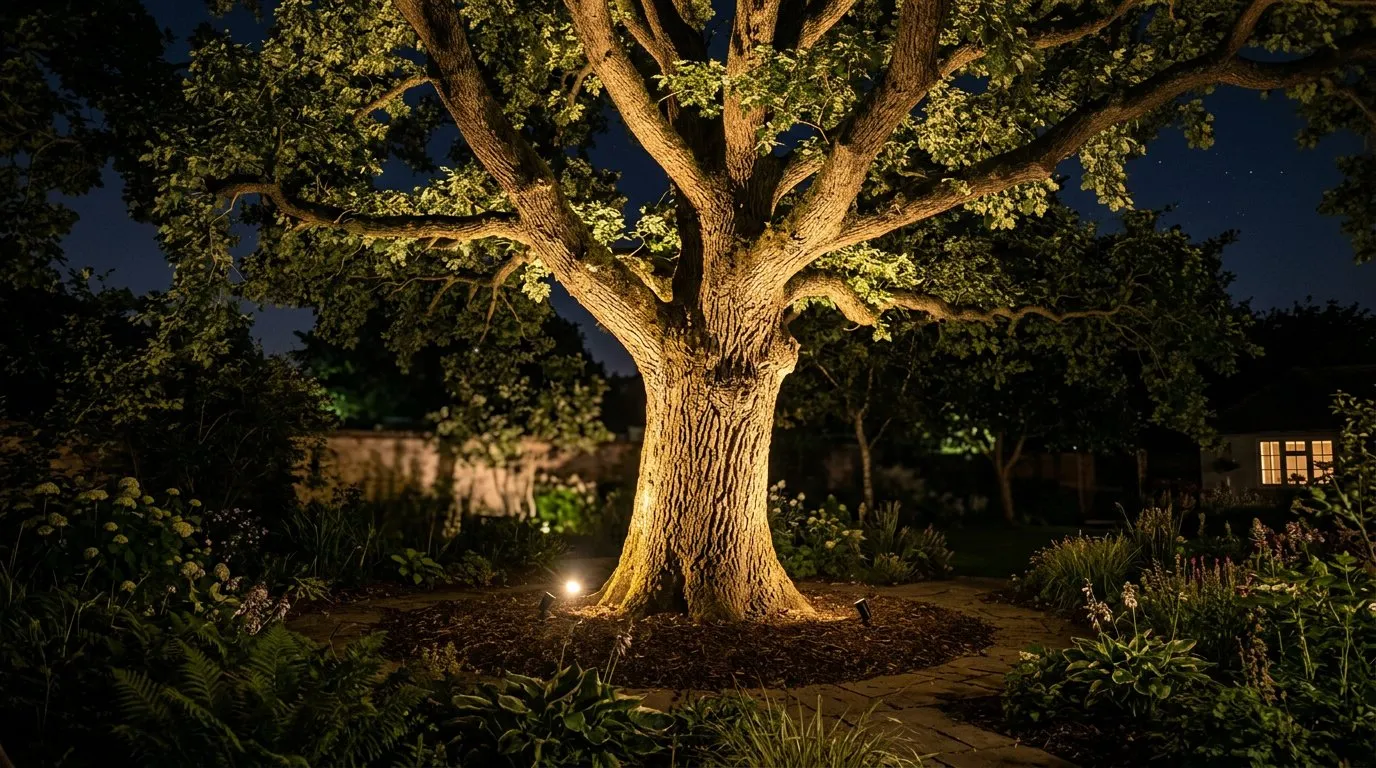
Uplighting highlights the bark texture and canopy of a mature tree, creating a dramatic focal point after dark.
If you enjoy attracting wildlife to your garden, consider leaving some areas permanently unlit. A dark corner with log piles and leaf litter is far more valuable to hedgehogs than another spotlight.
Smart garden lighting options
Smart outdoor lighting connects to your phone or voice assistant. Control brightness, colour, and on/off times without walking outside.
Philips Hue Outdoor is the most widely used smart system. Weatherproof (IP65), integrates with Alexa, Google Home, and Apple HomeKit. Individual lights cost 50-80 pounds each, plus a bridge unit. The app allows scheduling, colour changes, and brightness control from anywhere.
12V systems with smart plugs offer a cheaper route. Plug your existing 12V transformer into a smart plug (8-15 pounds) and control the whole system by voice or timer. No per-light control, but on/off and scheduling work well.
Solar smart lights exist but remain limited. Battery capacity restricts brightness and connectivity options. For now, smart mains or 12V systems are more reliable.
Why we recommend 12V plug-and-play systems over mains for most garden lighting projects: After 30 years of installing and advising on outdoor lighting, 12V systems consistently prove the best starting point. They require no electrician, pose no shock risk if a cable is cut by a spade, and deliver enough brightness for feature trees and entertaining areas. In every garden where we have specified them, owners have added circuits over the years without professional help — something mains systems never allow.
UK electrical regulations for outdoor lighting
Mains 230V outdoor electrical work falls under Part P of the Building Regulations in England and Wales. Non-compliance can result in fines up to 5,000 pounds and complications when selling your home.
What needs a qualified electrician: Any new mains circuit for outdoor lighting or buried mains cable runs. Also connections in bathrooms or within 3m of a swimming pool or pond.
What you can do yourself: 12V plug-and-play systems, solar lights, and battery lights. You can also replace like-for-like fittings on existing circuits.
Cable burial depth: Mains armoured cable must be buried at least 450mm deep, or 75mm deep if run through protective conduit. 12V cable needs no specific burial depth but should be protected from spade damage.
All outdoor mains circuits require RCD (residual current device) protection. This is a safety device that cuts the power in milliseconds if a fault is detected. Most modern consumer units have RCD protection built in, but older installations may need upgrading.
Seasonal lighting tips for UK gardens
Spring (March-May): Extend the evening as daylight grows. Position lights to highlight early blossom, spring bulbs, and fresh foliage. Solar lights start performing well again from March.
Summer (June-August): The main entertaining season. Focus on patio and dining area lighting. A raised deck with integrated step lights extends usable outdoor space into the evening. Festoon strings over seating areas create a relaxed feel for outdoor meals. Solar performance peaks.
Autumn (September-November): Warm-toned lighting suits autumn colours. Light specimen trees as leaves turn. Clean solar panels of fallen leaves to maintain output. Consider timer adjustments as clocks change.
Winter (December-February): Solar output drops to its lowest. Switch to mains or 12V for reliable lighting. Architectural uplighting works well on bare branches. Check IP ratings have held up through winter weather and replace any failed seals.
Frequently asked questions
What IP rating do I need for garden lights?
IP44 is the minimum for sheltered positions. Use IP65 for lights exposed to rain, such as path lights and open-area spotlights. IP67 or IP68 is needed for pond lights or anything at ground level where standing water collects.
Do solar garden lights work in winter UK?
Solar lights work but produce 25-35% of summer output. Shorter days and lower sun angle reduce charging. Position panels facing south and keep them clear of fallen leaves. Expect 2-4 hours of light per winter evening versus 6-8 in summer.
How many lumens do I need for garden lighting?
Path lights need 50-100 lumens each. Patio ambient lighting works at 100-300 lumens. Feature spotlights need 300-600 lumens. Security lights range from 700-1500 lumens. Use the lowest brightness that serves the purpose.
Do garden lights need an electrician?
Mains 230V outdoor lighting requires a Part P qualified electrician. 12V plug-and-play systems and solar lights are DIY-safe with no qualification needed. Battery lights require no installation at all.
How much does it cost to run garden lights?
A typical LED setup costs 2-11 pounds per year. Ten 5W LED spotlights running 4 hours nightly at 25p per kWh cost around 18 pounds annually. Solar and battery lights cost nothing to run beyond replacement batteries.
Are garden lights bad for wildlife?
Bright, cool-white lights disrupt moths, bats, and nesting birds. Use warm white LEDs (2700K or below), point them downward, and switch off by 11pm. Avoid lighting hedgerows and mature trees. The Bat Conservation Trust provides detailed guidance.
Now you’ve mastered garden lighting for outdoor spaces, read our guide on garden path ideas for the next step.
Further reading
- Small garden design ideas — making the most of limited space after dark
- Garden path ideas — paths that look even better with lighting
- Garden fence ideas — fence-mounted lighting options
- Front garden ideas — entrance lighting and kerb appeal
- Attract birds to your garden — wildlife-friendly outdoor practices
Lawrie has been gardening in the West Midlands for over 30 years. He grows his own veg using no-dig methods, keeps a wildlife-friendly garden, and writes practical advice based on real UK growing conditions.