Garden Room Ideas for the UK
Garden room ideas for the UK. Covers planning permission, insulation, costs from £5,000 to £30,000, and year-round use as offices and studios.
Key takeaways
- Permitted development allows garden rooms up to 2.5m high within 2m of a boundary without planning permission
- A fully insulated garden room with electrics costs £15,000 to £30,000 depending on size and specification
- 100mm wall insulation and double glazing keep a garden office comfortable from October to March
- A qualified electrician must run a dedicated circuit from the house consumer unit to the garden room
- Concrete pad, screw pile, and ground screw foundations suit different budgets and ground conditions
- Broadband reaches a garden room via Wi-Fi mesh, powerline adapters, or a direct ethernet cable run
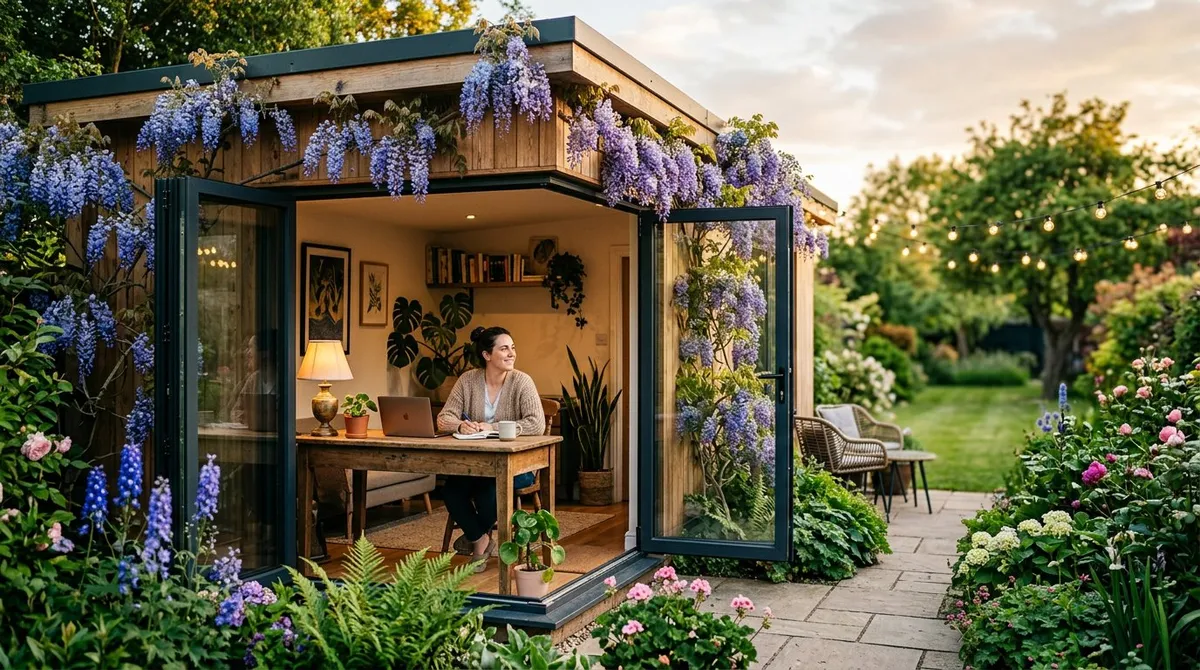
A garden room turns dead lawn into usable living space. Whether you need a home office, art studio, gym, or simply a quiet retreat from the house, a purpose-built garden building delivers it without an extension or loft conversion. The UK garden room market has grown sharply since 2020. Remote working made a dedicated workspace essential for millions of people. A spare bedroom doubles as an office, but a garden room separates work from home life entirely.
This guide covers every decision: planning rules, insulation, foundations, electrics, heating, broadband, and realistic costs. We focus on permanent, insulated structures rather than summer houses. For ideas on organising an existing outdoor building, see our garden shed ideas guide.
Do you need planning permission for a garden room?
Most garden rooms in the UK fall under permitted development rights. This means you do not need to apply for planning permission, provided you meet specific conditions set out by the Planning Portal.
The key rules for permitted development are straightforward. The building must not cover more than 50% of the total garden area. If the building sits within 2m of any boundary, the maximum height at the eaves is 2.5m. Flat-roofed buildings cannot exceed 2.5m overall. Pitched roofs are limited to 4m for a detached building or 3m if within 2m of a boundary.
The building must not include sleeping accommodation. It cannot be used as self-contained living space. No balconies, verandas, or raised platforms above 300mm are allowed.
Important exceptions: listed buildings and properties in conservation areas, Areas of Outstanding Natural Beauty, or National Parks have additional restrictions. In these cases, you may need full planning permission even for a small garden building. Always check with your local planning authority before ordering materials.
What about building regulations?
Building regulations and planning permission are separate requirements. A garden room under 15 square metres is generally exempt from building regulations, provided it contains no sleeping accommodation. Buildings between 15 and 30 square metres are exempt if placed at least 1m from any boundary and built from substantially non-combustible materials.
Electrical work must comply with Part P of the building regulations regardless of building size. A qualified electrician registered with a competent person scheme can self-certify the work.
Types of garden room and their uses
Garden rooms serve very different purposes. The specification you need depends entirely on how you plan to use the space.
| Use | Minimum size | Insulation needed | Electrics | Heating | Budget range |
|---|---|---|---|---|---|
| Home office | 3m x 3m | 100mm walls, double glazed | Full circuit, multiple sockets | Electric panel or infrared | £12,000-£25,000 |
| Art or music studio | 3m x 4m | 100mm walls, double glazed | Full circuit, good lighting | Electric panel | £15,000-£28,000 |
| Garden gym | 3m x 4m | 50-100mm walls | Full circuit, high-amp supply | Minimal (body heat) | £10,000-£20,000 |
| Guest room (needs planning) | 4m x 4m | 100mm+ walls, triple glazed | Full circuit, plumbing | Central heating or air source | £25,000-£40,000+ |
| Summer house | 2.5m x 3m | None or minimal | Optional lighting | None | £3,000-£8,000 |
| Therapy or treatment room | 3m x 3m | 100mm walls, double glazed | Full circuit, plumbing | Electric panel | £15,000-£30,000 |
A home office is the most popular choice. It needs full insulation, adequate heating, multiple electrical sockets, USB charging points, and reliable broadband. Sound insulation matters if you take video calls. For ideas on designing the space around your garden room, see our small garden design ideas.
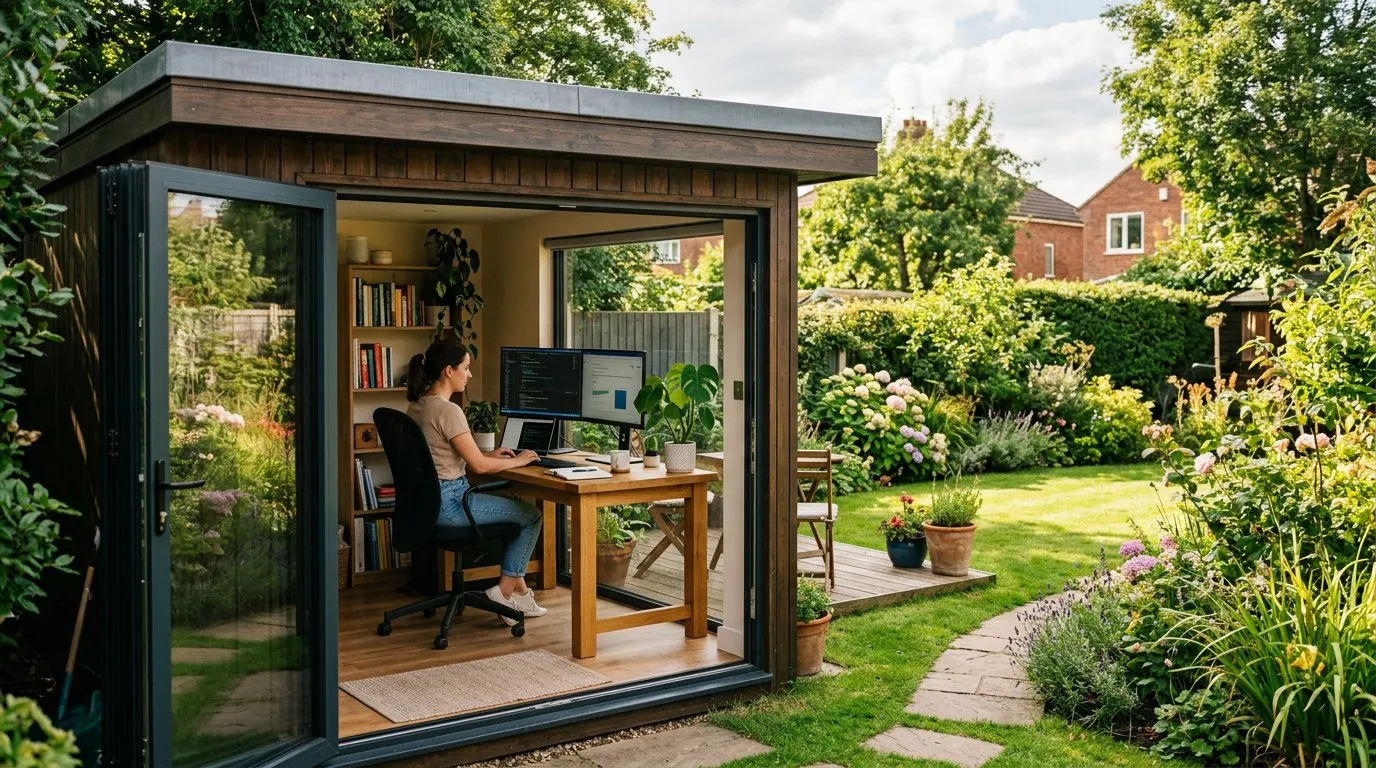
A well-specified garden room office with large glass doors gives you a dedicated workspace surrounded by greenery.
A garden gym has different demands. It needs a strong floor, ventilation rather than heating, and enough power for equipment. Impact-absorbing rubber flooring laid over a solid subfloor protects both you and the building.
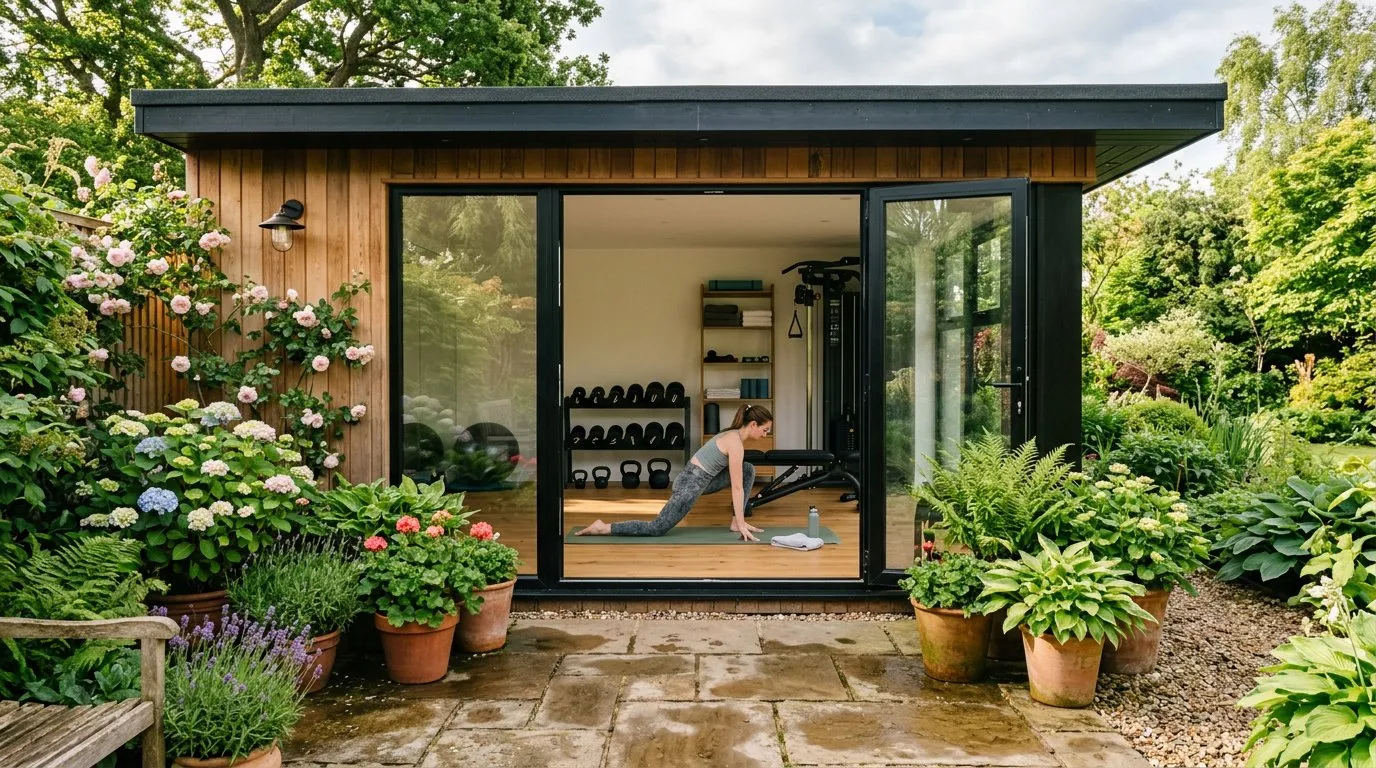
A garden room gym with glass doors and surrounding planting makes exercise feel less like a chore.
Insulation and year-round comfort
The difference between a summer house and a genuine garden room is insulation. Without it, the building is unusable from October to March.
Wall insulation
100mm rigid insulation boards (PIR or phenolic foam) fitted between the wall studs give a U-value of around 0.18 W/m2K. This matches the standard for new-build house walls. A vapour barrier on the warm side prevents condensation inside the wall cavity.
Cheaper builds use 50mm insulation. This works for spring-to-autumn use but leaves the room cold in deep winter. For year-round office use, 100mm is the minimum sensible specification.
Floor insulation
75-100mm rigid insulation laid over a damp-proof membrane and under the floor deck prevents cold rising from the ground. An uninsulated floor loses 15-20% of the room’s heat. It also feels cold underfoot, which is deeply uncomfortable during long working hours.
Roof insulation
Insulate between and below the rafters with 100-150mm of rigid board or mineral wool. The roof is the largest heat-loss surface. Vented air gaps above the insulation prevent condensation.
Double or triple glazing
Standard double glazing with a U-value of 1.2 W/m2K suits most garden rooms. Triple glazing (U-value 0.8 W/m2K) adds £1,000-£2,000 but makes a noticeable difference in buildings with large glass areas. Toughened safety glass is essential for doors and low-level windows.
Foundations: getting the base right
Every garden room needs a level, stable base. The foundation type depends on your budget, ground conditions, and how permanent the structure is.
| Foundation type | Cost (3m x 4m) | Installation time | Best for |
|---|---|---|---|
| Concrete pad | £500-£1,500 | 2-3 days (plus curing) | Heavy buildings, clay soil, permanent structures |
| Ground screws | £800-£2,000 | Half a day | Sloping sites, tree root zones, minimal disruption |
| Screw piles | £1,200-£2,500 | 1 day | Poor ground, heavy buildings |
| Paving slabs | £200-£500 | 1-2 days | Lighter summer houses, budget builds |
| Timber frame on bearers | £300-£800 | Half a day | Temporary or semi-permanent buildings |
A concrete pad is the most stable and durable option. It requires shuttering, mesh reinforcement, and 100-150mm of concrete. Allow 48 hours minimum for curing before building on it.
Ground screws avoid wet trades entirely. Steel screws are driven into the ground with a machine, and a steel or timber frame sits on top. They work well on sloping sites and can be removed later without trace.
Paving slabs on compacted hardcore suit lighter structures. Lay them on a 50mm sand bed over 100mm of compacted MOT Type 1 sub-base. Check levels carefully. An uneven base causes doors and windows to bind within months.
Electrics, heating, and broadband
These three services turn a garden building into a functional room. All three need planning before the build starts.
Electrical supply
A garden room needs a dedicated circuit from the house consumer unit, run through steel wire armoured (SWA) cable buried at least 500mm deep in a trench. Surface-mounted cable or extension leads are not safe and do not comply with building regulations.
A qualified electrician registered with NICEIC, NAPIT, or ELECSA must carry out the installation. Budget £1,500 to £3,000 for a full electrical fit-out including the trench, cable run, consumer unit in the garden room, sockets, lighting, and certification.
Heating options
A well-insulated 3m x 4m garden room needs only 1-2kW of heating. The most common options are:
- Electric panel radiators: £100-£300 each. Wall-mounted, thermostat-controlled, silent. Running cost approximately 30p per hour at 1kW.
- Infrared panels: £200-£500 each. Heat objects rather than air. More efficient in well-insulated spaces. Can be ceiling-mounted to save wall space.
- Underfloor heating mats: £300-£600 for a 12m2 room. Electric mats laid under vinyl or engineered wood. Even heat, no wall clutter. Slower to warm up.
- Air conditioning units: £600-£1,500 installed. Provide both heating and cooling. Ideal for south-facing rooms that overheat in summer.
Avoid fan heaters and oil-filled radiators as permanent solutions. They are inefficient, noisy, and create uneven temperatures.
Broadband
Working from a garden room demands reliable internet. The three main options are:
Wi-Fi mesh systems (£100-£250) place a satellite unit near the house wall closest to the garden room. Effective up to 20-30m with clear line of sight. Signal drops through thick walls, so position the satellite at a window facing the garden.
Powerline adapters with outdoor ethernet work if you bury armoured ethernet cable (Cat6 in conduit) in the same trench as the electrical supply. This gives wired-speed internet. Plan the conduit before the trench is filled.
A direct ethernet cable in its own conduit from your router to the garden room gives the most reliable connection. Bury it alongside the electrical cable but in a separate conduit. This is the best option for video calls and large file transfers.
Choosing a UK garden room supplier
The UK market ranges from flat-pack self-assembly kits to fully project-managed bespoke builds. Three established suppliers illustrate the range.
Crane Garden Buildings (Norfolk) build traditional timber garden rooms with painted cladding and Georgian windows. Their rooms start at around £8,000 for a small summer house and rise to £25,000+ for insulated studios. Lead times are typically 8-12 weeks.
Garden Spaces (Oxfordshire) specialise in contemporary insulated garden offices. Their Quad and Studio ranges feature floor-to-ceiling glazing, integrated electrics, and full insulation. Prices start at approximately £18,000 for a 3m x 3m office.
Malvern Collection (Worcestershire) offer a broad range from traditional summer houses to fully insulated garden rooms. Their Studio range starts at around £12,000. They supply nationwide with regional installation teams.
Always visit a show site before ordering. Brochure images rarely communicate build quality, insulation thickness, or the feel of the finished space. Ask to see the wall construction in section. Check what is included in the price: foundation, electrics, and internal finishing are often extras.
Planning the interior layout
A garden room works best when the interior is planned as carefully as the structure. A 3m x 4m space is generous for one person but tight for two.
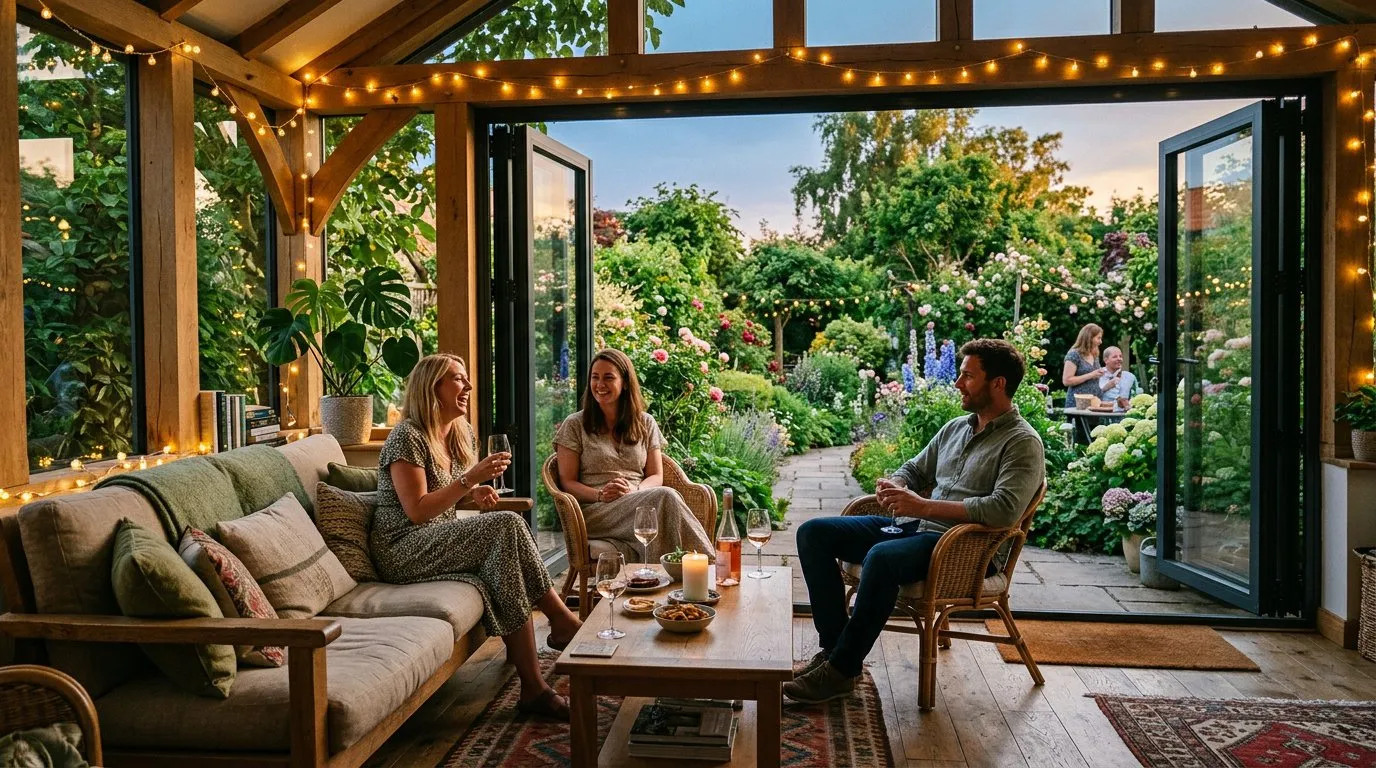
Bi-fold doors blur the line between indoors and garden, making a garden room ideal for entertaining on summer evenings.
Home office layout: Place the desk facing the garden, not the wall. Natural light reduces eye strain and improves concentration. Position the screen perpendicular to the window to avoid glare. Allow 1.2m behind the chair for movement.
Storage: Built-in shelving along one wall uses space efficiently. Avoid freestanding furniture that blocks floor area. A 300mm-deep shelf unit holds most office supplies without protruding into the room.
Acoustic treatment: For video calls and recording, add acoustic panels to at least one wall and the ceiling. Dense curtains over glass doors reduce echo. This matters more than most people expect in a hard-surfaced timber building.
Why we recommend infrared panels over electric radiators for garden room heating: After 30 years of advising on garden buildings, infrared panels consistently outperform panel radiators in well-insulated rooms. They heat objects and people directly rather than warming air that escapes every time the door opens. In a 3m x 4m insulated room, a 600W infrared ceiling panel maintains a comfortable working temperature while a 1.5kW panel radiator struggles. Running costs are typically 20-30% lower for the same perceived warmth.
Lighting: North-facing rooms need supplementary lighting even during the day. Overhead LED panels (4000K daylight) suit offices. Warmer task lighting (3000K) works for studios and therapy rooms. Garden lighting along the path from house to garden room is essential for dark winter mornings.
Garden room cost breakdown
Total costs depend on size, specification, and how much you do yourself. Here is a realistic breakdown for a 3m x 4m insulated garden office.
| Item | DIY/budget | Mid-range | High-end |
|---|---|---|---|
| Structure (walls, roof, windows) | £5,000-£8,000 | £12,000-£18,000 | £20,000-£30,000 |
| Foundation | £200-£500 | £800-£1,500 | £1,500-£2,500 |
| Insulation | Included | Included | Included |
| Electrics (full circuit) | £1,500-£2,000 | £2,000-£3,000 | £3,000-£4,000 |
| Heating | £100-£300 | £300-£600 | £600-£1,500 |
| Internal finishing | £500-£1,000 | £1,000-£2,000 | £2,000-£4,000 |
| Broadband solution | £100-£250 | £100-£250 | £250-£500 |
| Path and landscaping | £200-£500 | £500-£1,500 | £1,500-£3,000 |
| Total | £7,600-£12,550 | £16,700-£26,850 | £28,850-£45,500 |
The structure itself is 60-70% of the total cost. Electrics and foundations add another 20-25%. Do not underestimate the cost of internal finishing, the path from the house, and landscaping around the building. These finishing touches determine whether the garden room feels professional or temporary.
Common mistakes with garden rooms
1. Skipping proper insulation
A garden room used only in summer does not need insulation. A year-round office does. The difference in cost between an uninsulated and fully insulated build is typically £2,000-£4,000, but the difference in usability is enormous. Do not cut corners on insulation and expect to compensate with heating. The energy costs will exceed the saving within two winters.
2. Running extension leads from the house
An extension lead through a window or cat flap is a fire risk and does not comply with regulations. It also limits power to a single socket and trips the house breaker if you plug in a heater. A proper SWA cable installation costs £1,500-£3,000 and is worth every penny.
3. Ignoring ventilation
An insulated, sealed box gets stuffy quickly. A single occupant generates enough moisture and CO2 to make a 3m x 3m room uncomfortable within hours. Include at least two openable windows on different walls for cross-ventilation. A trickle vent in the roof helps in summer.
4. Forgetting the path
A garden room at the end of a muddy lawn is a chore to reach in November. A proper path, whether paving slabs, gravel, or decking, makes the garden room feel connected to the house. Outdoor lighting along the path is essential for winter use.
5. Underestimating lead times
Popular suppliers have lead times of 8-16 weeks. Foundation preparation, electrical trenching, and internal finishing add further time. If you need a garden office by September, order in May at the latest. Planning in winter means the build happens in spring when ground conditions are best.
How a garden room adds value to your home
Estate agents report that a quality garden office adds £15,000-£25,000 to a property’s value, often more than the cost of installation. Remote working has made a dedicated home office a sought-after feature for buyers.
A well-built garden room also extends the usable living space of a property without the disruption of a house extension. It avoids months of building work inside the home. It requires no structural changes to the house itself.
For front garden properties, a side-access garden room can improve kerb appeal if the building and landscaping are designed together. In smaller gardens, clever positioning near the house minimises the cable run and maximises remaining garden space.
Now you’ve mastered garden room ideas, read our guide on garden shed ideas and organisation for the next step.
Frequently asked questions
Do I need planning permission for a garden room UK?
Most garden rooms fall under permitted development. The building must stay below 2.5m at the eaves within 2m of a boundary, cover less than 50% of the garden, and not be used as separate living accommodation. Check the Planning Portal for the full rules. Listed buildings and conservation areas have stricter requirements.
How much does a garden room cost in the UK?
A basic uninsulated summer house costs £3,000 to £5,000. A fully insulated garden office with electrics and double glazing costs £15,000 to £25,000. Bespoke builds with plumbing and premium finishes reach £30,000 or more. Budget £2,000-£4,000 on top for foundation, path, and landscaping.
Can I use a garden room as a home office?
Yes, a garden room makes an excellent home office with the right specification. It needs 100mm wall insulation, double glazing, a dedicated electrical circuit, heating, and reliable broadband. HMRC allows self-employed workers to claim a proportion of running costs. The separation from the house creates a genuine boundary between work and home life.
How do I heat a garden room in winter?
Electric panel heaters or infrared panels are the most practical options. A well-insulated 3m x 4m room needs only 1-2kW of heating. Underfloor heating mats work well under vinyl or engineered wood. Air conditioning units provide both heating and cooling for south-facing rooms that overheat in summer.
What foundation does a garden room need?
A concrete pad is the most stable option, costing £500 to £1,500 for a 3m x 4m room. Ground screws avoid wet trades and suit sloping sites, costing £800 to £2,000. Paving slab bases suit lighter structures at £200 to £500. The ground must be level and free-draining.
How do I get broadband in a garden room?
A Wi-Fi mesh system reaches most garden rooms within 30m of the house. Powerline adapters with outdoor ethernet cable give a wired connection. A direct Cat6 ethernet cable buried in conduit alongside the electrical supply gives the fastest and most reliable speed for video calls and large file transfers.
Do I need building regulations for a garden room?
Buildings under 15 square metres with no sleeping accommodation are generally exempt. Buildings between 15 and 30 square metres are exempt if placed at least 1m from any boundary. All electrical work must comply with Part P. A registered electrician can self-certify the installation through their competent person scheme.
Lawrie has been gardening in the West Midlands for over 30 years. He grows his own veg using no-dig methods, keeps a wildlife-friendly garden, and writes practical advice based on real UK growing conditions.