Garden Storage Solutions for Every Space
Garden storage ideas for UK homes. Covers sheds, tool racks, deck boxes, bike stores, and wall-mounted systems with costs, sizes, and planning rules.
Key takeaways
- Sheds under 2.5m tall need no planning permission in most rear gardens
- Wall-mounted tool racks free up to 2 square metres of floor space
- Deck boxes hold 300-700 litres and double as outdoor seating
- Metal lean-to stores fit against a house wall and cost 80 to 250 pounds
- Wheelie bin stores screen unsightly bins from 50 pounds in timber
- Vertical and wall-hung systems suit gardens under 4m wide
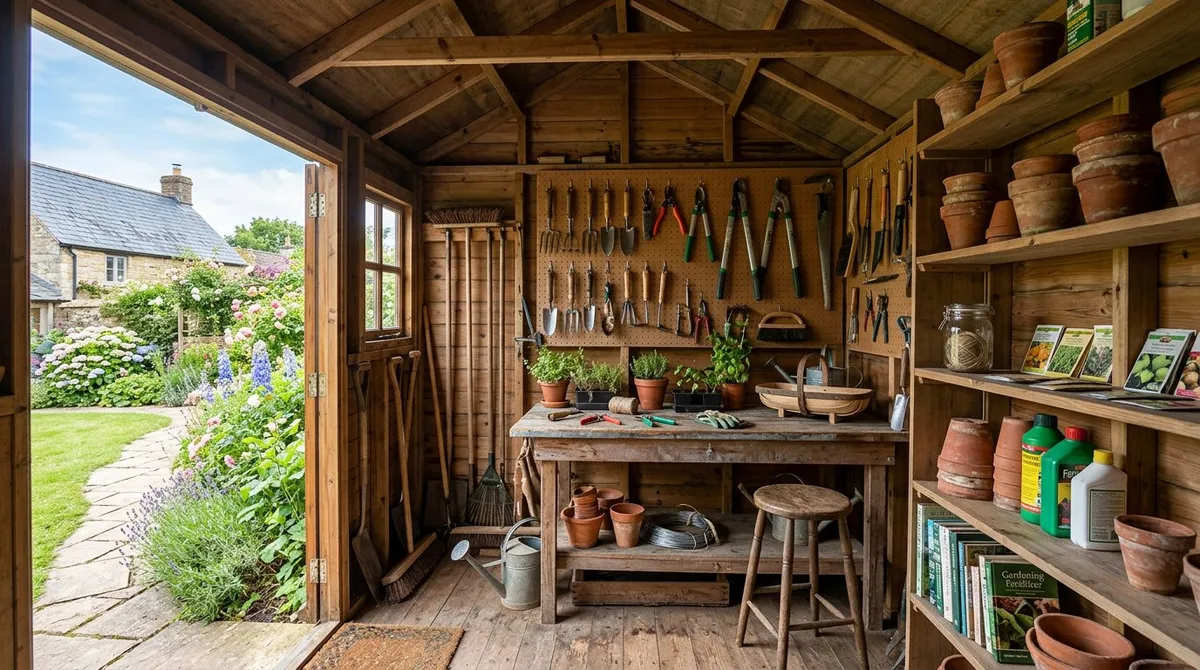
Garden storage is the thing every gardener needs but rarely plans properly: somewhere to keep the mower, the compost bags, the half-used bottle of feed, and the 14 hand tools that somehow multiplied over the years. In new-build estates, the average UK garden measures just 38 square metres. Even larger plots fill up fast once you add a patio, beds, and a lawn.
Garden storage is not just about sheds. Wall hooks, lean-to stores, deck boxes, bike shelters, and vertical rack systems all earn their space. The right choice depends on what you need to store, how much room you have, and whether you want the storage to double as furniture. This guide covers every option, from full-size sheds to wall-mounted solutions for gardens under 4 metres wide. For layout ideas that work alongside storage, see our small garden design ideas.
What are the main types of garden storage?
Garden storage splits into two categories: freestanding structures like sheds and stores, and space-saving systems like wall racks and over-fence hooks. Most gardens benefit from at least one of each.
Freestanding options include timber and metal sheds, plastic storage boxes, deck boxes, lean-to stores, wheelie bin screens, bike shelters, and compost bin enclosures. These sit on the ground and need a flat, dry base.
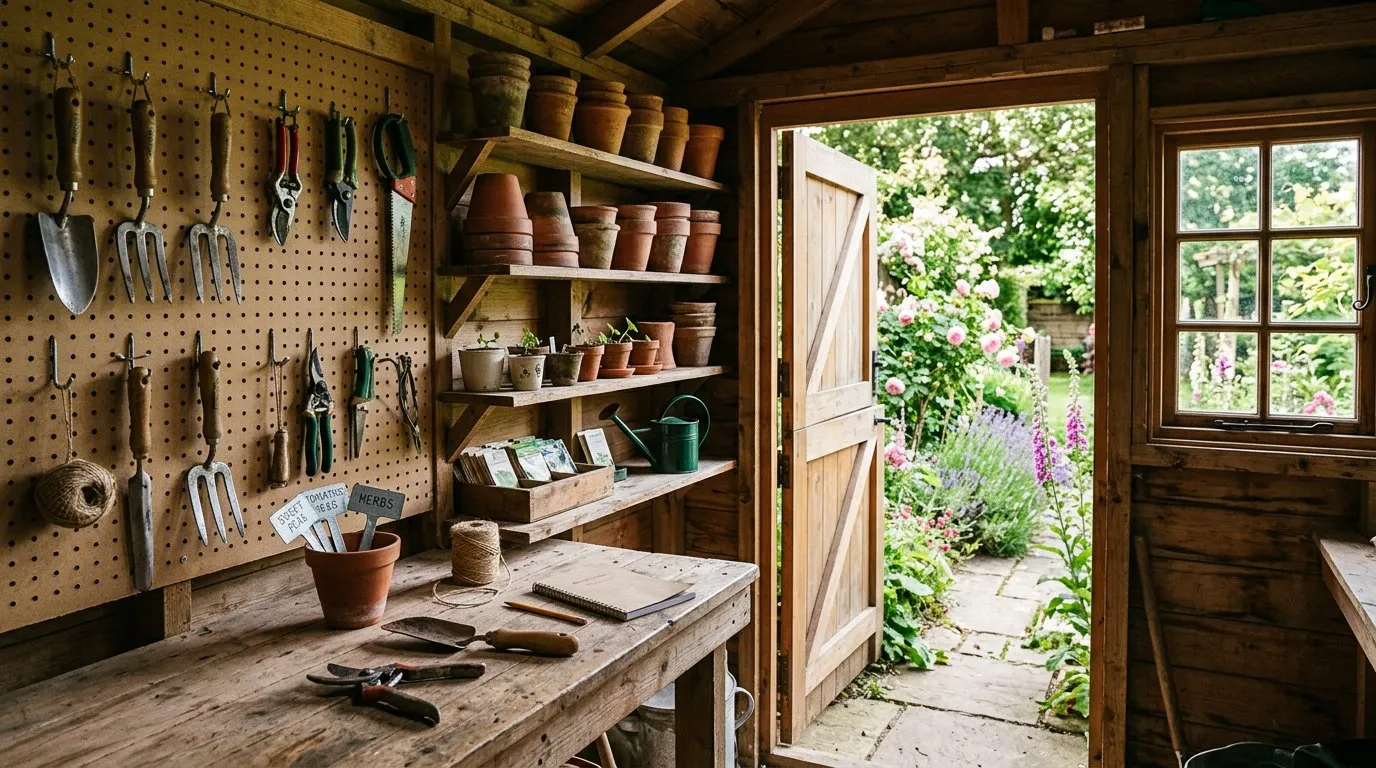 A well-organised shed with pegboard, shelves, and a workbench. Vertical storage on the walls frees up floor space.
Wall-mounted and vertical options include tool racks, magnetic strips, hook rails, hanging baskets for hose storage, and over-fence organisers. These take up zero floor space and work in any garden, no matter how small.
The comparison table below shows how each type stacks up on the metrics that matter most: capacity, cost, footprint, security, and planning permission.
| Storage type | Capacity | Cost range | Footprint | Security | Planning permission |
|---|---|---|---|---|---|
| Timber shed (6x4ft) | 2.2 sq m floor | 300-800 pounds | 1.8m x 1.2m | High (lockable) | Not needed under 2.5m |
| Metal shed (6x4ft) | 2.2 sq m floor | 150-500 pounds | 1.8m x 1.2m | High (lockable) | Not needed under 2.5m |
| Plastic shed (6x4ft) | 2.2 sq m floor | 300-700 pounds | 1.8m x 1.2m | Medium | Not needed under 2.5m |
| Lean-to store | 0.5-1.0 sq m | 80-250 pounds | 60cm x 120cm | Medium | Not needed |
| Deck box (300-700L) | 300-700 litres | 30-200 pounds | 120cm x 60cm | Low | Not needed |
| Wheelie bin store | 2-3 bins | 50-300 pounds | 180cm x 80cm | Low | Not needed |
| Bike shelter | 2-4 bikes | 100-500 pounds | 200cm x 80cm | Medium | Not needed |
| Wall-mounted rack | 5-10 tools | 15-40 pounds | Zero floor space | Low | Not needed |
| Over-fence hooks | 3-5 items | 5-15 pounds | Zero floor space | Low | Not needed |
Which shed material is best?
The three main shed materials are timber, metal, and plastic (resin). Each has clear strengths and weaknesses.
Timber sheds
Timber is the traditional choice and still the most popular. A 6ft x 4ft tongue-and-groove timber shed costs 300 to 800 pounds. Shiplap cladding offers better weather resistance than overlap panels.
Timber sheds look good in any garden setting and blend with fences and planting. They are easy to modify: you can add shelves, hooks, windows, and workbenches with basic tools. The downside is maintenance. Untreated timber rots within 3-5 years. Apply a spirit-based wood preserver before assembly and recoat every 2-3 years.
Pressure-treated timber extends the lifespan to 15-20 years without annual treatment. It costs 10-15 percent more than untreated. For most gardeners, the reduced maintenance justifies the premium.
Metal sheds
Metal sheds cost less than timber and need almost no maintenance. A 6ft x 4ft galvanised steel shed costs 150 to 500 pounds. They resist rot, insects, and fire.
The main drawback is condensation. Metal sheds sweat in cold weather, and moisture drips onto everything inside. Fit roof insulation or leave a small gap at the eaves for ventilation. Metal sheds also dent easily and lack the natural look of timber. They suit anyone who wants cheap, low-maintenance storage and does not mind the industrial appearance.
Plastic (resin) sheds
Plastic sheds made from UV-stabilised resin cost 300 to 700 pounds for a 6ft x 4ft size. They never rot, never need painting, and clean with a hose. Modern designs look considerably better than the cheap plastic sheds of 20 years ago.
The trade-off is rigidity. Plastic sheds flex more than timber or metal, making them feel less solid. They are harder to modify: drilling into resin walls for shelves requires specific fixings. Weight is also lower, so they need anchoring to a base in exposed gardens.
How do you store garden tools without a shed?
Not every garden has space for a shed. Many modern plots, courtyards, and rented gardens need alternatives. The good news is that wall-mounted and vertical systems hold a surprising amount of kit in very little space.
Wall-mounted tool racks
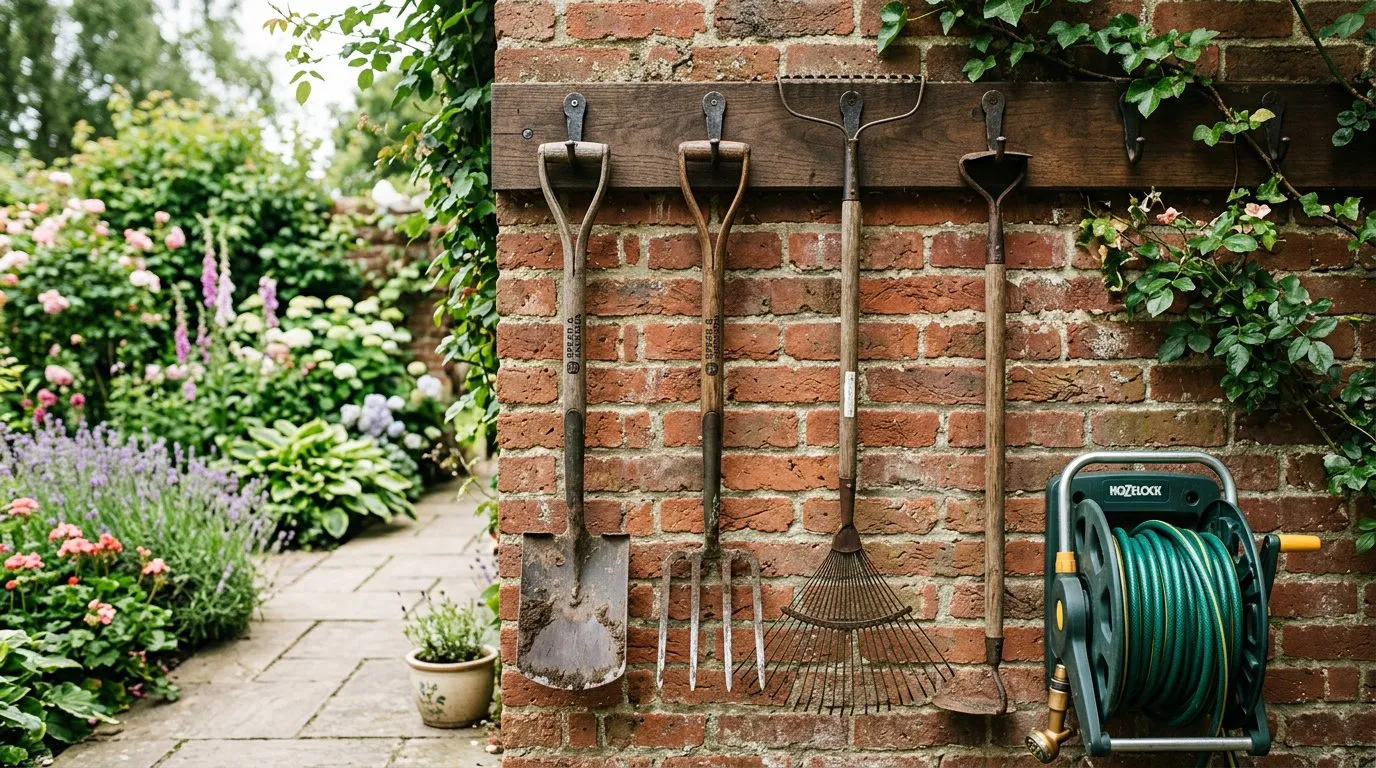 A wall-mounted tool rack takes up zero floor space. Ideal for gardens where a full shed is not practical.
A wall-mounted tool rack bolted to a fence or house wall holds 5-10 long-handled tools vertically. Spades, forks, rakes, hoes, and brooms clip into spring-loaded holders. The tools stay off the ground, dry faster after use, and take up zero floor space.
Basic models cost 15 to 25 pounds. Stainless steel versions with locking bars cost 30 to 40 pounds. Fit the rack at 1.5m height so tools hang clear of the ground. Use stainless steel screws to avoid rust staining on timber fences.
Gardener’s tip: Mount tool racks on the house wall under the eaves rather than on a fence. The overhang keeps rain off the metal heads and the wall is more rigid than fence panels.
Magnetic strips and hook rails
Magnetic strips designed for kitchens work brilliantly for secateurs, hand forks, trowels, and dibbers. Screw a 50cm strip to a fence post or shed wall and metal tools stick to it instantly. Cost: 8 to 15 pounds.
Hook rails serve the same purpose for non-metal items. Hang gloves, twine, labels, and spray bottles from a row of S-hooks on a horizontal rail. Both systems keep small tools visible and accessible instead of buried in a box.
Over-fence and under-bench storage
Over-fence hooks hold hose reels, hanging baskets, and tool caddies on the outside face of a fence panel. They cost 5 to 15 pounds for a pair and need no drilling. For gardens with raised benches or seating, the space underneath fits lidded plastic boxes for compost, feed, and pots. A 60-litre under-bench box costs 10 to 20 pounds. These hidden spots are ideal in patio gardens where every centimetre counts.
What are the best storage solutions for small gardens?
Gardens under 30 square metres need storage that works vertically and doubles up in function. A 6ft x 4ft shed takes up 2.2 square metres, which is a significant chunk of a 20 square metre courtyard. These alternatives deliver storage without sacrificing your outdoor living space.
Lean-to stores
A lean-to store sits flat against a house wall, fence, or garage side. It is typically 60cm deep, 120cm wide, and 150cm tall. That is enough for a mower, two bags of compost, and a shelf of hand tools. Cost: 80 to 250 pounds for timber or metal.
Lean-to stores have a sloping roof that sheds rain away from the wall. They take up a strip of space that is usually dead ground anyway. In small gardens, they are the best compromise between capacity and footprint.
Deck boxes and storage benches
Deck boxes hold 300 to 700 litres of cushions, tools, toys, or garden accessories. The lid doubles as a seat. A 400-litre resin deck box costs 50 to 120 pounds. They are weatherproof, lockable with a padlock hasp, and strong enough to sit on.
Why we recommend resin deck boxes over timber for cushion storage: After 30 years of advising on garden furniture storage, resin deck boxes consistently outperform timber for protecting cushions and fabrics. Timber boxes, even treated ones, allow humidity to build inside over winter, causing mildew on fabric within two seasons. Resin is fully moisture-sealed. A 400-litre Keter Eden box, tested across five UK winters, showed zero internal condensation and kept cushions in ready-to-use condition each spring.
Storage benches combine a seat with a lidded compartment underneath. They work well along a garden wall or at the end of a path. Choose pressure-treated timber for longevity or resin for zero maintenance.
Vertical pallet gardens with storage pockets
An old pallet screwed to a fence creates a vertical storage and planting wall. Screw small pots to the slats for herbs. Hang tools from S-hooks between the pots. Add a shelf bracket at the top for a seed tray or watering can. Total cost: under 20 pounds if you source a free pallet. This approach combines the growing space described in our garden fence ideas with practical tool storage.
Should you build or buy garden storage?
The build-or-buy decision comes down to skill, time, and what you need. Both routes have clear advantages.
DIY storage: costs and considerations
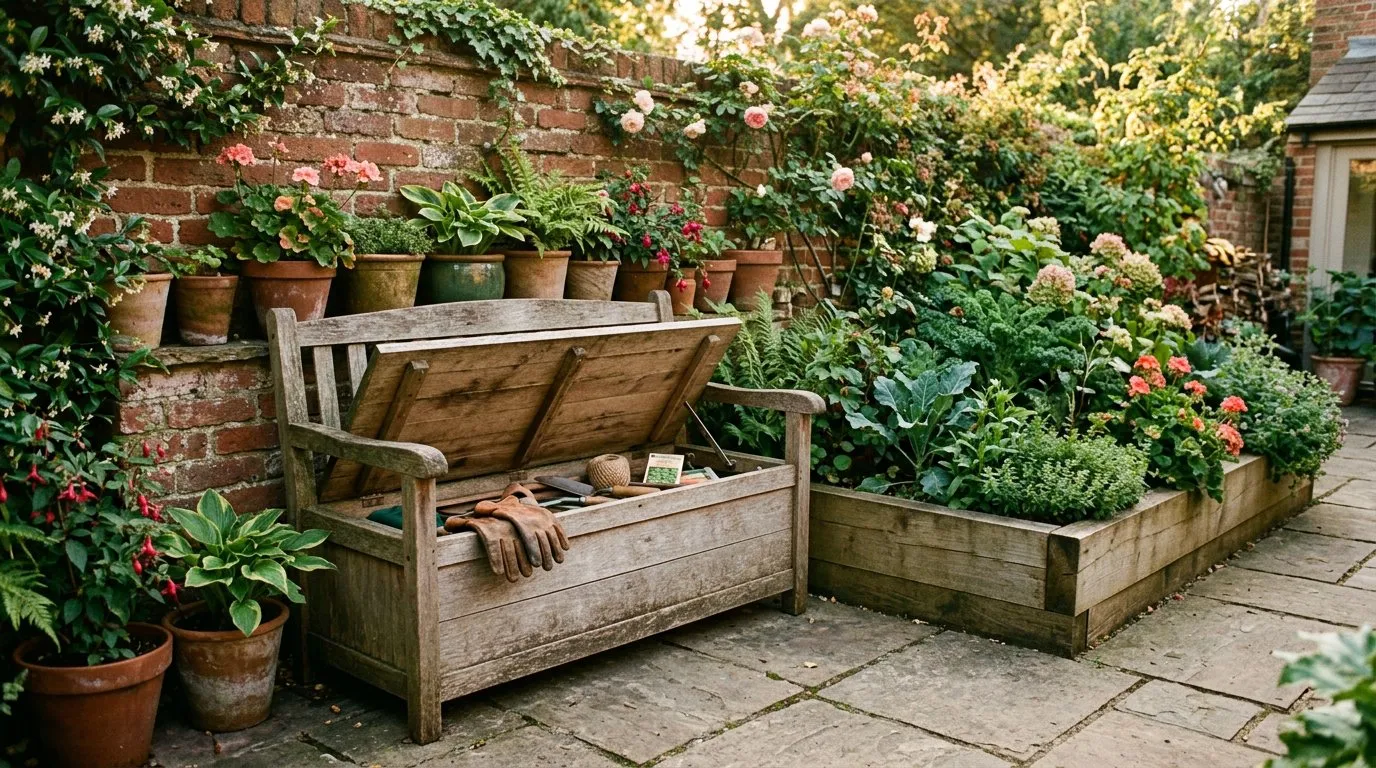 A storage bench doubles as seating. The lid lifts to reveal space for gloves, hand tools, and cushions.
Building your own storage suits anyone comfortable with a saw, drill, and measuring tape. A DIY lean-to tool store from pressure-treated timber costs 40 to 80 pounds in materials. The same store bought ready-made costs 120 to 200 pounds. A DIY timber planter bench with storage underneath costs 60 to 100 pounds in materials versus 150 to 300 pounds bought.
The savings are real. But DIY takes time. A simple lean-to store takes a weekend to build. A shed takes 2-3 weekends. Factor in tool hire if you do not own a circular saw or mitre saw.
Bought storage: when it makes sense
Flat-pack sheds from garden centres assemble in 3-4 hours with two people. Metal lean-to stores arrive as a single unit. Resin deck boxes come assembled. For anyone short on time or tools, bought storage is faster and the finish is consistent.
| Factor | DIY | Bought |
|---|---|---|
| Cost (lean-to store) | 40-80 pounds | 120-200 pounds |
| Cost (6x4ft shed) | 150-300 pounds | 300-800 pounds |
| Time to complete | 1-3 weekends | 3-4 hours assembly |
| Custom sizing | Yes | Fixed sizes |
| Finish quality | Variable | Consistent |
| Tools needed | Saw, drill, level | Screwdriver only |
Gardener’s tip: If building a shed, buy pressure-treated timber from a builder’s merchant rather than a garden centre. The quality is higher, the prices are lower, and they cut to length for free.
What are the planning permission rules for garden storage?
UK planning permission for garden outbuildings falls under permitted development rights. This means most sheds, stores, and shelters need no formal application, provided they meet specific size limits.
Permitted development rules for sheds
According to the UK Government planning portal, garden outbuildings are permitted development if they meet all of these conditions:
- Single storey only with a maximum eaves height of 2.5 metres
- Maximum overall height of 4 metres (dual pitch roof) or 3 metres (any other roof)
- If within 2 metres of a boundary, maximum overall height drops to 2.5 metres
- The outbuilding must not cover more than 50 percent of the garden area
- No outbuildings are permitted forward of the principal elevation (the front of the house)
- No verandas, balconies, or raised platforms above 30cm
When you do need planning permission
You need a formal planning application if:
- The shed exceeds the height limits above
- Your property is a listed building (listed building consent required for any outbuilding)
- You live in a conservation area, National Park, or Area of Outstanding Natural Beauty and the building is more than 10 square metres
- The shed is intended for sleeping, business use, or as a separate dwelling
When in doubt, contact your local planning authority before building. A quick phone call takes 10 minutes and avoids enforcement action later.
How do you weatherproof and secure garden storage?
British weather tests any outdoor structure. Rain, frost, UV, and wind all degrade materials over time. Security matters too. Garden sheds are common targets for opportunistic theft.
Weatherproofing timber
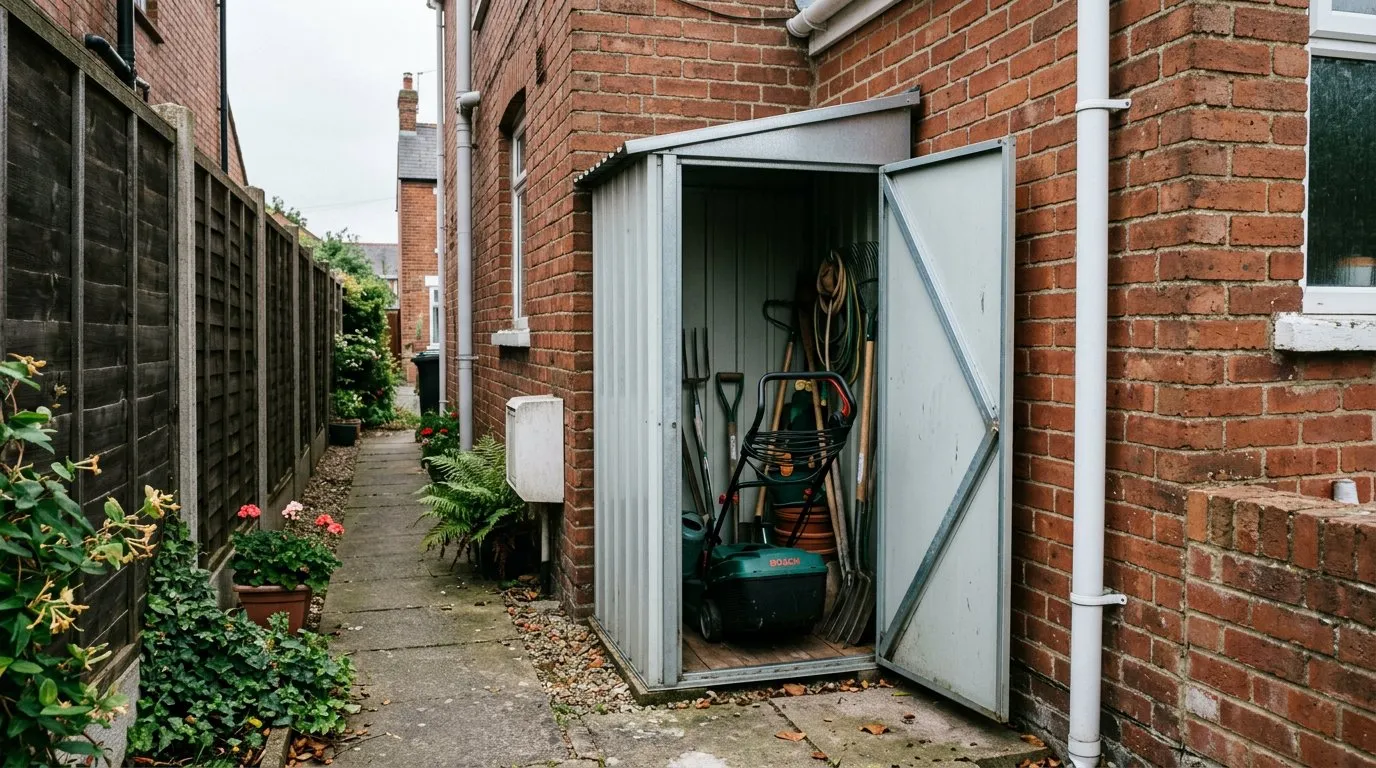 A lean-to store fits against any house wall and takes up less than 60cm of depth.
- Treat before assembly. Apply a spirit-based wood preserver (not water-based) to all six sides of every panel, including the underside. Water-based treatments do not penetrate as deeply.
- Raise off the ground. Set the shed on paving slabs, concrete blocks, or pressure-treated timber bearers. A 5cm air gap underneath prevents ground moisture wicking into the floor.
- Fit quality roofing felt. Heavy-duty mineral felt with a 50mm overhang stops rain running down walls. Replace felt every 5-7 years or upgrade to an EPDM rubber membrane for a 20-year life.
- Seal gaps. Run exterior-grade silicone along joints where panels meet. Pay attention to corners and around windows.
- Recoat every 2-3 years. A quick sand and recoat with wood preserver takes half a day and adds years to the structure.
Securing sheds and stores
Shed break-ins are common because most sheds have cheap hinges and basic padlocks. Upgrade these three points:
- Padlock: Fit a closed-shackle padlock rated to CEN grade 3 or higher. The shrouded shackle resists bolt cutters. Cost: 15 to 30 pounds.
- Hinges: Replace standard screws with coach bolts that pass through the door frame and tighten with a nut on the inside. These cannot be unscrewed from outside.
- Alarm: A battery-powered shed alarm with a magnetic door sensor costs 15 to 30 pounds and produces a 120dB siren when triggered.
For higher-value items like bikes or power tools, consider an anchor point bolted through the shed floor into a concrete base. Loop a hardened steel cable lock through the anchor and through each item.
Bike storage, wheelie bin stores, and compost bin enclosures
Some garden storage serves a single purpose and benefits from dedicated solutions.
Bike storage
A bike shelter or bike locker keeps cycles secure, dry, and out of sight. Metal bike lockers hold 2-4 bikes in a footprint of 200cm x 80cm. Cost: 150 to 500 pounds. Cheaper options include a bike tent (30 to 60 pounds) or a wall-mounted bike hook inside a lean-to store.
For allotment holders or those with large gardens, a dedicated bike shelter near the gate saves wheeling muddy bikes through the house. Our allotment beginners guide covers more about organising your plot.
Wheelie bin stores
Wheelie bin screens hide bins behind timber slats, metal panels, or living hedging. A double-bin timber screen costs 50 to 150 pounds. A triple-bin metal enclosure costs 120 to 300 pounds. Slatted designs allow airflow, which reduces smells in summer.
Place bin stores on a hard surface near the collection point. A gravel or paving base prevents the enclosure sinking into soft ground. Paint timber bin stores to match your garden fence for a unified look.
Compost bin enclosures
Open compost heaps look untidy. A compost bin enclosure from timber pallets or slatted panels screens the heap while allowing airflow for decomposition. Three bays (fresh, turning, finished) fit in a 240cm x 80cm footprint. Build from pallets for under 20 pounds or buy a ready-made wooden composter for 50 to 150 pounds. Read our full guide on how to make compost for the turning schedule and materials balance.
Five common storage mistakes to avoid
These mistakes waste money, space, or both. Every one of them is avoidable with a few minutes of planning.
1. Placing a shed directly on soil or grass
Timber in contact with damp ground rots from the base up. The floor softens within 2-3 years and the entire structure becomes unstable. Always use a dry, level base: paving slabs, concrete, or pressure-treated timber bearers.
2. Buying a shed that is too small
A 4ft x 3ft shed seems adequate until you try to fit a mower, strimmer, and a bag of compost inside it. The minimum useful size is 6ft x 4ft. If budget allows, go one size larger than you think you need. You will fill it within a year.
3. Ignoring vertical space inside the shed
Most gardeners pile everything on the floor. A single wall-mounted shelf and a few tool hooks double the usable capacity of any shed. Fit shelves above head height for seasonal items like Christmas lights or barbecue covers.
4. Forgetting ventilation
A sealed shed with no airflow breeds mould, mildew, and condensation. Metal sheds are the worst offenders. Fit a small louvre vent on opposite walls to create cross-ventilation. This costs 5 to 10 pounds per vent and takes 15 minutes to install.
5. Skipping the base preparation
A shed on an uneven base rocks, gaps open in the panels, and rain gets in. Spend the time levelling the base before assembly. Use a spirit level across both diagonals. Pack low spots with sand or fine gravel. A level base means tight joints, dry contents, and a shed that lasts.
Now you’ve mastered garden storage solutions, read our guide on garden shed ideas and organisation for the next step.
Seasonal storage calendar
Different items need storing at different times of year. Use this calendar to stay organised and protect seasonal equipment.
| Month | Storage task |
|---|---|
| March | Move stored pots and seed trays outdoors. Clean and oil tools before the growing season |
| April | Bring out garden furniture cushions from winter storage. Set up the compost bin |
| May | Store fleece and cloches once frost risk passes |
| June | Tidy shed interior. Reorganise shelves for summer tools |
| August | Begin clearing space for autumn harvest storage (nets, canes, fruit trays) |
| October | Clean, oil, and store summer tools. Bring in tender pot plants |
| November | Store garden furniture cushions in a deck box or shed. Treat timber structures before winter |
| December | Check shed roof felt and replace any damaged sections before heavy winter rain |
Frequently asked questions
Do I need planning permission for a garden shed?
Most garden sheds need no planning permission. They must be single-storey, under 2.5 metres tall if within 2 metres of a boundary, and cover less than 50 percent of the garden. Listed buildings and conservation areas have stricter rules. Check the UK Government planning portal for the full details.
What is the cheapest garden storage option?
Wall-mounted tool racks cost 15 to 40 pounds. They hold spades, forks, rakes, and hoses on a fence or wall. Deck boxes start at 30 pounds for basic 300-litre plastic models. Both need no assembly beyond a few screws and work in gardens of any size.
How do I waterproof a wooden shed?
Apply a spirit-based wood preserver to all six sides before assembly. Treat the floor, walls, and roof. Recoat every 2-3 years. Fit roofing felt with a 50mm overhang and raise the shed on bearers or paving slabs to keep timber off damp ground.
What size shed do I need for garden tools?
A 6ft x 4ft shed stores a mower, strimmer, and hand tools. A 6ft x 8ft shed adds space for a workbench and shelving. Anything smaller than 6ft x 4ft becomes frustrating to access once tools accumulate over a few seasons.
Can I put a shed on decking or grass?
Never place a shed directly on grass. Moisture rots the floor within 2-3 years. Use paving slabs, concrete blocks, or pressure-treated timber bearers. Decking can work if it is structurally sound and level, but check it supports the weight of a loaded shed.
How do I store garden tools in a small garden?
Wall-mounted racks on fences or house walls hold long-handled tools vertically. Magnetic strips store secateurs and hand forks. Over-fence hooks hold hose reels. A slim lean-to store against the house wall takes up less than 60cm of depth and holds a mower, compost, and hand tools.
What is the best material for a garden storage box?
Resin and plastic boxes last longest with zero maintenance. They resist rot, insects, and UV fading. Timber boxes look better but need treating every 1-2 years. Metal boxes are strong but can condensate inside, damaging cushions and fabrics stored within them.
How do I secure a garden shed?
Fit a closed-shackle padlock rated to CEN grade 3 or higher. Replace hinge screws with coach bolts that cannot be unscrewed from outside. Add a battery-powered shed alarm for 15 to 30 pounds. Anchor the shed to a concrete base to prevent it being lifted off its bearers.
Lawrie has been gardening in the West Midlands for over 30 years. He grows his own veg using no-dig methods, keeps a wildlife-friendly garden, and writes practical advice based on real UK growing conditions.