How to Design a Garden from Scratch
Step-by-step guide to designing a garden from scratch in the UK. Site assessment, drainage, sun mapping, budget breakdowns, and planting plans.
Key takeaways
- A full garden design costs £3,000-£25,000 depending on plot size and materials
- Sun mapping for 3+ days reveals microclimates that determine where plants thrive
- Hard landscaping (patios, paths, walls) accounts for 50-65% of the total budget
- Soil pH testing costs £8-15 and prevents hundreds of pounds in plant failures
- A 10m x 12m plot needs 150-200 plants across 20-30 species for structure
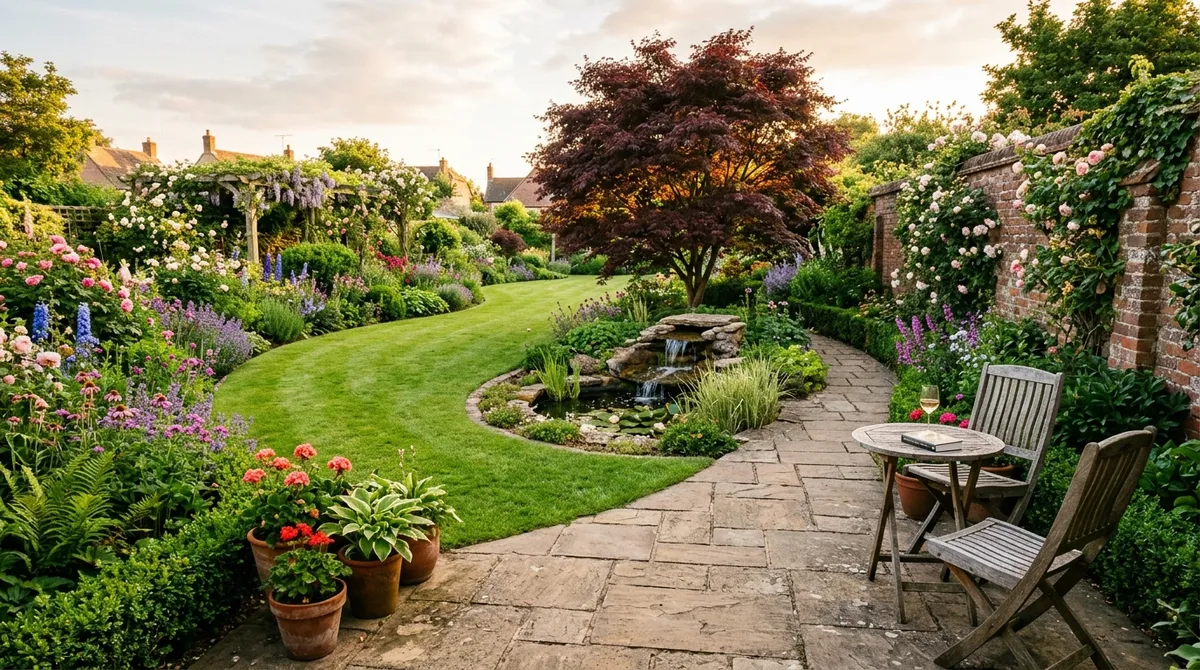
Designing a garden from scratch is one of the most rewarding projects a UK homeowner can take on. Whether you have a bare new-build plot or a neglected space that needs a complete rethink, the process follows the same proven sequence: assess the site, plan the layout, build the hard landscaping, then plant.
This guide covers every stage with real UK costs, specific materials, and planting recommendations based on 8 years of garden design projects across the Midlands. The average UK garden measures 14m x 12m, but these principles work for plots from 4m x 6m terraces to 25m+ rural gardens. If you have a small plot, the same sequence applies with tighter material choices. Browse our full garden design section for more layout and style inspiration.
Why most new gardens fail
Before picking paving samples or browsing plant catalogues, understand why gardens go wrong. The three most common failures all trace back to skipping the site assessment stage.
Ignoring the microclimate
Every garden has areas that behave differently. A south-facing wall radiates stored heat, creating a zone 2-3C warmer than the open plot. A north-facing corner behind the house may sit in shade for 8+ months of the year. Wind funnels between buildings, drying out soil and damaging tall plants.
Planting sun-loving lavender in a north-facing bed is a guaranteed failure. Placing a patio where the afternoon sun never reaches wastes thousands of pounds. These mistakes are permanent unless you assess the conditions first.
Ignoring drainage
Heavy clay soil covers 40% of English gardens. Clay holds water after rain, creating waterlogged conditions that kill roots. I have pulled out dead shrubs from new-build gardens where the soil was compacted construction rubble under 100mm of topsoil. The plants drowned within 6 months.
A simple drainage test takes 30 minutes and costs nothing. Dig a hole 300mm deep, fill it with water, and time how long it drains. Under 1 hour means free-draining soil. Over 4 hours means you need to improve the soil or install drainage before planting.
No structural backbone
Gardens designed entirely with flowering perennials look spectacular in July and bare in January. Evergreen structure is the skeleton that holds the garden together through winter. Without it, you have 5 months of colour and 7 months of empty beds.
A well-designed garden has 30-40% evergreen planting. That means box hedging, holly, laurel, yew, or evergreen grasses providing shape and texture when everything else has died back.
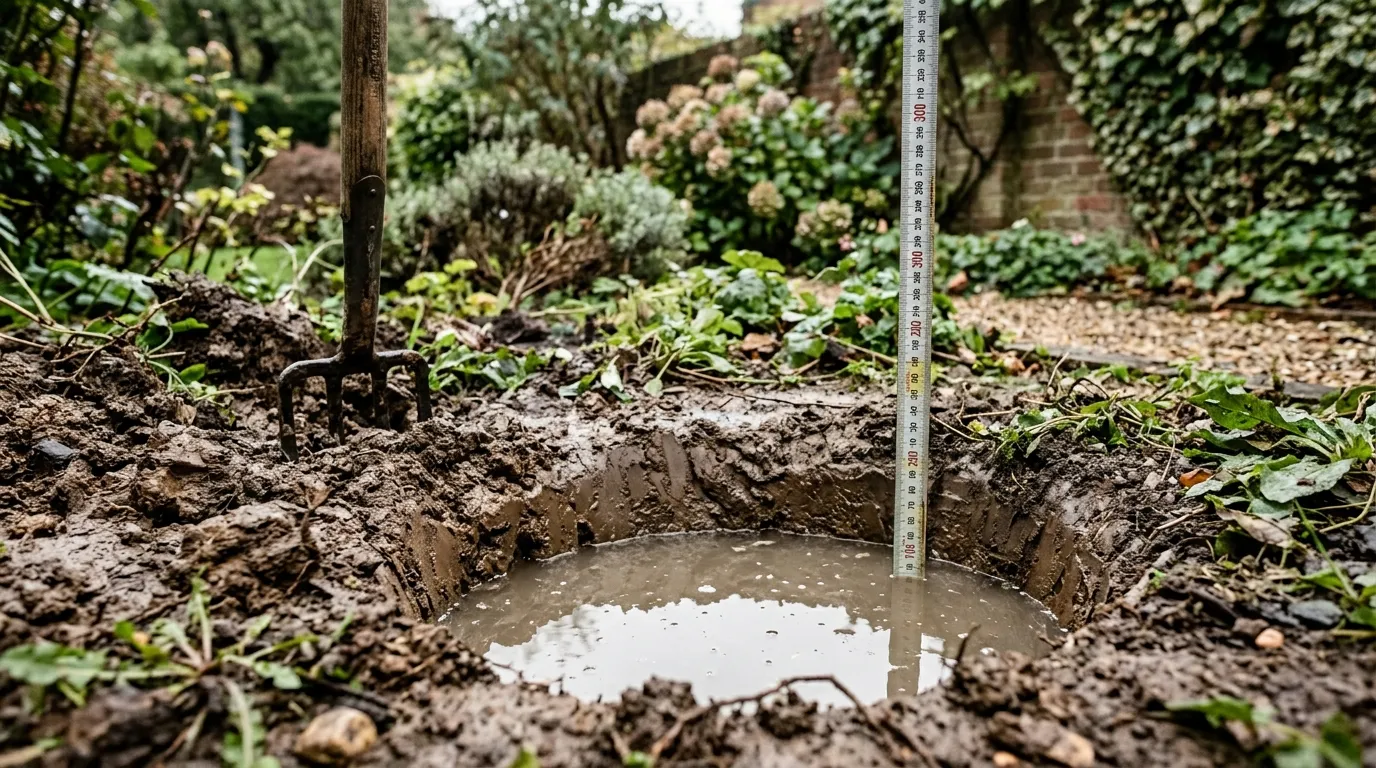 A 300mm drainage test hole filled with water. If it takes over 4 hours to drain, the soil needs improving before planting.
Step 1: site assessment (week 1-2)
The site assessment is the foundation of every successful garden design. Skip it and you are guessing. Spend 1-2 weeks gathering data and the design almost writes itself.
Measure the plot
Use a 30m tape measure and graph paper at 1:50 scale (1cm on paper = 50cm in the garden). Record the exact dimensions of boundaries, the house wall, doors, windows, drain covers, and any existing features you plan to keep.
Mark the position of:
- Manhole covers and drain runs (you cannot build over these)
- Overhead cables and underground services
- Trees with preservation orders (check with your local council)
- Boundary ownership (deeds or Land Registry title plan, £3 from GOV.UK)
Map the sun
Track where sunlight falls across your garden at three times: 9am, 12pm, and 4pm. Do this for a minimum of 3 days. Mark sunny, partially shaded, and fully shaded zones on your plan.
Key sun data:
- South-facing areas get 6-8 hours of direct sun in summer
- East-facing spots get morning sun until midday
- West-facing areas get afternoon sun from 1pm onwards
- North-facing zones may get zero direct sun from October to March
This sun map determines where you place the patio (maximum afternoon sun), where shade-loving plants go, and where you position a greenhouse or vegetable beds.
Test the soil
Buy a soil pH testing kit (£8-15 from garden centres or online). Test in 3-4 spots across the garden, as pH can vary. The result determines which plants thrive in your ground.
| pH Range | Soil Type | Best Plants |
|---|---|---|
| Below 5.5 | Very acid | Heathers, blueberries, rhododendrons, camellias |
| 5.5-6.5 | Slightly acid | Most plants thrive here, ideal range |
| 6.5-7.5 | Neutral to slightly alkaline | Roses, lavender, clematis, most vegetables |
| Above 7.5 | Alkaline/chalky | Dianthus, scabious, buddleja, yew |
Our soil testing guide covers pH adjustment methods including sulphur chips for alkaline soil (takes 6-12 months to lower pH by 0.5 units) and garden lime for acid soil (apply at 200g per square metre).
Check drainage
Dig three test holes, each 300mm deep, in different parts of the garden. Fill each with water and time how long it drains completely.
- Under 1 hour: free-draining, possibly too fast (sandy soil). Add organic matter to improve water retention.
- 1-4 hours: good drainage. Most plants will thrive.
- Over 4 hours: poor drainage. Amend with grit and compost, or install a French drain (perforated pipe in a gravel trench, sloping to a soakaway).
- Over 24 hours: severe waterlogging. Professional drainage may be needed. Budget £800-£2,000 for a full garden drain system.
Gardener’s tip: New-build gardens almost always have compacted subsoil from construction machinery. Rotavate or double-dig the entire plot to 450mm depth before any planting. This single step improves drainage and root growth more than any soil additive.
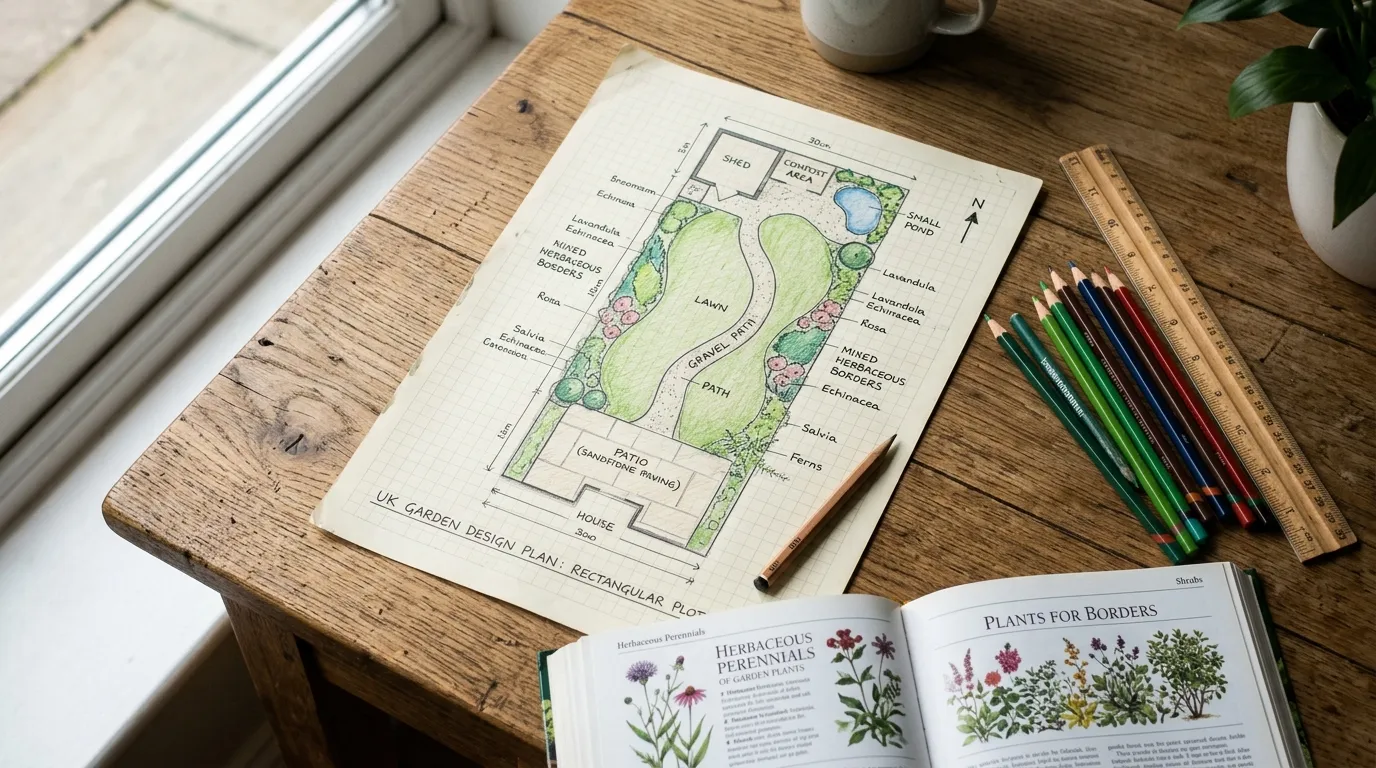 A garden plan at 1:50 scale on graph paper. Sun mapping at 9am, 12pm, and 4pm reveals which zones get the most light.
Step 2: design the layout (week 2-3)
With your site data collected, the design phase translates measurements into a working layout. This is where the garden takes shape on paper before any digging starts.
Draw bubble diagrams
Start with rough circles on your plan representing functional zones: dining area, lawn, planting borders, storage, children’s play area, productive beds. Do not worry about exact shapes yet. Focus on relationships between zones.
Core zoning rules:
- Place the patio where it gets the most afternoon sun (west or south-west facing)
- Put the compost bin and shed in the least attractive corner
- Position productive beds (vegetables, herbs) in the sunniest spot with at least 6 hours of direct sun
- Keep the children’s play area visible from the kitchen window
- Allow a minimum 3m x 3m for a comfortable dining area with table and 4 chairs
Choose a layout style
The layout style sets the character of the entire garden. Each has different costs, maintenance levels, and suitability for different plots.
| Style | Best Plot Size | Hard Landscaping Cost/m² | Maintenance | Character |
|---|---|---|---|---|
| Formal | 10m+ wide | £80-£150 | High (regular clipping) | Symmetrical, structured, box hedging |
| Cottage | Any size | £40-£80 | Medium (deadheading, staking) | Informal, abundant, romantic |
| Contemporary | 6m+ wide | £100-£200 | Low-medium | Clean lines, minimal planting, architectural |
| Japanese | 6m+ wide | £120-£250 | Low (raking, pruning) | Contemplative, asymmetric, minimal |
| Wildlife | Any size | £30-£60 | Low | Naturalistic, log piles, wildflower areas |
For more on specific styles, read our guides to cottage garden planting, Japanese garden design, and front garden ideas.
Diagonal and circular layouts
The most common mistake in garden layout is running borders parallel to the house walls and fences. This creates a rectangular frame that emphasises the boundaries and makes the garden feel smaller.
Diagonal layouts work with the longest dimension. In a 10m x 12m plot, the diagonal measures 15.6m, which is 30% longer than the 12m length. Laying a path or patio edge at 45 degrees to the house forces the eye along this longer line.
Circular layouts use overlapping circles for lawn, patio, and planting beds. The curves soften boundaries and create flowing movement through the space. A circular lawn with curved borders suits plots from 6m wide upward.
The Society of Garden Designers directory lists accredited professionals if you want to commission a bespoke layout plan. Fees typically range from £500-£2,500 for a full design.
Step 3: hard landscaping (week 3-7)
Hard landscaping includes patios, paths, walls, fences, raised beds, steps, and any built structure. This phase accounts for 50-65% of the total budget and determines the garden’s long-term framework.
Patio and path materials
Choose materials that complement your house. A Victorian terrace suits natural stone or clay pavers. A modern new-build works with porcelain or smooth sandstone. Limit yourself to 2-3 materials maximum to keep the design coherent.
| Material | Cost per m² (supply) | Cost per m² (laid) | Lifespan | Maintenance |
|---|---|---|---|---|
| Indian sandstone | £25-£45 | £60-£90 | 25+ years | Seal yearly, pressure wash |
| Porcelain paving | £35-£60 | £70-£110 | 30+ years | Wipe clean, almost zero maintenance |
| Concrete slabs | £15-£25 | £45-£65 | 15-20 years | Pressure wash, may stain |
| Clay pavers | £30-£50 | £65-£95 | 50+ years | Brush, re-sand joints occasionally |
| Gravel (10-20mm) | £3-£8 | £15-£30 | Top up every 2-3 years | Rake, weed, top up |
| Timber decking | £25-£40 | £60-£100 | 10-15 years (softwood) | Oil yearly, replace boards as needed |
Our patio laying guide covers the full installation process including sub-base preparation, which is critical for longevity. A properly laid patio on 100mm MOT Type 1 sub-base and 30mm mortar bed will last decades. Skip the sub-base and slabs shift within 2 years.
Paths
Garden paths need a minimum width of 900mm for comfortable walking, 1200mm for two people side by side, and 1500mm if you need wheelchair or pushchair access. Stepping stones through planting can be narrower at 450mm per stone with 150mm gaps.
Curved paths make gardens feel longer. An S-curve path through a 12m garden creates a walking distance of 15-16m, making the journey through the space feel more generous. See our garden path ideas for design inspiration.
Raised beds
Timber raised beds cost £40-£80 per linear metre using 150mm x 50mm treated softwood sleepers. They solve drainage problems on clay soil, bring planting to a comfortable working height, and create strong visual structure.
Standard raised bed dimensions:
- Width: maximum 1.2m (so you can reach the centre from both sides)
- Height: 300-450mm for most plants, 600mm for root vegetables or accessible gardening
- Length: any length, but add a cross-brace every 2m to prevent bowing
Fill with a mix of 60% topsoil, 30% compost, and 10% horticultural grit. Our raised bed guide covers construction, soil mixes, and planting plans.
Fences and boundaries
Most UK gardens need new or repaired fences as part of a full redesign. Closeboard fencing (featherboard) costs £60-£90 per 1.83m panel installed, including concrete posts and gravel boards. It lasts 15-20 years with annual treatment. For style options and legal boundary rules, read our garden fence ideas guide.
Gardener’s tip: Always build hard landscaping before planting. Heavy materials, cement mixers, and wheelbarrows destroy newly planted beds. Lay every paving slab, erect every fence panel, and build every raised bed before a single plant goes in the ground.
Step 4: budget breakdown
Understanding where the money goes prevents nasty surprises. These figures are based on 30+ real UK garden projects between 2018 and 2026.
Full budget guide by garden size
| Garden Size | Basic Redesign | Mid-Range | Premium |
|---|---|---|---|
| Small (4m x 6m) | £3,000-£5,000 | £5,000-£8,000 | £8,000-£15,000 |
| Medium (10m x 12m) | £6,000-£10,000 | £10,000-£18,000 | £18,000-£35,000 |
| Large (15m x 20m) | £10,000-£18,000 | £18,000-£30,000 | £30,000-£60,000+ |
Where the budget goes
A typical mid-range 10m x 12m garden design breaks down as follows:
| Category | Percentage | Typical Cost |
|---|---|---|
| Patio and paths | 25-30% | £2,500-£4,000 |
| Fencing and boundaries | 10-15% | £1,000-£2,000 |
| Raised beds and edging | 5-10% | £500-£1,200 |
| Soil improvement and drainage | 5-8% | £500-£1,000 |
| Plants and bulbs | 15-25% | £1,500-£3,000 |
| Lighting | 5-10% | £500-£1,200 |
| Furniture and accessories | 5-10% | £500-£1,200 |
| Contingency | 10% | £1,000-£1,500 |
Labour costs add 40-60% to material costs if you hire professionals. A landscaper typically charges £150-£250 per day. A garden design project for a medium plot takes 10-20 days of labour.
Money-saving tips
- Phase the project over 2-3 years: hard landscaping year one, planting year two, lighting and accessories year three
- Buy bare-root plants in autumn (October-March) instead of container-grown. A bare-root rose costs £12-18 versus £25-35 potted
- Propagate from cuttings: one £8 lavender plant produces 20+ cuttings in August, each ready to plant the following spring
- Use reclaimed materials: second-hand York stone pavers cost £15-£25 per m² versus £60-£80 new
- DIY the planting: even if you hire a landscaper for hard landscaping, planting is straightforward DIY work that saves £500-£1,500
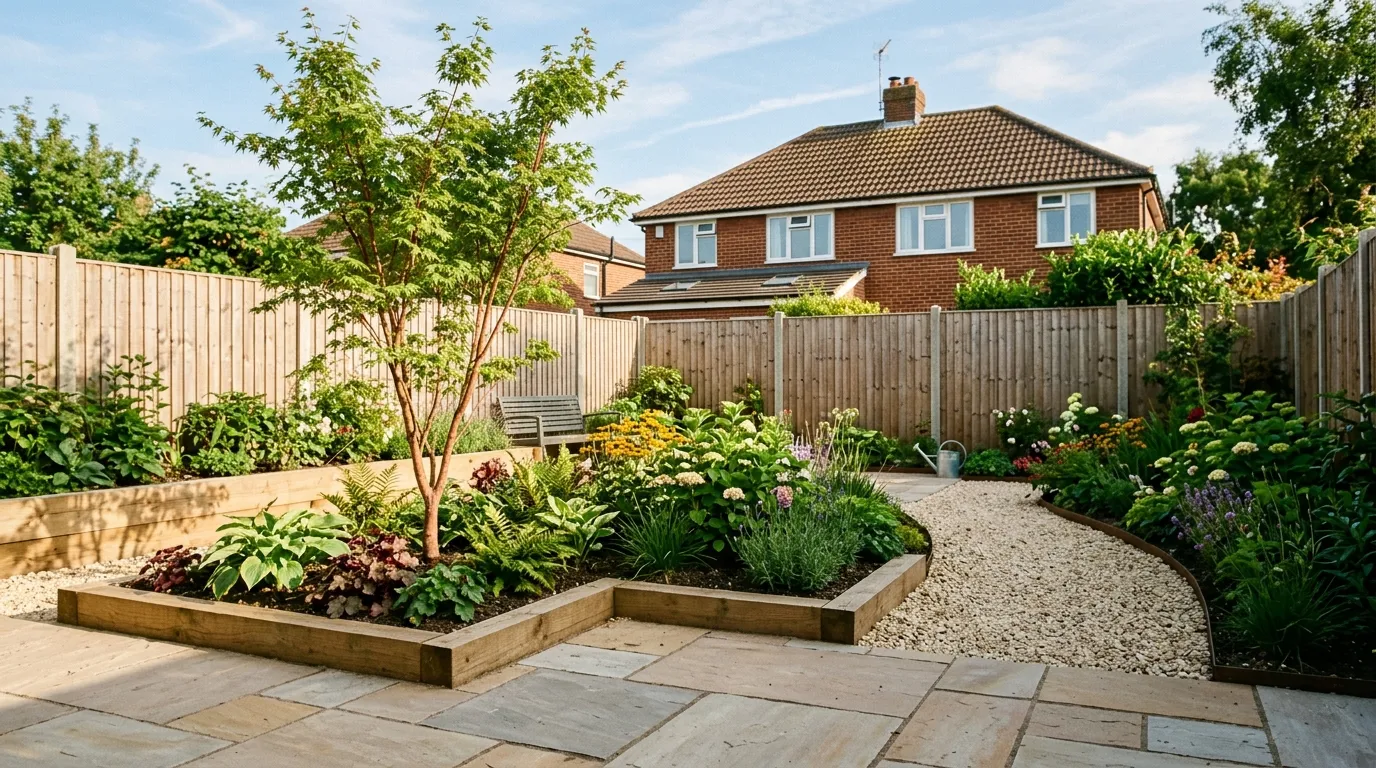 A mid-range garden design with Indian sandstone patio (£70/m² laid), timber raised beds, and mixed planting. Total cost for this 10m x 12m plot: approximately £12,000.
Step 5: the planting plan (week 7-10)
The planting plan brings the garden to life. Work from your sun map and soil test results to select plants that suit the actual conditions, not the ones you wish you had.
Structural planting first
Plant the evergreen backbone before anything else. These plants define the shape of the garden in every season.
Essential structural plants for UK gardens:
- Yew (Taxus baccata): the finest hedging and topiary plant. Grows 30cm per year. Hardy to minus 20C. Tolerates sun and deep shade. Clips to any shape. Plant at 3 per metre for hedging.
- Box (Buxus sempervirens): low hedging and balls. Maximum 1.5m. Susceptible to box blight in humid conditions. Use Ilex crenata as a blight-resistant substitute.
- Photinia ‘Red Robin’: evergreen screen to 3m. New growth is bright red. Clip twice yearly. Fast growing at 40cm per year.
- Portuguese laurel (Prunus lusitanica): glossy dark green leaves. Excellent screen to 5m. More elegant than cherry laurel. Tolerates most soils.
- Ornamental grasses: Miscanthus sinensis ‘Morning Light’ (1.5m, silver-edged) and Stipa tenuissima (60cm, blonde waves) provide movement and winter structure.
Perennials for seasonal colour
Layer perennials in groups of 3, 5, or 7 for natural-looking drifts. Mix flowering times so something is always in bloom.
| Season | Perennials | Height | Flower Colour |
|---|---|---|---|
| Spring (Mar-May) | Brunnera, pulmonaria, hellebores | 30-45cm | Blue, pink, white |
| Early summer (May-Jul) | Hardy geraniums, astrantia, lupins | 50-80cm | Pink, purple, white |
| Mid summer (Jul-Aug) | Echinacea, phlox, agapanthus | 60-120cm | Purple, pink, blue |
| Late summer (Aug-Oct) | Japanese anemones, asters, sedums | 60-120cm | Pink, white, purple |
| Winter interest | Hellebores, cyclamen, snowdrops | 15-30cm | White, pink, green |
Planting density guide
Under-planting is the most common mistake in new gardens. Sparse planting looks thin for 2-3 years and allows weeds to establish. Use these densities for full coverage within 2 growing seasons:
| Plant Type | Spacing | Plants per m² |
|---|---|---|
| Ground cover (geraniums, alchemilla) | 30cm | 9 |
| Small perennials (heuchera, nepeta) | 35cm | 7 |
| Medium perennials (echinacea, phlox) | 45cm | 5 |
| Large perennials (verbena bonariensis) | 60cm | 3 |
| Shrubs | 90-120cm | 1 |
| Hedging (yew, box) | 30-45cm | 3 per metre |
For a 10m x 12m garden with 40% planted area (48m²), you need approximately 150-200 plants at an average cost of £8-15 each. Budget £1,500-£3,000 for a full planting scheme, or £800-£1,500 using bare-root stock in autumn.
Step 6: the design timeline
A structured timeline prevents the common mistake of trying to do everything at once. This 8-12 week plan works for a medium-sized UK garden.
| Week | Phase | Key Tasks |
|---|---|---|
| 1-2 | Site assessment | Measure plot, sun map, soil test, drainage test, photograph site |
| 2-3 | Design | Bubble diagrams, choose layout style, select materials, get quotes |
| 3-4 | Preparation | Clear site, remove old paving/fencing, rotavate soil, install drainage |
| 4-6 | Hard landscaping | Lay patio and paths, build raised beds, erect fences |
| 6-7 | Soil improvement | Add compost (100 litres per m²), grit for clay, test pH again |
| 7-8 | Structural planting | Evergreen shrubs, hedging, specimen trees |
| 8-10 | Perennial planting | Fill borders, plant in groups of 3-5-7, mulch to 75mm depth |
| 10-12 | Finishing | Install lighting, add furniture, sow lawn seed or lay turf |
Best planting months: October-November for bare-root trees and shrubs (roots establish through winter). March-April for container-grown perennials. September for spring bulbs. Avoid planting in frozen ground (December-February) or during hot spells (July-August).
Five common mistakes when designing a garden from scratch
1. Starting with plants instead of structure
Buying plants before you have a layout leads to a random collection with no coherence. Design the bones of the garden first: patio position, path routes, bed shapes, and vertical elements. Then select plants to fill the framework. Structure lasts decades. Plants can be changed in a single afternoon.
2. Underestimating the sub-base
A patio without a proper sub-base is a patio that moves. Every hard surface needs 100mm of compacted MOT Type 1 aggregate beneath the mortar bed. New-build gardens often have soft, uncompacted ground. Budget for a mini-digger (£80-£120 per day hire) to excavate and level the sub-base properly.
3. Forgetting winter
Design for 12 months, not just summer. Deciduous plants are bare from November to March. Without evergreen structure, the garden disappears for 5 months. Include at least 30-40% evergreen planting, plus winter-flowering plants like hellebores, winter jasmine, and Viburnum x bodnantense ‘Dawn’ (fragrant pink flowers from November to March).
4. Planting too close to boundaries
Trees and large shrubs planted against fences cause problems. Roots push fence posts. Branches overhang neighbours. Standard boundary setback is 500mm minimum for shrubs and 2m for trees. Check the RHS guide to planting near boundaries for legal requirements.
5. Ignoring access
Every part of the garden needs practical access. A path to the bin store. Wheelbarrow access to the compost heap. A route from the gate to the front door that does not cross the lawn. Plan utility routes before ornamental design. A hidden service path behind a border costs almost nothing but saves years of frustration.
Why we recommend starting with site assessment: After designing 30+ gardens in the West Midlands, every project that skipped the site assessment needed remedial work within 2 years. The gardens where we spent 2 weeks on assessment, drainage testing, and sun mapping had a 95% plant survival rate after 3 years. The ones where clients pushed to start planting immediately averaged 60% survival. The data is clear: 2 weeks of assessment saves thousands of pounds.
Month-by-month garden design calendar
| Month | Design and Build Tasks |
|---|---|
| January | Order seed catalogues. Plan layout on paper. Get quotes from landscapers |
| February | Finalise design. Order materials with 4-6 week lead time |
| March | Clear site. Begin hard landscaping when ground is workable |
| April | Continue hard landscaping. Prepare soil in planting areas |
| May | Complete paths and raised beds. Plant container-grown perennials |
| June | Plant remaining perennials and annuals. Sow lawn seed |
| July | Water new plants daily. Mulch beds to 75mm depth |
| August | Take cuttings from lavender, rosemary, and box for free plants |
| September | Plant spring bulbs. Review which areas need more planting |
| October | Plant bare-root trees, shrubs, and roses (best month) |
| November | Plant tulip bulbs. Apply 75mm mulch to all beds |
| December | Maintain hard landscaping. Plan improvements for next year |
Frequently asked questions
How much does it cost to design a garden from scratch UK?
A full UK garden design costs £3,000-£25,000. Hard landscaping (patios, paths, walls) accounts for 50-65% of the budget. A 10m x 12m plot with Indian sandstone paving, timber raised beds, and mixed planting costs around £8,000-£12,000. Professional design fees add £500-£2,500 on top. DIY labour saves 30-40% on the total.
What is the first step in designing a garden?
Start with a site assessment before any design work. Measure the plot accurately, test the soil pH (£8-15 kit from garden centres), dig drainage test holes, and track sun patterns for a minimum of 3 days. This data determines which plants will thrive and where to place patios and seating areas.
How long does it take to design and build a garden?
A typical garden takes 8-12 weeks from assessment to planting. Site assessment and design takes 2-3 weeks. Hard landscaping takes 3-5 weeks depending on complexity. Planting takes 1-2 weeks. Autumn (October-November) is the best time to plant bare-root trees and shrubs. Spring planting works for container-grown stock.
Can I design a garden myself without a landscape designer?
Yes, most homeowners can design their own garden. Use graph paper at 1:50 scale or free software like SmartDraw. The key steps are site assessment, bubble diagrams for zones, and a planting plan based on soil and aspect. Professional designers charge £500-£2,500 for a full plan, which may save money on costly mistakes.
What is the best shape for a garden layout?
Diagonal and circular layouts feel larger than rectangular ones. A diagonal path across a 10m x 12m plot creates a 15.6m sight line versus 12m along the length. Overlapping circles for lawn and patio areas soften the space. Avoid mirroring the house wall with parallel borders, which emphasises the boundaries.
How do I design a garden on a slope?
Terrace the slope into level sections using retaining walls. Each terrace needs a minimum 2m depth to be usable. Retaining walls over 1m high need structural engineering. A 1:3 gradient (1m rise over 3m run) is the steepest you can plant without terracing. Our guide to sloped garden ideas covers detailed plans and costs.
What plants should I put in a new garden?
Start with 5-7 structural evergreen shrubs for year-round backbone. Add 10-15 perennials for seasonal colour. Include 3-5 grasses for movement and winter interest. Plant in odd-numbered groups of 3, 5, or 7. For a north-facing plot, use shade-tolerant species. A balanced mix gives colour from March to November.
Now you have a complete framework for designing a garden from scratch. If your plot has challenging soil, read our guide on how to improve clay soil for the next step. For inspiration on specific styles, explore our guides to cottage garden planting, garden path ideas, and garden lighting.
Lawrie has been gardening in the West Midlands for over 30 years. He grows his own veg using no-dig methods, keeps a wildlife-friendly garden, and writes practical advice based on real UK growing conditions.