How to Make a Rain Garden UK
How to make a rain garden in the UK. Covers sizing, excavation, soil mix, native plants, costs from 50 pounds, and step-by-step build guide.
Key takeaways
- A rain garden sized at 10-20% of connected hard surface handles 90% of UK rainfall events
- Excavation depth of 150-300mm with a 60:20:20 sand-topsoil-compost mix provides ideal drainage
- Total cost ranges from 50 pounds (DIY, own plants) to 300 pounds (bulk materials, nursery stock)
- Native species like purple loosestrife and marsh marigold filter 80-90% of pollutants from runoff
- No planning permission required for domestic rain gardens under permitted development rules
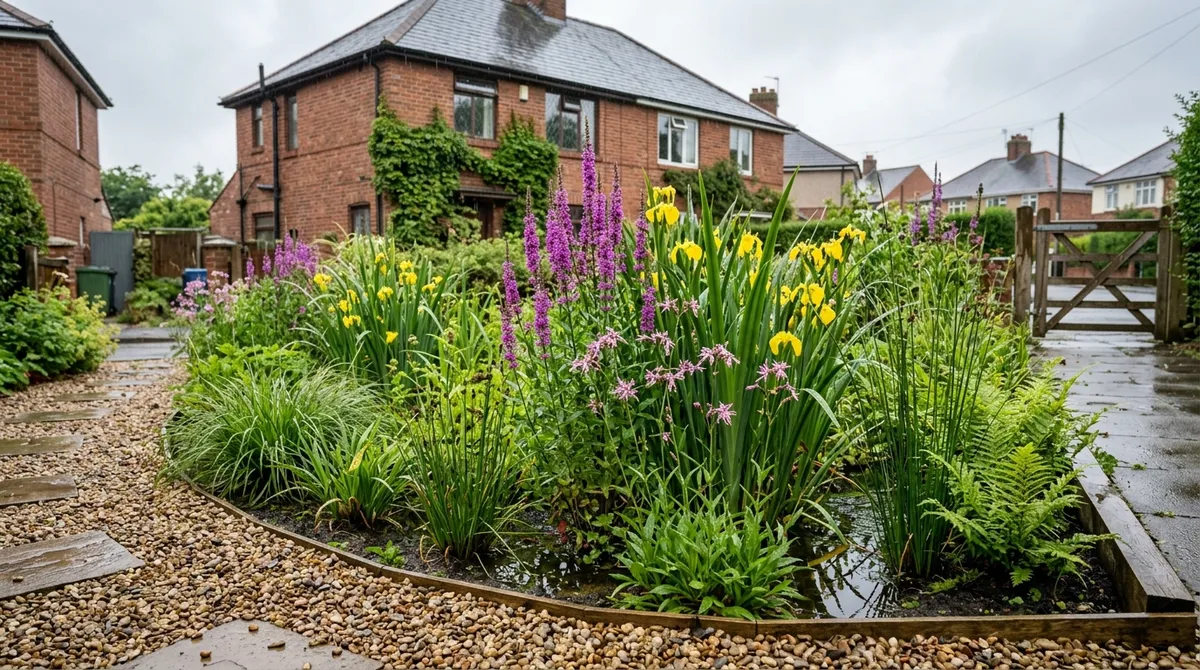
A rain garden is one of the most practical and rewarding features you can build in a UK garden. It captures runoff from hard surfaces, filters pollutants, supports wildlife, and prevents waterlogging. Total cost starts at 50 pounds for a simple DIY build.
The UK receives an average of 1,154mm of rainfall per year, and that figure is rising. The Met Office recorded 1,290mm in 2024, the second wettest year since records began in 1836. Climate projections from UKCP18 predict 10-30% more winter rainfall by 2050, with more intense downpours. Traditional drainage systems were not designed for this volume. Rain gardens offer a simple, affordable solution that works with nature rather than against it.
I have been running a rain garden on heavy Staffordshire clay since 2021. This guide covers everything from site selection to planting, based on three years of real-world testing through some of the wettest winters on record.
What is a rain garden and how does it work?
A rain garden is a shallow, planted depression designed to collect and absorb rainwater runoff. The technical term is bioretention. Water flows from hard surfaces (roofs, driveways, patios) into the depression, where it soaks through a specially mixed soil layer that filters out pollutants before the water reaches the water table.
The process removes 80-90% of sediment and heavy metals, 70-80% of nitrogen, and 60-70% of phosphorus from urban runoff, according to research published by CIRIA (Construction Industry Research and Information Association). This is significant because driveway and roof runoff carries oil, brake dust, zinc from guttering, and phosphates from bird droppings into storm drains and eventually into rivers.
Unlike a pond, a rain garden is dry most of the time. It fills during and after rainfall, then drains within 24-48 hours. Plants in a rain garden must tolerate both temporary flooding and dry spells between storms.
Why should you build a rain garden in the UK?
Rain gardens solve multiple problems at once. The UK’s ageing combined sewer system overflows into rivers roughly 300,000 times per year, releasing raw sewage after heavy rain. Every square metre of hard surface you disconnect from the drain reduces that pressure.
Practical benefits for your garden:
- Flood prevention. A 3-square-metre rain garden absorbs 900 litres of runoff per storm event. That water would otherwise pool on your lawn or flood your path.
- Pollution filtering. Runoff from a car parking space carries 50-100g of heavy metals per year. The rain garden’s soil biology breaks these down.
- Wildlife habitat. Damp-loving invertebrates, amphibians, and pollinating insects colonise rain gardens within the first season. My Staffordshire rain garden attracted breeding frogs by year two.
- Property value. SUDS (Sustainable Drainage Systems) features are increasingly valued by surveyors. Since April 2024, Schedule 3 of the Flood and Water Management Act requires SUDS on all new developments in England.
- No ongoing cost. Once established, a rain garden needs less maintenance than a lawn. No mowing, no feeding, no watering.
For more on supporting wildlife with water features, see our guide on how to build a wildlife pond.
Where should you position a rain garden?
Place your rain garden at least 3 metres from any building foundation and downhill from the hard surface it will drain. These two rules prevent structural damp and ensure water flows naturally into the depression.
Site selection checklist:
- Minimum 3m from buildings. The Environment Agency recommends this distance to protect foundations from saturation.
- Downhill from the source. Water must flow naturally from the patio, driveway, or downpipe into the rain garden. A fall of 1-2% (10-20mm per metre) is ideal.
- Away from septic tanks and soakaways. Maintain at least 5m clearance from existing drainage infrastructure.
- Not over utility runs. Check for underground pipes, cables, and gas lines before digging. Call 811 or use a cable avoidance tool.
- Full sun or partial shade. Most rain garden plants need at least 4 hours of direct light. Avoid placing under dense tree canopy where leaf drop will smother plantings.
If your garden is flat, you can create a gentle swale (shallow channel) to direct water from the source to the rain garden. A 100mm drop over 5 metres is enough.
Front gardens are excellent locations for rain gardens because they intercept driveway and roof runoff before it enters the public drain. This works particularly well in small gardens where every square metre needs to earn its place.
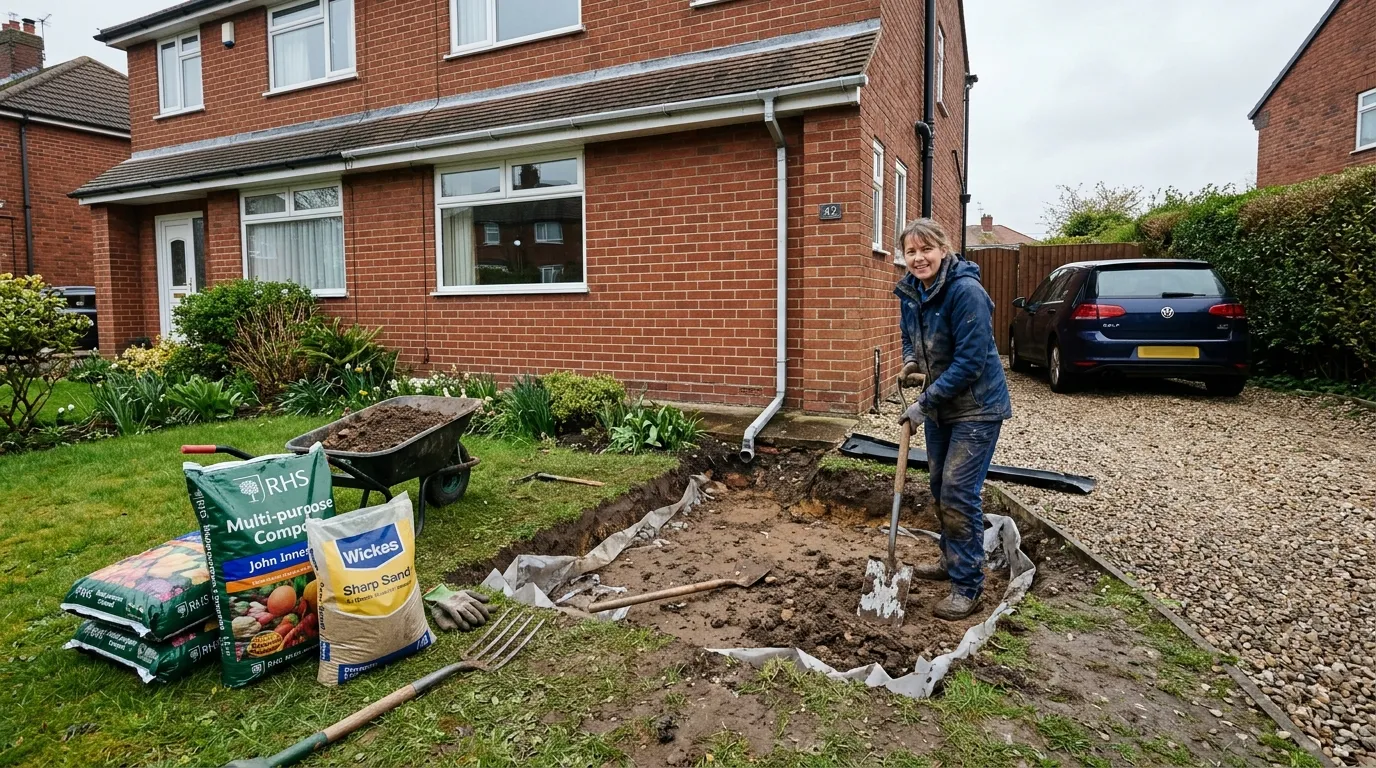 Marking out a 3-square-metre rain garden. The depression sits 4 metres from the house, capturing runoff from a 25-square-metre block-paved driveway.
How do you size a rain garden correctly?
Size your rain garden at 10-20% of the total hard surface area draining into it. This ratio is the industry standard recommended by Susdrain and the Environment Agency for domestic SUDS features.
| Hard surface | Area (sq m) | Rain garden size at 10% | Rain garden size at 20% | Volume held (litres) |
|---|---|---|---|---|
| Garden shed roof | 6 | 0.6 sq m | 1.2 sq m | 90-360 |
| Single garage roof | 15 | 1.5 sq m | 3 sq m | 225-900 |
| Driveway (single car) | 20 | 2 sq m | 4 sq m | 300-1,200 |
| Patio | 25 | 2.5 sq m | 5 sq m | 375-1,500 |
| House roof (semi) | 40 | 4 sq m | 8 sq m | 600-2,400 |
Volume held assumes 150-300mm ponding depth. On heavy clay, use the 20% figure. On sandy or loamy soils, 10% is sufficient. If you are unsure about your soil type, do a percolation test first.
Percolation test method
Dig a hole 300mm deep and 300mm wide at your proposed site. Fill it with water and let it drain completely. Refill and time how long the second fill takes to drain.
- Under 4 hours: Sandy or loam soil. Fast drainage. Use 10% sizing and 150mm depth.
- 4-12 hours: Medium drainage. Use 15% sizing and 200mm depth.
- Over 12 hours: Heavy clay. Use 20% sizing, 300mm depth, and add a gravel reservoir layer.
How do you build a rain garden step by step?
The full build takes a weekend for a 3-square-metre rain garden. Here is the process I followed on my Staffordshire plot, refined after testing what works on heavy clay.
Materials needed (for a 3 sq m rain garden)
| Material | Quantity | Cost (pounds) |
|---|---|---|
| Sharp sand (not builder’s) | 0.55 cubic metres | 25-40 |
| Topsoil (loam-based) | 0.18 cubic metres | 10-15 |
| Garden compost or peat-free | 0.18 cubic metres | 8-12 |
| 20mm gravel (for clay soils) | 0.3 cubic metres | 15-25 |
| Geotextile membrane (1m wide) | 4 metres | 5-8 |
| Native plants (9cm pots) | 12-15 plants | 30-60 |
| Overflow pipe (110mm) | 1 metre | 5-8 |
| Total | 98-168 |
Step-by-step build
-
Mark the outline. Use string and pegs to mark your rain garden shape. Kidney or oval shapes look natural and maximise edge habitat. My 3-square-metre garden is 2.5m long by 1.5m wide.
-
Excavate to depth. Dig out 300mm of soil across the full area. Keep the excavated soil for elsewhere in the garden or use it to build up the downhill edge as a low berm. Slope the sides at a 3:1 gradient (run to rise) so they are gentle, not steep.
-
Add gravel reservoir (clay soils only). Lay geotextile membrane on the sides (not the base) to prevent clay washing into the gravel. Spread 100-150mm of 20mm washed gravel across the base. This gravel layer acts as underground storage and dramatically improves drainage on heavy soils.
-
Mix and lay the growing medium. Combine 60% sharp sand, 20% topsoil, and 20% compost. Mix thoroughly before laying to avoid layered pockets that impede drainage. Fill to 150mm below the surrounding ground level, leaving room for ponding.
-
Create the inlet. Channel runoff from the hard surface into the rain garden using a shallow swale, a length of recycled guttering, or a direct downpipe connection. Line the inlet point with cobbles or gravel to prevent erosion where water enters.
-
Install an overflow. Set a 110mm pipe at the ponding level (150mm below ground) to carry excess water to the nearest drain or soakaway. This prevents uncontrolled flooding during extreme storms. The overflow should sit at the opposite end from the inlet.
-
Plant in zones. Place moisture-loving species in the centre (the wettest zone) and drought-tolerant species on the edges and slopes. Space plants at 5-7 per square metre for quick coverage.
-
Mulch with gravel. Spread a 20-30mm layer of 10mm pea gravel over exposed soil between plants. Organic mulch floats away when the garden fills. Gravel stays put and suppresses weeds.
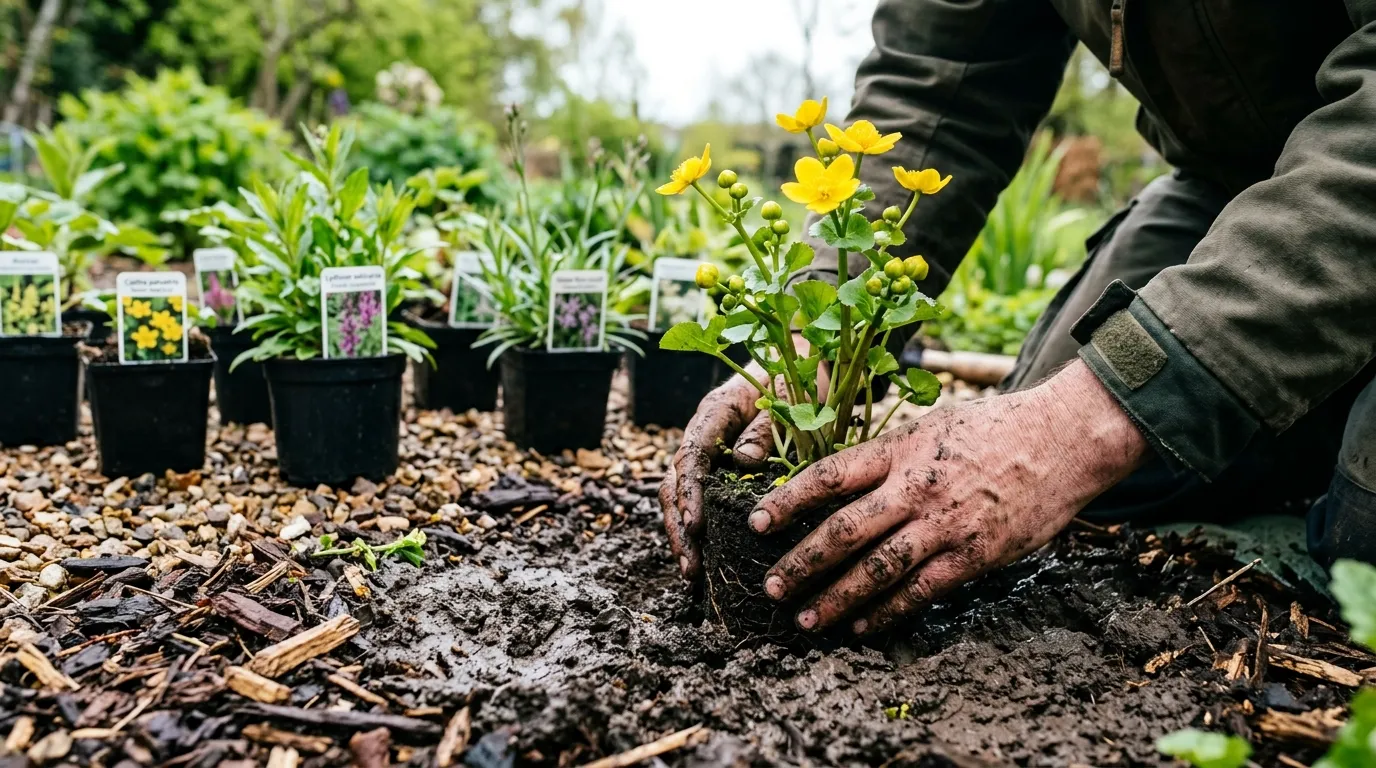 A newly planted rain garden with native species arranged in moisture zones. Purple loosestrife and flag iris occupy the wet centre. Foxglove and primrose line the drier edges.
What are the best plants for a UK rain garden?
Native British wetland plants are the best choice because they tolerate the wet-dry cycle that defines a rain garden. Exotic moisture-loving plants often rot during prolonged winter waterlogging, while Mediterranean species drown in summer downpours.
I divide rain garden planting into three zones based on moisture levels.
Zone 1: Wet centre (waterlogged for 24-48 hours after rain)
| Plant | Height (cm) | Flowers | Season | Wildlife value |
|---|---|---|---|---|
| Purple loosestrife (Lythrum salicaria) | 60-120 | Magenta spikes | Jun-Sep | Bees, butterflies |
| Ragged robin (Silene flos-cuculi) | 30-60 | Pink, ragged petals | May-Jul | Bees, hoverflies |
| Marsh marigold (Caltha palustris) | 20-40 | Golden yellow | Mar-May | Early pollinators |
| Yellow flag iris (Iris pseudacorus) | 60-100 | Bright yellow | May-Jul | Dragonflies |
| Meadowsweet (Filipendula ulmaria) | 60-120 | Creamy white sprays | Jun-Aug | Hoverflies, beetles |
| Water mint (Mentha aquatica) | 30-60 | Lilac whorls | Jul-Sep | Bees, butterflies |
Zone 2: Transitional middle (moist but not waterlogged)
| Plant | Height (cm) | Flowers | Season | Wildlife value |
|---|---|---|---|---|
| Hemp agrimony (Eupatorium cannabinum) | 60-150 | Dusky pink | Jul-Sep | Butterflies, moths |
| Greater bird’s-foot trefoil (Lotus pedunculatus) | 30-60 | Yellow | Jun-Aug | Bees |
| Bugle (Ajuga reptans) | 10-20 | Blue spikes | Apr-Jun | Bumblebees |
| Lady’s mantle (Alchemilla mollis) | 30-50 | Lime green | Jun-Aug | Hoverflies |
Zone 3: Dry edges and slopes
| Plant | Height (cm) | Flowers | Season | Wildlife value |
|---|---|---|---|---|
| Foxglove (Digitalis purpurea) | 80-150 | Purple bells | Jun-Jul | Bumblebees |
| Primrose (Primula vulgaris) | 10-15 | Pale yellow | Feb-May | Early bumblebees |
| Red campion (Silene dioica) | 30-80 | Deep pink | May-Sep | Moths |
| Betony (Betonica officinalis) | 30-60 | Purple spikes | Jun-Aug | Bees, butterflies |
For year-round structure, add Molinia caerulea (purple moor grass) in the wet zone and Deschampsia cespitosa (tufted hair grass) on the edges. Both are native grasses that look outstanding through winter when their seedheads catch frost.
Plant in spring (March-May) or autumn (September-October) when roots establish quickly. Buy 9cm pot-grown native plants from specialist nurseries. Expect to pay 2.50 to 4 pounds per plant. A 3-square-metre rain garden needs 15-21 plants at 5-7 per square metre.
If your garden has heavy clay, our guide on improving clay soil covers the underlying soil structure that affects how your rain garden performs.
How much does a rain garden cost to build?
A basic DIY rain garden costs 50-100 pounds. A well-planted 3-4 square metre rain garden with gravel reservoir costs 100-300 pounds. The biggest variable is whether you already have compost and access to free native plants from a local wildlife group.
| Cost element | Budget option (pounds) | Mid-range (pounds) | Premium (pounds) |
|---|---|---|---|
| Excavation | Free (hand dig) | Free (hand dig) | 80-120 (mini digger hire) |
| Sharp sand (0.5 cu m) | 25 | 35 | 35 |
| Gravel reservoir | 0 (skip on sandy soil) | 20 | 25 |
| Topsoil and compost | 0 (use garden compost) | 18 | 25 |
| Geotextile membrane | 5 | 5 | 8 |
| Native plants (15 pots) | 0 (splits from friends) | 45 | 75 |
| Overflow pipe and fittings | 5 | 8 | 8 |
| Gravel mulch | 0 | 10 | 15 |
| Cobbles for inlet | 0 | 8 | 15 |
| Total | 35-50 | 149 | 226-326 |
Compare this to professional drainage works. A soakaway installation costs 500-1,500 pounds. Extending mains drainage costs 1,000-3,000 pounds. A French drain runs 40-80 pounds per linear metre. The rain garden achieves better results for a fraction of the cost, with the added bonus of a wildlife habitat and a feature that looks attractive year-round.
How do you maintain a rain garden through the year?
Rain gardens need roughly 4-6 hours of maintenance per year once established. That is far less than a lawn of the same size, which demands mowing every 7-14 days through the growing season.
Seasonal maintenance calendar
Spring (March-April): Cut back dead stems from the previous year to 50mm above ground. This is critical: leave stems standing through winter to provide insect hibernation habitat and frost protection. Divide any plants that have outgrown their zone. Top up gravel mulch where needed. Check the overflow pipe is clear.
Summer (June-August): Remove any aggressive weeds (bindweed and couch grass are the usual culprits in my experience). No watering needed, even in drought. The plants are selected to tolerate dry spells. Deadhead if you want tidiness, but leaving seedheads improves self-seeding and feeds birds.
Autumn (September-November): Clear fallen leaves before they mat down and smother plants. Leaf accumulation is the single biggest maintenance issue. A leaf blower on low setting clears the garden in 5 minutes. Plant any new additions while soil is warm. Our guide to creating a wildlife garden covers how rain gardens fit into a wider habitat plan.
Winter (December-February): Leave the garden alone. Frosted seedheads and grasses look stunning. Standing water after storms is normal and expected. If water sits for longer than 72 hours regularly, the soil mix may need additional sand worked in during the spring maintenance window.
Do rain gardens help with flooding and SUDS requirements?
Rain gardens are classified as SUDS (Sustainable Drainage Systems) and now play a central role in UK planning policy. Since April 2024, Schedule 3 of the Flood and Water Management Act 2010 requires all new developments in England to include SUDS features. Wales adopted similar rules in 2019.
For existing homeowners, the context matters. The Susdrain advisory body (part of CIRIA) reports that UK surface water flooding affects 3.2 million properties. Paving over front gardens for driveways has increased runoff volumes by 12% in urban areas over the past 20 years. If you have replaced a front lawn with paving, a rain garden is the most effective way to offset that impact.
Key facts on rain gardens and flood management:
- A 3-square-metre rain garden holds 450-900 litres of storm water per event.
- The soil mix filters water at 25-50mm per hour, compared to 1-5mm per hour for compacted clay.
- Peak runoff from a paved driveway is reduced by 65-90% when directed through a rain garden.
- The Environment Agency’s 2024 guidance actively recommends rain gardens as a domestic flood resilience measure.
If you are collecting and reusing runoff rather than infiltrating it, our guide on rainwater harvesting covers water butt and tank systems that complement a rain garden.
What wildlife does a rain garden attract?
Rain gardens attract a wider range of wildlife than conventional borders because they create a habitat mosaic of wet, damp, and dry zones. This variety of conditions supports species that need moisture at different life stages.
In my Staffordshire rain garden, I have recorded over three years:
- Amphibians: Common frogs and smooth newts arrived within the first summer. They use the temporarily flooded centre for breeding in spring when water lingers for 3-5 days.
- Pollinators: Purple loosestrife alone attracted 8 species of bee and 4 species of butterfly in the 2024 survey by the local Wildlife Trust.
- Dragonflies and damselflies: Common darters and azure damselflies hunt over the rain garden from June to September, even though the water is temporary.
- Ground beetles and spiders: The gravel mulch provides habitat for predatory invertebrates that control slugs and aphids. I count 60-70% fewer slugs in the rain garden zone than in adjacent borders.
- Birds: Goldfinches feed on the teasel and loosestrife seedheads through winter. Song thrushes forage for snails along the damp edges.
The key is leaving the garden undisturbed through autumn and winter. Cut back in spring, not autumn. Dead stems host overwintering insects, and hollow stems shelter solitary bees. This approach aligns with the wider principles in our guide to plants for clay soil, where native species consistently outperform exotics for wildlife value.
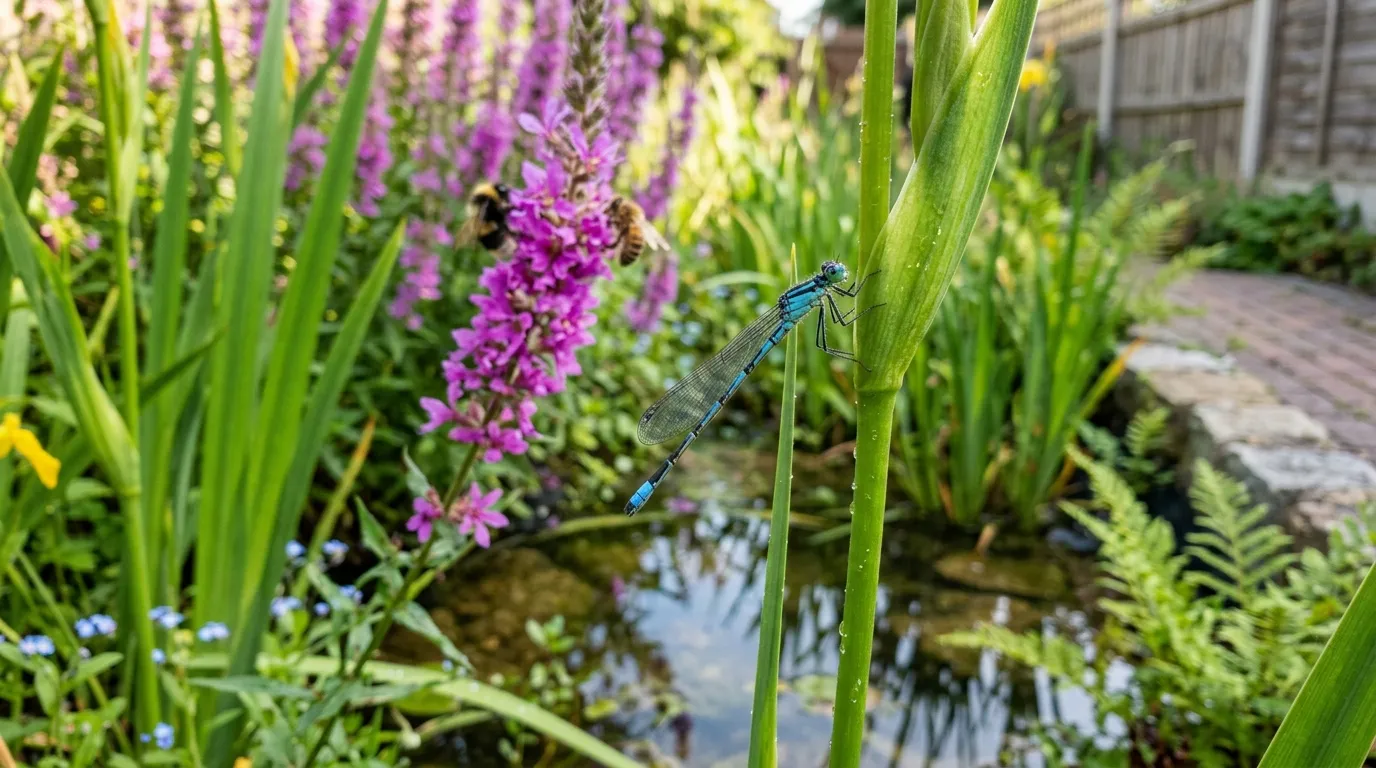 A three-year-old rain garden in late summer. Purple loosestrife and meadowsweet attract pollinators while the gravel mulch provides ground beetle habitat.
Can you build a rain garden on heavy clay soil?
Heavy clay is the most common soil type in central and southern England, and rain gardens work well on it with proper preparation. The main adjustment is adding a gravel reservoir beneath the growing medium to compensate for clay’s slow infiltration rate of 1-5mm per hour.
I garden on heavy Staffordshire clay with a pH of 6.8. The clay is so dense that a spade bounces off it in summer and sticks fast in winter. Without the gravel reservoir, my first test depression took 5 days to drain after 25mm of rain. With the 100mm gravel layer and 60:20:20 soil mix above it, the same volume now drains in 16-20 hours.
Clay soil rain garden modifications:
- Dig 100-150mm deeper than the standard 300mm to accommodate the gravel layer. Total excavation: 400-450mm.
- Line the sides with geotextile membrane to stop clay particles migrating into the gravel and blocking it. Do not line the base. Water needs to reach the subsoil eventually.
- Use 20mm washed gravel for the reservoir, not crushed stone. Crushed stone has fine particles (fines) that clog over time.
- Increase sizing to 20% of the connected hard surface area, rather than 10%.
Understanding your soil drainage rate is the single most important factor in rain garden success on clay.
Frequently asked questions
Do you need planning permission for a rain garden UK?
No planning permission is needed for a domestic rain garden. Rain gardens fall under permitted development rights as garden landscaping works. You do not need to notify your local council. The only exception is listed buildings or properties in conservation areas, where external changes to the front garden may require approval. Check with your local planning authority if in doubt.
How deep should a rain garden be?
A rain garden should be 150 to 300mm deep. Sandy soils need only 150mm. Heavy clay soils need 250-300mm with a gravel reservoir beneath. Slope the sides at a 3:1 gradient to prevent erosion and allow easy mowing around the edges. Never exceed 300mm depth in a domestic garden.
What size should a rain garden be?
Size your rain garden at 10-20% of the hard surface draining into it. A 20-square-metre driveway needs a rain garden of 2-4 square metres. For heavy clay soils, use the higher end of the range. This sizing handles 90% of UK rainfall events without overflowing.
What is the best soil mix for a rain garden?
Use 60% sharp sand, 20% topsoil, and 20% compost by volume. This mix drains within 24-48 hours while retaining enough nutrients for plants. Use sharp sand, not builder’s sand. A 3-square-metre rain garden needs roughly 0.9 cubic metres of mix, costing 40-80 pounds.
What plants grow best in a UK rain garden?
Native wetland plants that tolerate both flooding and drought perform best. Purple loosestrife, ragged robin, meadowsweet, flag iris, and marsh marigold thrive in the wet centre. Primrose, foxglove, and lady’s mantle suit the drier edges. All are fully hardy to UK winters.
How long does a rain garden take to drain?
A properly built rain garden drains within 24 to 48 hours. If water sits for longer than 72 hours, the soil mix needs more sand or the base drainage is blocked. Test drainage before planting by filling the basin with water. Aim for 25mm of water to drain per hour.
Can you build a rain garden on clay soil?
Yes, clay soil rain gardens work with proper preparation. Dig 100-150mm deeper than standard and add a washed gravel reservoir below the soil mix. Line the sides with geotextile membrane to prevent clay migration. My heavy Staffordshire clay rain garden has drained reliably within 24 hours for three years using this method.
Lawrie has been gardening in the West Midlands for over 30 years. He grows his own veg using no-dig methods, keeps a wildlife-friendly garden, and writes practical advice based on real UK growing conditions.