How to Plan a Mixed Border UK
Plan a mixed border with shrubs, perennials, and grasses for year-round colour. Covers depth, layers, spacing, soil prep, and planting for UK gardens.
Key takeaways
- Minimum border depth of 1.8m allows three distinct planting layers (back, middle, front)
- Plant in odd-numbered groups of 3, 5, or 7 spaced 30-60cm apart depending on mature spread
- Include at least 3 evergreen shrubs per 3m of border length for winter structure
- Prepare clay soil with 30% organic matter dug to 40cm depth before planting
- A single colour scheme with one accent colour creates more impact than a random mix
- Plan for 60% perennials, 25% shrubs, and 15% bulbs and grasses for balanced year-round interest
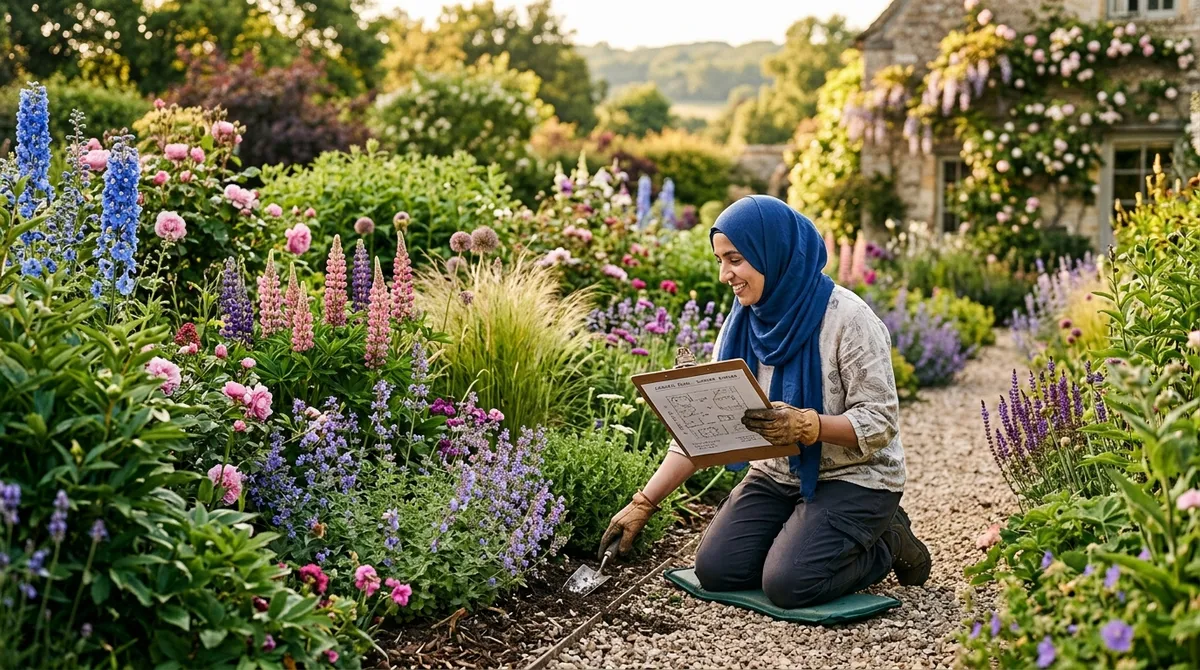
A mixed border is the backbone of British garden design, blending shrubs, perennials, bulbs, and grasses into one deep bed that changes through the seasons. Done well, it provides colour and structure in every month of the year. Done badly, it peaks for three weeks in July and looks bare the rest of the time.
The difference between the two comes down to planning. Choosing plants at the garden centre because they look good on the day is the fastest route to a muddled, gappy border. A proper plan on paper, with layers, a colour scheme, and a seasonal calendar, gives you a border that performs from January to December. This guide covers how to plan a mixed border from first sketch to final planting, based on eight years of building and maintaining mixed borders on heavy Midlands clay.
How deep should a mixed border be?
A mixed border needs a minimum depth of 1.8m to create three distinct planting layers. Borders shallower than 1.5m force everything into two rows and look flat from the front. The ideal depth is 2.4-3m, which gives enough room for tall structural plants at the back, a generous middle layer, and a spilling front edge.
For length, work in multiples of 3m. Each 3m section becomes a planting module that you can repeat or vary along the border. A 6m border gives two modules; a 9m border gives three. This modular approach keeps the design manageable and creates natural rhythm.
Island borders viewed from all sides need a minimum width of 2.4m. Place the tallest plants in the centre rather than the back, grading down to the edges. Island borders suit open lawns and give you twice the front edge of a wall-backed border.
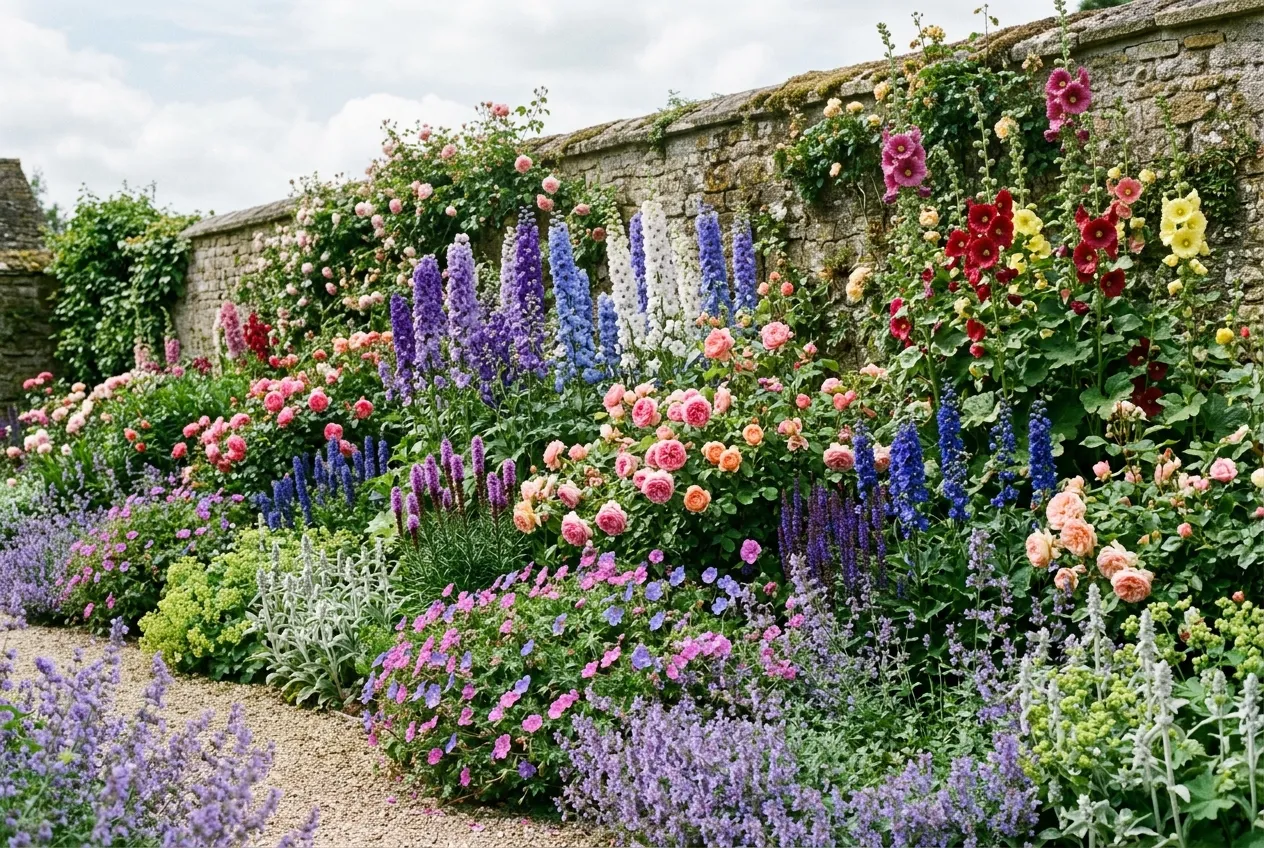
A well-planned mixed border at peak summer showing clear back, middle, and front layers against a stone wall.
What are the three layers of a mixed border?
Every mixed border follows the same layered structure. Understanding this framework is the first step to planning one that works. For more on combining plants within these layers, see our guide to plant combinations for UK borders.
Back layer (1.2-2.5m)
The back layer provides height, screening, and vertical structure. Place these plants against a wall, fence, or hedge, or at the centre of an island bed. Back-layer plants include tall shrubs like philadelphus (2-3m), buddleia (2-3m), and viburnum (2-2.5m). Tall perennials like delphiniums (1.5-1.8m), verbascum (1.2-1.8m), and hollyhocks (1.5-2.5m) add seasonal spikes of colour. Ornamental grasses like Miscanthus sinensis (1.5-2m) bring movement and late-season presence.
Middle layer (60cm-1.2m)
The middle layer is the engine of the border and typically holds 50-60% of the total planting. This is where most of the flower colour sits. Reliable middle-layer perennials include geranium ‘Rozanne’ (60cm), salvia nemorosa (60-90cm), penstemon (60-90cm), achillea (90cm), echinacea (90cm), and rudbeckia (90cm). Flowering shrubs like lavender (60cm), hebe (60-90cm), and potentilla (1m) add structure within this layer.
Front layer (15-45cm)
The front layer softens the edge and prevents bare soil showing at the base. Low-growing perennials like hardy geranium (30-45cm), nepeta (30-45cm), alchemilla mollis (30-40cm), and sedum (30-45cm) work well here. Mat-forming plants like aubrieta (15cm), ajuga (15cm), and Stachys byzantina (30cm) spill over path edges for a generous, informal look. For spring interest, front the border with crocus, muscari, and low-growing tulips.
How to choose a colour scheme for a border
Stick to 2-3 main colours plus one accent colour. Random colour mixing is the most common reason borders look chaotic rather than designed. A clear palette creates harmony and makes the eye travel along the border instead of bouncing from clash to clash.
Proven UK border colour schemes:
- Blue, purple, and white with silver foliage (cool and calming)
- Pink, mauve, and soft yellow (classic cottage garden feel)
- Hot orange, red, and deep yellow with bronze foliage (bold and energising)
- White and green with lime accents (elegant and bright in shade)
Repeat your chosen colours in groups along the full length of the border. Planting one salvia here and one echinacea there creates a spotty effect. Instead, plant three salvias together, then repeat another group of three salvias 2-3m further along the border. This repetition creates the rhythm that lifts a border from amateur to polished.
Why we recommend limiting colour: After trialling both mixed-colour and restricted-palette borders side by side, the single-palette borders drew far more compliments from visitors. On Staffordshire clay, a “hot border” of crocosmia, helenium, and rudbeckia looked deliberate and confident. A “bit of everything” border next to it looked like a garden centre trolley tipped out.
How to plan for year-round interest
A border that peaks for a month and then dies back is not a mixed border. It is a summer border. True mixed borders earn their space across all twelve months.
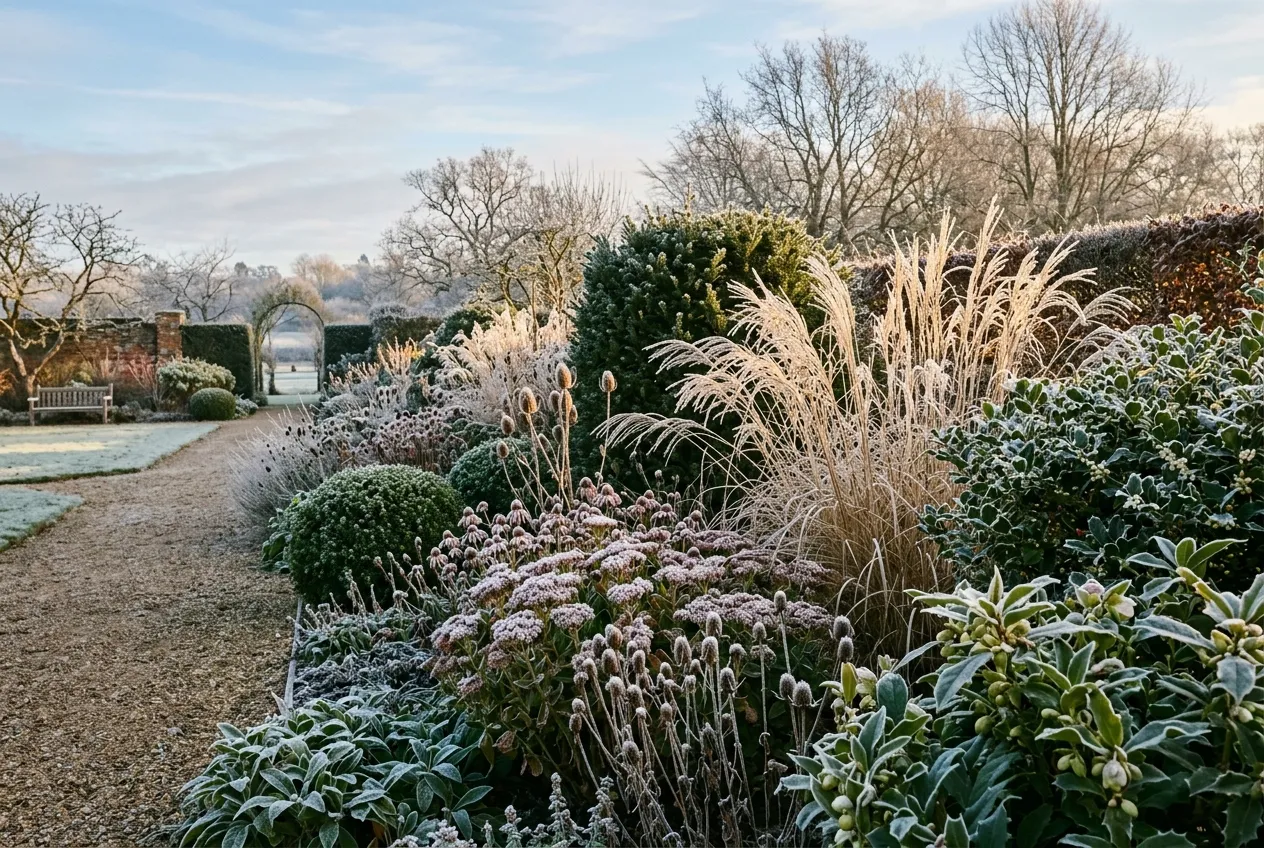
A mixed border in winter showing the structural value of evergreens, grasses, and standing seedheads.
Seasonal planting calendar
| Season | Key plants | Role in border |
|---|---|---|
| Winter (Dec-Feb) | Sarcococca, mahonia, hellebores, snowdrops, cornus stems | Structure, scent, ground-level colour |
| Spring (Mar-May) | Tulips, narcissus, brunnera, euphorbia, spiraea | Bulb colour, fresh foliage, early shrub flower |
| Summer (Jun-Aug) | Roses, delphiniums, salvias, achillea, geraniums, grasses | Peak flower colour, pollinator value |
| Autumn (Sep-Nov) | Sedum, asters, anemones, rudbeckia, miscanthus plumes | Late colour, seedheads, grass movement |
The rule of thumb is 3 evergreen shrubs per 3m of border length. These are the anchors that prevent the border looking bare from November to March. Box (Buxus), yew (Taxus), pittosporum, and sarcococca all provide reliable evergreen structure on most UK soils.
Ornamental grasses are the secret weapon for autumn and winter. Miscanthus, Calamagrostis, and Stipa gigantea hold their form and colour through frost and wind until you cut them back in February. Leave the seedheads of sedum, echinacea, and phlomis standing for the same reason.
How to prepare soil for a mixed border
Soil preparation is the single biggest investment you make in a border. Skipping it shows within two years as plants fail to establish, struggle in drought, or sit in waterlogged clay over winter.
On clay soil (most of the Midlands, South East, and parts of the North)
- Mark the border outline with a hosepipe or sand line
- Remove all turf and perennial weeds (bindweed, couch grass, ground elder)
- Dig the entire area to 40cm depth, turning the soil and breaking up compacted layers
- Work in organic matter (garden compost, well-rotted manure, or composted bark) at 30% by volume
- Add horticultural grit to the back 60cm if planting Mediterranean shrubs like lavender or cistus
- Allow the border to settle for 2-4 weeks before planting
On sandy or chalky soil
Sandy soils drain freely but lose nutrients fast. Add 20% organic matter to improve water retention. Chalky soils are alkaline and thin. Avoid acid-loving plants (rhododendrons, camellias, pieris) and choose lime-tolerant species. Add organic matter annually as a mulch to build soil depth.
For a full breakdown of garden design principles from scratch, see our guide to designing a garden from scratch.
How to draw a planting plan
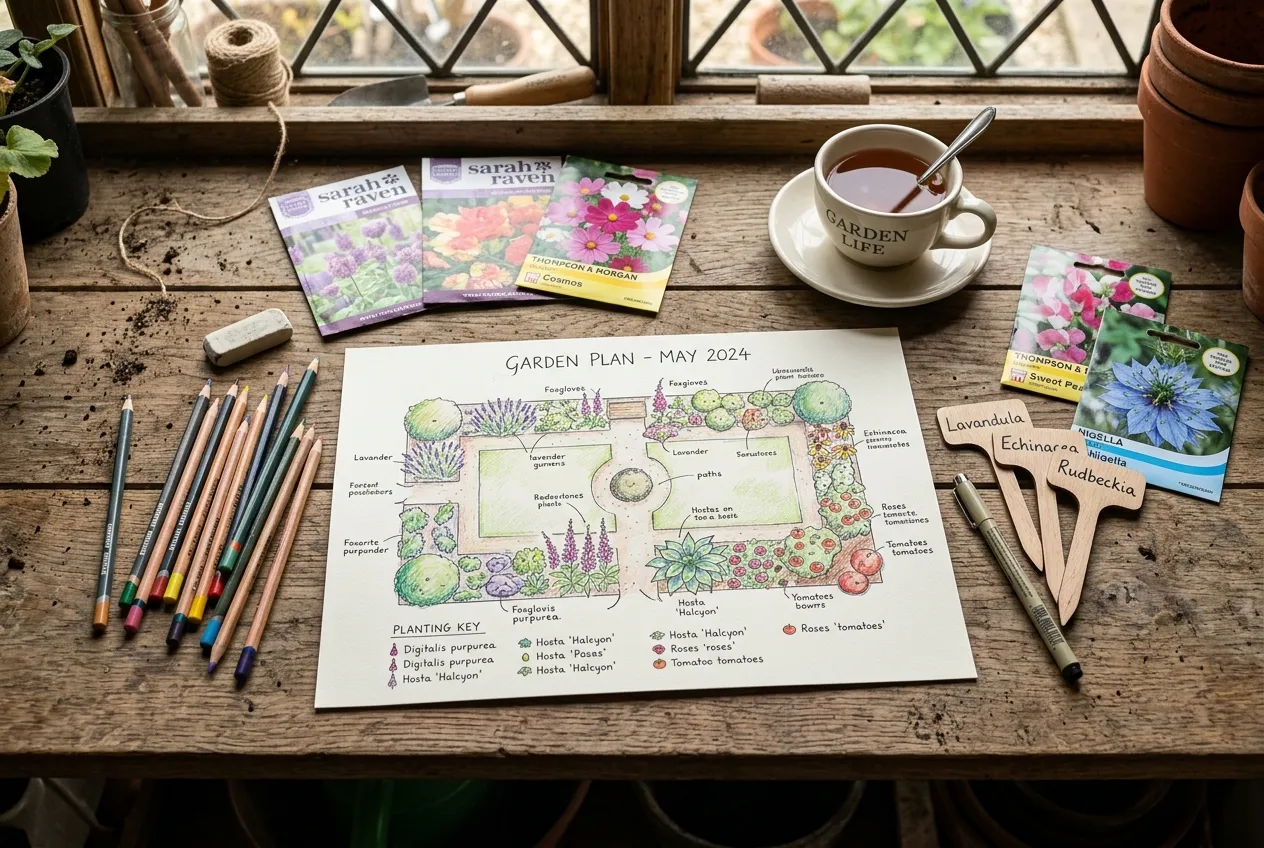
A hand-drawn planting plan with colour-coded sections helps you visualise spacing and seasonal gaps before buying a single plant.
Draw the plan to scale on graph paper. Use 1 square = 20cm for borders up to 6m long, or 1 square = 30cm for longer borders. Outline the border shape, then mark in the three layers.
Step-by-step method
- Place evergreen anchors first. Mark 3 evergreen shrubs per 3m section, spaced evenly. These are the bones of the border
- Add back-layer plants. Fill the rear 60cm with tall shrubs and perennials
- Fill the middle layer. Work in groups of 3, 5, or 7 plants of the same variety. Stagger the groups so no two identical clumps sit directly beside each other
- Edge with front-layer plants. Use 2-3 low species repeated along the front edge
- Tuck in bulbs. Mark bulb positions between perennials for spring and autumn colour
- Check the seasonal spread. Colour-code each plant by its flowering month. Flag any gaps wider than 6 weeks in any section
Plant in odd-numbered groups. Groups of 3, 5, or 7 plants look natural. Even numbers and singles look regimented or spotty. Space plants at two-thirds of their mature spread for a full look within 2-3 years.
Comparison table: plants by layer, height, and season
| Plant | Layer | Height | Flower season | Flower colour | Soil | Sun/Shade |
|---|---|---|---|---|---|---|
| Delphinium | Back | 1.5-1.8m | Jun-Jul | Blue, purple, white | Moist, fertile | Full sun |
| Miscanthus sinensis | Back | 1.5-2m | Sep-Feb (seedheads) | Silver, bronze | Any well-drained | Full sun |
| Buddleia | Back | 2-3m | Jul-Sep | Purple, white, pink | Any | Full sun |
| Salvia nemorosa | Middle | 60-90cm | Jun-Sep | Purple, blue, pink | Well-drained | Full sun |
| Echinacea purpurea | Middle | 90cm | Jul-Sep | Pink, white, orange | Well-drained | Full sun |
| Rosa ‘Boscobel’ | Middle | 1m | Jun-Oct | Salmon pink | Moist, fertile | Full sun |
| Nepeta ‘Walker’s Low’ | Front | 30-45cm | May-Sep | Lavender blue | Well-drained | Full sun |
| Alchemilla mollis | Front | 30-40cm | Jun-Jul | Lime green | Any | Sun or part shade |
| Geranium ‘Rozanne’ | Front | 30-60cm | Jun-Oct | Violet blue | Any | Sun or part shade |
| Sedum ‘Herbstfreude’ | Front | 45cm | Aug-Oct | Pink to rust | Well-drained | Full sun |
| Helleborus orientalis | Front | 40cm | Jan-Mar | Pink, white, green | Moist, humus-rich | Part shade |
| Sarcococca confusa | Middle | 1-1.5m | Dec-Feb (evergreen) | White (scented) | Any | Shade tolerant |
How to plan a mixed border for shade
Shady borders follow the same three-layer structure but swap sun-lovers for shade specialists. The focus shifts from flower colour to foliage texture, leaf shape, and seasonal interest from berries and stems.
Back layer for shade: Hydrangea paniculata (1.5-2m), fatsia japonica (2-3m), mahonia (2-2.5m), viburnum tinus (2-3m evergreen).
Middle layer for shade: Astilbe (60-90cm), hosta (40-80cm), brunnera (40cm), Japanese anemone (90cm-1.2m), ferns like Dryopteris (60-90cm).
Front layer for shade: Heuchera (30-40cm), pulmonaria (25-30cm), epimedium (25-35cm), cyclamen hederifolium (10-15cm), ferns like Polystichum (30-45cm).
Shade borders need careful thought about moisture. Dry shade under trees is the hardest condition. Epimedium, cyclamen, and Geranium macrorrhizum are the three most reliable plants for dry shade on UK clay. Moist shade under a north-facing wall is far easier and supports a much wider plant range.
Maintenance calendar for a mixed border
A well-planned border needs roughly 30 minutes per week in summer and almost nothing in winter. This is not a high-maintenance feature.
| Month | Task | Time |
|---|---|---|
| February | Cut back ornamental grasses hard to 15cm. Remove standing seedheads | 1-2 hours |
| March | Divide congested perennials. Mulch entire border with 5-8cm of compost | 2-3 hours |
| April | Stake tall perennials (delphiniums, verbascum). Plant summer bulbs | 1 hour |
| May | Pinch back asters and sedums for bushier growth. First weeding round | 30 mins/week |
| June-August | Deadhead spent flowers weekly. Water new plantings in dry spells | 30 mins/week |
| September | Plant spring bulbs between perennials. Take cuttings of tender plants | 1-2 hours |
| October | Plant bare-root shrubs and roses. Move any misplaced plants | 2-3 hours |
| November | Mulch with 5cm of bark or compost after leaf fall | 1-2 hours |
The RHS recommends refreshing a mixed border every 5-7 years by lifting, dividing, and replanting perennials. This is also the time to add fresh organic matter to the soil.
Field Report: Staffordshire clay border trial
Trial location: Staffordshire, West Midlands (heavy clay soil, pH 6.8) Date range tested: 2018-2026 Conditions: South-west facing, partially sheltered by beech hedge, exposed to prevailing wind on one end Observation: The most reliable performers on unamended heavy clay were Geranium ‘Rozanne’, Alchemilla mollis, Nepeta ‘Walker’s Low’, and Sedum ‘Herbstfreude’. Delphiniums needed annual staking and a raised gravel collar to prevent crown rot. Echinacea struggled in the first two winters but established strongly from year three once root systems reached below the clay pan. Adding 30% composted bark at planting made a measurable difference to first-year survival rates compared to unamended sections.
For more ideas on planning a cottage garden planting plan, which uses many of the same mixed border principles in a more informal style, see our dedicated guide.
Frequently asked questions
How deep should a mixed border be?
A mixed border needs a minimum depth of 1.8m. Borders of 2.4-3m depth produce the best results because they allow three distinct planting layers without crowding. Anything shallower than 1.5m limits you to two rows and creates a flat, unconvincing display. If space is genuinely tight, a single-sided border against a wall works at 1.2m depth with just a back and front layer.
What is the best plant ratio for a mixed border?
Aim for 60% perennials, 25% shrubs, and 15% bulbs and grasses. Perennials provide seasonal flower colour and change through the year. Shrubs give permanent structure, especially in winter when perennials die back. Bulbs fill the spring gap before perennials emerge, and grasses contribute movement and texture from midsummer through to late winter.
How many plants do I need per square metre?
Budget 5-7 plants per square metre for a full border. Large shrubs need roughly 1 plant per square metre. Medium perennials need 3-5 per square metre at 30-45cm spacing. Front-of-border groundcovers need 7-9 per square metre at 20-30cm spacing. A 3m x 1.8m border needs approximately 30-40 plants in total.
Can I plan a mixed border for shade?
Yes, shady mixed borders work well with foliage-focused planting. Replace sun-loving perennials with shade specialists such as hostas, ferns, astilbe, brunnera, and epimedium. Use evergreen shrubs like sarcococca, skimmia, and mahonia for year-round structure. Front the border with heuchera, pulmonaria, and woodland bulbs like cyclamen and snowdrops.
When is the best time to plant a mixed border?
Autumn (October-November) is the best planting window. Roots establish through winter while soil retains warmth from summer. Spring (March-April) is the alternative window, essential for tender plants and ornamental grasses. Avoid midsummer heat and midwinter frost. Container-grown plants can go in at any time provided you water them through dry periods.
How do I stop a mixed border looking messy?
Plant in groups of odd numbers and limit your colour palette. Repeat the same plant in 2-3 positions along the border to create rhythm. Use 2-3 core colours plus one accent. Include evergreen anchors at regular intervals for permanent structure. Maintain a crisp front edge with low-growing plants that spill slightly over paths.
How do I keep a mixed border looking good in winter?
Winter structure depends on evergreens, grasses, and standing seedheads. Include 3 or more evergreen shrubs per 3m of border length. Leave ornamental grass plumes and seedheads of sedum, echinacea, and phlomis standing until late February. Plant winter-flowering shrubs like sarcococca and mahonia for scent and colour. Underplant with snowdrops, hellebores, and winter aconites for ground-level interest.
Lawrie has been gardening in the West Midlands for over 30 years. He grows his own veg using no-dig methods, keeps a wildlife-friendly garden, and writes practical advice based on real UK growing conditions.