Japanese Garden Design for the UK
How to create a Japanese garden in the UK. Covers key elements, best plants for UK climate, zen dry gardens, water features, and budgets from £500.
Key takeaways
- Japanese maples (acers) are fully hardy across all UK regions to -15C
- A zen dry garden needs just 3-5m square and costs from £500 in gravel and stone
- Moss grows naturally in damp, shaded UK gardens without any special treatment
- Tsukubai water basins start at £80 for reconstituted stone, £300 for natural granite
- Cloud-pruned box and yew provide year-round structure without importing Japanese species
- The RHS recommends limiting hard landscaping to 30% of garden area for drainage
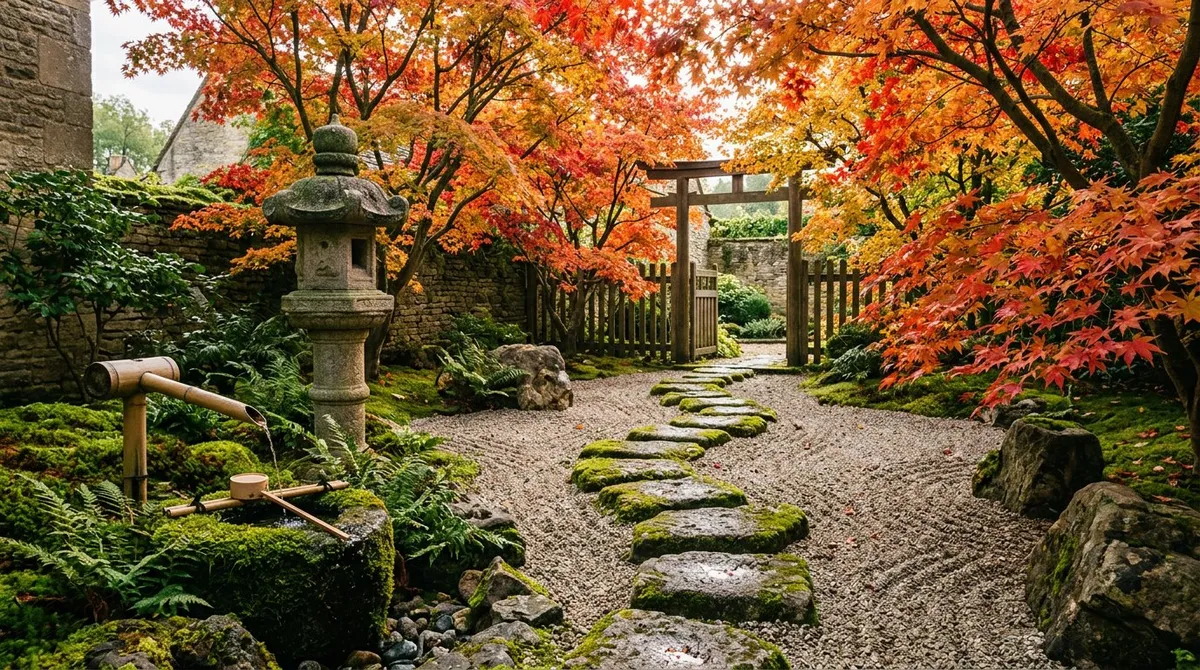
Japanese garden design is not about copying a garden from Kyoto. It is about adapting principles that have been refined over 1,000 years to work in British conditions. The good news: most of these principles suit the UK perfectly.
UK rainfall, mild winters, and naturally acidic soils in many regions create ideal growing conditions for acers, azaleas, moss, and bamboo. These are the same plants that define Japanese gardens. A 3m x 3m courtyard can hold a complete zen dry garden. A 10m x 15m suburban plot can include a pond, stone lanterns, a tea garden, and seasonal planting that changes character twelve times a year.
This guide covers the key elements of Japanese garden design, the best plants for UK conditions, budget breakdowns, and maintenance requirements. For more design inspiration on smaller plots, see our small garden design ideas.
Core principles of Japanese garden design
Japanese gardens follow principles that differ from Western garden design. Understanding these principles is more important than buying the right plants or ornaments.
Asymmetry over symmetry. Japanese gardens avoid straight lines, paired plantings, and mirror layouts. Stones are placed in odd-numbered groups of three, five, or seven. Paths curve rather than running straight. Planting is layered and naturalistic, never regimented.
Borrowed scenery (shakkei). The garden frames views beyond its boundaries. A gap in the planting might reveal a distant tree, church spire, or hillside. This makes the garden feel larger than its footprint and connects it to the wider setting.
Enclosure and discovery. Like the best courtyard garden designs, Japanese gardens reveal themselves gradually. Paths wind around screening plants. You never see the entire garden from one point. Each turn reveals a new composition.
Simplicity and restraint. A single perfectly placed stone is more powerful than a dozen. A clipped evergreen against raked gravel creates drama through contrast. This restraint makes Japanese gardens some of the lowest-maintenance designs when built correctly.
Wabi-sabi. The beauty of imperfection, age, and natural wear. A moss-covered stone has more value than a polished one. Weathered timber is preferred to painted wood. This principle suits UK conditions, where rain and age patina surfaces quickly.
Essential elements of a Japanese garden
Every Japanese garden combines some or all of these physical elements. You do not need all of them, but each one adds authenticity.
Stone and rock
Stone is the backbone of a Japanese garden. Rocks represent mountains, islands, or natural outcrops. Choose local stone where possible. Yorkshire sandstone, Welsh slate, and Scottish granite all work well and avoid the carbon footprint of imported stone.
Place rocks partially buried, as if they have been there for centuries. Never sit a rock on top of the soil surface. Bury at least one-third of each stone. Group rocks in odd numbers: three, five, or seven. One tall upright, one low flat, one angled. This creates natural-looking compositions.
Budget: £50-£200 per feature stone from a local quarry. Reclaimed stone from demolition yards costs less.
Water features
Water represents purification and the passage of time. Options range from a simple tsukubai (stone basin) to a full koi pond with a bridge.
A tsukubai is a low stone water basin originally used for hand-washing before tea ceremonies. Reconstituted stone versions start at £80. Natural granite basins cost £300-£600. Pair with a bamboo spout (shishi-odoshi) for sound.
For larger gardens, a pond with still, dark water reflects the sky and surrounding plants. Line with butyl rubber (£5-£8 per sqm) over a protective fleece. A 3m x 2m pond costs around £400-£600 in liner and edging materials. See our water feature ideas for more options.
Paths and stepping stones
Paths in Japanese gardens slow you down and direct your gaze. Stepping stones (tobi-ishi) set into moss or gravel force you to look down, then up at each new view. Space them at natural stride length, around 40-50cm centre to centre.
Use flat-topped natural stone, 30-50cm across and 5-8cm thick. Set them flush with the surrounding surface. A single line of stepping stones suits narrow gardens. A staggered two-and-one pattern creates a more considered pace.
Lanterns and ornaments
Stone lanterns (toro) serve as focal points rather than light sources. The most common types are yukimi-dori (snow-viewing lantern, with a broad cap) and kasuga (tall, formal style). Reconstituted stone lanterns cost £40-£150. Hand-carved granite versions start at £500.
Place lanterns near water, at path junctions, or beside a gate. Never in the centre of a space. One or two lanterns is enough for most gardens. Too many creates clutter.
Best Japanese plants for UK gardens
The UK climate suits Japanese garden plants remarkably well. Most are fully hardy and need no winter protection.
Trees
| Plant | Height | Conditions | UK hardiness | Key feature |
|---|---|---|---|---|
| Acer palmatum Bloodgood | 4-6m | Partial shade, acidic soil | Hardy to -15C | Deep purple foliage, crimson autumn colour |
| Acer palmatum Dissectum | 1.5-2.5m | Sheltered, dappled shade | Hardy to -15C | Finely cut weeping leaves |
| Prunus serrulata Kanzan | 8-10m | Full sun, any soil | Fully hardy | Double pink cherry blossom in April |
| Pinus mugo (dwarf mountain pine) | 1-2m | Full sun, any soil | Fully hardy | Cloud-pruning candidate, evergreen |
| Cornus kousa | 4-6m | Partial shade, acidic soil | Hardy to -15C | White bracts in June, red fruit in autumn |
For more on growing Japanese maples, including pruning and care through UK seasons, see our Japanese maple care guide.
Shrubs and ground cover
| Plant | Height | Conditions | Role |
|---|---|---|---|
| Azalea (evergreen types) | 60cm-1.5m | Acidic soil, part shade | Spring colour, clipped mounds |
| Camellia japonica | 2-4m | Acidic soil, sheltered | Winter and early spring flowers |
| Buxus sempervirens | 30cm-4m | Any soil, sun or shade | Cloud-pruning, topiary |
| Taxus baccata (yew) | Clippable to any height | Any soil, sun or shade | Formal shapes, hedging |
| Pieris japonica | 1.5-3m | Acidic soil, part shade | Red new growth, white flowers |
Ground layer and accents
Moss thrives naturally in damp, shaded UK gardens. Encourage it by keeping areas moist and removing competing plants. Rake away fallen leaves in autumn. Soleirolia soleirolii (mind-your-own-business) makes a good moss substitute in drier spots.
Bamboo provides movement, sound, and screening. Fargesia murieliae and Fargesia nitida are clumping types that stay contained without root barriers. For taller screening, Phyllostachys nigra (black bamboo) reaches 3-5m but needs a root barrier buried 60cm deep.
Hostas fill shaded areas with bold foliage. Protect from slugs with copper tape or biological controls. Hakonechloa macra (Japanese forest grass) adds soft, flowing texture.
Ferns are essential for shaded areas. Dryopteris erythrosora (autumn fern) has coppery new fronds. Polystichum setiferum grows well in deep shade under trees. Both are fully hardy and evergreen in mild UK winters.
Types of Japanese garden design
There are several distinct styles of Japanese garden. Each suits different plot sizes and budgets.
Zen dry garden (karesansui)
The most recognisable Japanese garden style. Raked gravel represents water. Rocks represent mountains or islands. No actual water is used.
A zen garden needs as little as 3m x 3m. Use angular granite gravel in 10-14mm grade for the best raking patterns. Lay woven landscape membrane first to suppress weeds. Spread gravel 50-70mm deep. Place three to five feature rocks in an asymmetric arrangement. Rake concentric circles around rocks and parallel lines across open areas.
Cost: £500-£1,500 for a small courtyard. Gravel at £60-£80 per tonne covers about 10 sqm at 50mm depth.
Why we recommend angular granite gravel in 10-14mm grade: After 30 seasons designing and maintaining Japanese-inspired gardens across the UK, this grade consistently holds raking patterns longer than any alternative. Rounded pea gravel shifts after a single rain shower. Angular granite, bedded to 60-70mm depth on a woven membrane, holds crisp parallel lines and concentric circles for 5-7 days between rakings, even on sloping ground.
Tea garden (roji)
Tea gardens create a transition from the ordinary world to the calm of the tea house. The path is the focus. Stepping stones lead through simple planting to a waiting bench, past a tsukubai for hand-washing, and into the tea space.
Plant the path with low evergreens, moss, and ferns. Keep colours muted: greens, greys, and browns. Avoid showy flowers. The atmosphere should be quiet, contemplative, and understated.
Stroll garden (kaiyushiki)
The largest type. A path circuits a central pond, revealing different views at each turn. This suits gardens of 15m x 10m or larger. Include a bridge (even a simple stone slab over a narrow point), a lantern, specimen trees, and seasonal planting.
This is the style seen at the Japanese Garden Society listed gardens across the UK, including Compton Acres in Dorset and the Japanese Garden at Tatton Park in Cheshire.
Budget breakdown for UK Japanese gardens
| Project scope | Size | Typical cost | What is included |
|---|---|---|---|
| Courtyard zen garden | 3m x 3m | £500-£1,500 | Gravel, membrane, 3-5 rocks, container acer |
| Small Japanese corner | 4m x 5m | £1,500-£3,500 | Gravel, stepping stones, lantern, tsukubai, bamboo screen, 5-8 plants |
| Mid-range redesign | 6m x 8m | £3,500-£7,000 | Paving, gravel areas, small pond or rill, stone lantern, 15-20 plants, mature acer |
| Full Japanese garden | 10m x 15m+ | £7,000-£15,000+ | Pond with bridge, tea area, multiple zones, mature specimen trees, stone work, lighting |
Where to save money: Source stone locally from quarries rather than garden centres. Grow bamboo and ferns from divisions rather than buying large specimens. Propagate azaleas from semi-ripe cuttings in July. Allow moss to colonise naturally rather than buying moss mats.
Where to invest: Spend on one or two mature specimen trees. A 2m tall Acer palmatum Dissectum costs £150-£300 but gives instant impact that would take 8-10 years to grow from a small plant.
Seasonal interest through the year
A well-planted Japanese garden changes character every month. This is central to the philosophy: celebrating the passage of time.
| Season | Key plants and features |
|---|---|
| Spring | Cherry blossom (Prunus), azaleas, camellias, fresh moss growth, new acer foliage |
| Summer | Iris ensata by water, hostas, bamboo at full height, deep green canopy, fern fronds |
| Autumn | Acer leaf colour (October-November), Hakonechloa turning gold, berries on Cornus kousa |
| Winter | Evergreen structure (pine, box, yew), stone and gravel exposed, frost on lanterns, bare branch silhouettes |
The Japanese concept of mono no aware (the pathos of things) finds beauty in each season’s passing. Fallen cherry blossom on raked gravel. Autumn leaves floating on a still pond. Frost patterns on a stone lantern. These moments are the point of the garden, not problems to tidy away.
Maintenance and care
Japanese gardens require regular but light maintenance. The work is meditative rather than laborious.
Gravel: Rake weekly to maintain patterns. Remove fallen leaves promptly with a leaf blower on low setting or by hand. Top up gravel depth annually, adding 10-20mm. Pull any weeds immediately.
Pruning: Cloud-prune box and pine in late spring (May-June) and again in late summer (August-September). Remove crossing branches on acers in late autumn when sap flow stops. Never prune acers in spring, as they bleed sap heavily.
Moss: Keep shaded and moist. Brush away fallen leaves with a soft broom. Avoid walking on moss when frozen. Apply sulphate of iron at 15g per sqm in spring to discourage grass and encourage moss on lawns.
Water features: Clean tsukubai basins monthly. Remove algae by hand. Add barley straw extract to ponds in spring to prevent algae. Keep pond pumps running through winter to prevent freezing. Drain bamboo spouts before hard frosts.
Gardener’s tip: Japanese gardeners treat maintenance as part of the garden experience, not a chore. Raking gravel is a form of active meditation. Pruning is a conversation with the plant about its ideal shape. Approach the work with this mindset and the garden rewards you twice: once in the doing, once in the result.
Common mistakes to avoid
Overcrowding the space. Japanese gardens rely on empty space as much as planted space. Resist the urge to fill every gap. Gravel, stone, and open ground are design elements, not wasted space.
Using too many ornaments. One stone lantern and one tsukubai is enough for most gardens. A cluttered collection of lanterns, pagodas, and Buddha statues looks like a garden centre display, not a Japanese garden.
Ignoring scale. A 4m plot needs rocks of 30-50cm, not 1m boulders. A small courtyard needs a dwarf acer of 1.5m, not an 8m cherry tree. Match every element to the size of the space.
Planting too many flowers. Japanese gardens prioritise foliage, texture, and form over flower colour. Azaleas and camellias provide seasonal colour. The rest of the year, the palette is greens, greys, and earth tones. If you want a colourful flower garden, consider a cottage garden planting plan instead.
Neglecting winter structure. Without evergreen bones, a Japanese garden looks bare from November to March. Ensure at least 60% of your planting is evergreen: box, yew, pine, bamboo, and evergreen azaleas.
Now you’ve planned your Japanese garden, read our guide on Japanese maple care in the UK to choose and grow the signature tree that defines the style.
Frequently asked questions
Can you create a Japanese garden in the UK?
Japanese gardens suit UK conditions well. High rainfall, mild winters, and acidic soils in many regions match the needs of acers, azaleas, bamboo, and moss. Over 40 public Japanese gardens exist across the UK, including Tatton Park in Cheshire, Compton Acres in Dorset, and the Japanese Garden at Kew.
What are the best Japanese plants for UK gardens?
Japanese maples, bamboo, azaleas, and camellias all thrive in the UK. Acer palmatum varieties are hardy to -15C. Phyllostachys nigra handles UK winters with a root barrier. Pieris, hostas, and ferns fill shaded areas beneath trees. For detailed acer growing advice, see our Japanese maple care guide.
How much does a Japanese garden cost in the UK?
A small courtyard zen garden costs £500-£1,500. Mid-range designs with stone lanterns and a water feature run £3,000-£7,000. A full Japanese garden with a pond, mature trees, and tea area reaches £10,000-£15,000 or more depending on plant sizes and stone quality.
How do you maintain a zen gravel garden?
Rake gravel weekly to maintain patterns and remove fallen leaves. Top up gravel annually, adding 10-20mm depth. Pull weeds by hand or lay a woven membrane beneath the gravel to suppress growth. The whole process takes 15-20 minutes for a 3m x 3m garden.
What gravel is best for a Japanese garden?
Angular granite gravel in 10-14mm grade holds raking patterns best. Rounded pea gravel shifts too easily and will not hold lines. Choose pale grey, cream, or warm buff tones. Budget around £60-£80 per tonne delivered. One tonne covers roughly 10 sqm at 50mm depth.
Do Japanese gardens need full sun?
Japanese gardens actually suit partial shade. Most key plants, including acers, azaleas, moss, and ferns, prefer dappled light. A north-facing or east-facing plot works well. Afternoon sun causes leaf scorch on acers. For more shade-tolerant plants, see our guide to the best plants for shade.
How do I stop bamboo spreading in my garden?
Use a root barrier of HDPE plastic buried 60cm deep. Alternatively, grow bamboo in large pots sunk into the ground. Running species like Phyllostachys need barriers without exception. Clumping types like Fargesia murieliae and Fargesia nitida stay contained naturally.
Further reading
- Small garden design ideas - layout principles that apply to Japanese courtyard designs
- Water feature ideas for gardens - pond, rill, and fountain options
- Courtyard garden ideas - making the most of enclosed spaces
- Best trees for small gardens - compact trees including Japanese maples
- Front garden ideas - Japanese-inspired designs for front plots
Lawrie has been gardening in the West Midlands for over 30 years. He grows his own veg using no-dig methods, keeps a wildlife-friendly garden, and writes practical advice based on real UK growing conditions.