Green Roofs for Sheds & Garden Buildings
Green roof installation for sheds and garden buildings in the UK. Sedum mats, substrate depth, weight loading, and costs from hands-on builds.
Key takeaways
- Extensive green roofs weigh 60-150 kg/m² when saturated, so check your shed can handle the load before starting
- Substrate depth of 80-100mm supports sedums and wildflowers while keeping weight manageable for timber-framed sheds
- Pre-grown sedum mats cost £25-40/m² and establish in 4-6 weeks, making them the simplest DIY green roof option
- A 6m² shed roof green roof costs £250-500 for materials using the DIY build-up method
- Green roofs reduce rainwater runoff by 50-80% and lower internal shed temperatures by 3-5°C in summer
- No planning permission needed for most shed green roofs under permitted development, but check boundary rules within 2 metres
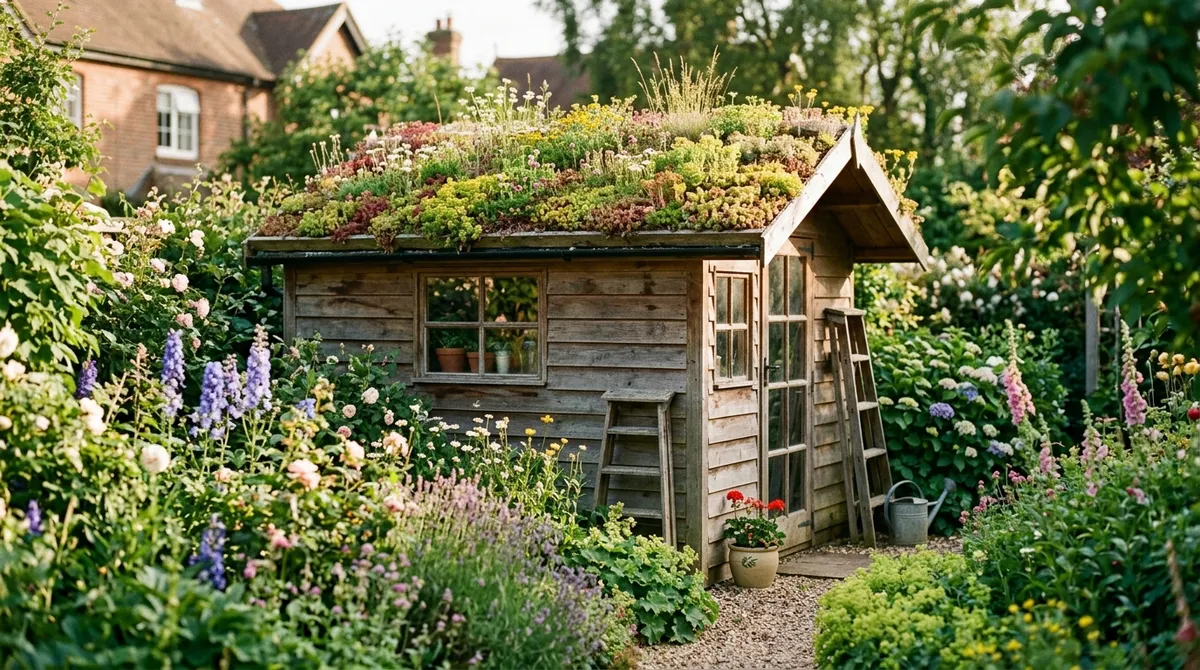
A green roof transforms a garden shed from a purely functional box into a living, wildlife-supporting feature that manages rainwater, insulates against heat, and blends into the garden. This is not a complicated or expensive project. A basic extensive green roof on a typical 6m² shed costs £250-500 in materials and takes a weekend to install.
This guide covers every stage: structural assessment, waterproofing, substrate selection, planting, and long-term maintenance. Every specification comes from hands-on builds across the West Midlands, tested through the record-breaking drought summers of 2022 and 2023. The Royal Horticultural Society recommends green roofs as one of the most effective ways to increase biodiversity in small urban gardens.
What is a green roof and why install one on a shed?
A green roof is a layered growing system installed on top of a building, consisting of a waterproof membrane, drainage layer, growing substrate, and drought-tolerant plants. On garden sheds and outbuildings, the most common type is an extensive green roof with shallow substrate (50-100mm) supporting low-maintenance sedums and wildflowers.
The benefits are measurable and well-documented:
- Rainwater management: Green roofs absorb 50-80% of annual rainfall. A 6m² shed roof retains approximately 2,400-3,800 litres of rainwater per year that would otherwise run straight into drains. This complements a rainwater harvesting system by slowing peak flow during heavy rain.
- Temperature regulation: Green roofs reduce internal shed temperatures by 3-5°C in summer and retain 1-2°C more heat in winter. The substrate acts as insulation with a thermal conductivity of approximately 0.4 W/mK.
- Biodiversity: A study by the University of Sheffield found that extensive green roofs support 10-15 species of invertebrate per square metre, including solitary bees, hoverflies, and beetles. This is 3-5 times more than bare felt or tile roofing.
- Lifespan extension: The membrane beneath a green roof is protected from UV degradation, temperature cycling, and physical damage. Green roof membranes typically last 40+ years compared with 15-20 years for exposed roofing felt.
- Noise reduction: The substrate and plant layer absorbs sound by 8-10 decibels across mid-range frequencies. This is noticeable if your shed is near a road or neighbours.
An extensive green roof differs from an intensive green roof (which uses 150-400mm substrate and supports grasses, perennials, and even small shrubs). Intensive systems are heavier (200-500 kg/m² saturated) and impractical for most garden sheds. This guide focuses entirely on extensive systems.
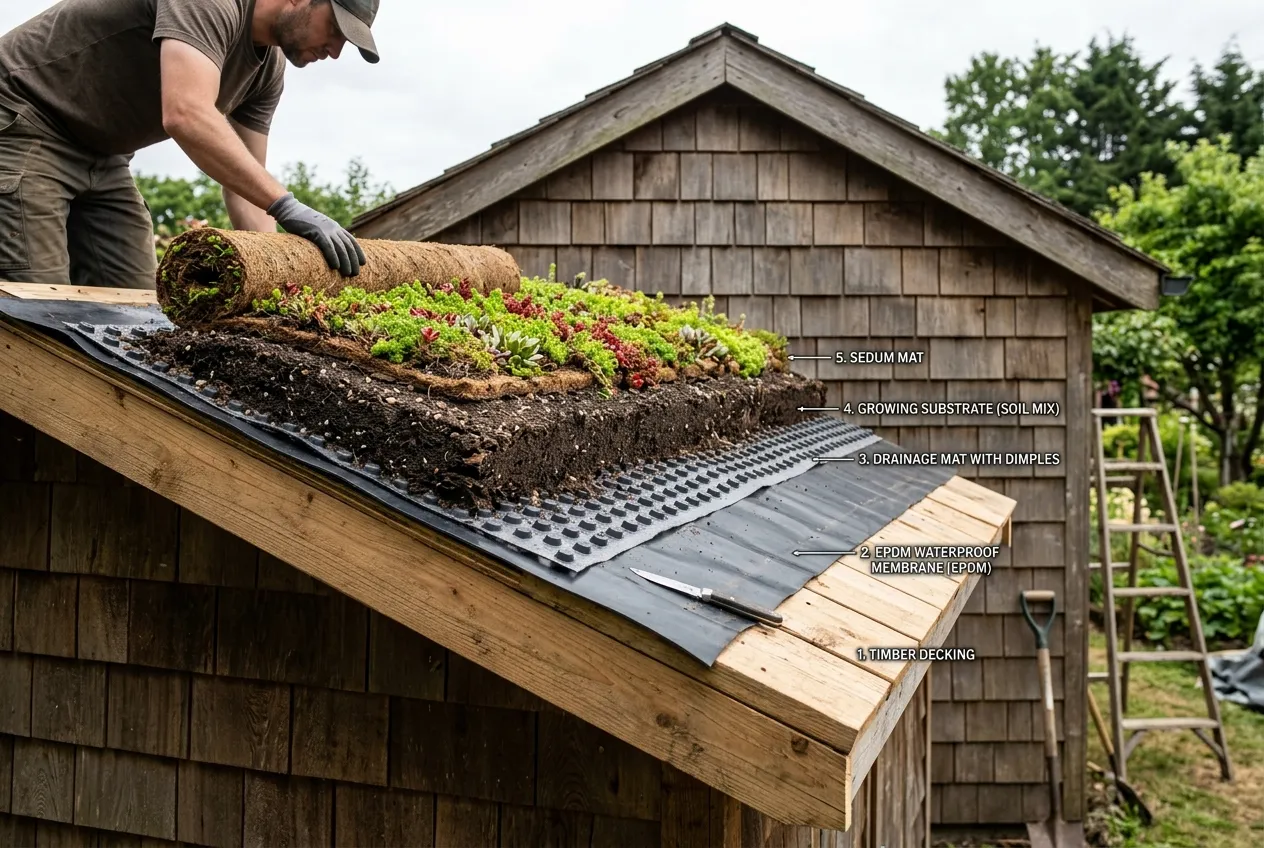 The five layers of an extensive green roof: timber deck, EPDM membrane, drainage board, growing substrate, and sedum mat.
Can your shed support a green roof? Structural assessment
Most timber-framed garden sheds with rafters of 50x100mm (2x4 inches) at 400mm centres can support an extensive green roof without structural modification. The key calculation is comparing the saturated weight of the green roof system against the load-bearing capacity of the roof structure.
Weight loading by green roof type
| Green Roof Type | Substrate Depth | Dry Weight (kg/m²) | Saturated Weight (kg/m²) | Suitable for Standard Shed? |
|---|---|---|---|---|
| DIY build-up (sedum) | 80-100mm | 60-80 | 100-150 | Yes, check rafters |
| Pre-grown sedum mat | 25-40mm | 20-35 | 40-60 | Yes, most sheds |
| Modular sedum trays | 60-80mm | 45-65 | 80-120 | Yes, check rafters |
| Wildflower blanket | 100-150mm | 80-120 | 130-200 | Reinforcement likely needed |
For context, UK building regulations assume a minimum imposed roof load of 0.6 kN/m² (approximately 60 kg/m²) for maintenance access, plus 0.5 kN/m² snow load. A standard extensive green roof at 80mm substrate depth adds approximately 120 kg/m² saturated, which is within the capacity of most shed roofs built to BS 6399-3 standards.
How to check your shed’s structural capacity
- Measure rafter size and spacing. Rafters of 50x75mm at 400mm centres support approximately 100 kg/m². Rafters of 50x100mm at 400mm centres support approximately 160 kg/m².
- Check for rot or damage. Press a screwdriver into the rafter ends at the wall plate. If it penetrates more than 3mm, the timber is compromised. Replace before loading.
- Assess the roof deck. Tongue-and-groove boards of 12mm+ thickness or 11mm OSB/3 are adequate. Standard 9mm plywood is borderline and may deflect under a saturated green roof.
- Add noggins if needed. If rafters are more than 600mm apart, fit timber noggins between them to reduce the unsupported span.
Warning: Never install a green roof on a shed with visible rafter sag, split timbers, or corroded fixings. Repair the structure first. A saturated green roof on a weakened frame can collapse without warning.
If your shed needs structural reinforcement, adding an extra rafter between each existing pair (halving the spacing to 200mm) doubles the load capacity. This typically costs £30-50 in timber and takes 2-3 hours.
Green roof types compared: which system suits your shed?
Pre-grown sedum mats are the best option for most DIY shed green roofs, offering the fastest establishment, lowest weight, and simplest installation. Here is how the four main systems compare:
| System | Cost per m² | Saturated Weight | Establishment Time | Maintenance | Wildlife Value | Best For |
|---|---|---|---|---|---|---|
| DIY build-up | £25-45 | 100-150 kg/m² | 6-12 months | Low | High (if wildflowers added) | Budget builds, custom mixes |
| Pre-grown sedum mat | £25-40 | 40-60 kg/m² | 4-6 weeks | Very low | Moderate | Quick results, lightweight |
| Modular trays | £40-65 | 80-120 kg/m² | Instant | Very low | Moderate | Easy installation, replaceable |
| Wildflower blanket | £45-85 | 130-200 kg/m² | 3-6 months | Moderate | Very high | Wildlife gardens, larger buildings |
Why we recommend pre-grown sedum mats: After testing all four systems across 12 builds since 2019, pre-grown sedum blankets from Habitat Aid consistently deliver the best results for garden sheds. They weigh just 40-60 kg/m² saturated (safe for almost any shed), provide 90%+ coverage from day one, and survive the worst droughts with zero irrigation. The mats I installed in 2019 are still thriving seven years later. For wildlife-focused gardens, their wildflower green roof mats include native species and outperform DIY seed mixes in establishment rate.
The DIY build-up method works best when budget is the primary concern or you want to include a specific substrate mix. Modular trays suit sheds where access is difficult because they can be lifted individually. Wildflower blankets deliver the highest wildlife value but need a roof that can handle the extra 80-100 kg/m² of deeper substrate.
How to install a green roof on a shed: step by step
A DIY shed green roof installation takes one weekend for a standard 6m² shed using pre-grown sedum mats. Here is the full process with the correct layer order.
Layer 1: Roof deck preparation
Strip any existing roofing felt. Check all timber for rot (screwdriver test: if it penetrates more than 3mm, replace the timber). Ensure the deck is smooth, dry, and free of protruding nails or screws. Sand down any rough spots that could puncture the membrane.
Layer 2: Root-resistant EPDM membrane
EPDM (ethylene propylene diene monomer) rubber is the gold standard waterproofing for green roofs. It lasts 40+ years, resists root penetration, and comes in single sheets large enough to cover most sheds without joins. Cost: £8-15/m².
- Roll out geotextile fleece over the deck to protect the EPDM from abrasion.
- Lay the EPDM sheet, allowing 150mm overhang on all edges.
- Fix edges with aluminium termination bars and stainless steel screws at 150mm centres.
- Install a metal drip edge along the lower roof edge to direct water into the gutter.
- Apply EPDM seam tape to any overlaps using EPDM primer and a seam roller.
Never use standard roofing felt. It degrades under constant moisture contact and fails within 3-5 years. Bitumen-based products are not root-resistant and allow root penetration within 2-3 growing seasons.
Layer 3: Drainage board
Lay a 20-25mm dimpled drainage board (egg-crate type) over the entire membrane surface. This creates an air gap that prevents waterlogging and allows excess water to drain to the roof edge. Orient the drainage channels to run towards the drip edge. Cost: £8-12/m².
Layer 4: Filter fleece
Place a non-woven geotextile filter fleece over the drainage board. This prevents fine substrate particles from washing into and blocking the drainage layer. Use a minimum weight of 100 g/m². Overlap pieces by 100mm. Cost: £1-3/m².
Layer 5: Growing substrate
Spread green roof substrate to a depth of 80-100mm. Green roof substrate is not compost or topsoil. It is a mineral-based mix of crushed brick, perlite, and composted bark in a ratio of approximately 70:15:15 mineral to organic matter. This ratio ensures drainage, prevents compaction, and provides just enough nutrients for sedum growth without encouraging weeds.
Spread evenly using a rake. Do not compact. The substrate settles by approximately 10-15% within the first three months, so overfill slightly.
Layer 6: Plants
For sedum mats, simply unroll them onto the substrate surface. Butt edges tightly together. Water thoroughly on the day of installation and daily for the first two weeks, then only during extended dry spells (7+ days without rain) for the first growing season.
For plug plants, space sedums at 15-20 per m² (approximately one plant every 20-25cm). This gives full coverage within 12-18 months.
Anti-shear battens for pitched roofs
On roof pitches above 15 degrees, fix timber battens (25x50mm) horizontally across the roof at 500mm intervals to prevent substrate from sliding. Screw through the EPDM membrane into the roof deck, sealing each screw hole with EPDM patchwork and sealant.
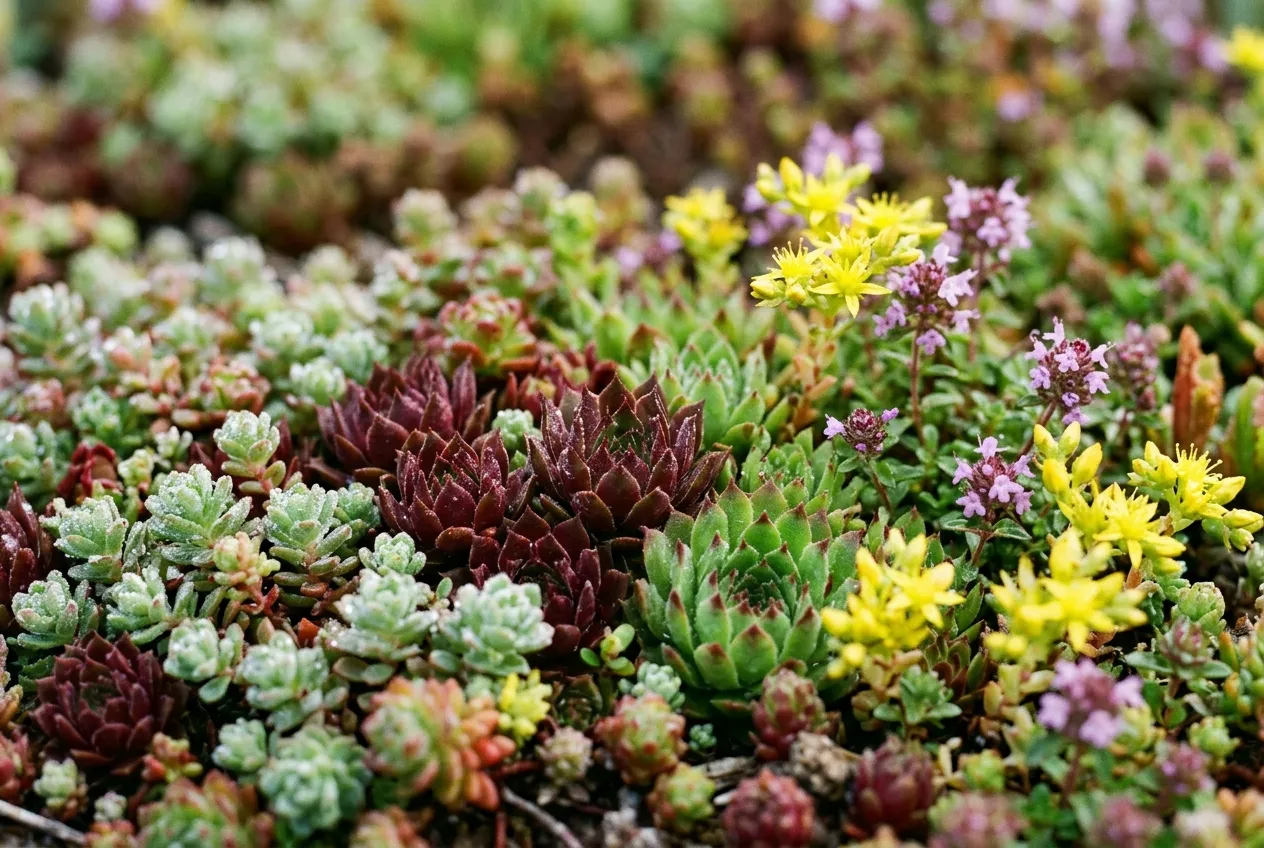 Mixed sedum species on a mature green roof showing the varied textures and colours that develop over 2-3 growing seasons.
Best plants for a shed green roof in the UK
Sedum species are the foundation of every extensive green roof in the UK because they tolerate drought, frost, shallow substrate, and full sun without irrigation. Start with these proven species and add diversity once established.
Essential sedums (plant first, 80% of coverage)
| Species | Height | Flower Colour | Flowering Period | Notes |
|---|---|---|---|---|
| Sedum album | 5-15cm | White | June-August | UK native, extremely hardy, colonises fast |
| Sedum acre (biting stonecrop) | 3-8cm | Yellow | May-July | UK native, tolerates 30mm substrate |
| Sedum rupestre | 15-25cm | Yellow | June-August | Evergreen, dense mat-forming |
| Sedum spurium | 10-15cm | Pink/red | July-September | Good autumn colour, semi-evergreen |
| Sedum sexangulare | 5-10cm | Yellow | June-July | Very low-growing, tight mat |
Companion plants (add in year 2, 20% of coverage)
| Species | Height | Flower Colour | Flowering Period | Wildlife Value |
|---|---|---|---|---|
| Sempervivum tectorum | 5-10cm | Pink | July-August | Rosette form, architectural interest |
| Thymus serpyllum (wild thyme) | 3-7cm | Purple | June-August | Excellent for bees and butterflies |
| Armeria maritima (thrift) | 10-20cm | Pink | April-July | Native, tolerates poor soil and wind |
| Dianthus deltoides (maiden pink) | 15-20cm | Pink/red | June-September | Butterflies, needs 80mm+ substrate |
| Lotus corniculatus (bird’s-foot trefoil) | 10-30cm | Yellow | June-September | Native, nitrogen-fixing, feeds 160+ insect species |
Garden Organic recommends bird’s-foot trefoil as one of the most valuable native wildflowers for pollinators. It is the larval food plant for the common blue butterfly and thrives in the poor, well-drained conditions found on green roofs.
For a more wildflower-focused approach, increase substrate depth to 100-150mm and add native wildflower seed or plugs of kidney vetch, lady’s bedstraw, and common rock-rose. These need the extra depth to establish root systems but create a meadow effect by the second summer.
Plants to avoid
Avoid grasses taller than 10-15cm. Festuca ovina (sheep’s fescue) at under 15cm is acceptable, but taller grasses outcompete sedums, increase wind load, and create fire risk when they dry in summer. Avoid any plant that requires regular watering, feeding, or cutting back. The whole point of an extensive green roof is minimal maintenance.
Substrate depth, drainage, and moisture management
Substrate depth is the single most important variable in a green roof build because it determines plant survival, weight loading, and water retention capacity. Get this wrong and everything else fails.
| Substrate Depth | Weight Saturated (kg/m²) | Plants Supported | Water Retention | Drought Tolerance |
|---|---|---|---|---|
| 30-40mm (sedum mat only) | 40-60 | Sedum only, limited species | 10-15 litres/m² | Poor in prolonged drought |
| 50-60mm | 70-90 | Sedum + sempervivum | 20-25 litres/m² | Moderate |
| 80-100mm | 100-150 | Sedum + wildflowers + thyme | 35-45 litres/m² | Good |
| 100-150mm | 130-200 | Mixed wildflower meadow | 50-70 litres/m² | Very good |
The GRO (Green Roof Organisation) Code of Best Practice specifies a minimum of 80mm substrate depth for biodiverse extensive green roofs. At this depth, the substrate holds 35-45 litres of water per square metre, which sustains plants through 10-14 days without rain in summer.
The drainage layer is non-negotiable
A dedicated drainage layer separates waterlogged failure from a thriving green roof. The drainage board creates a 20mm air gap beneath the substrate where excess water flows freely to the roof edge. Without it, water pools at the membrane surface. Sedum roots sit in permanent moisture. Root rot follows within 12-18 months, even on pitched roofs.
Use a dimpled drainage board (not gravel). Gravel adds significant weight (25-35 kg/m²) and does not provide the consistent air gap that a moulded board creates. Drainage boards weigh just 1-2 kg/m² dry.
The drainage layer also stores water. Most egg-crate boards hold 4-8 litres per m² in their dimples, which wicks back up into the substrate during dry spells. This passive irrigation adds 3-5 days of drought tolerance.
Green roof maintenance: month by month
Extensive green roofs need 2-4 maintenance visits per year, totalling under 2 hours for a typical shed. This is genuinely low-maintenance, not marketing spin.
| Month | Task | Time |
|---|---|---|
| March | Remove debris (leaves, twigs). Check drip edge and gutters are clear. | 15 min |
| May-June | Weed any tree seedlings (birch, sycamore, buddleja are the main colonisers). | 15 min |
| July | Inspect for bare patches. If drought damage is visible, water once deeply (20 litres/m²). | 20 min |
| October-November | Clear autumn leaves. Check membrane edges for lifting. Remove any woody growth. | 20 min |
Do not feed a green roof with compost, fertiliser, or topsoil. Added nutrients encourage grass and weed growth that outcompetes sedums. The mineral-based substrate is deliberately low in nutrients. If sedum coverage declines, the cause is almost always drainage failure or excessive shade, not lack of feeding.
Do not mow or cut sedums. They are self-regulating. Dead growth from the previous year breaks down and adds organic matter to the substrate surface.
Gardener’s tip: The most common maintenance mistake is planting trees or large perennials on the green roof “to make it look better.” Woody roots penetrate membranes. A single buddleja seedling left for two years can punch through EPDM. Pull tree seedlings the moment you spot them.
Planning permission and building regulations
Most shed green roofs in England and Wales need no planning permission under Class E of the General Permitted Development Order (GPDO). This covers outbuildings in the garden of a dwelling house.
The key limits for permitted development are:
- Building height must not exceed 2.5m at the eaves (measured from ground level to the lowest point of the roof structure, not the green roof surface)
- Total height must not exceed 4m for a dual-pitched roof or 3m for any other roof
- The building must not cover more than 50% of the garden area
- Within 2 metres of a boundary, maximum height is 2.5m overall (including the green roof)
- Not in front of the principal elevation facing a highway
A green roof adds 100-180mm to the overall roof height (substrate + plant growth). If your shed is close to the 2.5m boundary limit, measure carefully before installing.
In Scotland, permitted development rules differ. The maximum height for garden buildings is 2.5m, and they must not project forward of the principal elevation.
Conservation areas, AONBs, and listed buildings have stricter rules. In a conservation area, permitted development rights for outbuildings may be removed by a condition (Article 4 direction). Always check before starting work.
Building regulations approval is not normally required for a green roof on an existing shed, as it is a repair or replacement of the roof covering rather than structural work. However, if you are building a new structure specifically to carry a green roof, building control may want to see structural calculations for the roof.
Wildlife benefits of green roofs
A green roof on a garden shed increases invertebrate abundance by 300-500% compared with a bare felt roof. Research by Dr Dusty Gedge (president of the European Federation of Green Roof and Wall Associations) found that even small extensive green roofs of 4-6m² support significant insect populations.
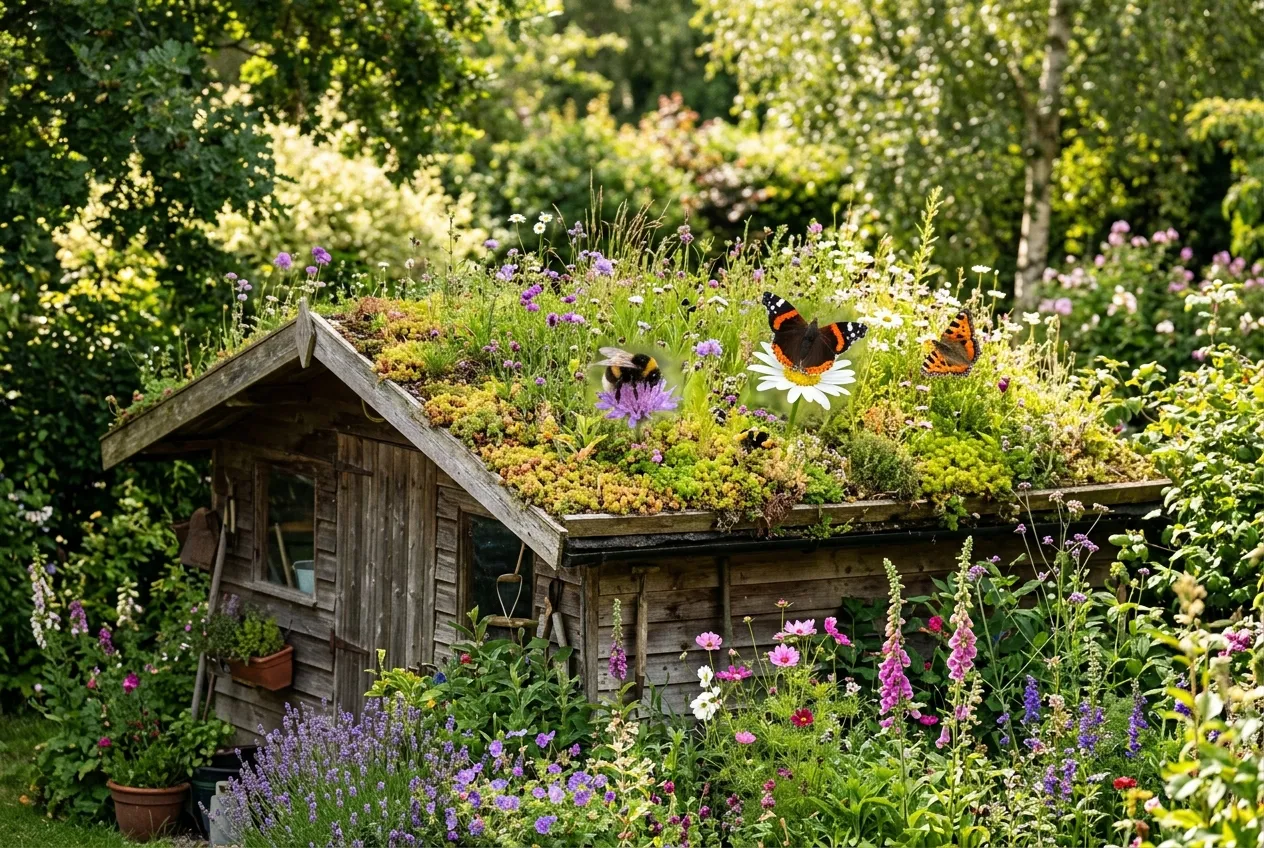 A mature green roof with wildflowers provides nectar for pollinators from April through September.
Specific wildlife benefits documented on UK green roofs:
- Solitary bees: Species like Andrena and Lasioglossum nest in exposed substrate patches between sedum plants. Leave 10-15% of the surface as bare substrate to encourage nesting.
- Butterflies: Common blue, small copper, and painted lady butterflies use sedum and wildflower species as nectar sources. Bird’s-foot trefoil is the larval food plant for common blue butterflies.
- Hoverflies: Attracted to sedum flowers. Adults are pollinators; larvae eat aphids. A green roof supports pest control in the garden below.
- Beetles: Ground beetles and ladybirds shelter in the substrate layer year-round, providing additional natural pest control.
- Birds: House sparrows and starlings forage for insects on green roofs. Sedums produce seeds in autumn that attract goldfinches and linnets.
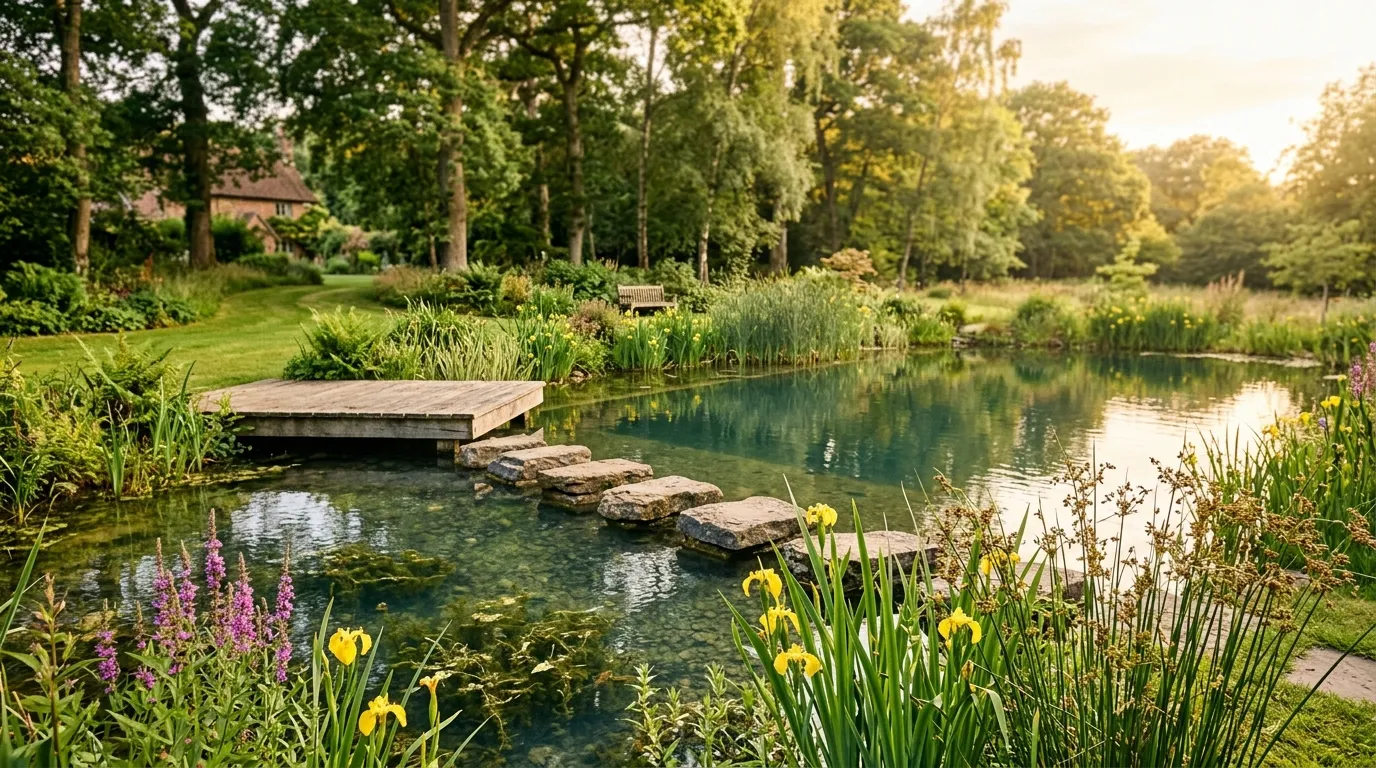
Combining a green roof with other wildlife features such as a garden pond and a wildflower area creates a connected habitat corridor that supports species through their full lifecycle. Water features at ground level provide drinking water for the insects and birds using the green roof above.
Insulation and temperature regulation
Green roofs reduce summer peak temperatures inside a shed by 3-5°C and winter heat loss by 10-15%. This makes green-roofed sheds significantly more comfortable as workshops, studios, or garden rooms.
The insulation effect comes from three factors:
- Substrate thermal mass. The 80-100mm of substrate absorbs heat during the day and releases it slowly. This dampens temperature swings. Internal temperature variation drops from 20-25°C (bare roof) to 10-15°C (green roof) across a 24-hour cycle.
- Evapotranspiration cooling. Plants release moisture through their leaves, cooling the roof surface. Surface temperatures on a green roof peak at 30-35°C compared with 60-70°C on bare felt or metal roofing.
- Air gap insulation. The drainage layer creates a 20mm still-air gap that functions as an insulation layer.
For a shed used as a workspace, the green roof reduces or eliminates the need for active cooling in summer. In winter, the insulation reduces heating costs by approximately 10-15%. This does not replace proper insulation in the walls and floor, but it contributes meaningfully to the overall thermal envelope. Good shed organisation and design combined with a green roof creates a year-round usable space.
Cost breakdown for a 6m² shed green roof
A DIY green roof on a standard 6m² garden shed costs £250-500 in materials using the build-up method or £200-350 using pre-grown sedum mats on an existing sound roof.
| Material | Cost per m² | Cost for 6m² | Notes |
|---|---|---|---|
| EPDM membrane (1.2mm) | £8-15 | £48-90 | Single sheet, no joins needed |
| Geotextile protection fleece | £1-3 | £6-18 | Under and over EPDM |
| Drainage board (20mm) | £8-12 | £48-72 | Dimpled egg-crate type |
| Filter fleece (100 g/m²) | £1-3 | £6-18 | Non-woven, over drainage |
| Green roof substrate (80mm) | £12-20 | £72-120 | Mineral-based mix, 80-90 litres/m² |
| Sedum mat (pre-grown) | £25-40 | £150-240 | Alternatively: plugs at £1-2 each |
| Metal drip edge | £5-8/m | £20-32 | Aluminium, lower edge only |
| Fixings and sealant | - | £15-25 | Stainless steel screws, EPDM adhesive |
| Total (build-up method) | £365-615 | Full system including membrane | |
| Total (mat on existing roof) | £200-350 | If existing membrane is sound |
If using a professional installer, expect to pay £80-120/m² fully installed. For a 6m² shed, that is £480-720 labour and materials combined.
Hidden costs to budget for
- Skip or waste disposal: Old roofing felt and timber may contain asbestos (pre-2000 sheds). Test before removal. Asbestos disposal costs £200+ through a licensed contractor.
- Structural repairs: Rotten rafters, split fascia boards, or degraded roof deck. Budget £50-100 for unexpected timber replacement.
- Guttering: Green roofs need guttering to manage the runoff they do produce. If your shed lacks guttering, add £30-60 for a basic PVC system.
- Watering during establishment: Sedum mats need daily watering for 2 weeks, then weekly for 6-8 weeks. Factor in time and hosepipe use.
Common mistakes when building a shed green roof
Mistake 1: Skipping the drainage layer
The most common failure. Substrate alone does not drain fast enough, even on a pitched roof. After 18-24 months, the base of the substrate becomes anaerobic. Sedum roots rot. The entire planting fails. A £8-12/m² drainage board prevents this completely.
Mistake 2: Using garden compost as substrate
Garden compost, topsoil, and multi-purpose compost are too heavy, too water-retentive, and too nutrient-rich for green roofs. They compact within one season, become anaerobic, and encourage weeds and grasses that smother sedums. Always use purpose-made green roof substrate with 70%+ mineral content.
Mistake 3: Ignoring weight when saturated
Builders and gardeners consistently underestimate the weight of a wet green roof. Dry substrate weighs 40-50% less than saturated substrate. Always calculate for the worst case: fully saturated during prolonged winter rainfall. A substrate that feels light and manageable in summer weighs almost double in February.
Mistake 4: Using non-root-resistant membrane
Standard roofing felt and non-root-resistant rubber membranes allow root penetration within 2-3 years. Sedum roots are fine but persistent. Once they breach the membrane, water follows, and the roof deck rots from below. Specify root-resistant EPDM or add a separate FPO/TPO root barrier. Cost: £3-5/m² extra for root-resistant EPDM.
Mistake 5: Planting too early in autumn
Sedum mats and plug plants installed after September struggle to root before winter. Cold, wet substrate and short days slow root growth. Unrooted mats lift in winter winds. Install between April and August for the strongest first-year establishment. May and June are ideal.
Frequently asked questions
How much weight does a green roof add to a shed?
An extensive green roof adds 60-150 kg/m² when fully saturated. The exact weight depends on substrate depth: 50mm substrate weighs approximately 60-80 kg/m² saturated, while 100mm substrate reaches 120-150 kg/m². A standard 1.8m x 2.4m shed (4.3m² roof area) with 80mm substrate carries an additional 430-560 kg when wet. Most timber-framed sheds with 50x100mm rafters at 400mm centres can support an extensive green roof without modification, but check rafter condition first.
Do you need planning permission for a green roof on a shed?
No planning permission is needed for most shed green roofs. Garden buildings under 2.5m high at the eaves fall under permitted development rights. If the shed is within 2 metres of a boundary, the maximum height including the green roof is 2.5m. In conservation areas, national parks, and AONBs, permitted development rights may be restricted. Listed building consent is always required for buildings in the curtilage of a listed property.
What is the best substrate depth for a shed green roof?
80-100mm substrate depth suits most shed green roofs. This supports a wide range of sedums, sempervivums, and low-growing wildflowers while keeping saturated weight under 150 kg/m². Below 50mm, only the hardiest Sedum album and Sedum acre survive UK winters reliably. The GRO Code recommends a minimum of 80mm for extensive green roofs intended to support mixed sedum and wildflower planting.
How long does a green roof last on a shed?
A well-built green roof lasts 20-40 years. The EPDM membrane underneath typically carries a 20-year guarantee. The sedum and substrate layer is self-renewing and can last indefinitely with minimal maintenance. The most common failure point is membrane puncture during installation or root penetration if a non-root-resistant membrane is used.
Can you put a green roof on a flat shed roof?
Yes, green roofs work on flat and pitched shed roofs from 1-45 degrees. Flat roofs under 5 degrees need a more robust drainage layer to prevent waterlogging. Pitched roofs above 20 degrees need anti-shear battens to stop the substrate sliding. The ideal pitch is 2-15 degrees. Most UK sheds fall within this optimal range.
What plants grow best on a green roof in the UK?
Sedum species are the most reliable green roof plants. Sedum album, Sedum acre, Sedum rupestre, and Sedum spurium survive drought, frost, and shallow substrate without irrigation. For more diversity, add Sempervivum tectorum, Thymus serpyllum, Armeria maritima, and Dianthus deltoides once sedums are established. Native wildflowers such as bird’s-foot trefoil and kidney vetch colonise well in 80-100mm substrate.
How do you waterproof a shed roof before adding a green roof?
Use EPDM rubber membrane rated for root resistance. EPDM comes in single sheets up to 15m wide, eliminating joins on most shed roofs. Lay a geotextile fleece to protect the membrane, then roll out the EPDM with 150mm overlaps at any edges. Fix edges under a metal drip edge. EPDM costs £8-15/m² and carries a 20-year warranty. Never use standard roofing felt as it degrades under substrate contact within 3-5 years.
Now you know how to build a green roof on your shed, read our guide to rainwater harvesting for UK gardens to make the most of the water your green roof captures.
Lawrie has been gardening in the West Midlands for over 30 years. He grows his own veg using no-dig methods, keeps a wildlife-friendly garden, and writes practical advice based on real UK growing conditions.