Native Hedgerow Species Guide UK
Native hedgerow species for UK gardens ranked by wildlife value, soil tolerance, and growth rate. Ten species compared with planting guide.
Key takeaways
- Hawthorn is the single most important native hedgerow species, supporting 300+ invertebrate species and tolerating any UK soil
- Plant bare-root whips from November to March at 30-45cm spacing for around 80p-2 pounds per plant
- A mixed native hedge of five or more species qualifies as a Priority Habitat under the UK Biodiversity Action Plan
- Holly and hornbeam give winter structure — holly is evergreen, hornbeam holds its dead leaves until spring
- Dog rose, elder, and guelder rose provide the best flower and berry display for foraging and wildlife
- Cut new whips back by one-third at planting to force dense branching from the base
- Never trim hedgerows between March and August — it is illegal under the Wildlife and Countryside Act 1981
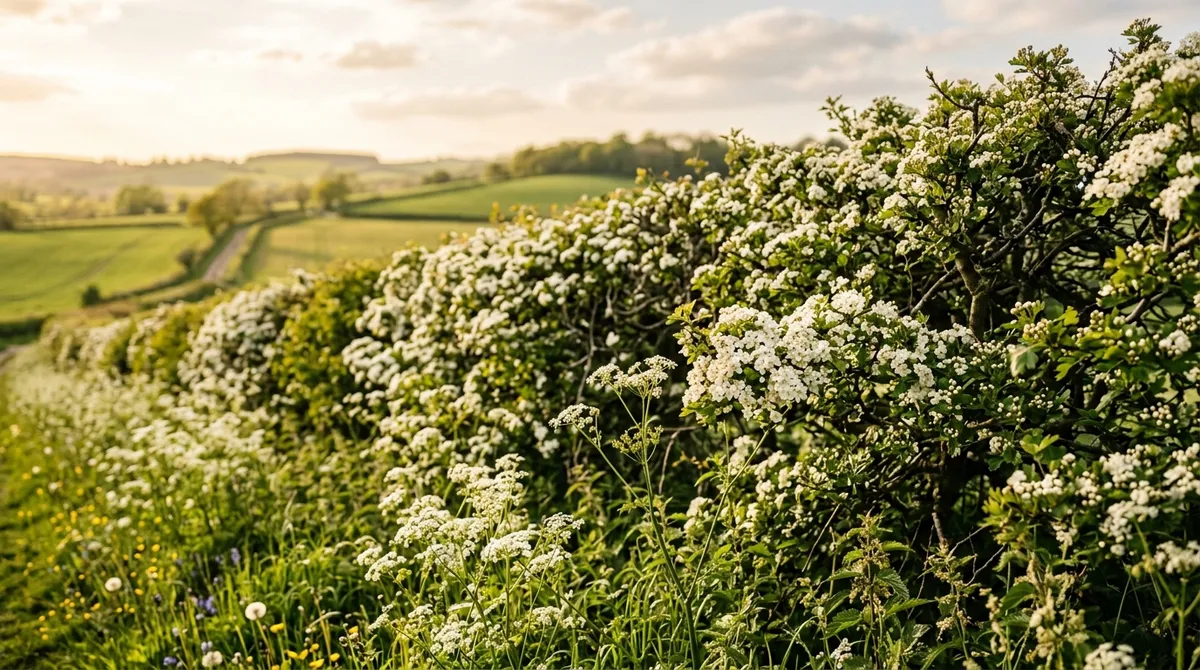
Native hedgerow species form the backbone of the British countryside. A single hawthorn hedge supports more wildlife than any ornamental boundary, feeding over 300 invertebrate species, sheltering nesting birds, and providing berries for thrushes, redwings, and fieldfares through winter.
This guide covers ten native species for UK hedgerows, ranked by wildlife value and soil tolerance. It includes a comparison table, a planting guide for bare-root whips, and the legal rules around hedge trimming dates. Whether you are planting a rural boundary or a garden hedge in a suburban setting, native species outperform any non-native alternative for wildlife, resilience, and long-term value.
Which native species are best for a UK hedgerow?
Hawthorn (Crataegus monogyna) is the single most important hedgerow species in Britain. It grows on any soil from heavy clay to thin chalk, tolerates exposed sites, and produces dense, thorny growth that forms a stock-proof barrier. White blossom in May feeds early pollinators. Red haws from September through to December feed fieldfares, redwings, blackbirds, and small mammals. Hawthorn supports 300+ invertebrate species according to research by the Royal Horticultural Society. It should form 50-60% of any mixed native hedge. For a detailed growing guide, see our article on how to grow hawthorn.
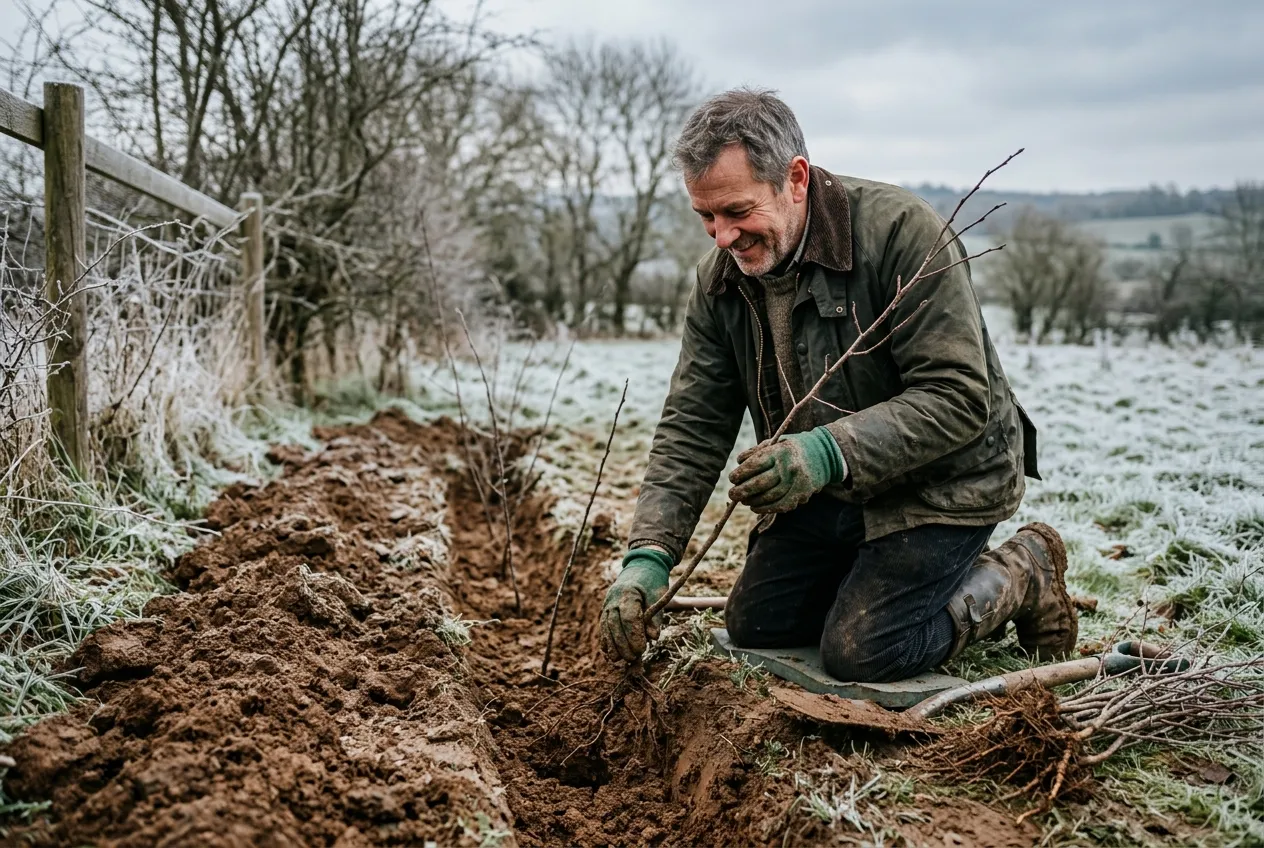
Bare-root hawthorn whips being planted in a prepared trench during the November-to-March dormant season
Blackthorn (Prunus spinosa) flowers before hawthorn, producing white blossom on bare stems in March and April. This early nectar is vital for queen bumblebees emerging from hibernation. Purple-black sloes ripen in October and are used for sloe gin and jelly. The dense, spiny growth creates impenetrable cover for nesting birds. Blackthorn suckers freely, so allow space for it to spread. It thrives on clay, chalk, and sandy soils.
Hazel (Corylus avellana) produces catkins in February, one of the earliest pollen sources for honeybees. Hazelnuts ripen in September and feed squirrels, dormice, and nuthatches. Coppiced hazel produces straight poles useful for plant supports, bean frames, and hurdle making. It grows 40-60cm per year and tolerates partial shade. Hazel is one of the best species for creating a thick hedge base because it responds well to hard cutting.
Field maple (Acer campestre) is Britain’s only native maple. It turns brilliant gold and amber in October, providing the best autumn colour of any hedgerow species. Field maple tolerates heavy clay, chalk, and exposed sites. Growth rate is moderate at 30-40cm per year. The winged seeds (samaras) provide autumn food for small mammals. It clips well and mixes particularly well with hawthorn and hornbeam.
Dog rose (Rosa canina) scrambles through hedgerows, producing pink-white flowers in June and July followed by bright red rosehips from September. Rosehips contain twenty times more vitamin C per 100g than oranges. The flowers attract hoverflies, bees, and beetles. Plant dog rose within the hedge structure rather than on the edge, as it needs neighbouring plants for support. It tolerates any soil and grows 1-3m per year once established.
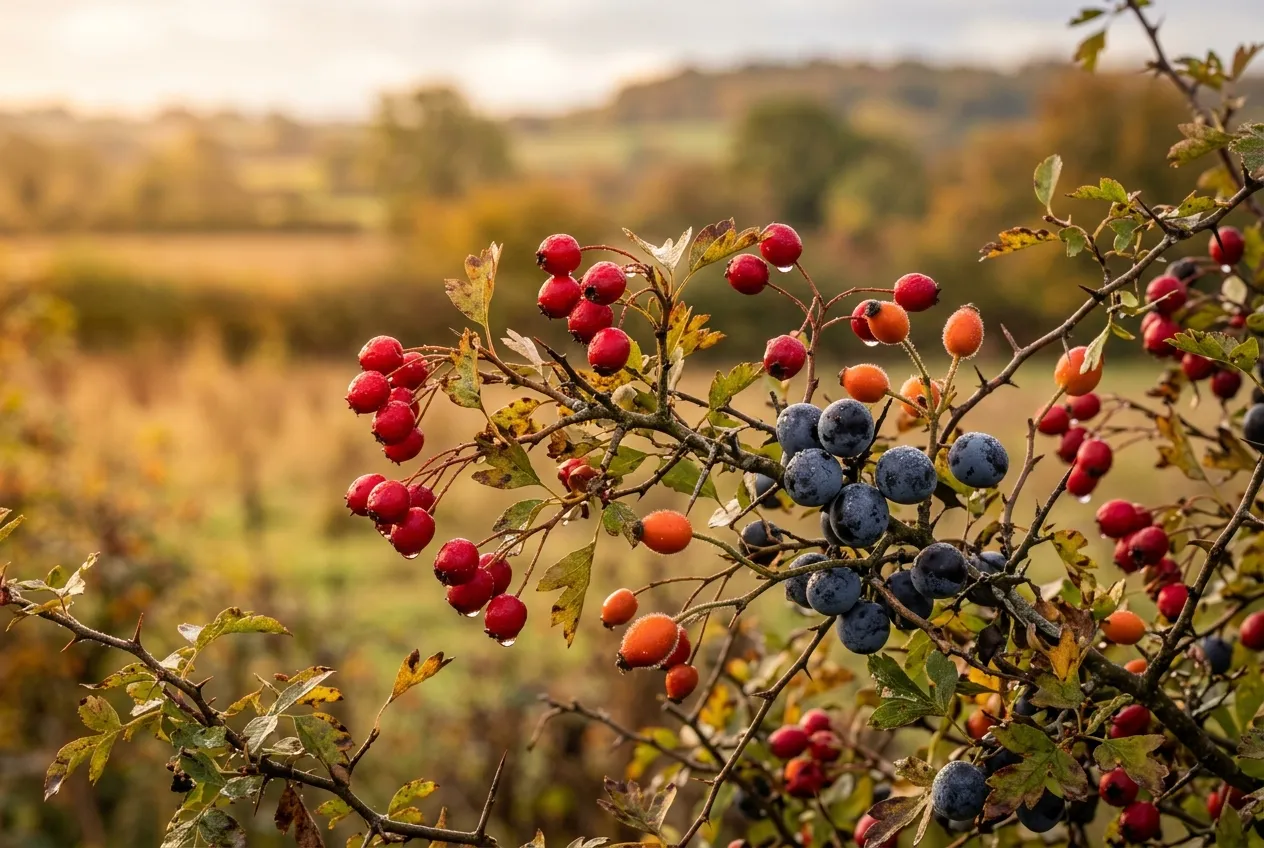
Hawthorn berries, sloes, and rosehips provide vital autumn and winter food for birds and small mammals
Elder (Sambucus nigra) grows faster than any other native hedgerow species, reaching 1-2m in its first year from bare-root. Creamy white elderflower heads in June make cordial and champagne. Purple-black elderberries in September make wine, syrup, and jam. Elder is short-lived compared to hawthorn or holly, but it fills gaps quickly and provides early cover. It grows best in nitrogen-rich soil near the base of walls and compost heaps. For recipes and foraging tips, see our guide to edible hedgerows.
Holly (Ilex aquifolium) is the most valuable evergreen native hedgerow species. Prickly leaves deter browsing animals and provide year-round cover for roosting birds. Female plants produce red berries from November to March if a male pollinator is nearby. Growth is slow at 15-25cm per year, so buy the largest plants you can afford. Holly tolerates deep shade, exposed sites, and poor soil. The cultivar ‘J.C. van Tol’ is self-fertile.
Guelder rose (Viburnum opulus) produces flat white lacecap flowers in May and June, followed by translucent red berries in autumn that hang on the bare stems into winter. The berries are mildly toxic to humans but loved by thrushes and waxwings. Autumn foliage turns deep crimson. Guelder rose prefers damp soil and tolerates waterlogged ground better than most hedgerow species. It grows 30-40cm per year.
Spindle (Euonymus europaeus) is often overlooked but provides the most striking fruit display of any native hedge species. Pink-orange capsules split open in October to reveal bright orange seeds, creating a vivid contrast with autumn foliage. The berries are toxic to humans but eaten by robins. Spindle grows well on chalk and limestone soils. It is smaller than hawthorn, reaching 3-6m, and suits the middle tier of a mixed hedge.
Hornbeam (Carpinus betulus) holds its dead brown leaves through winter when clipped, giving semi-evergreen screening from a deciduous species. It tolerates heavy clay and wet ground better than beech. Growth rate is 30-40cm per year. Hornbeam produces small nuts called nutlets that feed hawfinches and bramblings. It clips into formal shapes and mixes well with hawthorn, field maple, and holly in a privacy screening hedge.
Native hedgerow species comparison table
| Species | Height (uncut) | Growth/year | Soil tolerance | Flowers | Berries/fruit | Wildlife value |
|---|---|---|---|---|---|---|
| Hawthorn | 8-10m | 30-45cm | Any soil | White, May | Red haws, Sep-Dec | 300+ invertebrate species |
| Blackthorn | 4-6m | 30-40cm | Any soil | White, Mar-Apr | Sloes, Oct-Nov | Early nectar for bees |
| Hazel | 6-8m | 40-60cm | Moist, well-drained | Catkins, Feb | Hazelnuts, Sep | Dormice, nuthatches |
| Field maple | 10-15m | 30-40cm | Clay, chalk, any | Inconspicuous | Samaras, Oct | Best autumn colour |
| Dog rose | 1-3m (scrambler) | 1-3m | Any soil | Pink-white, Jun-Jul | Rosehips, Sep-Nov | Hoverflies, bees |
| Elder | 6-10m | 60-200cm | Rich, moist | Cream, Jun | Elderberries, Sep | Fastest growing |
| Holly | 10-15m | 15-25cm | Any soil | White, May | Red berries, Nov-Mar | Year-round evergreen cover |
| Guelder rose | 4-5m | 30-40cm | Damp, clay | White lacecap, May-Jun | Red, Oct-Dec | Thrushes, waxwings |
| Spindle | 3-6m | 20-30cm | Chalk, limestone | Green-white, May | Pink-orange, Oct | Robins, striking display |
| Hornbeam | 15-25m | 30-40cm | Clay, wet ground | Catkins, Apr | Nutlets, Oct | Hawfinches, winter leaf cover |
Field report: In my 35m of mixed hedgerow in Staffordshire, hawthorn and blackthorn together account for 60% of the planting and carry 90% of the nesting bird activity. The hazel sections produce the most autumn interest for human foragers, while holly provides the only reliable bird shelter through January and February when everything else is bare.
How to plant a native hedgerow
The dormant season from November to March is the only time to plant bare-root hedgerow whips. Bare-root stock costs 80p to 2 pounds per plant compared with 5-15 pounds for container-grown. A 10m single-row hedge needs 25-33 plants depending on spacing.
Step-by-step planting method
-
Mark out the line using string and canes. Allow at least 30cm from a fence or boundary for the hedge base to spread.
-
Dig a trench 30cm wide and 30cm deep along the full length. On heavy clay, fork the bottom of the trench to break up compaction.
-
Soak bare-root plants in a bucket of water for one to two hours before planting. Never let roots dry out.
-
Space plants 30-45cm apart in the trench. Set hawthorn and blackthorn at 30cm. Space hazel and field maple at 45cm. Mix species in random groups of three to five.
-
Plant at the soil mark visible on the stem. Spread roots evenly. Backfill with the excavated soil and firm gently with your heel.
-
Cut all whips back by one-third immediately after planting. This forces dense, bushy growth from the base. Without this cut, the hedge develops bare stems at the bottom.
-
Water thoroughly and mulch with bark or compost in a 60cm-wide strip along both sides. This suppresses weeds and retains moisture through the first growing season.
For detailed planting instructions, including double-row spacing and how to handle bare-root trees, see our full hedge planting guide.
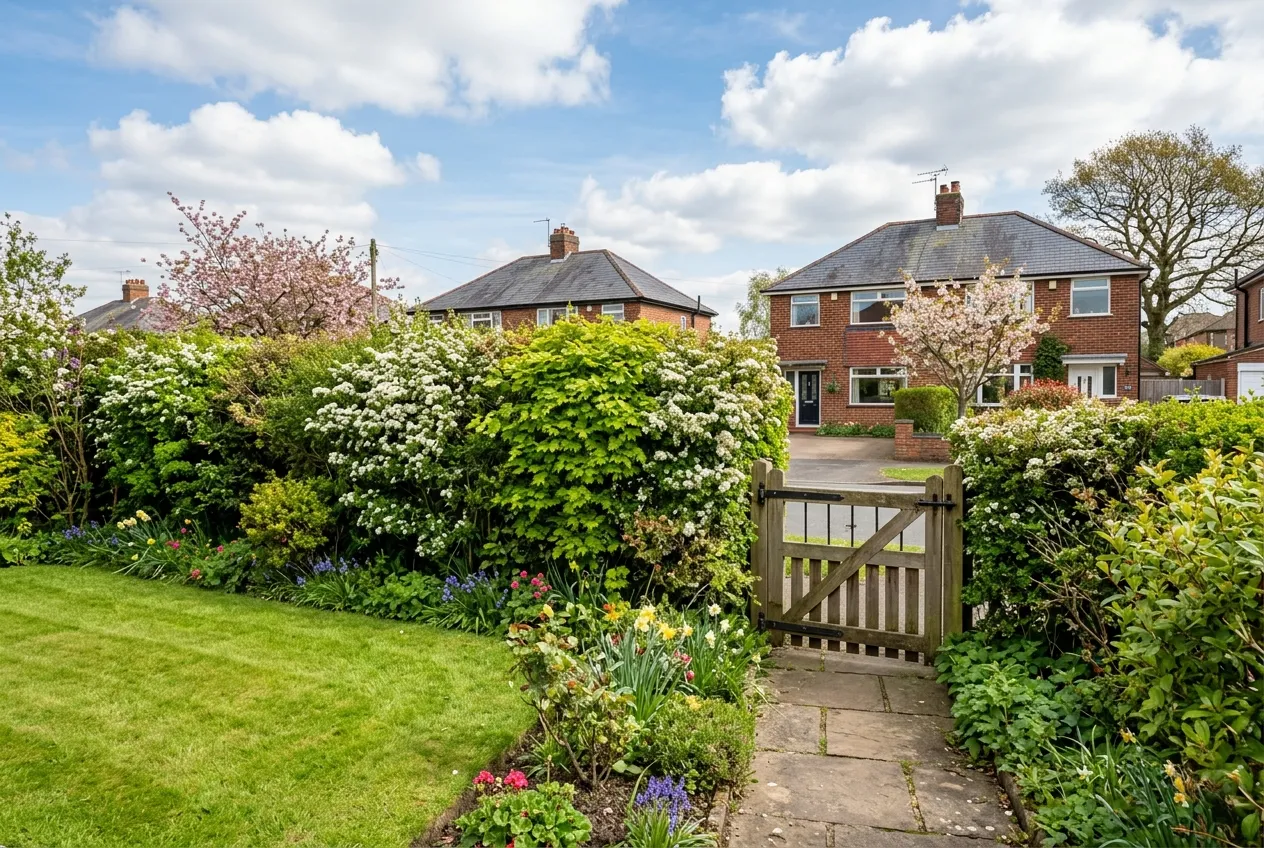
An established mixed native hedge creates a dense, attractive boundary between suburban UK gardens
What soil do native hedgerows need?
Every species in the core native mix tolerates heavy clay, the most common garden soil in England and Wales. Hawthorn, blackthorn, field maple, and dog rose grow in clay soil without any amendment. Holly and hornbeam also handle waterlogged ground well. Hazel prefers slightly better drainage but still performs on clay. Only spindle shows a strong preference, favouring chalk and alkaline soils.
No compost or fertiliser is needed at planting. Native hedgerow species have evolved in British soils for thousands of years and establish best in unimproved ground. Adding rich compost encourages soft, sappy growth that is more vulnerable to frost and browsing damage.
When to trim a native hedgerow
Never trim between March and August. The Wildlife and Countryside Act 1981 makes it an offence to intentionally destroy or disturb nesting birds. Most hedgerow birds, including blackbirds, song thrushes, dunnocks, and wrens, nest from early March through to late August.
Trim established hedges once per year between September and February. Late January to mid-February is ideal because it leaves the maximum berry crop available for birds through winter while still allowing a clean shape before spring growth. Cut the sides to a slight A-shape, wider at the base, to allow light to reach the lower branches and prevent bare legs developing.
For the first two to three years, do not trim at all except for the initial one-third cutback at planting. Let the hedge grow naturally to build a strong root system and dense base. From year three onward, clip annually to the desired height and width.
For more on legal trimming dates and seasonal maintenance, see our guide on when to cut hedges.
Why choose native species over non-native hedging?
A mixed native hedge of five or more species qualifies as a Priority Habitat under the UK Biodiversity Action Plan. Non-native hedging plants like cherry laurel, Leylandii, and privet support a fraction of the wildlife.
The difference is stark. Hawthorn alone supports over 300 invertebrate species. Cherry laurel supports fewer than 15. A native hedge feeds caterpillars, which feed nesting birds, which control garden pests. An ornamental hedge provides screening and little else.
Native hedges also cost less. Bare-root hawthorn whips cost around 80p each, while container-grown laurel plants cost 8-12 pounds. A 10m native hedge costs under 50 pounds. The same length in laurel costs 200-400 pounds.
Native species are tougher, too. Hawthorn, blackthorn, and field maple shrug off the hardest British winters without protection. They recover from hard pruning, resist most diseases, and live for centuries. For gardens where wildlife value matters as much as appearance, native hedgerow species are the obvious choice. If you want to build a wildlife-friendly garden, a native hedge is the single most effective thing you can plant.
How native hedgerows support UK wildlife
A native hedge is not just a boundary. It functions as a linear nature reserve, providing food, shelter, and nesting sites through every season.
Spring: Blackthorn blossom (March-April) feeds queen bumblebees and early solitary bees. Hawthorn blossom (May) supports hoverflies, beetles, and moth larvae. Dense thorny growth shelters nesting blackbirds, song thrushes, and dunnocks.
Summer: Dog rose flowers attract pollinators in June and July. Hazel leaves feed moth caterpillars including the nut-tree tussock. Elder flowers feed pollen beetles. The hedge canopy shades ground-nesting amphibians.
Autumn: Hawthorn haws, sloes, rosehips, elderberries, and spindle fruits feed migrating fieldfares and redwings arriving from Scandinavia in October. Hazelnuts feed dormice, which are now endangered in Britain and depend on hedgerow corridors.
Winter: Holly berries sustain thrushes and waxwings. Hornbeam and beech retain dead leaves, providing wind shelter for roosting birds. The dense hedge base shelters hibernating hedgehogs, slow worms, and overwintering queen bumblebees.
For more on attracting wildlife with native plants, including wildflower planting at the hedge base, see our full guide.
Frequently asked questions
What are the best native species for a UK hedgerow?
Hawthorn, blackthorn, hazel, field maple, and dog rose are the five core species. Hawthorn should make up 50-60% of any mixed native hedge because it supports the most wildlife and tolerates every UK soil type. Add holly for evergreen winter structure, elder for fast early growth, and guelder rose for autumn colour. A mix of five or more native species qualifies as a Priority Habitat.
When should I plant a native hedgerow?
Plant bare-root whips from November to March while they are dormant. November planting gives roots the longest establishment period before spring growth. Bare-root stock is only available during the dormant season and costs 60-80% less than container plants. Avoid planting in frozen or waterlogged ground.
How far apart should native hedgerow plants be?
Space bare-root whips 30-45cm apart in a single row. For a thicker hedge, plant a double staggered row with 40cm between plants and 30cm between rows. A 10m single-row hedge needs 25-33 plants. Hawthorn and blackthorn suit closer 30cm spacing. Hazel and field maple need wider 45cm spacing because of their larger mature size.
How long does a native hedge take to establish?
A mixed native hedge reaches 1.5m in three to four years from 60cm bare-root whips. Hawthorn and blackthorn grow 30-45cm per year. Hazel grows faster at 40-60cm per year. Holly is the slowest at 15-25cm per year. The hedge provides useful wildlife habitat from its second year.
Is it legal to cut a hedgerow during summer?
No. Under the Wildlife and Countryside Act 1981, it is an offence to intentionally destroy or disturb nesting birds. Most hedgerow birds nest from March to August. Defra recommends cutting only between September and February. Many local councils enforce this rule through cross-compliance requirements.
Can I plant a native hedgerow in clay soil?
Yes. Every core native hedgerow species tolerates heavy clay. Hawthorn, blackthorn, field maple, dog rose, and elder grow naturally in UK clay soils. Holly and hornbeam handle waterlogged clay better than most garden plants. No soil amendment is needed for native species on clay ground.
How many species should a native hedgerow contain?
A minimum of five native woody species per 30m qualifies as an important hedgerow under the Hedgerow Regulations 1997. For a garden hedge, aim for five to eight species. Use hawthorn as 50-60% of the mix, then add four to seven others in random groups of three to five plants.
Lawrie has been gardening in the West Midlands for over 30 years. He grows his own veg using no-dig methods, keeps a wildlife-friendly garden, and writes practical advice based on real UK growing conditions.