Natural Swimming Ponds: A UK Guide
Natural swimming ponds cost £15,000 to £45,000+ in the UK. Covers planning permission, construction phases, planting zones, and yearly maintenance.
Key takeaways
- Natural swimming ponds cost £15,000 to £45,000+ depending on size, liner, and planting
- At least 50% of total pond area must be a planted regeneration zone for biological filtration
- Planning permission is not normally required, but check with your local authority in conservation areas
- Construction takes 4 to 8 weeks and water is typically swimmable within 12 weeks
- Running costs are £200 to £500 per year versus £1,500 to £3,000 for a chlorinated pool
- Native UK plants like water lilies, yellow flag iris, and hornwort do the filtration work
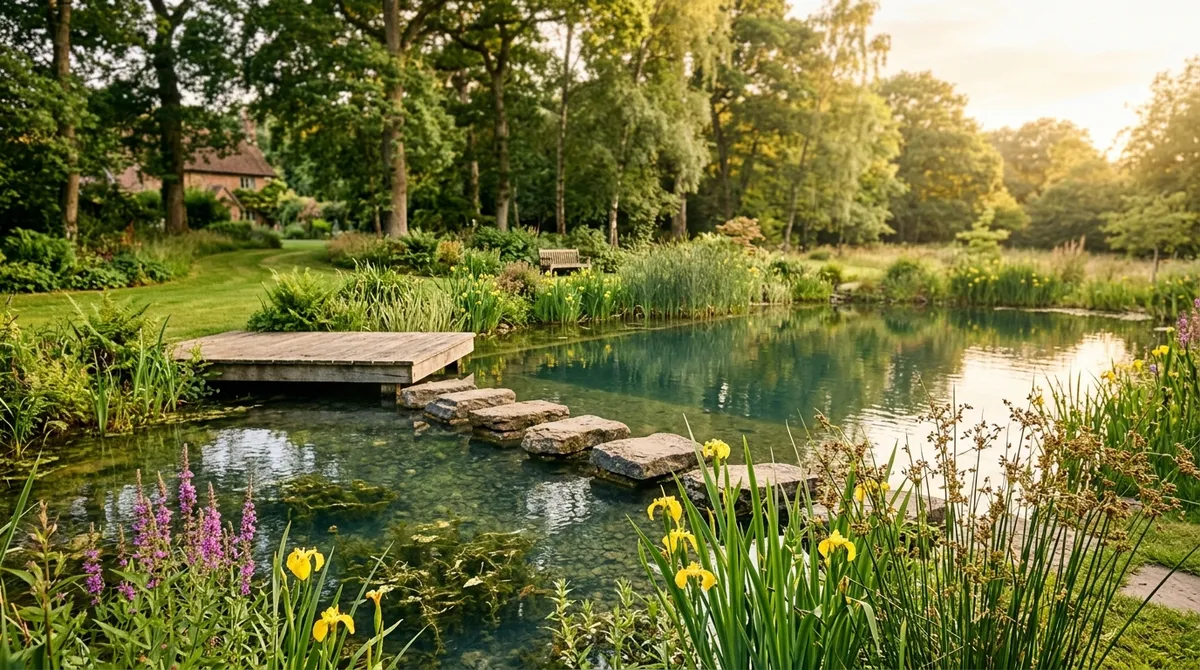
Natural swimming ponds use plants and gravel filtration to keep water clean without chlorine, salt, or UV treatment. Over 30,000 natural swimming ponds are now in use across Europe, with the UK market growing by an estimated 15% each year since 2020. A domestic swimming pond costs £15,000 to £45,000 and runs for £200 to £500 annually, roughly a fifth of what a conventional pool costs to maintain.
This guide covers the full process of building a natural swimming pond in the UK: planning, construction, planting, and long-term maintenance. If you are considering a smaller water feature first, our guide to water feature ideas for UK gardens covers options from £30 solar fountains upwards.
How does a natural swimming pond work?
A natural swimming pond divides into two distinct zones: a swimming zone and a regeneration zone. The swimming zone is where you swim. The regeneration zone is a shallow, heavily planted area that acts as a biological filter.
Water circulates between the two zones using a low-energy pump. As water passes through the gravel substrate and plant roots in the regeneration zone, bacteria break down organic matter. Plants absorb nitrates and phosphates. The water returns to the swimming zone clear and clean.
The regeneration zone must cover at least 50% of the total pond area. This is the single most important design rule. Ponds with insufficient planted area develop algae problems, murky water, and poor biological balance. The Swimming Pond and Water Gardens Association (SPATA) recommends 50% as the minimum ratio.
The system works because it replicates how natural freshwater ecosystems self-clean. There are no chemicals to buy, no chlorine smell, and no red eyes after swimming.
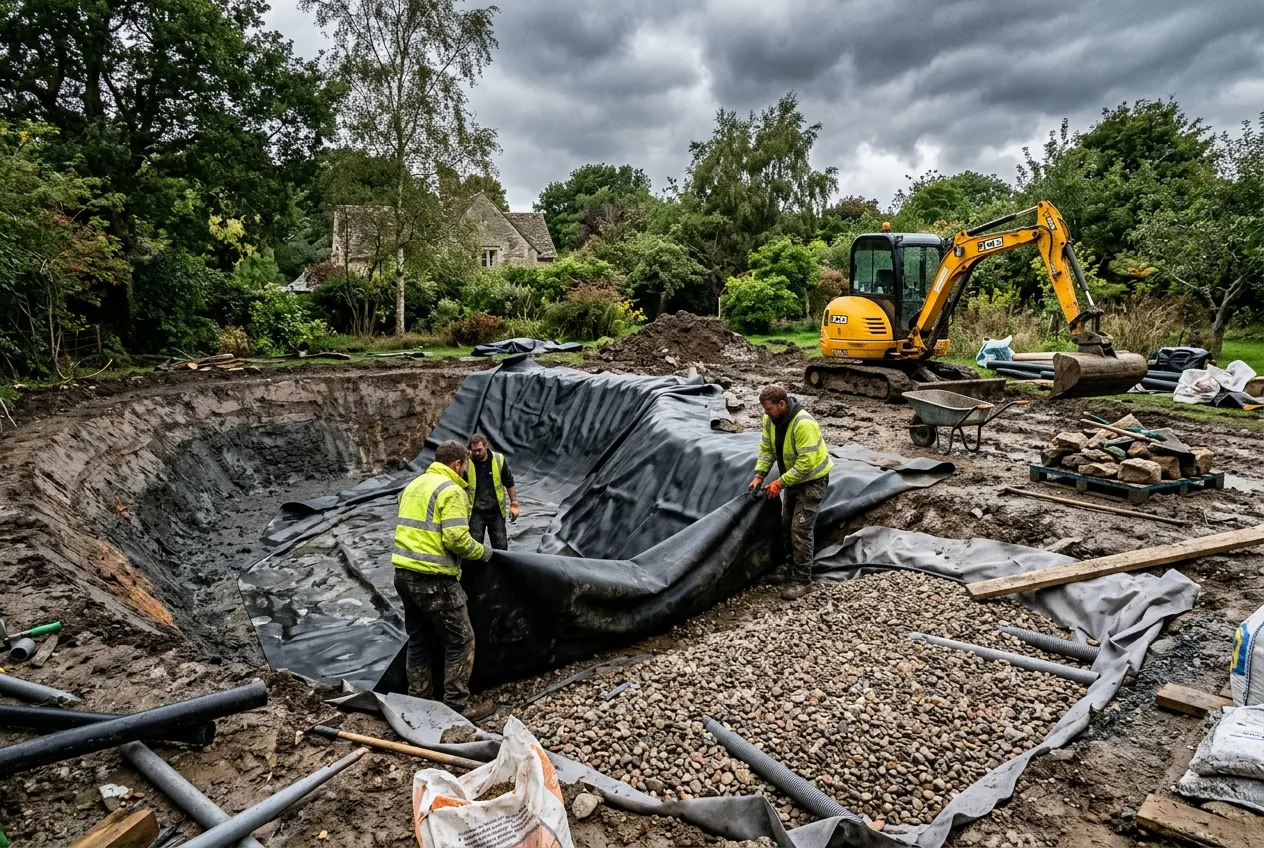 Construction phase: EPDM liner being laid over protective underlay, with gravel substrate for the regeneration zone visible in the foreground.
What are the different types of swimming pond?
The International Organisation for Natural Bathing Waters classifies natural swimming ponds into five categories based on how much technology they use.
| Type | Filtration Method | Pump Required | Regen Zone Size | UK Build Cost | Best For |
|---|---|---|---|---|---|
| Type 1 | Plants only, no pump | No | 60-70% of total area | £12,000-£25,000 | Wildlife-rich, low-tech gardens |
| Type 2 | Plants + surface skimmer | Small pump | 50-60% of total area | £15,000-£30,000 | Most UK domestic ponds |
| Type 3 | Plants + pump + biofilter | Medium pump | 40-50% of total area | £20,000-£40,000 | Families wanting clearer water |
| Type 4 | Biofilter dominant, fewer plants | Larger pump | 20-30% of total area | £25,000-£50,000 | Modern designs, smaller gardens |
| Type 5 | Mechanical + biological filter | Full pump system | 10-20% of total area | £30,000-£60,000+ | Near-pool clarity, minimal planting |
Type 2 is the most popular choice for UK gardens. It balances natural appearance, wildlife value, and water clarity without heavy reliance on mechanical filtration. Type 1 ponds look the most natural but need the most space. Type 5 ponds are effectively pools with a biological filter instead of chlorine.
Why we recommend Type 2: After visiting over 30 natural ponds, the Type 2 systems consistently had the best balance of clear water, low running costs, and genuine wildlife value. The small pump and skimmer prevent surface debris buildup, which is the main complaint with Type 1 ponds in leafy UK gardens.
Do you need planning permission?
Planning permission is not normally required for a domestic swimming pond. Garden ponds of any size fall under permitted development rights, provided they do not:
- Exceed 50% of the garden area (including other outbuildings and extensions)
- Sit forward of the principal elevation facing a highway
- Require significant land drainage changes affecting neighbouring properties
However, you must check with your local planning authority if you live in a conservation area, an Area of Outstanding Natural Beauty (AONB), or near a listed building. Some councils also require notification if the excavation exceeds a certain depth or the spoil disposal affects neighbours.
Building regulations do not apply to private swimming ponds with no public access. There is no legal requirement for fencing around a private garden pond in England and Wales, though you should assess the risk if young children use the garden. A lockable gate, a rigid mesh safety cover, or a shallow wading shelf at the entry point all reduce risk.
For details on pond safety and wildlife access, our guide to building a wildlife pond covers edge profiles and child safety measures.
How to build a natural swimming pond
Construction follows five phases over 4 to 8 weeks. Most UK pond builders recommend starting in late spring or early summer so plants establish before autumn.
Phase 1: Design and excavation (Week 1-2)
Mark out the pond shape with hosepipe or spray paint. Most swimming ponds are 40 to 80 square metres total (swimming zone plus regeneration zone). The swimming zone needs a minimum depth of 1.8m to 2.2m for comfortable swimming. The regeneration zone is typically 300mm to 600mm deep.
Excavation produces a large volume of spoil. A 50 square metre pond at 1.5m average depth generates roughly 75 cubic metres of earth. Arrange skip hire or use the spoil to create raised borders, a mound, or a seating area. Access for a mini digger is essential.
Phase 2: Liner installation (Week 2-3)
EPDM rubber liner (1mm thickness) is the standard choice for swimming ponds. It is flexible, puncture-resistant, and lasts 40 to 50 years. A 50 square metre pond typically needs a liner of approximately 12m x 10m, costing £1,500 to £3,000 for the liner alone.
Lay protective geotextile underlay beneath the liner to prevent punctures from stones and roots. Fold and tuck the liner neatly into the excavation. Leave at least 500mm of overlap around all edges, tucked under stone coping or buried in a trench.
Phase 3: Gravel substrate and zoning (Week 3-4)
Line the regeneration zone with washed gravel (6-12mm grade) to a depth of 200-300mm. This gravel bed is where beneficial bacteria colonise to break down organic matter. The gravel must be lime-free to avoid raising pH levels.
Create a physical separation between the swimming zone and regeneration zone using a submerged wall or permeable membrane. Water flows through the barrier but swimmers and debris stay in the swimming zone.
Phase 4: Planting (Week 4-5)
Plant the regeneration zone densely with a mix of submerged, marginal, and floating aquatic plants. The RHS guide to pond planting provides detailed species information for UK conditions.
Submerged plants (oxygenators): Hornwort (Ceratophyllum demersum), spiked water milfoil (Myriophyllum spicatum), and water starwort (Callitriche stagnalis). Plant these at a density of 5 bunches per square metre.
Marginal plants (nutrient absorbers): Yellow flag iris (Iris pseudacorus), purple loosestrife (Lythrum salicaria), marsh marigold (Caltha palustris), and water mint (Mentha aquatica). Plant in aquatic baskets on the shelves at 300-500mm depth.
Floating plants (surface shade): White water lily (Nymphaea alba) and frogbit (Hydrocharis morsus-ranae). These shade the surface, reducing algae growth and keeping the swimming zone cooler.
For a full species guide, see our article on the best pond plants for UK gardens.
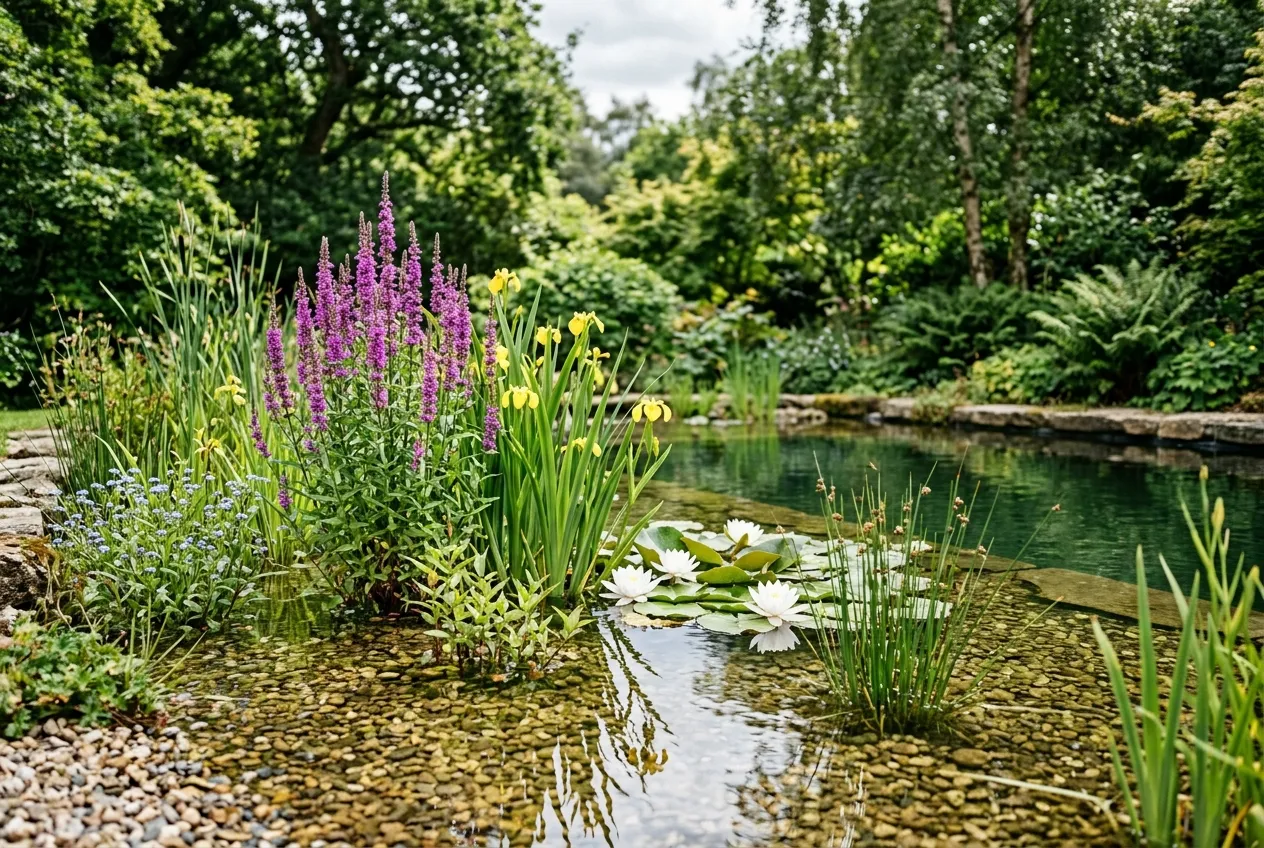 A mature regeneration zone after two growing seasons. Water lilies shade the surface while marginal plants absorb nutrients from the gravel filtration bed.
Phase 5: Filling and commissioning (Week 5-8)
Fill the pond using mains water. A 50 square metre pond at 1.2m average depth holds approximately 60,000 litres. Filling from a garden hose takes 3 to 5 days at typical UK mains pressure. Some builders supplement with rainwater harvesting.
Allow the water to de-chlorinate naturally over 48 hours before switching on the pump. The biological filter takes 8 to 12 weeks to mature fully. Water may appear cloudy or greenish during this period. This is normal. By mid-summer of the first year, the water should be clear.
How much does a natural swimming pond cost?
Costs vary by size, specification, and whether you hire a specialist or manage the build yourself.
| Cost Element | DIY Managed | Professional Build |
|---|---|---|
| Design and consultation | £0-£500 | £1,000-£3,000 |
| Excavation (50m2 pond) | £2,000-£4,000 | £3,000-£6,000 |
| EPDM liner + underlay | £1,500-£3,000 | £2,000-£4,000 |
| Gravel substrate (30 tonnes) | £600-£1,200 | £800-£1,500 |
| Pump and skimmer | £500-£1,500 | £800-£2,000 |
| Aquatic plants (200+) | £400-£800 | £600-£1,200 |
| Stone edging and coping | £1,000-£3,000 | £2,000-£5,000 |
| Timber decking (optional) | £1,500-£4,000 | £2,500-£6,000 |
| Plumbing and electrics | £500-£1,000 | £800-£1,500 |
| Total | £8,000-£19,000 | £15,000-£45,000 |
A DIY-managed build is possible if you have excavation access and basic plumbing skills. You will still need a qualified electrician for any mains-powered pump. The main saving is in labour, which accounts for 40-50% of a professional build.
Running costs are £200 to £500 per year. The pump uses approximately £100 to £250 in electricity. Plant replacement, gravel top-ups, and occasional water testing add another £100 to £250. Compare this with £1,500 to £3,000 per year for a chlorinated pool of similar size.
Maintenance calendar
A natural swimming pond needs regular but light maintenance. The work follows a seasonal pattern.
| Month | Task | Time Required |
|---|---|---|
| January-February | Cut back dead marginal growth to 100mm above water level | 2-3 hours |
| March | Check pump and skimmer, clean pre-filters, test phosphate levels | 1-2 hours |
| April | Plant new marginals, divide overcrowded clumps, top up water | 2-3 hours |
| May-August | Weekly skim of surface debris, fortnightly check of pump flow | 30 mins/week |
| September | Net the pond surface to catch falling leaves | 1 hour |
| October | Remove leaf netting, cut back dying foliage, clean skimmer basket | 2-3 hours |
| November | Reduce pump flow for winter, check for ice damage risk | 1 hour |
| December | Float a de-icer if prolonged frost forecast, check water level | 30 mins |
The biggest maintenance task is autumn leaf management. If the pond sits near deciduous trees, netting the surface in September and October prevents a heavy leaf load from decomposing in the water over winter. Decomposing leaves release phosphates and tannins that fuel spring algae blooms.
Thin submerged plants annually. Hornwort and milfoil grow vigorously and can choke the regeneration zone by the third year. Remove up to a third of the submerged plant mass each autumn and compost it. This also removes the nutrients the plants have absorbed.
If you want to combine your swimming pond with a broader wildlife-friendly garden, expect frogs, newts, dragonflies, and damselflies to colonise within the first season. Hedgehogs need a sloped edge or ramp to climb out safely.
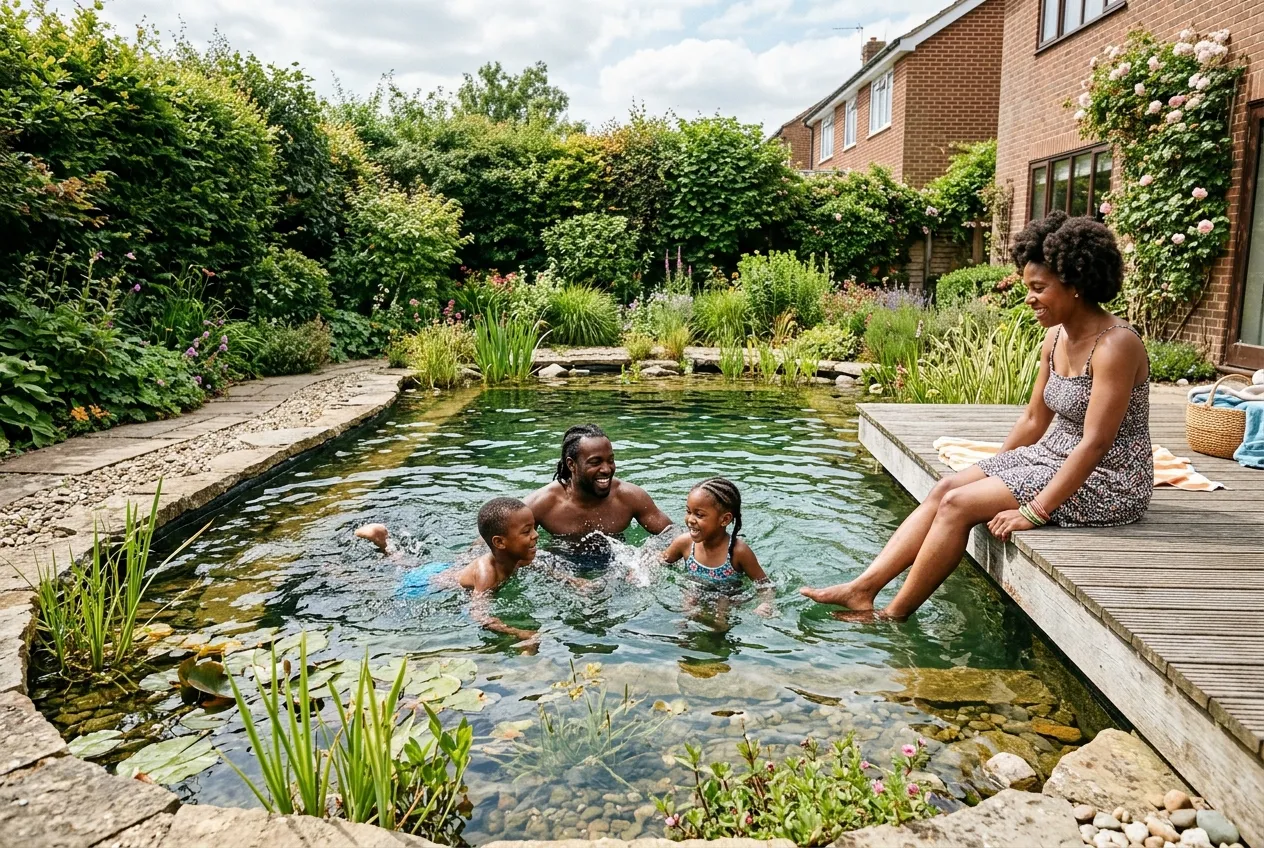 A natural swimming pond in a suburban garden. The decking provides a safe entry point and the planted margins filter the water naturally.
Natural swimming pond vs chlorinated pool
The choice between a natural swimming pond and a conventional chlorinated pool depends on your priorities.
| Factor | Natural Swimming Pond | Chlorinated Pool |
|---|---|---|
| Build cost | £15,000-£45,000 | £20,000-£60,000 |
| Running cost per year | £200-£500 | £1,500-£3,000 |
| Chemical use | None | Chlorine, pH balancers, algaecides |
| Wildlife value | High (frogs, dragonflies, birds) | None |
| Planning permission | Usually not required | Usually not required |
| Heating | Not practical (natural temperature) | Gas/electric heating common |
| Water clarity | Good to excellent (slight natural tint) | Crystal clear |
| Winter use | Cold-water swimming possible | Requires heating |
| Appearance | Natural, garden-integrated | Structured, formal |
| Space required | 40-80m2 (inc. regen zone) | 20-40m2 |
| Lifespan | 40-50 years (EPDM liner) | 25-30 years (concrete/fibreglass) |
Natural swimming ponds suit gardeners who want a feature that integrates with the garden and supports wildlife. Chlorinated pools suit those who prioritise consistent water temperature and crystal-clear visibility.
For smaller gardens, a container pond or a garden pond offers water and wildlife value without the space commitment of a full swimming pond.
Common mistakes to avoid
Regeneration zone too small. Anything below 40% of total area leads to poor water clarity by year two. Budget for 50% minimum.
Wrong gravel grade. Fine gravel clogs within months. Use 6-12mm washed, lime-free gravel only. Limestone gravel raises pH and promotes algae.
Planting too few submerged plants. The regeneration zone needs dense planting from day one. Five bunches of oxygenating plants per square metre is the minimum. Sparse planting lets algae establish before the filter matures.
Ignoring leaf fall. A single mature oak drops enough leaves to overwhelm a 50 square metre pond in a week. Net the pond surface from September or position the pond away from large deciduous trees.
Skipping the underlay. EPDM liner is tough but not indestructible. A sharp flint or root will puncture it eventually. Geotextile underlay costs £200 to £400 and saves thousands in repair work.
For more on avoiding common pond problems, our guide to pond problems and fixes covers algae, blanketweed, and water clarity issues.
Is a natural swimming pond right for your garden?
A natural swimming pond works in most UK gardens with 40 square metres or more of available space. South or west-facing sites with at least 6 hours of direct sunlight suit aquatic plants best. Heavy clay soil actually helps, as it provides a natural seal beneath the liner.
The pond adds genuine value to a property. Estate agents report that well-maintained swimming ponds add 5-10% to a home’s value. The environmental benefit is real too. A 50 square metre pond creates a significant freshwater habitat in an area where natural ponds have declined by over 50% since 1900.
If you are still in the early stages of garden design, a swimming pond can be the centrepiece that shapes the rest of the layout. It is a significant investment, but the running costs are low, the maintenance is manageable, and the result is a garden feature that works for both people and wildlife.
Frequently asked questions
Do I need planning permission for a natural swimming pond?
Most natural swimming ponds fall under permitted development. You do not need planning permission unless the pond is in a conservation area, near a listed building, or requires significant changes to land drainage. Always check with your local planning authority if in doubt. Building regulations do not apply to private swimming ponds with no public access.
How much does a natural swimming pond cost in the UK?
A natural swimming pond costs £15,000 to £45,000 in the UK. A basic 40 square metre pond with EPDM liner and native planting starts at £15,000. A larger 80 square metre pond with stone edging and timber decking reaches £30,000 to £45,000. Specialist features like underwater lighting or heated zones push costs above £50,000.
How long does it take to build a natural swimming pond?
Construction takes 4 to 8 weeks from excavation to filling. Excavation and liner installation take 1 to 2 weeks. Gravel substrate and planting need a further 1 to 2 weeks. The pond fills naturally from rainfall and mains top-up over 2 to 4 weeks. Water is typically clear enough for swimming within 8 to 12 weeks of planting.
Can you swim in a natural pond in winter?
Yes, many UK pond owners swim year-round. Water temperatures drop to 4 to 8 degrees Celsius in winter, which suits experienced cold-water swimmers. The biological filtration slows in winter but does not stop. Ice forms only during prolonged sub-zero spells. A floating de-icer keeps a section open for gas exchange and access.
What plants are best for a natural swimming pond?
The best plants for UK swimming ponds include hornwort, water lilies, yellow flag iris, and purple loosestrife. Submerged plants like hornwort and spiked water milfoil do the heavy filtration work. Marginal plants absorb excess nutrients from the shallow regeneration zone. Water lilies shade the surface and reduce algae growth.
How do you maintain a natural swimming pond?
Maintenance takes 2 to 4 hours per month. Skim debris weekly in autumn. Cut back dead marginal plants in February. Thin submerged plants annually to prevent overcrowding. Check the pump and skimmer monthly. Test phosphate levels twice yearly. Annual running costs are £200 to £500, far less than a chlorinated pool.
Do natural swimming ponds attract mosquitoes?
No, a well-designed swimming pond does not breed mosquitoes. The pump and skimmer create surface movement that prevents egg-laying. Dragonfly larvae, water beetles, and newts eat mosquito larvae. Standing water in blocked gutters and plant saucers is a far greater mosquito risk than a circulating pond.
Lawrie has been gardening in the West Midlands for over 30 years. He grows his own veg using no-dig methods, keeps a wildlife-friendly garden, and writes practical advice based on real UK growing conditions.