Outdoor Kitchen and BBQ Area Ideas
Outdoor kitchen and BBQ area ideas for UK gardens. Covers built-in grills, pizza ovens, countertops, shelter options, and budgets from £1,000 to £20,000.
Key takeaways
- UK outdoor kitchens cost from £1,000 for a basic setup to £20,000 or more fully fitted
- A roof or pergola cover is essential for cooking in British weather
- Kamado grills hold temperature in wind and rain better than open barbecues
- Granite and porcelain countertops handle UK frost and rain without damage
- Gas and water connections need qualified installers and Building Regulations sign-off
- Position the cooking area 3m or more from the house to manage smoke and fire risk
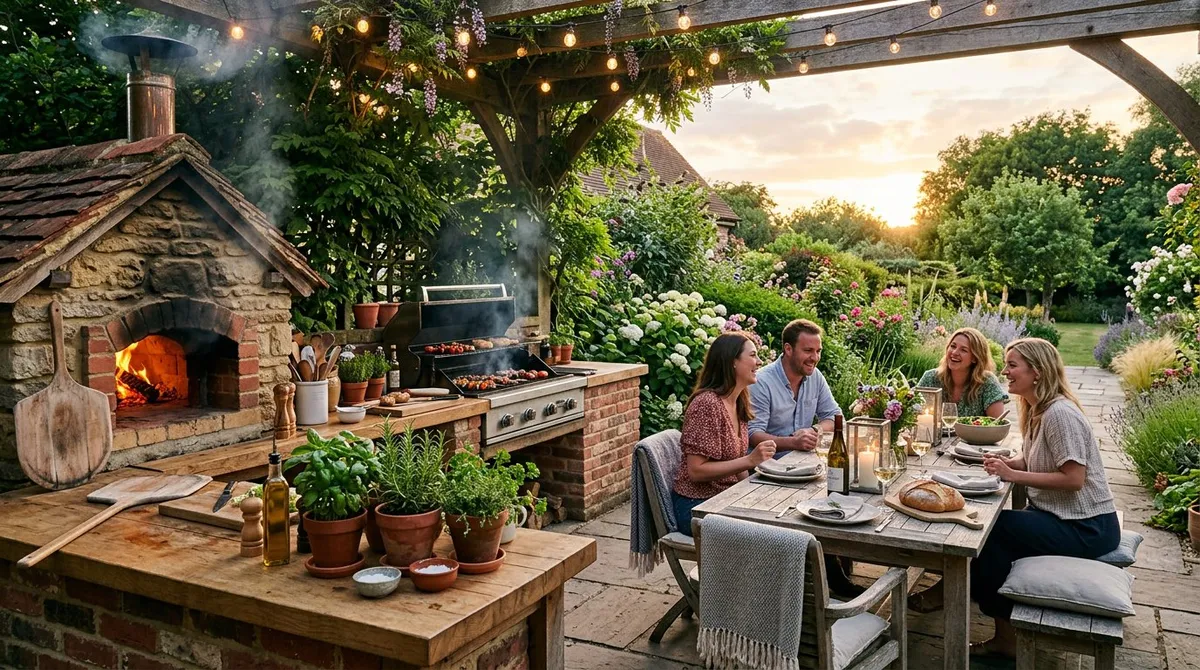
Cooking outdoors in the UK used to mean standing in the rain over a disposable barbecue. That has changed. A well-planned outdoor kitchen or BBQ area works through a British summer and well into autumn, provided you account for the weather from the start.
This guide covers every stage: choosing between grill types, selecting countertop materials that survive frost and rain, planning utilities, and building shelter into the design. We include real costs for every budget level, from a £1,000 barbecue station to a £20,000 full kitchen. For layout ideas that work alongside an outdoor kitchen, see our garden design guides. If you already have a structure in mind, our pergola guide covers the shelter side in detail.
Choosing your grill or cooking appliance
The cooking appliance is the centrepiece. Choose the wrong one for your cooking style and the rest of the build is wasted.
Gas grills
Gas barbecues offer push-button ignition and precise temperature control via burner knobs. They heat up in 10-15 minutes and are ready to cook. Popular UK brands include Weber (Spirit and Genesis ranges), Napoleon, and Char-Broil. A three-burner gas grill suits most families. Four or more burners suit frequent entertainers.
Advantages: fast heat, temperature control, clean burning, minimal ash cleanup. Disadvantages: less smoky flavour than charcoal, running costs (a 13kg propane cylinder costs £30-£40 and lasts 8-12 cooks).
Charcoal grills
Charcoal barbecues produce the traditional smoky flavour that gas cannot fully replicate. They reach higher temperatures (up to 350C) for searing. The Weber Mastertouch and Napoleon Pro are popular mid-range choices.
Advantages: intense smoky flavour, very high searing temperatures, lower purchase cost. Disadvantages: 20-30 minute heat-up time, less predictable temperature, ash disposal, more affected by wind.
Kamado grills
Kamado grills (Big Green Egg, Kamado Joe, Masterbuilt) are thick-walled ceramic cookers that excel in UK conditions. The insulated body holds steady temperatures from 70C for low-and-slow smoking to 350C for pizza. Wind and rain barely affect performance because the sealed lid traps heat.
Advantages: all-weather performance, smoking capability, fuel efficiency (one load lasts 12-18 hours), versatile. Disadvantages: heavy (60-90kg), expensive (£800-£2,500), slow heat-up for quick midweek grilling.
Pizza ovens
Wood-fired pizza ovens reach 400-500C and cook a pizza in 60-90 seconds. Ooni, DeliVita, and Gozney are the leading UK brands. Portable table-top models start at £250. Built-in masonry ovens cost £1,500-£5,000. A pizza oven doubles as a bread oven and roasting oven.
| Appliance | Heat-up time | Temperature range | Fuel cost per cook | Best for |
|---|---|---|---|---|
| Gas grill (3-burner) | 10-15 min | 150-300C | £3-5 (propane) | Weeknight grilling, families |
| Charcoal grill | 20-30 min | 180-350C | £2-3 (lumpwood) | Weekend cookouts, flavour seekers |
| Kamado (ceramic) | 15-25 min | 70-350C | £2-4 (lumpwood) | All-weather, low-and-slow, versatile |
| Pizza oven (wood) | 20-40 min | 250-500C | £1-2 (kiln-dried wood) | Pizza, bread, roasting |
| Pizza oven (gas) | 15-20 min | 250-500C | £2-3 (propane) | Quick pizza, less smoke |
Countertop materials for UK outdoor kitchens
The worktop must survive frost, rain, UV, grease, and hot pans. Not all materials manage this.
Granite
Granite is the gold standard for outdoor kitchen worktops. It handles temperature extremes, resists staining (when sealed), and shrugs off UV exposure. A 30mm thick polished granite slab costs £200-£400 per linear metre installed. Dark colours like Nero Impala and Steel Grey hide stains better than pale tones. Seal annually with a penetrating stone sealer.
Porcelain
Porcelain slab worktops (Dekton, Neolith) are engineered to resist frost, UV, heat, and scratching. They come in large format pieces up to 3.2m x 1.6m, reducing joints. Available in stone, concrete, and wood-effect finishes. Porcelain costs £250-£500 per linear metre installed. It needs no sealing.
Concrete
Cast or polished concrete worktops suit industrial and contemporary designs. They can be cast in any shape on site. Budget £150-£300 per linear metre. Concrete is porous and needs sealing every 6-12 months to prevent water absorption and staining. Unsealed concrete in a British winter will crack from freeze-thaw cycles.
Stainless steel
Stainless steel is hygienic, heat-proof, and weather-resistant. It suits professional-style outdoor kitchens. Grade 316 stainless resists corrosion better than 304 in outdoor settings. Cost: £300-£600 per linear metre. It scratches easily and shows fingerprints, but this develops into a patina over time.
| Material | Frost proof | UV resistant | Heat resistant | Sealing needed | Cost per linear metre |
|---|---|---|---|---|---|
| Granite (30mm) | Yes | Yes | Yes (use trivet) | Annual | £200-£400 |
| Porcelain slab | Yes | Yes | Yes | No | £250-£500 |
| Concrete | Needs sealing | Yes | Yes (use trivet) | Every 6-12 months | £150-£300 |
| Stainless steel 316 | Yes | Yes | Yes | No | £300-£600 |
Shelter and cover for UK weather
An outdoor kitchen without a roof is a fair-weather-only investment. In the UK, that means it sits unused for half the year.
Pergola with solid or louvred roof: the most popular shelter option. A timber or aluminium pergola over the cooking area keeps rain off the cook and the worktop. Louvred roof models adjust from full sun to complete rain cover. Budget £3,000-£8,000 for a 3m x 4m pergola with a waterproof roof.
Lean-to canopy: bolts to the house wall and extends 2-3m over the cooking zone. Polycarbonate or glass roof panels on an aluminium frame. Lower cost than a freestanding pergola at £1,500-£3,500. Works best when the kitchen is positioned against the back wall of the house.
Retractable awning: a motorised fabric awning extends from the house wall to cover the cooking area. Good for intermittent rain. Not suitable as permanent cover because fabric degrades faster with constant cooking grease and smoke.
Gazebo or permanent garden building: for a fully enclosed kitchen, a timber or composite garden building with open sides provides year-round protection. This approaches garden room territory. Budget £8,000-£15,000 for a purpose-built outdoor kitchen structure.
Warning: Never use a gas or charcoal grill inside an enclosed space without adequate ventilation. Carbon monoxide poisoning is a real risk. A minimum of two open sides is essential for any covered cooking area. Follow the grill manufacturer’s clearance guidelines for distance from combustible surfaces.
Layout and positioning
Where you place the outdoor kitchen in your garden affects how much you use it.
The work triangle
Professional kitchen design uses the work triangle principle: the grill, prep area, and sink (or cool storage) form a triangle with sides of 1.2-2.7m. This minimises steps while cooking. Apply the same principle outdoors.
Key positioning rules
- 3m minimum from the house for charcoal and wood-fired cooking (smoke and fire risk)
- Near the back door for easy access to the indoor kitchen (carrying food, drinks, utensils)
- Prevailing wind awareness: position the grill so smoke blows away from the seating area and neighbours. In most UK gardens, the prevailing wind comes from the southwest
- Level ground is essential. Build on an existing patio or lay a concrete slab
- Away from overhanging trees and timber fences. Heat and sparks from grills are a fire risk
Zones
A well-planned outdoor kitchen has three zones:
- Cooking zone: grill, oven, burner. Central position. All hot work happens here.
- Prep zone: worktop, sink (if plumbed), chopping boards. Adjacent to the cooking zone. 800-1000mm worktop depth provides practical prep space.
- Serving and dining zone: table and seating, drinks storage. Separated from the cooking zone by at least 1.5m so diners are not in the smoke path.
For smaller gardens, a linear layout along one wall saves space. L-shaped layouts suit corner positions. U-shaped layouts work in larger gardens with dedicated outdoor kitchen areas.
Utilities: gas, water, and electricity
Permanent outdoor kitchens benefit from mains connections, but each utility has regulations.
Gas
A built-in gas grill can run from bottled propane (no installation needed) or a permanent mains natural gas connection. Mains gas lines must be installed by a Gas Safe registered engineer. The connection runs underground in protective ducting from the house supply to the outdoor kitchen. Budget £500-£1,500 for a mains gas connection depending on distance.
Water
An outdoor sink requires mains water supply and waste drainage. The supply pipe must be buried below frost depth (750mm in England, deeper in Scotland). Waste water needs to connect to the household foul drain, not the surface water drain. A qualified plumber handles the connection. Budget £300-£800.
Electricity
Outdoor sockets, lighting, and fridge connections must be installed by a Part P certified electrician. Circuits need RCD protection and IP65-rated sockets. Run armoured cable underground in ducting. Budget £400-£1,000 depending on the number of sockets and distance from the consumer unit.
Tip: Install all utility runs before laying the final patio surface. Retrofitting means lifting paving and digging trenches through a finished garden. Plan the routes during the design phase, not after.
Budget breakdown
| Budget level | What you get | Typical cost |
|---|---|---|
| Starter | Freestanding gas or charcoal BBQ, prep trolley, portable table | £1,000-£2,000 |
| Mid-range | Built-in grill in masonry or modular frame, granite worktop, storage cupboard | £3,000-£7,000 |
| Premium | Built-in grill, pizza oven, sink, fridge, granite or porcelain worktops, pergola cover | £8,000-£15,000 |
| Bespoke | Full mains gas, water, electricity, bespoke masonry or stainless frame, louvred roof | £15,000-£25,000+ |
Where the money goes in a £10,000 build:
| Component | Cost |
|---|---|
| Built-in gas grill (Weber or Napoleon) | £1,500-£3,000 |
| Masonry frame and cladding | £1,500-£2,500 |
| Granite worktop (3m run) | £800-£1,200 |
| Pizza oven (Ooni Karu or Gozney Roccbox) | £350-£700 |
| Pergola or lean-to cover | £2,000-£4,000 |
| Electrical supply and lighting | £500-£1,000 |
| Accessories (utensils, storage, cover) | £300-£600 |
Seating and dining layout
The eating area matters as much as the cooking area. People spend more time sitting than standing at the grill.
Table and chairs: a 1.5m round or 1.8m rectangular table seats six adults comfortably. Allow 80cm clearance behind each chair for movement. This means a dining area of at least 3.5m x 3.5m for six people.
Built-in bench seating: L-shaped masonry benches with cushions use less space than individual chairs. They double as storage underneath. A bench along two sides of a 2m x 1m table seats eight.
Bar-height counter: a raised section of the worktop at 1050mm height with bar stools creates a casual dining and socialising space. Guests watch the cook while eating. This suits smaller setups where a separate dining table is not practical.
Fire pit or chiminea: a fire pit near (but not too near) the dining area extends the evening into cooler months. Keep at least 2m between any open flame and the cooking area. See our garden design ideas on a budget for affordable fire pit options.
Storage and organisation
Outdoor kitchens need storage for fuel, utensils, cleaning supplies, and cover accessories.
Built-in cupboards: marine-grade stainless steel or powder-coated aluminium doors on a masonry frame. Ensure all cupboard interiors have drainage holes so trapped rainwater can escape.
Drawer units: stainless steel drawer stacks beneath the worktop. Keep utensils, lighter fluid, and cleaning cloths dry and accessible. Magnetic catches hold better than friction catches in outdoor settings where expansion and contraction move panels.
Overhead shelving: mounted under a pergola beam. Stores spice jars, oil bottles, and frequently used tools within arm’s reach.
Fuel storage: propane cylinders must be stored upright in a ventilated area. Never store them in a sealed cupboard. Charcoal bags need dry storage. A lockable, ventilated metal locker suits both.
Winter protection and maintenance
UK outdoor kitchens face five months of cold, wet weather. Proper winterisation protects your investment.
Appliance covers: fitted, breathable covers on every grill, oven, and countertop. Waterproof but ventilated to prevent condensation underneath. Replace covers when they tear or lose their waterproofing.
Drain water lines: if you have an outdoor sink, drain the supply pipe before the first frost. A burst outdoor pipe is an expensive and messy fix. Fit an isolation valve on the indoor supply side so you can shut off the outdoor line easily.
Worktop treatment: re-seal granite and concrete worktops in early autumn before the wet season. Clean porcelain and stainless surfaces with a degreaser and rinse.
Grill deep clean: burn off residue at maximum heat for 20 minutes, then brush grates clean. Remove and wash drip trays. Check gas connections for leaks using soapy water (bubbles indicate a leak).
Timber structures: re-stain or treat pergola posts and any timber cladding every 2-3 years. Autumn is the best time, before the wet months.
Common mistakes with outdoor kitchens
Why we recommend a kamado grill as the centrepiece of a UK outdoor kitchen: After 30 years of cooking outdoors in a British climate, I have owned gas, charcoal, and kettle grills. The kamado is the only format that performs without compromise in wind, rain, or cold. A Big Green Egg loaded with lumpwood charcoal holds 120C for low-and-slow pork shoulder for 14 hours without opening the lid. The same unit sears steaks at 300C. Fuel consumption is roughly 40% lower than an open kettle grill for equivalent cook times, and the ceramic body shows no signs of degradation after a decade outdoors.
1. No shelter
Building a beautiful outdoor kitchen with no rain cover limits it to 4-5 months of use. In a British summer, you will still get rained on at least once a week. Budget for a pergola or canopy from day one.
2. Too far from the house
An outdoor kitchen at the bottom of a long garden means carrying every plate, glass, and ingredient 20 metres each way. Position it within 5-8m of the back door. Near enough for convenience, far enough to keep smoke out of the house.
3. Forgetting about smoke
Charcoal and wood-fired cooking produces smoke. If the prevailing wind blows smoke into the neighbour’s open windows, expect complaints. Test the wind direction on several days before deciding where to place the grill. Position the cooking zone downwind of the dining area.
4. Under-specifying the base
A full outdoor kitchen weighs 300-500kg. Paving slabs on sand will shift and settle unevenly under that weight. Lay a proper 100mm concrete slab on 150mm compacted hardcore. This is not a shortcut you can take without consequences.
5. Ignoring food safety
The Food Standards Agency guidelines apply to home cooking too. Keep raw meat separate from cooked food. Use a meat thermometer (chicken to 75C internal, burgers to 70C). Wash hands after handling raw meat, even outdoors. Store perishables in a cooler with ice packs or an outdoor fridge, not in the sun.
Now you’ve planned your outdoor kitchen, read our guide on pergola ideas for UK gardens for the shelter structure that makes it a year-round space.
Frequently asked questions
How much does an outdoor kitchen cost UK?
A basic barbecue station with a quality gas grill and prep trolley costs £1,000-£3,000. A mid-range built-in setup with granite worktop and storage runs £5,000-£10,000. A fully plumbed outdoor kitchen with gas, water, pizza oven, fridge, and pergola cover typically costs £10,000-£20,000. Bespoke builds with premium materials can exceed £25,000.
Do I need planning permission for an outdoor kitchen?
Most outdoor kitchens fall under permitted development. Freestanding structures under 2.5m tall that cover less than 50% of the garden area do not need planning permission. A permanent roofed building may change the classification. Gas installations need Gas Safe certification. Electrical work needs Part P compliance. Check with your local authority if adding a fixed structure.
What is the best BBQ for UK weather?
Kamado-style ceramic grills perform best in UK conditions. The insulated ceramic body holds steady temperatures even in wind and rain. The sealed lid means weather barely affects cooking performance. A Big Green Egg or Kamado Joe holds 120C for 12 hours on a single load of charcoal. Gas grills work well under a covered area but struggle with side wind.
What countertop material is best for outdoor kitchens UK?
Granite is the most durable all-round choice. It handles frost cycles, UV, direct heat from pans, and grease stains (when sealed). Porcelain slabs are lighter, frost-proof, and maintenance-free. Concrete works if sealed regularly but is more vulnerable to freeze-thaw damage. Stainless steel is hygienic but scratches easily.
Can I have a pizza oven in my garden UK?
Garden pizza ovens are perfectly legal. Wood-fired models produce smoke, so position the oven at least 3m from the house and be mindful of neighbours. No planning permission is needed for a freestanding oven. Gas-fired pizza ovens (Ooni Koda, Gozney) produce minimal smoke and suit closer positioning. A table-top gas pizza oven starts at £250.
How do I protect an outdoor kitchen from rain?
A pergola with a solid or louvred roof is the best long-term solution. A lean-to canopy attached to the house wall costs less and shelters kitchens near the back door. At minimum, use fitted breathable covers on all appliances and worktops when not in use. Stainless steel resists water but still develops surface staining without shelter.
What base do I need for an outdoor kitchen?
A concrete slab at least 100mm thick on 150mm of compacted hardcore. The slab must be flat, level, and extend at least 200mm beyond the kitchen footprint on all sides. Existing patio paving works if the slabs are stable, level, and mortared rather than loose-laid. A full outdoor kitchen weighs 300-500kg, so the base must handle that load without settlement.
Lawrie has been gardening in the West Midlands for over 30 years. He grows his own veg using no-dig methods, keeps a wildlife-friendly garden, and writes practical advice based on real UK growing conditions.