Pergola Ideas for UK Gardens
Pergola ideas for UK gardens. Timber, aluminium and steel designs, freestanding and wall-mounted options, costs from £500 to £8,000.
Key takeaways
- Timber pergola kits start at £500, bespoke aluminium designs reach £8,000 or more
- Freestanding structures under 2.5m tall usually count as permitted development
- Wisteria, climbing roses, jasmine, clematis, and grape vines are the top five UK pergola plants
- Louvred roof pergolas adjust from full sun to complete rain cover in seconds
- Aluminium pergolas last 25 years or more with zero maintenance
- A 3m x 3m pergola suits most average UK gardens without overwhelming the space
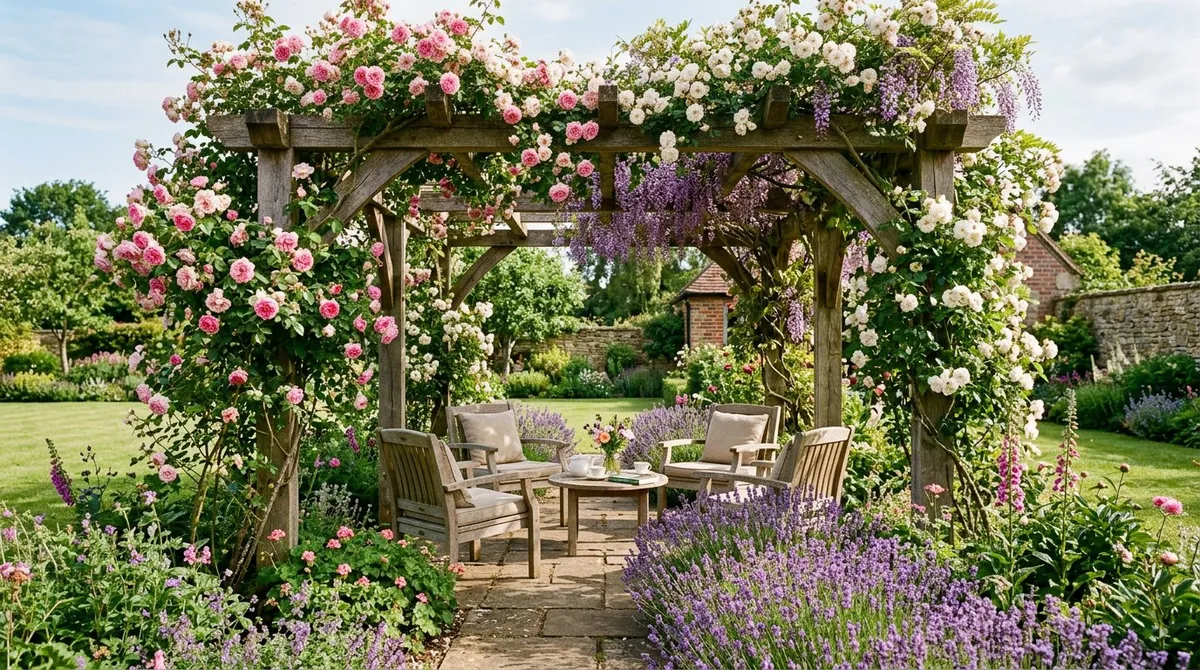
A pergola turns a flat patio into a defined outdoor room. It frames a dining area, supports climbing plants, and creates the kind of dappled shade that makes a garden usable on bright summer days. In the UK, where rain and wind dictate how we use outdoor space, a pergola also extends the season by weeks at each end.
This guide covers materials, sizes, costs, planning rules, and the best climbing plants for UK pergolas. Whether you want a simple timber frame for £500 or a louvred aluminium structure for £8,000, the principles are the same. Start with function, choose materials that suit your maintenance tolerance, and plant something that will soften the frame within two growing seasons. For more structural and layout ideas, see our garden design guides.
Freestanding vs wall-mounted pergolas
The first decision is whether your pergola stands alone in the garden or attaches to the house wall. Each has distinct advantages.
Freestanding pergolas sit independently on four or more posts. They work anywhere in the garden, over a patio, beside a pond, or at the end of a path as a focal point. They feel more like a garden feature than a building extension. A freestanding pergola over a deck area creates a distinct outdoor room that feels separate from the house.
Wall-mounted (lean-to) pergolas bolt to the house wall using a horizontal wall plate at 2.4m or higher. They need only two front posts instead of four. This design creates a natural transition from kitchen to garden, ideal for dining and barbecue areas. A lean-to pergola paired with an outdoor kitchen makes a practical year-round cooking and eating space.
| Feature | Freestanding | Wall-mounted |
|---|---|---|
| Posts required | 4 or more | 2 (plus wall plate) |
| Placement | Anywhere in garden | Against house wall only |
| Planning rules | Permitted development if under 2.5m | May need building regs check for wall fixings |
| Best for | Garden focal point, remote dining | Kitchen extension, BBQ shelter |
| Wind resistance | Exposed on all sides | Sheltered by house wall |
| Cost (timber, 3m x 3m) | £800-£2,000 | £600-£1,500 |
Tip: If you are unsure, start with a freestanding pergola. You can always add a retractable canopy for rain shelter. Wall-mounted pergolas are harder to reposition if you change your garden layout later.
Pergola materials compared
The frame material determines how the pergola looks, how long it lasts, and how much work it needs each year.
Timber
Pressure-treated softwood is the most popular choice in UK gardens. Posts are typically 90mm x 90mm or 100mm x 100mm. Cross beams at 45mm x 145mm span up to 3.6m without sagging. Expect 10-15 years from treated softwood with regular maintenance.
Western red cedar resists rot naturally and weathers to an attractive silver-grey. It lasts 20-25 years without chemical treatment. Cedar costs roughly twice as much as treated softwood.
Oak is the premium timber. Green oak joints tighten as the wood seasons, creating incredibly strong structures. An oak pergola lasts 30 years or more. Budget three to four times the cost of softwood. Oak also weighs considerably more, so foundations must be solid.
Aluminium
Powder-coated aluminium is the modern choice. It does not rot, rust, warp, or need painting. Available in anthracite grey, black, white, and custom RAL colours. Aluminium pergolas typically use 100mm x 100mm hollow section posts with integrated drainage channels. They last 25 years or more with zero maintenance.
Many aluminium pergolas come with louvred roof blades that rotate from fully open (maximum sun) to fully closed (complete rain protection). A remote control adjusts the angle. This is the closest a pergola gets to an all-weather garden room without walls.
Steel
Galvanised and powder-coated steel creates slimmer profiles than timber. A steel post at 60mm x 60mm is as strong as a timber post at 100mm x 100mm. Steel suits contemporary garden designs where clean lines matter. It needs re-coating every 10-15 years in coastal areas where salt air accelerates corrosion.
| Material | Lifespan | Maintenance | Cost (3m x 3m installed) | Style |
|---|---|---|---|---|
| Treated softwood | 10-15 years | Re-treat every 2-3 years | £1,500-£3,000 | Traditional, rustic |
| Western red cedar | 20-25 years | Optional oiling | £2,500-£4,500 | Natural, warm tone |
| Oak | 30+ years | Minimal | £4,000-£7,000 | Premium, traditional |
| Aluminium | 25+ years | None | £4,000-£8,000 | Contemporary, clean |
| Steel | 20-25 years | Re-coat every 10-15 years | £3,000-£6,000 | Modern, slim profile |
Planning permission and building regulations
Most garden pergolas fall under permitted development and need no planning application. The Planning Portal sets out the rules clearly.
Your pergola is permitted development if it meets all of these conditions:
- Height does not exceed 2.5m at the highest point
- Structure is more than 2m from any boundary if over 2.5m tall
- Covers no more than 50% of the garden area (including all outbuildings)
- Not in front of the principal elevation (not facing the road)
- Not in a conservation area, national park, or the curtilage of a listed building
Wall-mounted pergolas that affect the external appearance of the house may need a building regulations check, particularly if you drill into a structural wall. Consult your local authority building control team for confirmation.
Warning: If your property is a flat, maisonette, or has had its permitted development rights removed by a planning condition, you will need a planning application. Check your property’s planning history before ordering materials.
Pergola sizes and spacing
Getting the proportions right matters more than building as large as possible. A pergola that is too tall or too wide for the garden looks awkward.
Recommended dimensions for common uses:
| Use | Width | Depth | Minimum height | Post spacing |
|---|---|---|---|---|
| Bistro dining (2 people) | 2.4m | 2.4m | 2.2m | 2.4m |
| Family dining (4-6 people) | 3m | 3.6m | 2.4m | 1.8-2m |
| Walkway / garden path | 1.2-1.8m | Any length | 2.2m | 1.8-2.4m |
| Hot tub cover | 3m | 3m | 2.4m | 3m |
| Outdoor kitchen | 3.6m | 3m | 2.5m | 1.8m |
Height guidelines: 2.2m is the minimum comfortable headroom beneath cross beams. For climbing plants that drip rainwater, add 10-20cm to avoid walking into wet foliage. A 2.4m height works well for most UK gardens. Anything over 2.5m starts to feel out of scale in a standard suburban plot.
Post spacing: keep cross beams at 1.8-2.4m centres. Wider spacing causes timber beams to sag over time. Aluminium and steel span further without deflection. Rafters (the lengthwise timbers) sit on top of the cross beams at 400-600mm centres to create the characteristic shadow pattern.
Best climbing plants for UK pergolas
A pergola without plants is an empty frame. The right climber turns it into a living structure within two to three seasons. For a full list, see our guide to the best climbing plants for UK gardens.
Wisteria
The classic pergola plant. Long cascading racemes of purple, blue, or white flowers appear in May and June. Wisteria sinensis (Chinese) flowers on bare wood before leaves appear. Wisteria floribunda (Japanese) has longer racemes up to 90cm. Both need strong support: a mature wisteria weighs several hundred kilograms. Prune twice a year, in July and February, to control growth and encourage flowering. Our guide to growing wisteria covers pruning and training in detail.
Climbing roses
Repeat-flowering varieties like ‘New Dawn’ (pale pink), ‘Compassion’ (salmon-apricot), and ‘Generous Gardener’ (warm pink) provide colour from June to October. Train stems horizontally along the cross beams and they produce flowering side shoots along their entire length. A single climbing rose covers a 3m span within three years. Deadhead spent blooms to encourage repeat flushes.
Star jasmine
Trachelospermum jasminoides is evergreen with intensely fragrant white flowers in June and July. It needs a sheltered, south or west-facing position. Growth is slow in the first two years, then vigorous. Star jasmine gives year-round green cover, unlike deciduous climbers that leave the frame bare in winter.
Grape vines
Vitis vinifera varieties create dappled shade in summer and drop their leaves in autumn, letting winter sun through. ‘Boskoop Glory’ produces edible black dessert grapes in southern England. ‘Dornfelder’ suits cooler areas. Train the main rod along the central beam and allow side shoots to drape across rafters. See our grape vine growing guide for pruning and training steps.
Clematis
Fast-growing and available in dozens of colours. Group 3 clematis (viticella types) flower on new wood from July to September and are cut back hard each February. This keeps growth manageable on a pergola. ‘Etoile Violette’ (deep purple) and ‘Polish Spirit’ (rich violet) are both vigorous and reliable. Clematis like their roots in shade and their heads in sun: mulch the base heavily.
| Plant | Flower period | Evergreen | Coverage speed | Weight on structure |
|---|---|---|---|---|
| Wisteria | May-Jun | No | 3-4 years full cover | Very heavy |
| Climbing rose | Jun-Oct | No | 2-3 years full cover | Medium |
| Star jasmine | Jun-Jul | Yes | 3-4 years full cover | Light |
| Grape vine | Foliage May-Oct | No | 2-3 years full cover | Medium |
| Clematis (Group 3) | Jul-Sep | No | 1-2 years full cover | Light |
Tip: Plant two different climbers on opposite sides of the pergola for a longer season of interest. Wisteria and a late-flowering clematis together give colour from May to September.
Louvred roof pergolas
Louvred roof pergolas are the fastest-growing category in the UK market. Aluminium blades rotate from fully open to fully closed, controlled by a remote or wall switch. When closed, they shed rainwater through integrated guttering in the posts.
Advantages over traditional pergolas:
- Complete rain protection when closed
- Adjustable shade from full sun to full cover
- Integrated LED strip lighting in most models
- Some models include motorised side screens for wind protection
- No climbing plants needed (though they can be added to posts)
Costs: entry-level louvred pergolas from brands like Maranza and Renson start at £4,000 for a 3m x 3m unit. Premium models with integrated heating, lighting, and side screens reach £12,000-£15,000. Installation typically adds £1,000-£2,000.
Planning note: louvred pergolas with a solid closed position may be classed as a covered structure rather than an open pergola. This can affect permitted development rights. Check with your local planning office before ordering.
Lighting your pergola
Pergola lighting extends usable hours from May through October. Integrated lighting turns a daytime shade structure into an evening dining space. For a full guide, see our garden lighting ideas.
Options that work well on pergolas:
- Festoon lights strung between posts or along beams. Warm white (2700K) creates the best atmosphere. Solar-powered versions avoid wiring.
- LED strip lighting tucked into the underside of beams. Hidden source, even glow. Available in warm white or RGB colour-changing.
- Pendant lights hung from the centre beam above a dining table. Use outdoor-rated IP44 fittings. One or two pendants provide focused task lighting for eating.
- Uplights on the posts, angled into climbing plants above. This creates a canopy of light and shadow overhead.
Tip: Run an outdoor-rated electrical supply (armoured cable or via conduit) to the pergola base during construction. Retrofitting electrics is far harder once plants have grown through the frame. A qualified electrician can install a weatherproof socket and switched lighting circuit in half a day.
Pergola cost breakdown
Costs vary widely depending on materials, size, and whether you install it yourself or hire a professional.
| Type | DIY cost | Professional install | Includes |
|---|---|---|---|
| Softwood kit (3m x 3m) | £500-£1,000 | £1,500-£2,500 | Posts, beams, rafters, post fixings |
| Cedar kit (3m x 3m) | £1,000-£2,000 | £2,500-£4,000 | As above in cedar |
| Oak bespoke (3m x 3m) | N/A (specialist build) | £4,000-£7,000 | Green oak, traditional joints |
| Aluminium flat-top (3m x 3m) | £2,000-£3,500 | £3,500-£5,500 | Powder-coated frame, fixings |
| Aluminium louvred roof (3m x 3m) | N/A (specialist install) | £4,000-£8,000 | Motorised blades, guttering, LED |
| Steel bespoke (3m x 3m) | N/A (fabricated) | £3,000-£6,000 | Galvanised, powder-coated |
Additional costs to budget for:
- Concrete post foundations: £100-£200 (DIY) or £300-£500 (professional)
- Electrical supply for lighting: £200-£400 (electrician)
- Climbing plants (5-6 plants): £60-£120
- Post-mounted planters: £50-£150
Common mistakes with pergolas
1. Building too small
A 2m x 2m pergola barely fits a small table and two chairs. Once climbing plants grow inward by 20-30cm on each side, the usable space shrinks further. Build at least 2.4m x 2.4m for a bistro setup. For family dining, 3m x 3.6m is the practical minimum.
2. Weak foundations
Every pergola post needs a solid foundation. In firm ground, a 300mm x 300mm hole filled with 450mm of concrete holds a post securely. In soft or clay soil, go deeper to 600mm. Post spikes driven into the ground work for lightweight timber structures but fail under the weight of mature climbing plants.
3. Ignoring wind exposure
UK gardens are windier than most of Europe. An open pergola with a flat top catches less wind than one with a solid roof. If your garden is exposed, avoid adding full side screens. Louvred pergolas should have blades set to open automatically in high winds. Anchor all structures to concrete foundations, not just surface-fixed brackets.
4. Planting too many climbers
One vigorous climber covers a 3m x 3m pergola. Two complementary species give a longer flowering season. More than two creates a tangled mass that is impossible to prune and traps moisture against the timber. Moisture trapped against wood accelerates rot. Choose one or two plants and train them deliberately.
5. Forgetting maintenance access
Timber pergolas need re-staining every 2-3 years. Climbing plants need pruning at least once a year. If the pergola is crammed against a fence with no access behind, maintenance becomes a nightmare. Leave 50-60cm clearance on at least two sides.
Maintenance by material type
Why we recommend Western red cedar for a first timber pergola in the UK: After 30 years of specifying and building garden structures, cedar is the timber I come back to when clients want longevity without the maintenance burden of softwood. A cedar pergola treated with a single coat of Danish oil at installation and left alone weathers to a consistent silver-grey within two seasons. I have structures in exposed West Midlands gardens that are 18 years old with no structural repairs, compared with treated softwood pergolas on the same sites that needed significant timber replacement at the 10-year mark.
| Material | Annual tasks | Every 2-3 years | Every 10+ years |
|---|---|---|---|
| Treated softwood | Check fixings, clear debris | Sand and re-stain/treat | Replace damaged timbers |
| Cedar | Check fixings | Optional oil treatment | None (weathers naturally) |
| Oak | Check fixings | None | None |
| Aluminium | Wash with soapy water | Nothing | Nothing |
| Steel | Check for chips in coating | Touch up any bare metal | Full re-coat if needed |
Styling your pergola space
A pergola is the framework. What you put beneath and around it creates the atmosphere.
Flooring: natural stone paving, porcelain tiles, or timber decking all work beneath a pergola. Avoid loose gravel under dining areas as chair legs sink and wobble. For smaller gardens, pale paving reflects light upward into the covered space.
Furniture: match the scale to the pergola. A 3m x 3m pergola suits a round table with four chairs or a compact corner sofa. Leave 80cm clearance between furniture and posts for comfortable movement.
Accessories: outdoor rugs define the seating zone. Weatherproof cushions in neutral tones age better than bright colours. A wall-mounted shelf on one post holds a speaker, candles, or herb pots.
Heating: a wall-mounted electric infrared heater extends the season into October and November. Mount at 2m height, angled downward. A 2kW heater covers a 3m x 3m area. Position it where diners face away from the glare.
A Mediterranean planting scheme around the base of a pergola suits the sheltered microclimate created by the structure. Lavender, rosemary, and olive trees in large pots complement the architectural frame.
Now you’ve mastered pergola design, read our guide on outdoor kitchen and BBQ area ideas for how to build the perfect cooking space beneath it.
Frequently asked questions
Do I need planning permission for a pergola UK?
Most garden pergolas are permitted development and need no planning application. The structure must stay under 2.5m at its highest point and sit more than 2m from any boundary. It must not cover more than 50% of the total garden area. Properties in conservation areas, national parks, or listed building curtilages have stricter rules. Check the Planning Portal for the current guidelines.
What is the best wood for a pergola in the UK?
Pressure-treated softwood is the most common and affordable option, lasting 10-15 years with regular treatment. Western red cedar resists rot naturally and lasts 20-25 years without chemical treatment. Green oak is the premium choice, lasting 30 years or more with virtually no maintenance. Oak joints tighten as the wood seasons, making incredibly strong structures.
How much does a pergola cost in the UK?
A basic softwood DIY kit starts at £500-£1,000 for a 3m x 3m frame. Professional installation of timber pergolas costs £1,500-£3,500 depending on size and material. Aluminium louvred roof pergolas run £4,000-£8,000 installed. Bespoke oak or steel structures exceed £5,000 and often reach £10,000 for larger designs.
What are the best climbing plants for a pergola?
Wisteria produces the most dramatic display, with cascading flower racemes up to 90cm long in May and June. Climbing roses give the longest flowering season from June to October. Star jasmine provides evergreen cover and intense fragrance. Grape vines create natural dappled shade in summer. Clematis fills gaps quickly with flowers from July to September.
How big should a pergola be for a small garden?
A 2.4m x 2.4m pergola is the practical minimum for a small dining area. This fits a bistro table and two to four chairs. For small gardens, keep the height proportionate at 2.2-2.4m. Anything taller looks top-heavy. Consider a half-pergola (lean-to) attached to the house wall to save floor space.
Can I attach a pergola to my house wall?
A lean-to pergola bolts directly to the house wall using a horizontal timber or aluminium wall plate secured with expanding masonry bolts. The wall plate should sit at least 2.4m above ground level. Ensure the fixings go into solid masonry, not mortar joints. A lean-to design needs only two front posts, saving space and cost.
How do I maintain a timber pergola?
Apply a quality exterior wood stain or preservative every 2-3 years. Ronseal, Sadolin, and Cuprinol all make suitable pergola treatments. Check all bolts and fixings each spring, tightening any that have loosened over winter. Clear climbing plant growth away from joints where moisture can collect. Sand any grey or rough patches before re-treating. Cut back dead or overcrowded climber growth in late winter.
Lawrie has been gardening in the West Midlands for over 30 years. He grows his own veg using no-dig methods, keeps a wildlife-friendly garden, and writes practical advice based on real UK growing conditions.