The Potager Garden: Edibles Meets Design
Plan a potager garden mixing vegetables, herbs and flowers in one beautiful UK plot. Layout tips, plant combos and seasonal plans from 8 years of trials.
Key takeaways
- A potager is a French kitchen garden where edibles and ornamentals grow together in geometric beds for beauty and food
- Beds should be no wider than 1.2m with 60-90cm gravel paths — the same dimensions as any productive kitchen garden
- Purple and red vegetables like ruby chard, red cabbage and purple basil create striking colour contrasts with orange marigolds and yellow calendula
- Companion planting in a potager is functional: marigolds repel whitefly, nasturtiums trap aphids, and borage attracts pollinators
- A 4x4m potager with four raised beds feeds two people in salads and herbs from May to October while looking decorative year-round
- Succession sowing every 3-4 weeks keeps beds full and colourful from spring through to the first frosts
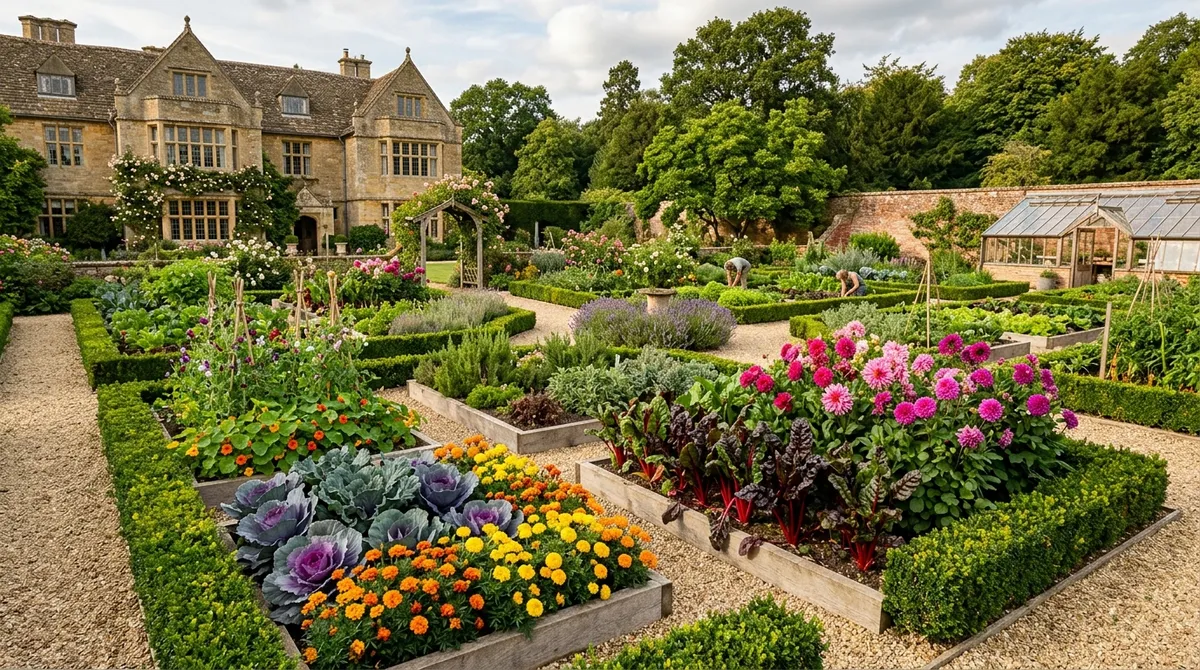
A potager garden is where food growing meets garden design — and the result is one of the most satisfying plots you can create in a UK garden. Every bed produces food. Every bed looks beautiful. The two goals are not in conflict.
I have been growing vegetables, herbs and flowers together in potager-style beds since 2018, refining plant combinations over eight seasons on heavy Staffordshire clay. This guide covers the design principles, the best edible-ornamental plant pairings, and the practical techniques that keep a potager productive and attractive from spring through winter.
What is a potager garden?
A potager is a French kitchen garden where vegetables, herbs and flowers share the same beds in a formal, geometric layout. The word comes from potage — the thick vegetable soups that were the staple of French country kitchens. Unlike a conventional kitchen garden where productivity is the only goal, a potager treats edible plants as design elements.
The tradition goes back to the Renaissance gardens of France, most famously the potager du roi at Versailles and the restored gardens at Villandry in the Loire Valley. These were formal gardens with symmetrical beds, clipped box edging, gravel paths, and carefully colour-coordinated plantings of vegetables and flowers.
You do not need a chateau to make one work. A potager scales from a single raised bed on a patio to a full walled garden. The principles are the same at any size: geometric layout, deliberate colour combinations, productive plants chosen partly for their ornamental qualities, and companion flowers that earn their space through pest control. For more on the productive side of the equation, see our full kitchen garden design guide.
How to design a potager garden layout
The bones of a potager are the same as any productive kitchen garden: beds, paths and focal points. The difference is that everything is arranged with visual impact in mind.
Beds no wider than 1.2m. This is a practical rule, not an aesthetic one. You must reach the centre of every bed without stepping on the soil. Compacted soil grows poor crops regardless of how pretty the layout looks. Standard raised bed dimensions of 1.2m x 2.4m work perfectly.
Symmetrical layout. The defining feature of a potager is formal geometry. Four beds arranged around a central cross path is the classic layout. Eight beds in a wheel pattern with a central focal point is more ambitious. Even two long beds flanking a single path counts as potager-style if the planting is deliberate.
Gravel paths of 60-90cm. Gravel over landscape fabric gives year-round access, suppresses weeds, and looks right in a formal layout. The main path should be 90cm for wheelbarrow access. Secondary paths between beds can be 60cm.
A central focal point. Traditional potagers use a standard-trained bay tree, a sundial, a small water feature, or a rose-covered obelisk at the centre where paths cross. This anchors the design and draws the eye. My central feature is a hazel wigwam planted with climbing French beans in summer and sweet peas in spring — productive and ornamental at once.
Bed edging defines the structure. Low box hedging (Buxus sempervirens ‘Suffruticosa’) is the classic choice, clipped to 15-20cm. Dwarf lavender, compact thyme, or chive edging are productive alternatives that do not require clipping. I switched from box to thyme edging in 2021 after box moth caterpillars arrived in Staffordshire, and the thyme looks just as neat while producing a usable herb crop.
Best potager plant combinations
The art of a potager is pairing edibles with flowers so the colour contrasts are deliberate. These are the combinations I have tested over eight seasons that reliably produce striking beds.
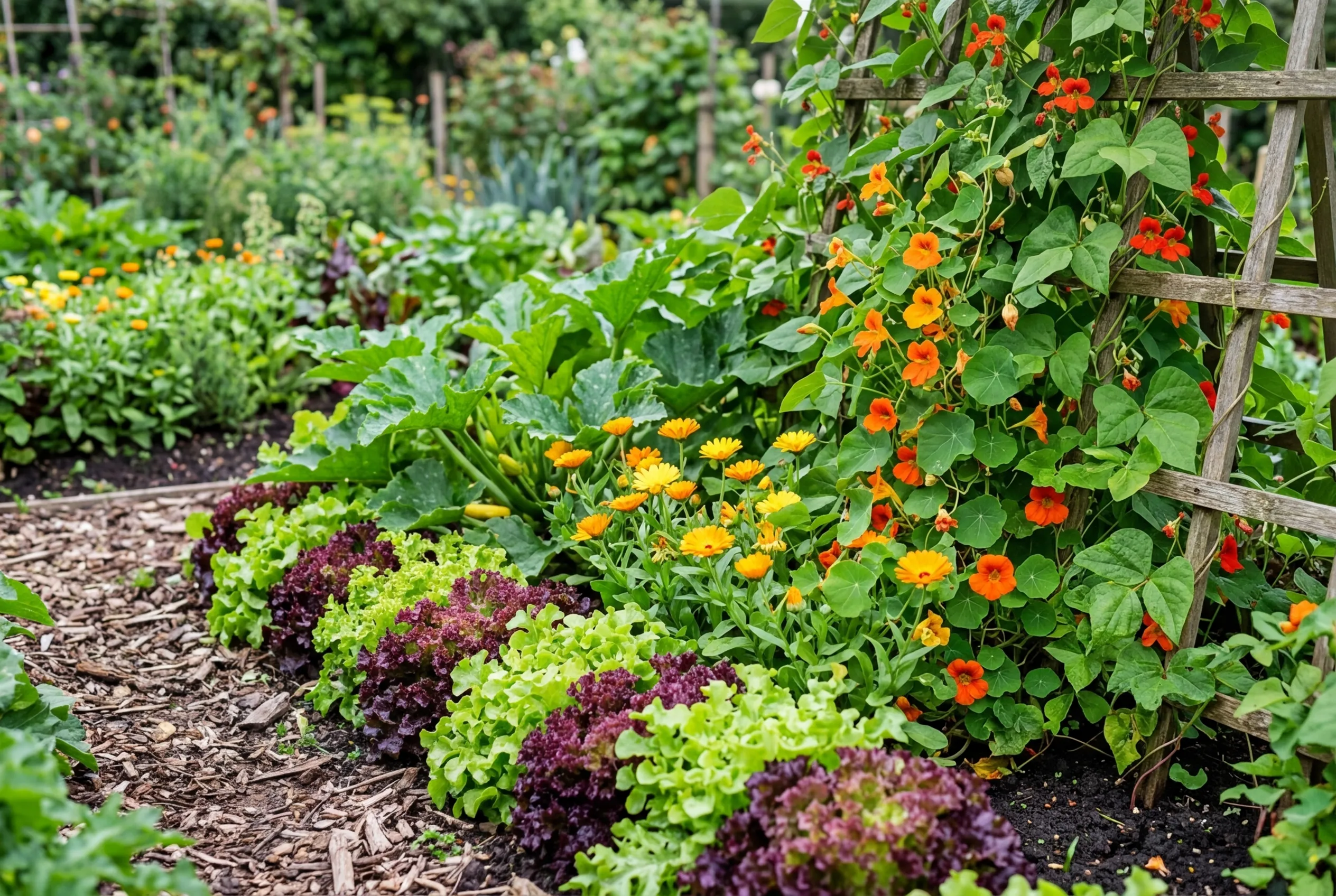
Companion flowers like nasturtiums and calendula earn their place in a potager through pest control and pollinator attraction.
Purple and orange: the signature potager palette
Ruby chard beside orange marigolds is the single most effective colour combination in a potager. The deep crimson stems and dark green leaves of ruby chard create a dramatic backdrop for the hot orange of French marigolds (Tagetes patula). Plant chard at 20cm spacing in the centre of the bed with a single row of marigolds 15cm from the bed edge.
Red cabbage with calendula. The blue-purple heads of red cabbage look spectacular surrounded by orange calendula (pot marigold). Calendula self-seeds freely once established, so you only need to buy seed once. As a bonus, calendula flowers attract hoverflies whose larvae eat aphids — a genuine pest control function alongside the visual impact.
Purple basil with yellow courgettes. Dark Opal or Purple Ruffles basil planted between yellow courgette plants creates a rich contrast of purple foliage against golden flowers and fruit. The basil needs the same warmth and shelter as courgettes, so they are natural growing companions.
Height and structure combinations
Runner beans on hazel wigwams provide the vertical element every potager needs. A 1.8m wigwam of 6-8 hazel poles, planted with scarlet-flowered runner beans, becomes a focal point from July onwards. Underplant with trailing nasturtiums — the nasturtiums trap aphids that would otherwise attack the beans, while their orange and red flowers echo the bean blossoms above. For more on growing beans and other climbing crops, see our guide to growing your own vegetables.
Globe artichokes as architectural plants. A single globe artichoke plant reaches 1.5m tall with silver-green serrated leaves spanning 90cm. Place one at each corner of a four-bed potager for structural height. The flower buds are edible; any you miss open into stunning purple thistle-like blooms that attract bees.
Climbing sweet peas for scent and colour. Trained up obelisks or wigwams, sweet peas provide cut flowers from June to September. They are not edible, but they attract pollinators and fill the potager with scent. Plant them where a structural accent is needed — at bed corners or flanking the entrance path.
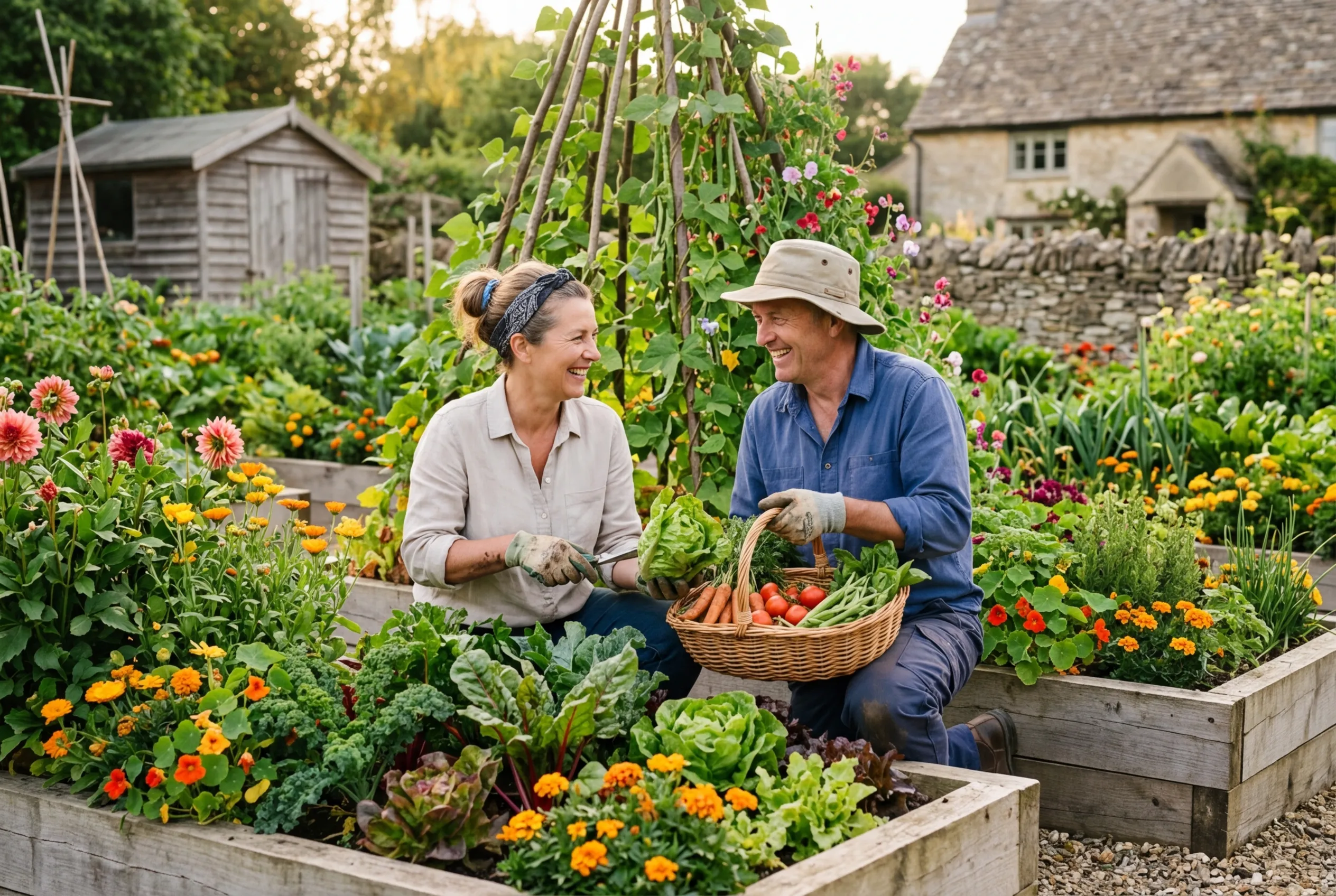
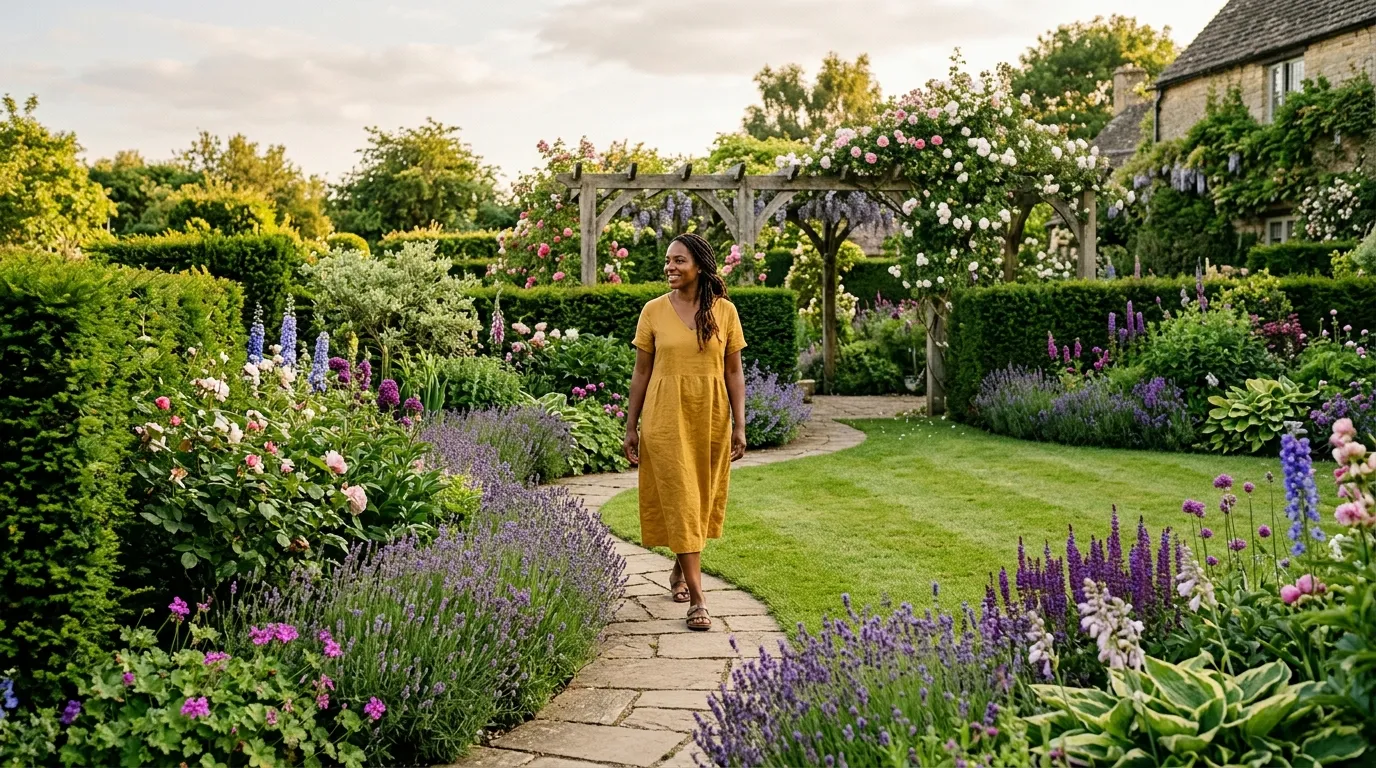
A potager is a garden you visit daily — harvesting, replanting and enjoying the colour combinations up close.
Edible edging combinations
Lettuce as bed edging. Alternate green and red lettuce varieties (Lollo Rossa and Little Gem, or Red Salad Bowl and Butterhead) along bed edges for a decorative scalloped border that you harvest leaf by leaf. Re-sow every three weeks for unbroken coverage. See our lettuce growing guide for variety recommendations.
Parsley and chive borders. Flat-leaf parsley planted at 15cm spacing makes a dense, bright green edge 20-25cm tall. Chives offer the same effect with the bonus of purple flower heads in May and June. Both are productive herbs used daily in the kitchen — this is potager thinking at its best: beautiful and functional.
| Combination | Colours | Height | Spacing | Season | Companion Benefit |
|---|---|---|---|---|---|
| Ruby chard + French marigolds | Crimson/orange | 45cm/25cm | 20cm/15cm | May-Oct | Marigolds repel whitefly |
| Red cabbage + calendula | Purple/orange | 30cm/40cm | 45cm/20cm | Jun-Nov | Calendula attracts hoverflies |
| Purple basil + yellow courgette | Purple/gold | 30cm/50cm | 20cm/90cm | Jun-Sep | Basil may deter aphids |
| Runner beans + nasturtiums | Scarlet/orange | 1.8m/trailing | 15cm/30cm | Jul-Oct | Nasturtiums trap aphids |
| Red lettuce + green lettuce | Red/green | 20cm/20cm | 15cm/15cm | Mar-Nov | Visual contrast only |
| Globe artichoke + borage | Silver/blue | 1.5m/60cm | 90cm/30cm | Jun-Sep | Borage attracts pollinators |
| Cavolo nero + violas | Dark green/purple | 70cm/15cm | 45cm/10cm | Sep-Mar | Winter interest |
| Curly kale + purple sprouting | Blue-green/purple | 60cm/80cm | 45cm/60cm | Oct-Apr | Winter food production |
Herbs in the potager garden
Herbs are the backbone of a potager. They provide edging, ground cover, height, fragrance, and pest control — and every one is usable in the kitchen.
Perennial herbs need permanent positions. Rosemary, thyme, sage, and oregano stay in the ground year-round and cannot be part of a rotation system. Plant them along the edges of the potager or in a dedicated herb bed at the entrance. A standard-trained rosemary at the centre of a bed makes a year-round focal point. See our herb growing guide for detailed planting and care advice.
Annual herbs rotate with crops. Basil, coriander, dill, and chervil are planted fresh each year and can go wherever there is space in the current rotation. Basil beside tomatoes, dill among courgettes, and coriander as a quick-growing gap filler between slower crops.
Herb edging replaces box. Compact thyme (Thymus vulgaris or Thymus serpyllum) clipped to 10-15cm makes a dense evergreen edge that produces a usable crop. Hyssop, winter savory, and dwarf lavender are alternatives that flower for pollinators. After losing box plants to box tree moth in 2021, I now use thyme exclusively for bed edging — it looks just as structured and smells far better when you brush past.
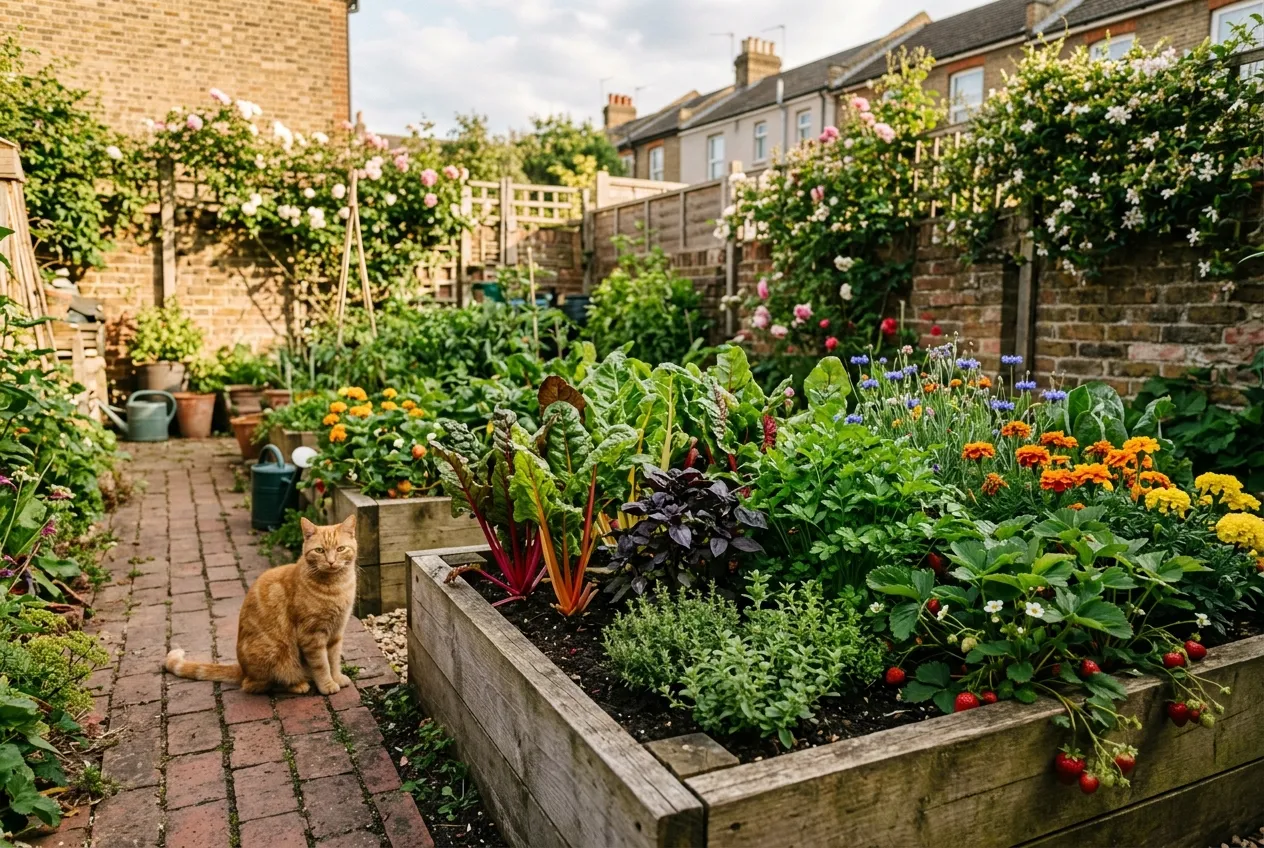
Even a small urban plot can become a productive potager with raised beds, colourful chard and companion herbs.
Companion planting in a potager
Every flower in a potager should earn its space through pest control, pollinator attraction, or soil improvement — not just colour. This is what separates a well-designed potager from a random mix of edibles and flowers.
French marigolds (Tagetes patula) release chemicals from their roots that suppress root-knot nematodes and repel whitefly. Plant them at 15cm intervals along bed edges and between tomato plants. They are the single most valuable companion plant in any edible garden.
Nasturtiums (Tropaeolum majus) are sacrificial trap crops. Blackfly preferentially colonise nasturtiums over beans and brassicas. Letting the nasturtiums take the hit keeps your food crops cleaner. The leaves, flowers, and seed pods are all edible — peppery and sharp, excellent in salads.
Calendula (Calendula officinalis) attracts hoverflies, lacewings, and ladybirds. The larvae of these insects eat aphids. One calendula plant within a square metre of brassicas measurably reduces aphid damage compared to an unplanted control bed, based on my observations over five seasons.
Borage (Borago officinalis) is the supreme pollinator plant. Its blue star-shaped flowers produce nectar continuously and attract bees throughout the day. Place borage near courgettes, squash, and runner beans — all crops that depend on insect pollination for fruit set. The flowers are edible and freeze well in ice cubes. For more on edible blooms, see our guide to edible flowers.
Seasonal succession for year-round beauty
The hardest skill in potager gardening is keeping beds full and colourful across all four seasons. A conventional kitchen garden can have bare soil in winter. A potager cannot — the gaps show.
Spring (March-May)
Start with lettuce, radishes, and spring onions direct-sown in March under fleece. Interplant with violas and primroses for early colour. By late April, plant out chard, kale, and cabbage seedlings raised under cover. Chive borders will be in full green growth. Tulip bulbs planted between beds the previous autumn provide structural colour until the edibles fill in.
Summer (June-August)
This is peak potager season. Runner beans climb wigwams. Courgettes unfurl their golden flowers. Chard, basil, and lettuce fill every bed. Marigolds, nasturtiums, and calendula are in full flower. Succession-sow lettuce and radishes every three weeks so harvested gaps are filled within days. Keep dead-heading sweet peas to extend flowering.
Autumn (September-November)
Transition to winter crops as summer plants finish. Replace spent courgettes and beans with cavolo nero, purple sprouting broccoli, and winter lettuces. Sow green manure (phacelia or field beans) in any bed that will be empty until spring. Ornamental kale provides colour through autumn and mild winters. Leave globe artichoke seedheads standing for architectural interest and bird food.
Winter (December-February)
Structure carries the potager through winter. Evergreen herb edging (thyme, rosemary, box), the permanent framework of paths and bed edges, and any overwintering brassicas keep the garden from looking abandoned. Purple sprouting broccoli and cavolo nero are both handsome and productive through the coldest months. Hazel wigwams stripped of beans still provide vertical structure.
How to create a potager in a small space
You do not need a large garden to grow a potager. A single raised bed of 1.2m x 2.4m, planted with intention, is a potager in miniature.
The four-bed patio potager. Four raised beds of 1m x 1m arranged in a square with 60cm paths creates a 3.2m x 3.2m potager — small enough for a patio or back garden corner. Plant each bed with a colour theme: one bed of ruby chard and orange marigolds, one of purple basil and yellow courgettes, one of green and red lettuce, and one of mixed herbs. Add a small obelisk or standard bay in the centre where the paths cross.
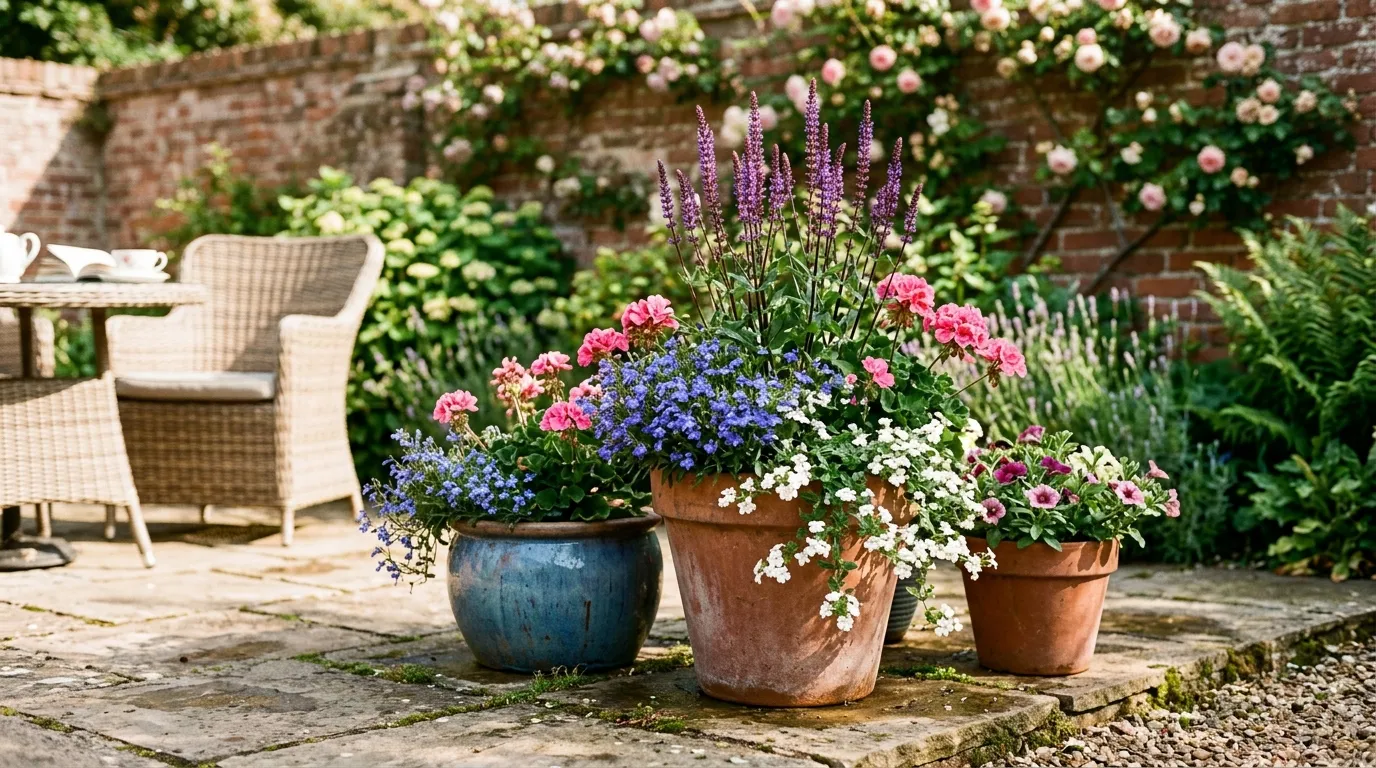
Containers as potager elements. Large terracotta pots (40cm+) planted with trailing nasturtiums, a standard rosemary, or a mixed herb collection extend the potager onto paving. Group pots at bed corners and along paths to blur the boundary between beds and hard landscaping.
Vertical growing maximises small spaces. Wall-mounted planters, obelisks, and bean wigwams add growing area without taking floor space. A 1.8m obelisk planted with climbing French beans produces 3-4kg of beans from a 30cm x 30cm footprint. The RHS has excellent guidance on kitchen garden design in smaller spaces.
Common potager mistakes to avoid
Planting too densely. A potager should look full, not cramped. Overcrowded plants compete for light, produce smaller harvests, and trap moisture that encourages fungal disease. Follow spacing recommendations even when a bed looks sparse at planting time — it fills in within weeks.
Ignoring succession sowing. The single biggest cause of an untidy potager is gaps where harvested crops leave bare soil. Keep a sowing schedule and a tray of backup seedlings in a cold frame. Every time you harvest a lettuce, a replacement should go in the same day.
Choosing plants only for looks. A potager must produce food to justify its existence. Ornamental cabbages that are bred for display rather than eating, flowers with no companion planting function, and decorative elements that take growing space all dilute the purpose. Every plant should be edible, a proven companion, or structural.
Neglecting winter structure. A potager that looks stunning in July and derelict in January is only half-designed. Plan the permanent framework — paths, edging, focal points, evergreen herbs — before choosing a single vegetable. The bones of the garden must stand alone.
Frequently asked questions
What is a potager garden?
A potager is a French-style kitchen garden where vegetables, herbs and flowers grow together in geometric beds designed for beauty as well as food production. Unlike a standard allotment or kitchen garden, a potager treats edible plants as ornamental features. The word potager comes from the French potage, meaning soup or vegetable stew. The tradition dates to the Renaissance gardens of France, most famously Villandry in the Loire Valley.
How big does a potager garden need to be?
A potager works from 4x4m upwards, though even a single raised bed can be planted in potager style. Four raised beds of 1.2x1.5m with 60cm gravel paths between them gives you enough space for salads, herbs, climbing beans, and companion flowers for two people. A 6x6m potager allows more ambitious planting with a central focal point and dedicated herb beds.
What vegetables look best in a potager?
Ruby chard, purple cabbage, curly kale, rainbow chard and red lettuce varieties provide the strongest ornamental impact. Globe artichokes add architectural height reaching 1.5m. Runner beans on wigwams create vertical structure. Courgettes have bold foliage and large golden flowers. Purple sprouting broccoli and cavolo nero offer striking form through autumn and winter.
Do potager gardens produce as much food as normal kitchen gardens?
A potager produces 15-20% less food by weight than a conventional kitchen garden of the same size. Space given to flowers, formal edging and decorative paths reduces growing area. However, the food you do grow is often higher quality because companion flowers attract pollinators and beneficial insects. Many potager gardeners find they waste less because the garden is visited daily and harvested at peak freshness.
What flowers should I plant in a potager?
French marigolds repel whitefly and nematodes, making them the most valuable potager flower. Nasturtiums trap aphids away from beans and brassicas. Calendula attracts hoverflies whose larvae eat aphids. Borage brings pollinators to courgettes and beans. Sweet peas on wigwams add scent and cutting flowers. All of these earn their place through pest control as well as beauty.
Can I make a potager garden in raised beds?
Raised beds are ideal for a potager because their defined edges create the formal geometry the style requires. Build four beds of 1.2x1.5m or 1.2x2.4m in a symmetrical layout with gravel paths. Edge beds with low herbs like thyme or chives instead of box hedging. The structure of raised beds gives instant formality without the expense of stone or brick edging.
How do I keep a potager looking good all year?
Succession sowing every 3-4 weeks is the single most important technique for year-round potager beauty. Always have replacement seedlings ready in a cold frame so harvested gaps are filled immediately. Use winter-interest plants like cavolo nero, purple sprouting broccoli and ornamental kale from November to March. Plant spring bulbs between beds for early colour. Evergreen herb edging of thyme, rosemary or clipped box provides permanent structure even in the coldest months.
Lawrie has been gardening in the West Midlands for over 30 years. He grows his own veg using no-dig methods, keeps a wildlife-friendly garden, and writes practical advice based on real UK growing conditions.