School Garden Ideas UK
Practical school garden ideas for UK primary schools. Raised beds, wildlife areas, sensory gardens and seasonal projects tested in Staffordshire.
Key takeaways
- Raised beds are the single best starting point for any school garden on compacted or poor urban soil
- Match planting to school terms: sow in spring, grow through summer, harvest in early autumn
- A wildlife area with bug hotel, mini pond, and wildflower patch teaches ecology with almost no ongoing cost
- Sensory gardens using herbs, textured plants, and water features support SEN pupils and the whole curriculum
- A single 1.2m x 2.4m raised bed costs 50 to 150 pounds and feeds a class-sized growing project
- Sunflower competitions from April to July are the easiest first project for schools new to gardening
A school garden transforms a patch of unused ground into a living classroom that teaches science, maths, and teamwork. Across the UK, over 38,000 schools now run gardening projects with support from the RHS Campaign for School Gardening. The results go far beyond growing a few tomatoes. Pupils who garden at school eat more vegetables, concentrate better in lessons, and develop a lasting connection with nature.
This guide covers every type of school garden project, from a single raised bed to a full wildlife area. Every idea here has been tested in real Staffordshire primary schools over four academic years. The projects are sorted by difficulty, cost, and which school term they suit best. Whether you are a teacher, parent volunteer, or school governor, you will find a project that fits your space, budget, and timetable.
What are the best raised bed projects for school gardens?
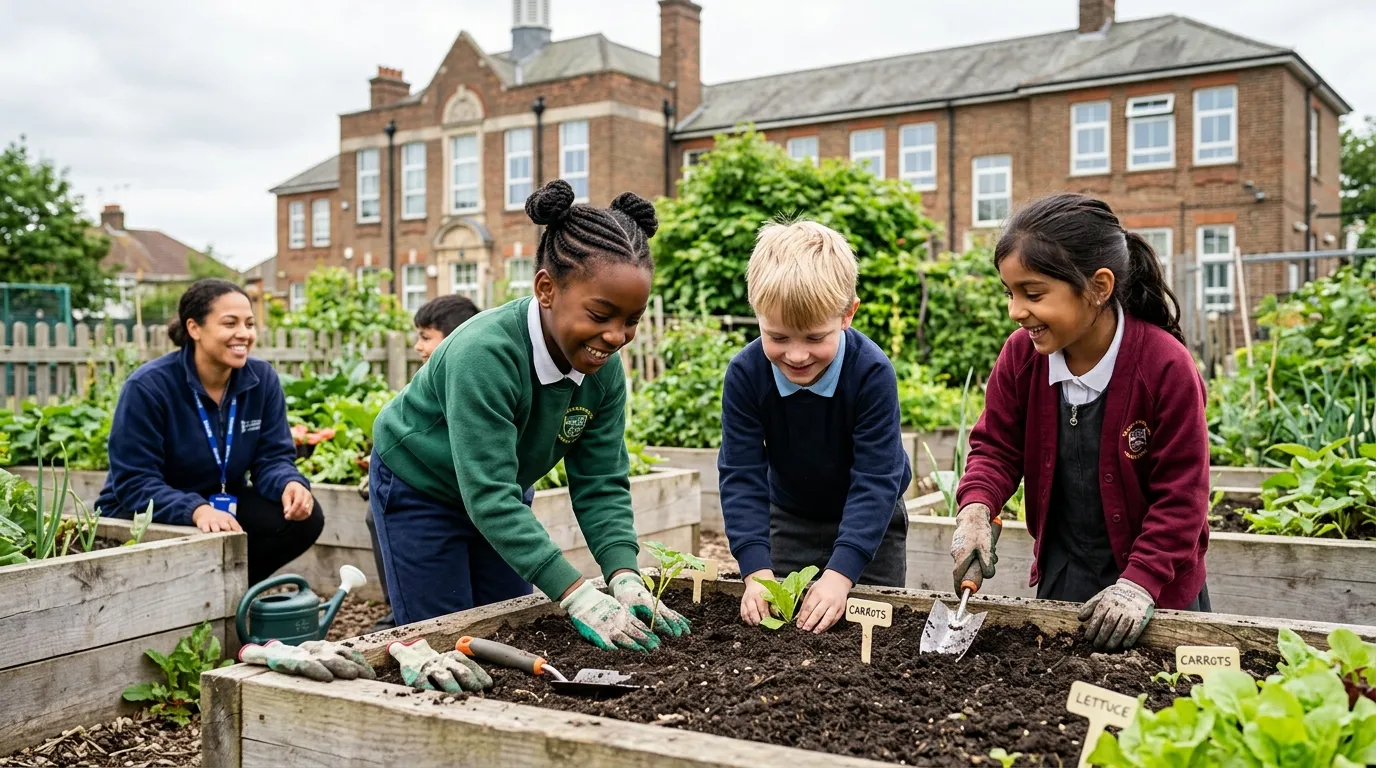
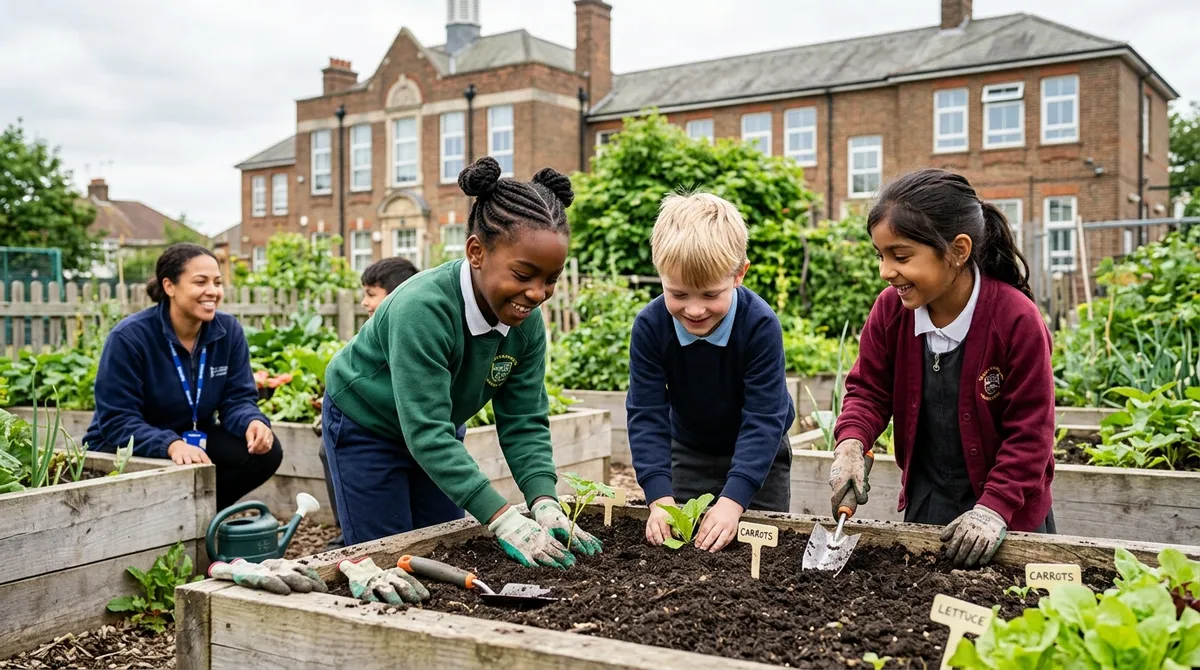
Children planting vegetables in raised beds at a UK primary school
Raised beds are the single most practical starting point for any school garden. They solve the two biggest problems schools face: compacted soil and drainage. Most school grounds sit on heavily compacted clay or rubble-filled ground that nothing will grow in without serious digging. Raised beds bypass this entirely.
A standard raised bed of 1.2m by 2.4m costs 80 to 120 pounds including timber, screws, soil, and compost. One bed provides enough growing space for a class of 30 pupils working in small groups. Build beds from untreated softwood or scaffold boards. Avoid reclaimed railway sleepers, which may contain creosote.
Fill beds with a 50/50 mix of topsoil and peat-free compost. This gives the free-draining, fertile growing medium that vegetables need. On heavy clay sites, line the base with landscape fabric to prevent the bed soil mixing with the compacted ground beneath.
For wheelchair access, build beds at 60cm height with a solid base. This lets pupils reach comfortably from a seated position. Standard ground-level beds at 20 to 30cm height work well for most primary-age children who are happy kneeling or crouching. Our guide to raised bed gardening for beginners covers construction and soil filling in full detail.
What to grow in school raised beds
Match crops to the school calendar. This is the most important principle for school growing projects. A crop that matures over the summer holidays is wasted effort.
Spring term (January to March): Sow radishes, lettuce, and spring onions indoors on windowsills. Plant seed potatoes in bags or beds from mid-March. Start sunflower seeds indoors in individual pots.
Summer term (April to July): Transplant seedlings outdoors after the last frost. Sow runner beans, courgettes, and French beans directly into beds from May. Harvest radishes, lettuce, and early potatoes before the end of term.
Autumn term (September to December): Plant garlic cloves and overwintering broad beans in October. Sow green manure (field beans, phacelia) to protect and improve the soil over winter. Plant spring bulbs for a colour display in the following March.
For detailed guidance on the easiest crops for younger children, see our list of easy vegetables for kids to grow.
How do you create a school wildlife garden?
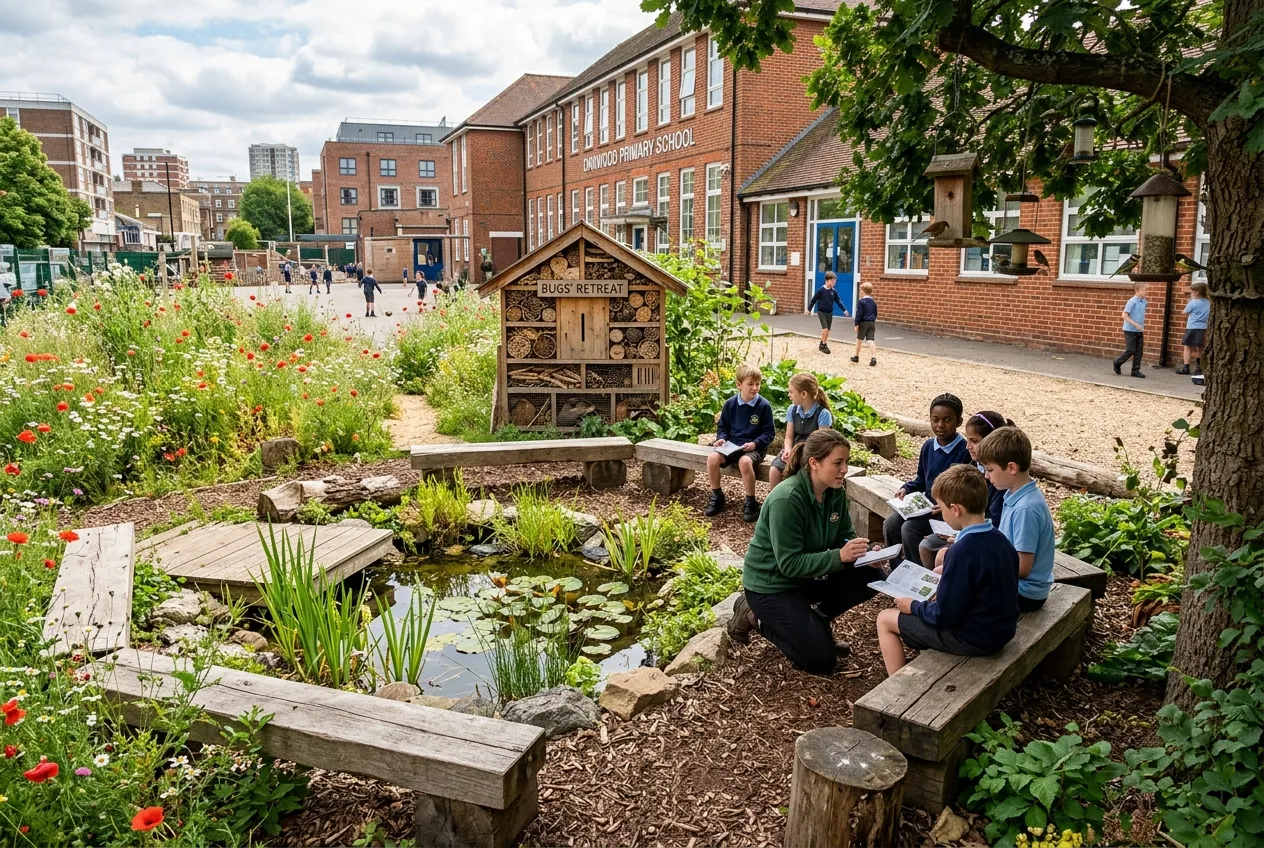
A school wildlife area with bug hotel, mini pond, wildflower patch, and outdoor seating
A wildlife area is the lowest-maintenance school garden project and delivers the richest curriculum links. Once established, it runs almost entirely on its own. A bug hotel, mini pond, and wildflower patch together cost under 100 pounds and teach ecology, biodiversity, and habitat management across multiple year groups.
Bug hotels
Build a bug hotel from wooden pallets, bamboo canes, pine cones, bark, and straw. Stack the materials inside a pallet frame and secure with chicken wire. Position in a sheltered, south-facing spot near the wildflower patch. Solitary bees, ladybirds, lacewings, and woodlice will colonise it within weeks. Our full how to build a bug hotel guide covers construction step by step.
Mini ponds
A mini pond is the single most effective wildlife feature any school can add. Even a half-barrel or old washing-up bowl sunk into the ground attracts frogs, newts, dragonflies, and water beetles within the first season. Use rainwater rather than tap water. Add native aquatic plants like marsh marigold, water forget-me-not, and miniature water lily. Include a ramp (a stone or log) so hedgehogs and other animals can climb out.
Safety is the top concern with school ponds. Use a rigid mesh cover secured at ground level for unsupervised areas. Alternatively, create a “bog garden” (a lined, waterlogged area without standing water) that supports wetland plants and invertebrates with no drowning risk.
Wildflower patches
Convert a strip of mown grass into a wildflower meadow by stopping mowing in March and scattering native wildflower seed. A 2m by 5m patch costs under 20 pounds in seed. Cornfield annuals (poppies, cornflowers, corn marigolds) flower in the first summer. Perennial meadow mixes take two years to establish but return annually. Cut once in September and rake off the cuttings to keep fertility low, which favours wildflowers over grass.
What makes a good sensory garden for schools?
A sensory garden engages all five senses and is particularly valuable for SEN provision. It also links to PSHE, science, and art. The best school sensory gardens are compact, enclosed spaces that feel distinct from the main playground.
Plant lavender, rosemary, mint, and thyme along paths for scent. Add lamb’s ear (Stachys byzantina) for soft, touchable leaves and ornamental grasses for movement and sound. Include a small water feature or wind chimes for auditory stimulation. Grow edible herbs and strawberries for taste. Bright marigolds, sunflowers, and nasturtiums provide strong visual colour. Our sensory garden design guide covers plant selection and layout planning in detail.
Use raised planters at different heights so all pupils can reach. Lay different surface materials (smooth paving, gravel, bark chips, rubber matting) to create a tactile path. Add seating with backrests for pupils who need physical support during outdoor lessons.
How do you run a sunflower growing competition?
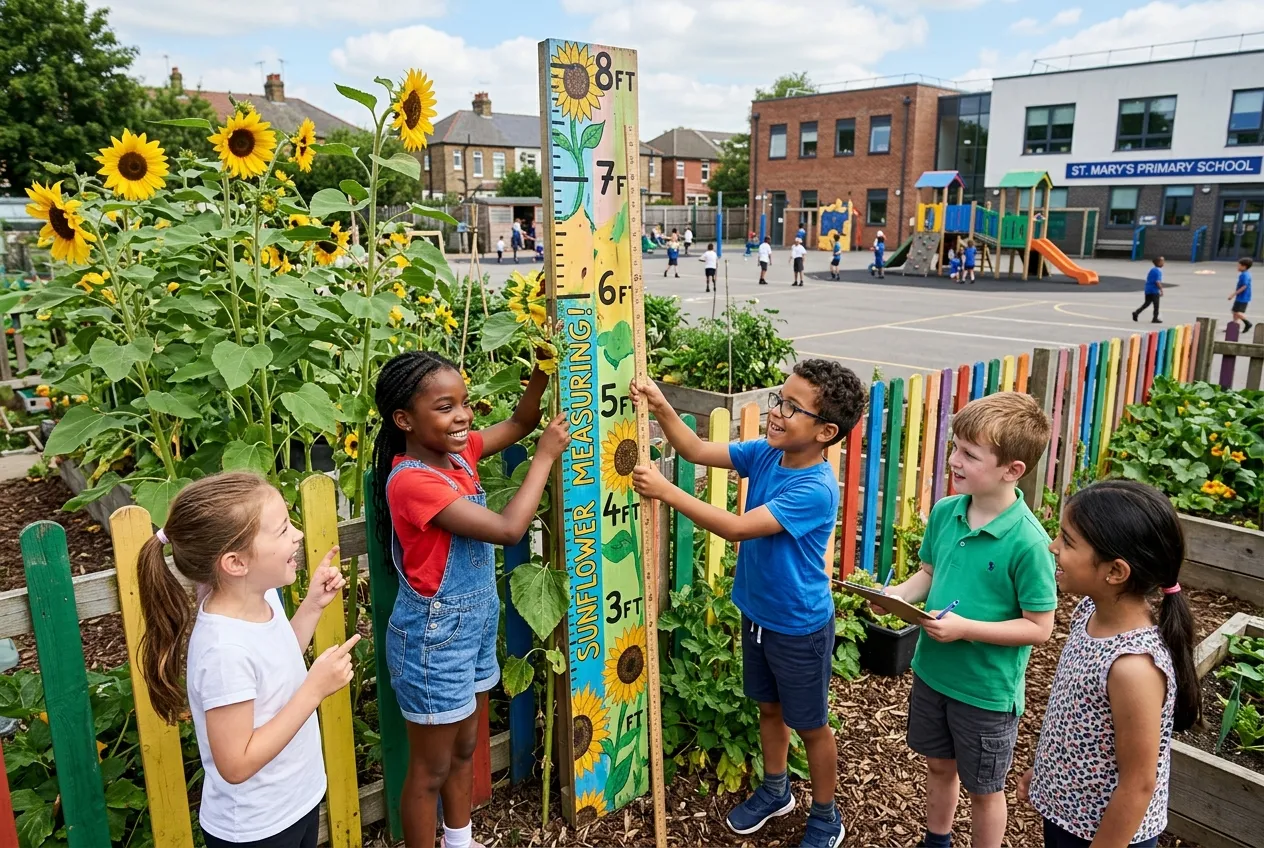
Children measuring sunflowers against a height chart in a school garden competition
Sunflower competitions are the easiest first project for schools with no gardening experience. They need minimal space, almost no equipment, and deliver dramatic visible results within a single term. Our guide on growing sunflowers with children covers varieties and techniques in detail.
How to run it
Give each class or pupil a sunflower seed and a pot in April. Grow seedlings on classroom windowsills for 3 to 4 weeks. Transplant into the school garden or individual large pots in May after the last frost. Measure weekly with a height chart pinned to a fence or wall. The tallest sunflower at the end of July wins.
Giant varieties like ‘Russian Giant’ and ‘Mongolian Giant’ reach 3 to 4 metres. Dwarf varieties like ‘Teddy Bear’ and ‘Big Smile’ stay under 60cm and suit container growing. For a maths link, pupils record heights on a line graph and calculate average growth rates per week.
Curriculum connections
Sunflower competitions naturally link to science (germination, growth conditions, plant structure), maths (measuring, data handling, averages), and English (diary writing, instruction texts). Year 2 and Year 3 classes get the most from the maths and science crossover. The competition element keeps pupils engaged through the entire growing season.
How do you set up a school composting station?
Composting teaches the full cycle of growing. Food scraps and garden waste become soil improver that feeds next year’s crops. A school compost station needs two bins: one filling, one maturing. Wooden pallet bins cost nothing to build and hold a class-sized volume of waste.
Place bins on bare soil in a partly shaded spot. Add fruit and vegetable scraps from the school kitchen, garden waste, shredded paper, and cardboard. Avoid meat, dairy, and cooked food. Turn the heap every 2 to 3 weeks with a garden fork. Compost is ready to use in 3 to 6 months. Our full guide on how to make compost covers the process from start to finish.
Wormeries are an excellent indoor alternative for classrooms with no outdoor space. A stacking worm bin fits on a shelf and processes fruit peelings into rich vermicompost. Children are fascinated by worms and the process teaches decomposition better than any textbook.
What is the best layout for a school outdoor classroom?
An outdoor classroom turns the garden into a teaching space for any subject. The simplest setup is a circle of log stumps or benches around a central demonstration area. Position it near the raised beds and wildlife area so lessons can move between zones.
Add a large whiteboard or chalkboard on a fence for writing and drawing. Install a simple pergola or sail shade for rain and sun protection. A noticeboard displays the planting calendar, wildlife sightings, and pupil work. Storage for tools, gloves, and watering cans needs to be lockable and weatherproof. A garden shed or large plastic chest works well.
For inspiration on designing children’s outdoor spaces more broadly, see our guide to children’s garden design ideas.
School garden project comparison table
| Project | Cost | Difficulty | Best term | Curriculum links | Maintenance |
|---|---|---|---|---|---|
| Raised vegetable beds | 80-150 pounds per bed | Easy | Spring/Summer | Science, maths, DT | Weekly watering |
| Sunflower competition | Under 20 pounds | Easy | Summer | Science, maths, English | Weekly measuring |
| Bug hotel | Under 30 pounds | Easy | Any | Science, art, DT | Almost none |
| Wildflower patch | Under 20 pounds | Easy | Spring | Science, geography | Cut once in September |
| Mini pond | 30-80 pounds | Moderate | Spring | Science, ecology | Seasonal checks |
| Sensory garden | 100-500 pounds | Moderate | Any | PSHE, science, SEN | Light seasonal care |
| Composting station | Under 30 pounds | Easy | Any | Science, geography | Fortnightly turning |
| Outdoor classroom | 200-1000 pounds | Moderate | Any | All subjects | Seasonal upkeep |
| Fruit trees/bushes | 15-30 pounds per plant | Easy | Autumn | Science, maths | Annual pruning |
| Greenhouse/polytunnel | 500-2000 pounds | Hard | Any | Science, DT, enterprise | Regular attention |
What seasonal planting plan works for school term dates?
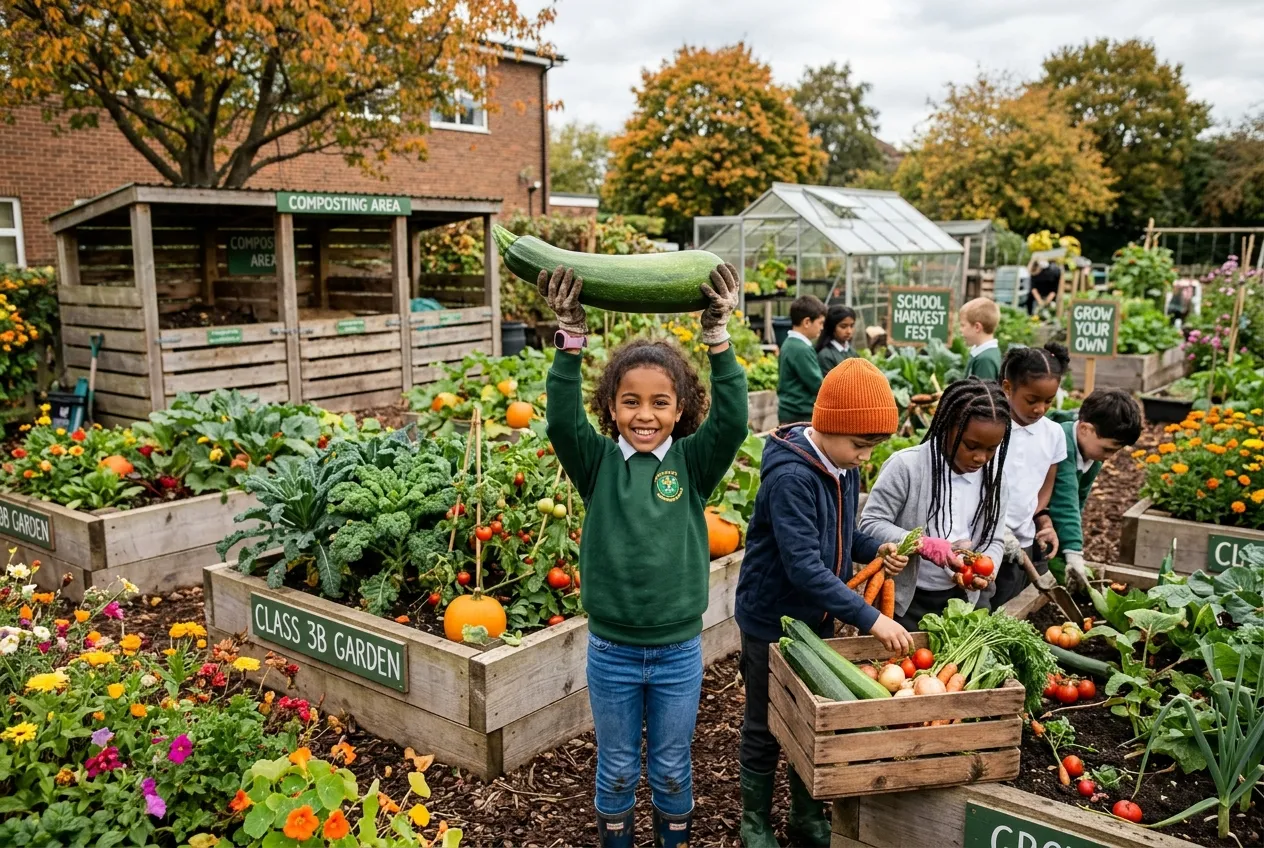
Autumn harvest at a school garden with children picking vegetables from raised beds
The academic calendar is the biggest constraint on school gardening. Six weeks of summer holiday falls right in the peak growing season. Plan around it rather than fighting it.
Spring term picks (January to Easter)
Sow indoors on windowsills: radish, lettuce, cress, sunflower seeds, sweet peas. Plant outdoors from March: seed potatoes, onion sets, garlic (if not autumn-planted), broad beans. Early crops like cress germinate in 3 days, giving immediate results for younger classes.
Summer term picks (Easter to July)
Transplant seedlings outdoors. Direct sow: runner beans, French beans, courgettes, pumpkins. Harvest: radishes (4 weeks), lettuce (3 weeks from sowing cut-and-come-again), early potatoes (June). Everything sown after May needs to either crop before mid-July or survive the summer holidays.
Autumn term picks (September to December)
Harvest pumpkins and late courgettes in September. Plant: garlic cloves, overwintering onion sets, broad beans, spring bulbs (daffodils, tulips, crocuses). Sow green manure on empty beds. Collect seeds from sunflowers and marigolds for next year.
For more on getting children involved with hands-on growing projects, see our guide to gardening projects for kids.
How do you fund a school garden?
Most school gardens start with under 500 pounds. Funding sources include:
PTA and fundraising: Cake sales, sponsored events, and plant sales generate 100 to 300 pounds easily. Selling surplus harvest at the school gate raises awareness and small amounts of cash.
Local businesses: Garden centres, builders merchants, and supermarkets often donate materials, compost, or vouchers. Write a one-page proposal explaining the educational benefits and offering to display a sponsor board.
RHS Campaign for School Gardening: The RHS provides free resources, curriculum-linked activities, and regional support for registered schools. Registration is free. RHS School Gardening Champions get additional training and access to seed packs.
Grants: The National Lottery Community Fund, Groundwork UK, and local community foundations offer grants from 300 to 10,000 pounds for school garden projects. Applications typically need a simple project plan, budget, and letter of support from the head teacher.
Donated materials: Parents often have spare timber, tools, compost, and plants. A “garden donation day” at the start of the project gathers materials and parent volunteers simultaneously.
Frequently asked questions
How much does a school garden cost to set up?
A basic school garden starts from 50 to 150 pounds per raised bed. Timber raised beds measuring 1.2m by 2.4m cost 80 to 120 pounds including soil and compost. Seed packets cost under 2 pounds each. Bug hotels can be built free from scrap wood and pallets. A complete starter garden with two raised beds, seeds, tools, and a compost bin costs 300 to 500 pounds. Many schools fund this through PTA grants, local business sponsorship, or the RHS Campaign for School Gardening.
What vegetables grow best in a school garden?
Radishes, lettuce, and potatoes suit school term dates best. Radishes germinate in 5 days and crop within 4 weeks. Cut-and-come-again lettuce produces leaves within 3 weeks of sowing. First early potatoes planted in March are ready by late June. Runner beans sown in May produce beans from July onwards. All these crops fit within a single school term and give children a quick, visible result.
When should we start a school garden?
Start planning in January and begin planting from March. The spring term is ideal for sowing seeds indoors and preparing raised beds. April is the key outdoor planting month after the last frost risk passes in most UK regions. Starting in autumn also works well for planting bulbs, garlic, and overwintering broad beans that pupils return to find growing in spring.
How do we maintain a school garden over summer holidays?
Choose crops that harvest before July or survive without watering. Install a simple drip irrigation timer connected to an outside tap for around 25 pounds. Mulch beds thickly with bark or straw to retain moisture. Recruit parent volunteers for a summer watering rota of one visit per week. Alternatively, focus the growing calendar on spring and autumn terms and leave beds fallow over summer with a green manure crop like phacelia or clover.
Do we need permission to build a school garden?
Most school gardens need only head teacher approval. Raised beds, planters, and compost bins are classed as temporary structures and rarely need planning permission. Check with your local authority if you plan permanent structures like greenhouses or sheds. If the site involves breaking concrete or tarmac, consult the school estates team first. Academy trusts may have their own estates policies.
How do we make a school garden accessible for SEN pupils?
Raised beds at 60cm height allow wheelchair access from the side. Wide paths of at least 1.2m suit wheelchairs and walking aids. A sensory garden with fragrant herbs, textured leaves, and sound elements engages pupils with visual or cognitive impairments. Avoid toxic plants entirely. Use contrasting colours on bed edges for visually impaired pupils. The RHS provides free SEN gardening resources and activity guides tailored to different needs.
What curriculum subjects link to school gardening?
School gardening connects directly to at least six curriculum subjects. Science covers plant biology, lifecycles, habitats, and soil. Maths includes measuring, data recording, weighing harvests, and graphing growth. English links through garden diaries, instruction writing, and reports. Art uses observational drawing and natural materials. PSHE covers teamwork, responsibility, and healthy eating. Geography explores weather, seasons, and food miles.
Lawrie has been gardening in the West Midlands for over 30 years. He grows his own veg using no-dig methods, keeps a wildlife-friendly garden, and writes practical advice based on real UK growing conditions.