Sensory Garden Design: All Five Senses
Sensory garden design using all five senses. Plants, zones, raised beds, and paths for UK gardens including scent, touch, sound, taste, and sight.
Key takeaways
- Lavender 'Hidcote' releases volatile oils strongest in the 20 minutes after midday — position paths beside it to catch the peak
- Lamb's ear (Stachys byzantina) provides tactile interest all year as its silvery foliage survives mild UK winters intact
- Phyllostachys nigra (black bamboo) produces sound at wind speeds as low as 5mph — the UK average is 12mph, so it works almost daily
- Raised sensory beds at 65-70cm with a 10cm undercut base allow wheelchair users to reach 40cm into the planting without stretching
- Thrive charity (thrive.org.uk) provides free sensory garden design consultations for healthcare settings and community projects
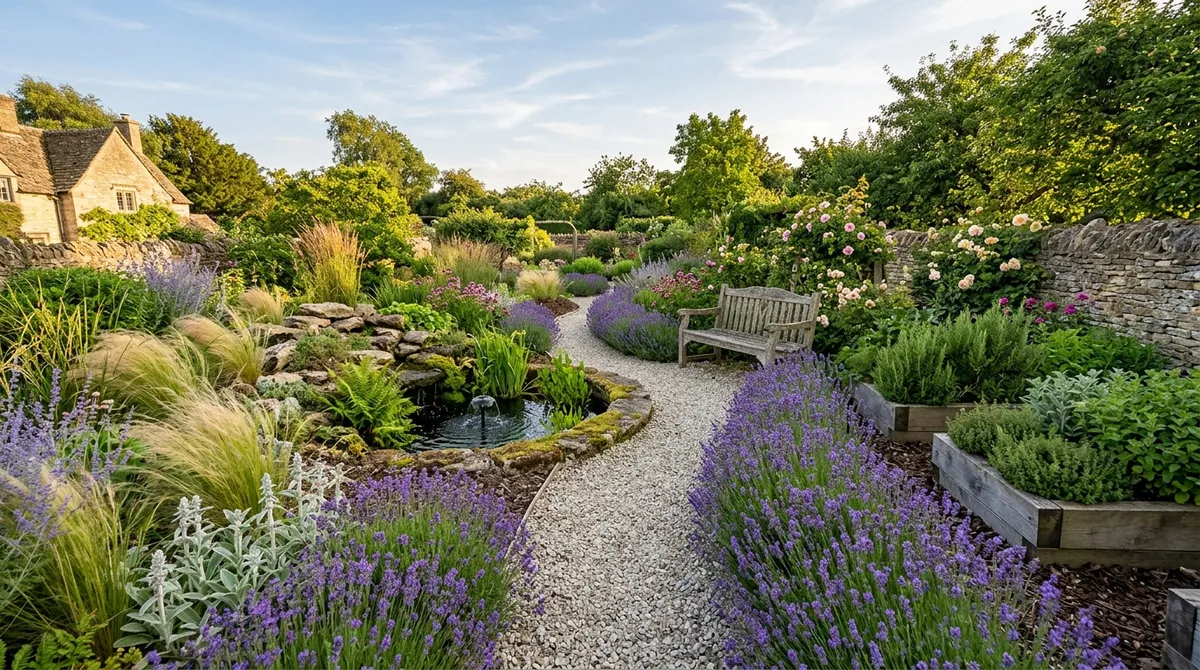
Sensory garden design turns a garden into an experience that anyone can fully engage with, regardless of age, ability, or experience. Rather than designing for visual impact alone, a sensory garden deliberately plans for scent corridors, textural contrast, sound from plants and water, edible produce within reach, and visual movement throughout the seasons.
This guide covers all five senses with specific plant recommendations, design zone layouts, wheelchair accessibility standards, and guidance from the charity Thrive, which has supported therapeutic gardening in the UK for over 50 years. For a broader overview of accessible outdoor spaces, see our guide to accessible gardening for disabilities.
What makes a sensory garden different from a standard garden?
Most gardens are designed primarily for sight. A sensory garden is explicitly designed for all five senses working together, with each plant and structural choice contributing to at least one sensory experience — ideally two or three.
The defining design principle is that every metre of a sensory garden should offer something the visitor can detect without looking hard. Fragrance at nose height. Leaves within arm’s reach. Sound from grasses or water that carries across the space. Fruit and herbs that invite tasting. Colour and movement that holds attention without effort.
This approach overlaps with therapeutic garden design, where the goal is measurable wellbeing outcomes. Research cited by the RHS shows that 30 minutes of garden activity reduces cortisol levels by an average of 11%. Sensory gardens extend that benefit by removing barriers to engagement — people do not need to kneel, bend, or actively garden to receive sensory stimulation.
If you’re starting from scratch, our guide to designing a garden from the ground up covers the broader layout principles that apply before you layer in sensory planting.
Plants for scent: building fragrance corridors
Scent is the most emotionally powerful sensory trigger. Studies show it connects more directly to memory than any other sense, making fragrant planting particularly valuable in therapeutic and dementia care settings.
The most effective sensory gardens position scent in layers — low ground-cover herbs at path edges, mid-height lavender and roses at waist and chest level, and climbing plants like jasmine at head height on arches or pergolas. The goal is continuous fragrance at multiple heights as a visitor moves through the garden.
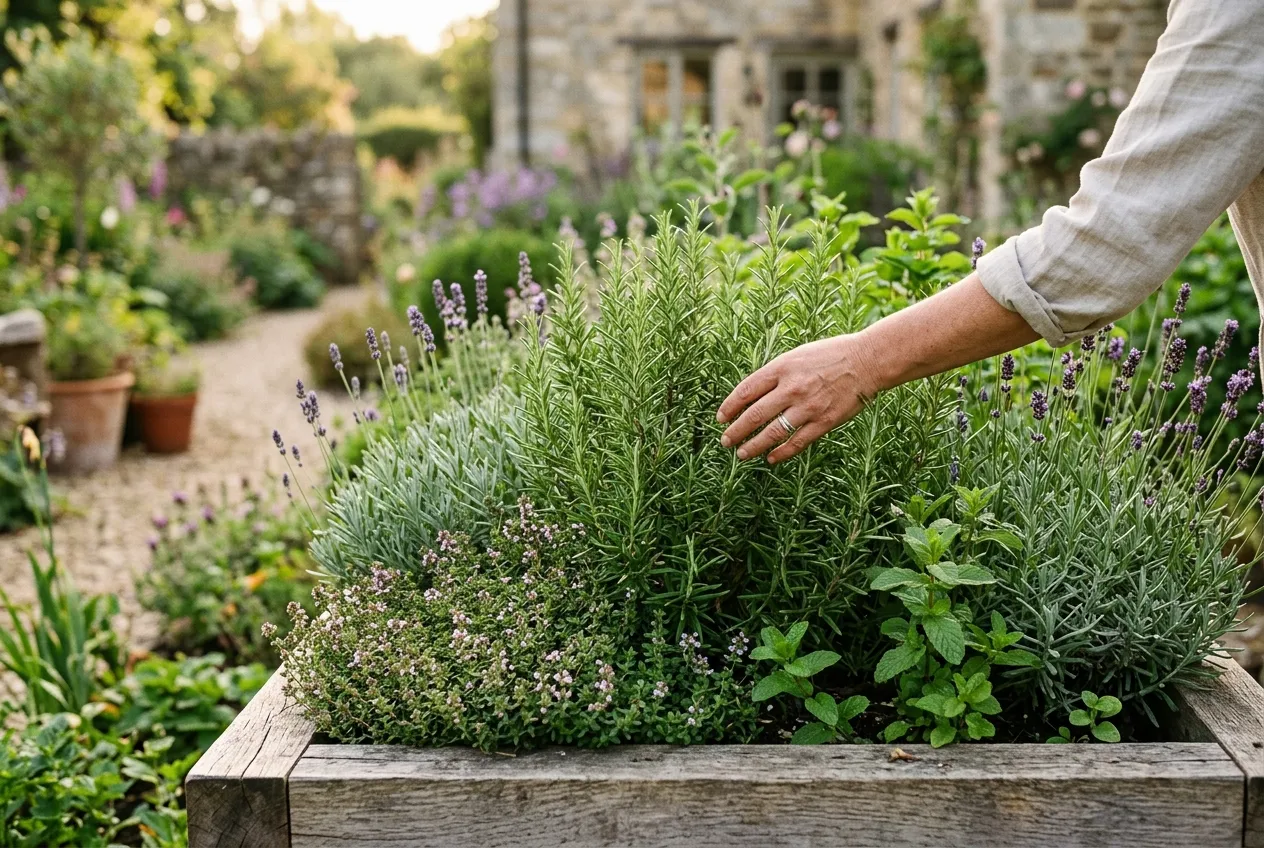 Lavender ‘Hidcote’ and thyme planted at raised bed height bring fragrance to wheelchair users and standing visitors alike.
Lavender ‘Hidcote’ is the benchmark sensory garden plant. It produces the highest concentration of linalool (the primary fragrant compound) of any UK-hardy lavender. Volatile oil release peaks in the 20 minutes after midday. Position paths within 1m. It flowers from June to August and can be clipped hard in August to maintain compact mounds. Hardy to -20C.
Rosa ‘Gertrude Jekyll’ is the strongest-scented UK garden rose. It flowers in repeat flushes from June to October. Grows to 1.5m as a shrub or 3m on a support. The scent carries 4-5 metres in still conditions. Deadhead every 10-14 days to maintain flowering.
Herbs at path edges release scent when brushed. Thyme, chamomile, and Alchemilla mollis planted within 20cm of a path edge are triggered by passing footsteps and wheelchair wheels. Repeat plantings every 1.5-2m create a continuous fragrance corridor. For detailed planting advice, see our herb garden guide.
| Plant | Scent season | UK hardiness | Best position | Fragrance reach |
|---|---|---|---|---|
| Lavender ‘Hidcote’ | June–August | Hardy to -20C | Full sun, raised bed edge | 1-2m |
| Rosa ‘Gertrude Jekyll’ | June–October | Fully hardy | Sunny wall or support | 4-5m |
| Philadelphus ‘Belle Étoile’ | June–July | Fully hardy | Border, shrub | 6-8m |
| Jasminum officinale | June–September | Hardy to -10C | Arch, pergola | 5-7m |
| Thymus serpyllum | May–August | Fully hardy | Path edge, cracks | Brush-triggered |
| Nicotiana sylvestris | July–October | Half-hardy annual | Border mid-height | 3-4m, evening peak |
| Dianthus ‘Mrs Sinkins’ | May–July | Fully hardy | Raised bed, front border | 1-2m, clove scent |
For a broader selection of fragrant species, our best scented plants guide covers over 30 varieties with seasonal coverage notes.
Plants for texture: the touch-first garden
Texture is often overlooked in conventional planting design, but it is the most inclusive sensory element — accessible to blind and partially sighted visitors, children, and anyone who naturally touches things as they move through a space.
The design principle here is creating textural contrast within reach. Soft velvet beside rough bark. Fine ferny foliage beside broad, waxy leaves. Smooth stone beside spiky grass. This contrast rewards exploration and gives the garden interest without flowers.
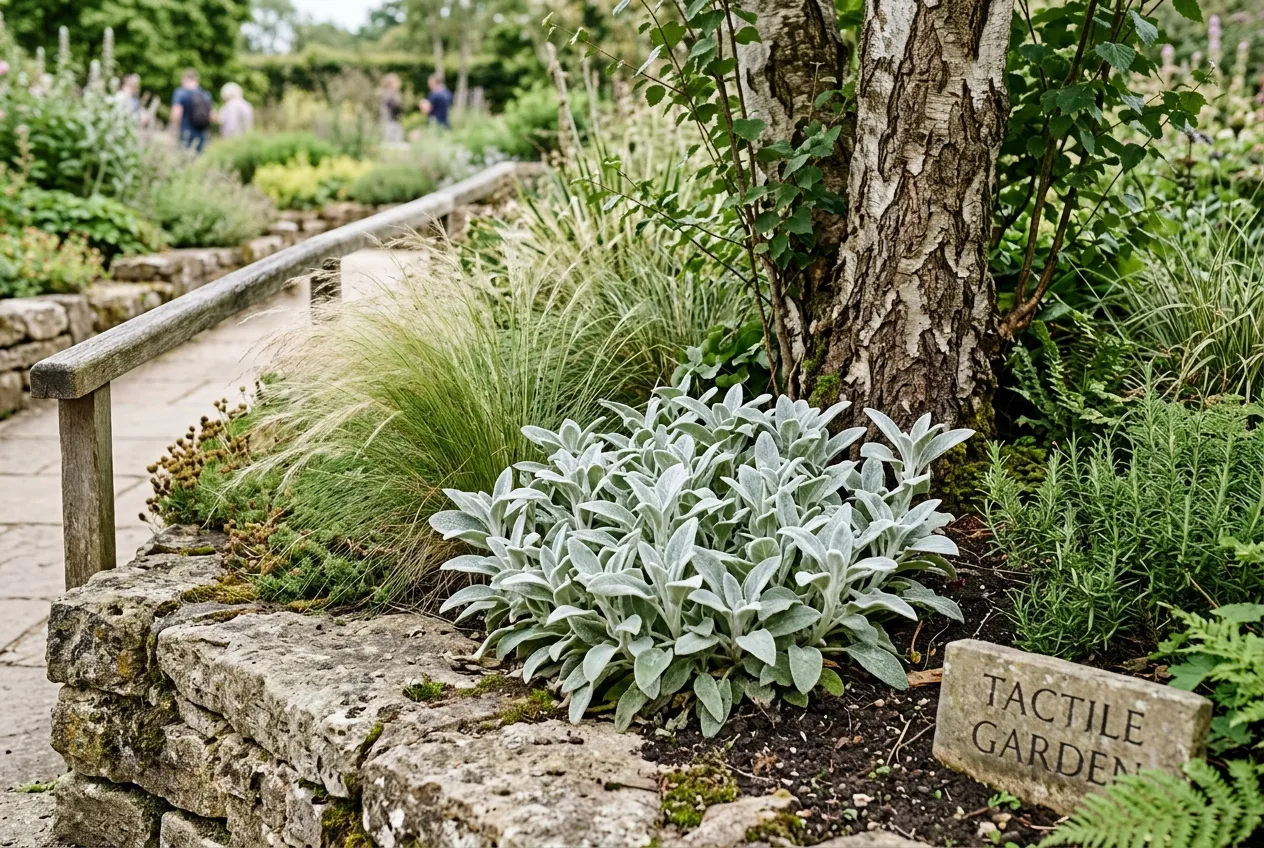 Lamb’s ear alongside ferns and bark mulch creates a textural palette that works through winter when flowers are absent.
Stachys byzantina (lamb’s ear) is the reference texture plant for sensory gardens. Its silver-grey leaves are covered in dense, soft hairs that feel like velvet and are irresistible to adults and children alike. It is fully hardy, spreads to form solid ground cover, and keeps its texture through winter in milder UK regions. Grows to 40cm. Divide every three years to maintain vigour.
Ferns provide the opposite sensation — fine, papery fronds with intricate structure. Dryopteris filix-mas (male fern) is fully hardy and grows in deep shade. Polypodium vulgare (common polypody) grows on walls, rocks, and tree bases and is evergreen. Place fern fronds at the edge of raised beds so they hang within easy reach.
Bark mulch and cobble paths serve double duty in sensory design: they suppress weeds and create auditory feedback underfoot. Bark produces a satisfying crunch. Smooth cobbles trigger attention. Vary surface materials across zones to map the garden through underfoot sensation.
| Plant | Texture | Season | Height | Notes |
|---|---|---|---|---|
| Stachys byzantina | Soft velvet | Year-round | 40cm | Silver-grey foliage, semi-evergreen |
| Pennisetum setaceum | Feathery plumes | August–November | 90cm | Hold shape into winter |
| Phormium tenax | Stiff, leathery strap | Year-round | 1.5-2m | Sharp leaf tips — position away from face height |
| Dryopteris filix-mas | Fine papery fronds | March–November | 90cm | Fully hardy, deep shade tolerant |
| Cortaderia selloana | Coarse, sharp-edged leaves | Year-round | 2-3m | Pampas grass — handle with gloves |
| Eryngium giganteum | Spiny silver-blue bracts | July–September | 90cm | Striking contrast to soft plants |
| Betula utilis ‘Jacquemontii’ | Papery white bark | Year-round | 8-12m | Peel-able bark, position beside path |
Sound in the garden: plants and water that work with UK wind
Sound is the most climate-dependent sensory element in UK gardens. The UK national average wind speed is 12mph, which makes it one of the best climates in the world for sound-generating plants. Even on calm days, UK gardens rarely experience true stillness.
The most effective approach layers sound sources at different heights: ground-level grasses that hiss in light breezes, mid-height bamboo that clicks and rattles, tall seed heads that provide percussion, and water that gives constant background sound regardless of wind.
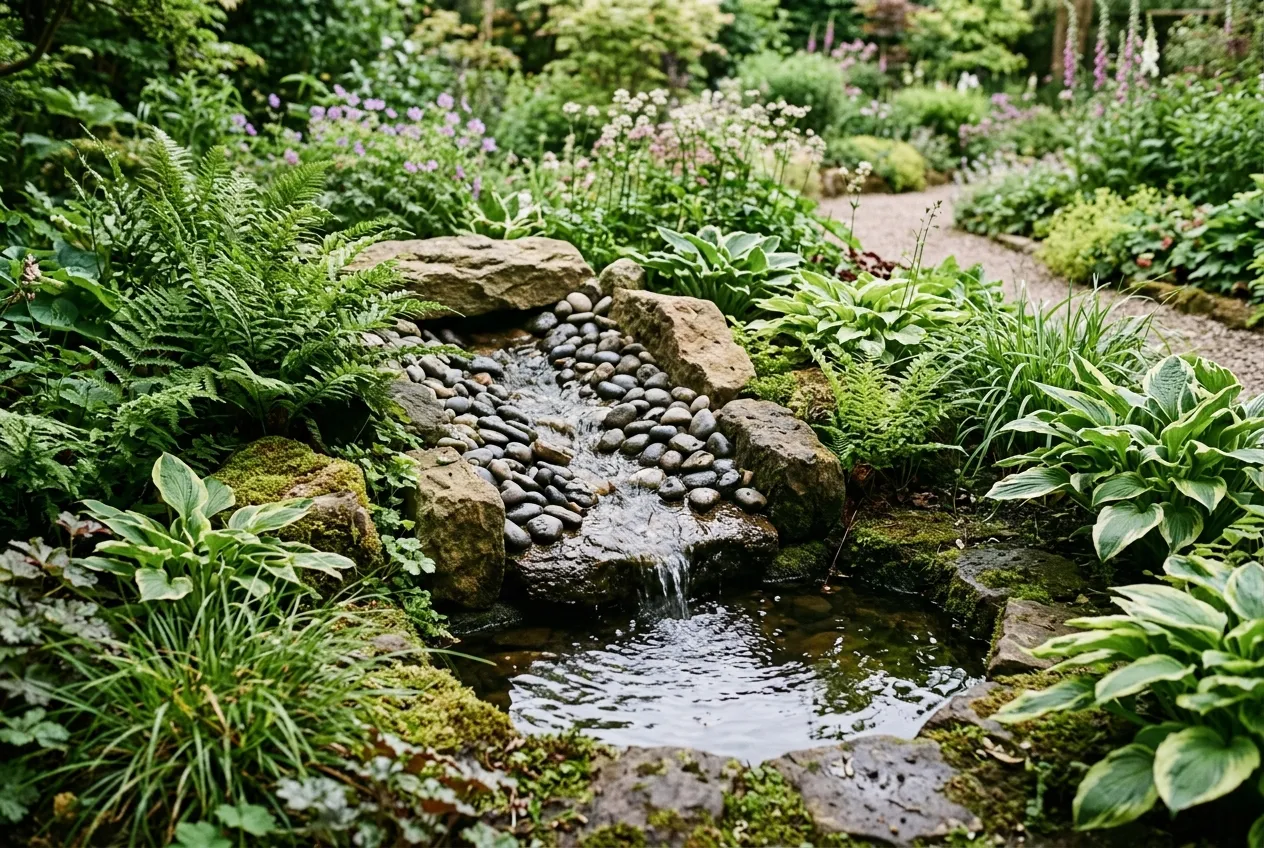 Phyllostachys bamboo, Stipa gigantea, and a bubble fountain create layered sound that works in light and strong winds alike.
Phyllostachys nigra (black bamboo) is the most effective sound plant for UK sensory gardens. Its hollow culms produce clicks and rattles from 5mph wind. At 12mph — the UK average — it creates a continuous, layered sound. Grow in a large buried pot or use a 60cm-deep HDPE root barrier to prevent spread. Reaches 3-4m in UK conditions. For a full growing guide, see our ornamental grasses and bamboo guide.
Stipa gigantea (giant oat grass) produces a papery rustling from its oat-like seed heads. It flowers from June and holds its structure into December. The seed heads catch low light and move in the gentlest air movement. Grows to 1.8m. Fully hardy. Do not cut back until February.
Moving water provides the most reliable sound in a sensory garden because it is not dependent on wind. A simple bubble fountain uses a submersible pump (£80-£150), a buried reservoir, and a single outlet stone or drilled rock. It runs on a 13-amp outdoor socket with an RCD adapter. The sound level ranges from gentle to assertive depending on the drop height and stone porosity.
For design ideas on different water feature formats from rills to formal pools, see our water feature ideas guide.
| Sound source | Wind threshold | Season | Notes |
|---|---|---|---|
| Phyllostachys nigra | 5mph | Year-round | Root barrier essential |
| Stipa gigantea | 8mph | June–December | Leave seed heads standing |
| Briza maxima (quaking grass) | 3mph | June–September | Annual, resow April |
| Molinia caerulea | 10mph | July–November | Upright culms rattle together |
| Bubble fountain | Independent | Year-round | Frost-proof submersible pump needed |
| Wind chimes (brass or bamboo) | 5mph | Year-round | Position at path entry points |
Taste: edible plants in reach of every visitor
Taste is the most intimate sensory engagement and the one that most encourages visitors to return to a sensory garden. Edible herbs are the most practical choice: they produce immediately recognisable flavours, tolerate clipping by visitors, and regenerate quickly. Alpine strawberries are the most accessible fruit — individual berries ripen continuously from June to October, allowing visitors to take single fruits without stripping the plant.
Position edible plants in raised beds at 65-70cm height and label them clearly with durable, weather-proof labels. This removes uncertainty about what is safe to eat and encourages interaction from visitors who would not otherwise touch unfamiliar plants.
Mint is the essential taste plant for sensory gardens. It is immediately recognisable, intensely flavoured, and survives heavy handling. Grow in sunken pots to contain spread (mint roots travel 2-3m through open soil). Spearmint, peppermint, and apple mint provide three distinct flavours in a small space. Replace plants every two to three years as established clumps become woody.
Edible nasturtiums offer a peppery taste and are safe for all ages. They climb or trail to 2m and flower in orange and yellow from July to October. Plants self-seed reliably in UK conditions. Flowers and leaves are both edible.
For a complete guide to setting up an edible herb area, see our how to create a herb garden guide.
| Plant | Taste | Season | Notes |
|---|---|---|---|
| Mentha spicata (spearmint) | Classic mint | May–September | Pot to contain; replace every 3 years |
| Thymus vulgaris (common thyme) | Warm, savoury | May–August | Brushing releases oils; drought-tolerant |
| Fragaria vesca (alpine strawberry) | Sweet strawberry | June–October | Individual berries for continuous picking |
| Lemon verbena | Sharp, citrus | July–September | Frost-tender — bring in October |
| Rosmarinus officinalis ‘Miss Jessopp’s Upright’ | Pine-resinous | Year-round | Hardy to -15C; good for raised beds |
| Origanum vulgare (oregano) | Savoury, aromatic | June–September | Intensifies in dry conditions |
| Tropaeolum majus (nasturtium) | Peppery | July–October | Edible flowers and leaves; self-seeds |
Sight: colour, form, and movement through the seasons
Sight is where most garden designs already excel, but sensory garden design approaches it differently. The goal is not a static composition that looks good in a photograph but a dynamic one that holds attention across all seasons through movement, changing light, and colour sequence.
Movement is the key differentiator. Grasses, tall perennials, and lightweight seed heads that respond to wind provide constant visual change without requiring maintenance. Planting for a 12-month colour sequence — from snowdrops in January through to rudbeckia and aster in November — means the garden rewards regular visits rather than peaking once and declining.
For layered planting ideas that create continuous seasonal interest, our best plant combinations guide covers colour sequencing in detail.
Crocosmia ‘Lucifer’ is the strongest sight plant for a UK sensory garden: arching stems to 1.2m, vivid red-orange flowers in July-August, and upright form that moves in light wind. It spreads slowly but stays contained without intervention. RHS Award of Garden Merit.
Rudbeckia fulgida ‘Goldsturm’ provides amber-yellow daisy flowers from August to October, a season when most other perennials are declining. It grows to 60cm with stiff upright stems that remain standing through November, providing form even after the petals fall. RHS AGM.
How to grow lavender in UK conditions including spacing, pruning, and winter care is covered in our dedicated lavender growing guide.
Sensory garden design zones: a practical layout plan
The most effective sensory gardens divide space into distinct zones, each anchored by a primary sense, while allowing sensory overlap between adjacent zones. This layout works from 20sqm upwards and can be adapted to a single raised bed or a full garden redesign.
| Zone | Primary sense | Key features | Recommended size |
|---|---|---|---|
| Fragrance corridor | Scent | Lavender border, rose arch, herb path edge | 2m wide × 6m long minimum |
| Tactile garden | Touch | Stachys, ferns, bark path, textured stones | 4m × 4m raised beds at 65-70cm |
| Sound garden | Sound | Bamboo screen, ornamental grasses, water feature | 3m × 3m, bamboo needs 1m from walls |
| Edible zone | Taste | Herbs, alpine strawberries, nasturtiums | Raised bed 1.2m × 0.9m minimum |
| Seasonal display | Sight | Crocosmia, rudbeckia, ornamental grasses, bulbs | Full sun border, any size |
| Rest and reflection | Multi-sense | Bench with scented backdrop, level surface, shade option | 3m × 2m minimum |
Place the fragrance corridor and sound garden as entry zones so visitors are engaged from the moment they enter. Position the edible zone nearest the rest area so tasting can be done while seated. Place the tactile garden at a central intersection point where multiple paths meet, maximising the number of people who pass through it. For ideas on how to lay out raised growing areas, our raised bed garden design guide covers construction options and layouts.
Accessibility and the Thrive approach
A sensory garden that is not physically accessible fails half its potential audience. The charity Thrive has refined accessible sensory garden standards over 50 years of therapeutic horticulture practice in the UK.
The core accessibility requirements for sensory gardens are:
Paths: Minimum 1.2m wide for a standard manual wheelchair. 1.5m for powered wheelchairs and passing space. Use non-slip paving — Yorkstone or textured concrete. Avoid loose gravel in circulation areas used by wheelchairs. Gradient must not exceed 1:20 (5%) for unaided wheelchair access.
Raised beds: Build beds at 65-70cm height with a 10cm undercut at the base so wheelchair footrests slide underneath. This allows wheelchair users to position themselves directly beside the bed and reach 35-40cm into the planting without stretching. Bed width must not exceed 60cm from one side (or 1.2m from both sides if accessible all round).
Labelling: Use embossed or Braille labels for key plants in sensory gardens serving visually impaired visitors. Position labels at 90-100cm height — readable from a seated position.
Seating: Place benches at each zone intersection with armrests at 68-72cm height and a firm, non-padded seat surface. Provide a 1.5m × 1.5m level hard surface beside each bench for wheelchair positioning. For the full design framework, see our accessible gardening guide.
Thrive provides free sensory garden design consultations for healthcare providers, schools, and community projects through their professional services team. Their accessible garden design guidance is the most practical UK-specific resource available.
Therapeutic gardening and mental health
Sensory gardens are not just for people with physical disabilities. The therapeutic gardening movement has produced compelling evidence for the mental health benefits of engaging with sensory-rich natural environments.
The RHS’s 2021 research programme found that people who garden for 30 minutes show measurable reductions in cortisol (stress hormone) regardless of gardening skill or experience. Sensory gardens that remove barriers to engagement — through raised beds, fragrance at nose height, and planting visitors can touch — make this benefit available to people who would not describe themselves as gardeners.
For a deeper look at how garden design can support mental health, see our gardening for mental health and wellbeing guide.
Dementia care settings are the largest institutional users of sensory garden design in the UK. Scent — particularly lavender and rose — is consistently reported by care staff as the most effective trigger for positive memory recall in residents with late-stage dementia. This is not anecdotal: research published in the International Journal of Environmental Research and Public Health (2019) found that garden-based sensory stimulation reduced agitation in dementia care residents by 23% compared to control groups with no garden access.
Frequently asked questions
What plants are best for a sensory garden in the UK?
Lavender ‘Hidcote’, Stachys byzantina, and Phyllostachys nigra cover three senses immediately. Add Rosa ‘Gertrude Jekyll’ for scent, Pennisetum for sound and texture, and mint, thyme, and alpine strawberries for taste. For sight, Crocosmia ‘Lucifer’ and Rudbeckia ‘Goldsturm’ give July-to-October colour. All are UK-hardy and widely available.
How do you make a sensory garden accessible for wheelchair users?
Raise beds to 65-70cm with a 10cm undercut base so wheelchair footrests slide underneath. Lay paths at 1.2m minimum width using non-slip paving. Position scented plants at elbow-to-nose height rather than ground level. Place seating with a 1.5m × 1.5m hard surface alongside for wheelchair positioning.
How much does a sensory garden cost in the UK?
A single raised sensory planter costs £200-£500 in materials and plants. A three-bed tactile and fragrance zone with a small water feature costs £1,500-£3,500. A full sensory garden redesign with multiple zones, hard landscaping, and accessible paths costs £4,000-£10,000 depending on size and specification.
What is the difference between a sensory garden and a therapeutic garden?
Sensory gardens focus on stimulating the five senses through deliberate plant and design choices. Therapeutic gardens are designed with measurable clinical outcomes in mind — reducing anxiety, supporting dementia care, enabling physical rehabilitation — and typically include sensory planting as one component within a broader clinical framework.
How do you create sound in a sensory garden?
Phyllostachys nigra bamboo produces sound from 5mph wind, which is below the UK daily average. Stipa gigantea and Briza maxima add papery rustling. A simple bubble fountain using an £80-£150 submersible pump provides continuous water sound independent of wind. Layer all three for sound that works in any conditions.
Which scented plants work best near garden paths?
Lavender, thyme, chamomile, and Alchemilla mollis release scent when brushed near path edges. Plant within 20cm of the path surface and repeat every 1.5-2m. For taller fragrance, Rosa ‘Gertrude Jekyll’ carries scent 4-5m from a position 1m back from the path. Jasmine on a path-side arch delivers fragrance overhead from June to September.
Can Thrive charity help with sensory garden design?
Yes — Thrive provides free sensory garden advice for community projects, healthcare settings, and individual gardeners with disabilities. They run therapeutic gardening programmes at sites across the UK and publish accessible design guides. Visit thrive.org.uk to find your nearest programme and access their free resources.
Further reading
- Accessible gardening for disabilities — raised bed heights, path widths, and Disabled Facilities Grant information
- Gardening for mental health and wellbeing — the evidence base and practical therapeutic garden approaches
- Water feature ideas for UK gardens — rills, bubble fountains, ponds, and installation costs
- Ornamental grasses guide for UK gardens — sound and movement plants with growing notes
- How to create a herb garden — edible zone planting and layout for sensory and kitchen gardens
- Making a fairy garden step by step — miniature sensory garden project ideal for children and families
Lawrie has been gardening in the West Midlands for over 30 years. He grows his own veg using no-dig methods, keeps a wildlife-friendly garden, and writes practical advice based on real UK growing conditions.