Vertical Gardening Ideas for Small Spaces
UK vertical gardening ideas for walls, fences, and tight plots. Living walls, trellis systems, pocket planters, and the best plants for growing upwards.
Key takeaways
- A 1.8m fence panel provides 3.24 sq m of growing space at zero floor cost
- Felt pocket planters start at £30 per sq m and hold 18-24 plants per panel
- South-facing walls are 2-3C warmer than the open garden, ideal for herbs and tomatoes
- Drip irrigation kits cost £20-£50 and cut watering time by 80%
- Green screens of climbers on trellis grow to 2m in one season for instant privacy
- Weight limit for standard UK fence panels is roughly 20-25kg per 1.8m section
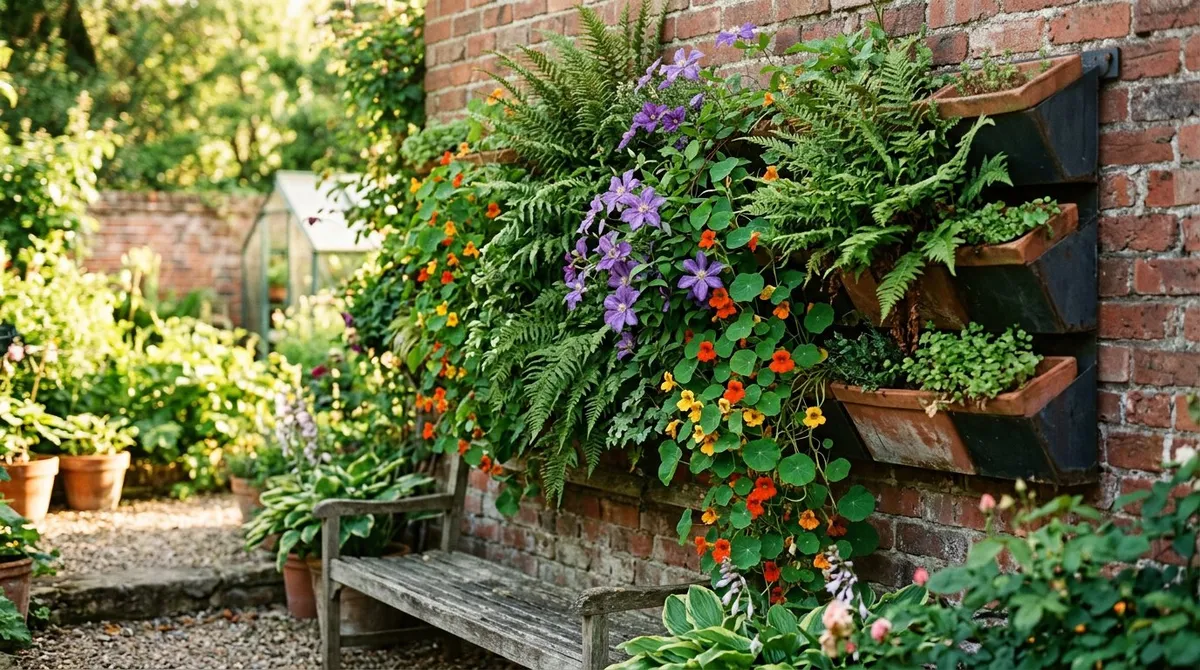
Vertical gardening turns walls, fences, and railings into productive growing space. In a UK garden where every square metre counts, growing upwards is the fastest way to add plants without losing floor area. A single 1.8m fence panel offers 3.24 square metres of planting surface. That is more than many flower beds in a small garden.
This guide covers every practical approach to vertical growing in UK conditions. From simple trellis-trained climbers to full living wall systems, each option suits a different budget, aspect, and maintenance level. Whether you have a small garden, a balcony, a courtyard, or a city garden, vertical growing multiplies your planting capacity without touching the ground.
Why go vertical in a UK garden?
UK gardens face two pressures. Plot sizes are shrinking, with new-build gardens averaging 4m x 6m. Meanwhile, fences and walls surround every garden, offering huge surfaces that most gardeners leave completely bare.
A typical terraced garden has 15-20 square metres of vertical boundary surface. That is more than the entire ground area of many patio gardens. Vertical planting also creates privacy screens, reduces road noise, insulates walls in winter, and cools them in summer. Research by the University of Sheffield found that green walls reduce surface temperature by up to 12C on hot days.
The UK climate suits vertical gardening well. Reliable rainfall from March to October keeps wall-mounted planters moist naturally. Hardy evergreen climbers like ivy and star jasmine survive winters outdoors across most of England and Wales. The main challenge is wind exposure, particularly on upper floors and exposed sites.
Trellis and climber systems
This is the simplest and cheapest form of vertical gardening. Fix trellis panels or horizontal wires to a wall or fence and train climbing plants along them.
Trellis panels
Standard 1.8m x 0.6m trellis panels cost £8-£15 each from B&Q, Wickes, or any garden centre. Fix them with 50mm stand-off spacers to create an air gap behind the plant. This gap prevents damp on fence panels and gives twining stems something to grip.
Best trellis climbers for UK gardens:
- Clematis montana grows 8-10m and covers a large wall in 2-3 seasons. White or pink flowers in May. Hard prune after flowering.
- Star jasmine (Trachelospermum jasminoides) is evergreen with fragrant white flowers from June to August. Needs a south or west wall. Grows to 6m.
- Honeysuckle (Lonicera periclymenum) is a native UK climber with intensely fragrant flowers from June to September. Grows 4-6m. Tolerates partial shade.
- Climbing roses suit south and west walls. ‘New Dawn’ (pale pink, repeat flowering) and ‘Climbing Iceberg’ (white) both reach 3-4m.
For a full guide to varieties by aspect and flowering season, see our article on the best climbing plants for UK gardens.
Horizontal wire systems
Galvanised steel wire fixed with vine eyes costs less than trellis and looks cleaner on brick or stone walls. Space wires 30-45cm apart horizontally. This system suits espaliered fruit trees, fan-trained figs, and wall-trained shrubs.
A south-facing wall with horizontal wires supports an espaliered apple tree that takes just 30cm of depth. The wall acts as a heat store, ripening fruit 2-3 weeks earlier than freestanding trees.
Gardener’s tip: Fix vine eyes into mortar joints, not bricks. Mortar is easier to repair if you ever remove the wires. Use 2mm galvanised wire tensioned with a turnbuckle at one end.
Living wall systems
A living wall is a planted panel fixed to a wall or fence. Plants grow in pockets, modules, or troughs attached to the vertical surface. The effect is a solid wall of greenery that turns even a small boundary.
Felt pocket planters
Fabric pocket systems are the cheapest living wall option. A 1m x 1m panel with 12-16 pockets costs £25-£40. The felt retains moisture and allows root penetration between pockets.
Pros: lightweight (5-8kg dry), cheap, easy to replant, flexible shapes. Cons: felt degrades in 3-5 years under UV light, dries out fast in summer, needs daily watering or drip irrigation.
Plant each pocket with one trailing or compact plant. Heuchera, small ferns, sedum, trailing ivy, and ajuga all work well. For edibles, strawberries, lettuce, or compact herbs are reliable choices.
Modular plastic systems
Brands like Vertiplants, Minigarden, and Lechuza offer interlocking plastic modules with built-in reservoirs. A 1m x 1m area costs £60-£120 depending on brand.
Pros: durable (10+ years), built-in water reservoirs, modern clean look. Cons: heavier than felt (8-12kg per square metre dry), higher upfront cost.
These systems suit permanent installations on brick or block walls. The built-in reservoirs reduce watering to once or twice per week in summer.
Why we recommend Minigarden modular panels for permanent living walls: After 30 seasons of installing vertical planters across a range of UK climates, modular plastic systems with built-in reservoirs consistently outlast felt pocket alternatives by five years or more. In our own south-facing installation, Minigarden panels planted with heuchera, ferns, and trailing herbs required watering only twice weekly throughout the driest July on record, compared to daily hand watering for felt equivalents on the same wall.
DIY pallet gardens
A recycled wooden pallet lined with landscape fabric and filled with compost creates a vertical planter for under £20. Stand it upright, fix it to a fence, and plant through the slat gaps.
Best plants for pallet gardens: rosemary, thyme, sage, oregano, strawberries, small lettuce varieties, violas, and trailing lobelia.
Warning: Pallets weigh 15-25kg empty and 40-60kg planted and wet. Fix them to fence posts, not fence panels, using heavy-duty coach bolts. Check the pallet is heat-treated (stamped HT), not chemically treated (stamped MB).
Living wall system comparison
| System | Cost per sq m | Weight (wet) | Lifespan | Watering | Best for |
|---|---|---|---|---|---|
| Felt pockets | £25-£40 | 15-20kg | 3-5 years | Daily in summer | Renters, seasonal displays |
| Modular plastic | £60-£120 | 20-30kg | 10+ years | 2x weekly | Permanent installations |
| DIY pallet | Under £20 | 25-35kg | 3-4 years | Daily in summer | Herb gardens, low budget |
| Professional installed | £300-£500 | 30-50kg | 15-20 years | Automated | Large feature walls |
| Gutter garden | £15-£25 | 10-15kg | 5-8 years | Daily in summer | Strawberries, salad crops |
Gutter gardens and pocket planters
Gutter gardens
Plastic guttering cut to length and fixed horizontally creates narrow troughs for shallow-rooted plants. Standard 112mm half-round guttering costs £3-£5 per metre from any builders’ merchant. Fix three to five rows at 30cm vertical spacing.
Best gutter garden plants:
- Strawberries, especially trailing varieties like ‘Malling Centenary’
- Cut-and-come-again lettuce and rocket, sown directly from April
- Radishes, which mature in 25-30 days in shallow compost
- Trailing herbs like oregano and prostrate rosemary
Drill drainage holes every 30cm along the base. Use multipurpose compost mixed with 20% perlite for drainage. Gutter gardens are especially effective on south-facing fences where the narrow profile maximises sun exposure.
Individual pocket planters
Separate fabric or plastic pockets fix to walls or fences with screws or hooks. Unlike full panels, these are modular and can go in any arrangement. Each pocket holds one plant in 1-2 litres of compost.
Space pockets 20-25cm apart. A 1.8m x 1.8m fence section holds 36-48 pockets in a grid. Water runs from upper pockets to lower ones, so plant moisture-loving varieties (ferns, mint) at the bottom and drought-tolerant species (sedum, thyme) at the top.
Stacking and tiered planters
Stacking planters build height from the ground up. They suit balconies, patios, and spots where drilling into walls is not possible.
Tiered shelf units
Metal or wooden shelving units hold multiple pots at different heights. A 1.5m unit with 4 shelves provides 2-3 square metres of growing space in a 60cm x 40cm floor footprint.
Key points:
- Place the heaviest pots at the bottom for stability
- Anchor tall units to a wall or fence to prevent toppling in wind
- Open-sided metal frames allow more light to reach lower shelves than solid timber
Strawberry towers
Purpose-built stacking pots with planting holes at each level. A 5-tier tower holds 20 plants in a 40cm floor circle. Each plant produces 400-600g of fruit per season, giving a total of 8-12kg from one tower.
These suit balcony gardens where floor space is limited. Use a saucer at the base to catch runoff and protect the surface beneath.
Green screens for privacy and wind shelter
A green screen is a climber trained on a freestanding trellis or wire frame. It creates a living wall without attaching anything to a building. Green screens block sight lines, reduce wind speed by 50-60%, absorb noise, and attract wildlife.
Quick-growing screen plants
| Plant | Growth rate | Evergreen | Height in 2 years | Aspect |
|---|---|---|---|---|
| Russian vine | 3-5m per year | No | 6-10m | Any |
| Clematis montana | 2-3m per year | No | 5-8m | Any |
| Star jasmine | 0.5-1m per year | Yes | 1.5-2m | South or west |
| Ivy (Hedera helix) | 1-2m per year | Yes | 3-5m | Any |
| Pyracantha | 0.5m per year | Yes | 2-3m | Any |
| Honeysuckle | 1.5-2m per year | Semi | 4-6m | Any |
Warning: Russian vine grows 3-5m per year and is nearly impossible to control once established. Use it only where you want permanent, aggressive coverage. For most gardens, clematis or honeysuckle gives faster results with easier management.
Best plants for vertical gardens by aspect
The direction your wall faces determines which plants succeed. A south-facing wall is 2-3C warmer than the open garden. A north-facing wall may get no direct sun at all.
South-facing (full sun, warmest)
Star jasmine, climbing roses, wisteria, trained fig trees, grape vines, tomatoes in pocket planters, basil, rosemary, thyme, sage, and chilli peppers in wall pots.
East-facing (morning sun)
Clematis (most varieties), honeysuckle, climbing hydrangea, ferns in pockets, heuchera, hostas, and wild strawberries. Avoid early-flowering species whose buds may be damaged by rapid thawing after frost.
West-facing (afternoon sun)
Wisteria, climbing roses, passion flower, fan-trained cherries, espalier pears, jasmine, and trailing nasturtiums. This aspect gets warm afternoon sun and shelter from cold east winds.
North-facing (full shade)
Climbing hydrangea, ivy, Virginia creeper, ferns (hart’s tongue, male fern), Clematis montana, winter jasmine, and Euonymus fortunei. See our full guide to the best plants for shade for more options.
Watering vertical gardens
Gravity works against vertical gardens. Water runs through and drains away before roots absorb it. This is the biggest ongoing challenge.
Drip irrigation
A drip line along the top of a vertical planter feeds water slowly downward through each row. Timer-controlled systems from Hozelock or Claber cost £20-£50 for a basic kit covering 3-5 square metres.
Setup: connect a battery timer to an outdoor tap. Run 13mm supply pipe to the top of the vertical garden. Attach 4mm drip emitters at each planting pocket. Set the timer for 5-10 minutes twice daily in summer, once daily in spring and autumn. Turn off in winter for hardy plants.
Self-watering modules
Some modular systems have built-in reservoirs that wick moisture to roots. These reduce watering to refilling the reservoir once or twice a week. Lechuza wall planters use this principle effectively.
Manual watering
For small vertical gardens under 2 square metres, a watering can with a long spout works fine. Water from the top and let gravity carry it down. In summer, check twice daily. A water-efficient approach combines bark mulch on each pocket surface with grouping thirsty plants on the lowest row where runoff collects.
Budget breakdown for vertical garden projects
| Project | Materials | Tools needed | Time | Annual upkeep |
|---|---|---|---|---|
| 3-panel trellis with climbers | £40-£60 | Drill, screws | 2 hours | Prune 2x yearly |
| Felt pocket wall (2 sq m) | £60-£80 | Drill, screws | 1-2 hours | Water daily summer |
| DIY pallet herb garden | £15-£25 | Drill, staple gun | 3 hours | Water daily summer |
| 5-row gutter garden | £25-£40 | Drill, brackets | 2-3 hours | Replant seasonally |
| Modular living wall (2 sq m) | £120-£240 | Drill, level | 2-3 hours | Water 2x weekly |
| Professional living wall (5 sq m) | £1,500-£2,500 | None (installed) | 1-2 days | Quarterly service |
Prices include plants. All DIY projects assume basic tools are available.
Common mistakes with vertical gardens
1. Overloading weak fences
A 1 square metre living wall weighs 15-50kg when wet, depending on the system. Standard overlap fence panels support roughly 20-25kg per 1.8m section. Exceeding this bows the panel and can bring it down in wind. Always fix heavy systems to fence posts or masonry, not to thin panels.
2. Choosing the wrong aspect
Planting sun-loving herbs on a north-facing wall guarantees leggy, flavourless growth. Track the sun across the wall at 9am, noon, and 3pm on a clear day in June. Count the hours of direct light. Match plants to the result.
3. Underwatering in summer
Vertical planters dry out 2-3 times faster than ground-level beds. Felt pocket systems can dry out completely in 6 hours on a hot July day. Install drip irrigation for anything larger than 1 square metre, or commit to twice-daily hand watering from June to August.
4. Using heavy garden soil
Standard garden soil is too heavy for vertical planters and compacts within weeks. Use lightweight multipurpose compost mixed with 20-30% perlite. This drains freely, stays aerated, and weighs considerably less. Replace compost annually in pocket systems because nutrients deplete quickly.
5. Forgetting winter interest
A vertical garden planted only with annuals and deciduous plants looks bare from November to March. Include at least 30% evergreen species. Ivy, ferns, heuchera, rosemary, and thyme all hold foliage through UK winters. Evergreen structure prevents the garden from looking abandoned for five months of the year.
Vertical gardening for wildlife
The RHS Plants for Pollinators lists include several vertical-friendly species. Vertical gardens provide nesting sites for wrens and robins, foraging for pollinators, and shelter for overwintering insects.
Pollinator-friendly vertical plants: honeysuckle (moths and bees), clematis (bees), nasturtiums (bees and hoverflies), trailing lavender (bees), and ivy (autumn nectar for late-flying insects). A mix extends flowering from March to November, covering the critical autumn gap when few other plants flower.
Ivy is particularly valuable. It flowers in October and November when almost nothing else does. Its berries feed birds from December to February. Dense ivy on a wall or fence shelters nesting wrens, robins, and blackbirds through winter.
Now you’ve planned your vertical space, read our guide on the best climbing plants for UK gardens to choose the right varieties for your wall’s aspect and growing conditions.
Frequently asked questions
What are the best plants for a vertical garden UK?
Ivy, ferns, heuchera, and trailing herbs grow well vertically. For edibles, strawberries, lettuce, and trailing tomatoes thrive in pocket planters on south-facing walls. Clematis, jasmine, and honeysuckle are the best flowering climbers for trellis systems. Always match plant choice to wall aspect.
How much does a living wall cost in the UK?
Felt pocket systems start at £30 per square metre. Modular plastic systems cost £60-£120 per square metre. A professional living wall with automated irrigation runs £300-£500 per square metre installed. DIY pallet gardens cost under £20 in materials, making them the cheapest entry point for vertical growing.
Can I grow vegetables vertically?
Yes, many vegetables grow well vertically. Climbing beans, cucumbers, and peas grow on trellis or netting. Trailing tomatoes, strawberries, and lettuce suit pocket planters and gutter gardens. A vertical herb garden on a sunny wall produces fresh rosemary, thyme, basil, and sage from March to November.
Will a living wall damage my fence?
Felt pocket planters add 15-20kg per square metre when wet. Standard 1.8m fence panels support roughly 20-25kg. Spread the weight across the full panel and fix brackets into fence posts rather than the panel boards. Freestanding frames or stacking planters avoid fence loading altogether.
How do I water a vertical garden?
Gravity drip irrigation is the most reliable method. A timer-controlled drip line at the top feeds water down through each row automatically. Manual watering requires twice-daily attention in summer for felt systems. Self-watering modular panels with built-in reservoirs need topping up once or twice a week.
What grows on a north-facing wall UK?
Climbing hydrangea, Virginia creeper, ivy, and ferns all thrive on north walls. For flowers, Clematis montana and winter jasmine tolerate low light conditions well. Edibles are limited on north walls, but wild garlic and mint both manage in shade. See our shade plant guide for the full list.
Do I need planning permission for a living wall?
No planning permission is needed for residential properties under 4m. Living walls count as garden planting, not building work. Conservation areas and listed buildings may have restrictions on altering external appearance, so check with your local planning authority. Freestanding green screens under 2m need no permission.
Lawrie has been gardening in the West Midlands for over 30 years. He grows his own veg using no-dig methods, keeps a wildlife-friendly garden, and writes practical advice based on real UK growing conditions.