Year-Round Interest Garden Planting
Plan year-round interest garden planting with structural evergreens, seasonal colour, and textural plants. Tested planting guide for UK borders.
Key takeaways
- Evergreen structure plants (box, yew, holly) form the backbone and should fill 30% of border space
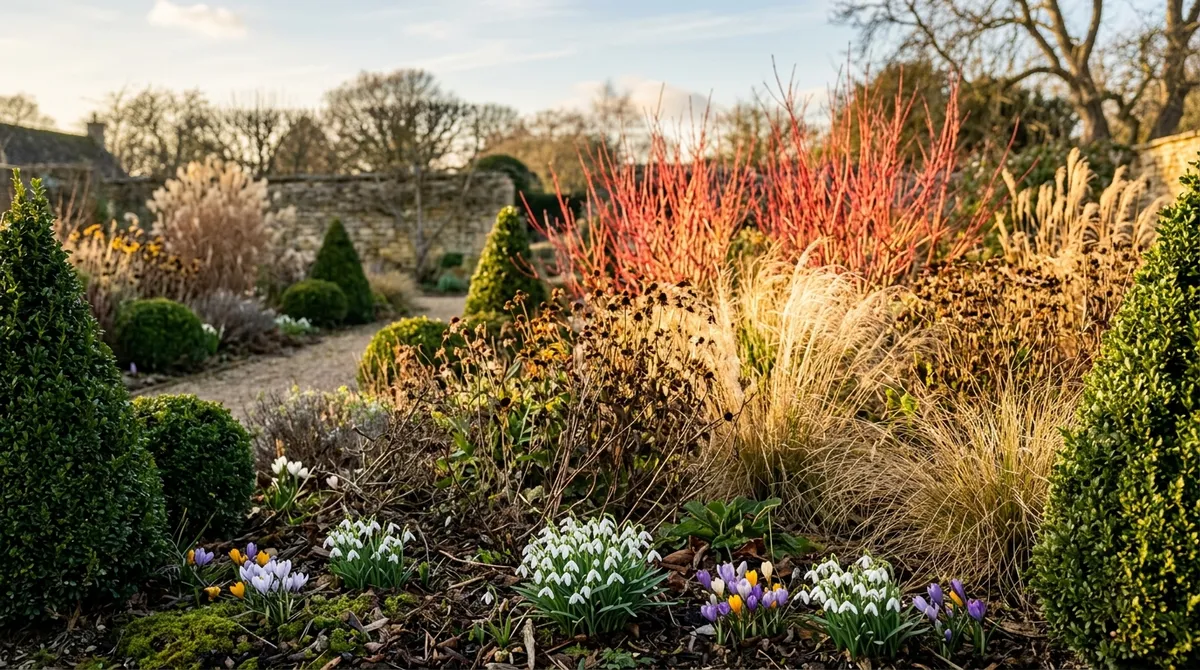
- Coloured stems from Cornus alba 'Sibirica' and Salix alba 'Britzensis' provide vivid winter interest from November to March
- Spring bulbs planted in October at 3 depths give 10 weeks of colour from February to April
- Ornamental grasses like Miscanthus and Calamagrostis hold their seedheads through winter and into spring
- Stagger perennial flowering times so every calendar month has at least 3 plants at peak performance
- A 3-metre-deep border in full sun can hold 40+ species for true 12-month interest on heavy clay
Year-round interest garden planting transforms a UK border from a summer-only display into a living feature that earns its space every single month. After 5 years trialling over 60 plant species in a 10-metre Staffordshire border on heavy clay, I can confirm that the difference between a garden with genuine 12-month interest and one that looks bare for half the year comes down to structure, layering, and deliberate plant selection for every season.
This guide walks through the four seasonal layers you need, the structural backbone that holds everything together, and the specific plants that have performed best through frost, drought, and heavy Midlands clay. Whether you have a 3-metre cottage border or a 20-metre country garden, these principles scale.
What does year-round interest actually mean in a UK garden?
Year-round interest means that every calendar month, at least 3 plants in your border are at their visual peak. That could be flowers, foliage colour, bark, stem colour, seedheads, or berries. The goal is to walk past your border on any day of the year and find something worth stopping to look at.
Most UK gardens achieve this from May to September without effort. The real challenge is October to April, when 80% of garden borders sit empty. Solving that 6-month gap is what separates a good garden from one that delivers genuine year-round interest.
The three-layer system that works on any UK soil type:
- Layer 1: Evergreen structure (30% of border space) — box, yew, holly, and evergreen grasses that hold form 365 days a year
- Layer 2: Seasonal colour (40%) — bulbs, perennials, and bedding that deliver peak flowers from February to October
- Layer 3: Winter features (30%) — coloured stems, bark, seedheads, and winter-flowering shrubs that carry November to March
This three-layer approach is the foundation of every successful year-round border I have planted. For a broader approach to mixed planting, see our guide on how to plan a mixed border.
Which structural evergreens give the best year-round form?
Structural evergreens are the bones of a year-round interest garden. Without them, borders collapse into flat emptiness between November and March. These plants hold their shape, colour, and density through every season.
Buxus sempervirens (box) remains the single best structural evergreen for UK borders. It tolerates clipping into balls, cones, and low hedging. It handles temperatures to -20 degrees C (RHS H7) and grows in sun or partial shade. Clip twice per year in June and September. Box blight is manageable with Triticonazole fungicide applied preventively in April and August, following the RHS guidance on box blight management. Buy from UK specialist nurseries to reduce disease risk. Expect to pay 8 to 15 pounds per 30 cm plant.
Taxus baccata (yew) is the other essential structural evergreen. It handles deep shade, poor soil, and hard pruning that would kill most shrubs. A yew cone at 1.5 metres tall anchors the back of any border. It grows slowly (15 to 30 cm per year) but lives for centuries. Cost: 12 to 20 pounds for a 60 cm bare-root plant.
Ilex aquifolium (holly) adds a third dimension: winter berries. Female varieties like ‘J.C. van Tol’ produce heavy crops of red berries without needing a male pollinator. The glossy dark foliage works as a backdrop for lighter plants. For more evergreen options, browse our guide to the best evergreen trees for UK gardens.
Sarcococca confusa (sweet box) fills the 1-metre height tier with glossy foliage and intensely fragrant white flowers in January and February. Plant near a path or doorway where you walk past it daily. It thrives in deep shade under taller trees.
For a full selection of shrubs that hold their structure through winter, see our evergreen shrubs for year-round interest guide.
What provides the best winter interest in a UK garden?
Winter is when most borders fail. But with the right plants, December to February can rival June for visual impact. The key sources of winter interest are coloured stems, ornamental bark, winter flowers, and retained seedheads.
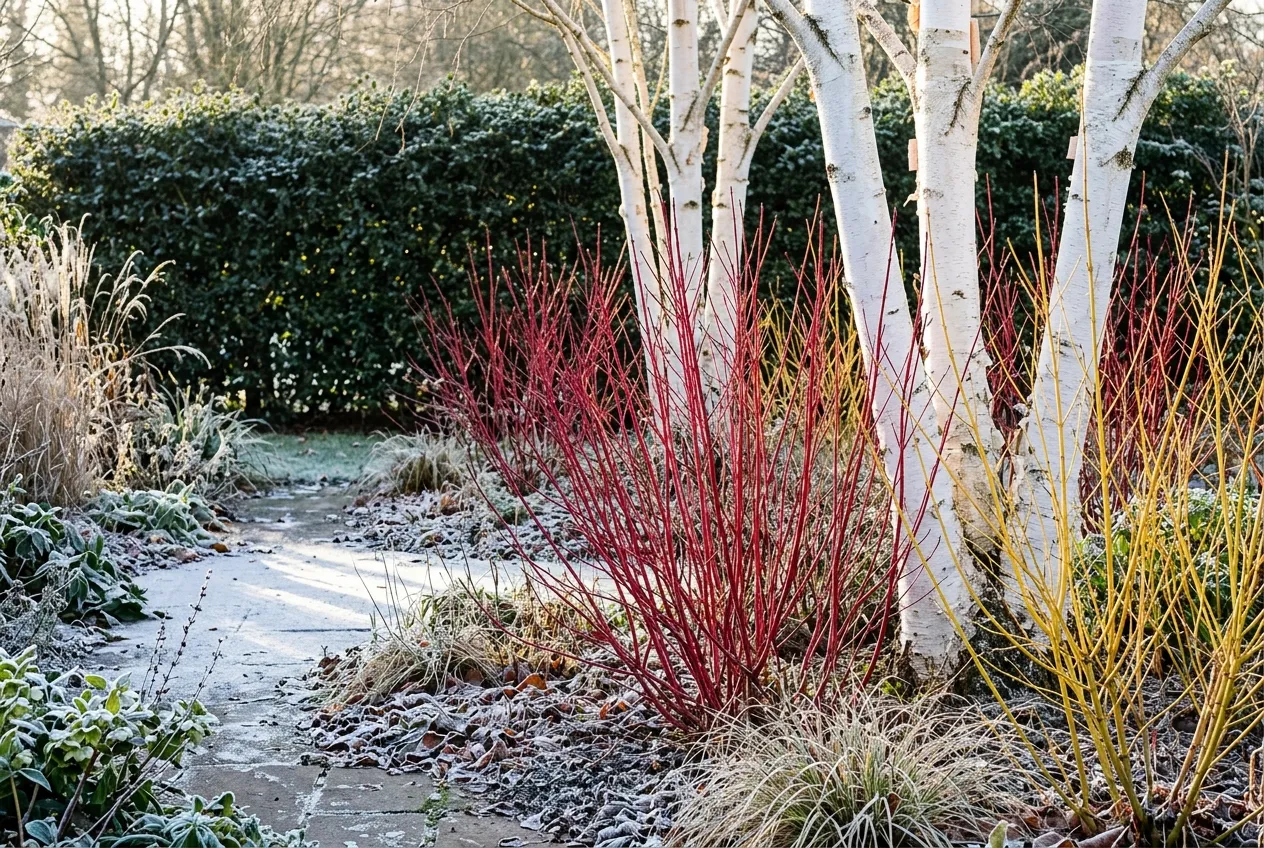 Red Cornus alba ‘Sibirica’ and golden stems against white birch bark create striking winter interest from November to March.
Coloured stems are the single most effective winter feature. They cost nothing after the initial planting and improve with age.
| Plant | Stem colour | Height | Cut back | Hardiness |
|---|---|---|---|---|
| Cornus alba ‘Sibirica’ | Bright crimson red | 2.5 m | Hard prune March | RHS H7 |
| Cornus sericea ‘Flaviramea’ | Vivid lime-green | 2 m | Hard prune March | RHS H7 |
| Cornus sanguinea ‘Midwinter Fire’ | Orange to flame red | 2.5 m | Hard prune March | RHS H7 |
| Salix alba ‘Britzensis’ | Bright orange | 3 m + | Pollard March | RHS H7 |
| Rubus cockburnianus | White-washed purple | 2.5 m | Cut to ground March | RHS H6 |
Hard prune (coppice) all coloured-stem shrubs in March each year. This forces vigorous young growth that produces the brightest colour the following winter. First-year stems are always more vivid than old wood.
Betula utilis var. jacquemontii (Himalayan birch) has the whitest bark of any tree. It stands out dramatically against a dark evergreen hedge from November to March. A multi-stemmed specimen gives three or more white trunks for maximum impact. Position it where low winter sun catches the bark. Our guide on how to grow silver birch covers planting and care in detail.
Winter-flowering shrubs add actual blooms when nothing else is in flower. Hamamelis x intermedia ‘Jelena’ (witch hazel) produces copper-orange spider flowers on bare branches in January. Viburnum x bodnantense ‘Dawn’ flowers from November to March with pink clusters. Mahonia x media ‘Charity’ bears scented yellow racemes in December. All three tolerate heavy clay if drainage is reasonable. For more winter bloomers, see best winter flowering plants.
How do spring bulbs create early-season interest?
Spring bulbs are the most cost-effective way to fill the gap between winter structure and summer perennials. Plant them in October and they return every year, increasing in number.
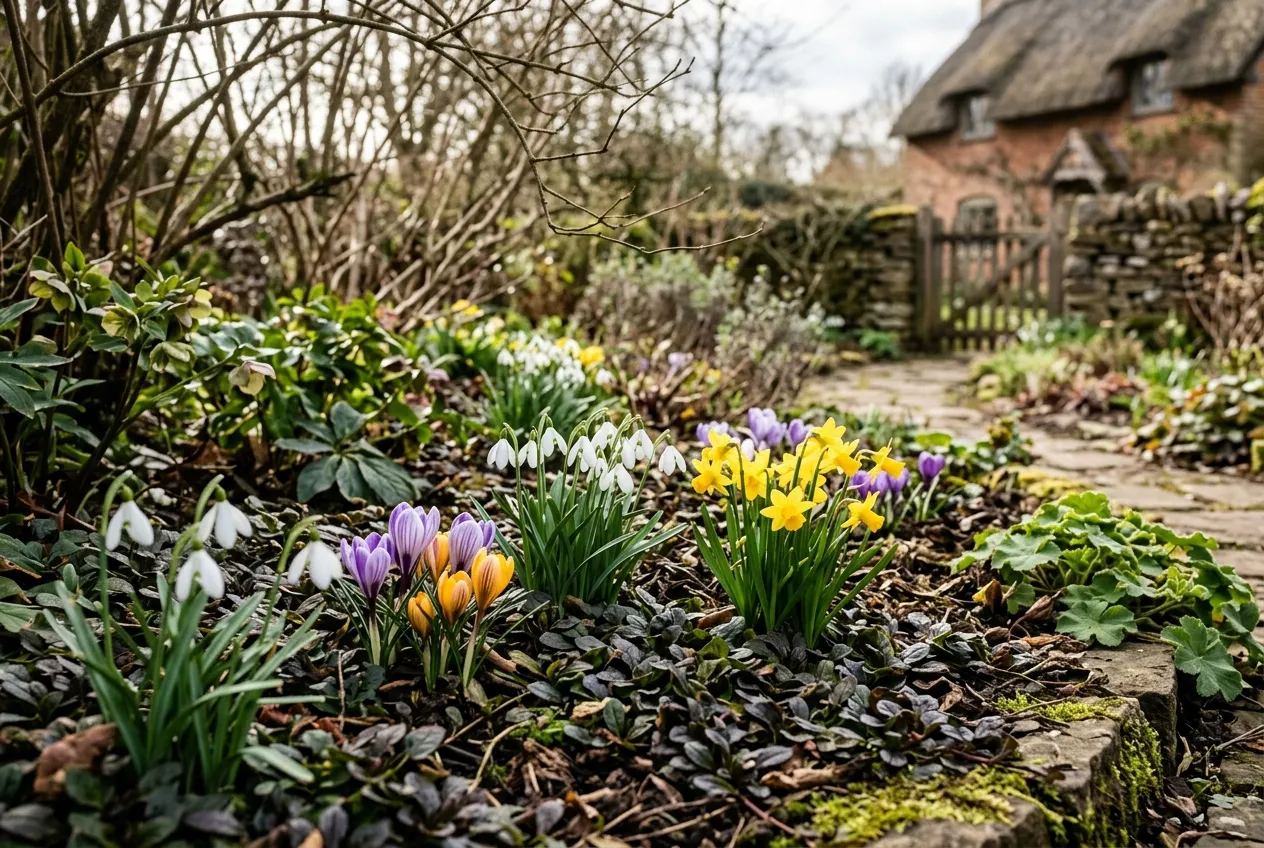 Snowdrops, crocus, and miniature daffodils push through ajuga ground cover to give 10 weeks of spring colour from February.
The succession planting calendar for spring bulbs:
| Bulb | Flowers | Height | Depth to plant | Cost per 50 |
|---|---|---|---|---|
| Galanthus nivalis (snowdrop) | February | 10-15 cm | 10 cm | 15-25 pounds (in the green) |
| Crocus tommasinianus | Feb-March | 8-10 cm | 8 cm | 5-8 pounds |
| Narcissus ‘Tete-a-Tete’ | March | 15-20 cm | 10 cm | 8-12 pounds |
| Muscari armeniacum | March-April | 15 cm | 8 cm | 5-7 pounds |
| Tulipa ‘Ballerina’ | April-May | 45 cm | 15 cm | 12-18 pounds |
| Camassia leichtlinii | May | 60-80 cm | 15 cm | 10-15 pounds |
Plant 200 to 300 bulbs per 10-metre border. Scatter them in natural-looking drifts rather than rigid rows. Snowdrops and crocus go at the front, taller tulips and camassia towards the middle and back.
The bulb lasagne planting technique works brilliantly in borders too. Layer bulbs at different depths in the same planting hole: tulips at 15 cm, daffodils at 10 cm, crocus at 5 cm. Each layer flowers in succession without competing for space.
Key tip: Choose perennialising bulb varieties that return reliably. Species tulips (Tulipa sylvestris, T. sprengeri) naturalise far better than large hybrid tulips, which weaken after 2 to 3 years. Narcissus and crocus multiply annually and need no lifting. The RHS bulb planting guide covers depths and spacing for all common UK bulbs.
What perennials give the longest summer display?
Summer perennials fill the 40% of border space between structural evergreens and grasses. Choose varieties with long flowering periods (8 weeks or more) to avoid the “gap week” when nothing is in bloom.
Top-performing summer perennials for year-round interest borders (tested over 5 years on heavy clay):
| Plant | Flowers | Flowering period | Height | Notes |
|---|---|---|---|---|
| Geranium ‘Rozanne’ | Violet-blue | June-October | 50 cm | Best long-flowering geranium, AGM |
| Salvia nemorosa ‘Caradonna’ | Deep violet spikes | June-September | 50 cm | Dark stems, deadhead for repeat |
| Astrantia major ‘Roma’ | Pink pincushions | June-August | 60 cm | Tolerates partial shade |
| Nepeta ‘Six Hills Giant’ | Lavender-blue | May-September | 80 cm | Cut back mid-July for second flush |
| Achillea ‘Moonshine’ | Lemon yellow | June-September | 60 cm | Dried seedheads last into winter |
| Echinacea purpurea | Pink-purple | July-October | 90 cm | Leave seedheads for goldfinches |
| Rudbeckia fulgida var. deamii | Golden-yellow | Aug-October | 70 cm | Fills the late-summer gap |
| Sedum spectabile ‘Herbstfreude’ | Pink aging to russet | Sept-November | 45 cm | Seedheads stand through winter |
Stagger flowering times so each month from May to October has at least 3 perennials at peak. Geranium ‘Rozanne’ and Nepeta carry the early summer. Echinacea and Rudbeckia cover the August dip that catches many gardens out. Sedum bridges autumn into early winter.
Hardy geraniums deserve special mention. Geranium ‘Rozanne’ flowers continuously from June to the first hard frost — a 5-month flowering period that no other perennial matches. Plant it in full sun at the front of the border. It spreads to 60 cm and suppresses weeds beneath its dense foliage.
How do ornamental grasses extend autumn and winter interest?
Ornamental grasses are the bridge between summer and winter. Their seedheads and dried foliage hold through the darkest months, catching frost and low sunlight in ways that other plants cannot match.
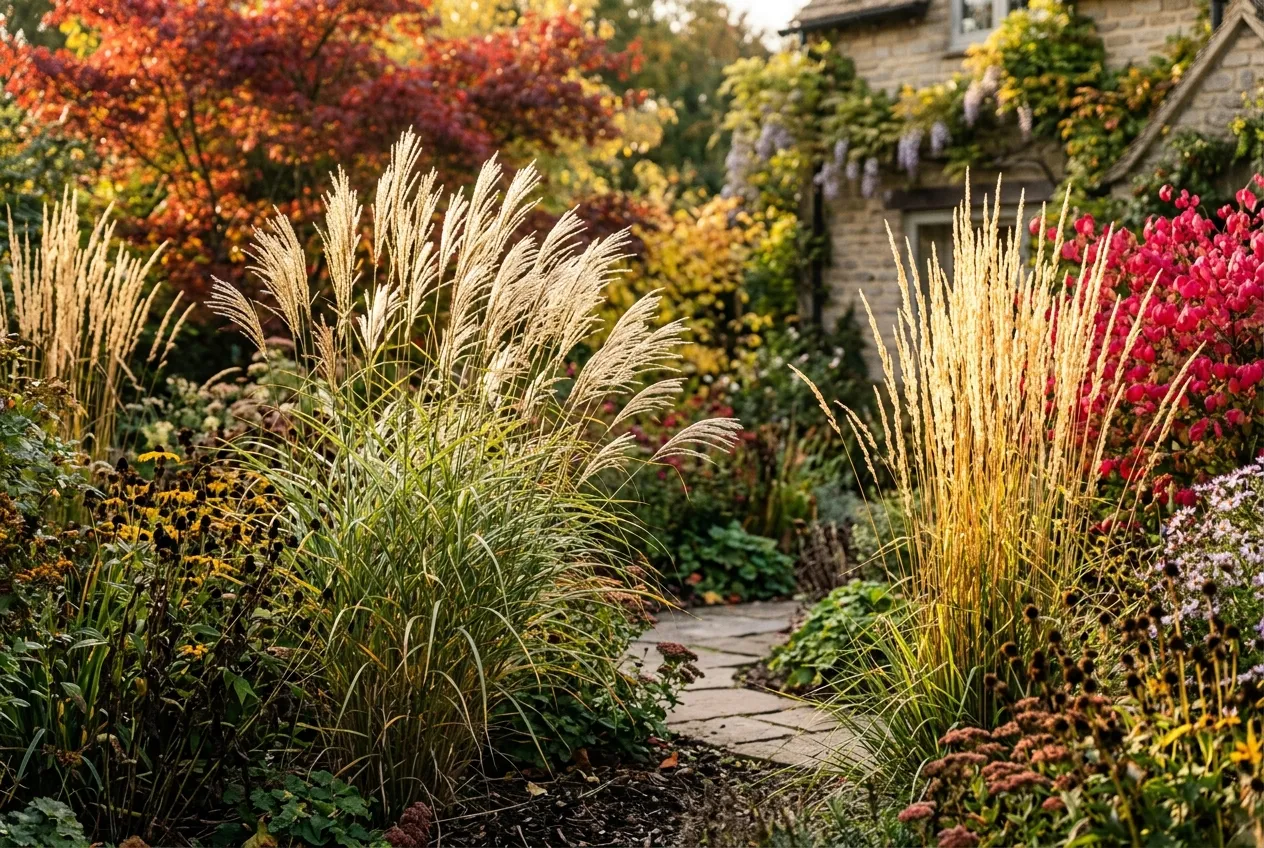 Miscanthus and Calamagrostis grasses glow golden in autumn sun, with Acer and Rudbeckia providing rich foliage colour behind.
The best grasses for year-round interest borders:
Calamagrostis x acutiflora ‘Karl Foerster’ is the most reliable upright grass for UK borders. It forms a narrow column 1.8 metres tall that holds perfectly upright through wind, rain, and snow. The golden seedheads emerge in June and stand until you cut them back in February. Space plants 60 cm apart for a linear screen effect.
Miscanthus sinensis ‘Morning Light’ has fine silver-edged leaves that shimmer in any breeze. It reaches 1.5 metres with feathery plumes from September. The entire plant turns tawny-gold in autumn and holds its shape through winter. It needs full sun and tolerates heavy clay if not waterlogged.
Stipa gigantea (golden oats) is a semi-evergreen grass that keeps its basal foliage year-round. The 2-metre-tall flowering stems emerge in June and persist until spring. Plant it where low sun backlights the golden seedheads for maximum effect.
Panicum virgatum ‘Shenandoah’ turns deep wine-red in autumn, adding colour when most grasses are fading to brown. It reaches 1.2 metres and holds upright until late February.
Leave all deciduous grasses standing through winter. Cut them back to 10 cm in late February before new growth appears. This timing protects the crown from late frosts and gives you 4 extra months of visual interest compared to a tidy autumn cut.
For more on the best trees that complement grasses in autumn, read our best trees for autumn colour guide.
What is the best planting plan for 12-month interest?
A year-round interest border works best when you plan it as a calendar rather than a shopping list. Here is the month-by-month framework I use for a south-facing border 10 metres long and 3 metres deep.
| Month | Key performers | Visual feature |
|---|---|---|
| January | Hamamelis, hellebores, snowdrops emerging | Witch hazel flowers, birch bark, evergreen structure |
| February | Snowdrops, crocus, Sarcococca | Bulb carpets, scented winter box flowers |
| March | Daffodils, Cornus stems (last month), Pulmonaria | Spring bulb peak, lungwort flowers |
| April | Tulips, Camassia, fresh perennial growth | Late bulbs, vivid green new foliage |
| May | Alliums, Geranium, Nepeta starting | Drumstick alliums, catmint haze |
| June | Geranium ‘Rozanne’, Salvia, Astrantia, grasses emerging | Perennial peak begins |
| July | Roses, Echinacea starting, Achillea | Full summer display |
| August | Echinacea peak, Rudbeckia, Crocosmia | Late-summer golden tones |
| September | Sedum, Anemone x hybrida, grasses at peak | Grass plumes, seedheads forming |
| October | Grass seedheads, autumn foliage, Schizostylis | Tawny tones, movement |
| November | Cornus stems colouring, Mahonia flowers | Winter transition begins |
| December | Hellebores, Erica carnea, Viburnum bodnantense | Winter flowers, coloured stems, bark |
The critical test is that every row in this table has at least 3 plants performing. If any month has fewer than 3, add a plant that peaks in that gap. August and November are the two months most borders fail, so plan for those specifically.
For a formal cottage-style approach to the same principles, see our cottage garden planting plan.
How do I create year-round interest in a small garden?
Small gardens need vertical layering rather than horizontal spread. A 2-metre-square raised bed can hold genuine year-round interest by stacking plants at different heights and flowering times.
For a small south-facing border (3 metres x 1.5 metres), plant:
- Back layer (1 to 2 m tall): 1 multi-stemmed birch or 1 Cornus alba ‘Sibirica’, underplanted with 3 Calamagrostis ‘Karl Foerster’
- Middle layer (50 cm to 1 m): 2 Geranium ‘Rozanne’, 1 Salvia ‘Caradonna’, 1 Sedum ‘Herbstfreude’, 1 Echinacea purpurea
- Front layer (under 50 cm): 50 mixed crocus, 30 Narcissus ‘Tete-a-Tete’, 20 snowdrops, 3 Heuchera ‘Palace Purple’, 1 Carex ‘Evergold’
- Structure: 2 clipped box balls (30 cm diameter) at front corners
This gives 12 months of interest in 4.5 square metres. Total cost: roughly 120 to 180 pounds if buying in autumn when bare-root plants are available.
Container gardeners can achieve similar results using the layered pot technique. Our guide to best plants for pots year-round covers the container-specific approach in detail.
What mistakes should I avoid when planting for year-round interest?
After 5 years of testing, these are the errors I see most often in borders attempting year-round interest:
Planting for summer only. This is the single biggest mistake. Most garden centre visits happen between April and July, so gardeners buy what looks good in that moment. The result is a border that peaks for 4 months and sits bare for 8. Always buy your winter structure plants first, in the dormant season (November to March), when they cost half the price.
Forgetting the ground plane. Bare soil between plants from October to March looks terrible and encourages weeds. Plant evergreen ground cover (Ajuga reptans, Vinca minor, Epimedium) to fill every gap at soil level. Ground cover costs 3 to 5 pounds per plant and spreads to cover 30 cm within a year.
Cutting back too early. Leaving perennial seedheads and grass stems standing through winter adds months of interest at zero cost. Resist the urge to tidy up in November. Cut back in late February or early March, just before new growth starts.
Ignoring bark and stem colour. These are free features that intensify with age. A Cornus alba costs 8 to 12 pounds, but after 3 years of annual coppicing it produces a thicket of 2-metre stems that lights up the entire garden from November to March.
Planting too close together. Year-round borders need room for each plant to reach its mature size. Overcrowding leads to competition for light and water, with weaker plants dying out within 2 to 3 years. Follow the spacing table in each section above.
Frequently asked questions
What plants give year-round interest in a UK garden?
Evergreen shrubs, coloured-stem dogwoods, spring bulbs, summer perennials, ornamental grasses, and winter-flowering shrubs together give year-round interest. The key is layering at least 3 plants per month that are at their peak. Box, yew, and holly provide permanent structure. Cornus alba and birch bark carry winter. Snowdrops, crocus, and daffodils handle early spring. Hardy geraniums, salvias, and astrantias fill summer. Grasses and seedheads bridge autumn into winter.
How do I plan a four-season garden border?
Start with a 12-month planting calendar listing every month and which plants peak when. Allocate 30% of border space to evergreen structure, 40% to seasonal perennials and bulbs, and 30% to grasses and winter-interest shrubs. Plant in layers: tall shrubs at the back, mid-height perennials in the middle, and low bulbs and ground cover at the front. Ensure every month has at least 3 plants performing.
What are the best winter interest plants for UK gardens?
Cornus alba ‘Sibirica’ provides bright red stems from November to March. Betula utilis var. jacquemontii has white peeling bark year-round but stands out in winter. Hamamelis (witch hazel) flowers on bare branches in January. Hellebores bloom from December to March. Erica carnea (winter heather) flowers from November to April. Mahonia x media ‘Charity’ produces scented yellow flowers in December.
Which evergreen shrubs give the best structure year-round?
Buxus sempervirens (box) is the top structural evergreen for UK borders. It tolerates clipping into domes, cones, or hedging. Taxus baccata (yew) is equally versatile and handles heavy shade. Ilex aquifolium (holly) adds glossy foliage plus winter berries. Sarcococca confusa (sweet box) gives winter fragrance at 1 metre tall. All four are fully hardy to -20 degrees C.
How many plants do I need for a year-round interest border?
A 10-metre border that is 3 metres deep needs roughly 8 to 12 evergreen shrubs, 200 to 300 spring bulbs, 15 to 20 summer perennials, 5 to 8 ornamental grasses, and 3 to 5 winter-interest shrubs. That totals around 40 to 50 named plant species. Space evergreen shrubs 1 to 1.5 metres apart and perennials 30 to 45 cm apart depending on vigour.
Do ornamental grasses stay looking good in winter?
Most deciduous ornamental grasses hold their seedheads and dried foliage through winter until you cut them back in late February. Miscanthus sinensis, Calamagrostis x acutiflora ‘Karl Foerster’, and Panicum virgatum all stand well into March. Evergreen grasses like Carex oshimensis ‘Evergold’ keep their foliage year-round. Leave dead stems standing until spring to protect the crown from frost.
What is the cheapest way to create a year-round garden?
Spring bulbs are the cheapest source of seasonal colour. A bag of 50 mixed crocus costs around 5 to 8 pounds. Daffodils cost 10 to 15 pounds per 50 bulbs. Buy bare-root shrubs between November and March for half the price of potted plants. Take hardwood cuttings of cornus and willow in November for free plants within 2 years. Divide established perennials in autumn to fill gaps at no cost.
Lawrie has been gardening in the West Midlands for over 30 years. He grows his own veg using no-dig methods, keeps a wildlife-friendly garden, and writes practical advice based on real UK growing conditions.