Allotment for Beginners
Practical beginner's guide to allotment gardening in the UK. Crop rotation, soil improvement, best crops for yield, and how to get the most from your plot.
Key takeaways
- Focus on high-yield crops in year one — potatoes, courgettes, runner beans, and salad leaves give the best return for beginners
- Use a four-bed rotation system from the start to prevent soil disease and build fertility naturally
- Succession sow fast crops like lettuce and radish every 2-3 weeks for harvests from May to October
- Improve soil with homemade compost and well-rotted manure — good soil is the single biggest factor in allotment success
- Short, regular visits of 1-2 hours beat infrequent marathon sessions — little and often keeps weeds and pests under control
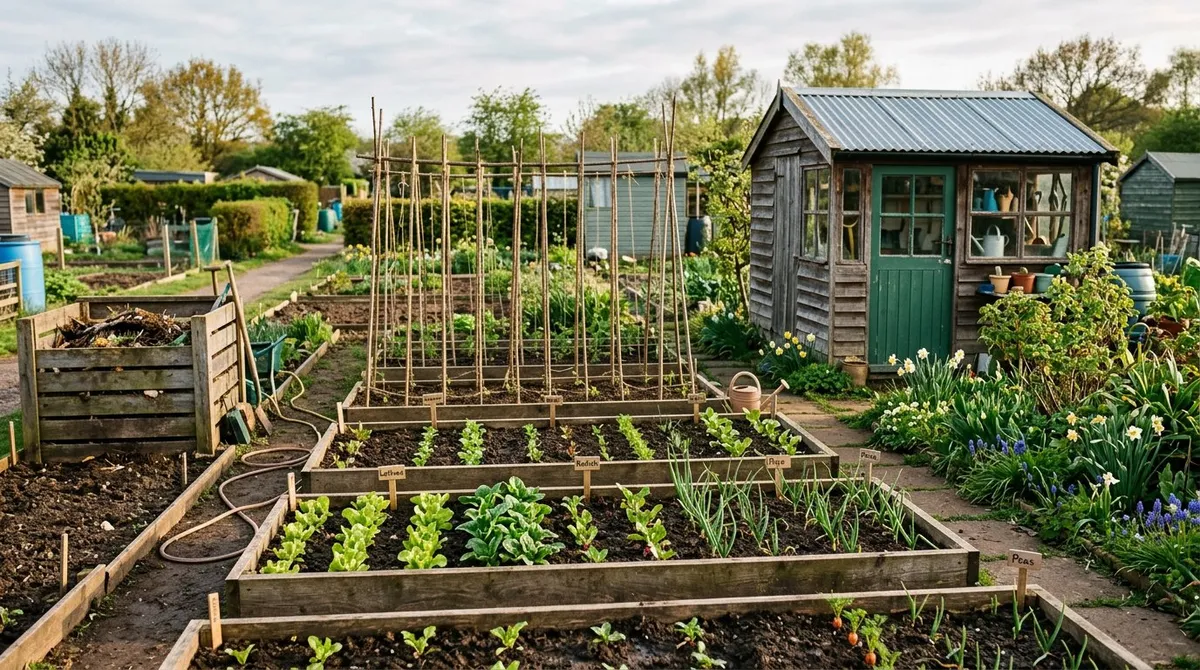
An allotment gives you something a back garden rarely can: enough space to grow serious quantities of food. A single half plot of 125 square metres produces enough vegetables to feed two people through summer and well into autumn, cutting hundreds of pounds from your annual food bill.
This guide covers the practical side of allotment growing — the skills, techniques, and knowledge that turn a patch of ground into a productive food garden. If you have not secured a plot yet, our guide on how to start an allotment covers the application process, waiting lists, and first-year setup costs.
What makes allotment growing different
Allotment gardening is not the same as growing a few tomatoes in a back garden. The scale changes everything. You are managing 125-250 square metres of soil, dealing with pests and weeds across a much larger area, and working without the convenience of a kitchen ten metres away.
The biggest advantage is space. Space means proper crop rotation, permanent fruit areas, and enough room to grow bulk staples like potatoes and onions alongside salad crops and beans. The biggest challenge is time. An allotment rewards consistent, regular attention. Neglect it for a fortnight in June and the weeds take over.
If you are completely new to food growing, our beginner guide to growing your own vegetables covers the basics before scaling up to an allotment. Companion planting is worth learning early — it reduces pest problems and improves yields. The community is the other difference. Allotment sites are full of experienced growers who share knowledge, surplus plants, and sometimes even tools. The advice from a neighbour who has grown on the same soil for twenty years is worth more than any book.
Understanding your allotment soil
Good soil produces good crops. Everything else — seeds, tools, watering — matters less than what is happening beneath the surface. Spend time understanding your soil before worrying about what to plant.
Testing your soil
Pick up a handful of moist soil and squeeze it. Clay soil holds its shape and feels sticky. Sandy soil crumbles apart immediately. Loam holds together loosely and feels gritty but not sticky. Most UK allotments sit on clay or clay-loam because allotment land tends to be on heavier ground that was less useful for other purposes.
Clay soil is fertile but heavy to work and slow to warm in spring. Sandy soil warms quickly but dries out fast and loses nutrients. Both improve dramatically with the same treatment: organic matter.
Improving your soil
Add 5-8 cm of well-rotted manure or compost to every bed each autumn. Spread it on the surface and let the worms pull it down. This single action improves drainage in clay, water retention in sand, and fertility in both. Our guide on how to make compost covers building a system that produces enough material to feed an entire allotment. Local stables often give away manure for free — stack it for six months before using it.
Avoid walking on growing beds. Compaction destroys the soil structure you are working to build. Use permanent paths between beds and reach in from the sides. Beds no wider than 1.2 metres let you reach the centre without stepping on the soil. For construction methods and layouts, see our raised bed gardening guide.
Tip: If your allotment soil is heavy clay, read our guide on improving clay soil. The gypsum and organic matter techniques described there turn sticky, waterlogged clay into workable ground within one season.
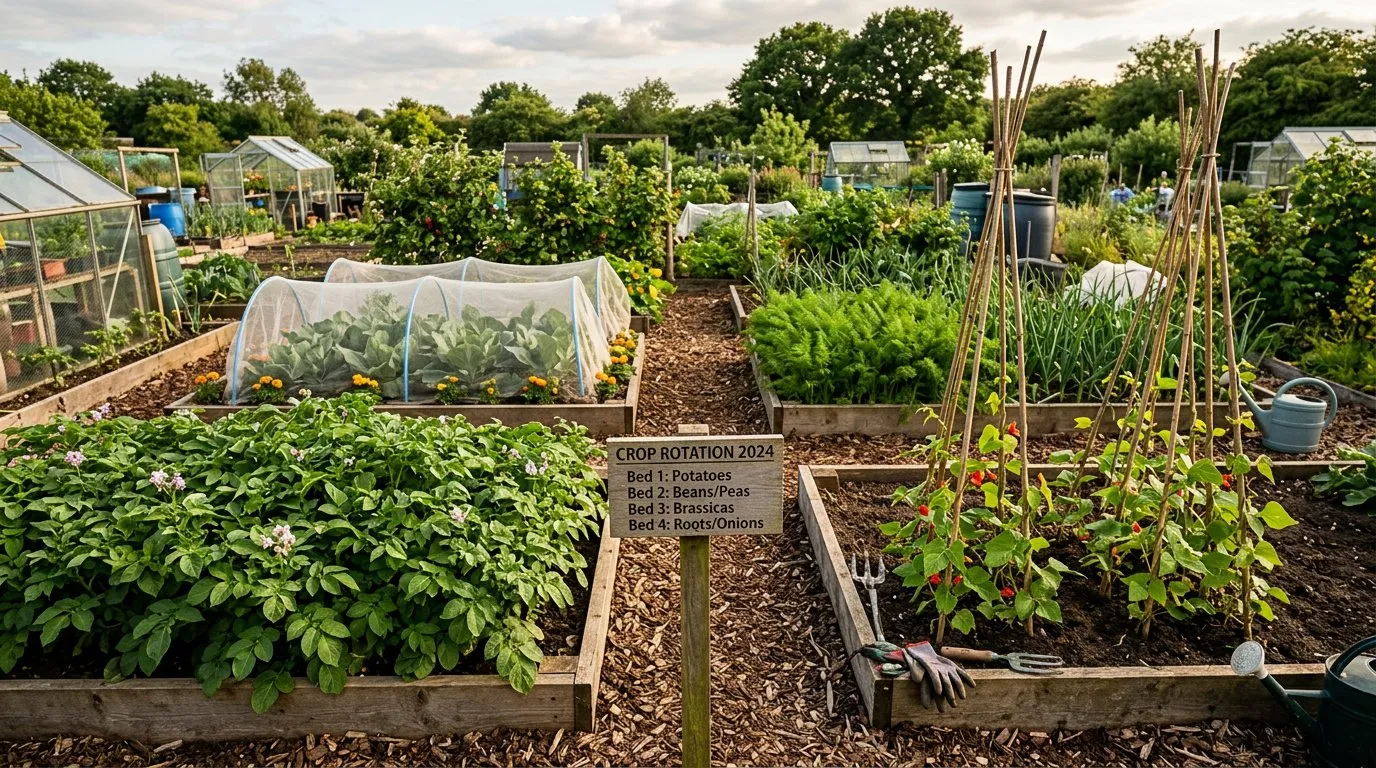 A four-bed rotation in action. Each bed grows a different crop family each year, preventing disease and building fertility naturally.
The four-bed crop rotation system
Crop rotation is the single most important technique for long-term allotment success. Growing the same crop family in the same bed year after year builds up soil-borne diseases, depletes specific nutrients, and increases pest problems.
How it works
Divide your growing area into four beds of roughly equal size. Each bed grows a different crop family each year, moving around the rotation on a four-year cycle.
| Year | Bed 1 | Bed 2 | Bed 3 | Bed 4 |
|---|---|---|---|---|
| 1 | Potatoes | Legumes | Brassicas | Roots and onions |
| 2 | Legumes | Brassicas | Roots and onions | Potatoes |
| 3 | Brassicas | Roots and onions | Potatoes | Legumes |
| 4 | Roots and onions | Potatoes | Legumes | Brassicas |
Why each group follows the other
Legumes (peas, beans) fix nitrogen in the soil through bacteria on their roots. Brassicas (cabbage, kale, broccoli) are hungry feeders that use that nitrogen. Roots (carrots, parsnips, beetroot) prefer soil that has not been freshly manured. Potatoes break up compacted ground with their vigorous root systems, preparing it for legumes.
This sequence means each crop benefits from what the previous group left behind. It also breaks pest and disease cycles — clubroot in brassicas, eelworm in potatoes, and white rot in onions all build up in soil where the same family grows repeatedly.
Best crops for beginners by yield
Not all vegetables give the same return for your effort. Some crops produce kilograms of food from a small area with minimal attention. Others take months and produce a disappointing handful.
Highest yield per square metre
| Crop | Yield per sq m | Growing period | Effort level |
|---|---|---|---|
| Courgettes | 5-8 kg | May-Sep | Low |
| Runner beans | 4-6 kg | Jul-Oct | Low |
| Potatoes (maincrop) | 3-5 kg | Mar-Sep | Low |
| Beetroot | 2-4 kg | Mar-Oct | Low |
| Lettuce (cut-and-come-again) | 1-2 kg | Mar-Oct | Very low |
| French beans | 2-3 kg | Jun-Sep | Low |
| Onions (from sets) | 3-4 kg | Mar-Sep | Very low |
| Broad beans | 1-2 kg | Nov/Mar-Jul | Low |
Courgettes are the highest-yielding crop for beginners. Two plants produce more than most families can eat. Runner beans on a wigwam produce kilograms of pods from a footprint of less than one square metre. See our UK harvest calendar for when each of these crops reaches picking stage.
Crops that save you the most money
The crops worth growing are the ones that cost the most in shops or taste dramatically better fresh. Cherry tomatoes at three pounds per punnet, fresh herbs at one pound fifty per packet, and salad leaves at two pounds per bag add up fast. Potatoes are cheap in shops but allotment-grown new potatoes taste incomparably better than anything from a supermarket.
Asparagus crowns take three years to establish but then crop for 20 years. A 3-metre row produces enough spears for a family each spring, saving forty to sixty pounds per season on a vegetable that costs eight to ten pounds per kilogram retail.
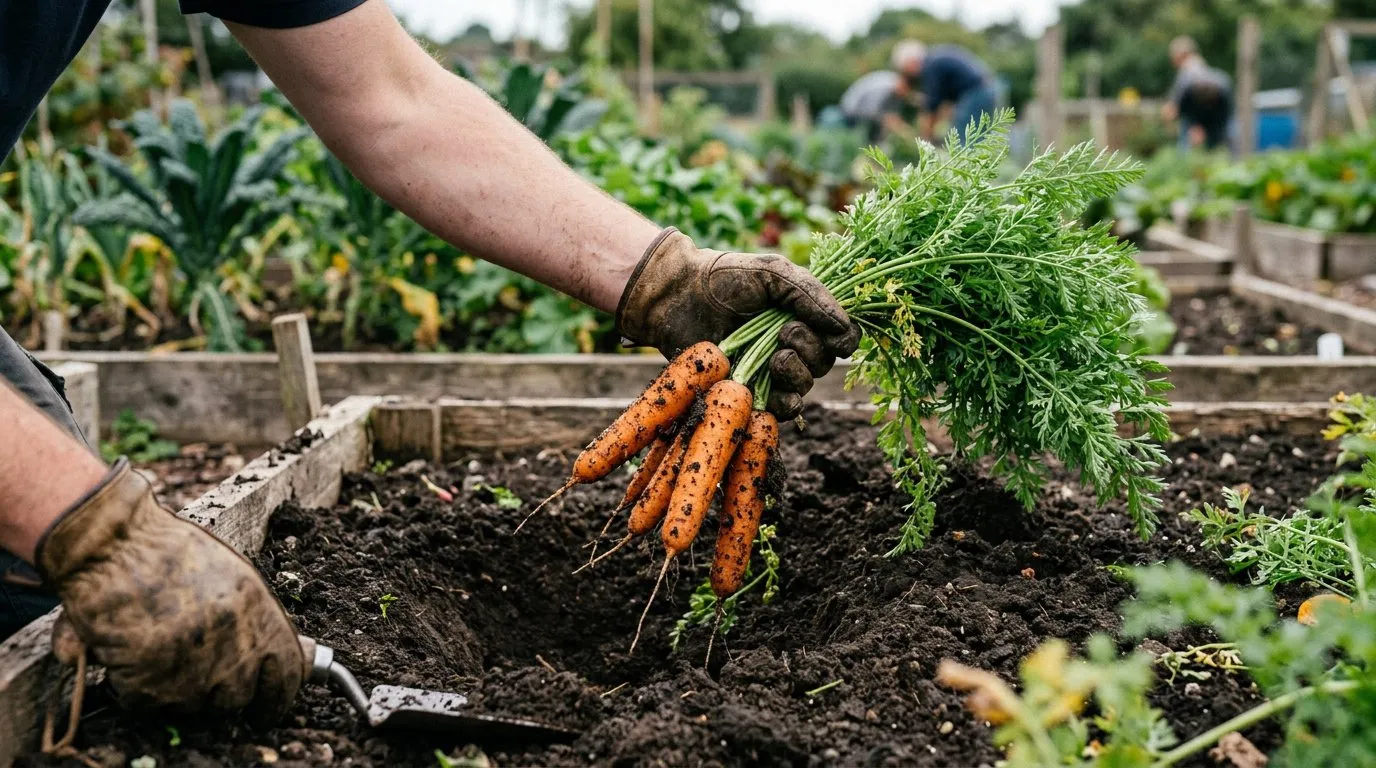
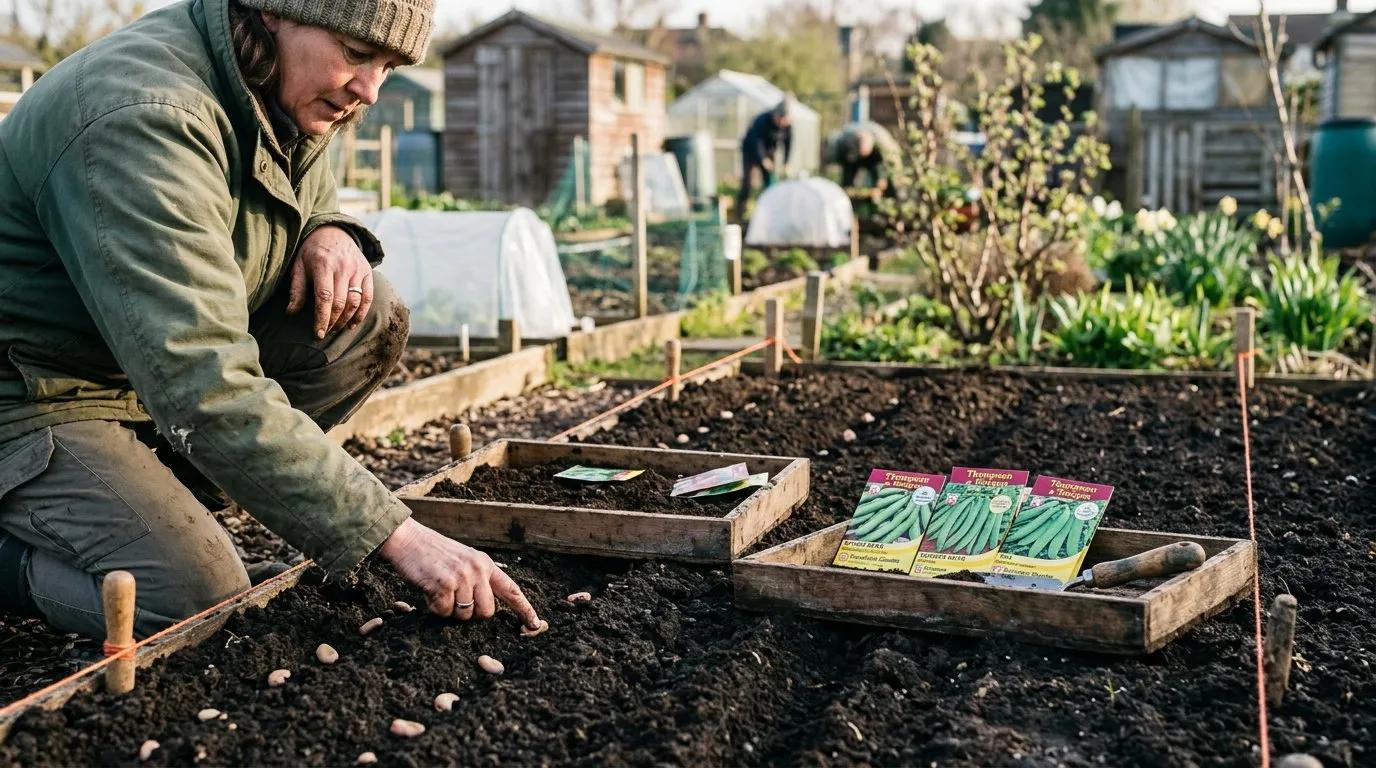 Sowing beans directly into prepared soil. Short, regular sowing sessions every two to three weeks keep the harvest coming all season.
Succession sowing: continuous harvests
The biggest beginner mistake is sowing everything in March and facing a glut in July followed by empty beds in September. Succession sowing solves this completely.
Instead of sowing a full row of lettuce in March, sow a short 1-metre row every two to three weeks from March through to August. Each row gives you fresh leaves for two to three weeks before running to seed. By the time one row finishes, the next is ready.
| Crop | Sow every | Period | Weeks to harvest |
|---|---|---|---|
| Lettuce | 2 weeks | Mar-Aug | 4-8 |
| Radish | 2-3 weeks | Mar-Aug | 4-6 |
| Spring onions | 3 weeks | Mar-Jul | 8-12 |
| Beetroot | 3-4 weeks | Apr-Jul | 8-12 |
| French beans | 3 weeks | May-Jul | 8-10 |
Use our vegetable planting calendar to plan the full sowing schedule for each crop across the season.
Tip: Set reminders on your phone for succession sowings. It takes five minutes to sow a short row, but forgetting costs you weeks of harvest.
Watering and feeding
When and how to water
Water in the morning whenever possible. Evening watering leaves foliage wet overnight, encouraging fungal diseases. Water the soil, not the leaves. A watering can with the rose removed lets you direct water straight to the base of each plant.
Prioritise watering for:
- Seedlings and transplants in their first two weeks
- Fruiting crops (beans, courgettes, tomatoes) once they start flowering
- Leafy crops (lettuce, spinach) which bolt in dry conditions
Established root crops like carrots, parsnips, and beetroot need less water than you think. Overwatering root crops produces lush tops and forked, split roots. Water them only during prolonged dry spells.
Feeding
Most allotment crops do not need additional feeding if you add compost or manure annually. The exceptions are heavy feeders like courgettes, pumpkins, and tomatoes. Feed these with a liquid seaweed or comfrey feed every two weeks once fruits start forming.
Grow a patch of comfrey (Bocking 14 variety) in a corner of your plot. Comfrey leaves make an excellent liquid feed when rotted in a bucket of water for four weeks. It is free, organic, and rich in potassium — exactly what fruiting crops need.
Dealing with allotment pests
Allotments face more pest pressure than enclosed back gardens. Open sites attract pigeons, rabbits, and larger populations of slugs and aphids. The trade-off is that allotments also support more beneficial insects — hoverflies, ladybirds, and ground beetles that eat aphids by the thousand.
The main threats
Slugs are the worst enemy of young plants. Beer traps sunk into the soil catch dozens overnight. Nematode biological controls applied in spring reduce populations before they peak. Water in the morning to deny slugs the damp conditions they need at night. For a full treatment plan, see our guide on getting rid of slugs.
Pigeons strip brassicas to bare stalks within days. Netting is the only reliable solution. Use 20mm mesh over a frame that keeps netting clear of the leaves. Pigeons push through netting that touches foliage.
Carrot fly lays eggs at the base of carrot and parsnip plants. The maggots tunnel into roots, ruining the crop. A 60cm barrier of fine mesh around your carrot bed stops the low-flying adults reaching the crop. Sow carrots next to onions — the onion scent confuses the fly.
Aphids cluster on broad bean tips and brassica leaves. Pinch out the top 10cm of broad bean plants once pods have set — this removes the aphid colonies and the tender growth they prefer.
Making your allotment pay
A well-run allotment saves real money. The National Allotment Society estimates that experienced growers save eight hundred to fifteen hundred pounds per year on food bills from a half plot.
Where the savings come from
Concentrate on crops that are expensive in shops or taste dramatically better fresh:
- Salad leaves and herbs — two to three pounds per bag in supermarkets, pennies to grow
- Soft fruit — raspberries, strawberries, gooseberries at three to five pounds per punnet
- New potatoes — freshly dug from your plot they taste nothing like shop-bought
- Runner and French beans — prolific producers that freeze well
Cutting costs on the allotment
- Save seed from open-pollinated varieties. Tomatoes, beans, peas, and lettuce all produce reliable seed. Let a few plants go to seed at the end of the season, dry the seeds, and store them for next year.
- Share plants with neighbours. Swap surplus seedlings rather than composting them.
- Source free manure from local stables. Stack it for 6-12 months before using.
- Collect rainwater from shed roofs into water butts.
- Grow green manures (field beans, crimson clover, phacelia) over winter instead of buying compost. They add nitrogen and organic matter when dug in come spring.
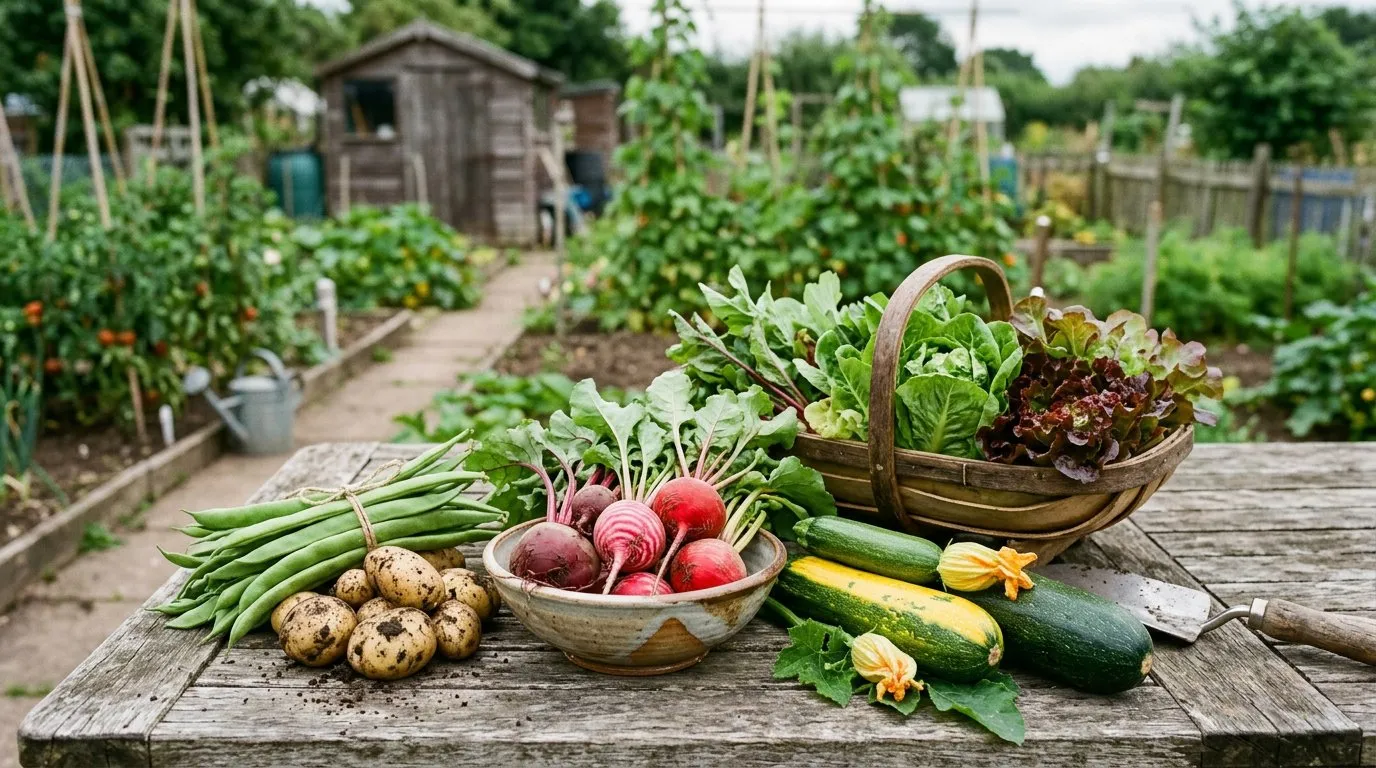 A typical midsummer allotment harvest. Courgettes, beans, beetroot, new potatoes, and salad leaves — all from a single half plot.
Why we recommend Bocking 14 comfrey: After 30 years of growing on allotments, Bocking 14 comfrey is the one plant I always put in first. It is a sterile variety that does not self-seed, and within one season it produces enough leaf material to make 30-40 litres of liquid feed. That is the equivalent of spending forty to fifty pounds on bought potassium fertiliser, for nothing but the cost of a single root cutting.
Preserving your harvest
Growing food is only half the equation. An allotment produces more than you can eat fresh during the peak months. Learning to store, freeze, and preserve extends your harvest through the year.
Storage
Potatoes store for months in paper sacks kept cool and dark. Onions and garlic dry in the sun for two weeks then hang in nets in a cool shed. Beetroot keeps in boxes of damp sand in an unheated garage. Carrots and parsnips store best left in the ground and dug as needed through winter — they actually taste sweeter after frost.
Freezing
Runner beans and French beans freeze well after blanching for two minutes. Broad beans double-pod and freeze on a tray before bagging. Courgettes grate and freeze in portions for adding to soups and sauces. Kale blanches and freezes perfectly.
Simple preserving
Chutneys, pickles, and jams turn gluts into gifts and storecupboard staples. A batch of runner bean chutney uses two kilograms of beans, costs pennies in vinegar and spices, and lasts twelve months. Beetroot pickled in vinegar keeps through winter and makes a ready-made side dish.
Your first-year plan
| Phase | When | Focus |
|---|---|---|
| Getting started | Jan-Feb | Clear plot, plan layout, order seeds, chit potatoes |
| Spring sowing | Mar-Apr | Plant potatoes, sow broad beans, peas, lettuce, beetroot outdoors |
| Main planting | May-Jun | Plant out courgettes, runner beans. Direct sow French beans. Start succession sowing |
| Peak growing | Jul-Aug | Harvest daily. Water and weed. Sow autumn crops. Save seed |
| Winding down | Sep-Oct | Clear spent crops. Add compost to beds. Plant garlic. Sow green manures |
| Winter rest | Nov-Feb | Maintain shed and paths. Plan next year. Review what worked |
The first year is about learning your plot — what grows well, where the wet patches are, which pests cause the most trouble, and how much time you realistically have. Do not try to cultivate the entire plot in year one. Start with a quarter to a half and expand as your confidence and soil quality grow.
Tip: Keep a simple notebook recording what you planted where, when it went in, and how it performed. This log becomes invaluable for planning future seasons. Note the first and last frost dates for your specific site — they vary even within the same town.
Now you have mastered allotment growing, read our guide on growing your own vegetables as a beginner for the foundations that underpin every crop you will ever grow.
Frequently asked questions
What are the best crops to grow on an allotment for beginners?
Potatoes, courgettes, runner beans, lettuce, and beetroot are the most reliable beginner crops. They tolerate imperfect soil, produce heavy yields, and need minimal specialist knowledge. Potatoes also break up compacted ground, making them ideal for a first-year plot. Add onion sets and broad beans for variety without extra complexity.
How many hours a week does an allotment need?
A half plot needs 5-8 hours per week from April to September. Winter drops to 1-3 hours for maintenance and planning. Three or four short visits of 1-2 hours each work far better than one long weekend session. Weeds grow fast in warm weather, and crops like runner beans need picking every few days to keep producing.
What is crop rotation and why does it matter?
Crop rotation means growing different plant families in different beds each year on a four-year cycle. It prevents soil-borne diseases building up, balances nutrient demands across the plot, and reduces pest pressure naturally. The four groups are potatoes, legumes (peas and beans), brassicas (cabbage family), and roots plus onions.
How do I improve allotment soil quickly?
Add 5-8 cm of well-rotted manure or homemade compost to beds each autumn and let the worms incorporate it. Grow green manures like field beans or clover on empty beds over winter. Avoid walking on growing beds to prevent compaction. Most allotment soil improves noticeably within one growing season of this treatment.
Can I grow fruit on an allotment?
Most allotment sites allow fruit growing and many encourage it. Raspberry canes, gooseberry bushes, strawberries, and blackcurrant bushes are the easiest to establish. Plant permanent fruit along one edge of your plot so it does not interfere with annual crop rotation. Most soft fruit bushes produce for 10-15 years once established.
How do I deal with slugs on an allotment?
Beer traps, copper tape around raised beds, and nematode biological controls are the most effective organic methods. Water in the morning rather than evening to reduce the damp conditions slugs need at night. Keep paths clear of debris where slugs shelter during the day. Encourage natural predators like hedgehogs, frogs, and ground beetles.
What should I do with my allotment in winter?
Spread compost or well-rotted manure on empty beds as a thick mulch. Sow green manure crops on any bare soil to prevent nutrient loss. Plant garlic cloves in October or November. Repair paths, sheds, and raised bed frames while the ground is quiet. Order seeds for next year and plan your rotation and sowing calendar.
Lawrie has been gardening in the West Midlands for over 30 years. He grows his own veg using no-dig methods, keeps a wildlife-friendly garden, and writes practical advice based on real UK growing conditions.