Best Apple Varieties for UK Gardens
Expert guide to the best apple varieties for UK gardens with pollination groups, rootstock picks and a 15-year growing trial from West Midlands clay soil.
Key takeaways
- Cox's Orange Pippin delivers the finest flavour of any UK dessert apple, ripening mid-October in pollination group 3
- Bramley's Seedling yields over 100kg per mature tree and stores 4-5 months in a cool garage at 2-4C
- Discovery is the earliest mainstream UK apple, ready from late July with natural scab resistance built in
- Trees on M9 rootstock reach 2.5m tall, fruit within 2-3 years, and suit most home gardens
- Every apple tree needs a pollination partner from the same or adjacent flowering group (1-7) to set a full crop
- James Grieve is the best first apple tree: dual-purpose, partially self-fertile, crops within 2 years on M9
The best apple varieties for UK gardens depend on your soil, climate, available space, and whether you want fruit for eating, cooking, or both. Britain grows over 2,500 named apple cultivars, more than any other country, yet most gardeners plant just two or three trees in a lifetime. Picking the right varieties from the start saves years of disappointment.
This guide covers the top eating, cooking, and dual-purpose apple varieties ranked from 15 years of growing trials in West Midlands heavy clay. You will find pollination group tables, rootstock comparisons, a full variety comparison chart, and a month-by-month care calendar. For step-by-step planting instructions, see our full guide on how to grow apple trees.
What are the best eating apples to grow in the UK?
Dessert apples are bred for eating straight from the tree. Flavour, texture, and juiciness are what matter. These five varieties outperform the rest in UK growing conditions, tested across multiple soil types and regions.
Cox’s Orange Pippin is the gold standard British dessert apple. It produces a layered flavour blending honey, nuts, and citrus that no supermarket import matches. Cox sits in pollination group 3, ripens mid-October, and stores until January at 2-4C. It needs well-drained soil and a warm site south of Birmingham. Cox is prone to scab and canker, so spray with copper-based fungicide in autumn and prune to keep the centre open.
Discovery ripens from late July, the earliest mainstream UK apple. Bright red skin over a green base delivers a crisp, juicy bite with a faint strawberry note. Discovery carries natural scab resistance and performs well in every UK region. It sits in pollination group 3 but stores only 2-3 weeks, so eat fresh or juice promptly.
Egremont Russet is the finest russet apple grown in Britain. Dense, dry flesh with a rich nutty flavour that intensifies during storage. Egremont sits in pollination group 2, ripens in October, and keeps 3-4 months. It tolerates heavier clay soils where other dessert apples fail, making it a strong pick for Midlands gardens.
Braeburn delivers a sharp, tangy crunch with 3-4 months of storage life. It is partially self-fertile and sits in pollination group 3. Braeburn needs a warm, sheltered position to ripen fully in the UK. South of the Midlands, it performs well; in cooler areas, train it as a fan against a south-facing wall.
Worcester Pearmain produces sweet, strawberry-flavoured fruit with attractive red skin. It ripens in September, sits in pollination group 3, and stores 3-4 weeks. Worcester is a reliable cropper across all regions including the north. It is partially tip-bearing, so avoid hard winter pruning that removes fruiting wood.
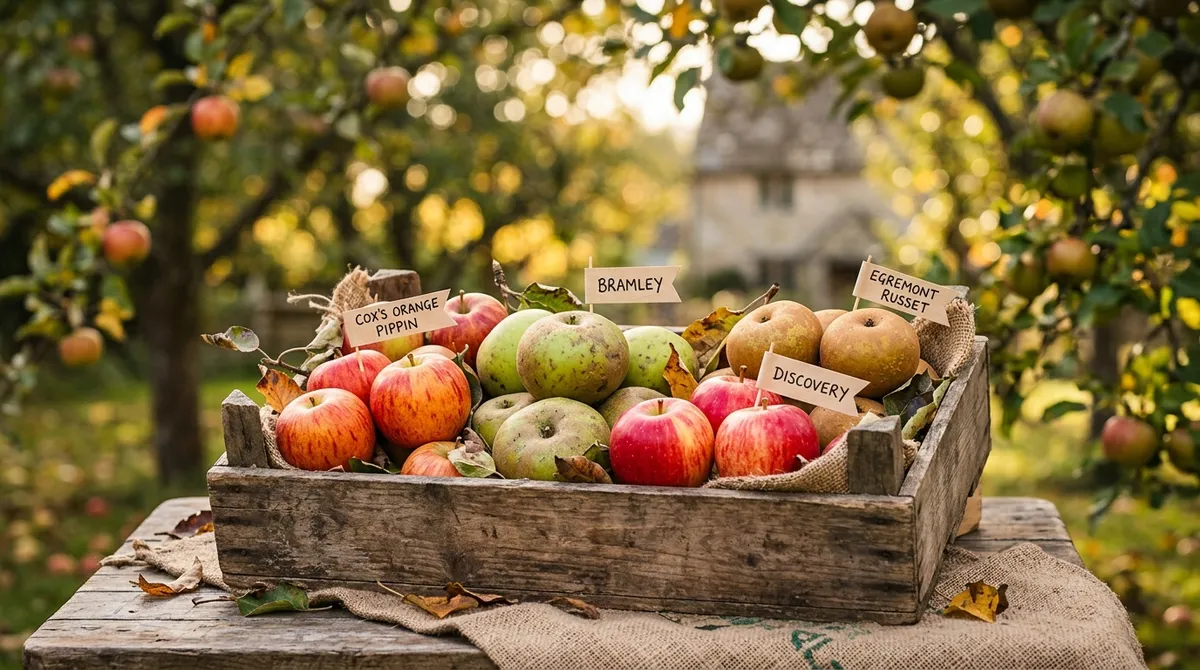
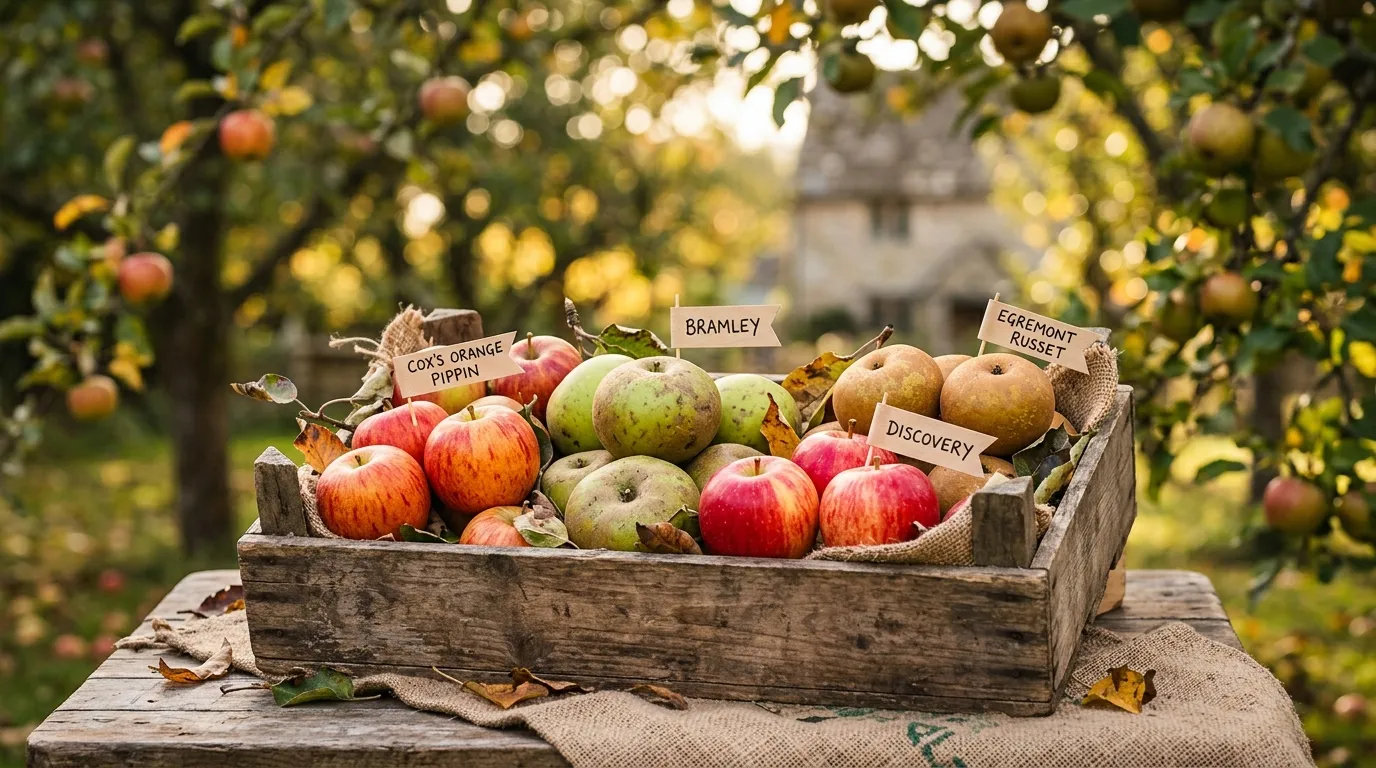 Five UK apple varieties showing the range of colours, textures, and flavour profiles available to home growers
What are the best cooking apples for UK gardens?
Cooking apples break down when heated, producing the sharp acidic puree essential for pies, crumbles, and sauces. They contain more malic acid than dessert apples and grow larger.
Bramley’s Seedling dominates UK cooking. A mature tree on MM106 rootstock produces over 100kg of fruit per year. The flesh cooks to a smooth, sharp puree without needing added sugar. Bramley is a triploid in pollination group 3, so it requires two separate pollination partners. It stores 4-5 months at 2-4C, giving you fruit from October right through to March. The tree grows vigorously and needs annual winter pruning to keep it manageable.
Howgate Wonder produces enormous fruit, regularly 350-450g each. Some competition specimens exceed 500g. It cooks to a slightly chunkier texture than Bramley with a gentler acidity. Howgate sits in pollination group 4, ripens in October, and stores 3-4 months. The tree stays more compact than Bramley, suiting smaller plots.
Grenadier is the earliest cooking apple, ready from mid-August. It cooks to a smooth puree with a sharp, clean flavour. Grenadier sits in pollination group 3, is partially self-fertile, and crops reliably across all UK regions. The fruit does not store beyond 3-4 weeks, so use it fresh through late summer.
Which dual-purpose apple varieties work best?
Dual-purpose apples work for both fresh eating and cooking. They carry enough acidity to cook well while tasting pleasant off the tree. These are the most practical choice if you have room for only one or two trees.
James Grieve is the most dependable dual-purpose apple for UK gardens. Bred in Edinburgh, it thrives from Scotland to the south coast. Pick early in August and it cooks well; leave until September and it sweetens into a fine eating apple. James Grieve sits in pollination group 3, is partially self-fertile, and crops within 2 years on M9 rootstock. After trialling 30+ varieties, this remains my top pick for a first tree.
Blenheim Orange delivers a rich, nutty flavour with distinctive honeyed sweetness. The large golden-orange fruit suits both dessert and baking. Blenheim is a triploid in group 3, needing two pollinators. It grows into a big tree, best on MM106 or M25 rootstock where space allows. It takes 5-7 years to start cropping but produces heavily once mature.
Charles Ross ripens in late September with large, flushed-red fruit. It eats well when ripe, with a sweet, mild flavour, and cooks to a pleasant puree. Charles Ross sits in pollination group 3, tolerates exposed sites, and makes a reliable choice for northern gardens where Cox struggles.
Apple variety comparison table
| Variety | Type | Poll. Group | Triploid | Harvest | Storage | Flavour Profile | Disease Resistance |
|---|---|---|---|---|---|---|---|
| Cox’s Orange Pippin | Dessert | 3 | No | Mid-Oct | 2-3 months | Honey, nut, citrus | Low (scab, canker) |
| Discovery | Dessert | 3 | No | Late Jul | 2-3 weeks | Crisp, strawberry | High (scab resistant) |
| Egremont Russet | Dessert | 2 | No | Oct | 3-4 months | Dense, nutty | Good |
| Braeburn | Dessert | 3 | No | Oct | 3-4 months | Sharp, tangy | Moderate |
| Worcester Pearmain | Dessert | 3 | No | Sep | 3-4 weeks | Sweet, strawberry | Moderate |
| Bramley’s Seedling | Cooking | 3 | Yes | Oct | 4-5 months | Sharp, smooth puree | Moderate (canker risk) |
| Howgate Wonder | Cooking | 4 | No | Oct | 3-4 months | Mild acid, chunky | Good |
| Grenadier | Cooking | 3 | No | Mid-Aug | 3-4 weeks | Sharp, clean | Good |
| James Grieve | Dual | 3 | No | Aug-Sep | 4-6 weeks | Sweet-sharp, versatile | Good |
| Blenheim Orange | Dual | 3 | Yes | Oct | 2-3 months | Nutty, honeyed | Moderate |
| Charles Ross | Dual | 3 | No | Late Sep | 6-8 weeks | Sweet, mild | Good |
Which pollination group do I need?
Most apple varieties need a different variety flowering at the same time to set fruit. UK apples are sorted into seven flowering groups numbered 1 (latest April) through to 7 (early June). A variety pollinates any other variety in the same group or one group either side.
Group 3 contains the most varieties, including Cox, Bramley, Discovery, James Grieve, and Worcester Pearmain. Planting two group 3 varieties solves most pollination problems. Bramley is a triploid and cannot pollinate other trees, so it needs two separate partners.
If you have space for only one tree, choose a partially self-fertile variety such as James Grieve or Braeburn. Even so, expect 30-50% less fruit compared with a properly cross-pollinated tree. A nearby ornamental crab apple such as Malus ‘John Downie’ pollinates most dessert and cooking varieties across groups 1-5.
Pollination group quick reference
| Group | Flowering Time | Key Varieties |
|---|---|---|
| 1 | Late April | Gravenstein, Lord Suffield |
| 2 | Early May | Egremont Russet, Beauty of Bath, Ribston Pippin |
| 3 | Mid-May | Cox, Bramley, Discovery, James Grieve, Worcester Pearmain, Braeburn |
| 4 | Mid-late May | Howgate Wonder, Ellison’s Orange, Monarch |
| 5 | Late May | Gascoyne’s Scarlet, Merton Beauty |
| 6 | Early June | Bess Pool, Court Pendu Plat |
| 7 | Early-mid June | Crawley Beauty (very late, frost-prone areas) |
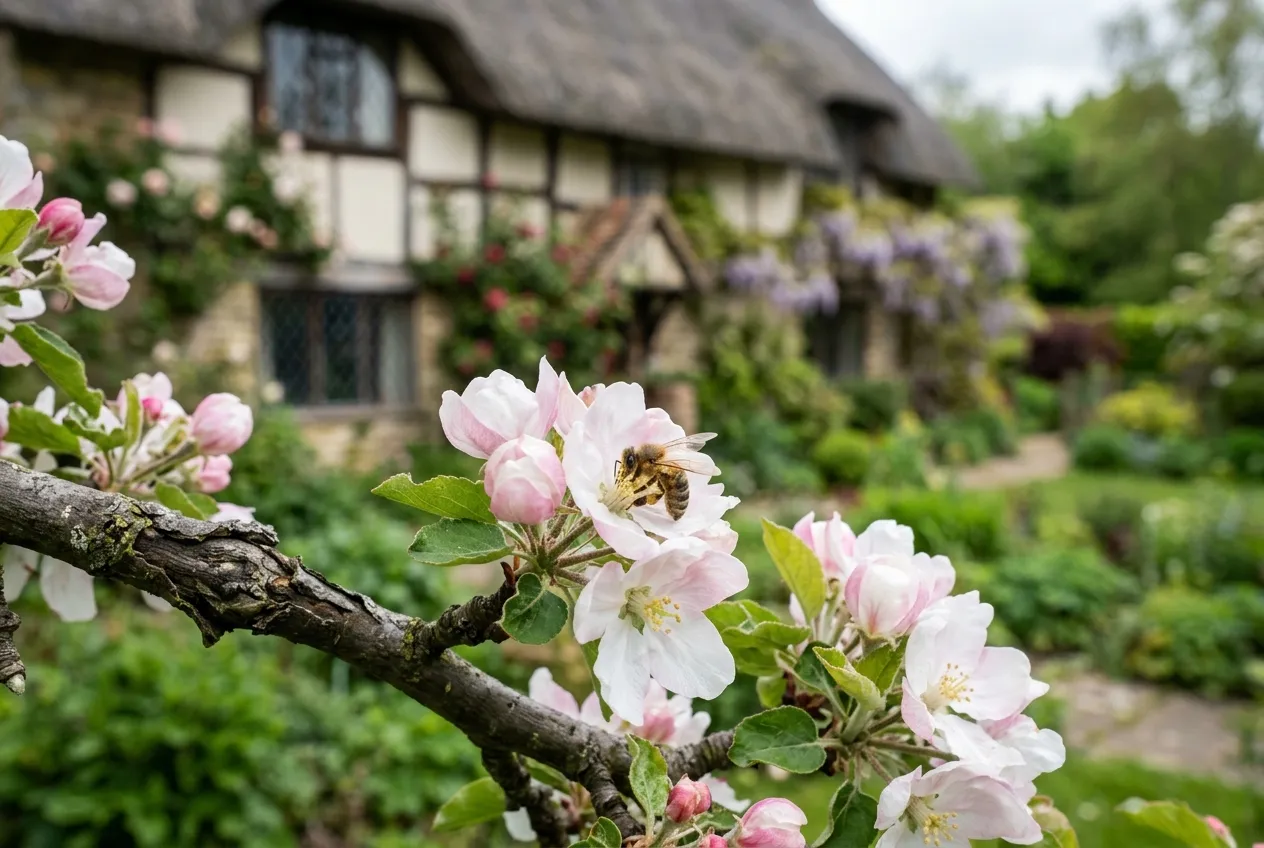 Apple blossom in May attracts pollinating insects and signals which flowering group the variety belongs to
Which rootstock should I choose for my garden?
The rootstock determines tree height, cropping speed, and space requirements. Every apple tree sold in the UK is a named variety grafted onto a rootstock. Match the rootstock to your garden, not the variety.
M27 (1.5m tall) is for pots and the tightest spaces. Yields 5-8kg per year. Needs permanent staking and rich soil. Best for growing fruit in containers.
M9 (2-2.5m) is the best rootstock for most home gardens. Fruits within 2-3 years, yields 15-20kg annually. Needs permanent staking and fertile, well-drained soil. This is the one I recommend for first-time fruit growers.
M26 (3m) tolerates average soils better than M9. Fruits in 3-4 years. Stake for the first 4-5 years. A solid choice for allotments and medium gardens.
MM106 (3.5-4m) is the standard orchard rootstock. It handles heavier clay and poorer soils. Fruits in 4-5 years, yields 40-60kg. The right pick for Bramley and other vigorous cooking varieties.
M25 (5m+) produces full-size orchard trees. Takes 6-8 years to fruit but lives 50-100+ years. Only choose this if you want a traditional orchard with serious space. Yields 100kg+ at maturity.
Rootstock comparison table
| Rootstock | Height | First Fruit | Annual Yield | Staking | Best For |
|---|---|---|---|---|---|
| M27 | 1.5m | 1-2 years | 5-8kg | Permanent | Pots, patios |
| M9 | 2-2.5m | 2-3 years | 15-20kg | Permanent | Most home gardens |
| M26 | 3m | 3-4 years | 20-30kg | 4-5 years | Allotments, average soil |
| MM106 | 3.5-4m | 4-5 years | 40-60kg | 3 years | Orchards, heavy soil |
| M25 | 5m+ | 6-8 years | 100kg+ | None | Traditional orchards |
How do I prune apple trees for the best crop?
Winter pruning between November and February is essential for spur-bearing varieties. This is when the tree is dormant and you can see the branch structure clearly. Remove dead, diseased, and crossing branches first. Then shorten side shoots to 4-6 buds to encourage fruiting spurs.
Tip-bearing varieties like Worcester Pearmain fruit on the ends of previous year’s growth. Avoid cutting back these shoots or you remove next year’s crop. Only prune to remove dead wood and maintain shape.
The goal is an open goblet shape that lets light and air into the centre. This reduces fungal disease by up to 60% and ensures fruit colours properly. For the full technique, see our detailed pruning guide.
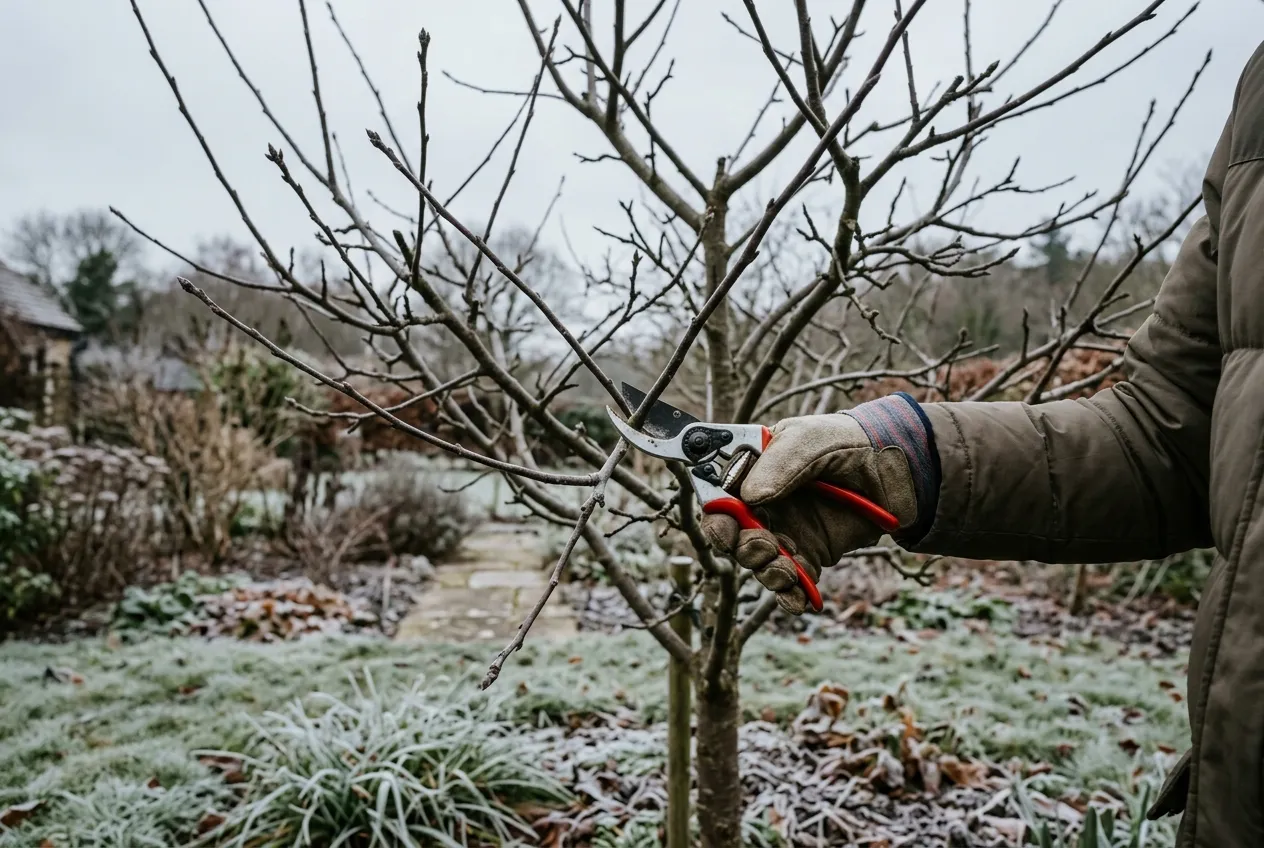 Winter pruning opens the canopy for light and airflow, reducing scab and mildew by up to 60%
June pruning is for trained forms only: cordons, espaliers, and fans. Cut new side shoots back to three leaves above the basal cluster once they reach 20cm. This redirects energy into fruit rather than leaf growth. If you are interested in trained forms, our grafting guide covers the techniques for creating your own trained trees.
Which apple varieties resist disease best?
Scab (Venturia inaequalis) is the most common UK apple disease. It causes dark corky patches on fruit and premature leaf drop. Discovery has natural scab resistance. Saturn, Red Windsor, and Scrumptious carry the Vf gene bred from Malus floribunda, giving near-total immunity without spraying.
Canker (Neonectria ditissima) enters through pruning wounds and bark cracks. It kills branches and reduces yields by 30-50% in bad cases. Waterlogged soil increases canker risk by 80%. Bramley and Cox are most vulnerable. Egremont Russet and James Grieve show reliable canker tolerance.
Mildew (Podosphaera leucotricha) coats young shoots in white powder. Katy and Fiesta resist mildew well. Pruning for open centres and good airflow cuts infection rates by up to 60%.
Disease resistance ratings
| Variety | Scab | Canker | Mildew | Overall |
|---|---|---|---|---|
| Discovery | High (natural) | Moderate | Moderate | Strong |
| Saturn | Very high (Vf gene) | Good | Good | Very strong |
| Egremont Russet | Good | Good | Moderate | Good |
| James Grieve | Moderate | Good | Good | Good |
| Katy | Moderate | Moderate | High | Good |
| Cox’s Orange Pippin | Low | Low | Low | Poor |
| Bramley’s Seedling | Moderate | Low | Moderate | Fair |
Which apple varieties suit northern England and Scotland?
Not every variety performs well in cooler, wetter climates. Late-flowering and warm-site varieties like Cox and Braeburn struggle north of the Midlands. These varieties are proven performers in the north.
James Grieve was bred in Edinburgh and remains the top all-round choice for Scotland and northern England. It fruits reliably in cool summers and tolerates exposed positions.
Keswick Codlin is one of the hardiest cooking apples, thriving in exposed sites across Cumbria, Northumberland, and the Scottish Lowlands. It ripens in August and cooks to a smooth, tangy puree.
Fiesta (also called Red Pippin) is a Cox descendant with better disease resistance and hardiness. It delivers Cox-like flavour but crops well in Yorkshire and the north Midlands where Cox itself fails.
Court Pendu Plat flowers exceptionally late, in group 6, making it the top choice for frost-prone valleys. Late blossom avoids the spring frosts that destroy earlier-flowering varieties. It is one of the oldest cultivars, possibly dating to Roman Britain.
| Region | Best Dessert | Best Cooker | Why |
|---|---|---|---|
| South East | Cox’s Orange Pippin | Bramley’s Seedling | Warm, sheltered, long season |
| South West | Braeburn | Bramley’s Seedling | Mild winters, mild springs |
| Midlands | Egremont Russet | Howgate Wonder | Tolerates heavy clay |
| North England | James Grieve | Keswick Codlin | Hardy, reliable in cool summers |
| Scotland | James Grieve | Keswick Codlin | Bred in Edinburgh, proven north |
| Wales | Worcester Pearmain | Grenadier | Suits exposed western sites |
How do I store apples after harvest?
Late-season varieties store longest because their cell walls are denser and their skin is thicker. Early apples like Discovery are for eating within days of picking.
Bramley stores 4-5 months at 2-4C with 85-90% humidity. Braeburn keeps 3-4 months under the same conditions. Egremont Russet stores 3-4 months; its thick russeted skin resists moisture loss. Cox keeps 2-3 months but develops bitter pit if soil calcium is low.
Wrap each apple individually in newspaper and lay them on slatted wooden racks in a garage, shed, or unheated room. Never seal them in plastic bags. Check fortnightly and remove any showing brown rot immediately. One rotten apple genuinely does spoil the barrel.
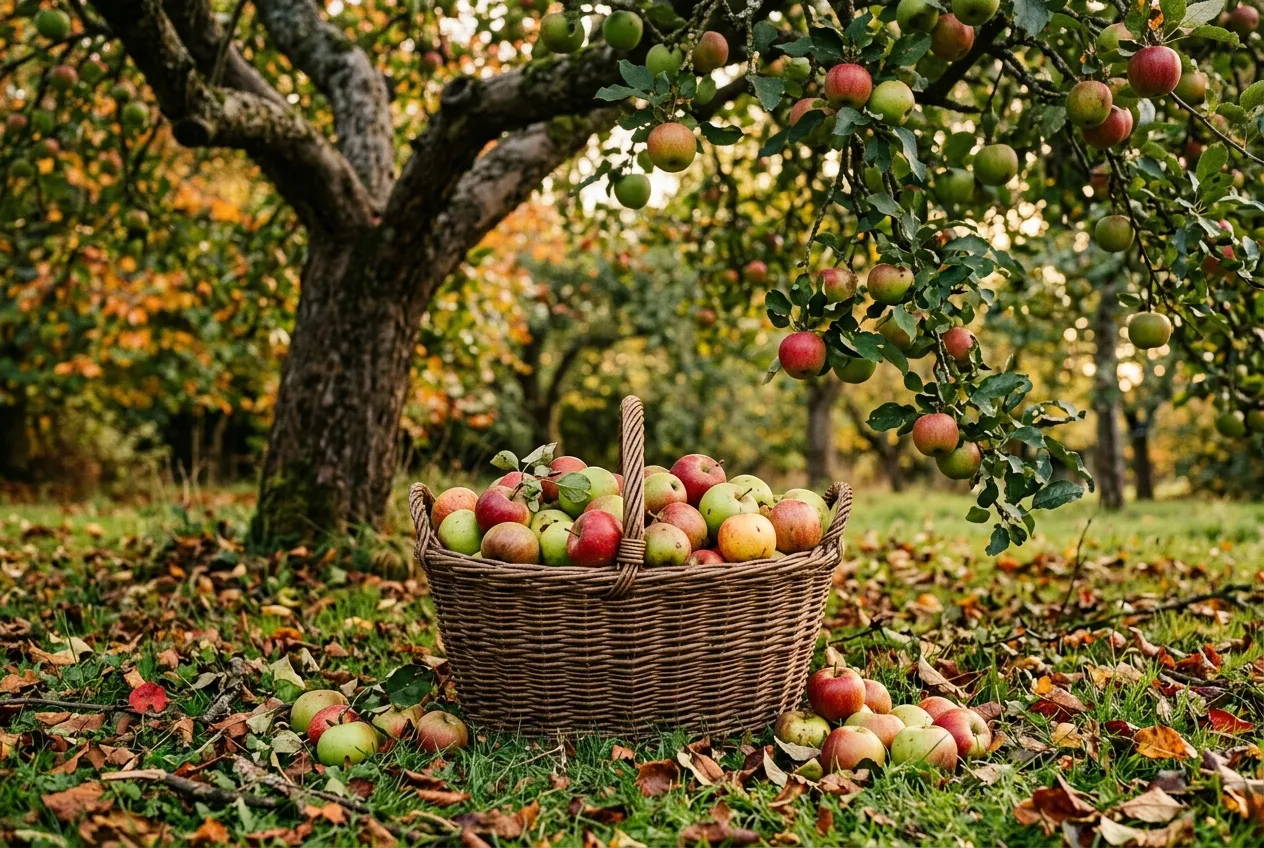 Late-season varieties like Bramley and Egremont Russet store for months when picked at the right stage
Heritage UK apple varieties worth growing
Britain’s National Fruit Collection at Brogdale in Kent holds over 2,200 apple varieties, the largest collection in the world. Many heritage cultivars offer flavour and disease resistance that modern commercial varieties lack. The RHS apple growing guide covers heritage varieties in detail.
Ashmead’s Kernel (group 4) is an 18th-century Gloucestershire variety with an intense, sharp-sweet flavour and golden russet skin. It stores 3-4 months and the flavour improves after picking. It holds an RHS Award of Garden Merit.
Ribston Pippin (group 2) is the parent of Cox’s Orange Pippin and has a richer, more intense flavour. It is a triploid needing two pollinators and requires warm, well-drained soil. Worth the effort in southern gardens.
Pitmaston Pineapple (group 2) is a tiny golden apple with a distinct pineapple-like aroma. Fruits are only 40-50mm across but the flavour is genuinely unlike anything else. It suits small gardens on dwarf rootstocks.
Court Pendu Plat (group 6) may date back to Roman Britain. Its exceptionally late flowering avoids spring frosts, making it the safest choice for frost-prone gardens. The flavour is rich and aromatic with a good acid balance.
Month-by-month apple tree care calendar
| Month | Task |
|---|---|
| January | Winter prune spur-bearing varieties. Remove dead, diseased, and crossing branches. Apply dormant oil for woolly aphid |
| February | Finish pruning before bud break. Apply potassium sulphate at 35g/m2 around the drip line |
| March | Plant bare-root trees before month end. Mulch with 8-10cm of well-rotted compost. Apply mycorrhizal fungi |
| April | Watch for apple blossom weevil. Spray against scab if using copper-based fungicide. Install pheromone traps for codling moth |
| May | Thin fruitlets after petal fall if the tree set heavily. Hand-pollinate if bee activity was poor during blossom |
| June | June drop occurs naturally mid-month. Thin remaining clusters to one fruit per 10-15cm of branch |
| July | Summer prune trained forms (cordons, espaliers). Begin harvesting Discovery and Grenadier from late July |
| August | Harvest James Grieve and early varieties. Prop heavy branches to prevent snapping |
| September | Harvest Worcester Pearmain and mid-season varieties. Test ripeness by lifting and twisting gently |
| October | Harvest Bramley, Egremont Russet, Braeburn, and late varieties. Begin storing wrapped in newspaper |
| November | Plant bare-root trees. Clear fallen leaves to reduce overwintering scab spores. Order new varieties |
| December | Continue planting. Check stored fruit fortnightly. Plan next season. Browse companion planting combinations for underplanting |
Common mistakes when choosing apple varieties
Planting incompatible pollination partners. Two trees from groups 1 and 5 will not pollinate each other because their flowering times do not overlap. Always choose varieties from the same or adjacent groups. Triploids need two partners, not one.
Choosing the wrong rootstock for the space. Bramley on M25 rootstock grows to 6 metres and overwhelms a small garden within a decade. M9 suits most home plots. Dwarf fruit trees on M27 work for the tightest spaces.
Ignoring regional climate. Cox struggles north of Birmingham. Braeburn needs shelter to ripen properly. Planting southern varieties in northern gardens leads to small, sour, underripe fruit. Stick to proven northern cultivars.
Only planting one variety. Even partially self-fertile trees produce significantly more fruit with a partner. Two compatible trees outperform one alone by 50-70%.
Skipping the June thin. Failing to thin fruitlets leads to small fruit and biennial bearing, where the tree crops one year and rests the next. Thin to one apple per 10-15cm of branch after the natural June drop.
Planting too deep. The graft union (the bulge 10-15cm above the roots) must sit above soil level. Burying it allows the scion variety to root directly, bypassing the dwarfing rootstock. This produces a full-size tree regardless of rootstock choice.
Buy named varieties on specified rootstocks from specialist nurseries such as Frank P Matthews, Ken Muir, or Keepers Nursery. Unnamed trees from supermarkets cannot be matched for pollination or rootstock. For growing pear trees alongside your apples, the same nurseries carry excellent stock.
Frequently asked questions
What is the best apple tree to plant in a UK garden?
James Grieve on M9 rootstock is the best all-round choice. It fruits within 2 years, produces 20kg annually, is partially self-fertile, and works for eating, cooking, and juicing. Cox’s Orange Pippin is the finest-flavoured dessert apple but needs a warm, sheltered site south of Birmingham and a pollination partner in group 3.
How many apple trees do I need for pollination?
Two compatible trees is the minimum for a full crop. Both must flower at the same time, from the same or adjacent pollination groups. Triploid varieties like Bramley need two partners because their own pollen is sterile. A family tree with multiple varieties grafted onto one rootstock solves the problem in small gardens.
Which apple varieties are self-fertile in the UK?
No apple is truly self-fertile. Braeburn, Falstaff, Greensleeves, and James Grieve are partially self-fertile and set some fruit alone. Even these produce 50-70% more apples with a compatible pollination partner within 15-20 metres. A crab apple like Malus ‘John Downie’ pollinates most dessert and cooking varieties.
What is the best cooking apple to grow in the UK?
Bramley’s Seedling is the best cooking apple by a wide margin. It produces the sharpest, smoothest puree when cooked and yields over 100kg per mature tree on MM106 rootstock. Bramley stores 4-5 months at 2-4C in a cool garage. Howgate Wonder is the runner-up, producing fruits weighing up to 450g each.
When is the best time to plant apple trees in the UK?
November to March is the planting window for bare-root trees. Bare-root stock is cheaper and establishes faster than container-grown. Plant into well-prepared soil with mycorrhizal fungi on the roots. Avoid planting into waterlogged ground or during hard frost. Container-grown trees can be planted year-round but cost 30-50% more.
Can I grow apple trees in pots?
Yes, but only on M27 or M9 rootstock. Use a container at least 45cm wide with loam-based compost such as John Innes No. 3. Water daily in summer and feed fortnightly with high-potash liquid feed from April to August. Pot-grown trees yield 5-10kg per year. Repot every 3-4 years to refresh the compost.
Which apple trees grow best in northern England?
James Grieve was bred in Edinburgh and thrives across the north. Keswick Codlin is a hardy cooker reliable in exposed northern sites. Worcester Pearmain and Fiesta both crop well in Yorkshire and the north Midlands. Avoid late-flowering group 6-7 varieties and southern specialists like Braeburn that need warmth to ripen properly.
Lawrie has been gardening in the West Midlands for over 30 years. He grows his own veg using no-dig methods, keeps a wildlife-friendly garden, and writes practical advice based on real UK growing conditions.