Crop Rotation Planner for UK Gardens
Plan crop rotation for your UK vegetable garden or allotment. Covers four-bed and three-bed systems, plant families, green manures, and record keeping.
Key takeaways
- Rotate crops on a four-year cycle: legumes, brassicas, roots, then alliums and potatoes
- Rotation reduces clubroot and other soil-borne diseases by up to 80% over four years
- Legumes fix nitrogen in the soil, benefiting the brassicas that follow the next year
- A three-bed system works well for small gardens by combining alliums with roots
- Green manures sown between crops add nitrogen, suppress weeds, and improve soil structure
- Keep a simple plan or diary each year to track which family grew where
Crop rotation is one of the simplest ways to prevent the problems caused by growing the same vegetables in the same patch of soil year after year. It feels logical: the tomatoes did well in that sunny corner, so why move them? But beneath the surface, disease organisms multiply, nutrients deplete unevenly, and yields quietly decline.
Crop rotation fixes this. It is a system as old as agriculture itself, and it works as well in a four-bed allotment as it does on a farm. This guide explains how to plan and run a practical rotation for UK vegetable growing, whether you have a large allotment or a few raised beds in the back garden.
What crop rotation is and why it matters
Crop rotation means growing different plant families in different beds each year, following a set sequence. After a fixed number of years, each family returns to its original position. The cycle then repeats.
The benefits are well documented by the RHS and supported by decades of allotment experience:
- Disease prevention: Soil-borne pathogens like clubroot (brassicas), white rot (alliums), and eelworm (potatoes) build up when the same family grows in the same soil repeatedly. Moving crops breaks the disease cycle.
- Nutrient balance: Different families have different nutrient demands. Legumes add nitrogen to the soil. Brassicas are heavy nitrogen feeders. Following legumes with brassicas puts free nitrogen exactly where it is needed.
- Soil structure: Root crops open up heavy soil. Leafy crops shade the surface and suppress weeds. The variety of root types and growing habits improves soil structure over time.
- Pest disruption: Many pests overwinter in soil near their host plants. Moving crops away from last year’s position means emerging pests cannot find their food source.
Research from Garden Organic shows that a four-year rotation reduces clubroot incidence by up to 80% compared with continuous brassica cropping. White rot in onions drops by 60-70% with a four-year gap between allium crops on the same bed.
The four-bed rotation plan
The classic four-bed rotation is the most practical system for UK allotment holders and vegetable gardeners. It divides crops into four groups based on plant family and growing requirements.
Group 1: Legumes and fruiting crops
- Peas (see our pea growing guide)
- Broad beans (our broad bean guide covers varieties and timing)
- Runner beans and French beans
- Sweetcorn
- Courgettes, squash, pumpkins
- Tomatoes (outdoor only — greenhouse tomatoes are handled separately)
Why they go first: Legumes fix atmospheric nitrogen in their root nodules via symbiotic bacteria. When the plants are cleared, the nitrogen remains in the soil for the next crop. Fruiting crops (courgettes, sweetcorn, tomatoes) share similar nutrient needs and are not affected by legume diseases.
Group 2: Brassicas
- Cabbages, cauliflower, broccoli, calabrese
- Brussels sprouts, kale
- Sprouting broccoli (purple and white)
- Swede, turnips, radishes (all brassica family)
- Rocket, pak choi, mizuna
Why they follow legumes: Brassicas are the heaviest nitrogen feeders in the vegetable garden. Placing them after legumes gives them the free nitrogen left by the previous year’s peas and beans. Brassicas also benefit from firm soil, which the undisturbed legume bed provides.
Group 3: Roots and tubers
- Potatoes (our potato growing guide covers chitting and earthing up)
- Carrots (see our carrot guide for variety recommendations)
- Parsnips, beetroot
- Celeriac, celery
- Florence fennel
Why they follow brassicas: Root crops prefer soil that was enriched the previous year but not freshly manured. Fresh manure causes carrots and parsnips to fork and split. The brassica bed has been manured two seasons ago (for the legumes), so it has settled to the right fertility level.
Group 4: Alliums and others
- Onions (our onion guide covers sets and seed)
- Garlic (see our garlic growing guide)
- Shallots, spring onions, leeks
- Lettuce, spinach, chard
- Any crops that do not fit neatly into the other groups
Why they come last: Alliums have modest nutrient demands and suffer from white rot, which persists in soil for 8-15 years. The four-year gap between allium crops in the same bed helps manage this disease. Salads and leafy greens are light feeders that mop up residual fertility.
The four-year rotation table
This table shows exactly what goes where over a four-year cycle. After year four, the pattern repeats from year one.
| Year | Bed 1 | Bed 2 | Bed 3 | Bed 4 |
|---|---|---|---|---|
| Year 1 | Legumes and fruiting | Brassicas | Roots and tubers | Alliums and others |
| Year 2 | Alliums and others | Legumes and fruiting | Brassicas | Roots and tubers |
| Year 3 | Roots and tubers | Alliums and others | Legumes and fruiting | Brassicas |
| Year 4 | Brassicas | Roots and tubers | Alliums and others | Legumes and fruiting |
Each group moves one bed clockwise (or whichever direction you choose) each year. The sequence is always the same: legumes followed by brassicas followed by roots followed by alliums.
This four-year rotation means that every bed gets a dose of nitrogen from legumes every four years. It means that brassicas never return to the same soil for three full years, giving clubroot spores time to decline. And it means root crops always follow a bed that was manured two seasons ago, giving them the settled, fertile soil they prefer.
The three-bed alternative for small gardens
If you have limited space, a three-bed rotation works well by combining alliums with root crops. This is practical for back gardens with just three raised beds or a small vegetable patch.
| Year | Bed 1 | Bed 2 | Bed 3 |
|---|---|---|---|
| Year 1 | Legumes and fruiting | Brassicas | Roots, alliums, and salads |
| Year 2 | Roots, alliums, and salads | Legumes and fruiting | Brassicas |
| Year 3 | Brassicas | Roots, alliums, and salads | Legumes and fruiting |
The three-bed system sacrifices some disease-break benefit — alliums return to the same bed every three years instead of four. But it is far better than no rotation at all. For gardeners with just two or three beds, including those using raised beds, this system is practical and effective.
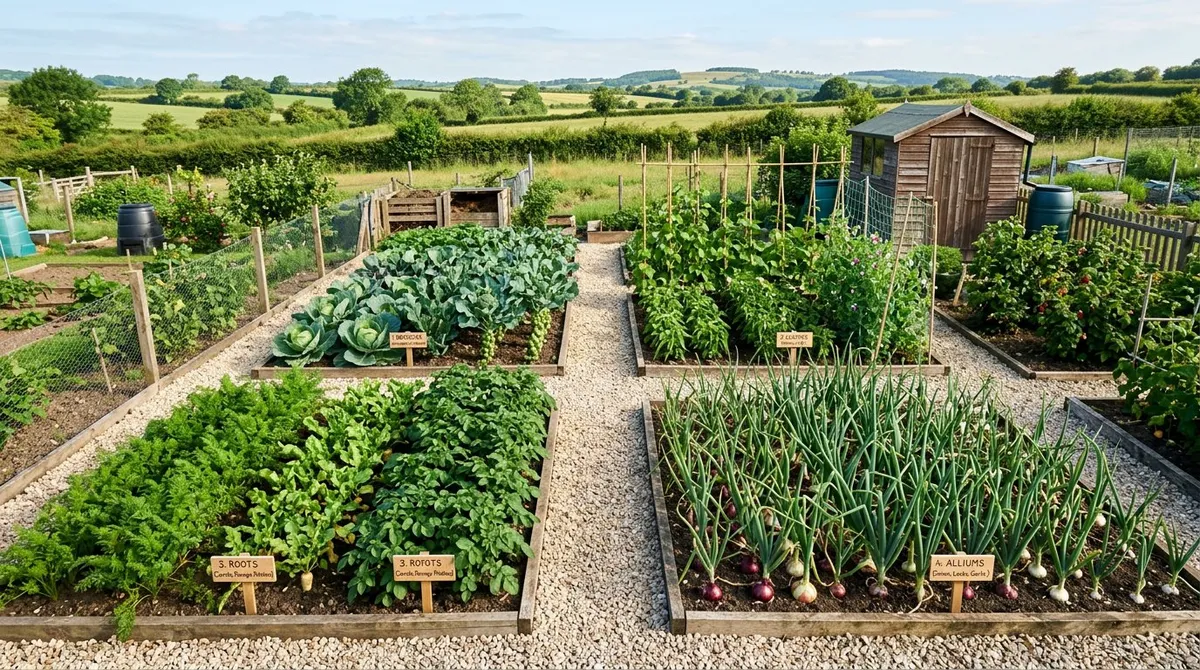
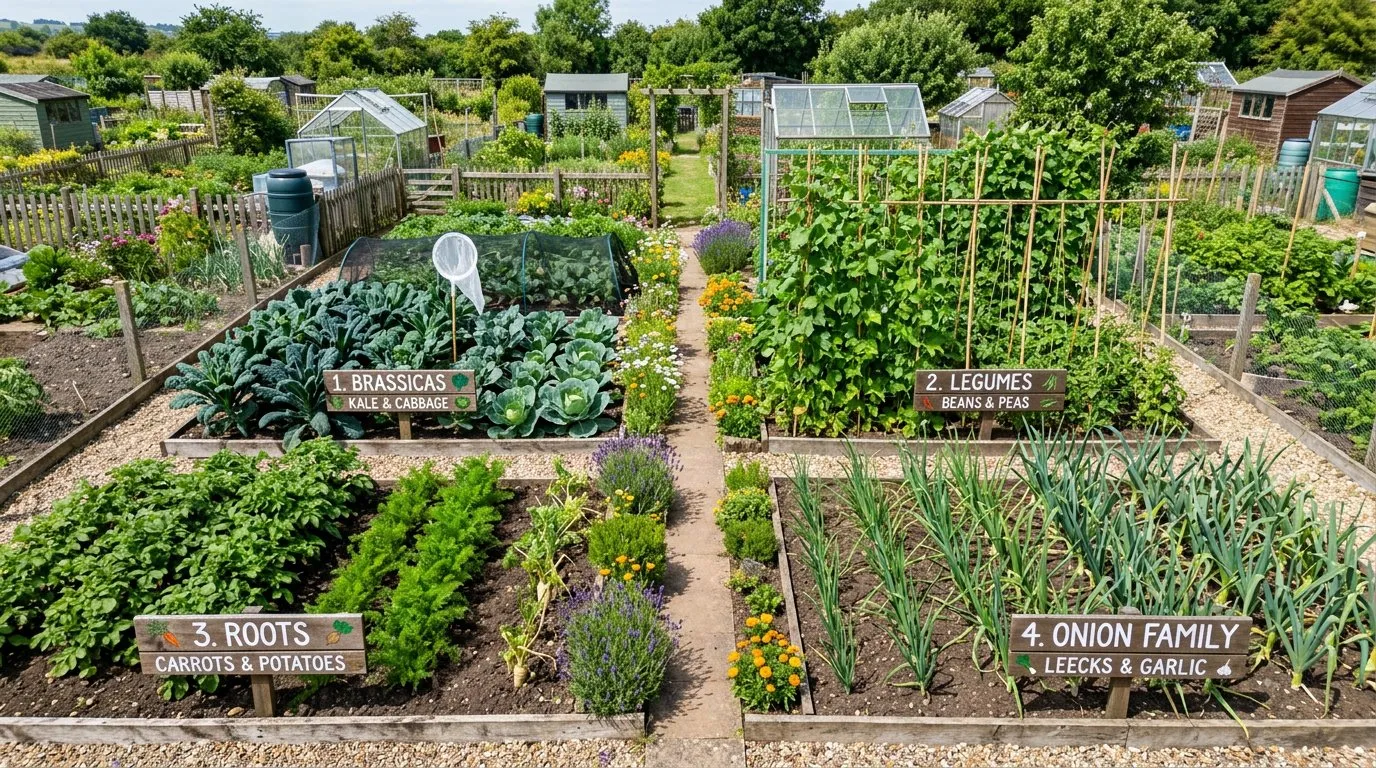 A four-bed rotation layout. Each family moves one bed each year, completing the full cycle in four years.
What goes where: a detailed planting list
Knowing which plant family each crop belongs to prevents common mistakes. Some groupings are not intuitive. Swede and turnips are brassicas, not root crops. Beetroot and chard are the same family (Chenopodiaceae). Tomatoes, potatoes, and peppers are all Solanaceae.
| Plant family | Common crops | Rotation group |
|---|---|---|
| Fabaceae (legumes) | Peas, broad beans, runner beans, French beans | Group 1 |
| Cucurbitaceae | Courgettes, squash, pumpkins, cucumbers | Group 1 |
| Poaceae (grasses) | Sweetcorn | Group 1 |
| Brassicaceae | Cabbage, kale, broccoli, cauliflower, Brussels sprouts, swede, turnip, radish, rocket | Group 2 |
| Solanaceae | Potatoes, outdoor tomatoes, peppers, aubergines | Group 3 |
| Apiaceae (umbellifers) | Carrots, parsnips, celery, celeriac, fennel | Group 3 |
| Chenopodiaceae | Beetroot, chard, spinach | Group 3 or 4 |
| Alliaceae | Onions, garlic, leeks, shallots, spring onions | Group 4 |
| Asteraceae | Lettuce, chicory, endive | Group 4 |
Permanent crops that do not rotate
Some vegetables stay in the same position for years or decades. These need their own dedicated area, separate from the rotation beds.
- Asparagus — a well-maintained asparagus bed produces for 15-20 years. Plant crowns 30cm deep in a sunny, well-drained spot and leave them permanently.
- Rhubarb — crowns last 10-15 years in the same position. They prefer partial shade and rich, well-manured soil.
- Globe artichokes — perennial plants lasting 4-5 years before needing replacement from offsets.
- Perennial herbs — rosemary, thyme, sage, oregano, and bay remain in fixed positions.
- Fruit bushes — gooseberries, blackcurrants, raspberries, and other soft fruit stay in permanent positions.
- Strawberries — although replanted every 3-4 years, they are best kept in a separate bed rather than included in the vegetable rotation.
Give permanent crops a sunny border or a dedicated bed along one edge of your plot. Keep them well mulched and fed annually with garden compost.
Green manures between crops
Green manures are fast-growing cover crops sown on bare soil between main vegetable crops. They suppress weeds, prevent nutrient leaching in winter rain, and some fix nitrogen. Think of them as a living mulch that feeds the soil while it waits for the next crop.
When to sow
The main window is August to October, after summer crops are cleared and before winter sets in. Some green manures can also be sown in spring to fill gaps before main crops go in.
Best green manures for UK vegetable gardens
| Green manure | Sow | Dig in | Nitrogen fixing? | Notes |
|---|---|---|---|---|
| Field beans | September-November | March-April | Yes | Very hardy, survives any UK winter |
| Winter tares | August-October | March | Yes | Good nitrogen fixer, less hardy than field beans |
| Phacelia | March-September | Before flowering | No | Attracts pollinators, decomposes quickly |
| Mustard | March-September | 4-6 weeks after sowing | No | Fast-growing, but is a brassica so avoid before brassica crops |
| Crimson clover | April-August | Before flowering | Yes | Attractive flowers, good for pollinators |
| Grazing rye | September-November | March | No | Deep roots improve soil structure on heavy ground |
Important rule: never sow a green manure from the same family as the crop that will follow it. Mustard is a brassica, so do not sow it before cabbages or broccoli. Field beans are a legume, but since legumes are followed by brassicas in the rotation, field beans before brassicas is actually the ideal sequence.
Cut or chop the green manure and dig it in (or lay it on the surface if practising no-dig) at least 3-4 weeks before sowing or planting the next crop. This allows the material to decompose and release its nutrients.
Why we recommend field beans as your default winter green manure: After testing most options over 30 seasons on UK allotments, field beans consistently outperform the alternatives. They are hardy enough to survive any UK winter without dying back, fix 50-100kg of nitrogen per hectare across the plot, and decompose quickly in spring once dug in. On a standard 10-bed allotment, sowing field beans after the summer crop in September adds the equivalent of two applications of balanced fertiliser before the next brassica year.
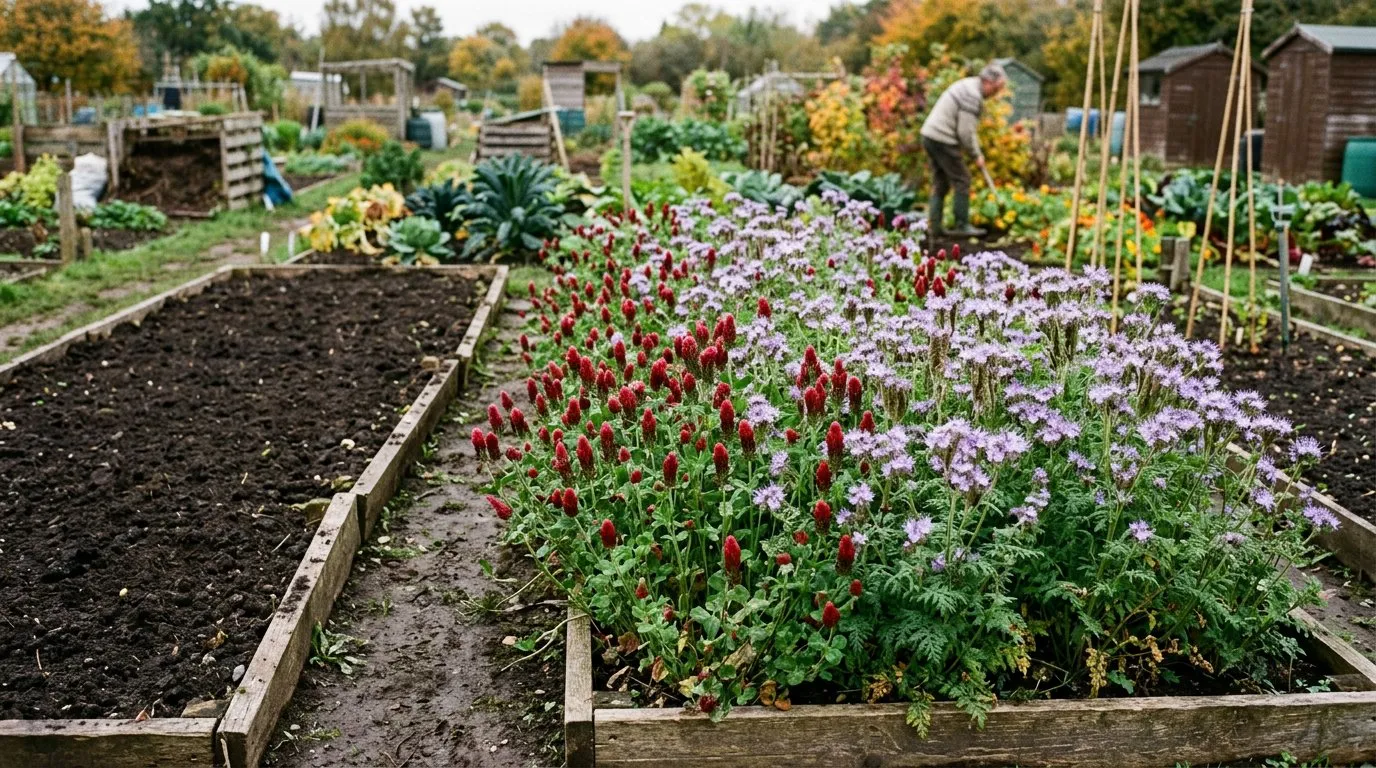 Winter field beans growing as a green manure on a cleared vegetable bed. They fix nitrogen and protect the soil through winter.
Nutrient management within the rotation
Each position in the rotation has different nutrient requirements. Understanding these prevents over- or under-feeding and helps you use manure and compost efficiently.
Where to add manure and compost
- Before legumes: Dig in well-rotted manure or compost. The legumes themselves do not need it, but the brassicas following next year will benefit from the settled fertility.
- Before brassicas: Add a nitrogen-rich top dressing (blood, fish, and bone or pelleted chicken manure) at planting time. Brassicas are the heaviest feeders.
- Before roots: No fresh manure. Root crops fork in freshly manured soil. The residual fertility from two seasons ago is ideal.
- Before alliums: A light dressing of garden compost is sufficient. Alliums have modest needs.
This system means you add manure or compost to each bed once every four years, in the autumn before the legume year. The nutrients work their way through the rotation, providing exactly what each group needs.
Our vegetable planting calendar helps coordinate sowing and planting dates with your rotation plan.
Common rotation mistakes
Even experienced allotment holders make rotation errors. Here are the most frequent problems and how to avoid them.
Forgetting that turnips and swedes are brassicas
Turnips and swedes are brassica family members, not root crops. Growing them in the root bed after cabbage in the brassica bed means they follow brassicas with brassicas — defeating the purpose of rotation. Always group them with cabbages and kale.
Ignoring greenhouse crops
Greenhouse tomatoes, peppers, and cucumbers are difficult to rotate because most gardeners have only one greenhouse. If you grow tomatoes in the same greenhouse border every year, soil-borne diseases like verticillium wilt build up. The solution is to grow in containers or grow bags, replacing the compost annually.
Making the beds too different in size
If one bed is twice the size of the others, you end up with far more alliums than brassicas in one year and the reverse in another. Try to keep all rotation beds roughly the same area. Adjust by using part of a larger bed for green manure.
Not keeping records
After two or three years, you will forget what grew where. Draw a simple plan each year or keep a diary. A sketch on the back of a seed packet is better than nothing. I keep a notebook with a dated bed map each spring — it takes two minutes.
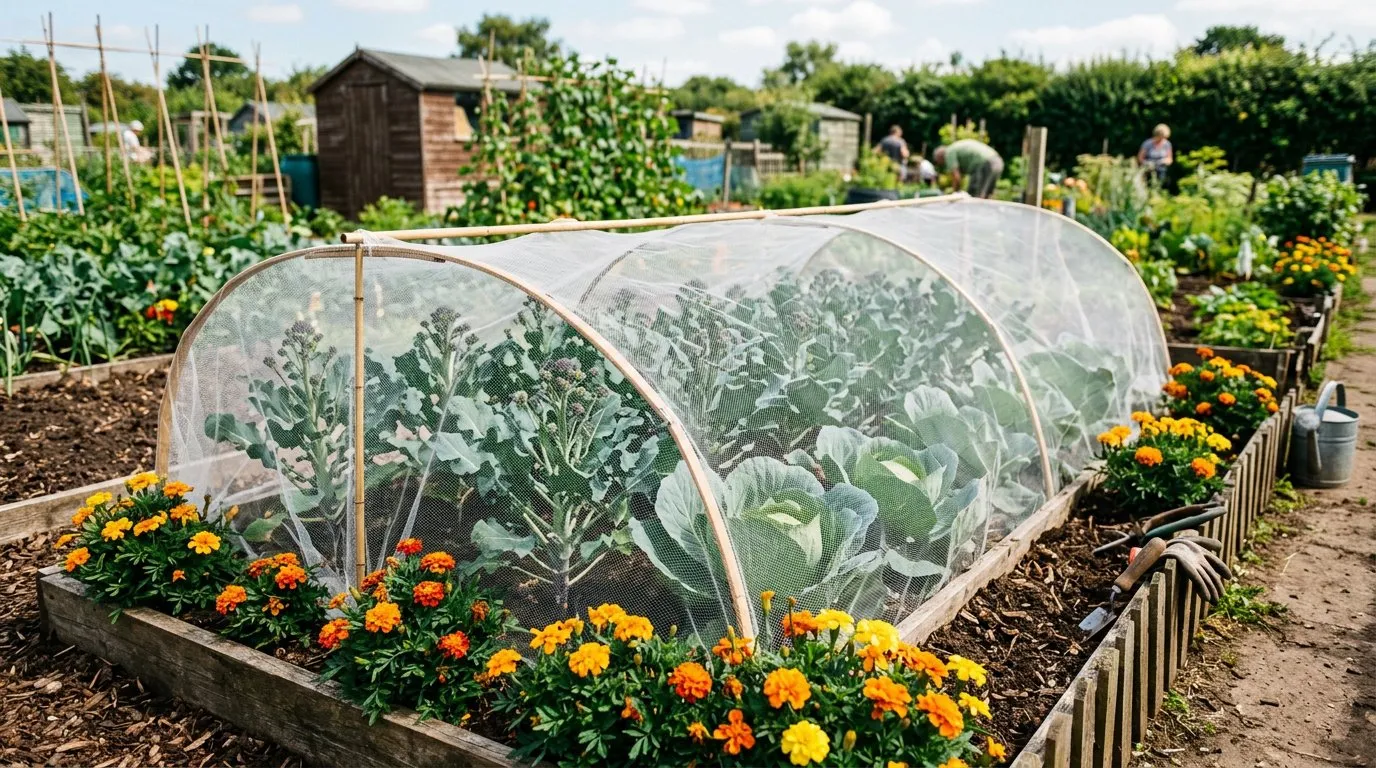 A dedicated brassica bed in the second year of rotation. Cabbages, kale, and purple sprouting broccoli follow the nitrogen-rich legume bed from the previous year.
Record keeping templates
A simple record helps you stick to the plan and troubleshoot problems. Here is a template you can copy into a notebook or spreadsheet.
| Year | Bed 1 | Bed 2 | Bed 3 | Bed 4 | Notes |
|---|---|---|---|---|---|
| 2026 | Peas, beans, courgettes | Cabbage, kale, broccoli | Potatoes, carrots, parsnips | Onions, garlic, lettuce | First rotation year |
| 2027 | Onions, garlic, lettuce | Peas, beans, courgettes | Cabbage, kale, broccoli | Potatoes, carrots, parsnips | Manure added to Bed 2 |
| 2028 | Potatoes, carrots, parsnips | Onions, garlic, lettuce | Peas, beans, courgettes | Cabbage, kale, broccoli | Manure added to Bed 3 |
| 2029 | Cabbage, kale, broccoli | Potatoes, carrots, parsnips | Onions, garlic, lettuce | Peas, beans, courgettes | Manure added to Bed 4 |
Record any problems — disease outbreaks, pest damage, poor yields — alongside the plan. Over several years, you build a picture of which crops perform best in which beds. Soil type, drainage, and sunlight exposure vary across most plots, and your records help you adapt the rotation to suit your specific conditions.
Rotation for container growers
Even gardeners growing entirely in containers benefit from rotation principles. The key is to avoid reusing the same compost for the same plant family.
If you grow tomatoes in grow bags one year, do not plant tomatoes in the same bags the following year. Use the spent compost for a different family (beans or lettuce work well in partially depleted compost), and start the tomatoes in fresh material.
For permanent containers, swap the crops each year following the four-group system. A large pot that grew potatoes in 2026 should grow beans in 2027, brassicas in 2028, and salads in 2029. Top up with fresh compost and a balanced fertiliser each time.
Making rotation work long-term
Crop rotation is a framework, not a rigid rulebook. Real allotments and gardens rarely follow the plan perfectly. The key is to follow the main principles — never the same family in the same bed two years running, and ideally a three to four year gap — while adapting to practical realities.
Some flexibility is fine:
- Intercropping — growing quick salads between slow brassicas does not break the rotation
- Catch crops — a row of radishes in a gap between potatoes and the next crop is harmless
- Emergency substitutions — if seedlings fail, plant whatever you have rather than leaving the bed empty
The rotation becomes second nature after two or three seasons. You stop thinking about which family goes where and simply move everything along one bed each spring. The soil health improvements are cumulative. By the fourth year, you should notice fewer disease problems, more balanced growth, and more consistent harvests across the whole plot.
Now you have mastered crop rotation, read our UK vegetable planting calendar to coordinate sowing and planting dates with your new rotation plan.
Start your rotation plan this spring. Draw a simple map of your beds, assign each group to a bed, and commit to moving everything along next year. It is one of the most effective things you can do for the long-term productivity of your vegetable garden.
Lawrie has been gardening in the West Midlands for over 30 years. He grows his own veg using no-dig methods, keeps a wildlife-friendly garden, and writes practical advice based on real UK growing conditions.