Grow Sunflowers with Children UK
How to grow sunflowers with children in the UK. Step-by-step guide with best varieties, age-appropriate tasks, growing competitions, and seed harvesting.
Key takeaways
- Total project cost is under £5 for seeds, pots, and compost
- Seeds germinate in 7-14 days and plants grow up to 5cm per day at peak
- Giant Russian reaches 2-3m, perfect for height competitions between siblings
- Dwarf Sunspot (45-60cm) suits pots on patios and balconies
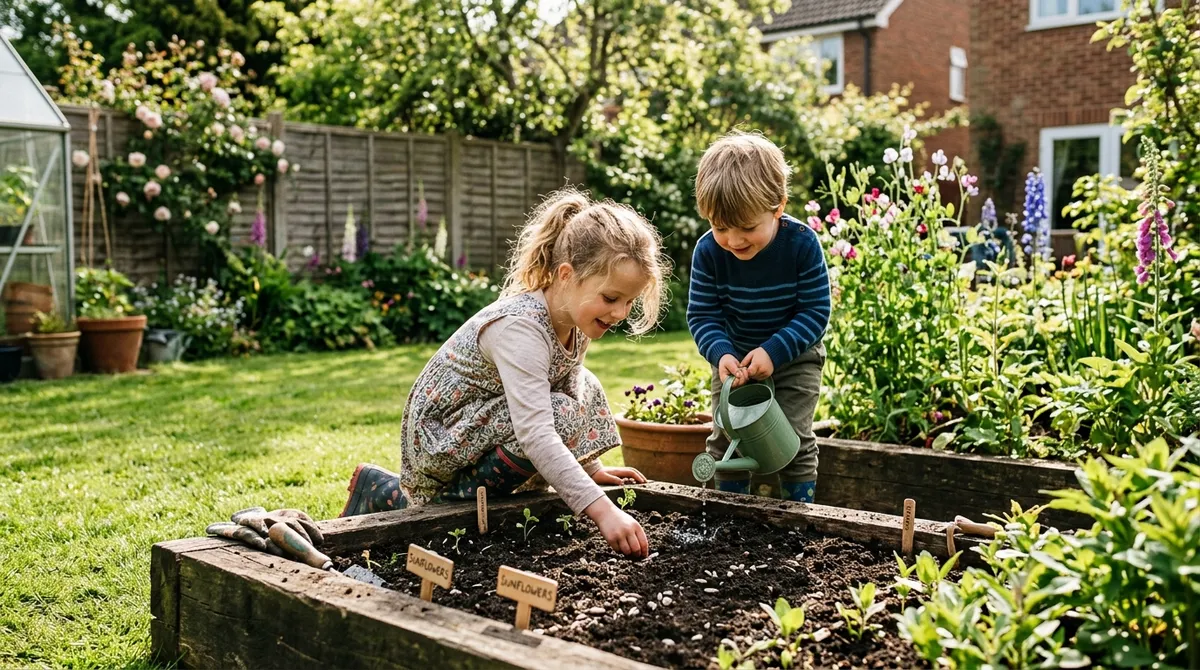
- Children aged 3 and up can sow the large seeds independently
- Leave seed heads standing in autumn to feed goldfinches and blue tits
Growing sunflowers with children in the UK is one of the simplest and most rewarding garden projects a family can tackle together. A single seed costs pennies. It germinates in a week. By August, it towers above the child who planted it.
This guide covers everything from sowing to seed harvesting, with age-appropriate tasks, competition ideas, and science activities. The whole project costs under £5 and runs from April to October. Whether you have a large garden, a small patio, or just a sunny windowsill, there is a sunflower variety that fits. For the full technical growing guide, see our how to grow sunflowers article.
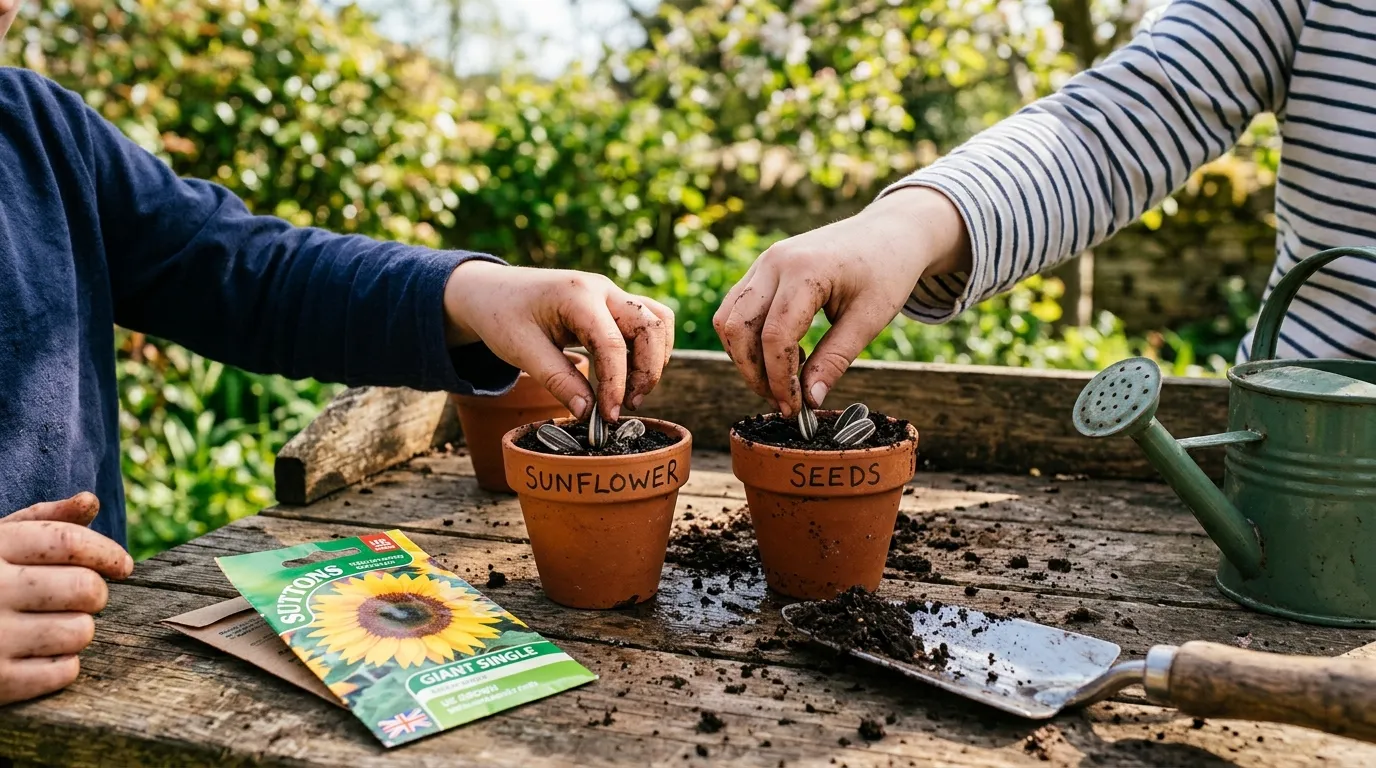
Sowing sunflower seeds is a hands-on activity that children as young as three can manage independently
What do you need to grow sunflowers with children?
The materials list is short and cheap. Most families already have half of it at home.
Seeds: One packet of sunflower seeds costs £1-£3 from any garden centre or supermarket. A single packet contains 15-50 seeds, enough for the whole family and a few spares. Choose Giant Russian for height competitions or Dwarf Sunspot for pots.
Pots: Recycled yoghurt pots, toilet roll tubes stood upright in a tray, or 9cm plastic pots all work. Punch drainage holes in the base of yoghurt pots with a pencil. Save money by collecting containers from the kitchen recycling over a week.
Compost: A 20-litre bag of peat-free multipurpose compost costs £3-£5 and fills 20-30 small pots. This is enough for an entire sunflower project with compost left over for other plantings.
Extras: A watering can with a fine rose head (£2-£4). Labels made from lolly sticks or cut-up milk cartons. A tape measure or ruler for height tracking.
| Item | Cost | Where to buy |
|---|---|---|
| Sunflower seeds (1 packet) | £1-£3 | Garden centre, supermarket, online |
| Peat-free compost (20L) | £3-£5 | Garden centre, DIY store |
| Small pots or yoghurt pots | Free | Kitchen recycling |
| Watering can (fine rose) | £2-£4 | Garden centre, pound shop |
| Labels (lolly sticks) | Free | Craft box, kitchen |
| Total | £3-£5 |
When to sow sunflower seeds with children
Timing matters. Sow too early and cold soil kills the seedlings. Sow too late and flowers do not open before autumn.
Indoor sowing (April-May): Fill pots with compost to 1cm below the rim. Push one seed 2cm deep per pot. Water gently until the compost is damp but not soggy. Place on a sunny windowsill at 18-25°C. Seeds germinate in 7-14 days. This is the safest method because it avoids slug damage and gives children the satisfaction of watching shoots appear indoors.
Outdoor sowing (May-June): Wait until the soil temperature reaches 10°C at a 10cm depth. In southern England this is typically late April. The Midlands and northern England usually reach 10°C by mid-May. Scotland may need to wait until late May. Make a hole 2cm deep with a finger, drop in one seed, cover with soil, and water.
Hardening off: Move indoor-raised seedlings outside for increasing periods over 7-10 days before planting out. Start with 2 hours on a sheltered patio and extend daily. For a full walkthrough, see our guide on how to sow seeds indoors.
| UK Region | Indoor sowing | Outdoor sowing | Expected flowering |
|---|---|---|---|
| Southern coast | Early April | Late April | July |
| London and Home Counties | Mid-April | Early May | Late July |
| Midlands | Mid-April | Mid-May | August |
| Northern England | Late April | Late May | August |
| Scotland (lowlands) | Late April | Late May-June | Late August |
Best sunflower varieties for children
Not all sunflowers are equal. A 3m giant needs staking and space. A 30cm dwarf fits on a windowsill. Match the variety to the child’s age, attention span, and available space.
Giant varieties for competitions
Giant Russian: The classic children’s sunflower. Reaches 2-3m with flower heads 25-30cm across. Single stem, single head. Perfect for “who can grow the tallest?” contests. Needs staking once it passes 1m.
Mongolian Giant: The tallest option at 3-4m. Flower heads reach 40-45cm. Needs sturdy staking and a sheltered position. Best for older children (8+) with garden space.
Dwarf varieties for pots and small spaces
Sunspot: Reaches 45-60cm with oversized flower heads on short, sturdy stems. The best visual impact for container growing. No staking needed.
Teddy Bear: Produces fluffy, double golden flowers at 60-90cm. Children love the texture. Holds an RHS Award of Garden Merit. Suits pots of 30cm diameter or larger.
Suntastic Yellow: A compact 20-30cm variety for windowsills and balconies. Pollen-free, so no mess indoors. Flowers in just 8-10 weeks.
| Variety | Height | Weeks to flower | Best for | Pot suitable |
|---|---|---|---|---|
| Giant Russian | 2-3m | 12-16 | Height competitions | No |
| Mongolian Giant | 3-4m | 14-18 | Record attempts | No |
| Sunspot | 45-60cm | 8-10 | Big heads, small space | Yes (30cm+) |
| Teddy Bear (AGM) | 60-90cm | 10-12 | Fluffy texture | Yes (30cm+) |
| Suntastic Yellow | 20-30cm | 8-10 | Windowsill growing | Yes (20cm+) |
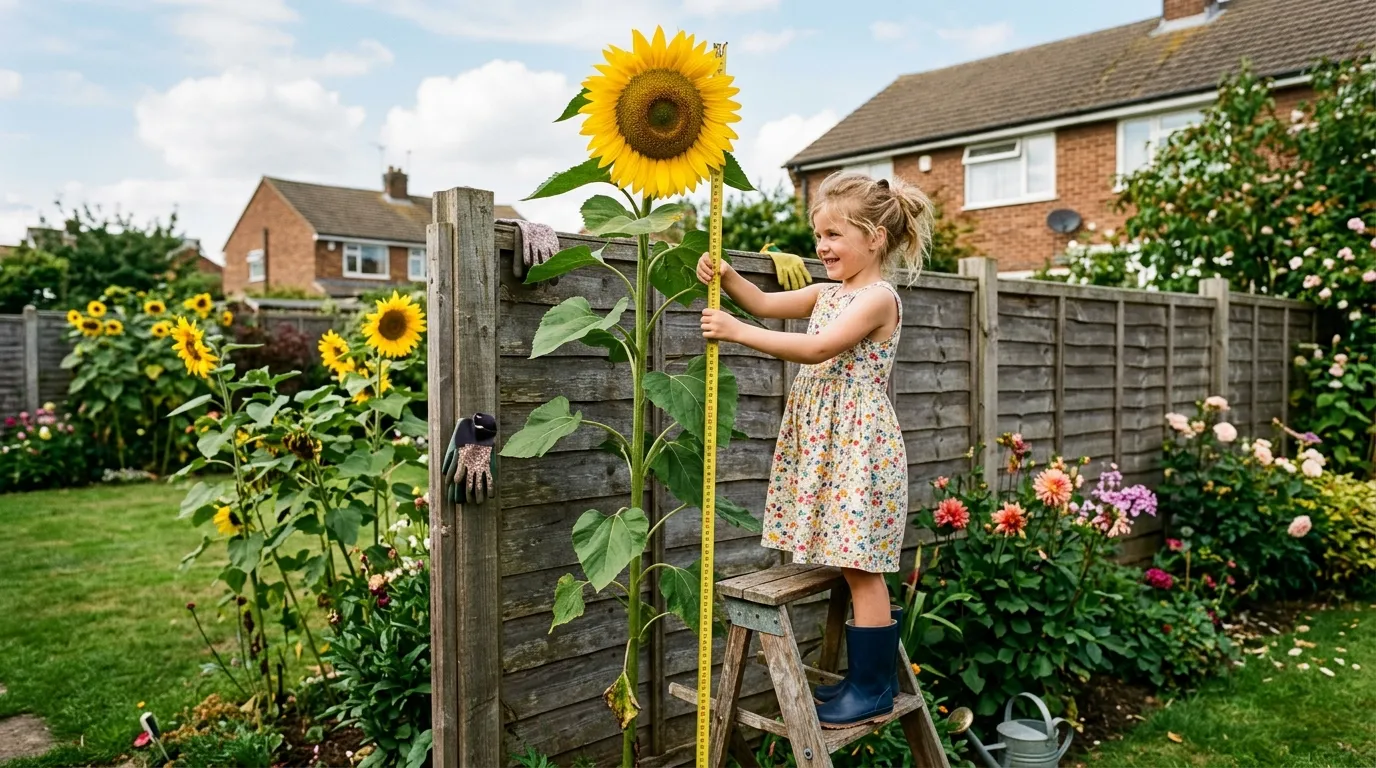
Measuring sunflower height each week gives children a tangible connection to the growing process
Step-by-step growing guide for children
Break the project into clear stages. Each stage has tasks suited to different ages.
Stage 1: Sowing (April-May)
- Fill a pot with compost to 1cm below the rim.
- Make a hole 2cm deep with a finger or pencil.
- Drop one seed into the hole, pointy end down.
- Cover with compost and press gently.
- Water with a fine-rose watering can until damp.
- Write the child’s name and the date on a label.
- Place on a sunny windowsill.
What children learn: Seed structure, germination requirements (water, warmth, air), measurement, recording data.
Stage 2: Growing on (May-June)
Once seedlings reach 10-15cm with two pairs of true leaves, they are ready to move outdoors. Harden off over 7-10 days. Plant into the ground with 45-60cm spacing for giants, or into pots of 30cm+ for dwarfs. Water the planting hole before placing the seedling. Firm the soil around the base.
Stage 3: Caring (June-August)
Water once a week in dry weather. Twice weekly in hot spells. Feed fortnightly with a balanced liquid fertiliser from June. Switch to tomato feed once buds appear. Stake giant varieties when they pass 1m using a bamboo cane and soft twine tied in a figure-of-eight.
Stage 4: Flowering and harvesting (August-October)
Watch the flower heads open over 2-3 days. Observe visiting bees, hoverflies, and butterflies. When the back of the head turns brown, the seeds are ripening. Cut the head with 30cm of stem and hang upside down to dry for 1-2 weeks. Store seeds in paper envelopes.
Age-appropriate tasks for sunflower growing
Children develop different motor skills and attention spans at different ages. Match the task to the child.
Ages 3-5: Little helpers
Toddlers and reception-age children can fill pots with compost using a scoop. They can push large sunflower seeds into pre-made holes. They enjoy watering with a small can. Show them how seedlings emerge and let them check the windowsill daily. Attention span: 10-15 minutes per session.
Ages 5-8: Independent growers
Primary school children can manage the full sowing process. They can write labels, record germination dates, and measure height weekly with a ruler. They can water and weed around their plant. Introduce simple science concepts: why does the stem lean towards the light? This age group thrives on the daily measurement routine.
Ages 8-12: Young scientists
Older children can run proper experiments. Compare two varieties side by side. Test different compost types. Measure growth in millimetres and plot it on a graph. Investigate phototropism by rotating pots. Count Fibonacci spirals in the seed head (typically 34 and 55 spirals). Harvest and save seeds for next year using our seed saving guide.
| Age group | Key tasks | Session length | Supervision |
|---|---|---|---|
| 3-5 years | Fill pots, push seeds in, water | 10-15 minutes | Full |
| 5-8 years | Sow, label, measure, water, weed | 15-25 minutes | Light |
| 8-12 years | Experiment, graph, photograph, harvest | 20-40 minutes | Minimal |
How to run a sunflower growing competition
A height competition keeps children engaged for the full 8-16 week growing season. Here is how to organise one that is fair and fun.
Rules: Each child gets one seed of the same variety (Giant Russian works best). All seeds sown on the same day into the same compost. Each child is responsible for watering and caring for their own plant. Measure height from soil level to the top of the growing tip every Sunday morning.
Height tracking chart: Create a simple chart on a large sheet of paper taped to a wall or fence. Write dates along the bottom and heights in centimetres up the side. Each child uses a different colour to mark their plant’s height weekly. At peak growth in July, expect 3-5cm per day. The chart becomes a visual record of the entire project.
Prizes: Tallest plant, largest flower head (measure diameter across the face), most seeds harvested, best sunflower drawing, most creative pot decoration. Multiple prize categories mean every child wins something.
School and community competitions: The RHS Campaign for School Gardening provides free resources for sunflower projects. National Children’s Gardening Week runs in late May each year and often includes sunflower challenges. Both are worth checking for downloadable activity sheets.
Science activities with sunflowers
Sunflowers are living science lessons. Every stage of growth demonstrates a principle that children study at school.
Phototropism (light-seeking): Place a sunflower seedling on a windowsill and mark which way it faces. After 2-3 days, it leans towards the window. Turn the pot 180 degrees. Within 24 hours, the stem curves back towards the light. The cells on the shaded side grow faster, bending the stem sunward. A 2016 study in Science confirmed this increases leaf area capture by over 10%.
Fibonacci spirals: When the seed head matures, count the spirals running clockwise and anticlockwise. Most sunflowers show 34 spirals one way and 55 the other. These are consecutive Fibonacci numbers (1, 1, 2, 3, 5, 8, 13, 21, 34, 55). This packing pattern is the most efficient way to fit the maximum number of seeds into a circular head.
Germination experiment: Sow seeds in three conditions. One pot on a warm windowsill (20°C), one in a cool room (10°C), and one in a dark cupboard at room temperature. Record which germinates first, which grows tallest after 2 weeks, and which produces the greenest leaves. This demonstrates the roles of warmth and light in plant growth.
Pollination observation: Watch the flower head for visiting insects. Bumblebees, honeybees, hoverflies, and butterflies all visit sunflowers. Count visitors over 10-minute intervals at different times of day. Morning visits peak between 9am and 11am when the east-facing flower head is warmest. Link this to our guide on bee-friendly plants for more pollinator activities.
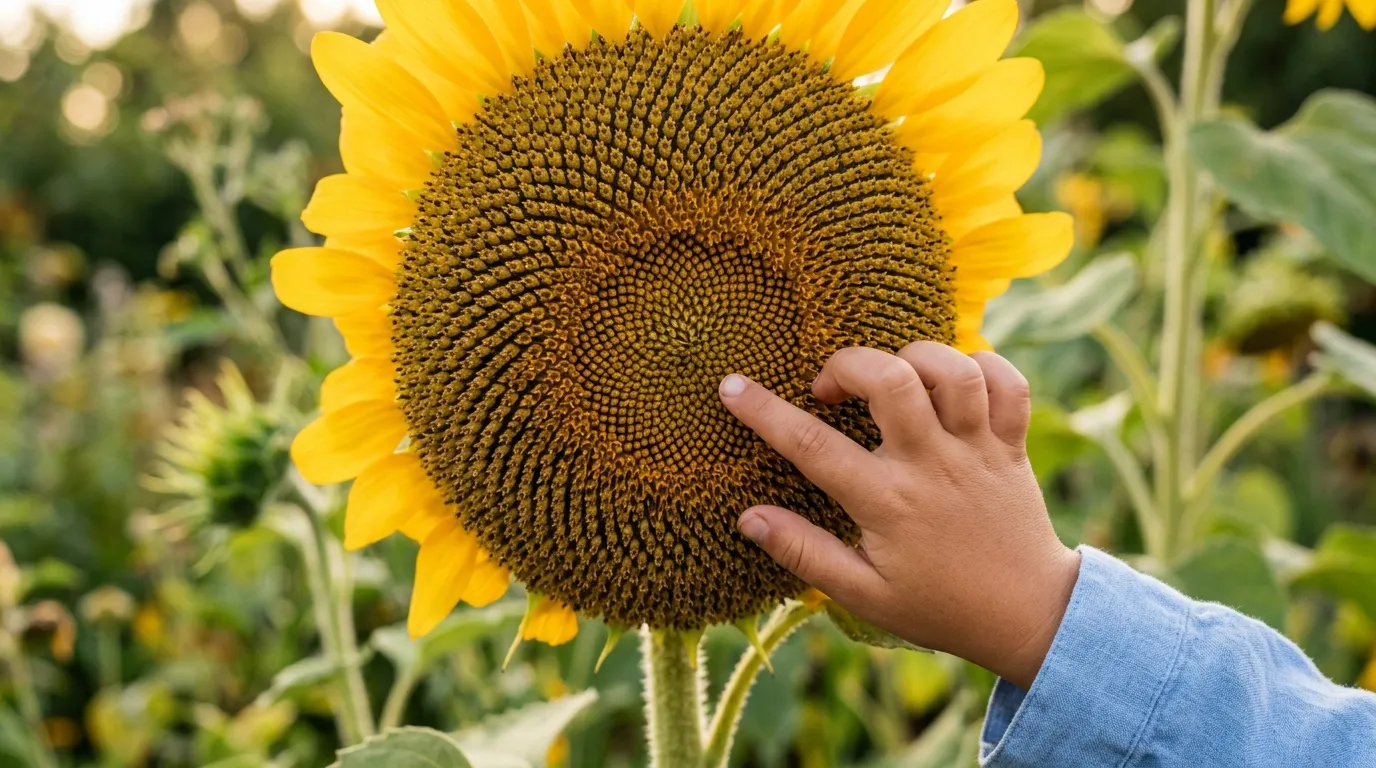
Counting the clockwise and anticlockwise spirals in a sunflower head reveals Fibonacci numbers — a real-world maths lesson
How to harvest sunflower seeds with children
Harvesting is the grand finale. Children who planted the seed in April get to collect hundreds of seeds from a single head by September.
When to harvest: The back of the flower head turns from green to yellow to brown. Petals dry and fall. Seeds look plump and the shells have black-and-white stripes. This usually happens in September or early October.
How to harvest: Cut the head with 30cm of stem attached. Hang it upside down in a dry, ventilated shed or garage for 1-2 weeks. Lay newspaper underneath to catch falling seeds. Once dry, children can rub the seeds out with their thumbs. A single Giant Russian head produces 400-1,000 seeds.
For eating: Rinse harvested seeds in water. Spread on a baking tray. Roast at 150°C for 20-25 minutes with a light drizzle of oil and a pinch of salt. Cool completely. Store in an airtight jar. Nutritional value per 30g serving: 170 calories, 6g protein, 14g healthy fats, 2.5mg iron (18% of a child’s RDA).
For birds: Leave 2-3 seed heads standing in the garden through autumn and winter. Goldfinches, blue tits, and greenfinches feed on them daily. This connects the growing project to wildlife observation. See our bird feeding guide for year-round feeding strategies.
For next year: Store dried seeds in labelled paper envelopes in a cool, dry place. Open-pollinated varieties like Giant Russian grow true from saved seed. Hybrid (F1) varieties do not reproduce reliably. Home-saved seeds remain viable for 2-3 years if kept dry.
Common problems when growing sunflowers with children
Slugs eating seedlings: The single biggest threat. Slugs strip young seedlings to bare stems overnight. Solution: grow indoors until seedlings reach 15cm, then plant out. Copper tape around pots deters slugs. Beer traps catch them. Avoid chemical slug pellets around children. See our slug control guide for safe methods.
Seeds not germinating: Usually caused by cold, wet compost. Sow into moist (not soggy) compost at 18-25°C. If nothing appears after 14 days, the seed may be unviable. Sow 2-3 extras as insurance.
Stems snapping in wind: Stake tall varieties early. Push the cane in when planting out, not after the stem has grown thick. Tie loosely with soft twine. A sheltered spot near a south-facing wall or fence gives wind protection and extra warmth.
Leaning towards light: Rotate pots a quarter-turn every 2-3 days on windowsills. Outdoors, plant in an open position with light from all sides. Some lean is natural and adds character.
Aphids on stems: Green or black aphids cluster on stems and buds from May. Blast them off with a jet of water from a hose. Encourage ladybirds by planting companion flowers like marigolds and calendula nearby.
Sunflower growing calendar for families
This month-by-month timeline keeps the project on track from spring to autumn.
| Month | Task | Who does it |
|---|---|---|
| April | Sow seeds indoors on windowsill | Children (with adult help for ages 3-5) |
| May | Harden off seedlings; sow outdoors in warm regions | Children water and move pots |
| June | Plant out; begin weekly measuring; start height chart | Children measure and record |
| July | Water twice weekly; stake tall varieties; feed fortnightly | Children water; adults stake |
| August | Flowers open; observe pollinators; photograph | Children count bees and draw |
| September | Harvest seed heads; dry indoors for 1-2 weeks | Children cut and hang heads |
| October | Rub out seeds; sort for eating, saving, and birds | Children sort and label |
Add spent sunflower stems to the compost heap in October. They are carbon-rich and break down over winter. Chop them into 15-20cm sections first to speed decomposition.
Making sunflowers part of a wildlife garden
Sunflowers attract more than 50 insect species during flowering. Bees, hoverflies, butterflies, and beetles all visit for nectar and pollen. After flowering, the seed heads become a bird feeder. A single head keeps a pair of goldfinches fed for a week.
Plant sunflowers alongside other wildlife-friendly flowers to extend the season. Wildflower lawns provide habitat from May through September. A bug hotel near the sunflower patch gives solitary bees and ladybirds a nesting site within foraging distance.
Children who grow sunflowers learn that a garden is not just a decorative space. It is a working ecosystem. The seed they pushed into compost in April feeds a goldfinch in November. That connection, from seed to flower to wildlife, is the most valuable lesson a garden can teach.
Frequently asked questions
What age can a child start growing sunflowers?
Children from age 3 can sow sunflower seeds. The seeds are 10-15mm long, large enough for small hands to grip and push into compost. Younger toddlers enjoy watering with a small can. By age 5, children can manage the full process from sowing to harvesting with light supervision.
When should children plant sunflower seeds in the UK?
Sow indoors from April, outdoors from May. Indoor sowing on a sunny windowsill gives a 2-3 week head start and avoids slug damage to young seedlings. Wait until soil reaches 10°C for outdoor sowing. Southern England is ready by late April; northern regions and Scotland by mid-May.
How long does it take for a child’s sunflower to grow?
Seeds germinate in 7-14 days. Dwarf varieties flower in 8-10 weeks from sowing. Giant varieties take 12-16 weeks. At peak growth in July, stems can add 5cm per day, which children find thrilling to measure each morning.
What is the best sunflower variety for children to grow?
Giant Russian is best for height competitions at 2-3m tall. Dwarf Sunspot suits pots and small gardens at 45-60cm. Teddy Bear produces fluffy double flowers that children love to touch. For classrooms, try Suntastic Yellow at just 20-30cm.
How much does it cost to grow sunflowers with children?
A packet of sunflower seeds costs £1-£3 and contains 15-50 seeds. A bag of peat-free compost costs £3-£5. Recycled yoghurt pots or toilet roll tubes work as free seed starters. Total project cost is under £5 for a full season of growing.
Can children grow sunflowers in pots?
Dwarf varieties grow well in pots of 30cm diameter or larger. Use peat-free multipurpose compost and water daily in summer. Sunspot, Teddy Bear, and Suntastic Yellow are the best container choices. Place pots in full sun for at least 6 hours daily.
What can children do with sunflower seeds after harvesting?
Children can save seeds for next year, roast them as snacks, or leave them for birds. Store dried seeds in paper envelopes in a cool, dry place. Roast at 150°C for 20 minutes with salt. Leaving seed heads in the garden feeds goldfinches and blue tits through autumn and winter.
Further reading
- How to grow sunflowers in the UK — the full technical guide to sowing, growing, and harvesting
- Children’s garden design ideas — safe plants, play areas, and growing zones for families
- When to plant sunflowers — detailed timing guide for every UK region
- How to create a wildlife garden — ponds, hedgehog highways, and habitat building
- Seed sowing calendar — month-by-month guide for all UK seeds
Lawrie has been gardening in the West Midlands for over 30 years. He grows his own veg using no-dig methods, keeps a wildlife-friendly garden, and writes practical advice based on real UK growing conditions.