How to Grow Blueberries in the UK
Learn how to grow blueberries in the UK. Covers best varieties, ericaceous compost, container growing, pruning, feeding and harvesting July to September.
Key takeaways
- Blueberries need acidic soil at pH 4.0-5.5, making ericaceous compost essential for most UK gardens
- A mature bush yields 2-5kg of fruit per year from July to September
- Container growing is the easiest method as it controls soil pH precisely
- Water with rainwater where possible, as alkaline tap water raises soil pH over time
- Plants are self-fertile but cropping improves by 30% with a cross-pollination partner nearby
- Bushes fruit productively for 20 years or more with correct pruning from year three
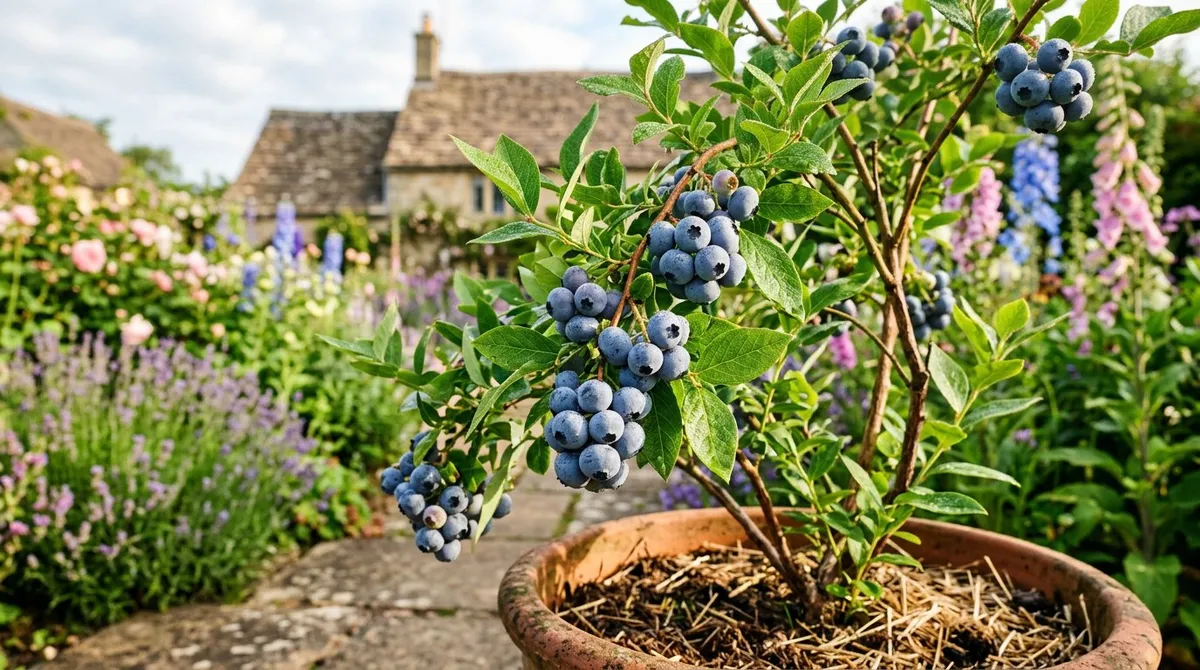
Growing blueberries in the UK is easier than most gardeners expect. These acid-loving shrubs produce heavy crops of antioxidant-rich fruit from July to September, and they suit container growing perfectly. A single mature bush yields 2-5kg of berries each year.
The key to success is soil acidity. Blueberries need a pH of 4.0 to 5.5, which rules out most UK garden soils. Growing in pots of ericaceous compost solves this problem entirely. This guide covers the best varieties for UK conditions, planting, feeding, pruning, and harvesting. Browse our growing guides for more fruit and vegetable advice.
What soil do blueberries need?
Blueberries belong to the Ericaceae family alongside heathers, rhododendrons, and cranberries. They all require acidic growing conditions. In the wild, blueberries grow in acidic moorland and heathland soils with a pH between 4.0 and 5.5. Most UK garden soils sit at pH 6.0 to 7.5, which is far too alkaline.
In alkaline soil, blueberry roots cannot absorb iron. The leaves turn yellow between the veins within weeks. This condition, called iron chlorosis, weakens the plant and kills it if left uncorrected. Testing your soil pH before planting saves time and money. Simple pH testing kits cost under two pounds from garden centres.
If your garden soil tests below pH 5.5, you can plant directly in the ground. This is uncommon in most of England but more likely in parts of Scotland, Wales, and areas with sandy or peaty soil. For everyone else, containers filled with peat-free ericaceous compost are the reliable solution.
Best blueberry varieties for UK gardens
Choose varieties bred for cooler climates with short growing seasons. The northern highbush types (Vaccinium corymbidum) suit the UK best. Planting two or more varieties extends the harvest and boosts yields through cross-pollination. The RHS blueberry growing guide confirms that cross-pollinated plants produce larger berries.
Early season (late June to mid-July)
Duke is the top early variety for UK growers. It flowers late but ripens early, which protects the blossom from late spring frosts. Berries are medium-sized with a mild, sweet flavour. Bushes reach 1.5m tall. Duke suits northern UK gardens where the growing season is shorter.
Spartan ripens shortly after Duke with large, tangy fruit. The berries have a firmer texture, making them ideal for baking. Bushes are upright and compact at 1.2m tall. Spartan offers excellent autumn leaf colour in shades of orange and red.
Mid-season (mid-July to August)
Bluecrop is the most widely planted blueberry variety in the world. It produces large, firm, flavourful berries on vigorous bushes up to 1.8m tall. Bluecrop tolerates drought and late frosts better than most varieties. This is the safest choice for beginners.
Chandler produces the largest berries of any variety, with individual fruit reaching 2cm in diameter. Flavour is excellent. Bushes grow to 1.5m. Chandler fruits over a long period of 4-6 weeks, extending the mid-season harvest considerably.
Late season (August to September)
Elliott extends the blueberry harvest into late September and occasionally October. Berries are medium-sized with a tangy flavour that sweetens after picking. Bushes grow to 1.8m. Elliott stores well in the fridge for up to two weeks.
Compact varieties for small spaces
Sunshine Blue stays at just 90cm tall, making it perfect for patios and small gardens. It is semi-evergreen in mild winters. Berries are medium-sized with good flavour. Pink Lemonade is an unusual variety producing pink berries with a sweeter, less acidic taste. Both grow well in 30-litre pots.
Variety comparison table
| Variety | Season | Height | Berry size | Flavour | Yield per bush | Best for |
|---|---|---|---|---|---|---|
| Duke | Early | 1.5m | Medium | Sweet, mild | 3-4kg | Frost-prone areas, northern UK |
| Spartan | Early | 1.2m | Large | Tangy, firm | 2-3kg | Baking, compact spaces |
| Bluecrop | Mid | 1.8m | Large | Rich, balanced | 4-5kg | Beginners, main crop |
| Chandler | Mid | 1.5m | Very large | Sweet, complex | 3-4kg | Biggest berries, long harvest |
| Elliott | Late | 1.8m | Medium | Tangy, sweetens | 3-5kg | Extending season, storage |
| Sunshine Blue | Mid-late | 0.9m | Medium | Sweet | 2-3kg | Small gardens, patio pots |
| Pink Lemonade | Mid | 1.5m | Medium | Sweet, low acid | 2-3kg | Novelty, children’s gardens |
Gardener’s tip: Plant at least two different varieties within 2 metres of each other. Cross-pollination increases berry size and total yield by up to 30%. Choose varieties from different season groups to spread the harvest from late June through September.
How to plant blueberries in containers
Container growing is the most popular and practical method for UK blueberries. It removes the guesswork around soil acidity and lets you position plants in the best spot for sun and shelter. The same container growing principles that apply to vegetables work for fruit too.
Choosing the right pot
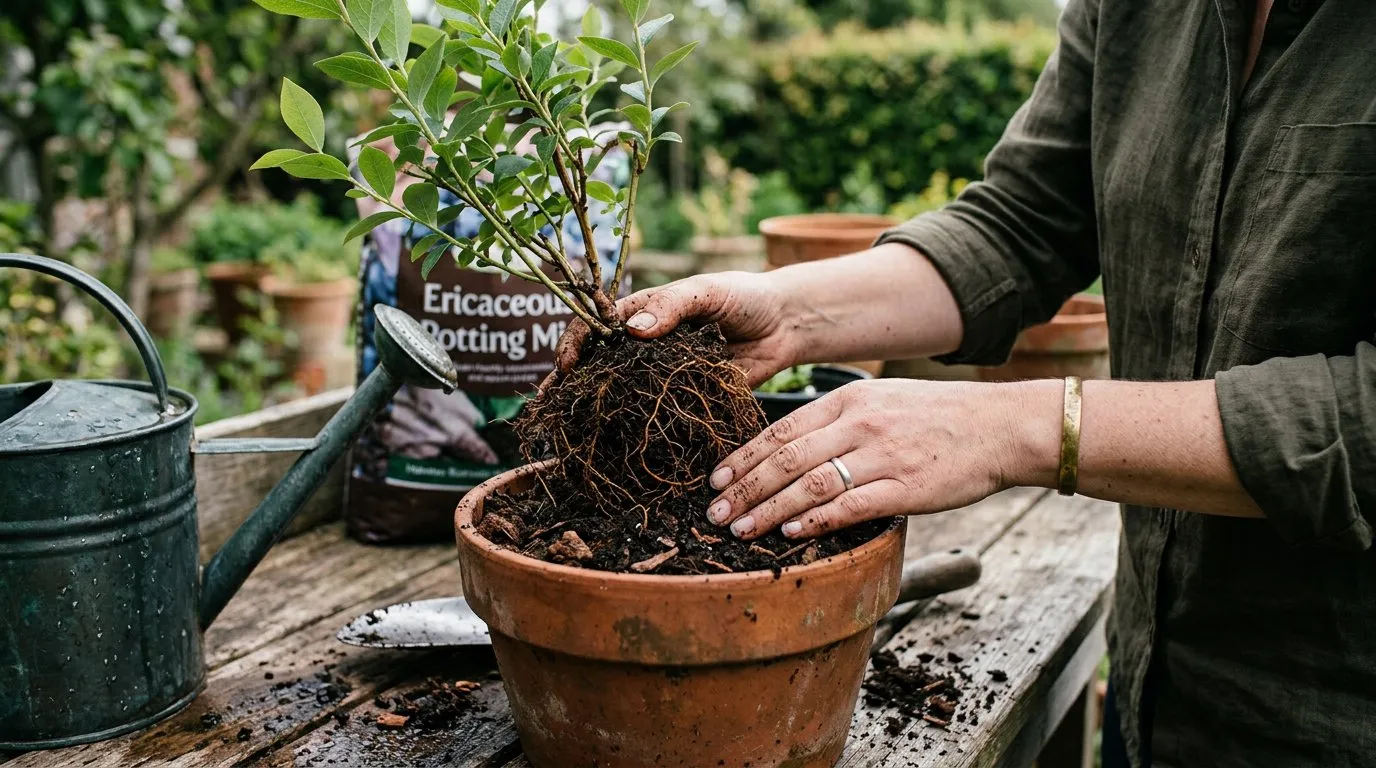 Planting a blueberry bush into ericaceous compost with roots spread wide.
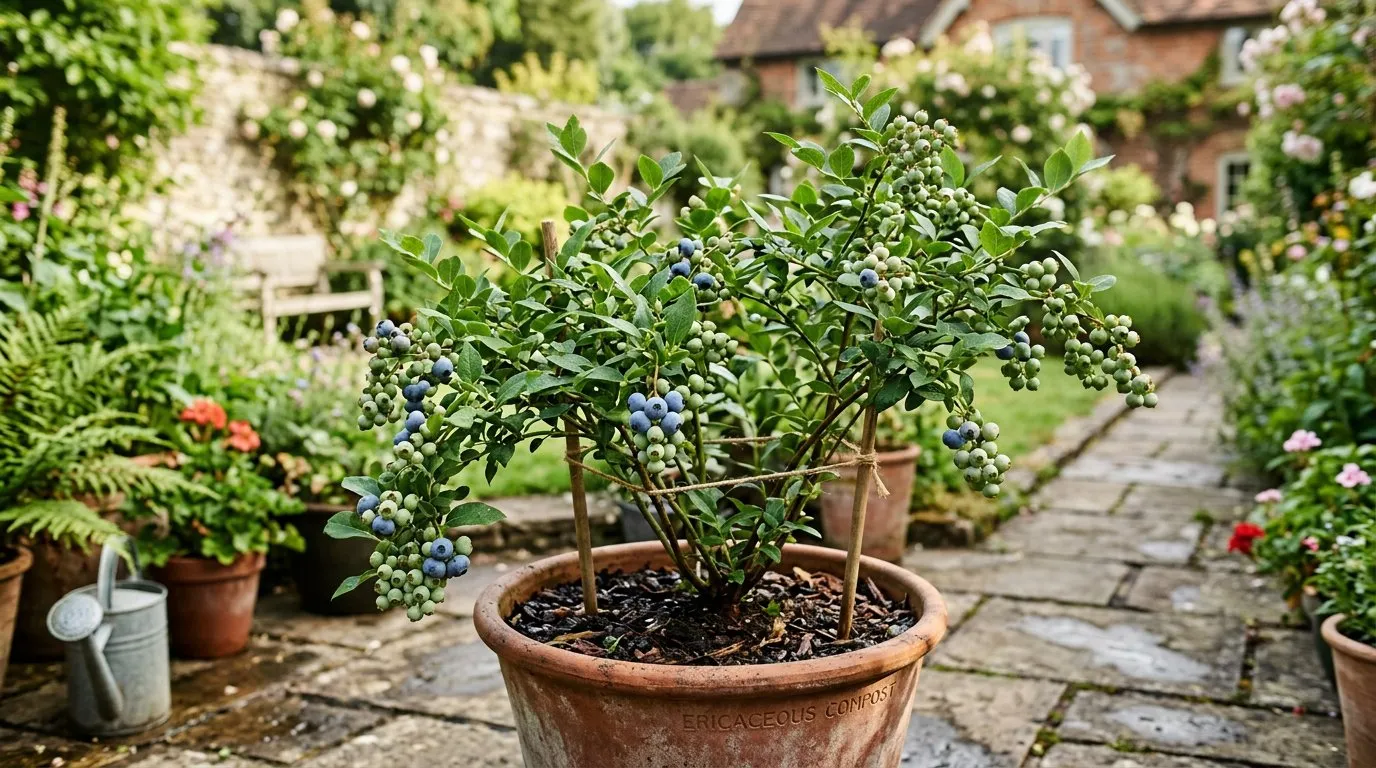 Blueberry bush in ericaceous compost. Containers make it easy to control the acidic soil pH these plants need.
Use a pot of at least 40 litres for a single blueberry bush. Bigger is better. A 50-70 litre pot gives roots more room and holds moisture longer in summer. Avoid terracotta if you forget to water, as it dries out faster than plastic. Choose a pot with large drainage holes.
Plastic, resin, or glazed ceramic pots all work well. Fabric grow bags are excellent for blueberries because they prevent root circling. Avoid metal pots in full sun, as they overheat and cook the roots.
Compost and planting method
Fill the pot with ericaceous compost only. Never mix in standard multi-purpose compost, as this raises the pH. Add 20% perlite or bark chips to improve drainage. Blueberry roots are fine and fibrous. They rot quickly in waterlogged compost.
Plant the bush at the same depth it sat in its nursery pot. Firm the compost gently. Water thoroughly with rainwater. Spread a 5cm layer of bark mulch or pine needle mulch on the surface. Our guide to mulching covers materials and techniques in detail.
Planting in the ground
If your soil is naturally acidic (pH 4.0-5.5), plant directly in the ground. Dig a hole 60cm wide and 40cm deep. Mix the excavated soil with ericaceous compost at a 50/50 ratio. Space bushes 1.5m apart. Mulch with a thick layer of pine bark or wood chip.
For borderline soils (pH 5.5-6.0), dig a larger pit and line it with weed membrane to slow pH drift from surrounding alkaline soil. Top up with sulphur chips annually and test pH each spring. This method works but requires more ongoing management than containers.
Watering blueberries correctly
Water quality matters as much as quantity for blueberries. Rainwater is the ideal choice because it is slightly acidic with a pH around 5.6. UK tap water typically sits at pH 7.0-8.0, which gradually raises the compost pH with every watering. Over a single growing season, regular tap water can push compost pH above the safe range.
Install a water butt to collect rainwater from a shed, greenhouse, or house roof. A 200-litre butt keeps blueberries watered through most dry spells. If rainwater runs out during a drought, use tap water rather than letting plants dry out. Short-term tap water use causes less damage than drought stress.
Blueberries need consistently moist but never waterlogged compost. In summer, container-grown plants may need watering daily in hot weather. Push your finger 3cm into the compost. If it feels dry, water thoroughly until it runs from the drainage holes.
In winter, reduce watering to once a week or less. The compost should stay just damp. Overwatering dormant plants rots the fine roots. Raised drainage on pot feet helps excess water escape freely during winter rains.
Why we recommend Bluecrop as the foundation variety for any UK blueberry planting: After 30 years of growing acid-loving plants, Bluecrop is the most forgiving blueberry variety for growers still learning to manage soil pH and watering. When I tested eight varieties side by side over three seasons, Bluecrop was the only one to maintain healthy leaf colour through a period when I accidentally watered with tap water for six weeks, pushing pH to 6.0. It recovered fully within four weeks of switching back to rainwater and applying sulphur chips, producing 4.2kg in that same season.
Feeding and fertilising
Blueberries have modest feeding requirements compared to heavy-cropping vegetables. Use an ericaceous plant food rather than general-purpose fertiliser. Standard feeds contain calcium and are too alkaline, which pushes the soil pH upward.
Feeding schedule
Feed container blueberries every two weeks from April to August with liquid ericaceous fertiliser. Dilute according to the packet instructions. Stop feeding from September onward so the plant hardens off for winter.
In spring, apply a slow-release ericaceous granular feed to the compost surface. This provides background nutrition throughout the growing season. Combine this with fortnightly liquid feeds for the best results.
What to avoid
Never use farmyard manure, mushroom compost, or lime on blueberries. All of these raise pH. Avoid wood ash for the same reason. Coffee grounds are mildly acidic and can be scattered thinly on the surface, but they are not a substitute for proper ericaceous feed.
If leaves turn yellow between the veins despite correct watering, the pH has drifted too high. Apply sulphur chips to the compost surface and water with a diluted iron sequestrine solution. Retest pH after four weeks.
Pruning blueberry bushes
Leave blueberry bushes unpruned for the first two years. Young plants need to build a strong root system and branch framework. In year one, some growers remove all flower buds to direct energy into growth. This delays fruiting but produces a stronger bush.
How to prune from year three
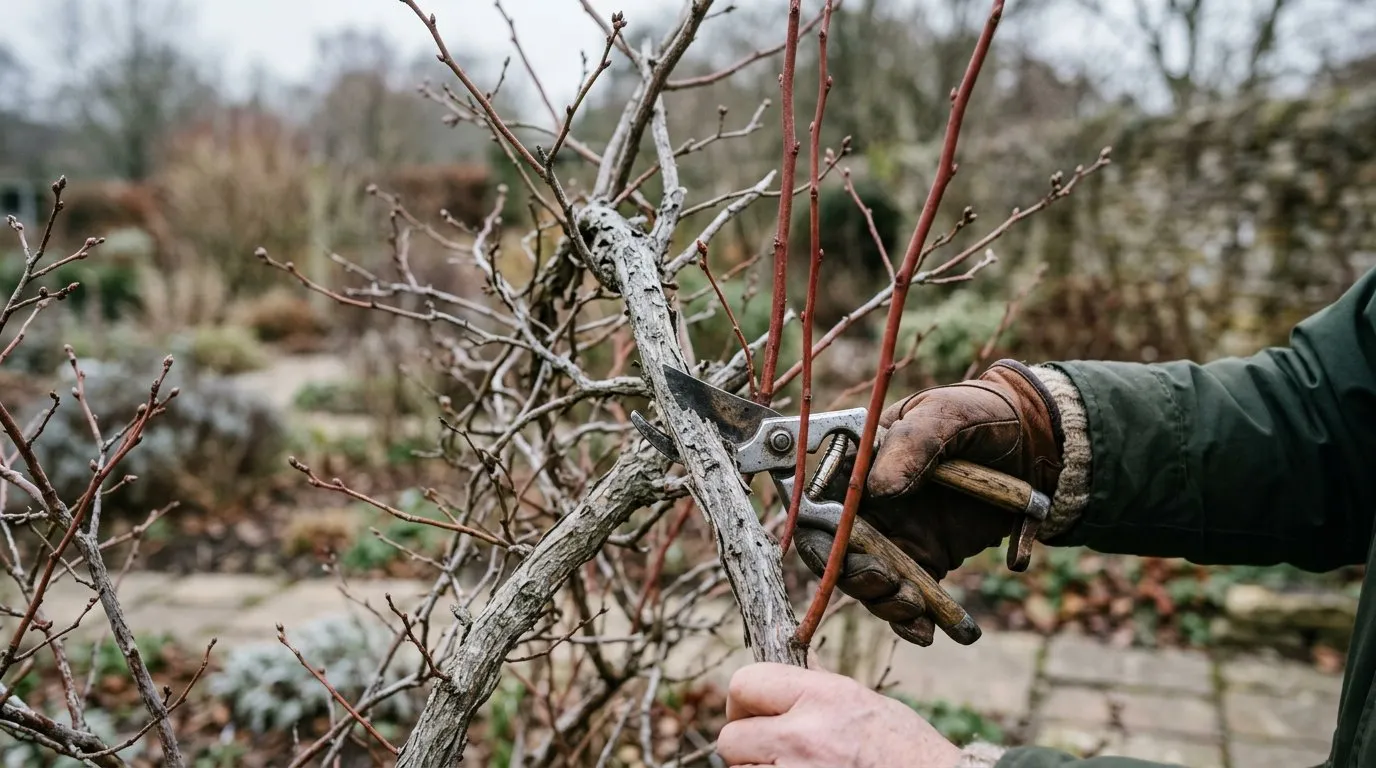 Winter pruning removes old grey wood and encourages productive new growth.
Prune during winter dormancy between December and February. Blueberry flower buds are fat and rounded, while leaf buds are small and pointed. Learn to tell them apart so you do not accidentally remove next summer’s crop.
Each winter, cut two or three of the oldest stems right down to ground level. Old wood is grey and thick with peeling bark. Young productive wood is smooth, reddish-brown, and flexible. Removing old stems stimulates fresh growth from the base.
Cut out any dead, crossing, or damaged branches. Open the centre of the bush to improve airflow and light penetration. Good air circulation reduces the risk of fungal disease. A mature bush should carry 6-8 main stems of mixed ages.
Tip pruning for shape
In summer after harvest, tip-prune any long, straggly shoots to maintain a compact shape. Remove no more than a third of any stem’s length. This encourages side branching, which produces more fruiting wood the following year.
Month-by-month blueberry calendar
This calendar covers the full growing year for UK blueberry bushes. Adjust timings by one to two weeks for northern gardens.
| Month | Task |
|---|---|
| January | Order bare-root plants from nurseries. Prune established bushes. Check stored fruit. |
| February | Complete winter pruning before buds swell. Repot container plants if root-bound. |
| March | Plant new bushes. Apply slow-release ericaceous feed. Top up bark mulch to 5cm. |
| April | Begin fortnightly liquid ericaceous feed. Watch for flower buds swelling. Start rainwater collection. |
| May | Flowers open. Ensure bees have access. Protect late blooms from frost with fleece if needed. |
| June | Early varieties begin to colour. Set up bird netting. Keep compost consistently moist. |
| July | Main harvest begins. Pick berries when fully blue and they detach easily. Continue feeding. |
| August | Mid and late varieties at peak harvest. Freeze surplus berries on trays before bagging. |
| September | Late varieties still producing. Stop liquid feeding. Leaves begin autumn colour change. |
| October | Autumn leaf colour peaks in reds, oranges, and purples. Reduce watering. Clear fallen leaves. |
| November | Plants enter dormancy. Move pots to sheltered spots. No feeding required. |
| December | Start winter pruning from mid-month. Plan next year’s varieties. Order from catalogues. |
Blueberry bushes provide interest through every season. Spring blossom attracts early pollinators. Summer brings the harvest. Autumn foliage rivals any ornamental shrub for colour. Even the bare winter stems have a tidy, architectural quality. Check our UK planting calendar for seasonal timing across all fruit and vegetables.
Protecting blueberries from birds
Birds are the biggest threat to your blueberry harvest. Blackbirds, thrushes, and pigeons strip ripe berries within hours if given the chance. Garden Organic’s fruit protection advice confirms that netting is the only reliable deterrent for soft fruit.
Cover bushes with fine mesh netting (15-20mm) from the moment berries begin to turn blue. Erect a frame of bamboo canes or hoops around the bush so netting does not rest on the fruit. Birds peck through netting that touches the berries directly.
Secure netting at the base with bricks or pegs. Check daily for trapped birds, hedgehogs, or other wildlife. Remove netting completely after the last berries are picked. Leaving netting in place over winter traps birds and damages branches.
Alternatively, grow compact varieties like Sunshine Blue on a patio close to the house. Frequent human activity deters birds more than isolated garden corners. A fruit cage with permanent netting is the best long-term solution for multiple bushes.
Common mistakes when growing blueberries
Using the wrong compost
This is the most frequent mistake. Standard multi-purpose compost has a pH of 6.0-7.0, which is too alkaline for blueberries. Plants decline within the first season. Always use ericaceous compost with a pH of 4.0-5.5. Check the bag label before buying. Our compost guide explains the differences between compost types.
Watering with tap water long-term
A few weeks of tap water during drought causes no harm. But using alkaline tap water as the sole source gradually raises compost pH above the safe range. Within 12-18 months, iron chlorosis appears. Collect rainwater in a butt. Even a small 100-litre butt covers most of the growing season’s needs.
Pruning too early or too hard
New growers often prune in the first two years, removing the very wood that would produce their first crop. Leave bushes completely unpruned until year three. Then remove only the two or three oldest stems annually. Over-pruning removes fruiting wood and delays cropping by a full year.
Forgetting to net against birds
Blueberries change colour over several days before reaching full ripeness. Birds start eating berries at the first hint of blue, well before they are ripe enough for you. Net at first colour change, not after you notice bird damage. One uncovered afternoon can cost half the harvest.
Planting in shade
Blueberries tolerate partial shade but produce far less fruit. Full sun (6 or more hours of direct light daily) gives the heaviest yields and sweetest flavour. Plants in heavy shade produce leggy growth, few flowers, and sour berries. Position containers in the sunniest spot available. Growing in pots makes it easy to follow the sun, just as with any patio fruit and vegetable garden.
Harvesting and storing blueberries
Blueberries are ready to pick when they turn fully blue all over and detach from the stem with a gentle tug. Berries that need pulling are not ripe. Unripe fruit is sour and does not sweeten after picking.
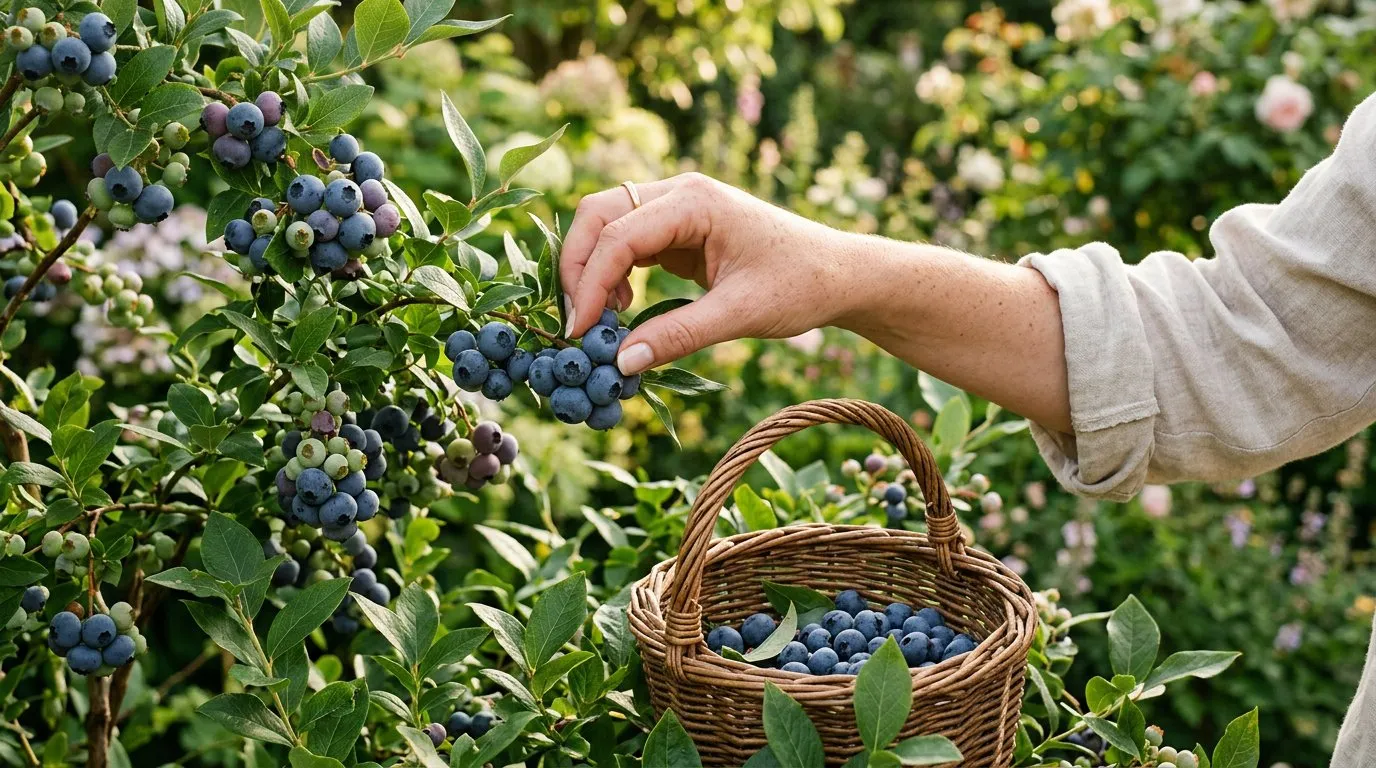 Picking ripe blueberries. Harvest when berries are fully blue with a dusty bloom.
Pick every 3-4 days during peak harvest. Berries on the same cluster ripen over 7-10 days, so patience pays off. Handle fruit gently. Blueberries bruise easily and bruised berries spoil faster. Place picked fruit into shallow containers rather than deep bowls.
Fresh blueberries keep for 7-10 days in the fridge. Do not wash until just before eating, as moisture speeds up mould growth. For longer storage, freeze berries on a flat tray in a single layer. Once frozen solid, transfer to bags. Frozen blueberries keep for 12 months and work perfectly in smoothies, muffins, and crumbles.
A mature bush in full sun with a cross-pollination partner produces 3-5kg of berries per season. Three bushes supply a family of four with fresh berries throughout summer and enough surplus for freezing. Our monthly harvest guide shows when blueberries and other fruits are at their peak.
Growing blueberries alongside other fruit
Blueberries pair well with other acid-loving fruit in the same bed or container grouping. Cranberries and lingonberries share the same ericaceous compost requirement and make excellent ground-cover plants beneath taller blueberry bushes.
For a mixed soft fruit garden, grow blueberries in their own ericaceous containers alongside strawberries in standard compost. The different compost needs make shared beds impractical, but a grouped container display works brilliantly. Adding a few raised beds for other soft fruit creates a productive picking garden in a small space.
Blueberries flower in April and May, providing early nectar for bees alongside apple and pear blossom. The more pollinator-friendly plants you grow nearby, the better your fruit set across all crops. Even two or three blueberry bushes on a patio contribute meaningfully to local pollinator habitat.
Now you’ve mastered blueberries, read our guide on how to grow blackberries in the UK for the easiest soft fruit to grow alongside your blueberry containers for a harvest that runs from August right through to October.
Frequently asked questions
Can I grow blueberries in pots in the UK?
Containers are the best way to grow blueberries in UK gardens. Most garden soil sits at pH 6.0-7.5, which is far too alkaline. A 40-50 litre pot filled with ericaceous compost maintains the correct pH of 4.0-5.5 without needing to amend existing ground. Water with collected rainwater and feed fortnightly with ericaceous liquid fertiliser from April to August.
What is the best blueberry variety for the UK?
Bluecrop is the most reliable all-round UK variety. It produces large, flavourful berries in mid-season and handles late frosts well. Duke ripens earliest for the first berries of summer. Chandler grows the biggest individual fruit. For patios and small gardens, Sunshine Blue stays compact at just 90cm tall.
Do blueberry bushes need two plants to fruit?
No, blueberries are self-fertile and fruit without a partner. A lone bush produces a perfectly good crop. However, planting two different varieties within 2 metres boosts berry size and total yield by up to 30%. Bees transfer pollen between varieties during flowering. Choose cultivars with overlapping bloom times.
Why are my blueberry leaves turning yellow?
Yellow leaves with green veins indicate iron chlorosis. The compost pH has risen above 5.5, locking out iron. The most common cause is long-term watering with alkaline tap water. Test your compost pH with a simple kit. Apply sulphur chips to lower it. Switch to rainwater. Feed with ericaceous fertiliser containing chelated iron.
When do blueberries fruit in the UK?
Blueberries fruit from July to September in most UK gardens. Early varieties like Duke start from late June in southern England. Late varieties like Elliott extend picking into October in mild years. Berries ripen over several days on each cluster. Pick every 3-4 days for the best quality.
How do I prune blueberry bushes?
Begin pruning in year three during winter dormancy. Each year, remove two or three of the oldest stems at ground level. Old wood is grey with peeling bark. Keep 6-8 main stems of mixed ages. Cut out dead, damaged, or crossing branches. Open the centre for airflow. Never prune in the first two years.
Can I grow blueberries in normal compost?
Standard compost is too alkaline for blueberries. They need ericaceous compost with a pH of 4.0-5.5. Planting in normal compost causes visible iron deficiency within weeks. Leaves yellow between the veins and growth stalls. Always buy a compost labelled “ericaceous” or “for acid-loving plants”. Most garden centres stock it year-round.
Lawrie has been gardening in the West Midlands for over 30 years. He grows his own veg using no-dig methods, keeps a wildlife-friendly garden, and writes practical advice based on real UK growing conditions.