How to Grow Carrots in the UK
Practical guide to growing carrots in UK gardens. Covers varieties, sowing times, soil prep, carrot fly prevention, containers, and storing your harvest.
Key takeaways
- Sow carrots direct into the ground from March to July for harvests from June to November
- Choose stone-free, sandy soil and never add fresh manure, which causes forked roots
- Nantes varieties are the best all-rounder for UK gardens, ready in 12-14 weeks
- Prevent carrot fly with barriers at least 60cm high or by companion planting with onions
- Short varieties like Chantenay and Amsterdam Forcing grow well in pots just 20cm deep
- Succession sow every 3-4 weeks from March to July for a continuous supply
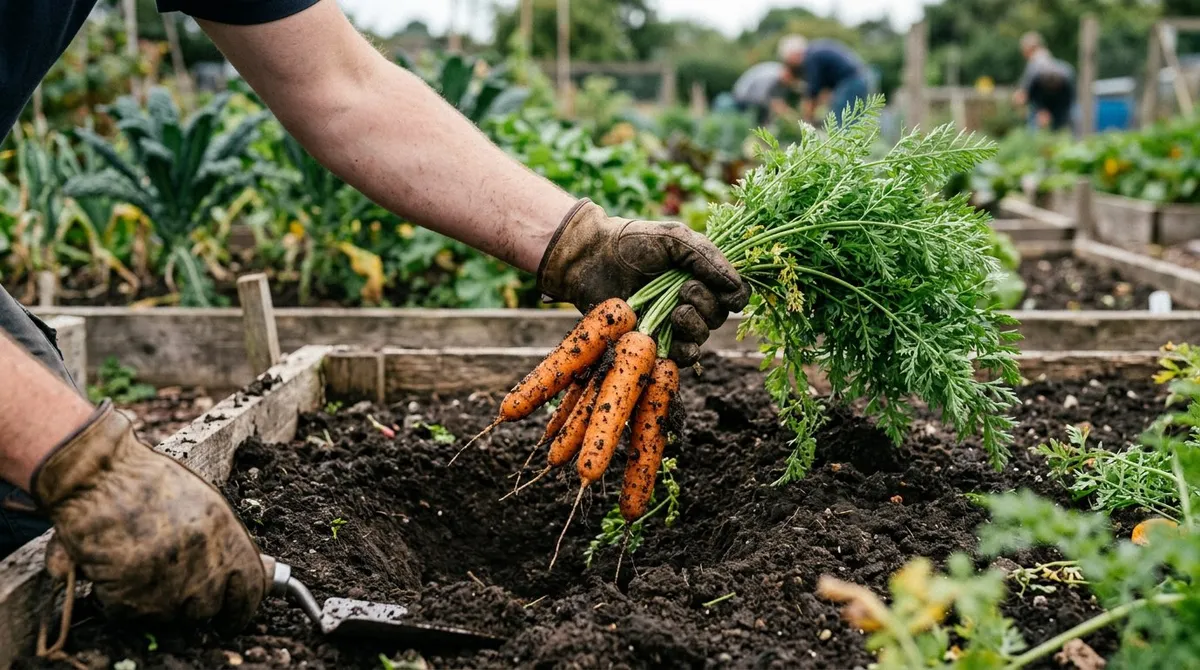
Carrots are one of the most popular vegetables grown in British gardens, and for good reason. They are straightforward to grow from seed, produce heavy crops in a small space, and taste dramatically better pulled fresh from the soil than anything wrapped in plastic from a supermarket. A single 3-metre row yields roughly 4-5kg of roots.
The UK climate suits carrots well. They are a cool-season crop that germinates from soil temperatures as low as 7C and tolerates light frost. Carrots grow well in allotments, raised beds, and deep containers on patios. This guide covers soil preparation, variety choice, dealing with carrot fly, and storing your harvest through winter.
Choosing the best carrot varieties
Selecting the right variety is the first step. UK garden centres and seed catalogues offer dozens of choices, but they all fall into a handful of types based on root shape and growing speed.
| Variety type | Root shape | Length | Weeks to harvest | Best for |
|---|---|---|---|---|
| Amsterdam Forcing | Slim, cylindrical | 10-15cm | 10-12 | Containers, early sowings, baby carrots |
| Nantes | Cylindrical, blunt tip | 15-20cm | 12-14 | All-round use, fresh eating, freezing |
| Chantenay | Short, conical, broad shoulders | 10-15cm | 12-14 | Heavy soil, containers, stews |
| Autumn King | Long, tapered | 20-30cm | 16-20 | Maincrop, winter storage |
| Purple/Rainbow | Variable | 15-25cm | 14-16 | Visual interest, salads, roasting |
Best varieties for UK gardens
Nantes types are the best all-rounders. They produce straight, sweet, cylindrical roots with almost no core. Nantes 2 is the classic and still one of the best. Nairobi is an improved Nantes with strong disease resistance. Bolero stores exceptionally well.
Chantenay Red Cored is the go-to for heavier soils where longer varieties would fork. The short, stumpy roots push through imperfect ground more reliably than any Nantes type. Chantenay Royal has improved colour and sweetness.
Amsterdam Forcing 3 is the variety for containers and early sowings under cloches. The slim, 15cm roots mature quickly and taste outstanding pulled young as baby carrots.
Autumn King is the classic maincrop storage carrot. Long, tapered roots with excellent keeping quality. Sow in April or May for lifting in October and storing through winter.
Purple Haze and Rainbow varieties add striking colour to salads and roasting trays. Purple carrots contain anthocyanins, the same antioxidants found in blueberries. The flavour is slightly more complex than standard orange varieties.
Gardener’s tip: Grow at least two varieties each season. An early Nantes type for summer eating and an Autumn King for winter storage gives you home-grown carrots for most of the year.
Preparing the soil
Soil preparation matters more for carrots than almost any other vegetable. The roots grow downward through the soil for 15-30cm. Anything that gets in the way causes forking, splitting, or stunted growth.
Stone-free soil is essential. Spend time raking the bed and removing stones, lumps, and old roots. Even a small stone will cause a carrot to split around it. The ideal soil is a light, sandy loam that drains freely and warms up early in spring.
Never add fresh manure to a carrot bed. Fresh or partly rotted manure causes roots to fork wildly as they grow around nitrogen-rich pockets. If you want to add organic matter, dig in well-rotted compost the previous autumn and let it break down fully over winter.
Heavy clay soil is not ideal, but carrots will grow in it with preparation. Add sharp sand and fine compost to lighten the top 20-30cm. Alternatively, grow short varieties like Chantenay or Amsterdam Forcing, which do not need the depth that long-rooted types require. Raised beds filled with a light compost mix solve the clay problem entirely.
Soil pH and fertility
Carrots prefer a slightly acidic to neutral soil, pH 6.0-6.8. They are not heavy feeders. Over-feeding with nitrogen produces lush foliage at the expense of root development. A bed that grew well-fed brassicas or potatoes the previous year will have enough residual fertility for a good carrot crop.
If you are following a crop rotation, carrots fit neatly into the root vegetable year, following legumes or brassicas. Avoid growing carrots in the same spot two years running, as soil-borne pests and diseases accumulate.
How to sow carrots
Carrots must be sown direct. They cannot be transplanted. The taproot is easily damaged during handling, and even a gentle move causes forking or the root dying off entirely. Sow seed where you want the carrots to grow, no exceptions.
When to sow
Carrots need a minimum soil temperature of 7C to germinate. In most of southern England, the soil reaches this by early to mid-March. Northern England and Scotland may need to wait until late March or April. Use a soil thermometer for accuracy.
For detailed month-by-month timing, see our UK vegetable planting calendar.
- Early sowings (March-April): Use quick-maturing varieties like Nantes or Amsterdam Forcing. Cover with cloches or fleece to warm the soil and speed germination.
- Main sowings (April-June): The peak sowing window. All varieties perform well. This is the time for Autumn King and other maincrops.
- Late sowings (June-July): Quick-maturing Nantes types for an autumn harvest. Sow by mid-July at the latest.
Sowing method
- Rake the soil to a fine tilth, removing any stones
- Draw a shallow drill 1-2cm deep using a cane or the edge of a hoe
- Water the drill before sowing if the soil is dry
- Sow seed thinly along the drill. Carrot seed is tiny, so take your time
- Cover lightly with fine soil and firm gently with the back of a rake
- Space rows 15-20cm apart for early varieties, 25-30cm for maincrops
Carrot seed is notoriously slow to germinate. Expect to wait 14-21 days before seedlings appear. Do not give up on them. Sow a few radish seeds along the row as markers. They germinate in 4-5 days and show you where the drill is before the carrots emerge.
Succession sowing for a continuous harvest
One of the biggest mistakes new growers make is sowing all their carrots at once. This produces a glut in late summer followed by nothing. Succession sowing solves the problem entirely.
Sow a short row every 3-4 weeks from March through to July. Each sowing matures at a different time, giving you fresh carrots from June right through to November. A typical schedule looks like this:
| Sowing date | Variety type | Expected harvest |
|---|---|---|
| Early March (under cloches) | Amsterdam Forcing, early Nantes | June |
| Late March | Nantes | July |
| Mid-April | Nantes, Chantenay | August |
| Early May | Autumn King, Nantes | September |
| Late May | Autumn King | October |
| Mid-June | Nantes | October-November |
| Early July | Nantes (quick-maturing) | November |
Our guide to how to sow seeds indoors covers general seed-starting techniques, though remember that carrots must always go directly into outdoor soil.
Thinning seedlings
Thinning is necessary but needs care. Overcrowded carrots compete for space and produce small, spindly roots. But thinning releases the scent of crushed foliage, which attracts carrot fly. Timing and technique matter.
Thin seedlings in two stages. When they reach 2-3cm tall, remove the weakest plants to leave seedlings roughly 3cm apart. A few weeks later, thin again to a final spacing of 5-8cm between plants. Wider spacing produces larger roots.
Thin in the morning when carrot fly is least active. Water the row before and after thinning to settle the soil around remaining roots. Pinch off unwanted seedlings at soil level rather than pulling them out, which disturbs neighbouring roots less. Remove all thinnings from the bed and compost them away from the carrot patch.
Some gardeners avoid thinning entirely by sowing into a wide, shallow drill and scattering seed very thinly. This works well but requires discipline at sowing time. Pelleted seed, where each seed is coated in a clay shell, makes precise spacing much easier.
Carrot fly prevention
Carrot fly (Psila rosae) is the most damaging pest for UK carrot growers. The female fly lays eggs at the base of carrot plants. The larvae burrow into the roots, leaving brown tunnels and ruining the crop. A badly affected bed can lose 80-100% of its harvest.
How carrot fly finds your carrots
Carrot fly locates crops by scent. Crushing or bruising carrot foliage releases volatile compounds that the fly detects from hundreds of metres away. Thinning seedlings is the single biggest trigger. The fly is a weak flier and stays within 45-60cm of the ground.
Physical barriers
The most effective prevention is a barrier at least 60cm tall around the carrot bed. Use fine insect mesh (0.8mm or smaller) supported on canes or a wooden frame. The fly cannot get over or through it. Alternatively, cover the entire bed with horticultural fleece immediately after sowing and leave it in place until harvest.
Companion planting
Growing onions, spring onions, or chives between carrot rows helps mask the carrot scent. The strong allium smell confuses the fly. Interplant one row of spring onions for every two rows of carrots. This is not foolproof on its own but reduces the risk when combined with other methods.
Resistant varieties
Several varieties have been bred with lower levels of chlorogenic acid, the compound that attracts carrot fly. Flyaway, Resistafly, and Sytan all show significantly reduced damage in trials. They are not fully immune, but they reduce losses by 50-70% compared to standard varieties.
Timing
Carrot fly has two main generations per year. The first arrives in May-June, the second in August-September. Sowing after early June avoids the first generation entirely, which is why late sowings often produce the cleanest roots.
Growing carrots in containers
Containers are an excellent option if your garden soil is stony, heavy clay, or infested with carrot fly. You control the growing medium entirely, and a raised container puts the crop above the fly’s typical flight path.
Choosing containers
Any container at least 20cm deep works for short varieties (Amsterdam Forcing, Chantenay). For Nantes types, use pots or troughs 30cm deep. Old wooden crates, large pots, grow bags, and window boxes are all suitable. Ensure drainage holes in the base.
Growing medium
Fill containers with multipurpose compost mixed 50:50 with sharp sand or perlite. This creates the light, free-draining mix that carrots need. Pure compost holds too much moisture and can cause roots to rot. Do not use garden soil, which may contain stones, weed seeds, and carrot fly pupae.
Container sowing and care
Scatter seed thinly across the surface or sow in rows 10cm apart. Cover with 1cm of fine compost. Water with a fine rose to avoid washing seed away. Thin seedlings to 3-5cm apart.
Water containers regularly. Carrots in pots dry out faster than those in open ground, especially in summer. Inconsistent watering causes roots to split. A daily check is sensible in hot weather. Feed is rarely needed if you used fresh compost.
Month-by-month carrot growing calendar
| Month | Task |
|---|---|
| February | Order seed. Prepare beds by raking out stones. Cover soil with cloches to warm it |
| March | First outdoor sowings under cloches (south). Direct sow late March in mild areas |
| April | Main sowing window opens. Sow Nantes, Chantenay, and maincrop varieties |
| May | Continue succession sowing. Thin early sowings to 5-8cm apart. Erect carrot fly barriers |
| June | Harvest earliest sowings as baby carrots. Last sowing for Autumn King. Succession sow Nantes |
| July | Final sowings of quick-maturing varieties. Water consistently in dry spells |
| August | Harvest summer sowings. Watch for second generation of carrot fly |
| September | Lift maincrops for storage. Leave some in the ground for fresh pulling |
| October | Cover remaining rows with straw for frost protection. Store lifted roots in damp sand |
| November | Continue harvesting from the ground as needed. Roots sweeten after light frost |
For a broader overview of when to plant everything in your vegetable garden, see our complete UK vegetable planting calendar.
Watering and feeding
Carrots are not demanding, but they need consistent moisture. Irregular watering is the main cause of split roots. When the soil dries out and then receives a heavy watering or rain, the roots absorb water rapidly and crack.
Water steadily once or twice a week in dry weather. Aim for 2-3cm of water per week from rainfall and irrigation combined. A drip hose or soaker hose along the row works well.
Carrots do not need heavy feeding. Over-feeding with nitrogen produces bushy foliage and small, hairy roots. If the soil was well prepared with compost, no additional feeding is necessary. On very poor soil, a light dressing of a balanced general fertiliser before sowing is sufficient.
Common mistakes when growing carrots
Even experienced gardeners make these errors. Avoiding them saves a season of disappointment.
Sowing too deep. Carrot seed is tiny and has limited energy reserves. Sow at 1-2cm depth, no deeper. Seeds buried at 3cm or more may never emerge.
Sowing too thickly. Overcrowded seedlings compete for light and space. Thin ruthlessly. It feels wasteful, but 50 crowded carrots produce less usable crop than 20 well-spaced ones.
Adding fresh manure. This is the most common cause of forked carrots. Fresh manure creates nitrogen-rich pockets that roots grow around. Only use well-rotted compost, and ideally apply it the previous autumn.
Forgetting to thin. Unthinned carrots bunch together and produce thin, tangled roots. Thin twice: once at 2-3cm tall, again at 5-8cm tall.
Neglecting carrot fly barriers. Assuming it will not happen to you is a gamble. Once carrot fly larvae are in the soil, nothing saves that crop. Prevention is the only option.
Inconsistent watering. Drought followed by heavy watering splits roots every time. Water steadily and mulch to retain moisture.
Harvesting too late. Oversize maincrops become woody and lose flavour. Pull a test root to check before the whole row is past its best.
Harvesting carrots
Most varieties are ready 12-16 weeks after sowing. The shoulder of the root becomes visible at the soil surface when it is approaching maturity. For baby carrots, pull when roots are finger-thick, typically 8-10 weeks after sowing.
Loosen the soil beside the row with a fork before pulling. Yanking carrots straight out of firm ground snaps the tips off. Water the row an hour before harvesting to soften the soil.
Early varieties (Amsterdam, Nantes) are best eaten fresh. Their thin skins and tender flesh do not store well. Pull as needed and use within a few days.
Maincrop varieties (Autumn King, Chantenay) store well and can stay in the ground until needed. Light frost actually improves their sweetness by triggering the roots to convert starch into sugar. Cover the row with a thick layer of straw or fleece for insulation if hard frost is expected.
Storing your harvest
For long-term storage, lift maincrops in October before the ground becomes waterlogged. Choose a dry day. Twist off the foliage immediately; do not cut it, as this leaves a stump that rots. Brush off loose soil but do not wash the roots.
Sand storage
The traditional method is still the best. Layer unwashed carrots in boxes of damp (not wet) sand, ensuring no roots touch each other. Store in a cool, dark, frost-free place at 1-5C. A garage, cellar, or unheated shed works well. Check every few weeks and remove any roots showing soft spots.
Properly stored, maincrops last 4-6 months. You can be eating home-grown carrots well into March of the following year.
Freezing
Wash, peel, and cut into batons or slices. Blanch in boiling water for 3 minutes, then plunge into ice water. Drain, bag, and freeze. Blanching preserves colour, texture, and nutritional value. Frozen carrots keep for 12 months.
In-ground storage
In mild winters, particularly in southern and western England, maincrops will survive in the ground until needed. Cover the row with 10-15cm of straw held in place with fleece or netting. Pull as required throughout winter. The roots stay fresh and crisp in the cold soil.
Why we recommend Flyaway for carrot fly-prone gardens: After 30 years of growing carrots across various UK gardens, Flyaway consistently reduces carrot fly damage by around 60% compared to standard varieties in the same beds. In a side-by-side trial using Nantes 2 and Flyaway in adjacent rows with identical management, Flyaway produced 91% clean roots versus 38% clean roots in the Nantes row during a high-pressure carrot fly year. It is not fully immune, but the difference in a badly affected garden is transformative.
Companion planting with carrots
Certain plants benefit from being grown alongside carrots, and vice versa. The best-known partnership is carrots and onions. Onion foliage masks the scent of carrots from carrot fly, while carrot foliage is said to deter onion fly. Interplanting rows of each is a classic allotment strategy.
Other good companions for carrots include rosemary, sage, and chives, all of which produce strong scents that confuse carrot fly. Lettuce and radishes make good catch crops between carrot rows, harvested before the carrots need the space.
Avoid planting carrots near dill or fennel. Both are in the same family (Apiaceae) and can cross-pollinate with carrots if allowed to flower. They also attract the same pests. Keep parsnips, celery, and celeriac in a separate part of the rotation for the same reason.
If you are planning a new plot from scratch, our guide to starting a vegetable garden covers layout, crop grouping, and rotation planning in detail. The RHS carrot growing guide is also an excellent reference for variety recommendations tested in British conditions.
Now you’ve mastered carrots, read our guide on growing parsnips in the UK — the natural next root vegetable in any UK kitchen garden.
Frequently asked questions
When should I sow carrots in the UK?
Sow outdoors from March to July. Early sowings under cloches can start in late February in southern England. March sowings produce the first harvest in June. July is the last month for sowing maincrop varieties, though quick-maturing Nantes types can go in until mid-July for an autumn crop.
Why are my carrots forked and misshapen?
Forked roots are caused by stony or compacted soil. Carrots push down through the soil and split when they hit stones or hard ground. Fresh manure also causes forking, as roots grow around nitrogen-rich pockets. Prepare beds by raking out stones and using well-rotted compost only. Sandy, loose soil produces the straightest roots.
How do I stop carrot fly?
Carrot fly finds crops by scent and flies close to the ground. Erect a barrier of fine mesh or fleece at least 60cm tall around the bed. Companion plant with onions or spring onions to mask the carrot scent. Avoid thinning in the evening when carrot fly is most active. Resistant varieties like Flyaway and Resistafly also reduce damage by 50-70% in trials.
Can I grow carrots in pots?
Short-rooted varieties grow well in containers. Use a pot or trough at least 20cm deep for round or Chantenay types, or 30cm deep for Nantes varieties. Fill with multipurpose compost mixed with sharp sand for drainage. Sow thinly and thin seedlings to 3-5cm apart. Water regularly, as containers dry out faster than open ground.
Do carrots need full sun?
Carrots grow best in full sun with at least six hours of direct light. They tolerate light shade, though roots grow more slowly and may be smaller. Avoid deep shade where growth will be poor. South-facing beds give the best results across the UK.
How do I know when carrots are ready to harvest?
Most varieties are ready 12-16 weeks after sowing. The tops of the root crowns become visible at the soil surface when mature. For baby carrots, harvest when roots are finger-thick, typically at 8-10 weeks. Maincrop varieties can stay in the ground until needed. Light frost improves their sweetness by converting starch to sugar.
How should I store harvested carrots?
Twist off the foliage immediately after lifting. Store unwashed carrots in boxes of damp sand in a cool, dark, frost-free place at 1-5C. They keep for 4-6 months stored this way. Alternatively, leave maincrops in the ground over winter and lift as needed, covering the row with straw for frost protection.
Lawrie has been gardening in the West Midlands for over 30 years. He grows his own veg using no-dig methods, keeps a wildlife-friendly garden, and writes practical advice based on real UK growing conditions.