How to Grow Celery in the UK
Practical guide to growing celery in UK gardens. Covers self-blanching and trench types, sowing, watering, blanching methods, best varieties, and problems.
Key takeaways
- Sow indoors from February to March on the compost surface, as celery seeds need light to germinate
- Self-blanching celery is the easiest type, planted in blocks 23cm apart so plants shade each other's stems
- Celery is an extremely heavy drinker, needing a minimum of 25mm of water per week through the growing season
- Trench celery produces the best flavour but needs earthing up with soil from August to exclude light from the stems
- Victoria and Loretta are the two most reliable self-blanching varieties for UK conditions
- Celery leaf spot is the most common disease, spreading rapidly in wet weather through water splash on foliage
- Celery leaf celery is a low-effort alternative that produces abundant flavourful leaves for cooking and salads
Celery is one of the most rewarding salad vegetables to grow in a British garden, yet few gardeners attempt it. Home-grown stems have a crunch and sweetness that shop-bought celery cannot match. The flavour difference is striking. Supermarket celery has often spent days in cold storage. A stalk pulled fresh from the garden tastes of something entirely different.
The reputation for difficulty puts people off. Celery does demand more attention than most vegetables, particularly with watering. It is a marsh plant by origin, happiest in rich, constantly moist soil. Get the water right and celery rewards you generously. Get it wrong and you end up with bitter, stringy stems. This guide covers both self-blanching and trench celery, from sowing to harvest, with varieties and methods tested in UK conditions. For a related crop with similar growing needs, see our guide to growing celeriac.
Self-blanching vs trench celery
Understanding the two main types is the first step. Each has distinct growing methods, flavour, and season. Your choice determines how much effort the crop requires.
Self-blanching celery
Self-blanching celery produces naturally pale stems that need no earthing up or wrapping. The stems are creamy white to pale green. Plant in blocks rather than rows and the outer plants shade the inner ones, blanching the stems further. This is the easiest type for most UK gardeners.
Self-blanching varieties are ready from late July to September. They do not tolerate frost. Harvest the entire block before the first autumn frost or the stems turn mushy. Victoria, Loretta, and Celebrity are the three most reliable self-blanching varieties for British gardens.
Trench celery
Trench celery produces dark green stems with a stronger, more complex flavour. It takes its name from the traditional method of planting in trenches and mounding soil around the stems to exclude light. This blanching process turns the stems white and reduces bitterness.
Trench celery demands more work than self-blanching types. You start earthing up from August and continue through September. The reward is superior flavour and a longer harvest season. Trench celery tolerates light frost and keeps in the ground until November. Giant Red and Utah are the classic trench varieties.
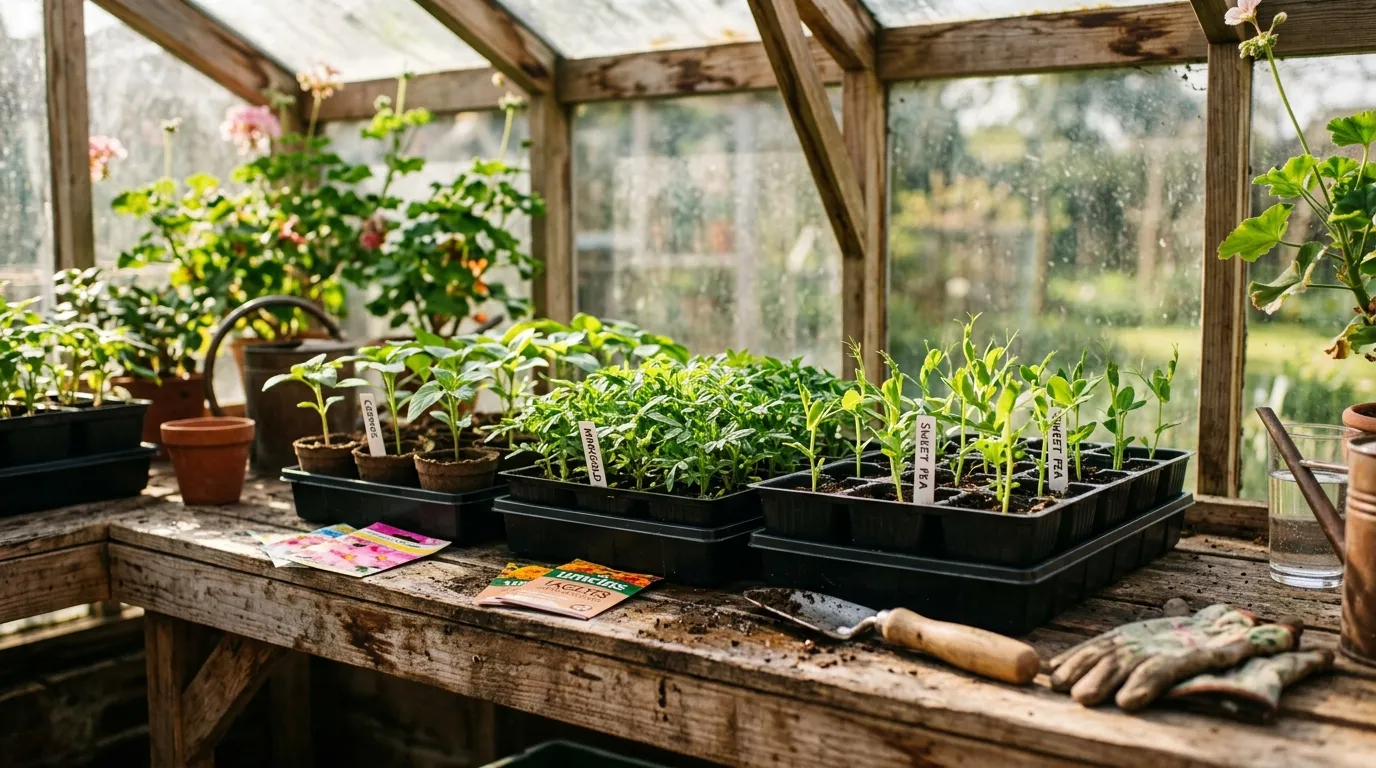
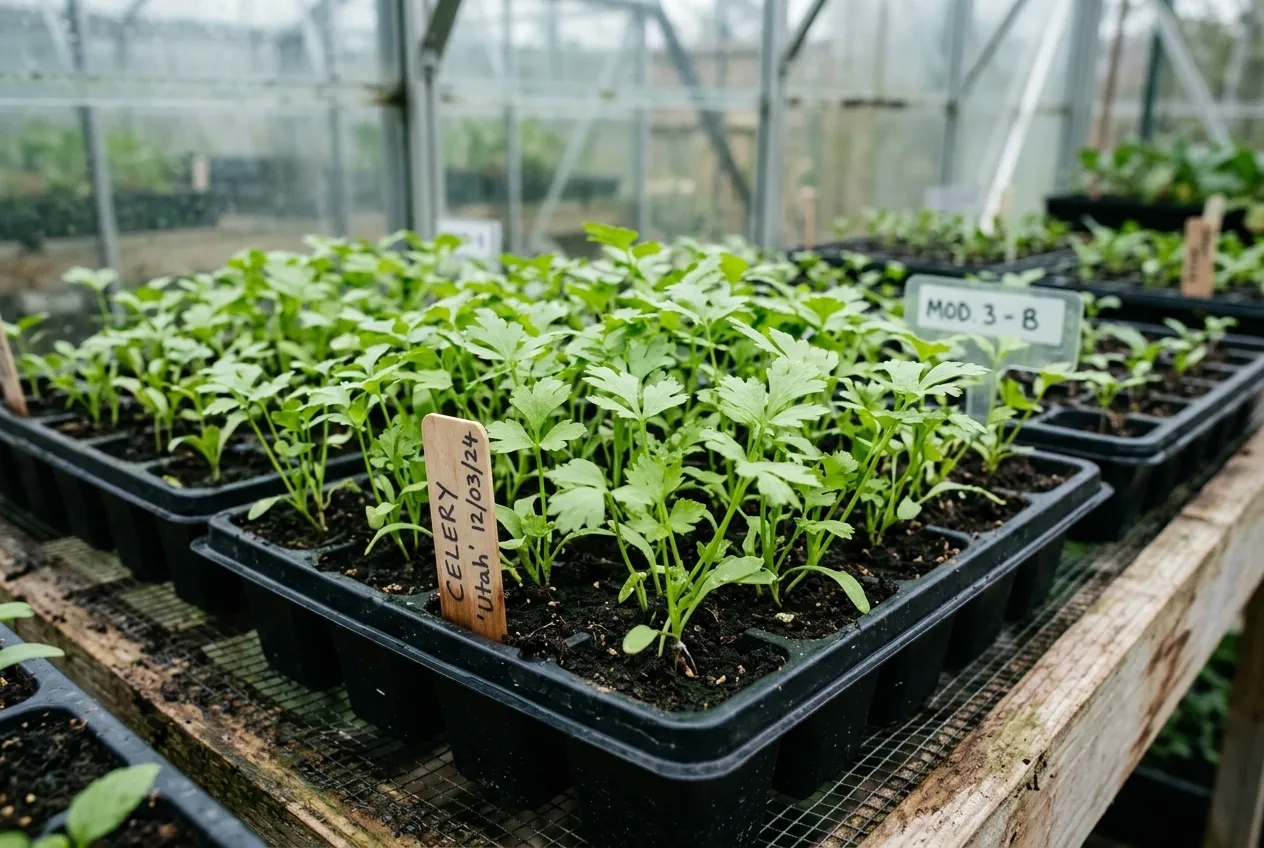 Celery seedlings in module trays under glass. Surface sow the seeds and keep at 15-18C for germination.
How to sow celery indoors
Celery must be started indoors. The seeds need warmth and light to germinate and the seedlings grow slowly in the early weeks. Direct sowing outdoors does not work in UK conditions.
When to sow
Sow from mid-February to late March. February sowings produce the largest plants. Sowing after the end of March shortens the growing season and reduces stem size at harvest. For a succession planting approach, make two sowings three weeks apart.
Sowing method
Celery seeds are tiny and need light to germinate. This is the single most important thing to know. Do not cover the seeds with compost. Buried seeds will not sprout.
- Fill module trays or small pots with fine seed compost
- Water the compost thoroughly and allow to drain
- Scatter 2-3 seeds on the surface of each module
- Press seeds gently onto the compost using a flat piece of card
- Do not cover with compost or vermiculite
- Place in a heated propagator at 15-18C
- Cover with a clear lid for humidity while allowing light through
Germination takes 14-21 days and is often patchy. Keep the compost moist with a fine mist spray. A windowsill or heated greenhouse bench provides ideal conditions.
Seedling care
Celery seedlings grow slowly for the first 4-6 weeks. When seedlings have 2-3 true leaves, thin to the strongest plant per module. If sowing in pots, prick out into individual 7cm pots. Handle seedlings by the leaves to avoid crushing the delicate stems.
Keep seedlings at 15-18C with good light. Growth accelerates from April as light levels improve. Begin hardening off in early May. Place plants outside during the day and bring in at night for 10-14 days before transplanting. Plants exposed to temperatures below 10C for prolonged periods may bolt later.
Transplanting celery outdoors
Celery is not frost hardy. Transplant after the last frost, typically in late May or early June. In southern England, late May is usually safe. In the Midlands and further north, wait until the first week of June.
Site and soil preparation
Celery needs rich, moisture-retentive soil in a sunny or lightly shaded position. It is one of the hungriest and thirstiest vegetables in the garden.
- Dig in generous amounts of well-rotted compost several weeks before planting
- The soil should hold moisture without becoming waterlogged
- A pH of 6.5-7.0 is ideal
- Avoid exposed, windy positions that dry out the soil surface
Celery grows well in raised beds filled with rich compost. See our guide to container vegetable gardening if space is limited.
Planting self-blanching celery
Plant in blocks, not rows. Space plants 23cm apart in all directions. A block of 16 plants (4 x 4) is the minimum for effective self-blanching. The outer plants shade the inner ones, turning the stems pale without any covering.
Water thoroughly after planting. Apply a 5cm mulch of well-rotted compost around the plants to retain moisture and suppress weeds.
Planting trench celery
Dig a trench 30cm deep and 40cm wide in winter or early spring. Fork well-rotted manure into the base to a depth of 15cm. Backfill with soil mixed with compost until the trench is 10cm below ground level. Space plants 30cm apart in a single row along the centre of the trench.
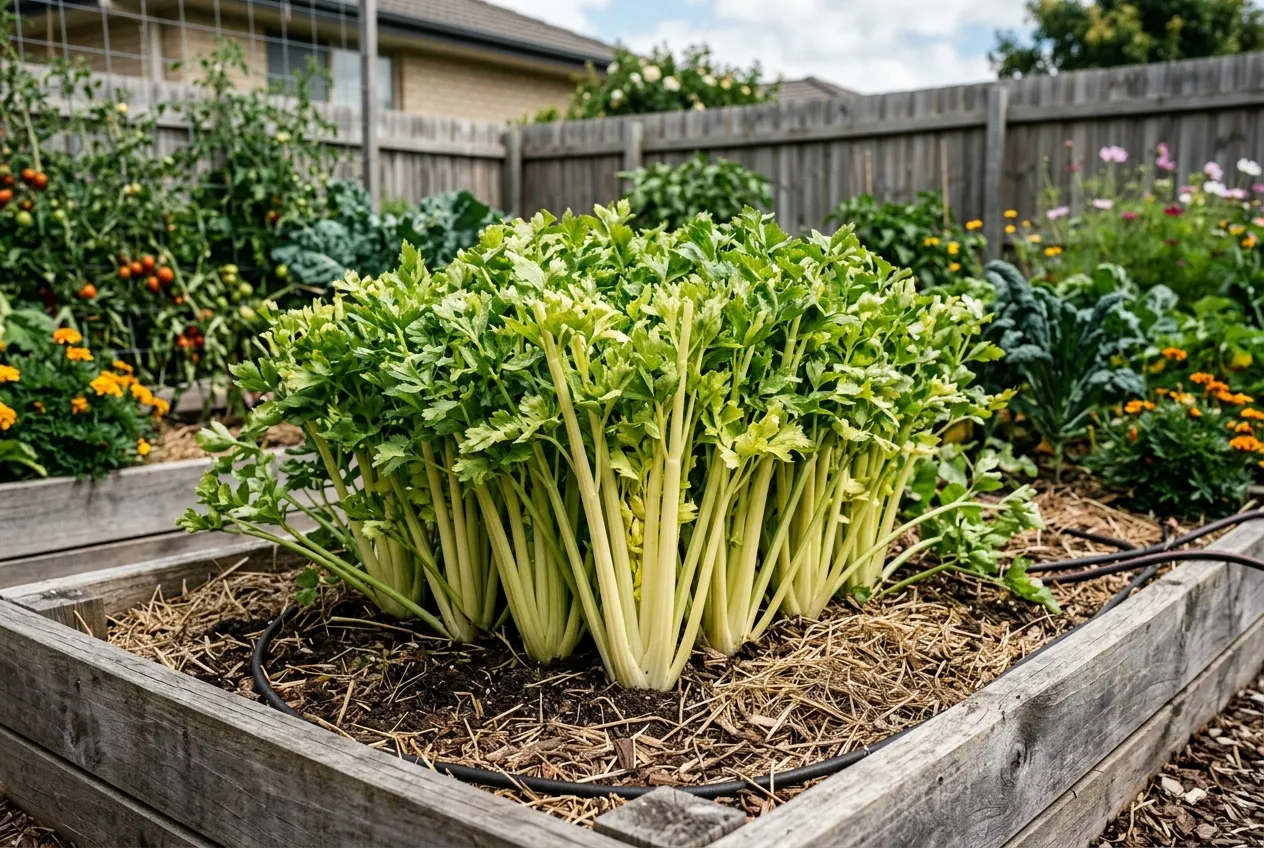 Self-blanching celery planted in a tight block. The inner stems blanch naturally when shaded by the outer plants.
Watering and feeding celery
This is where most people fail with celery. Celery is a marsh plant that needs constant moisture. Any period of drought produces bitter, stringy, hollow stems. The damage cannot be reversed by watering afterwards.
Watering requirements
Celery needs a minimum of 25mm of water per week through the growing season. In hot, dry spells, increase to 35-40mm. Water deeply 2-3 times per week rather than a light daily sprinkle. Drip irrigation or a soaker hose along the row delivers water steadily without wetting the foliage. Read our guide on how to water your garden properly for techniques that suit thirsty crops.
Mulching is essential. Apply a 5-8cm layer of compost, straw, or grass clippings in June. This retains soil moisture, keeps roots cool, and reduces watering frequency by roughly 30%.
Feeding
Apply a balanced liquid feed (seaweed-based is ideal) every two weeks from June to September. Celery is a moderate to heavy feeder. A fortnightly feed keeps growth steady. Avoid high-nitrogen feeds after July, which produce lush leaves at the expense of stem quality.
How to blanch trench celery
Blanching excludes light from the stems, turning them white and reducing bitterness. Self-blanching types handle this automatically through close block planting. Trench celery needs your help.
Earthing up method
From August onwards, begin mounding soil around the stems. Tie the leaves loosely together with string to keep soil out of the crown. Push soil from the sides of the trench up around the stems, covering roughly one third of the stem height. Repeat every 2-3 weeks through September, adding more soil each time.
By October, the soil should cover all but the top 15cm of foliage. The stems beneath are blanched white, tender, and ready for harvest. This method produces the finest-flavoured celery of any growing technique.
Alternative blanching methods
If you grow self-blanching varieties but want paler stems, wrap corrugated cardboard collars around individual plants in August. Secure with string. This improves blanching on the outer plants of a block that receive more light. Black polythene tubes (15cm diameter, cut from bin liners) also work well.
Best celery varieties for UK gardens
Choosing the right variety makes a real difference. These varieties are all available from UK seed suppliers and proven in British growing conditions.
Victoria is the most widely grown self-blanching celery in the UK. Pale green stems with a crisp, mild flavour. Good bolt resistance and reliable in variable British summers. RHS Award of Garden Merit holder.
Loretta produces long, smooth, pale stems with excellent eating quality. Slightly later maturing than Victoria. Strong resistance to bolting and celery leaf spot. A top choice for first-time growers.
Celebrity is a newer self-blanching variety with impressively tall, thick stems. Good disease resistance and bolt tolerance. The stems are particularly crisp with a sweet, mild taste.
Giant Red is a traditional trench variety with striking red-flushed stems. The colour intensifies after blanching. Rich, nutty flavour that stands out in salads. Needs earthing up like all trench types.
Utah 52-70 is the standard green trench celery. Strong-flavoured, thick stems that blanch to creamy white. Very vigorous. Takes longer to mature but produces large plants with excellent keeping quality into November.
Leaf celery (Par-Cel) produces abundant, intensely flavoured leaves on thin stems. Grown for the foliage rather than the stalk. Far less demanding than standard celery. Cut-and-come-again harvest from June to October.
Variety comparison table
| Variety | Type | Stem colour | Flavour | Bolt resistance | Best for |
|---|---|---|---|---|---|
| Victoria | Self-blanching | Pale green | Mild, crisp | Very good | All-round reliability |
| Loretta | Self-blanching | Pale cream | Sweet, smooth | Very good | Beginners |
| Celebrity | Self-blanching | Pale green | Sweet, crisp | Good | Large stems |
| Giant Red | Trench | Red-flushed | Nutty, rich | Moderate | Salads, visual appeal |
| Utah 52-70 | Trench | Green to white | Strong | Moderate | Flavour, late harvest |
| Par-Cel | Leaf celery | Dark green | Intense | Excellent | Cooking, garnish |
Why we recommend Victoria for UK celery growers: After 5 seasons of growing multiple varieties side by side on the same plot, Victoria has outperformed every other self-blanching type for consistency. In a block of 16 plants, average stem height reached 35cm with good blanching to the base. Its bolt resistance handled the erratic May temperatures in 2024 without a single plant running to seed, while two other varieties lost 3 plants each. The stems were crunchy and sweet right through to early October.
Common problems when growing celery
Most celery failures come from drought stress or disease. Knowing the main threats helps you prevent them.
Celery leaf spot
The most serious disease affecting celery in UK gardens. Brown spots with tiny black fruiting bodies appear on the leaves. Spots merge as the disease progresses, killing entire leaves and weakening the plant. It spreads through water splash in wet weather.
Prevention is essential. Space plants correctly for air circulation. Water at soil level, not from overhead. Remove affected leaves immediately and destroy them. Do not compost diseased foliage. The RHS provides detailed guidance on celery leaf spot identification and treatment. Resistant varieties like Loretta reduce the risk.
Bolting
Celery bolts (runs to seed) when exposed to temperatures below 10C for prolonged periods after transplanting. Once a plant bolts, the stems become bitter and stringy. Prevent bolting by hardening off properly and not planting out too early. Cover with fleece if late cold spells threaten.
Slugs
Young transplants are vulnerable to slug damage. Slugs can destroy newly planted celery overnight. Use ferric phosphate slug pellets, copper tape, or beer traps around the planting area. Once plants establish beyond 15cm tall, slug damage becomes less of a problem.
Celery fly
Celery fly larvae create visible brown mines (tunnels) through the leaves. Check plants weekly from May to August. Pick off and destroy affected leaves immediately. Covering plants with fine mesh from transplanting prevents adult flies laying eggs on the foliage.
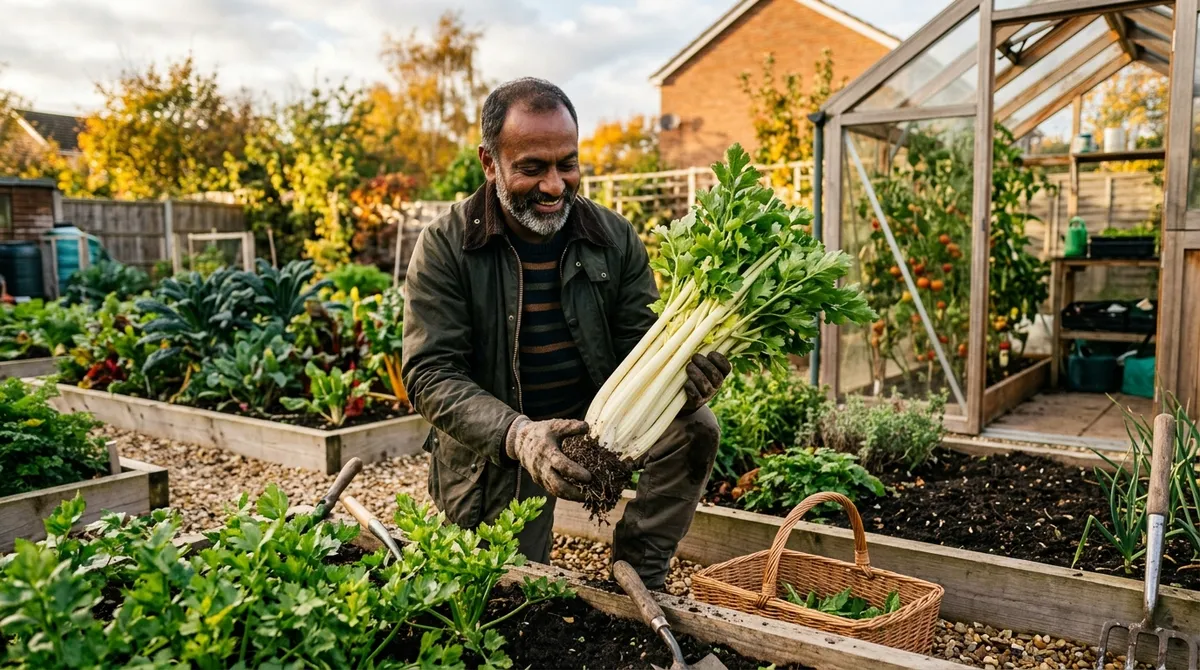
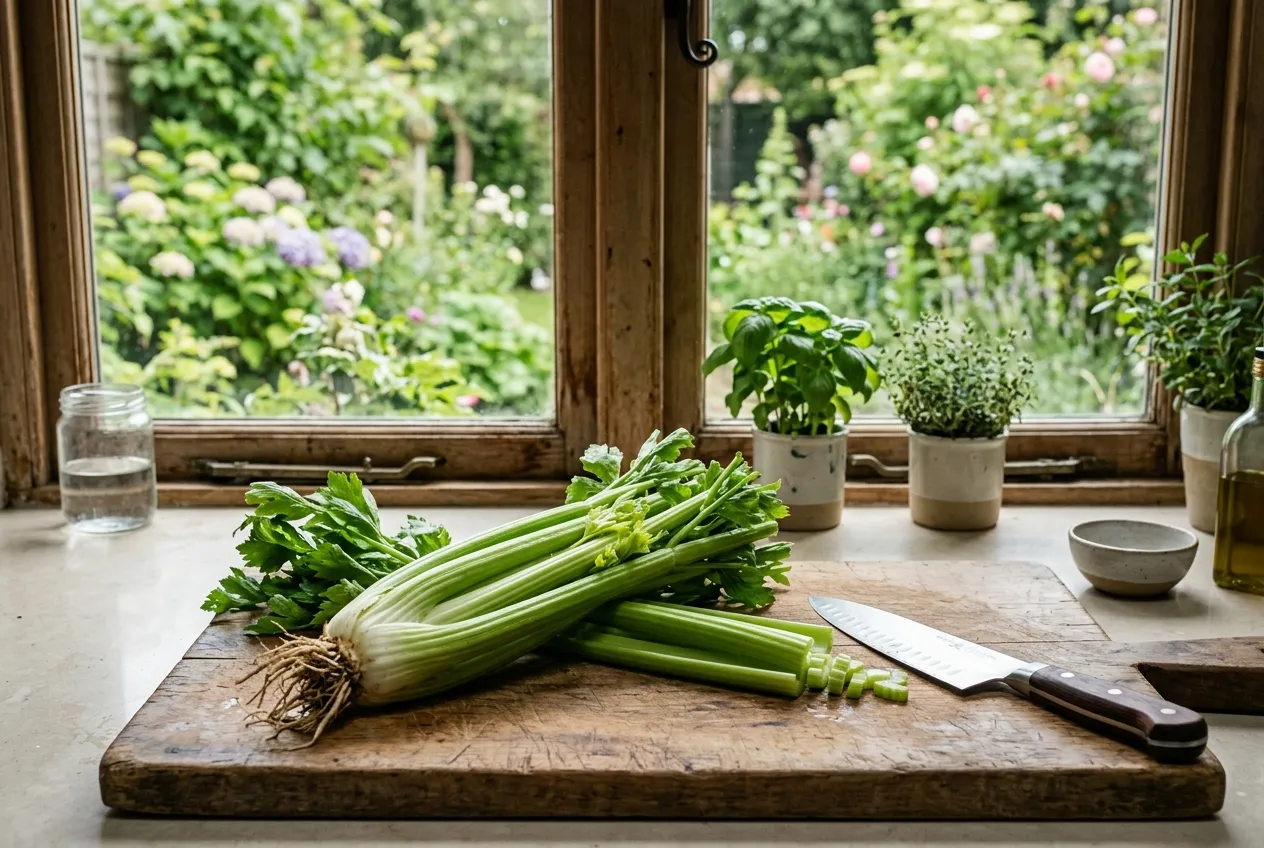 Home-grown celery ready for the kitchen. The stems should snap cleanly with a satisfying crunch when fresh.
Month-by-month celery growing calendar
This calendar covers the full season. Adjust timings two weeks later for northern England and Scotland.
| Month | Task |
|---|---|
| February | Sow indoors in a heated propagator at 15-18C. Surface sow, do not cover seeds |
| March | Continue sowing until late March. Prick out early seedlings into 7cm pots |
| April | Pot on strongest plants into 9cm pots. Growth accelerates in better light |
| May | Harden off from early May. Transplant after last frost (late May, south) |
| June | Transplant in northern areas. Water regularly. Mulch with 5-8cm compost. Start liquid feeding |
| July | First self-blanching harvests from late July. Water 25mm+ per week. Continue feeding fortnightly |
| August | Begin earthing up trench celery. Harvest self-blanching as needed. Watch for celery leaf spot |
| September | Continue earthing up trench celery. Main self-blanching harvest. Clear before first frost |
| October | Harvest trench celery. Final self-blanching harvest before frost. Trench types tolerate light frost |
| November | Late trench celery harvest from blanched plants. Season ends for most types |
Celery leaf celery as an alternative
If standard celery sounds like too much work, celery leaf celery (also called cutting celery or Par-Cel) offers intense celery flavour with far less effort. The thin stems are not worth eating, but the leaves are packed with flavour.
Sow and transplant like standard celery. The plants tolerate drier conditions and need no blanching. Harvest by cutting the outer stems and leaves from June onwards. New growth replaces what you cut within 2-3 weeks. A row of 6 plants provides enough celery-flavoured leaves for soups, stocks, salads, and garnishing all summer.
Celery leaf celery also makes a handsome edging plant for vegetable beds. The dark green, deeply cut foliage looks attractive alongside lettuce and other salad crops.
Now you have mastered growing celery, read our guide on growing celeriac for the closely related root vegetable that shares many of the same sowing and watering requirements.
Frequently asked questions
When should I sow celery in the UK?
Sow celery indoors from mid-February to late March. Use a heated propagator set to 15-18C and scatter seeds on the compost surface. Do not cover them, as celery seeds need light to germinate. Germination takes 14-21 days and is often uneven. Sow more than you need to account for losses. Earlier sowings in February produce the largest plants by autumn.
Why is my celery bitter and stringy?
Drought stress is the most common cause. Celery stems become tough, hollow, and bitter when the soil dries out, even for a few days. Water consistently at a minimum of 25mm per week throughout the growing season. Mulch around plants with compost to retain moisture. Bolting also causes bitterness, triggered by cold snaps below 10C after transplanting outdoors.
What is the difference between self-blanching and trench celery?
Self-blanching celery has naturally pale stems and is planted in blocks so plants shade each other. It needs no earthing up and suits beginners. Trench celery has dark green stems with stronger flavour. It needs soil mounded around the stems from August to blanch them white. Trench types take longer to mature but have superior taste and keep in the ground until November.
Can I grow celery in containers?
Yes, celery grows well in pots at least 30cm deep and 30cm wide. Use a rich, moisture-retentive compost and water daily in warm weather. Containers dry out faster than open ground, so vigilance is essential. Feed weekly with liquid seaweed fertiliser from June. Self-blanching varieties are the best choice for containers. Expect slightly smaller stems than ground-grown plants.
How do I stop celery bolting?
Bolting is triggered by cold temperatures below 10C after transplanting. Wait until late May or early June to plant outdoors. Harden off gradually over 10-14 days before planting. Cover young plants with fleece if late frosts threaten. Consistent watering also reduces bolt risk, as drought stress can push plants to flower prematurely. Victoria is the most bolt-resistant variety.
Is celery leaf celery worth growing?
Celery leaf celery is one of the easiest crops in the vegetable garden. It produces masses of intensely flavoured leaves on thin stems, similar to flat-leaf parsley but with true celery flavour. Sow like standard celery but with far less fuss over watering and blanching. The leaves are brilliant in soups, stocks, salads, and as a garnish. It is a cut-and-come-again crop.
What pests and diseases affect celery in the UK?
Celery leaf spot is the most serious disease. It causes brown spots with tiny black dots on the leaves and spreads rapidly in wet weather. Remove affected foliage immediately and avoid overhead watering. Slugs attack young transplants in May and June. Carrot fly occasionally targets celery, prevented with 60cm fine mesh barriers. Celery fly larvae mine tunnels through leaves in summer.
Lawrie has been gardening in the West Midlands for over 30 years. He grows his own veg using no-dig methods, keeps a wildlife-friendly garden, and writes practical advice based on real UK growing conditions.