How to Grow Crab Apple Trees UK
UK guide to growing crab apple trees. Covers best varieties, pollination groups, jelly making, planting, pruning, and pests. From a Staffordshire grower.
Key takeaways
- Crab apples cross-pollinate nearly all UK dessert and cooking apple varieties — one tree does the job of a dedicated pollination partner
- John Downie is the best variety for crab apple jelly, producing heavy crops of orange-red fruit with exceptional flavour and pectin content
- Evereste is the most versatile pollinator, covering pollination groups 3-5 including Cox, Bramley, and Discovery
- Plant bare-root trees November to March for 30-40% cost savings over container-grown specimens
- Crab apples are less prone to apple scab and codling moth than dessert apples, making them genuinely low-maintenance
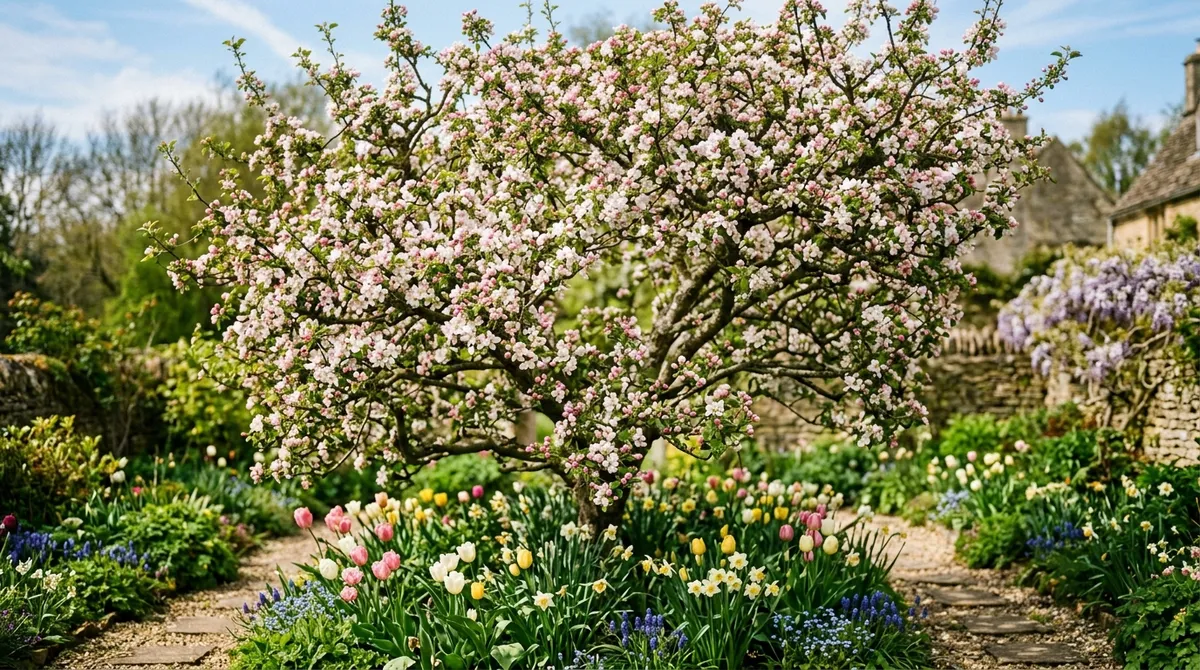
Crab apple trees earn their place in any UK garden three times over: first in spring, when the blossom rivals any ornamental tree; second in summer and autumn, when the fruit ripens into vivid clusters of red, orange, and yellow; and third throughout the year, when the tree acts as an invisible engine powering the pollination of every apple tree nearby. A single crab apple — well chosen for your situation — does more practical work in a garden than almost any other tree its size.
I’ve grown crab apples on a Staffordshire allotment and in my garden since 2014, testing three varieties on heavy clay. This guide covers the best varieties for jelly and pollination, how to plant bare-root trees, pruning, making crab apple jelly, and common pests and diseases. If you grow dessert or cooking apples, see our guide to growing apple trees in the UK.
Why grow a crab apple tree?
Crab apples are the most versatile small trees for UK gardens. They offer ornamental value across all four seasons — blossom in spring, attractive foliage through summer, vivid fruit in autumn, and persistent berries through winter. But the practical case for growing one is just as strong as the aesthetic one.
As a pollination partner for dessert apples, a crab apple is almost uniquely effective. Most dessert apple varieties need a cross-pollinator from the same or adjacent flowering group. A crab apple typically flowers across a 3-week window that overlaps with pollination groups 1 through 7, covering virtually all named UK apple varieties. Planting a single Evereste or John Downie near your apple trees means you never need to match flowering groups again.
For jelly and preserves, crab apples are among the best fruit in any garden. Their flesh is naturally high in pectin — the setting agent that commercial jam makers have to add artificially to low-pectin fruits. Crab apple jelly sets firmly, keeps for 12 months, and has a sharp, aromatic flavour that pairs exceptionally well with game, lamb, and strong cheese. See our guide to making jam from garden fruit for the full technique.
For wildlife, crab apple trees support more species than almost any other garden tree. The spring blossom feeds bumblebees, honeybees, and hoverflies for 2-3 weeks. Persistent-fruiting varieties like Red Sentinel carry berries well into February, feeding blackbirds, fieldfares, and occasional waxwings. As part of a wildlife garden, a crab apple is a year-round resource.
Crab apples are also native trees in the UK sense. The wild crab apple (Malus sylvestris) is indigenous to Britain. It supports over 93 insect species in its bark, leaves, and fruit. Named garden varieties are selections and hybrids of wild and European crab apples, but they retain much of the wildlife value of the original species.
Best crab apple varieties
Choosing the right variety depends on your main purpose: jelly making, pollination, ornamental display, or wildlife value. These five varieties cover the full range, and more than one can share the same garden.
Varieties at a glance
| Variety | Height | Fruit | Best for | Pollination group |
|---|---|---|---|---|
| John Downie | 6-8m | Orange-red, large | Jelly, preserves | Groups 2-5 |
| Evereste | 5-6m | Red-orange, small | Pollination partner | Groups 3-5 (wide window) |
| Royal Beauty | 2-3m | Dark red, small | Small gardens, ornament | Groups 3-5 |
| Golden Hornet | 5-7m | Yellow, medium | Ornament, mild jelly | Groups 3-5 |
| Red Sentinel | 5-7m | Deep red, persistent | Winter wildlife, display | Groups 3-5 |
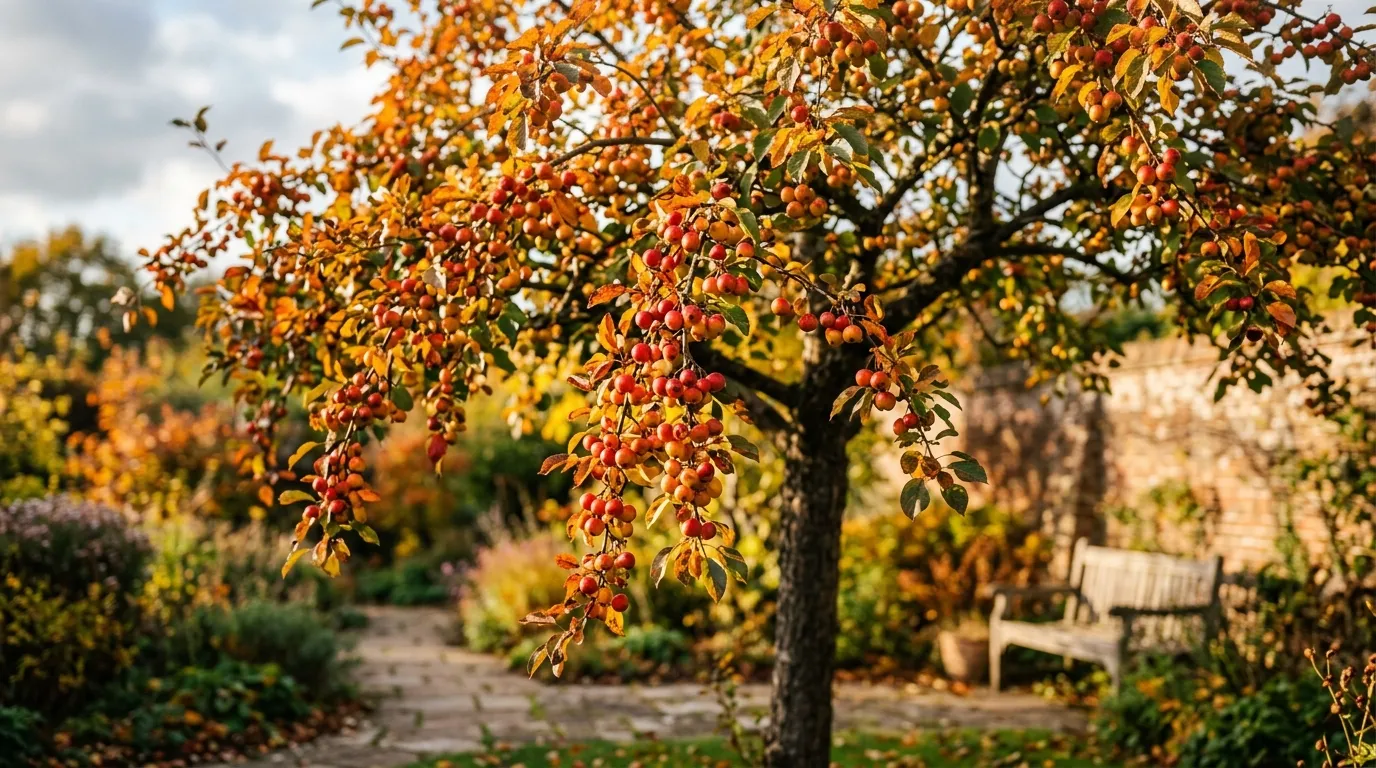
Crab apples ripening in October. John Downie produces the best fruit for jelly making.
John Downie — best for jelly
John Downie is the finest crab apple for jelly and preserves. It produces conical, orange-flushed fruit of 3-4cm diameter that ripens to a rich red in September. The flesh is firm, tart, and extremely high in pectin — a mature tree yields enough fruit for 20-30 jars of jelly from a single autumn harvest. The flavour of John Downie jelly is exceptional: clear amber, sharp, and aromatic.
The tree itself is vigorous, reaching 6-8m at maturity, with a graceful vase-shaped crown. Spring blossom is white, freely produced, and a good pollinator for groups 2-5. On M26 rootstock, height can be restricted to 4-5m with annual pruning. If you only have room for one crab apple and want to make jelly, this is the variety to choose.
Evereste — best pollination partner
Evereste is the most effective pollination partner for UK apple growers. Bred in France and awarded the RHS Award of Garden Merit, it flowers prolifically over a long 3-week window that spans pollination groups 3, 4, and 5. This makes it compatible with Cox’s Orange Pippin, Bramley’s Seedling (a triploid that needs two partners), Discovery, James Grieve, Worcester Pearmain, and dozens of other popular varieties — all from a single tree.
The tree is compact and rounded at 5-6m. White-flushed-pink blossom appears in abundance in May. The fruit is small (1-2cm), orange-red, and not worth harvesting for jelly, but it persists into November, feeding birds. Evereste was one of the three varieties I tested on my Staffordshire allotment. The improvement to my Cox’s pollination was immediate and dramatic. For any garden where apple trees are underperforming, this is the first tree to plant.
Royal Beauty — best for small gardens
Royal Beauty is a weeping crab apple that stays under 3m tall — the right choice for small or courtyard gardens where a full-sized tree is impractical. The long, pendulous branches carry deep pink blossom in spring, followed by small dark red fruit that hang attractively through autumn. The purple-bronze foliage adds interest through summer.
On MM106 rootstock, Royal Beauty reaches 2.5-3m with a spread of 2-3m. It suits small gardens and containers, and it pollinates apple trees in groups 3-5 despite its small stature. For anyone wanting a crab apple with a genuinely different form, Royal Beauty stands apart from the rounded crown of most varieties.
Golden Hornet — best for ornamental display
Golden Hornet produces the most striking autumn display of any yellow-fruited crab apple. The fruit is bright canary yellow, 2-3cm diameter, and hangs in dense clusters from October well into December. The contrast of golden fruit against bare branches in winter is outstanding. It is also a reliable pollinator for groups 3-5.
The tree reaches 5-7m with an upright, broadly columnar habit. White blossom in May. Fruit yield is heavy, and while Golden Hornet makes acceptable jelly, the flavour is milder than John Downie. As a purely ornamental choice, or for a garden that does not need a prolific jelly variety, Golden Hornet earns its place through sheer visual impact in autumn and winter.
Red Sentinel — best for persistent winter fruit
Red Sentinel holds its deep red fruit well into February — longer than any other common crab apple variety. The fruit is small (1-2cm), dark crimson, and clings to the branches through frost, snow, and prolonged cold spells. This makes it the highest-value crab apple for winter bird feeding. Fieldfares and waxwings, which visit UK gardens from October onwards, rely on persistent fruit sources like this through January and February.
The tree is upright and medium-vigorous at 5-7m. White blossom in May pollinates groups 3-5. The fruit is too small and astringent to make high-quality jelly in quantity, but Red Sentinel is unmatched as a wildlife tree and winter ornamental. Pair it with John Downie if you want both jelly and winter wildlife value. For more on attracting wildlife with native and near-native planting, see our guide to bee-friendly garden plants.
How to plant a crab apple tree
When to plant
Plant bare-root crab apple trees from November to March while the tree is fully dormant. November and early December are ideal — the soil is still warm from summer, and autumn rains settle the roots. Container-grown trees can go in at any time, but bare-root specimens are 30-40% cheaper and establish just as well when planted in the dormant season. See our detailed guide to planting bare-root trees for the full step-by-step method.
Choosing a site
Crab apple trees are tolerant of most UK conditions. They grow in full sun or partial shade, though blossom is more profuse and fruit production heavier in full sun. They tolerate most soil types — including the heavy clay common in Staffordshire and the Midlands — as long as drainage is reasonable. On waterlogged ground, plant on a raised mound to keep roots above the worst of the wet.
Avoid severe frost pockets where blossom risk is highest in late April and early May. A sheltered site facing south or west gives the best results, but crab apples perform reliably in most UK aspects.
Crab apple blossom in early May. The flowering period lasts 2-3 weeks, covering most apple pollination groups.
Planting method
- Dig a hole twice the width of the root spread and the same depth as the nursery soil mark on the trunk
- Drive a stake into the hole before placing the tree to avoid root damage
- Place the tree with the graft union (the swollen joint at the base of the trunk) sitting 10cm above final soil level
- Spread roots evenly in the hole without bending or coiling
- Backfill with excavated soil mixed with a handful of bonemeal
- Firm the soil with your heel, working inward from the outside
- Tie the trunk to the stake with a rubber tree tie and spacer
- Water thoroughly with 10-15 litres to settle the soil
- Apply a 5-8cm mulch of garden compost around the base, keeping it 10cm clear of the trunk
Stake for 2-3 years until the roots anchor the tree. Dwarf trees on M9 or M26 rootstock need staking for life.
Rootstock and size
Most crab apples sold in garden centres are grafted onto MM106 rootstock, producing trees of 4-6m in a garden. For smaller spaces, ask for trees on M26 (3-4m) or M9 (2-3m) rootstock. Royal Beauty is usually sold on its own roots or M26, keeping it compact at 2.5-3m.
If buying for pollination purposes, rootstock choice makes no difference to pollination effectiveness — a small tree on M9 pollinates just as reliably as a full-sized one on MM106.
How to prune a crab apple tree
Crab apple trees need very little pruning compared to dessert apples. The aim is to maintain a healthy, open structure with good light and airflow — not to maximise fruit production from every branch.
Prune in late winter or early spring (January to March) before blossom opens. Remove:
- Dead, diseased, or damaged branches first (the three Ds)
- Branches that cross or rub against each other
- Inward-growing shoots that crowd the centre
- Any water shoots (vigorous vertical growth from the main branches)
Do not shorten the previous year’s growth heavily on ornamental varieties — this reduces blossom and fruit. The goal is removal, not reduction.
For weeping varieties like Royal Beauty, prune lightly to maintain the pendulous habit. Remove only crossing branches and any strong vertical shoots that would convert the weeping form into an upright one.
Crab apples do not require the detailed spur management of dessert apple trees. A five-minute inspection and light tidy each winter is usually sufficient. See our guide to pruning fruit trees for more detail on timing and technique.
How to make crab apple jelly
Crab apple jelly is one of the most rewarding preserves a gardener can make. High pectin content means it sets firmly without added pectin. The flavour is sharp, aromatic, and versatile — it works with roast lamb, game, strong cheddar, and as a glaze for pork or duck.
Red and orange crab apple fruit ready for harvesting. John Downie produces the best jelly fruit.
What you need
- 1.5-2kg crab apples (John Downie or Golden Hornet)
- Granulated sugar (quantity determined by strained juice — see below)
- Water to cover
- Juice of 1 lemon per kg of fruit
- Large preserving pan or heavy saucepan
- Jelly bag or muslin cloth
- Sterilised jars with lids
Method
Step 1: Prepare the fruit. Wash the crab apples and cut off any damaged sections. Do not peel or core them — the pectin is concentrated in the skin and core. Quarter large fruit like John Downie. Leave small varieties like Red Sentinel whole.
Step 2: Simmer until soft. Place the fruit in the pan and add just enough water to cover (roughly 500ml per kg of fruit). Simmer for 30-40 minutes until completely soft and pulpy. Do not boil vigorously at this stage.
Step 3: Strain overnight. Pour the pulp into a jelly bag or muslin cloth suspended over a large bowl. Leave overnight without squeezing — squeezing produces cloudy jelly. Measure the strained juice the next morning.
Step 4: Add sugar and lemon. For every 600ml of juice, add 450g granulated sugar and the juice of 1 lemon. Stir over gentle heat until all the sugar dissolves before bringing to a boil.
Step 5: Boil to setting point. Bring to a rolling boil and cook until the setting point is reached: 104.5°C on a sugar thermometer, or the wrinkle test — place a teaspoon of jelly on a cold saucer; if the surface wrinkles when pushed, the jelly will set.
Step 6: Pot and seal. Skim off any foam and pour immediately into warm sterilised jars. Seal with lids while hot. Label when cool. Properly sealed jelly keeps for 12 months in a cool, dark cupboard. See our guide to making jam and jelly from garden fruit for more on sterilising jars and testing the set.
A 1.5kg batch of John Downie crab apples typically yields around 900ml of strained juice and produces 4-5 standard 340g jars of jelly.
Clear amber crab apple jelly after potting. High pectin content means crab apple jelly sets easily without added pectin.
Crab apples as pollination partners
The most underused role of the crab apple is as a universal pollination partner for apple trees. Most dessert and cooking apple trees need a cross-pollinator flowering at the same time. Getting this right usually means researching which pollination group your variety belongs to and finding a compatible second apple tree.
A crab apple eliminates this complexity. Because crab apples typically flower over a 3-week window — longer than most named apple varieties — they overlap with nearly all UK pollination groups from 1 to 7. Evereste in particular has been documented as an effective pollinator for triploid varieties including Bramley’s Seedling, which needs two compatible pollinators because its own pollen is sterile.
The practical rule: plant a crab apple within 15-20m of your apple trees. Bees carry pollen between trees during the flowering window. One crab apple pollinating two, three, or even four apple varieties simultaneously is perfectly realistic.
For full details on pollination groups and matching compatible varieties, the RHS guide to apple tree pollination is the most authoritative UK reference. Our guide to growing fruit trees in the UK also covers pollination in depth across all common tree fruit species.
Crab apple autumn colour and ornamental value
Crab apple trees are among the finest trees for autumn colour in UK gardens. The combination of ripening fruit and turning foliage creates a display that matches any ornamental tree. Varieties differ significantly in their autumn and winter visual impact.
John Downie has yellow-green foliage that turns golden in October, but the main event is the heavy crop of orange-red fruit. Against the golden leaves, the effect is striking. The fruit is quickly taken by blackbirds, so the display is relatively brief — 4-6 weeks from September.
Golden Hornet offers the longest-lasting autumn display of any yellow-fruited variety. The dense clusters of bright yellow fruit persist through November and into December, hanging from bare branches long after the leaves have dropped. In a winter garden it is as close to a statement planting as a small tree can achieve.
Red Sentinel is the winter champion. The small, deep-red fruit persists through frost and into February. In a prolonged cold snap, the berries become a food source for winter thrushes — fieldfares, redwings, and occasional waxwings — creating wildlife spectacle at its best.
Crab apples also make excellent choices as garden trees for seasonal interest, particularly in suburban and town gardens where space restricts tree choice to species under 8m.
Pests and diseases
Crab apple trees share the same pest and disease threats as dessert apple trees, but in practice they are significantly less affected. The ornamental Malus species and hybrid varieties commonly sold as crab apples tend to have better natural resistance to apple scab and codling moth than named dessert cultivars bred for flavour over toughness.
Apple scab
Apple scab (Venturia inaequalis) causes dark, crusty patches on fruit and olive-green spots on leaves. In a wet spring it can affect John Downie fruit significantly. Prune for an open canopy to improve air circulation. Rake up and remove fallen leaves in autumn to reduce spore carryover. Most crab apple varieties have better scab resistance than Cox’s Orange Pippin or Bramley, and cosmetic scab on crab apples destined for jelly does not affect the end product.
Evereste and Red Sentinel have good resistance to scab and rarely need treatment.
Codling moth
Codling moth (Cydia pomonella) larvae tunnel into fruit, but crab apple fruit is too small for most codling moth larvae to develop fully. The problem is far less severe than on dessert apples. If you grow dessert apples nearby and notice codling moth damage, hang pheromone traps from March and remove all fallen fruit promptly. The RHS guide to Malus includes current recommendations on pest management for the genus.
Fireblight
Fireblight (Erwinia amylovora) is the most serious disease risk for crab apple trees. Affected shoots and blossom turn brown and wither as if scorched by fire. Cut out infected growth at least 60cm below the visible damage, sterilising tools between cuts. Burn all prunings. Avoid heavy nitrogen feeds that stimulate soft, susceptible growth. Evereste and John Downie have moderate fireblight susceptibility — choose Red Sentinel or Malus toringo ‘Gorgeous’ if fireblight is a persistent problem in your area.
Winter moth and aphids
Winter moth caterpillars eat young leaves and blossom buds in spring. Wrap grease bands around the trunk in October to trap wingless females climbing to lay eggs. This simple method prevents most damage without chemicals.
Rosy apple aphid can cause leaf curling on young growth in spring. Natural predators — ladybirds, hoverflies, and blue tits — usually control the population without intervention. Encourage natural predators by growing a mix of flowering plants in the garden.
Crab apple trees and wildlife
No other small tree delivers as much year-round wildlife value as a crab apple. In spring, the blossom is a major resource for bumblebees and solitary bees emerging from hibernation. Over a 2-3 week flowering period, a single mature tree feeds thousands of pollinators. This matters not just for the garden ecosystem but for the productivity of any apple, pear, or plum tree growing nearby.
In summer, the bark and foliage host over 90 invertebrate species — beetles, moths, aphids, and their predators. This insect diversity supports blue tits, great tits, and other garden birds through their nesting season.
In autumn and winter, the fruit becomes a critical food source. Blackbirds take fruit as soon as it softens in September and October. Fieldfares arrive from Scandinavia from October onwards and target persistent-fruiting varieties like Red Sentinel. In hard winters when berries are scarce, waxwings descend on crab apple trees and strip the remaining fruit within hours. For a wildlife garden strategy, there are few easier wins than planting one of these trees.
Common mistakes growing crab apples
Choosing a purely ornamental variety
Many crab apples sold as ornamentals are bred for blossom and foliage rather than fruit. If you want jelly, confirm that the variety you buy is listed as a fruiting crab apple — John Downie, Golden Hornet, and Red Sentinel are unambiguous choices. ‘Profusion’, ‘Liset’, and ‘Royalty’ are primarily blossom and foliage trees; their fruit is sparse.
Planting too far from apple trees to pollinate effectively
Bees work efficiently between trees within 15-20m of each other. Planting a crab apple at the far end of a large garden while your apple trees are at the other end may not deliver the pollination benefit you expect. Position the crab apple to minimise the distance bees have to travel between species.
Pruning at the wrong time
Heavy summer pruning removes fruit and blossom buds for the following year. Prune crab apples in late winter or early spring before blossom opens, and keep it light — removal of dead and crossing wood rather than aggressive shortening. Over-pruning produces vigorous leafy growth at the expense of fruit and blossom.
Not harvesting for jelly
John Downie fruit left on the tree eventually rots and falls. If you grow a fruiting variety, pick in September when the fruit reaches full colour and make jelly while the pectin content is at its peak. Overripe fallen fruit produces inferior jelly that is harder to set clearly.
Now you’ve understood crab apple growing, read our guide to how to graft fruit trees — grafting is how new crab apple varieties are propagated and how you can convert an existing crab apple to a different variety.
Frequently asked questions
Do crab apple trees need a pollination partner?
Crab apple trees are self-fertile and fruit without a partner. Their main role, however, is to act as cross-pollination partners for dessert and cooking apples. A crab apple typically covers pollination groups 1-7, making it compatible with virtually all UK apple varieties. If your apple trees produce poor fruit set, a crab apple planted within 15-20m will usually solve the problem within one growing season.
What is the best crab apple variety for jelly?
John Downie is the definitive choice for crab apple jelly. It produces large, conical, orange-red fruit with high pectin content and exceptional flavour. A mature tree yields 15-20kg of fruit — enough for 20-30 jars of amber jelly from a single autumn harvest. Golden Hornet is a worthwhile second choice for a milder-flavoured, yellow jelly.
How big do crab apple trees grow?
Most crab apple trees reach 5-8m on standard rootstocks. John Downie and Golden Hornet reach 6-8m. Evereste stays more compact at 5-6m. Royal Beauty, a weeping variety, grows to just 2.5-3m tall with a wide pendulous canopy. On M26 rootstock, any of these varieties can be restricted to 3-4m with annual pruning.
When do crab apple trees flower in the UK?
Crab apple trees flower from late April to mid-May across most of the UK. The exact timing varies by variety and location: southern gardens typically see peak flowering in late April, while Staffordshire and northern gardens peak in early May. Most crab apples flower for 2-3 weeks — a longer window than many named dessert apple varieties — which is why they make such effective universal pollinators.
Can I make jelly from any crab apple?
All crab apples are high in pectin and suitable for jelly. However, the quality and yield vary by variety. John Downie and Golden Hornet are the best choices for flavour and fruit volume. Purely ornamental varieties bred for blossom tend to produce sparse, small fruit — fine for jelly in principle but impractical in quantity. For jelly making in volume, stick to named fruiting varieties.
Are crab apple trees good for wildlife?
Crab apple trees are outstanding for wildlife. The spring blossom feeds bumblebees, honeybees, and hoverflies over a 2-3 week period. The bark and foliage support over 90 invertebrate species through the growing season. In autumn and winter, the fruit feeds blackbirds, fieldfares, and waxwings. Persistent-fruiting varieties like Red Sentinel provide food well into February, when other garden berries have been exhausted.
When is the best time to plant a crab apple tree?
Plant bare-root crab apple trees from November to March while dormant. November to December is ideal: soil temperatures remain above 5°C, autumn rain settles roots, and the trees establish before spring growth begins. Container-grown trees can go in year-round, but bare-root specimens are significantly cheaper and establish equally well in the dormant season.
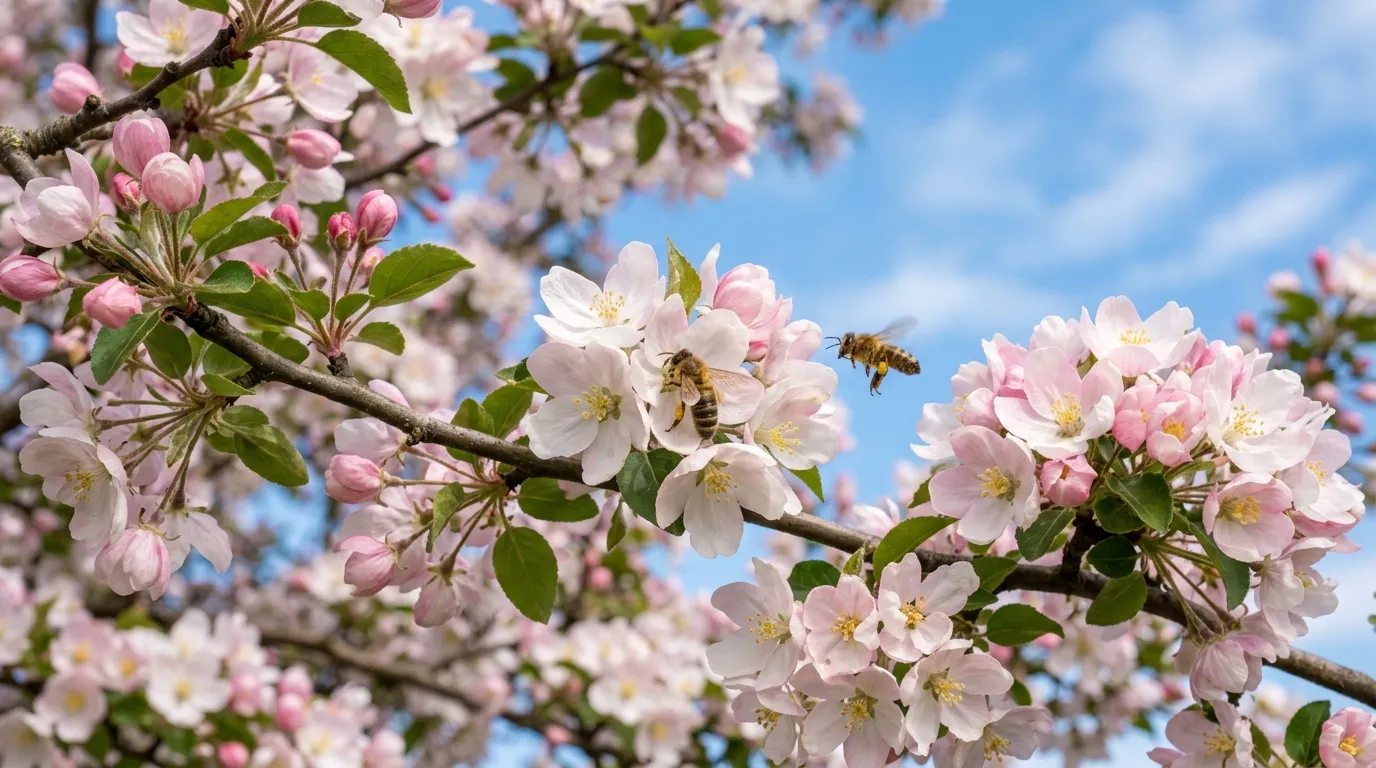
Crab apple blossom in April. The flowers attract pollinators and serve as pollination partners for dessert apple trees.
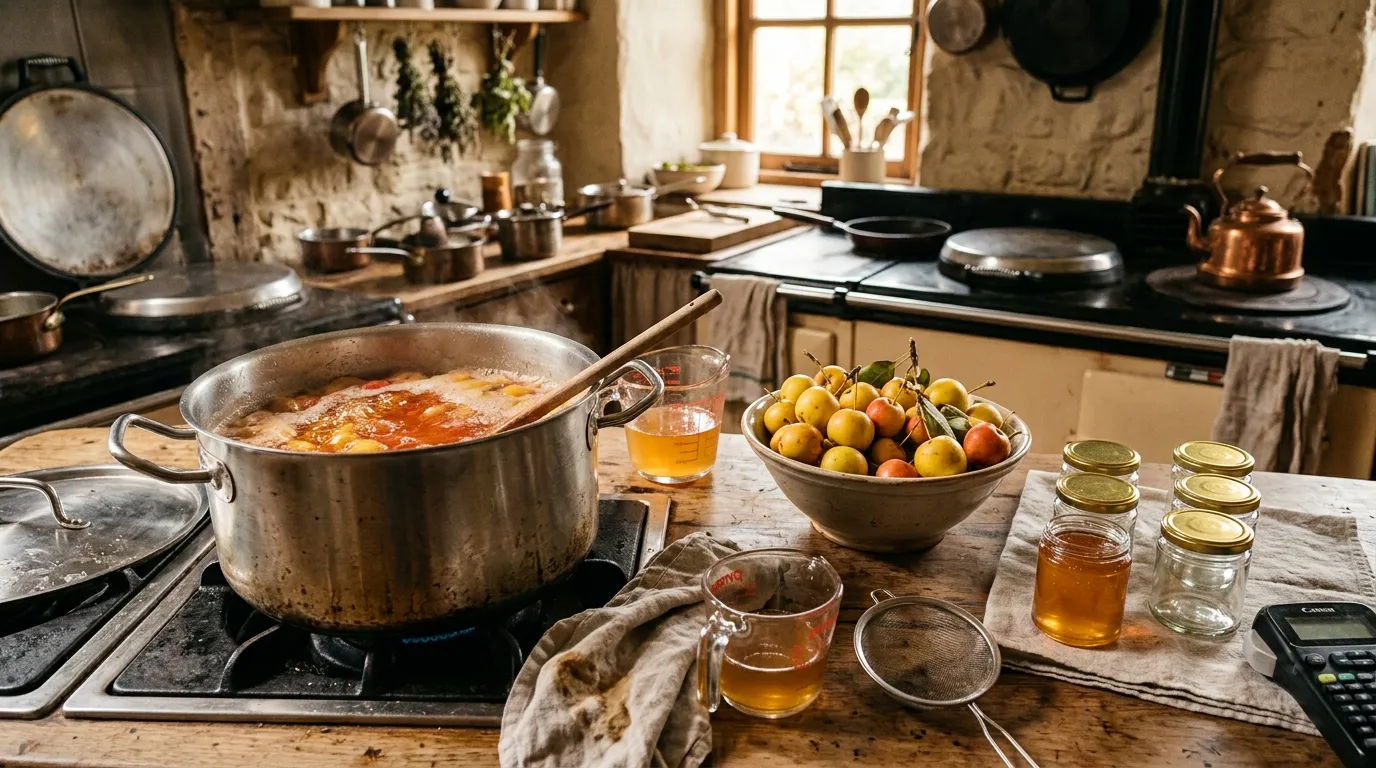
Crab apple jelly requires no added pectin. The fruit is naturally high in pectin and sets easily.
Related reading
- How to Grow Apple Trees in the UK — rootstocks, pollination groups, dessert and cooking varieties
- How to Grow Fruit Trees in the UK — the complete guide to all UK tree fruit
- How to Prune Fruit Trees — timing, tools, and technique for apples, pears, and plums
- How to Plant a Bare-Root Tree — step-by-step planting for bare-root trees
- Best Trees for Small Gardens — compact trees for gardens under 10m wide
Lawrie has been gardening in the West Midlands for over 30 years. He grows his own veg using no-dig methods, keeps a wildlife-friendly garden, and writes practical advice based on real UK growing conditions.