How to Grow Fennel (Herb) in the UK
How to grow fennel herb in UK gardens. Common fennel vs Florence fennel, sowing, harvesting seeds and fronds, and garden uses.
Key takeaways
- Common fennel is a perennial herb grown for fronds and seeds. Florence fennel is a different crop grown as an annual for its swollen bulb
- Sow fennel seed directly outdoors in April, or start indoors in March and transplant after the last frost
- Harvest fronds on a cut-and-come-again basis from May to October. Regular picking encourages fresh bushy growth
- Collect seeds in September when the umbels turn brown. Dry them indoors for 2 weeks before storing in airtight jars
- Keep fennel away from dill and coriander to prevent cross-pollination. It grows well alongside most vegetables
- Bronze fennel is one of the best dual-purpose plants for UK borders, combining culinary use with striking ornamental foliage
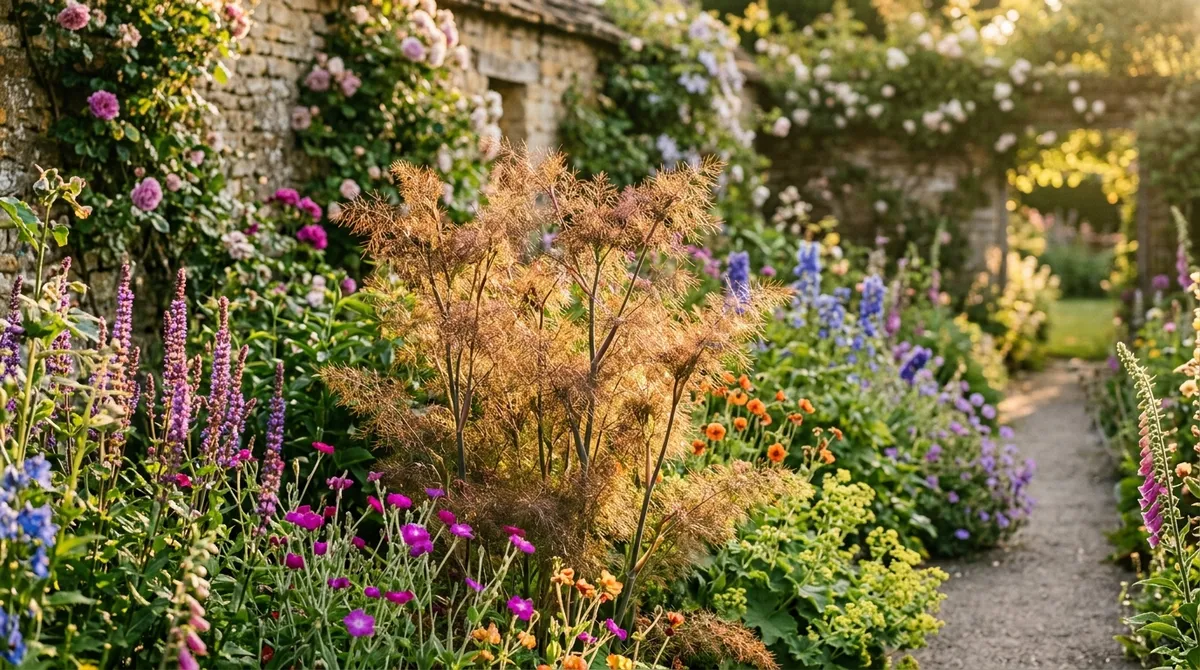
Fennel herb is one of the most rewarding perennials you can grow in a UK garden. This tall, feathery plant (Foeniculum vulgare) produces anise-flavoured fronds for the kitchen, aromatic seeds for cooking and teas, and clouds of yellow flowers that draw hoverflies and beneficial insects from June through September.
This guide covers everything needed to grow fennel herb successfully in British conditions. Every recommendation comes from six seasons of growing common fennel and bronze fennel in borders and herb gardens across Staffordshire, tracking seed production, self-sowing habits, and companion planting results in heavy clay soil.
Common fennel vs Florence fennel
The first thing any UK grower needs to understand is that common fennel and Florence fennel are different crops with different purposes. Confusing the two is the most common mistake in fennel growing.
Common fennel (Foeniculum vulgare) is a tall, hardy perennial that grows 1.5-2m high. It produces feathery fronds and aromatic seeds. You grow it as a permanent herb in borders and herb gardens. It returns reliably every spring and needs almost no maintenance.
Florence fennel (Foeniculum vulgare var. azoricum) is a shorter annual grown for its swollen white bulb at the base of the stem. It is a vegetable, not a herb. Florence fennel bolts easily in UK conditions and needs precise sowing timing to produce good bulbs. The two plants share a species name but require completely different approaches.
This article covers common fennel only. If you want bulb fennel for the kitchen, that is a separate growing guide entirely.
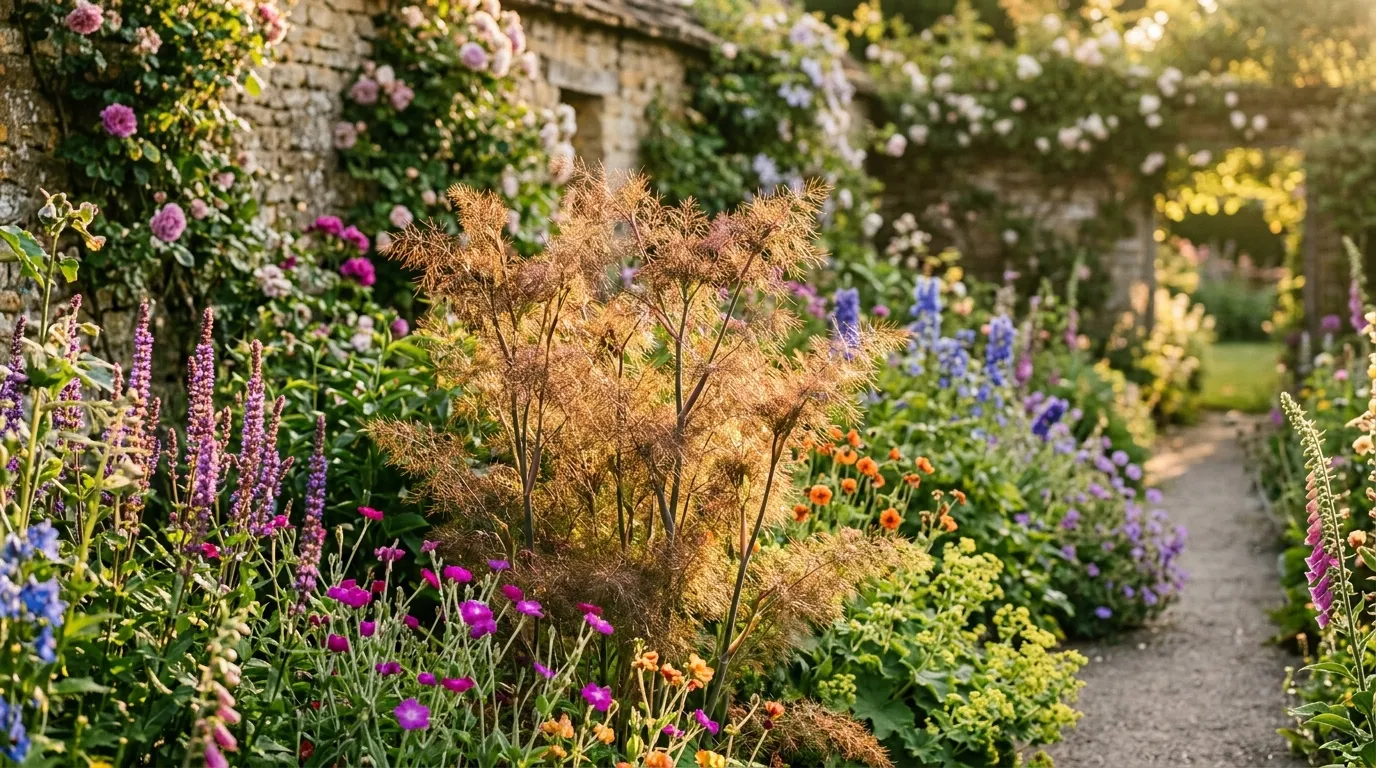
Common fennel reaches 1.5-2m tall by midsummer. The fine, thread-like foliage adds texture and movement to any border.
Types of fennel herb for UK gardens
Three forms of common fennel are widely available from UK nurseries and seed suppliers. All are fully hardy and grow well across Britain.
Green common fennel (Foeniculum vulgare) is the standard form. Bright green, thread-like foliage on upright stems. Strong anise flavour in both fronds and seeds. This is the type to choose if your main interest is culinary use. It self-sows the most aggressively of the three forms.
Bronze fennel (Foeniculum vulgare ‘Purpureum’) has deep purple-bronze foliage that fades to a coppery green as the season progresses. The flavour is identical to the green form. Bronze fennel is the best choice for mixed borders because it combines culinary use with genuine ornamental value. It works beautifully alongside silver-leaved plants, blue geraniums, and late-summer perennials. Self-sows slightly less than the green form.
Giant fennel (Ferula communis) is a different genus entirely and is grown purely as an architectural ornamental. It is not culinary fennel and the foliage has no anise flavour. Avoid it if you want a herb for the kitchen.
How to sow and plant fennel herb
Fennel is straightforward to grow from seed. Direct sowing outdoors is the simplest method and produces the strongest plants because the long taproot is never disturbed.
Direct sowing (recommended)
Sow fennel seed directly into prepared ground in April, once the soil temperature reaches 10 degrees Celsius. Choose a spot in full sun with well-drained soil. Rake the surface to a fine tilth and sow seed thinly in shallow drills 1cm deep. Space rows 45cm apart. Water gently and keep the soil moist until germination, which takes 10-14 days. Thin seedlings to 45cm apart once they have developed two true leaves.
Starting indoors
For an earlier start, sow seed in modules or 9cm pots in March. Fill with seed compost, sow 2-3 seeds per module at 1cm depth, and place on a warm windowsill or in an unheated greenhouse. Thin to one seedling per module. Harden off in late April by placing pots outside during the day for a week. Transplant to final positions in early May. Handle the rootball gently because fennel resents root disturbance.
Buying plants
Garden centres sell potted fennel plants from April onwards. Plant at the same depth as the pot, firm in, and water well. This is the quickest route to a harvest but the most expensive. A single packet of seed produces dozens of plants for a fraction of the cost. Our guide to growing herbs covers the best starter herbs to grow alongside fennel.
Lawrie’s experience: I have sown fennel both ways over six seasons and direct sowing wins every time. The transplanted seedlings from my indoor sowings always sulk for 2-3 weeks after planting out, and their first-year growth is noticeably smaller. The direct-sown plants put down a deep taproot immediately and are twice the size by July. Save yourself the bother of modules and sow straight into the ground.
Growing conditions for fennel herb
Fennel is undemanding once established. Getting the basics right at planting time is all that matters.
Sun: Full sun is essential. Fennel in partial shade grows leggy, produces thin fronds, and sets fewer seeds. A south-facing border or herb garden bed is ideal. Six hours of direct sun per day is the minimum.
Soil: Well-drained soil of any type. Fennel tolerates sand, chalk, loam, and light clay. It struggles in heavy, waterlogged clay. On my Staffordshire clay, I improved drainage by working in sharp grit and compost before planting. Raised herb beds solve drainage issues on heavy soil.
Water: Water young plants during dry spells in their first season. Established fennel is drought-tolerant and rarely needs watering. Overwatering causes root rot.
Feeding: Fennel needs no feeding in average garden soil. A light mulch of compost in spring provides enough nutrients for the year. Too much nitrogen produces lush foliage with weaker flavour.
Shelter: Choose a sheltered spot. At 1.5-2m tall, fennel acts as a sail in strong winds. Staking is rarely needed in sheltered positions but essential in exposed gardens. Planting behind a low wall or hedge provides natural wind protection.
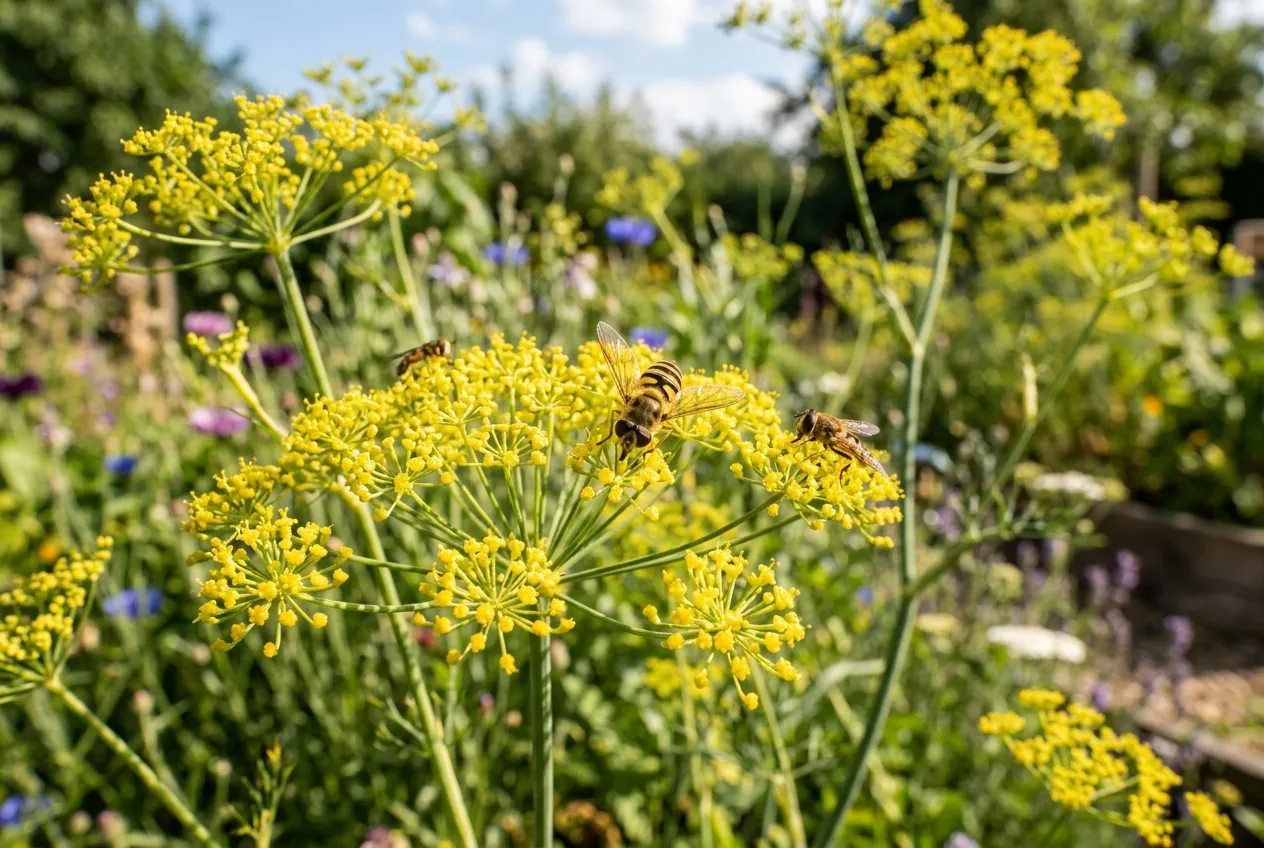
Fennel flowers attract hoverflies, ladybirds, and parasitic wasps. These beneficial insects help control aphids across the garden.
Harvesting fennel fronds
Fennel fronds are ready to pick from May onwards, as soon as the plant has established enough growth. Harvest on a cut-and-come-again basis throughout the growing season. Snip individual stems at the base using scissors or secateurs. The plant responds by producing fresh side shoots within a week.
Regular picking encourages bushier growth and delays flowering. Once fennel flowers, the fronds become coarser and less flavourful. If you want fronds all summer, remove flower stems as they form in June. If you want seeds as well, let some stems flower while continuing to harvest fronds from the remaining growth.
The youngest, most tender fronds grow at the tips of new shoots. These have the strongest anise flavour and the finest texture for salads and garnishes. Older fronds lower on the stem are tougher and better suited to cooking.
Fennel fronds do not store well. Use them within a day of picking for the best flavour. They wilt quickly and lose their aroma in the fridge. For longer storage, chop fronds finely and freeze in ice cube trays with a splash of water or olive oil. These frozen cubes drop straight into soups, stews, and fish dishes.
Harvesting fennel seeds
Fennel seeds are one of the most useful spices you can grow at home. They ripen in September and October in most UK gardens, about 6-8 weeks after the flowers open.
Watch the seed heads (umbels) closely from late August. The seeds are ready when they turn from green to light brown and detach easily when rubbed between your fingers. Do not wait until they fall naturally or you will lose most of the crop to birds and wind.
Harvesting method:
- Cut the entire umbel with 15cm of stem attached.
- Place the heads upside down inside a paper bag.
- Tie the bag around the stems and hang in a warm, dry room.
- Leave for 2 weeks. The seeds drop into the bag as they dry.
- Remove any chaff and store in airtight glass jars away from light.
Home-grown fennel seeds are far more aromatic than shop-bought. The volatile oils that give fennel its distinctive anise flavour degrade with age. Seeds used within 12 months of harvest have noticeably more punch than anything from a supermarket spice rack.
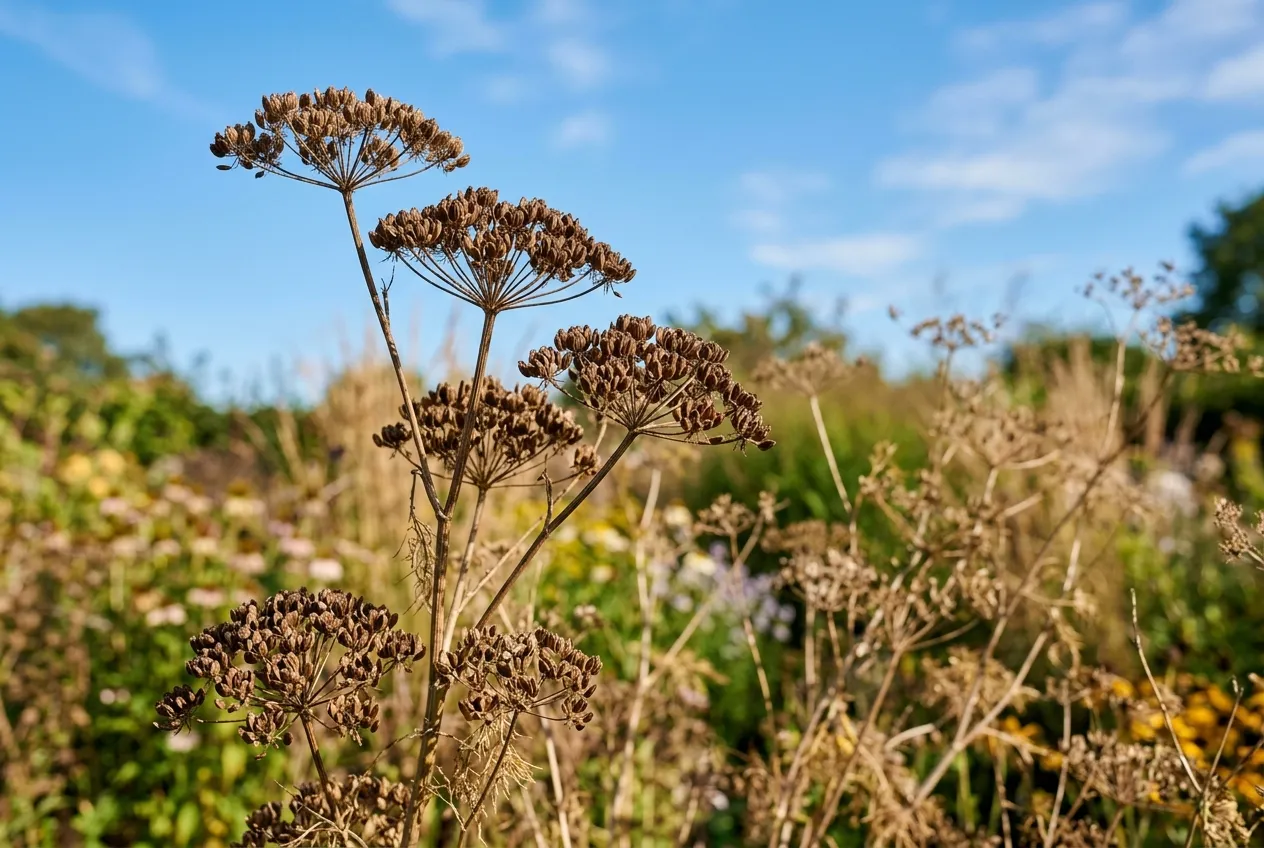
Fennel seeds are ready to harvest when the umbels turn brown and the individual seeds detach with a gentle rub.
Bronze fennel as an ornamental border plant
Bronze fennel deserves a place in every mixed planting scheme. It is one of the finest dual-purpose plants available to UK gardeners, combining genuine culinary value with year-round structural interest.
The foliage emerges in late March as deep purple-bronze shoots that unfurl into clouds of fine, hair-like leaves. Through summer the colour softens to a coppery bronze-green. By September the entire plant is a haze of yellow flowers above dark foliage, reaching 1.8m tall. It looks superb planted alongside silver-leaved plants, blue geraniums, and late-flowering salvias. The scented plants guide covers more aromatic border companions that pair well with fennel.
In winter, the dried seed heads and stems provide structural interest through frost and snow. Leave the dead stems standing until late February, then cut back to 15cm above ground level. Fresh growth appears within weeks.
Bronze fennel self-sows less vigorously than the green form but still scatters seed if you leave the heads intact. Deadhead in late August if you want to control spread. Any self-sown seedlings produce a mix of bronze and green plants, with bronze colouring dominant in most offspring.
Managing self-sowing
Fennel self-sows freely. A single mature plant can produce hundreds of viable seeds that scatter across borders, gravel paths, and cracks in paving. In a large informal garden, this is a benefit. In a small or structured garden, it is a nuisance.
Prevention: Deadhead all flower stems in late August, before the seeds ripen. Cut them at the base and compost them. This eliminates self-sowing completely but means you forfeit the seed harvest. A practical compromise is to bag one or two seed heads for harvesting and remove the rest.
Removal: Self-sown seedlings appear from March onwards and are easy to identify by their fine, thread-like leaves. Pull them when small, ideally before the taproot establishes. Once the taproot is established, seedlings become difficult to remove cleanly. Hoeing catches them while they are still shallow-rooted.
Relocation: Transplant wanted seedlings in April when they are 10-15cm tall. Water well after moving. Fennel dislikes root disturbance, so move seedlings with as much soil around the roots as possible.
Companion planting with fennel herb
Fennel has a mixed reputation in companion planting. Understanding which plants it helps and which it harms avoids problems in the vegetable garden and herb beds.
Plants to keep away from fennel
Dill is fennel’s closest relative and the two cross-pollinate readily. The resulting seed produces plants with muddled flavour that tastes of neither herb properly. Grow dill and fennel at least 3 metres apart, or on opposite sides of the garden.
Coriander also cross-pollinates with fennel, though less readily than dill. Keep them separated to preserve seed purity.
Tomatoes and beans can be inhibited by fennel’s root exudates. Research suggests fennel roots release compounds that suppress the growth of nearby solanaceae and legumes. Keep fennel at least 1 metre from tomato plants and runner beans.
Good companions
Fennel grows well alongside most brassicas, root vegetables, lettuce, and squash. Its tall, airy habit provides light dappled shade that benefits salad crops in midsummer without blocking significant light.
The real companion planting value of fennel lies above ground. The flowers are one of the best attractors of hoverflies, ladybirds, and parasitic wasps in any UK garden. These beneficial insects feed on aphids, whitefly, and other pests. Planting fennel near a vegetable plot draws natural pest control directly to where it is needed. For more ideas on using plants together, see our edible flowers guide.
Fennel type comparison table
| Feature | Green common fennel | Bronze fennel | Giant fennel (Ferula) |
|---|---|---|---|
| Botanical name | Foeniculum vulgare | F. vulgare ‘Purpureum’ | Ferula communis |
| Height | 1.5-2m | 1.5-2m | 2-3m |
| Foliage colour | Bright green | Purple-bronze to copper | Green |
| Edible fronds | Yes, strong anise | Yes, identical flavour | No, not culinary |
| Edible seeds | Yes | Yes | No |
| Ornamental value | Moderate | High | Very high |
| Self-sowing | Heavy | Moderate | Light |
| Hardiness (RHS) | H5, fully hardy | H5, fully hardy | H4, borderline |
| Lifespan | Perennial, 4-6 years | Perennial, 4-6 years | Monocarpic, dies after flowering |
| Best use | Herb garden, kitchen use | Mixed borders, dual purpose | Architectural specimen |
Culinary uses for fennel herb
Every part of the fennel herb plant is usable in the kitchen. The flavour profile is warm, sweet anise that pairs naturally with fish, pork, Mediterranean vegetables, and baking.
Fronds: Chop finely and scatter over grilled fish, potato salad, or roasted beetroot. Fennel fronds work as a direct substitute for dill in most recipes. Add them raw at the end of cooking to preserve the delicate flavour.
Seeds: Toast lightly in a dry pan to release the oils. Use in bread doughs, sausage mixes, Indian spice blends, and fish marinades. Crush with a pestle and mortar for maximum flavour release. Fennel seed tea, made by steeping a teaspoon of seeds in boiling water for 5 minutes, is a traditional digestive aid.
Stems: The thick base stems of mature fennel plants can be dried and used as a smoky fuel for barbecuing fish. Lay dried fennel stems directly on charcoal before placing fish on the grill. The aromatic smoke flavours the fish beautifully. This is a classic Provencal technique that works perfectly with British-caught mackerel and sea bass.
Pollen: Fennel pollen is a gourmet ingredient collected by shaking open flowers over a plate. The tiny yellow grains have an intense, concentrated anise flavour. Sprinkle over grilled meat, roasted vegetables, or fresh pasta. A single plant produces enough pollen for dozens of meals across the flowering season.
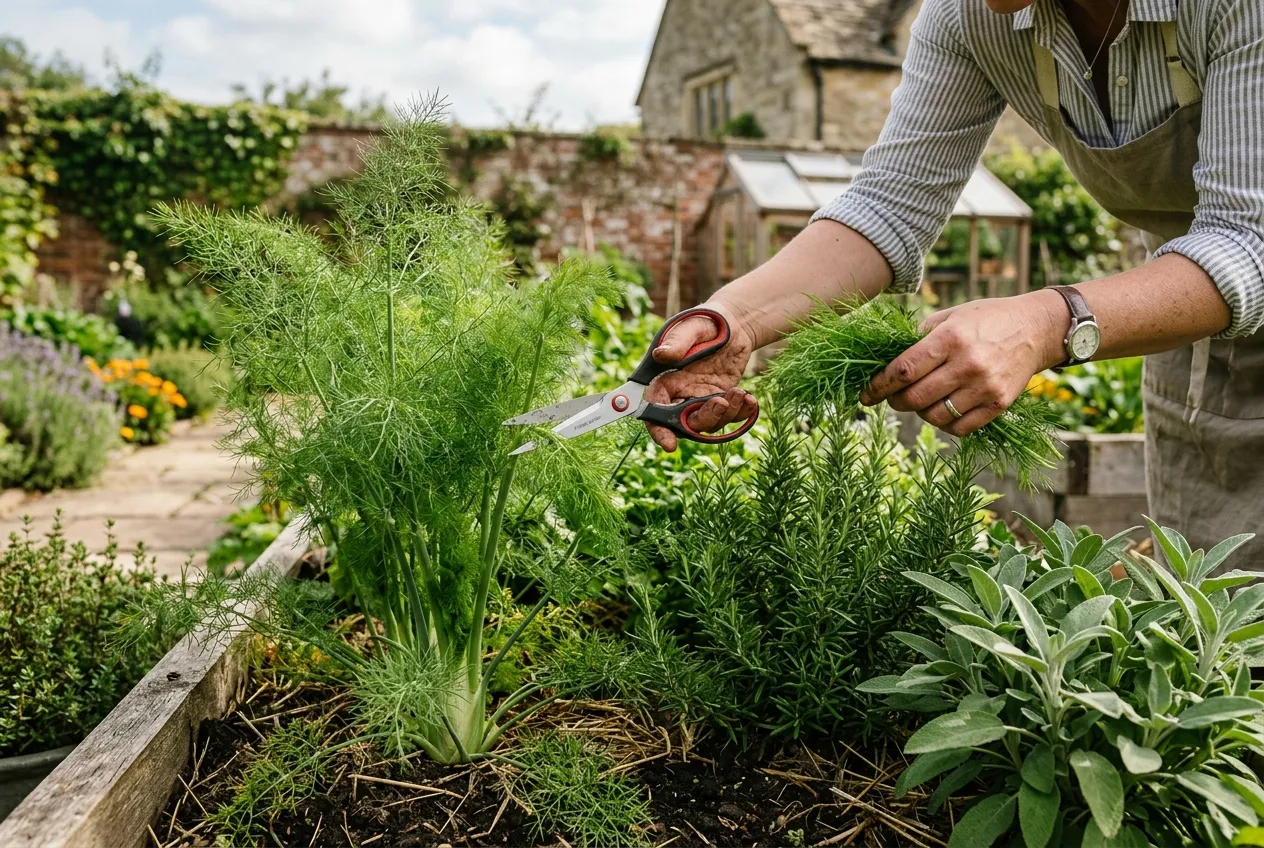
Harvesting fennel fronds and seeds. Use fronds fresh on the day of picking for the strongest anise flavour.
Common problems
Fennel is one of the least troubled herbs in UK gardens. Serious problems are rare.
Aphids occasionally colonise young growth in spring. Hoverflies, attracted by fennel’s own flowers later in the season, are the best long-term control. A strong water jet from a hose removes heavy infestations. Fennel outgrows minor aphid damage within days.
Slugs can damage young seedlings in wet springs. Protect emerging plants with copper tape, wool pellets, or organic slug pellets until they reach 15cm tall. Established fennel is not attractive to slugs.
Root rot occurs only in waterlogged soil. Ensure good drainage at planting. Fennel on heavy clay benefits from a 10cm gravel layer below the planting hole. Raised herb beds eliminate this risk entirely.
Powdery mildew may appear in late summer on crowded plants with poor air circulation. Thin plants to 45cm spacing and avoid overhead watering. Affected leaves can be removed without harming the plant.
Wind damage topples tall plants in exposed positions. Stake plants individually with bamboo canes in windy gardens, or grow them against a south-facing wall for natural shelter. Cutting back to 1m in July produces a shorter, sturdier plant that resists wind better, though it will not flower that year.
Frequently asked questions
Is fennel herb the same as Florence fennel?
No, common fennel herb and Florence fennel are different crops. Common fennel (Foeniculum vulgare) is a tall perennial grown for its feathery fronds and aromatic seeds. Florence fennel (Foeniculum vulgare var. azoricum) is a shorter annual grown for its swollen white bulb at the base. They belong to the same species but require different growing methods. Common fennel thrives as a permanent border plant. Florence fennel needs sowing each year and bolts easily if conditions are not right.
When should you sow fennel herb seed in the UK?
Sow fennel herb seed directly outdoors in April after the last hard frost. Alternatively, start seeds indoors in March using modules or small pots and transplant after hardening off in late April. Direct sowing is simpler and produces strong taproots because the seedlings are not disturbed. Fennel seed germinates in 10-14 days at soil temperatures above 10 degrees Celsius. Thin seedlings to 45cm apart once they have developed two true leaves. The RHS fennel growing guide provides further sowing advice for UK conditions.
Can you grow fennel herb in pots?
Fennel herb grows in large pots of at least 30 litres but performs better in open ground. The deep taproot needs room to develop. Use a tall, deep container filled with free-draining compost and position it in full sun. Water regularly in summer because container compost dries quickly. Pot-grown fennel rarely reaches full height and produces fewer seeds than plants grown in borders. It is a practical option for patios where ground planting is not possible.
How do you harvest fennel seeds?
Harvest fennel seeds in September when the umbels turn brown and the seeds detach easily. Cut the entire seed head with 15cm of stem attached. Place the heads upside down in a paper bag and hang in a warm, dry room for 2 weeks. The seeds will drop into the bag as they dry. Store in airtight glass jars away from light. Home-grown fennel seeds are far more aromatic than shop-bought because the volatile oils are freshest within the first 12 months of harvest.
Does fennel self-sow and become a problem?
Yes, fennel self-sows freely in UK gardens if seed heads are left on the plant. A single mature plant can scatter hundreds of seeds across borders and paths. Deadhead spent flower umbels in late August before the seeds ripen to prevent unwanted seedlings. Any self-sown seedlings that do appear are easy to pull out in spring when they are small. Bronze fennel self-sows slightly less aggressively than the green form but still needs deadheading in most gardens.
What should you not plant near fennel?
Never plant fennel next to dill or coriander in UK herb gardens. Fennel and dill cross-pollinate readily because they are closely related members of the Apiaceae family. Cross-pollinated seed produces plants with poor flavour. Fennel also inhibits the growth of tomatoes and beans through root exudates. Keep fennel at least 1 metre from these crops. It grows well alongside most other vegetables, brassicas, and salad crops without any negative effects. Garden Organic’s herb directory has further companion planting guidance.
Is bronze fennel edible or just ornamental?
Bronze fennel is fully edible and tastes identical to green common fennel. The deep purple-bronze foliage, feathery fronds, and aromatic seeds are all used in exactly the same way as the green form. The only difference is the striking dark colour of the leaves, which makes bronze fennel a popular choice for ornamental borders and mixed planting schemes. It reaches the same 1.5-2m height, produces the same yellow umbel flowers, and attracts the same beneficial insects.
Lawrie has been gardening in the West Midlands for over 30 years. He grows his own veg using no-dig methods, keeps a wildlife-friendly garden, and writes practical advice based on real UK growing conditions.