How to Grow Garlic Chives in the UK
Grow garlic chives in UK gardens with our guide to sowing seed, dividing clumps, container growing, harvesting leaves and edible flowers.
Key takeaways
- Garlic chives are fully hardy to -15C and grow well across all UK regions
- Flat leaves taste of mild garlic and are ready to cut from March to November
- White star-shaped flowers appear in August-September and are edible
- Sow seed indoors from March or outdoors from April — germination takes 14-21 days
- Divide established clumps every 3-4 years in spring or autumn
- Deadhead spent flowers to prevent vigorous self-seeding around the garden
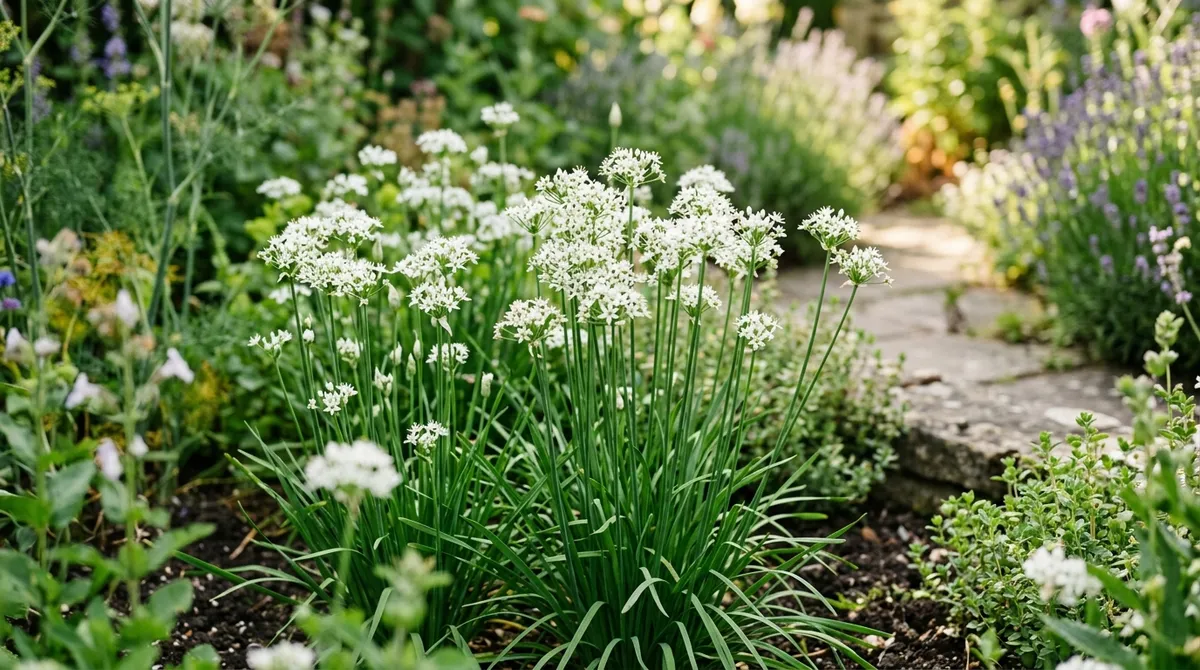
Garlic chives are one of the most underrated herbs for UK gardens. They produce flat, garlic-flavoured leaves from spring to late autumn and clusters of white star-shaped flowers in August that attract bees and butterflies.
Also known as Chinese chives, this hardy perennial belongs to the allium family alongside onions, leeks, and regular chives. The botanical name is Allium tuberosum, and the plant originates from East and Southeast Asia where it has been cultivated for over 3,000 years. In UK gardens, garlic chives are fully hardy to -15C and grow in almost any soil. Here is everything you need to know to grow them well.
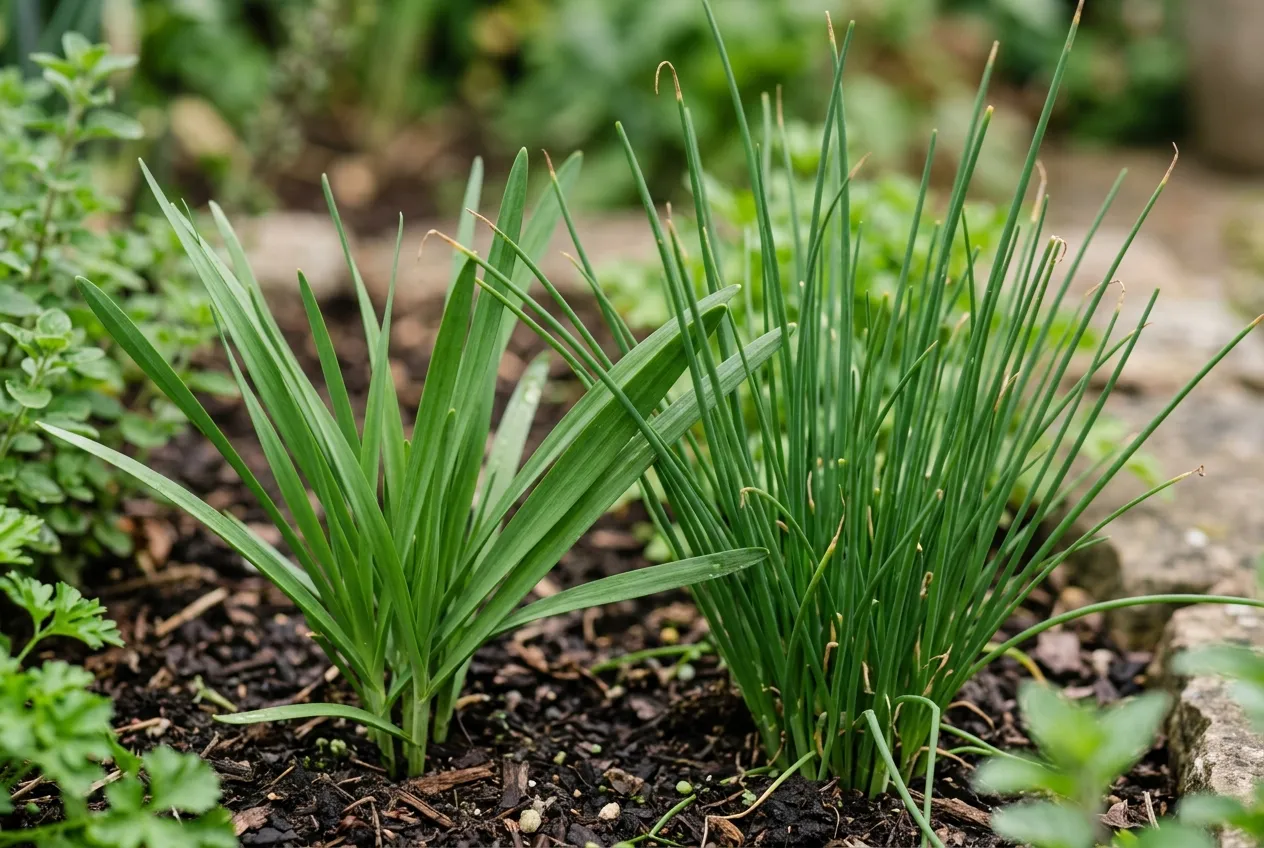 Garlic chives (left) have distinctive flat leaves, while regular chives (right) have hollow tubular stems
What are garlic chives?
Garlic chives (Allium tuberosum) are hardy perennial herbs with flat, solid leaves that taste of mild garlic rather than onion. They grow 30-45cm tall and form dense clumps that increase in size each year. Unlike common chives, which have hollow tubular leaves, garlic chives have strap-shaped foliage similar to miniature leeks.
The flavour sits somewhere between garlic and spring onions but milder than either. The leaves are the primary harvest, usable raw or cooked. The white flowers are edible too, with a more intense garlic flavour than the leaves.
In Chinese, Korean, and Japanese cooking, garlic chives are a staple ingredient. They appear in dumplings, stir-fries, pancakes, and egg dishes. In UK gardens, they fill a gap that no other herb covers: a reliable, perennial source of fresh garlic flavour without the effort of growing bulb garlic annually.
Key characteristics
| Feature | Detail |
|---|---|
| Botanical name | Allium tuberosum |
| Common names | Garlic chives, Chinese chives, Oriental chives |
| Family | Amaryllidaceae (allium subfamily) |
| Height | 30-45cm |
| Spread | 30cm (clump-forming, spreading) |
| Leaf type | Flat, solid, strap-shaped |
| Flower colour | White, star-shaped |
| Flowering period | August-September |
| Hardiness | Hardy to -15C (RHS H5) |
| Soil | Any well-drained soil, pH 6.0-7.5 |
| Position | Full sun to partial shade |
| Lifespan | Perennial, indefinite with division |
Garlic chives vs regular chives vs wild garlic
These three alliums are often confused but they are distinct plants with different uses, growing habits, and seasons.
Garlic chives produce flat leaves with a garlic flavour. They grow as clump-forming perennials in open, sunny positions. The leaves are available from March to November and the white flowers appear in late summer. They tolerate almost any soil.
Regular chives (Allium schoenoprasum) have hollow, tubular leaves with an onion flavour. They flower earlier with purple pompom blooms from May to June. They are slightly hardier than garlic chives, surviving temperatures down to -20C.
Wild garlic (Allium ursinum, also called ramsons) is a woodland plant with broad, soft leaves and a strong garlic flavour. It grows in damp, shady conditions and dies back completely by June. Wild garlic is a spring-only crop whereas garlic chives produce throughout the growing season.
| Feature | Garlic chives | Regular chives | Wild garlic |
|---|---|---|---|
| Botanical name | Allium tuberosum | Allium schoenoprasum | Allium ursinum |
| Leaf shape | Flat, solid | Hollow, tubular | Broad, soft |
| Flavour | Mild garlic | Mild onion | Strong garlic |
| Height | 30-45cm | 25-30cm | 15-25cm |
| Flower colour | White | Purple-pink | White |
| Flowering time | Aug-Sep | May-Jun | Apr-May |
| Best position | Sun to part shade | Sun to part shade | Damp shade |
| Harvest period | Mar-Nov | Mar-Nov | Mar-May |
| Self-seeding | Vigorous | Moderate | Moderate |
| Hardiness | -15C | -20C | -15C |
| Best culinary use | Stir-fries, dumplings, egg dishes | Salads, baked potatoes, soups | Pesto, soups, risotto |
The key practical difference is season. If you want garlic flavour from March to November, garlic chives are the answer. Wild garlic gives you an intense burst in spring then disappears.
How to grow garlic chives from seed
Growing from seed is the cheapest way to establish garlic chives. A single packet produces dozens of plants, though they take longer to reach full productivity than divisions.
When to sow
Sow garlic chive seeds indoors from March or directly outdoors from late April to May. Indoor sowing gives a head start of 6-8 weeks. Outdoor sowing works once the soil temperature reaches 15C consistently, which is typically mid-April in southern England and early May in northern regions.
Sowing method
Fill 9cm pots with multipurpose compost and water thoroughly before sowing. Scatter 10-12 seeds per pot on the surface. Cover with a thin 3-5mm layer of compost or vermiculite. Place on a warm windowsill or in a propagator at 15-20C. Germination takes 14-21 days, sometimes up to 28 days for older seed.
Grow seedlings on in their pots until they reach 10-15cm tall. Harden off outdoor-destined plants over 7-10 days in late May. Plant the whole clump without separating individual seedlings. Space clumps 25-30cm apart. Like common chives, garlic chives grow best as a cluster rather than as single plants.
First-year plants from seed produce harvestable leaves within 8-10 weeks of sowing but will not flower until their second year. Allow first-year plants to build up energy by harvesting lightly — take no more than one-third of the foliage at a time.
Seed viability
Garlic chive seeds remain viable for 2-3 years when stored in a cool, dry place. Fresh seed germinates at a higher rate (80-90%) than year-old seed (60-70%). If you save seed from your own plants, collect it in October when the seed heads have dried and the black seeds rattle inside the papery capsules.
Dividing established garlic chive clumps
Division is faster than seed and produces full-sized, flowering plants immediately. It is also essential maintenance for existing clumps.
When to divide
Divide garlic chive clumps every 3-4 years. The best time is early spring (March-April) just as new shoots emerge, or early autumn (September-October) while the soil still holds warmth. Spring division is preferable because the plants establish during the growing season ahead.
How to divide
Lift the entire clump with a garden fork. Shake off excess soil to expose the white, fleshy rhizomes beneath. Pull or cut the clump apart into sections of 6-8 shoots each. Discard the old, woody centre of the clump where growth has slowed.
Replant divisions 25-30cm apart in soil refreshed with garden compost. Water well after planting and keep moist for the first two weeks. New growth appears within days in spring. Each division produces a fully productive clump by mid-summer of its first year.
Why we recommend dividing rather than buying new plants: A single four-year-old garlic chive clump yields 8-12 new divisions at no cost. After trialling both methods over several seasons, divisions planted in March produced harvestable leaves by early May and flowered in August of the same year. Seed-grown plants took a full year longer to reach the same productivity. If you have access to an established clump — from a neighbour, allotment, or garden centre — division is always the better starting point.
Where to plant garlic chives
Garlic chives are tolerant plants but giving them their preferred conditions produces the best leaf flavour and the most flowers.
Light
Full sun produces the strongest garlic flavour and the heaviest flowering. Partial shade is tolerated, though plants grow taller and leggier with fewer flowers. Avoid deep shade. Four to six hours of direct sunlight is the minimum for good results.
Soil
Any well-drained soil works. Garlic chives grow in clay, loam, sand, or chalk. They prefer a neutral to slightly alkaline pH (6.0-7.5) but tolerate mild acidity. Heavy clay soils benefit from adding garden compost to improve drainage. Waterlogged conditions cause root rot over winter.
If you are creating a herb garden, plant garlic chives alongside other alliums and moisture-tolerant herbs like mint and parsley rather than with Mediterranean herbs like rosemary and thyme, which need drier conditions.
Spacing and position
Space plants 25-30cm apart. They form clumps that expand over time, eventually filling the gaps between them. Plant at the front or middle of a sunny border where you can reach them for regular harvesting. A row along a path edge works well.
Garlic chives also make effective edging plants. The flat leaves create a neat, grass-like border for much of the year. The white flowers in late summer add seasonal interest. As a member of the allium family, garlic chives deter aphids, making them useful planted near roses and vegetables.
Growing garlic chives in containers
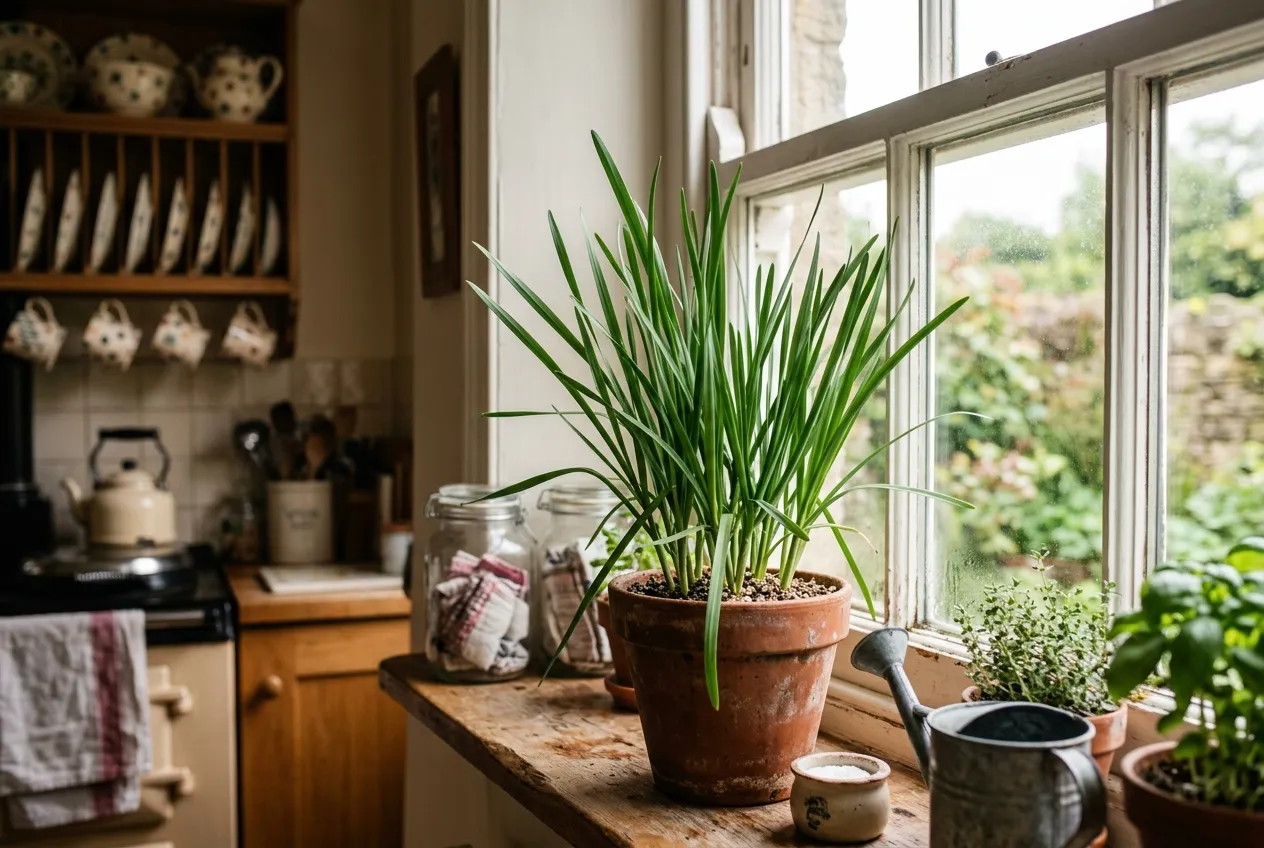 A pot of garlic chives on the kitchen windowsill gives you fresh garlic-flavoured leaves year-round
Containers suit garlic chives well. Pot growing keeps the plants within reach for quick harvesting and — critically — prevents the self-seeding that makes them invasive in borders.
Choosing the right pot
Use a container at least 20cm wide and 20cm deep. Garlic chives have denser, deeper roots than common chives and need slightly more room. Terracotta or ceramic pots work well. Ensure drainage holes are present and use crocks or gravel at the base.
Compost and feeding
Fill with standard multipurpose compost. Garlic chives are not fussy about growing medium. Feed monthly with a half-strength liquid general-purpose fertiliser from April to September. This replaces nutrients that regular watering leaches from the compost.
Watering
Keep compost consistently moist but not waterlogged. Water every 2-3 days in warm weather, less in cool periods. Garlic chives prefer slightly more moisture than Mediterranean herbs but will not tolerate sitting in water. If you grow other vegetables in pots, our container vegetable gardening guide covers the watering principles in detail.
Indoor windowsill plants produce leaves year-round given at least four hours of daylight. Winter leaves are thinner and paler but still carry the garlic flavour. Rotate the pot weekly to prevent the plant leaning toward the light.
Harvesting garlic chive leaves
Regular harvesting keeps garlic chives productive and encourages fresh, tender regrowth. Left uncut, the leaves become tough and fibrous.
How to harvest
Cut leaves with sharp scissors about 3cm above soil level. Never pull individual leaves as this damages the rhizome beneath. Cut from the outside of the clump first, letting the centre continue growing. Each stem regrows within 2-3 weeks.
Begin harvesting when leaves reach 15-20cm tall, typically from late March in mild areas. Continue cutting until the foliage dies back naturally in November. A healthy, established clump supports 5-6 complete harvests per season.
Storing fresh leaves
Fresh garlic chive leaves keep for 5-7 days wrapped in damp kitchen paper inside a sealed container in the fridge. For longer storage, freeze them. Chop finely, pack into ice cube trays, top up with a little water, and freeze. Each cube gives you a ready-measured portion for cooking. Frozen garlic chives retain their flavour for up to six months.
Drying is not recommended. Like common chives, garlic chives lose most of their flavour when dried. The volatile garlic compounds evaporate during the drying process. Freezing is always the better preservation method.
Blanching for yellow chives
In Chinese cooking, blanched garlic chives (jiu huang) are a prized delicacy with a sweeter, milder flavour than green leaves. To produce them, cover an established clump with a large upturned pot or bucket in early spring. Exclude all light for 2-3 weeks. The leaves grow pale yellow, tender, and with a delicate flavour. Remove the cover after harvesting to allow the plant to recover.
This technique works well in UK gardens from mid-March onward. It is identical in principle to blanching rhubarb or chicory and produces an ingredient you cannot buy in most UK shops.
Edible garlic chive flowers
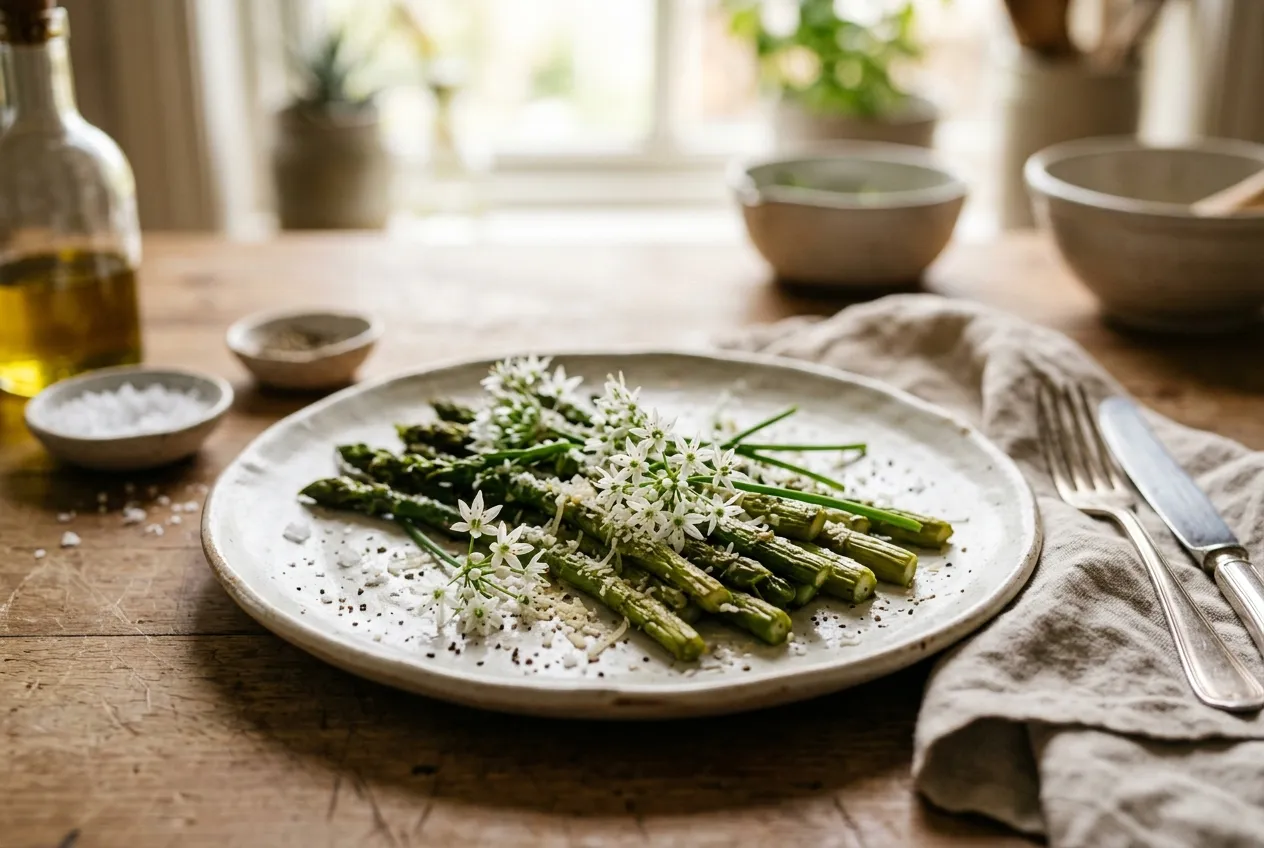 White garlic chive flower heads make a beautiful and flavourful edible garnish
The white, star-shaped flowers that appear in August and September are edible and ornamental. They have a stronger garlic flavour than the leaves, making them a useful kitchen ingredient.
Harvesting flowers
Pick flower heads just as they fully open for the best flavour and appearance. Cut the stem 10cm below the flower head. The stems are tough and fibrous so discard them and use only the flower heads. Pull apart individual florets for scattering over dishes.
Using garlic chive flowers in cooking
Scatter fresh florets over salads, soups, stir-fries, and egg dishes. They add colour, texture, and a hit of garlic flavour without dominating the dish. The flowers also work well stirred through cream cheese or butter.
For a garlic chive flower vinegar, pack fresh flower heads loosely into a jar and cover with white wine vinegar. Seal and store in a cool, dark place for two weeks. Strain through muslin. The resulting vinegar carries a subtle garlic flavour that works in dressings and marinades.
Balancing flowers and self-seeding
Here is the trade-off every garlic chive grower faces. The flowers are beautiful, attract pollinators, and taste good. But each flower head produces 20-30 black seeds that germinate readily. If you let all flowers go to seed, you will find garlic chive seedlings appearing across your garden the following spring.
The practical approach: allow half the flowers to bloom for bees and the kitchen, and deadhead the other half before seeds form. Or grow in containers where self-seeding falls on paved surfaces and is easy to sweep up.
Garlic chives in Asian and UK cooking
Garlic chives are one of the most widely used herbs in East Asian cuisine. In UK kitchens, they fill a useful niche between garlic and onion, adding a mild garlic flavour without the pungency of raw garlic cloves.
Traditional Asian uses
In Chinese cooking, garlic chives appear in jiaozi (dumplings) with pork and prawn, stir-fried with eggs, and in savoury pancakes. Korean cooking uses them in kimchi, japchae (glass noodle stir-fry), and buchujeon (chive pancakes). Japanese cooking includes them in gyoza fillings and ramen toppings.
The flower buds (harvested before they open) are used across Southeast Asia as a vegetable in their own right. Stir-fried garlic chive buds with oyster sauce is a classic Cantonese dish.
UK kitchen ideas
Add finely snipped leaves to scrambled eggs, omelettes, or quiche. Stir through mashed potato, cream cheese, or butter for an instant garlic herb butter. Use as a fresh garnish on soups, particularly potato and leek. Fold into homemade bread dough before baking.
Garlic chive leaves wilt quickly when heated, so add them at the last moment in cooked dishes. The garlic flavour intensifies slightly with heat but the texture softens within seconds.
For a broader look at growing culinary herbs, see our guide to how to grow herbs in the UK.
Managing self-seeding
Vigorous self-seeding is the single biggest management challenge with garlic chives. Left unchecked, they colonise borders, paths, and cracks in paving within two to three years.
Prevention
Deadhead all flower stems before seeds ripen. Seeds mature roughly 4-6 weeks after flowering, typically by mid-October. Cut flower stems to ground level once the petals fade and before the seed capsules swell. Composting the spent flower heads is safe — the seeds have not ripened yet.
Containment strategies
Growing in containers is the simplest solution. A sunken pot (buried in the border with the rim protruding 2cm above soil level) contains root spread while keeping the plant looking natural in the border. The rim also prevents the rhizomes from creeping outward.
Raised beds with solid sides work equally well. If planting in an open border, surround the planting area with a physical barrier such as a bottomless bucket sunk into the soil. This approach also works for controlling mint, another vigorous spreader.
Removing unwanted seedlings
Pull seedlings promptly in spring when they are small and easy to identify by their flat, garlic-scented leaves. Hoeing the soil surface in March disturbs germinating seeds before they establish. A 5cm layer of bark mulch also suppresses germination around the parent plant.
Winter dormancy and care
Garlic chives die back to ground level in late autumn, typically November. The flat leaves yellow and collapse. This is normal dormancy, not a sign of problems.
Winter protection
No winter protection is needed anywhere in mainland UK. Garlic chives survive temperatures down to -15C. The underground rhizomes are the plant’s energy store and remain unaffected by frost, snow, or prolonged cold. Container plants are slightly more vulnerable to extreme cold because the roots are above ground level — move pots against a sheltered house wall during severe freezes but do not bring them indoors.
Spring emergence
New shoots appear from late February in mild areas and March elsewhere. The first leaves are pale green and grow rapidly, reaching harvestable size within 3-4 weeks. Mark the planting position in winter so you do not accidentally dig into dormant clumps.
Common problems
Garlic chives are largely trouble-free. Their allium chemistry deters most pests, and fungal problems are rare in well-drained soil.
Rust — Orange pustules on leaves. Caused by the fungus Puccinia allii. Remove and destroy affected leaves. Do not compost them. Improve air circulation by thinning congested clumps. The RHS advises that allium rust is most common in warm, humid conditions. In Staffordshire trials, rust appeared only in one exceptionally wet August out of six growing seasons.
Onion fly — Maggots eat into the base of stems. Damage is usually minor on garlic chives because the rhizomes recover quickly. Cover plants with horticultural fleece in May and June when adult flies are active.
Slugs and snails — Occasionally graze young spring growth. Garlic chives are not a preferred food, so damage is light. Slug pellets or beer traps solve the problem quickly.
Self-seeding — The most common complaint. See the management section above.
Month-by-month care calendar
| Month | Task |
|---|---|
| February | Watch for first new shoots in mild areas |
| March | Begin light harvesting once leaves reach 15cm. Divide congested clumps. Sow seed indoors |
| April | Sow seed outdoors once soil reaches 15C. Plant out indoor-raised seedlings after hardening off |
| May | Main growing season. Harvest regularly. Water containers every 2-3 days |
| June | Continue harvesting. Feed container plants monthly |
| July | Flower buds begin forming. Continue leaf harvests |
| August | Flowers open. Harvest some for the kitchen, deadhead others. Peak flowering period |
| September | Late flowers continue. Begin deadheading spent flower heads before seeds ripen |
| October | Final harvests. Collect seed if wanted. Divide any clumps due for splitting |
| November | Foliage dies back. No action needed. Tidy dead leaves if desired |
| December-January | Fully dormant. Plan next year’s herb garden |
Garlic chives pair well with other alliums in the kitchen garden. Planting them alongside onions and leeks creates a productive allium bed that deters pests through shared sulphur chemistry.
Frequently asked questions
Are garlic chives easy to grow in the UK?
Garlic chives are one of the easiest perennial herbs for UK gardens. They tolerate most soils, grow in sun or partial shade, and survive winters down to -15C without protection. The main task is deadheading spent flowers to prevent self-seeding. Established clumps need dividing every 3-4 years to stay productive.
What is the difference between garlic chives and regular chives?
Garlic chives have flat, solid leaves with a mild garlic flavour. Regular chives have hollow, tubular leaves with an onion flavour. Garlic chives produce white flowers in late summer while regular chives bloom purple in early summer. Garlic chives grow taller at 30-45cm versus 25-30cm for common chives.
Can you eat garlic chive flowers?
Garlic chive flowers are completely edible and delicious. The white star-shaped florets have a mild garlic flavour that works well scattered over salads, stir-fries, and soups. Pick flower heads just as they fully open for the best flavour. The stems holding the flowers are tough and should be discarded.
Do garlic chives come back every year?
Garlic chives are reliably perennial across the whole of the UK. They die back to ground level in late autumn and reappear in early spring. Established clumps return for many years without replanting. Division every 3-4 years prevents the centre from dying out and keeps leaf production strong.
How do you stop garlic chives from spreading?
Deadhead all flower stems before seeds ripen in October. Each flower head produces dozens of black seeds that germinate freely the following spring. Growing plants in sunken pots or raised beds with solid sides contains root spread. Removing seedlings promptly in spring prevents colonisation of nearby beds.
Can you grow garlic chives in pots?
Garlic chives grow very well in containers at least 20cm wide and deep. Use multipurpose compost and keep it consistently moist. Feed monthly with liquid fertiliser from April to September. Pot growing also prevents the self-seeding problem that troubles border plantings. Bring pots to a sheltered spot near the kitchen for easy harvesting.
When should you divide garlic chives?
Divide garlic chives every 3-4 years in early spring or early autumn. Spring division in March or April gives plants the full growing season to establish. Lift the clump, split into sections of 6-8 shoots each, discard the woody centre, and replant in refreshed soil 25-30cm apart.
Lawrie has been gardening in the West Midlands for over 30 years. He grows his own veg using no-dig methods, keeps a wildlife-friendly garden, and writes practical advice based on real UK growing conditions.