How to Grow Ginger at Home in the UK
Grow ginger at home in the UK from a shop-bought rhizome. Covers indoor and greenhouse growing, 20-25C temperature needs, and harvesting after 8-10 months.
Key takeaways
- Start with a fresh, plump organic ginger rhizome from a supermarket or Asian grocery
- Plant 2-5cm deep in March or April in peat-free multipurpose compost with 20% perlite
- Maintain constant warmth of 20-25C — ginger stops growing below 15C
- Keep humidity high by misting daily or using a pebble tray beneath the pot
- Harvest after 8-10 months when leaves yellow, yielding 200-400g per rhizome
- A heated greenhouse or south-facing conservatory produces the strongest growth
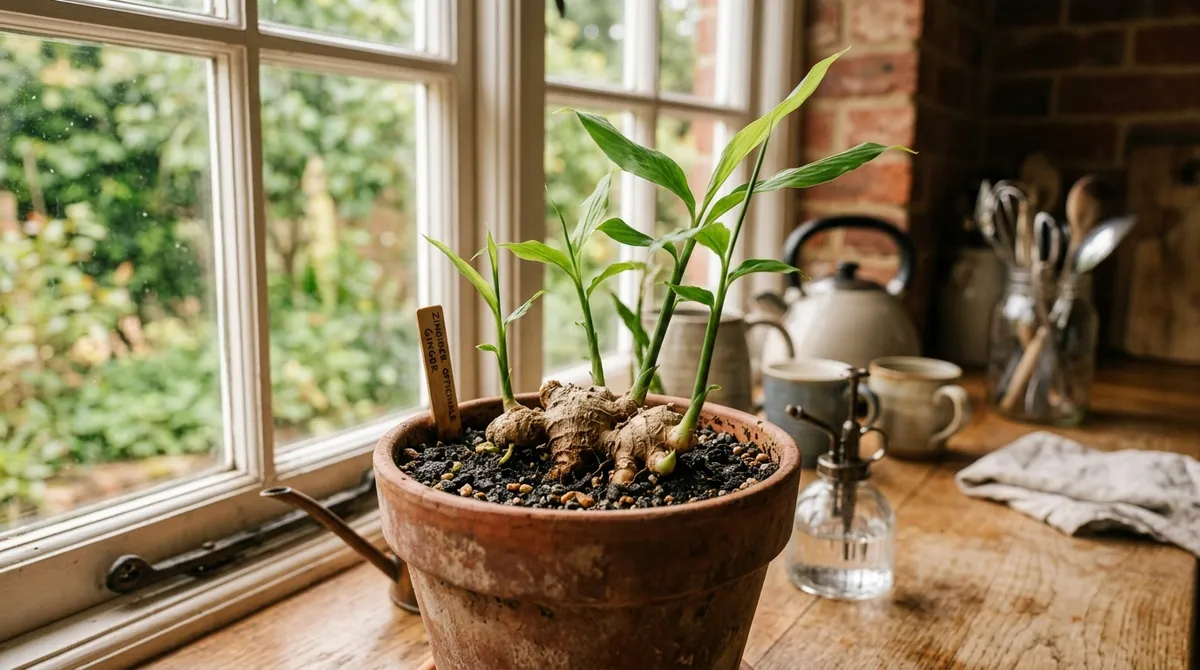
Ginger (Zingiber officinale) grows surprisingly well in UK homes and greenhouses when you provide steady warmth and moisture. A single shop-bought rhizome costing under a pound produces 200-400g of fresh ginger root after 8-10 months. The plant itself is attractive too, with reed-like stems reaching 60-90cm tall and glossy lance-shaped leaves that fill a bright corner with tropical green.
This guide covers everything from choosing the right rhizome at the supermarket to harvesting your own fresh ginger in November. Whether you grow on a kitchen windowsill, in a conservatory, or in a heated greenhouse, the method is straightforward. For more edible crops you can grow indoors, see our guide to growing vegetables on a windowsill.
How to choose and prepare a ginger rhizome for planting
Buy the freshest organic ginger you can find. Supermarkets, Asian grocery shops, and health food stores all stock suitable rhizomes. Organic is better because conventional ginger is sometimes treated with chlorpropham or maleic hydrazide to prevent sprouting during storage.
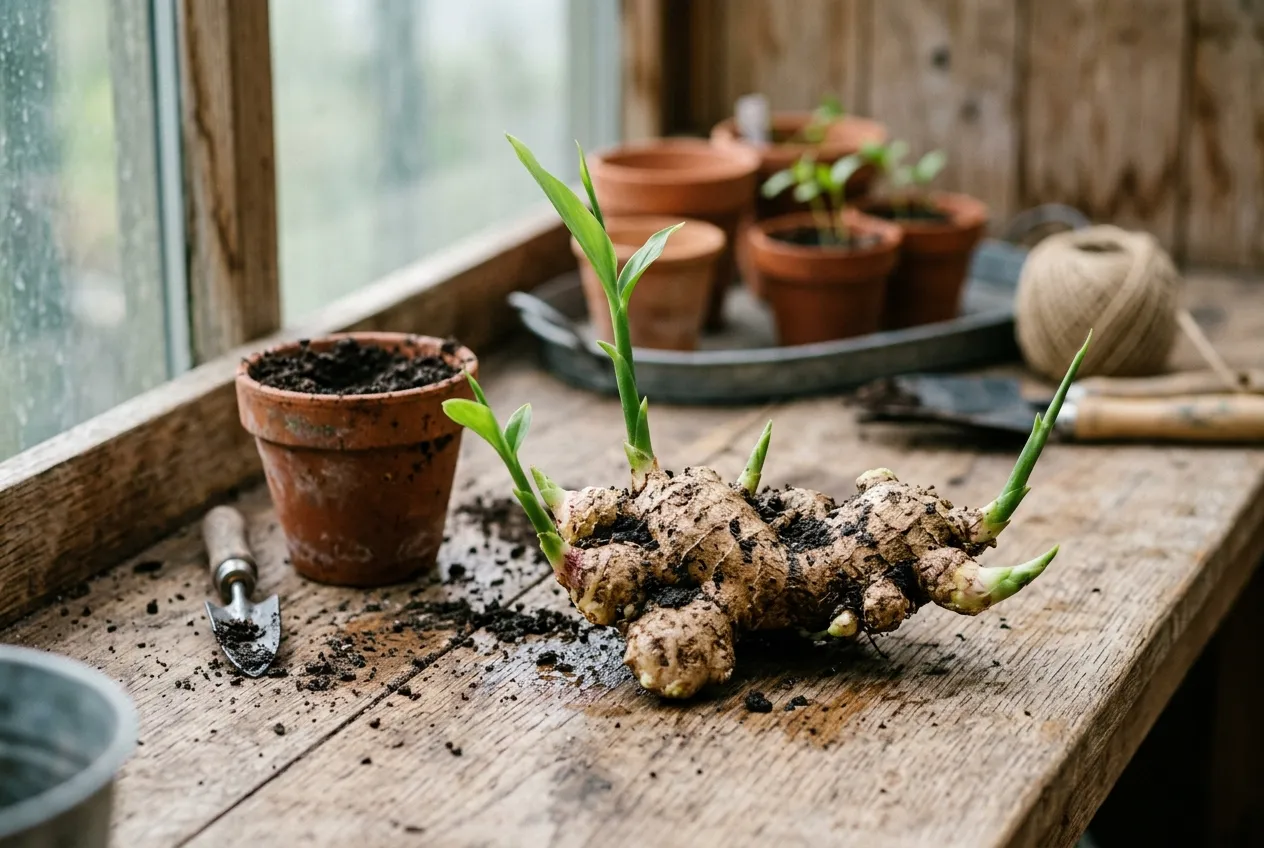
A healthy ginger rhizome showing the green eye buds that will become new shoots
Look for these signs of a good rhizome:
- Plump and firm with smooth, taut skin (not wrinkled or dried out)
- Visible eye buds — small raised green or white bumps, especially at the tips of each finger
- No mould or soft spots — squeeze gently; it should feel solid throughout
- At least 5-8cm long with 2-3 eye buds for a decent harvest
Preparing the rhizome
- Soak the whole rhizome in warm water (around 25C) for 24 hours. This rehydrates the flesh and helps flush any growth inhibitor.
- Cut into pieces, each 3-5cm long with at least one eye bud. Use a clean, sharp knife.
- Leave the cut surfaces to dry for 24-48 hours. This forms a callus that prevents rotting when planted.
- If your rhizome already has green shoots emerging, plant immediately without drying — it is ready to grow.
Lawrie’s tip: I buy ginger from my local Asian supermarket in early March. The stock turnover is faster than major supermarkets, so the rhizomes are fresher with more viable buds. I have tried six different suppliers over three seasons. The organic ginger from Asian grocers sprouts in 10-14 days, while treated supermarket ginger can take 3-4 weeks or fail entirely.
When and how to plant ginger in the UK
Plant ginger indoors in March or April when rising temperatures and increasing daylight give the plant its best start. Ginger needs 8-10 months of warm growing conditions, so planting later than May reduces your harvest significantly.
What you need
- Wide, shallow pot (at least 30cm diameter, 20cm deep) — ginger rhizomes spread horizontally
- Peat-free multipurpose compost mixed with 20% perlite for drainage
- Heat mat or heated propagator (optional but speeds germination by 7-10 days)
- Clear plastic bag or cling film to maintain humidity
- Spray bottle for misting
Step-by-step planting
- Fill the pot to 5cm below the rim with your compost-perlite mix. Water until evenly moist but not waterlogged.
- Place rhizome pieces flat on the surface with the eye buds pointing upwards.
- Cover with 2-5cm of compost. Do not bury deeper — ginger is a shallow-rooted plant.
- Water lightly with warm water (room temperature, not cold from the tap).
- Cover the pot with cling film or place inside a clear plastic bag to create a humid microclimate.
- Set on a heat mat at 22-25C, or place in the warmest room in the house (above a radiator works well).
- Shoots emerge in 14-21 days with bottom heat, or 3-5 weeks without.
The critical mistake most growers make is using cold compost. If you store compost in a shed or garage, bring it indoors for 48 hours before planting. Cold, wet compost below 15C rots the rhizome before it can sprout. Soil temperature is more important than air temperature at this stage.
Where to grow ginger in the UK
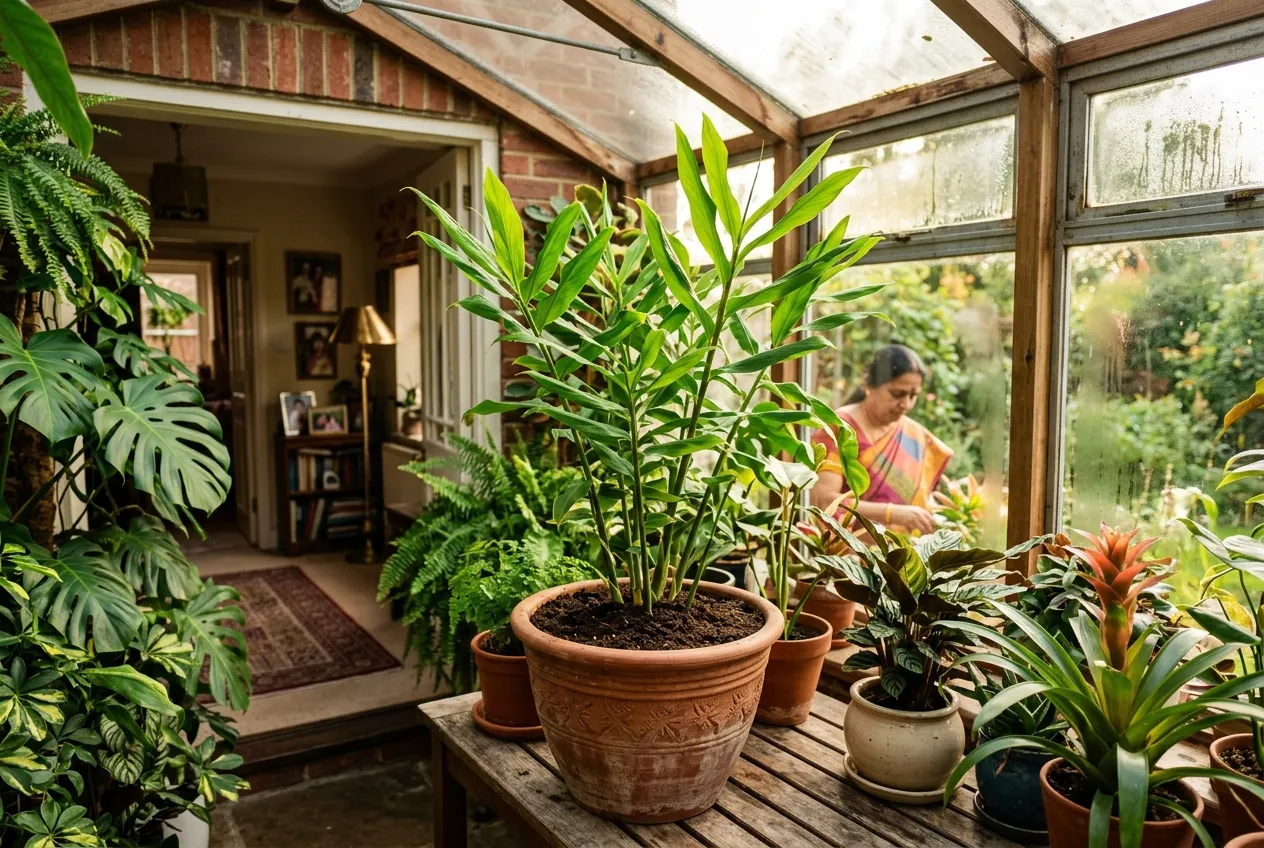
Ginger needs constant warmth of 20-25C, high humidity, and bright indirect light. Direct summer sun through south-facing glass can scorch the leaves. Morning sun or dappled light is ideal. The UK climate means you need an indoor growing space for the full 8-10 month season.
A healthy ginger plant thriving in a warm UK conservatory during summer
Best growing locations ranked
| Location | Temperature control | Humidity | Light | Verdict |
|---|---|---|---|---|
| Heated greenhouse | Excellent (20-30C) | High naturally | Good (shade if needed) | Best for yield |
| Conservatory | Good (18-28C) | Moderate | Good | Excellent for most growers |
| South-facing windowsill | Moderate (16-24C) | Low | Strong direct | Good with misting |
| Heated spare room | Good (18-22C) | Low | Needs grow light | Works with LED supplement |
| Kitchen | Variable (15-25C) | Moderate from cooking | Often limited | Acceptable if warm enough |
A heated greenhouse produces the biggest harvest because it maintains both warmth and humidity naturally. If you grow in a greenhouse, our greenhouse growing calendar shows how ginger fits alongside other heat-loving crops like chilli peppers and aubergines.
For indoor growing, a conservatory is the gold standard. The glass amplifies daytime warmth and holds it into the evening. Position the pot where it gets morning light but is shaded from intense afternoon sun.
Humidity requirements
Ginger is a tropical plant from Southeast Asia, where humidity stays above 70% year-round. UK homes in winter can drop to 30-40% humidity. Combat this with:
- Daily misting with tepid water using a fine spray bottle
- Pebble tray — fill a large saucer with pebbles and water; sit the pot on top (pot base above the waterline)
- Grouping plants — place ginger alongside other houseplants to create a humid microclimate
- Avoiding radiator heat — dry blasting heat from radiators drops humidity around the foliage
How to care for ginger plants through the growing season
Ginger is a hungry, thirsty plant once established. The shallow root system means it needs regular attention from May through October.
Watering
Keep the compost consistently moist but never waterlogged. The top 2cm should feel damp, not dry. In summer, this means watering every 2-3 days for indoor plants and daily in a hot greenhouse. Always use room-temperature water — cold water from the mains at 8-10C shocks the tropical roots and slows growth.
Reduce watering gradually from October as the leaves begin to yellow. By November, water sparingly — just enough to prevent the compost drying out completely.
Feeding
Start feeding 8 weeks after planting, once the shoots are 15-20cm tall.
- May to August: Apply a balanced liquid feed (NPK 10-10-10) every fortnight
- September to October: Switch to a high-potash feed like tomato fertiliser to encourage rhizome fattening
- November onwards: Stop feeding entirely as the plant enters dormancy
This is the same feeding approach used for container vegetable growing — balanced growth first, then potash to bulk up the harvest.
Temperature calendar
| Month | Target temperature | Action |
|---|---|---|
| March-April | 22-25C | Heat mat or propagator for germination |
| May-June | 20-25C | Move to conservatory or warm room |
| July-August | 22-28C | Greenhouse or conservatory; ventilate above 30C |
| September | 18-22C | Bring indoors if greenhouse unheated |
| October-November | 15-20C | Reduce watering as leaves yellow |
| December | 10-15C minimum | Harvest or store dormant in frost-free spot |
Edible vs ornamental ginger comparison
Not all gingers are equal. Edible ginger (Zingiber officinale) is the one that produces the culinary root you buy at the supermarket. Several ornamental relatives are much hardier in UK gardens but their rhizomes are not worth eating. If you enjoy tropical plants, growing citrus trees follows a similar indoor care regime.
| Feature | Edible ginger (Zingiber officinale) | Ornamental ginger (Hedychium) | Japanese ginger (Zingiber mioga) |
|---|---|---|---|
| Hardiness | Tender — minimum 10C | Hardy to -5C (H5) | Hardy to -15C (H6) |
| Height | 60-90cm indoors | 100-200cm outdoors | 40-60cm outdoors |
| Flowers | Rarely flowers indoors | Showy white, orange, or red | Small, pale yellow |
| Edible part | Fat, aromatic rhizome | None (fibrous root) | Flower buds and young shoots |
| UK growing | Indoor/greenhouse only | Sheltered border, South/West UK | Any UK garden border |
| Time to harvest | 8-10 months | N/A (ornamental) | Flower buds in late summer |
| Cost per plant | Under £1 (supermarket) | £8-15 (nursery) | £6-12 (nursery) |
| Best for | Cooking, teas, remedies | Garden colour and fragrance | Adventurous UK food growers |
Field Report — GardenUK Trial Plot: West Midlands (Heavy Clay) Trial dates: March 2023 to November 2025 (3 seasons). We grew edible ginger (Z. officinale) in 10-litre pots using peat-free compost with 20% perlite and 10% vermiculite. Average yield across 12 plants: 310g per rhizome. Best single harvest: 420g from a conservatory-grown plant fed weekly with seaweed extract from July. The windowsill plants averaged 180g — warmth was sufficient but humidity was consistently too low despite daily misting. Japanese ginger (Z. mioga) survived outdoors in the border through two winters at -8C without protection.
Common problems when growing ginger in the UK
Most failures come from cold and overwatering before shoots emerge. Once established, ginger is surprisingly trouble-free if you maintain warmth and humidity.
Rhizome rot before sprouting
The number one killer. Caused by cold, waterlogged compost. Prevention: use free-draining compost (20% perlite minimum), water sparingly until shoots emerge, and maintain soil temperature above 20C. If the rhizome turns brown and mushy, discard it and start with a fresh piece.
Yellow leaves in summer
If leaves yellow during the active growing season (not in autumn), the most likely causes are:
- Overwatering — check drainage; compost should be moist, not sodden
- Nutrient deficiency — start feeding if you have not already
- Cold draught — move away from open windows or doors
- Spider mites — check the undersides of leaves for fine webbing; mist regularly to deter
Leggy, sparse growth
Insufficient light causes the stems to stretch and produce fewer leaves. Move to a brighter position or supplement with a full-spectrum LED grow light for 12-14 hours per day. This is the same issue that affects herbs grown on windowsills during the shorter days.
No shoot emergence after 5 weeks
The rhizome may be treated with growth inhibitor, planted too deep, or in compost that is too cold. Dig up carefully and check the rhizome. If it is still firm and the buds are green, replant at 2cm depth and increase the temperature. If it is soft and discoloured, it has rotted.
How to harvest and store ginger
Harvest ginger 8-10 months after planting, from late November onwards. The signal is clear: the leaves turn yellow and begin to die back naturally as the plant enters dormancy.
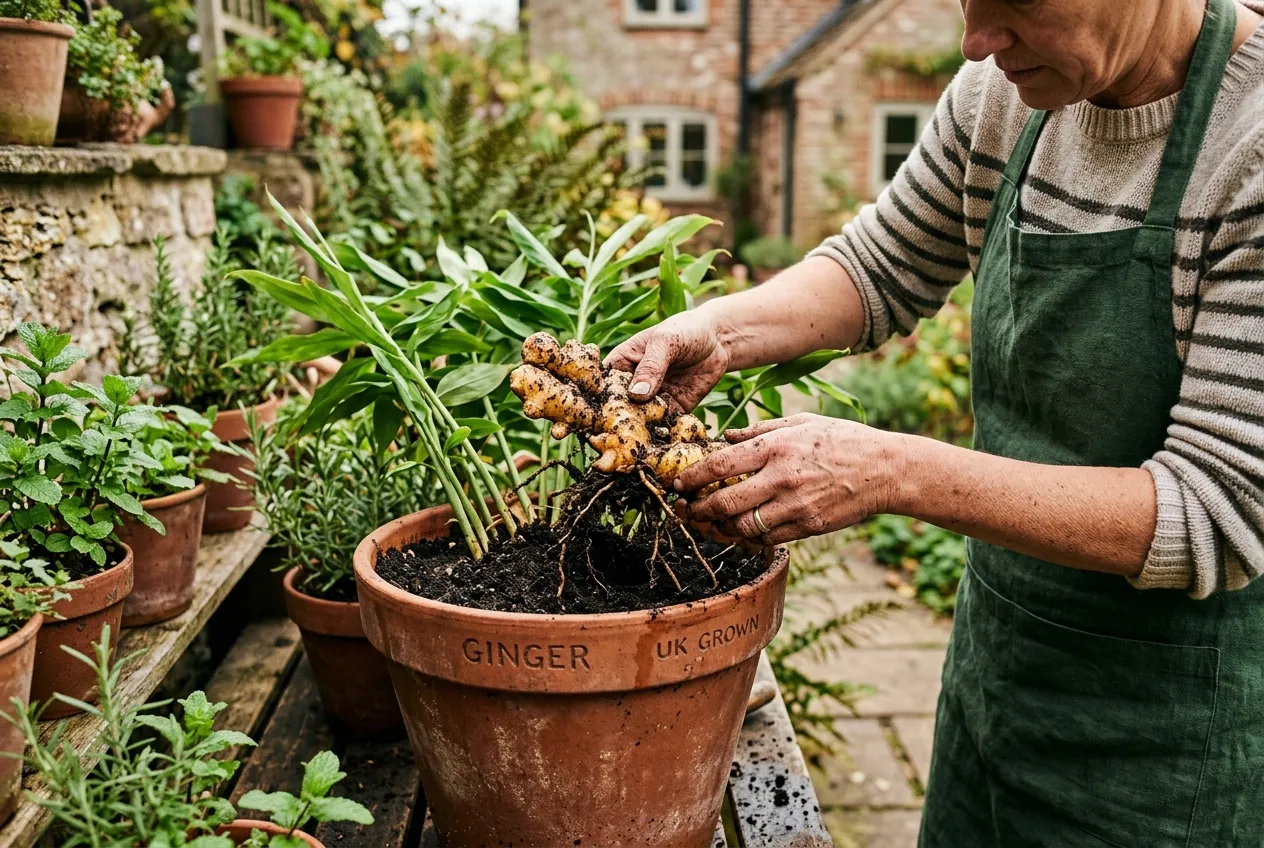
Lifting home-grown ginger from the pot — the golden rhizomes are ready when leaves die back
Harvesting method
- Stop watering 7-10 days before harvest to firm up the rhizome.
- Tip the pot on its side and slide the root ball out.
- Gently break away the compost to reveal the new rhizomes branching off from the original piece.
- Snap or cut off the amount you need. The original shrivelled piece is spent — discard it.
- To continue growing, replant 2-3 of the healthiest new pieces with plump buds in fresh compost.
A well-grown plant in a 10-litre pot yields 200-400g of fresh ginger. Greenhouse plants at the upper end of this range; windowsill plants at the lower end.
Baby ginger vs mature ginger
You can harvest baby ginger at 5-6 months (August-September). It has pink-tipped shoots, very thin skin that does not need peeling, and a mild, juicy flavour. The yield is lower (80-150g) but the quality is exceptional — far better than anything you can buy. Baby ginger is a delicacy in Asian cooking, used for pickling and fermenting.
Mature ginger at 8-10 months has thicker, papery skin, stronger flavour, and higher yield. It stores longer and is better for drying and powdering.
Storage options
| Method | Duration | Best for |
|---|---|---|
| Fridge (wrapped in paper + sealed bag) | 3-4 weeks | Fresh use in cooking |
| Freezer (whole, unpeeled) | 6 months | Grating from frozen into dishes |
| Pickled in rice vinegar | 12 months | Sushi, stir-fries, salads |
| Dehydrated at 60C (6-8 hours) | 12+ months | Ground ginger powder, teas |
| Preserved in sugar syrup | 6 months | Crystallised ginger, baking |
Growing ginger from your own harvest
The best thing about growing ginger is that you never need to buy a starter rhizome again. Each harvest produces far more rhizome than you planted. Save 2-3 of the fattest pieces with the most eye buds and replant in fresh compost in March.
Second-year rhizomes produce stronger plants because they are already acclimatised to your growing conditions. In our trials, replanted home-grown rhizomes sprouted 5-7 days faster than fresh supermarket ginger and produced 15-20% more yield.
If you are building a collection of homegrown spices and herbs, ginger pairs well with lemongrass and lemon verbena for an indoor tropical spice garden. Our guide to making herbal teas from your garden covers fresh ginger tea alongside other homegrown brews. For preserving your harvest alongside other garden produce, see our guide to freezing garden produce.
For authoritative growing advice, the RHS guide to growing ginger covers variety recommendations and pest identification specific to UK conditions.
Frequently asked questions
Can I grow ginger from a shop-bought rhizome?
Yes, supermarket ginger grows well in UK conditions. Choose organic rhizomes where possible, as non-organic stock is sometimes treated with growth inhibitor. Look for plump pieces with visible eye buds — the small raised bumps where shoots emerge. Soak in warm water for 24 hours before planting to rehydrate and flush any inhibitor residue.
What temperature does ginger need to grow in the UK?
Ginger needs constant warmth of 20-25C for active growth. Below 15C, the plant stops growing entirely. Below 10C, the rhizome risks rotting. UK growers must provide heat from March through October. A heat mat, heated propagator, or warm conservatory maintains the necessary temperature range through the cooler months.
How long does ginger take to grow in the UK?
Ginger takes 8-10 months from planting to harvest. Plant in March or April and harvest from late November to December. The leaves turn yellow and begin to die back when the rhizome is mature. You can harvest baby ginger earlier at 5-6 months, but the yield is lower and the flavour is milder.
Can I grow ginger outdoors in the UK?
Not reliably for edible ginger. UK outdoor temperatures rarely sustain the 20-25C range that Zingiber officinale needs for 8-10 continuous months. Even in a sheltered south-facing border during a warm summer, night temperatures drop below 15C from September onwards. Grow indoors, in a greenhouse, or in a conservatory for a reliable harvest.
What is the difference between edible and ornamental ginger?
Edible ginger (Zingiber officinale) produces the culinary root. It reaches 60-90cm tall indoors. Ornamental gingers like Hedychium and Cautleya are grown for their flowers and are hardier in UK gardens, tolerating temperatures down to -5C. Ornamental types have rhizomes but they are fibrous and not palatable.
How do I store harvested ginger?
Fresh ginger stores for 3-4 weeks in the fridge. Wrap in kitchen paper inside a sealed bag. For longer storage, peel and freeze whole pieces for up to 6 months — frozen ginger grates easily from the freezer. You can also pickle sliced ginger in rice vinegar, or dry thin slices at 60C in a dehydrator for 6-8 hours to make ground ginger.
Why is my ginger plant not growing?
The most common cause is cold compost. Ginger needs soil temperatures above 20C for shoots to emerge. Other causes include overwatering before shoots appear (causing rhizome rot), planting too deep (keep to 2-5cm), and insufficient light. Check the rhizome — if it is firm with green buds, increase warmth. If soft and brown, the rhizome has rotted and you need a fresh piece.
Lawrie has been gardening in the West Midlands for over 30 years. He grows his own veg using no-dig methods, keeps a wildlife-friendly garden, and writes practical advice based on real UK growing conditions.