How to Grow Globe Artichokes UK
Learn how to grow globe artichokes in the UK. Covers best varieties, planting from seed and offsets, soil prep, harvest timing, and overwintering.
Key takeaways
- Each established globe artichoke plant produces 10-12 edible buds per season from June to September
- Plants reach 1.2-1.5m tall and need 90cm spacing in full sun on well-drained soil with pH 6.5-7.5
- Harvest buds at 8-10cm diameter when scales are still tight, cutting 5cm below the head
- Divide and replant rooted offsets every 3-4 years in April to maintain vigorous cropping
- Imperial Star is the only variety that crops reliably in its first year from seed
- Protect crowns over winter with a 15-20cm mulch of straw or bark after cutting stems to ground level
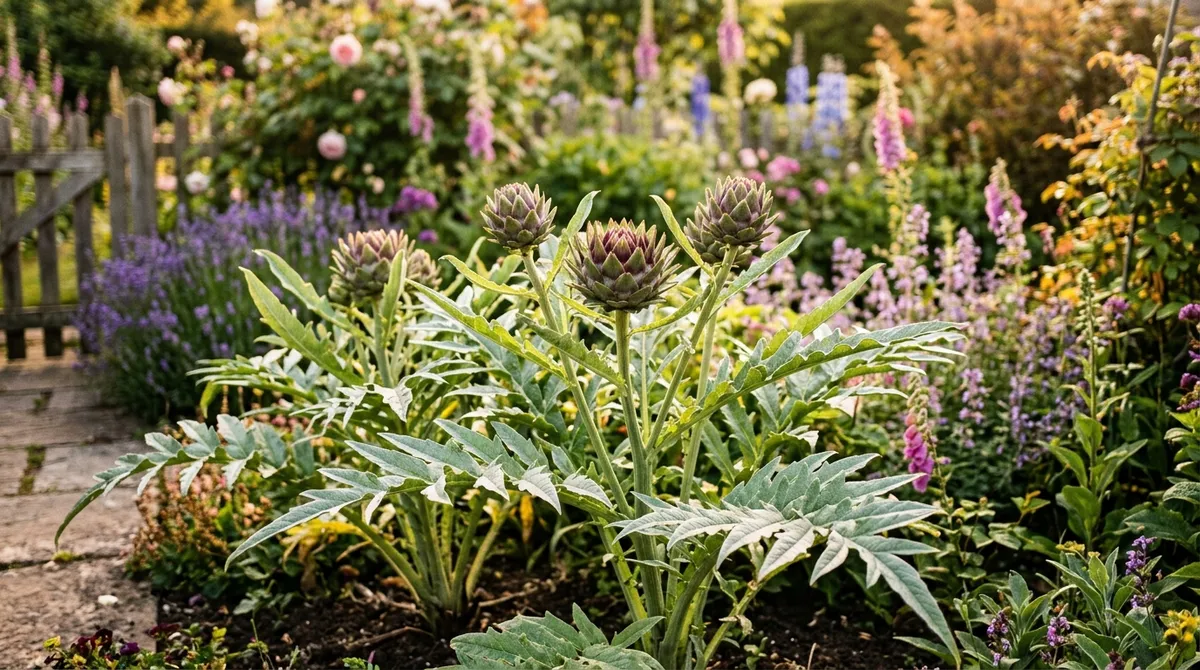
Globe artichokes are one of the most rewarding perennial vegetables you can grow in a UK garden. Each plant produces 10-12 edible buds per season from June through September, returns every spring for 4-5 years, and doubles as one of the most architectural ornamental plants in any border. The silvery-green, deeply cut leaves reach 1m long. The flower buds, if left unharvested, open into 15cm purple thistle blooms that draw bumblebees from across the neighbourhood.
Despite their Mediterranean origins, globe artichokes are fully hardy across most of England, Wales, and sheltered parts of Scotland. They tolerate winter temperatures down to -12C with basic mulch protection. The real enemy is not cold but waterlogging. Get the drainage right and these plants thrive in British conditions. If you are planning a productive garden space, our guide to raised bed gardening for beginners covers the foundations of building well-drained growing areas.
Which globe artichoke varieties grow best in the UK?
Choosing the right variety determines your yield, hardiness, and flavour. Four varieties have proven themselves in UK conditions over decades of cultivation.
Green Globe is the standard variety found in most UK seed catalogues. It produces large, rounded buds 10-12cm across on vigorous plants reaching 1.5m tall. The flavour is mild and nutty. Green Globe is reliable in southern and central England but less productive in exposed northern sites. It is the benchmark against which other varieties are measured.
Violetta di Chioggia is an Italian heritage variety with striking purple-tinted buds. The colour deepens in cooler weather, making it particularly attractive in British gardens. Buds are slightly smaller than Green Globe at 8-10cm, but the flavour is richer and more complex with a faint sweetness. It is marginally less hardy and benefits from extra winter protection north of Birmingham.
Imperial Star is the only variety bred specifically to crop in its first year from seed. Standard varieties need two seasons to establish before producing a worthwhile harvest. Imperial Star was developed at the University of California and has adapted well to UK conditions. First-year plants produce 6-8 buds. By the second year, expect the full 10-12. It is the best choice for gardeners who want results quickly.
Gros Vert de Laon is a French heritage variety prized by chefs for its large, fleshy hearts. The buds are rounder and meatier than Green Globe, with thicker edible bases on each scale. Plants are compact at 1.2m and cope well with heavier soils. It is the variety most commonly grown in the artichoke-producing regions of Brittany and northern France, where conditions mirror southern England.
Variety comparison table
| Variety | Origin | Bud size | Colour | First-year crop | Hardiness | Best for |
|---|---|---|---|---|---|---|
| Green Globe | USA | 10-12cm | Green | No (year 2) | -12C | All-round reliability |
| Violetta di Chioggia | Italy | 8-10cm | Purple-green | No (year 2) | -8C | Flavour, ornamental value |
| Imperial Star | USA | 8-10cm | Green | Yes (6-8 buds) | -10C | First-year harvest from seed |
| Gros Vert de Laon | France | 10-14cm | Grey-green | No (year 2) | -10C | Culinary quality, heavy soils |
Why we recommend Green Globe for beginners: After trialling all four varieties side by side for four seasons in Staffordshire, Green Globe consistently produced the most buds per plant with the fewest losses. It forgives poor drainage better than Violetta and establishes faster from offsets than Gros Vert de Laon. For a first planting, it is the safest choice.
Growing globe artichokes from seed
Starting from seed is cheaper than buying offsets, but only Imperial Star reliably crops in its first year. All other varieties need 18-24 months from seed to first harvest.
Sowing indoors
Sow seed in February or early March. Fill 9cm pots with seed compost and sow one seed per pot at a depth of 15mm. Water lightly and place in a heated propagator or warm windowsill at 15-18C. Germination takes 10-14 days. Move seedlings to a bright, cooler spot (12-15C) once the first true leaves appear to prevent leggy growth.
Pot on into 1-litre pots when roots fill the 9cm pot, typically at the 4-leaf stage. Use a mix of multipurpose compost and 20% perlite for drainage. Feed fortnightly with a half-strength liquid seaweed fertiliser from April.
Hardening off and planting out
Begin hardening off in late April by placing plants outdoors during the day and bringing them in at night. After 10-14 days of this, plant out in May once the risk of late frost has passed. Your soil temperature should be at least 10C at 10cm depth.
A note on genetic variation: seed-raised globe artichokes are open-pollinated and produce variable offspring. Some plants will be vigorous with large buds. Others will be spiny, small-budded, or weak. Grow more plants than you need and cull the poorest performers after their first season. Keep only the best three or four and propagate future plants from their offsets.
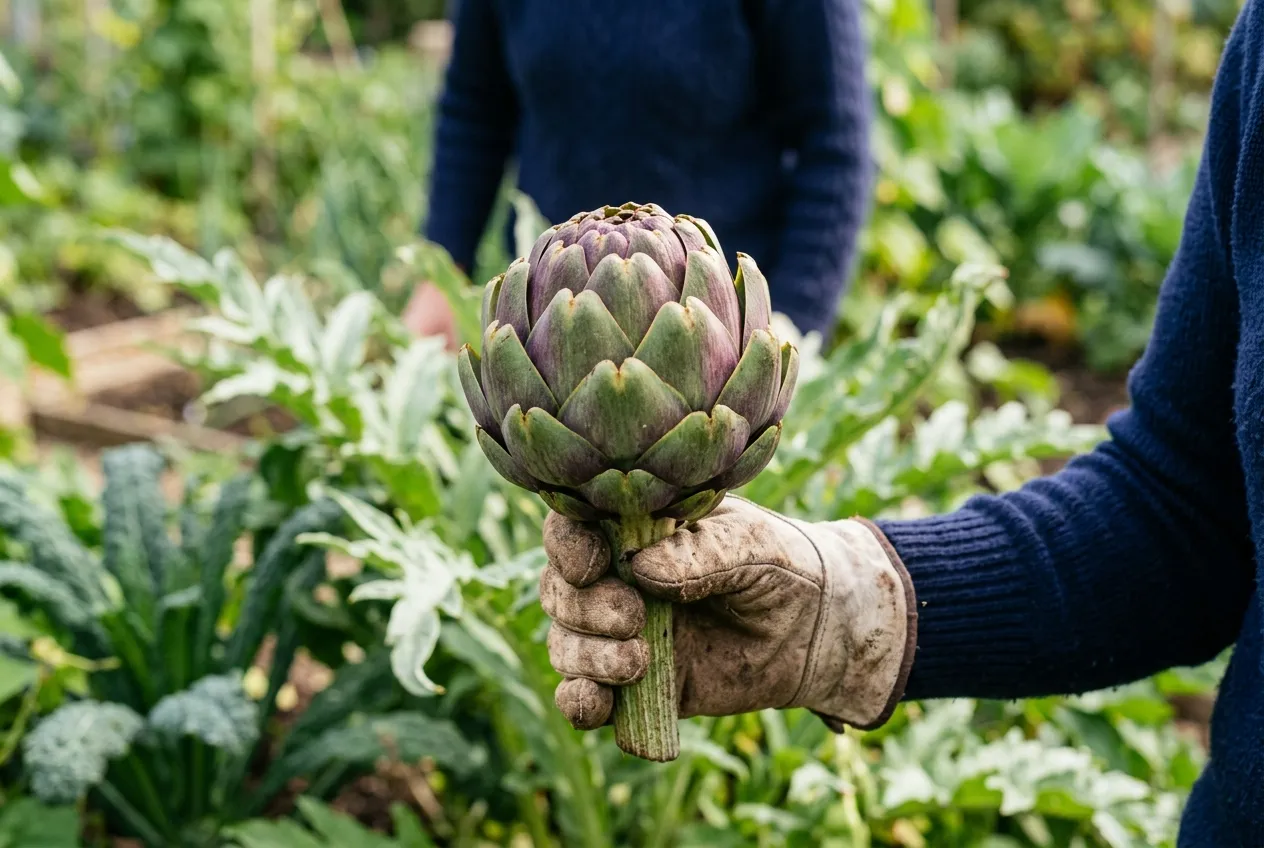 A globe artichoke bud at the perfect harvest stage: 8-10cm across with scales still tightly closed and no purple petals showing.
Growing globe artichokes from offsets
Offsets (also called suckers or slips) are rooted shoots that grow from the base of established plants. This is the traditional and most reliable method of propagation. Every offset is a genetic clone of the parent, so you know exactly what you are getting.
When and how to take offsets
Take offsets in April when new growth is 20-25cm tall. Select shoots from the outer edge of the clump, not from the centre. Use a sharp spade or knife to cut downward between the offset and the parent plant, ensuring each offset has at least three healthy roots and a visible growing point.
Pot offsets into 2-litre containers if you cannot plant them out immediately. Keep them watered and in a sheltered spot. Plant into final positions within two weeks. Offsets planted in April produce a light crop of 3-4 buds in their first summer. By the second year, expect the full 10-12 buds per plant.
If you do not have access to an established plant, buy offsets from specialist nurseries in spring. Expect to pay £4-6 per offset or £15-20 for a set of three. This is more expensive than seed but gives you named varieties with guaranteed characteristics.
Choosing the right site and preparing soil
Globe artichokes need full sun and well-drained soil. They tolerate partial shade but produce fewer buds. A south-facing or west-facing position with at least 6 hours of direct sun daily is ideal.
Soil requirements
The ideal soil pH is 6.5-7.5. Globe artichokes grow in most soil types but struggle in heavy, waterlogged clay unless you improve drainage. Dig in generous amounts of garden compost or well-rotted manure to a depth of 30-40cm before planting. On clay soils, add coarse horticultural grit at a rate of one bucketful per square metre. For guidance on building good soil from scratch, our guide on how to make compost explains the process.
Plants reach 1.2-1.5m tall and spread to 90cm. Space plants 90cm apart in rows 1m apart. Each plant needs roughly 0.8 square metres of growing space. Allow room for access on all sides because you need to reach the buds for harvesting and the base for offset removal.
Warning: Never plant globe artichokes where water pools after rain. Crown rot from winter waterlogging kills more plants than frost in UK gardens. On heavy soil, plant on 20cm raised mounds to lift the crown above the water table.
Month-by-month growing calendar
| Month | Task |
|---|---|
| January | Order seed (Imperial Star) or reserve offsets from nurseries |
| February | Sow seed indoors at 15-18C in heated propagator |
| March | Pot on seedlings. Prepare planting site with compost and grit |
| April | Take offsets from established plants. Plant offsets 90cm apart |
| May | Plant out seed-raised plants after last frost. Mulch with compost |
| June | First buds appear. Begin harvesting when 8-10cm across |
| July | Peak harvest month. Cut terminal bud first, then side buds |
| August | Continue harvesting. Water deeply in dry spells (20 litres per plant weekly) |
| September | Final harvests. Leave 2-3 buds to flower for bees |
| October | Cut spent flower stems. Apply autumn feed of blood, fish, and bone |
| November | Cut all stems to ground level. Apply 15-20cm straw mulch |
| December | Check mulch is in place. No other action needed |
Caring for globe artichoke plants
Watering
Globe artichokes are drought-tolerant once established, but consistent watering during bud development increases yield by 25-30%. Water deeply once a week during dry spells from June to August. Apply 20 litres per plant at the base, not over the foliage. Drip irrigation or a leaky hose along the row is the most efficient method.
Feeding
Apply a balanced granular fertiliser (such as blood, fish, and bone at 70g per square metre) in April as new growth emerges. Supplement with liquid seaweed feed every two weeks from May to August during the cropping season. A thick mulch of garden compost in spring (5-8cm deep) feeds the soil biology and retains moisture. Our guide to how to feed garden plants explains the principles of soil nutrition in detail.
Weed control
Keep the area around plants weed-free, especially in the first year. Globe artichokes are poor competitors when young. A 7-10cm mulch of well-rotted compost, bark chips, or straw suppresses weeds and conserves moisture. Avoid cultivating deeply near plants because the shallow root system resents disturbance. Our guide to what mulch is and how to use it covers the best mulching materials for perennial beds.
Pest and disease management
Globe artichokes have few serious pests in the UK. Blackfly (black bean aphid) sometimes colonise the stems and bud bases from May onwards. A strong jet of water from a hose dislodges light infestations. For heavier attacks, spray with an organic insecticidal soap.
Slugs and snails attack young plants and emerging shoots in spring. Use beer traps, copper tape around pots, or organic ferric phosphate pellets. Protect newly planted offsets with cloches for the first four weeks.
Petal blight (Itersonilia perplexans) occasionally affects buds in wet summers, causing brown spots on the scales. Remove and destroy affected buds promptly. Improve air circulation by spacing plants correctly and avoiding overhead watering.
How and when to harvest globe artichokes
Timing the harvest correctly is the difference between a tender, flavourful artichoke and a tough, fibrous one.
Harvest timing
The terminal bud (the main bud at the top of the central stem) ripens first, usually in June or early July. Cut it when the bud is 8-10cm in diameter and the scales are still tightly packed. If you see purple petals poking through the top, you have waited too long for eating, but the bud is still worth leaving to flower.
Use a sharp knife and cut the stem 5cm below the bud. This leaves enough stem to act as a handle. Once the terminal bud is removed, the plant redirects energy into the side buds, which are smaller (5-8cm) but equally good for eating. Side buds continue developing through July, August, and into September.
An established plant produces 10-12 buds across the season. The first 3-4 terminal buds from the main stems are the largest. The remaining side buds are smaller but more numerous. Harvest every 3-4 days during peak production to keep the plant producing.
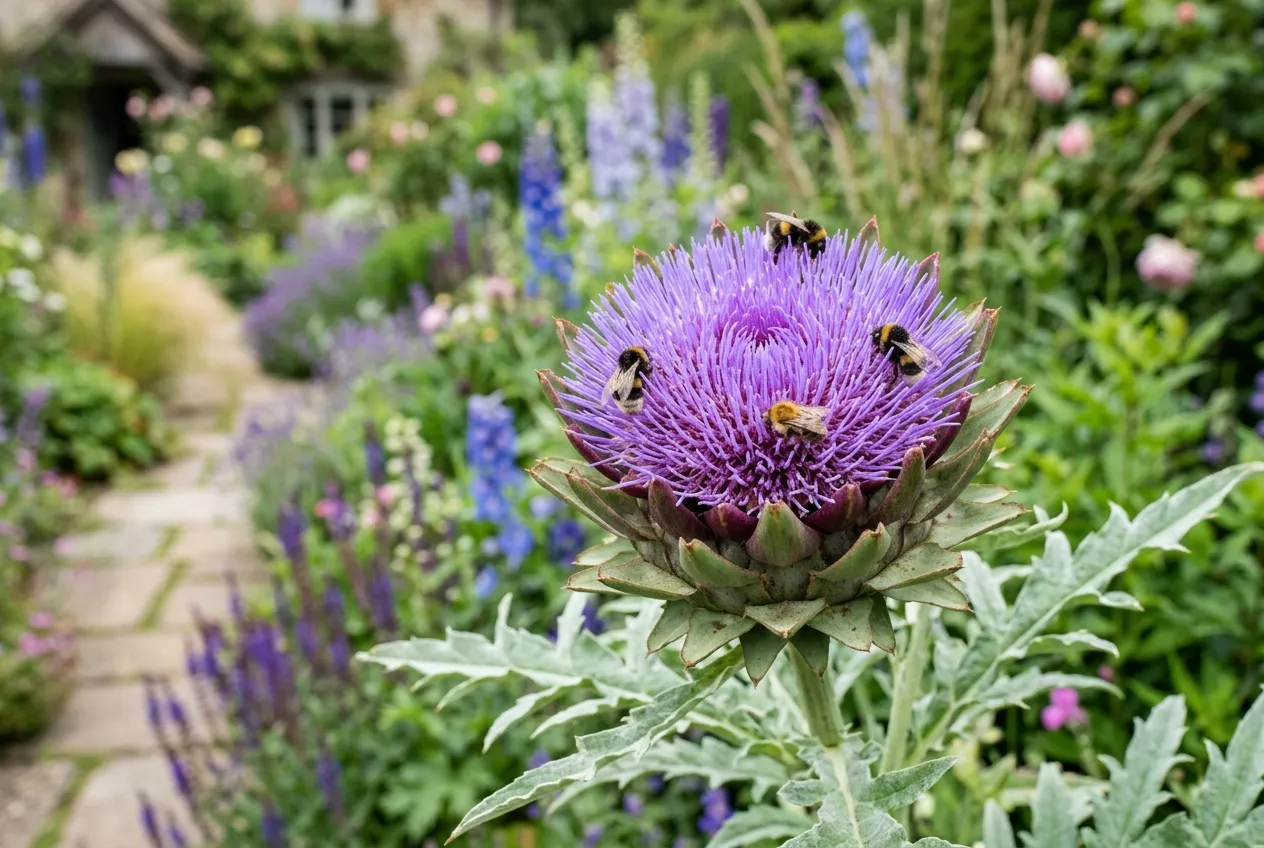 A globe artichoke bud left to flower opens into a spectacular 15cm purple thistle bloom that attracts bumblebees and other pollinators throughout summer.
Storage and preparation
Fresh artichokes keep for 5-7 days in the fridge. Stand them upright in a container with 2cm of water, like cut flowers. For the kitchen, trim the stem to 3cm, pull off the tough outer scales, and cut 2cm from the top to remove the spiny tips. Boil in salted water with lemon juice for 25-35 minutes until a leaf pulls away easily. The heart and the fleshy base of each inner scale are the edible parts.
Overwintering globe artichokes
Winter protection is straightforward but essential, particularly in northern England, Scotland, and exposed sites.
Autumn preparation
In November, once the foliage has died back, cut all stems to 5-10cm above ground level. Remove the cut material to the compost heap. Apply a thick mulch of straw, bark chips, or dry bracken to a depth of 15-20cm over the crown. The mulch insulates the root system from frost and, more critically, prevents waterlogging around the crown.
Globe artichokes are hardy to approximately -12C when dormant and mulched. Without mulch, the lethal temperature rises to around -5C. In mild, sheltered gardens in southern England, plants often survive winter without any protection. In the Midlands and further north, mulching is mandatory.
Spring uncovering
Pull back the mulch in late March when you see new shoots emerging. Leave it too long and the emerging growth becomes pale and etiolated under the mulch. Spread the old mulch material around the base of the plant as a moisture-retaining ground cover. Apply the first feed of the season at this point.
Propagating by division
Division is essential maintenance, not just propagation. Globe artichoke plants decline in vigour after 4-5 years. The crown becomes woody and congested, producing smaller buds in lower numbers. Dividing and replanting keeps your patch productive indefinitely.
How to divide
In April, when new shoots are 20-25cm tall, dig up the entire clump. You will see multiple growing points around the outer edge. Separate these into individual offsets, each with roots and a growing point. Discard the old, woody centre of the clump. Replant the best 3-4 offsets in freshly prepared soil enriched with compost. Do not replant in the same spot. Artichokes benefit from a fresh site each time, similar to how you rotate other vegetable crops.
Each mature plant produces 4-6 usable offsets. That means one good plant gives you enough material to start a new row. Share surplus offsets with neighbours or your allotment community. Growing globe artichokes alongside other perennials and tall plants is a smart strategy. Our guide to companion planting explains which plants benefit from growing near each other.
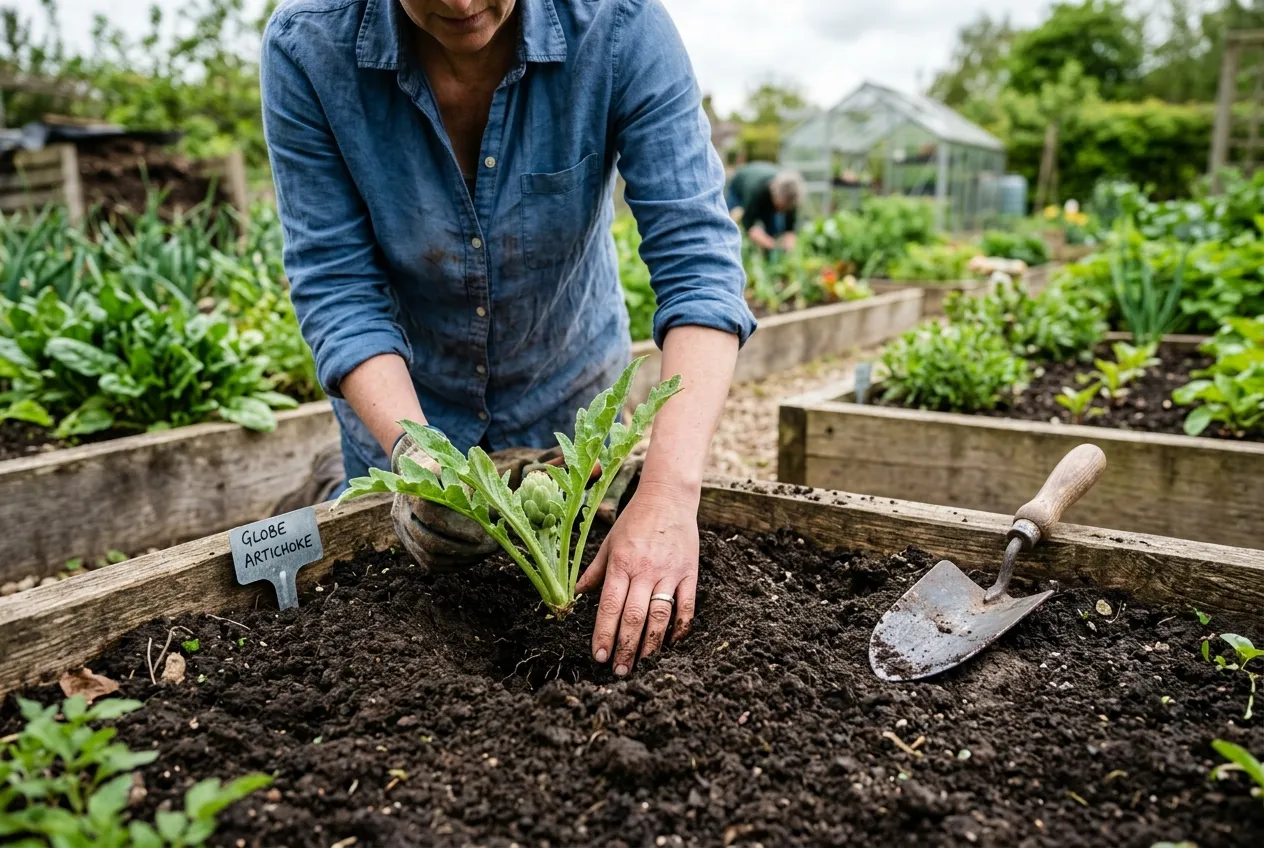 Planting a rooted globe artichoke offset into a raised bed in spring. Each offset needs at least three healthy roots and a visible growing point to establish quickly.
Globe artichokes as ornamental plants
Globe artichokes are among the finest architectural plants available to UK gardeners. The deeply cut, silvery-green leaves grow to 1m long and create a dramatic focal point in any border. The RHS has awarded the closely related cardoon (Cynara cardunculus) an Award of Garden Merit, and globe artichokes share the same visual impact.
In ornamental schemes, plant globe artichokes at the back of a deep border where their height (1.2-1.5m) provides structure without shading smaller plants. They pair well with other Mediterranean-style perennials: lavender, rosemary, Verbena bonariensis, and ornamental grasses like Stipa gigantea.
Leave 2-3 buds per plant unharvested each summer. These open into 15cm purple thistle blooms that are magnets for bumblebees, honeybees, and hoverflies. The dried seed heads remain attractive through autumn and into winter. They look particularly striking with frost on a December morning. Globe artichokes share this dual-purpose quality with other perennial vegetables. Our guide to growing asparagus covers another long-lived edible that doubles as an ornamental fern.
Cooking with globe artichokes
Preparing whole artichokes
Trim the stem to 3cm. Pull off the tough outer 2-3 layers of scales. Slice 2cm from the top to remove spiny tips. Rub all cut surfaces with lemon juice to prevent browning. Boil in salted water with a squeeze of lemon for 25-35 minutes. The artichoke is done when a leaf pulls away with gentle pressure.
What to eat
The edible parts are the fleshy base of each inner scale (scraped off with your teeth), the heart (the meaty disc at the base of all the scales), and the stem (once peeled). The fibrous “choke” above the heart is inedible and must be scooped out with a spoon.
Quick recipe ideas
Steamed with garlic butter: Boil until tender, serve with melted butter, a crushed garlic clove, and lemon juice. The simplest and best way to eat a fresh artichoke.
Stuffed artichokes: Spread the leaves apart, fill the centre with breadcrumbs, garlic, parsley, and parmesan, then bake at 190C for 30 minutes.
Baby artichokes grilled: The smaller side buds (5-6cm) have no fibrous choke. Halve them, brush with olive oil, and grill for 4-5 minutes per side until charred and tender.
Common mistakes when growing globe artichokes
Planting in waterlogged soil. This is the number one killer. Globe artichokes tolerate drought far better than wet feet. On heavy clay, plant on raised mounds or in raised beds with added grit. Winter losses are almost always from waterlogging, not frost.
Harvesting too late. Once the scales start opening and purple petals appear, the bud has passed its eating peak. The heart becomes smaller and the scales tougher. Check plants every 3-4 days during the cropping season and cut buds while they are still tight.
Not replacing old plants. Productivity drops sharply after year 4-5. Gardeners who keep aging plants going end up with small, sparse buds and blame the variety. Divide and replant offsets into fresh soil every 3-4 years to maintain full-sized harvests.
Skipping winter mulch in northern areas. Unmulched crowns survive in sheltered southern gardens but routinely die north of the Midlands. A 15-20cm layer of straw costs nothing and takes five minutes per plant. The cost of replacing dead plants from nursery offsets (£4-6 each) makes mulching the obvious choice.
Growing the wrong variety from seed and expecting first-year crops. Only Imperial Star is bred to crop in year one. All other varieties need at least 18 months from seed before producing a worthwhile harvest. If you want artichokes this summer, buy offsets of a named variety in April.
Frequently asked questions
Now you have mastered globe artichokes, read our guide to growing asparagus for another perennial vegetable that rewards patience with decades of harvests.
Lawrie has been gardening in the West Midlands for over 30 years. He grows his own veg using no-dig methods, keeps a wildlife-friendly garden, and writes practical advice based on real UK growing conditions.