How to Grow Hawthorn in the UK
Grow hawthorn in the UK: native hedging, specimen tree, May blossom, and haws. Planting, pruning, legal dates, and 300+ insect species wildlife value.
Key takeaways
- Hawthorn supports more insect species (300+) than any UK tree except oak — it is the single most wildlife-valuable hedging plant available
- Legal cutting dates in England and Wales are 1 September to 28 February — cutting outside this window risks destroying active bird nests and is an offence under the Wildlife and Countryside Act 1981
- Bare-root whips planted November to March establish more successfully than container-grown plants and cost 70-80% less (typically £1-2 per whip)
- Plant 3 whips per metre for a stock-proof hedge — a single-row hedge at this spacing closes up within 3-4 years
- C. laevigata 'Paul's Scarlet' is the best ornamental hawthorn for small gardens, producing double crimson flowers with no berries
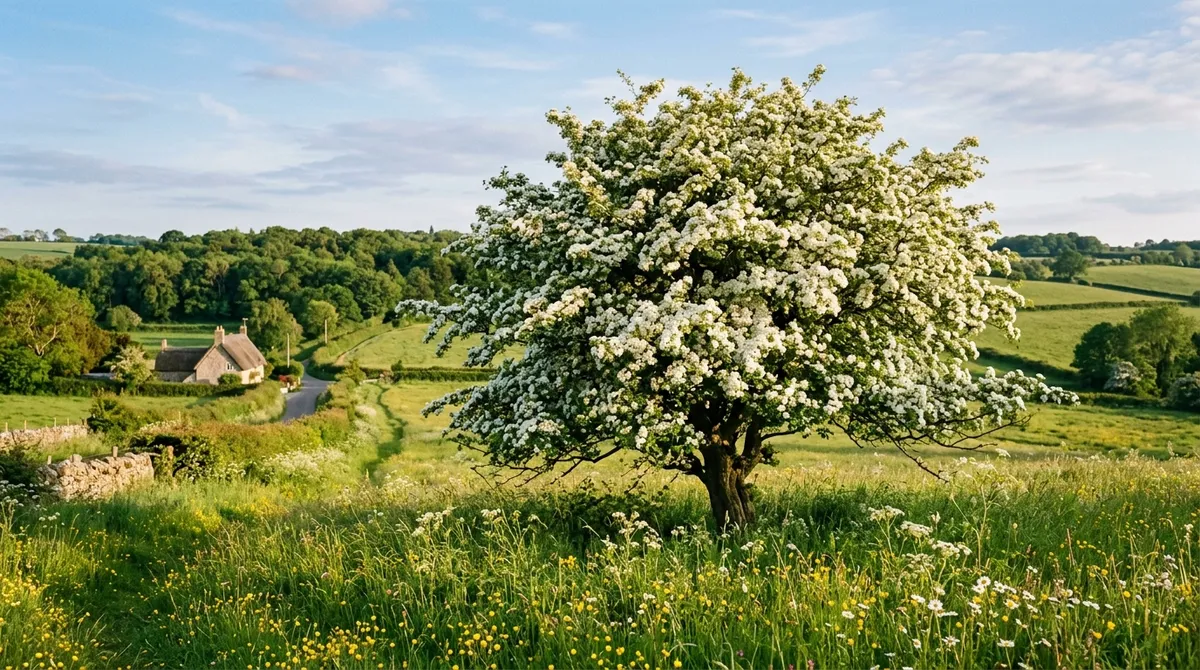
Hawthorn is the backbone of the British countryside — and in a garden context, it is the most wildlife-dense, fastest-closing, and cheapest boundary planting available in the UK. No other native tree or shrub delivers the combination of spring blossom, autumn berries, nesting habitat, and insect diversity that a well-managed hawthorn hedge or specimen tree provides. If you grow one plant primarily for wildlife this decade, make it hawthorn.
I’ve grown a 40-metre mixed hawthorn hedge in Staffordshire since 2016, planted from bare-root whips on heavy clay. This guide covers choosing between species and cultivars, planting a hawthorn hedge, legal cutting dates, pruning techniques, wildlife value, and growing hawthorn as a specimen tree. For the broader context of native trees in UK gardens, see our guide to native trees for UK gardens.
Hawthorn species and cultivars
Two hawthorn species are native to the UK, plus a range of ornamental cultivars bred from the Midland hawthorn. Choosing between them comes down to your main purpose: hedging, specimen tree, or ornamental display.
Species comparison
| Species / Cultivar | Type | Height | Flowers | Berries | Best for |
|---|---|---|---|---|---|
| C. monogyna (common hawthorn) | Native species | 5-10m (tree), 2-3m (hedge) | White, single, May | Single-seeded red haws | Hedging, wildlife, boundary |
| C. laevigata (Midland hawthorn) | Native species | 4-8m | White, single, April-May | Two-seeded red haws | Woodland edge, heavy soil |
| C. laevigata ‘Paul’s Scarlet’ | Ornamental cultivar | 4-6m | Double crimson, May | Few/none | Specimen tree, small gardens |
| C. laevigata ‘Plena’ | Ornamental cultivar | 4-6m | Double white, May | Few/none | Formal specimen, parks |
| C. laevigata ‘Rosea Flore Pleno’ | Ornamental cultivar | 4-5m | Double pink, May | Few/none | Smaller specimen, colour |
| C. persimilis ‘Prunifolia’ | Ornamental species | 6-8m | White, single, June | Persistent red-orange | Autumn colour, winter wildlife |
Crataegus monogyna — the hedging standard
Common hawthorn is the species to choose for hedging, wildlife planting, and boundary work. It is the most abundant native hedgerow plant in the UK — the Woodland Trust estimates over half a million miles of hawthorn hedgerow exist in the British Isles. Its dense, thorny growth makes it stock-proof within 3-4 years of planting. The single white flowers open in April and May in an abundant froth of blossom that gives the plant its popular name — the May tree. Red haws ripen September to November and persist well into winter.
C. monogyna tolerates any UK soil — chalk, clay, loam, sand — and any aspect including exposed north-facing slopes and windswept coastal sites. This is the species sold as bare-root whips for hedging at £1-2 per plant.
C. laevigata — Midland hawthorn
Midland hawthorn flowers slightly earlier than common hawthorn, typically late April in most UK regions, and is more tolerant of shade. Where C. monogyna prefers open, sunny hedgerows, C. laevigata thrives at woodland edge and in the dappled shade of larger trees. The two species hybridise freely in nature.
For hedging, C. laevigata is less commonly used than C. monogyna but equally effective. Its main garden relevance is as the parent species for ornamental cultivars. Both species support equivalent insect diversity — research by the Woodland Trust places both in the 300+ species category.
Ornamental cultivars for smaller gardens
‘Paul’s Scarlet’ is the most widely planted ornamental hawthorn in UK gardens. It produces double crimson flowers in May, covering the tree in a dense display that has won it the RHS Award of Garden Merit. The double flowers are sterile and produce few or no berries — a trade-off worth knowing if wildlife value is a priority. As a specimen tree for a small garden, ‘Paul’s Scarlet’ reaches 4-6m with a rounded crown and requires almost no maintenance once established.
‘Rosea Flore Pleno’ offers softer pink double flowers on a slightly more compact tree (4-5m). ‘Plena’ has white double flowers and is more frequently planted in formal or historic garden settings. All three cultivars need grafting onto C. monogyna or C. laevigata rootstocks and are sold as container-grown or bare-root standard trees rather than hedging whips.
Seasonal interest calendar
| Month | Foliage | Flowers | Berries | Wildlife activity |
|---|---|---|---|---|
| January | Bare | None | Haws persist | Fieldfares, redwings feeding |
| February | Bare | None | Haws persist (reduced) | Thrushes, blackbirds |
| March | Leaf bud break | None | None | Buds: early bees foraging |
| April | Fresh green | C. laevigata buds/opens | None | Early bees, butterflies |
| May | Full leaf | C. monogyna peak | None | Peak pollinator activity |
| June | Full leaf | Fading | Green haws forming | Nesting birds: blackbird, dunnock |
| July | Full leaf | None | Green haws developing | Invertebrates peak in foliage |
| August | Full leaf | None | Haws ripening (green-yellow) | Insects, spiders in canopy |
| September | Turning | None | Red haws ripe | First fieldfares arrive; berry feeding begins |
| October | Autumn colour | None | Haws peak | Fieldfares, redwings, blackbirds |
| November | Leaf fall | None | Haws persist | Winter thrushes; cutting window open |
| December | Bare | None | Haws (reduced) | Birds foraging bare branches |
How to plant a hawthorn hedge
When to plant
Plant bare-root hawthorn whips from November to March during the dormant season. November to January gives the best establishment — soil temperatures above 5°C allow root growth before winter, and autumn rain settles the plants without irrigation. Bare-root whips are 70-80% cheaper than container-grown plants (typically £1-2 per whip versus £8-15 for a pot-grown plant) and establish just as well when planted at the right time. See our complete guide to planting bare-root trees for the full method.
How many plants per metre
For a single-row hedge, plant 3 whips per metre (one every 33cm). This spacing closes up within 3-4 years. For a double-row staggered hedge — the most stock-proof and wildlife-rich option — plant 5 whips per metre in a zigzag pattern, rows 30-40cm apart. A 20-metre double-row hedge needs approximately 100 plants.
Mixed hawthorn hedges incorporating blackthorn (Prunus spinosa), field maple (Acer campestre), dog rose (Rosa canina), and elder (Sambucus nigra) provide higher biodiversity than pure hawthorn — the Woodland Trust recommends mixing 6-8 native species with hawthorn as the dominant 60-70% component.
Planting method
- Mark the hedge line with stakes and a string line
- Dig a trench 30-40cm wide and 30cm deep along the line (or use individual holes for single-row planting)
- If the soil is poor, incorporate garden compost or well-rotted manure at half a barrowload per metre
- Soak bare-root whips in water for 30-60 minutes before planting — never let roots dry out
- Place each whip at the same depth as the nursery soil mark — look for the darker stain on the stem
- Firm soil around the roots with your heel, working inward from the outside edge
- Apply a 5cm mulch of bark or compost along the hedge line, keeping it 5cm clear of stems
- Water thoroughly in the first spring if conditions are dry
No staking is required for whips under 60cm. For larger bare-root transplants (60-90cm), a single short cane gives initial support. See our hedge planting guide for a detailed step-by-step walk-through.
First-year management
Cut whips back by one-third to one-half immediately after planting. This reduces wind rock, encourages side-shoot production from low on the stem, and promotes the dense, branching base that a stock-proof hedge depends on. It is the step most gardeners skip — and the single biggest reason why hedges fail to thicken at ground level.
Water in the first summer if there is a prolonged dry spell (more than 3 weeks without significant rain). Once established into year two, hawthorn needs no irrigation even in dry conditions.
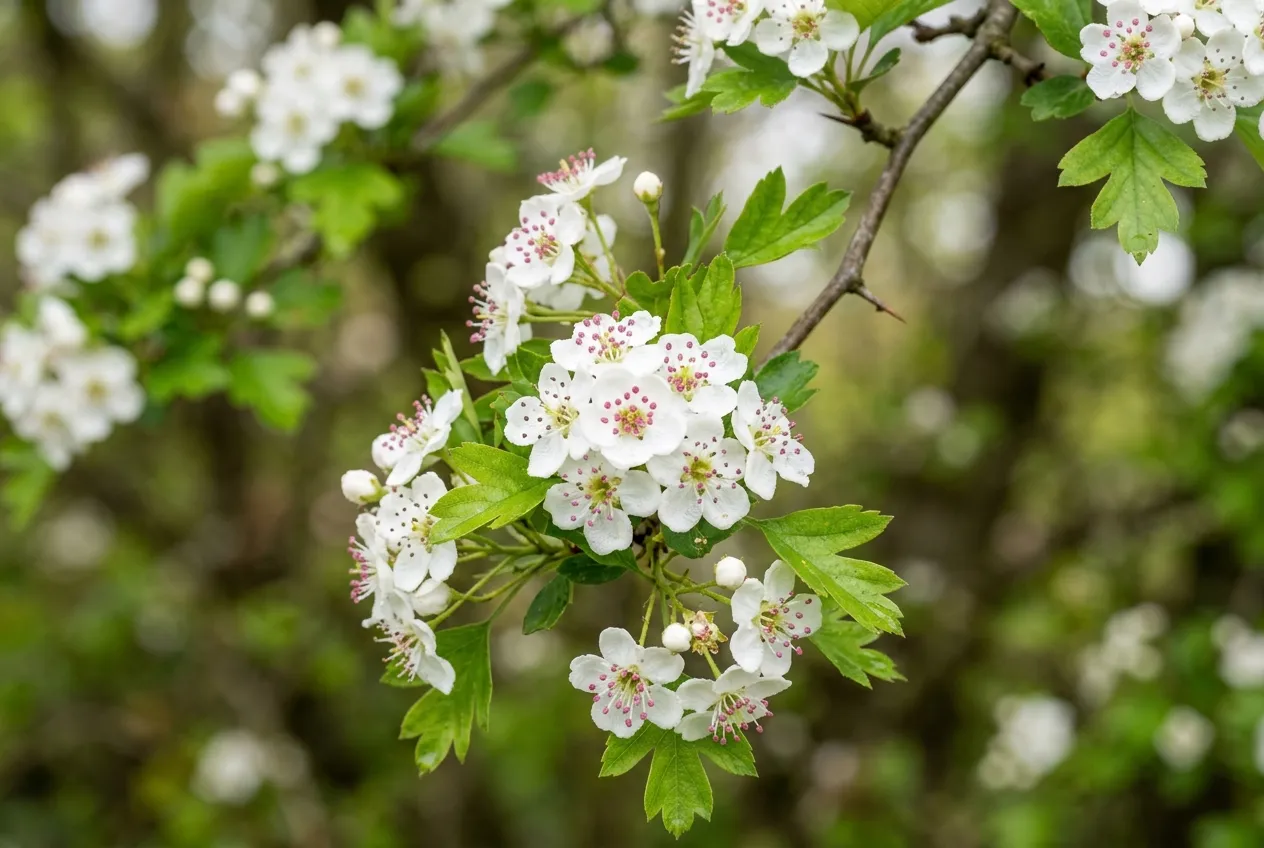
A mature hawthorn hedge in May blossom. Dense growth at the base requires cutting back hard in year one — most hedge failures start with this step being skipped.
How to prune hawthorn
Legal cutting dates
The legal hedge-cutting window in England and Wales is 1 September to 28 February. Under the Wildlife and Countryside Act 1981, deliberately destroying or damaging an active bird nest is a criminal offence. Cutting a hedge between March and August risks destroying nests and is subject to prosecution with an unlimited fine. The same principle applies in Scotland under the Nature Conservation (Scotland) Act 2004. See our detailed guide to legal cutting dates for UK hedges before scheduling any hedge work.
In practice, October to November is the best time to cut from a wildlife perspective as well as a practical one. The main flush of berry feeding by fieldfares and redwings typically runs September to early November — cutting after this period maximises wildlife value while still leaving three clear months of the legal window.
Maintenance cutting (established hedge)
For an established hedge (more than 3 years old), cut once a year in autumn or winter. Use a hedge trimmer for the flat faces and top; use loppers or a pruning saw for any thick stems the trimmer cannot handle. Cut to your target dimensions — typically 1.5-2m tall and 60-80cm wide for a garden boundary hedge.
For maximum wildlife value, leave the cut face slightly uneven rather than perfectly flat. This creates more structural diversity and more nesting opportunities. Avoid cutting every side every year — alternating which face you cut in a given year maximises berry production.
Hard renovation
An overgrown or neglected hawthorn hedge can be cut back hard in winter (January to February) and will regrow vigorously. This is one of hawthorn’s great virtues — few other hedging plants tolerate such severe renovation. Cut the main stems to within 30-50cm of ground level if necessary. New growth will emerge from the base in spring, and by year three the hedge will be substantially reformed.
Carry out hard renovation in two stages if the hedge is very tall: cut one side hard in year one, the other side in year two. This leaves the hedge with some photosynthetic capacity during recovery. Feed with a nitrogen-rich fertiliser after hard renovation to support regrowth.
Specimen tree pruning
Hawthorn grown as a specimen tree needs minimal pruning. In late winter (January to March), remove dead, diseased, or crossing branches. Do not attempt to reduce the crown of a mature specimen heavily — hawthorn responds poorly to large-scale crown reduction and is susceptible to silver leaf disease (Chondrostereum purpureum) through large pruning wounds. For shape maintenance, light formative pruning in the first five years is more effective than corrective pruning later.
Growing hawthorn as a specimen tree
Hawthorn is underused as a garden specimen tree. As a single tree, it develops a gnarled, characterful form over decades — thorny, twisting, and genuinely architectural in winter. The May blossom display on a well-grown specimen is difficult to rival among UK native trees. In autumn, the red haws create outstanding visual impact and a food source for birds that can be watched from the garden.
Choosing a site
Hawthorn tolerates almost any UK site. Full sun produces the heaviest blossom and berry crop; partial shade is acceptable. The tree grows in any soil pH from acid (5.5) to alkaline (8.5) and in any texture. On waterlogged ground, plant on a raised mound. Hawthorn is one of very few trees that thrives on thin chalk soil over limestone.
For ornamental cultivars like ‘Paul’s Scarlet’, a sheltered position enhances the blossom display. Wind does not harm the tree but shortens the lifespan of the delicate double flowers.
Size expectations
C. monogyna as a free-growing specimen reaches 8-10m in height over 30-50 years, with a spread of 6-8m. On a typical garden plot, the tree’s ultimate size needs planning — it will shade a significant area to the north and west at maturity. As a boundary tree or hedge-tree at the edge of a wildlife garden, the size is an asset rather than a problem. For smaller spaces, ‘Paul’s Scarlet’ or ‘Rosea Flore Pleno’ reach 4-6m and are more manageable. See our guide to the best trees for small gardens for other compact native options.
Planting a standard tree
For a specimen, choose a half-standard or standard bare-root tree (clear stem of 1-1.5m or 1.8-2m) rather than a hedging whip. Plant in the same dormant window (November to March) using the standard tree-planting method:
- Dig a hole twice the width of the root spread, the same depth as the nursery soil mark
- Stake with a short 50cm stake angled at 45° away from the prevailing wind — a short stake promotes root anchorage, a tall stake inhibits it
- Set the graft union (the swollen junction between rootstock and cultivar) 10cm above final soil level
- Backfill with excavated soil, firm with your heel, water with 15 litres
- Mulch in a 1m circle, 5cm deep, keeping 10cm clear of the trunk
Stake for two to three years. Check and loosen ties every autumn.
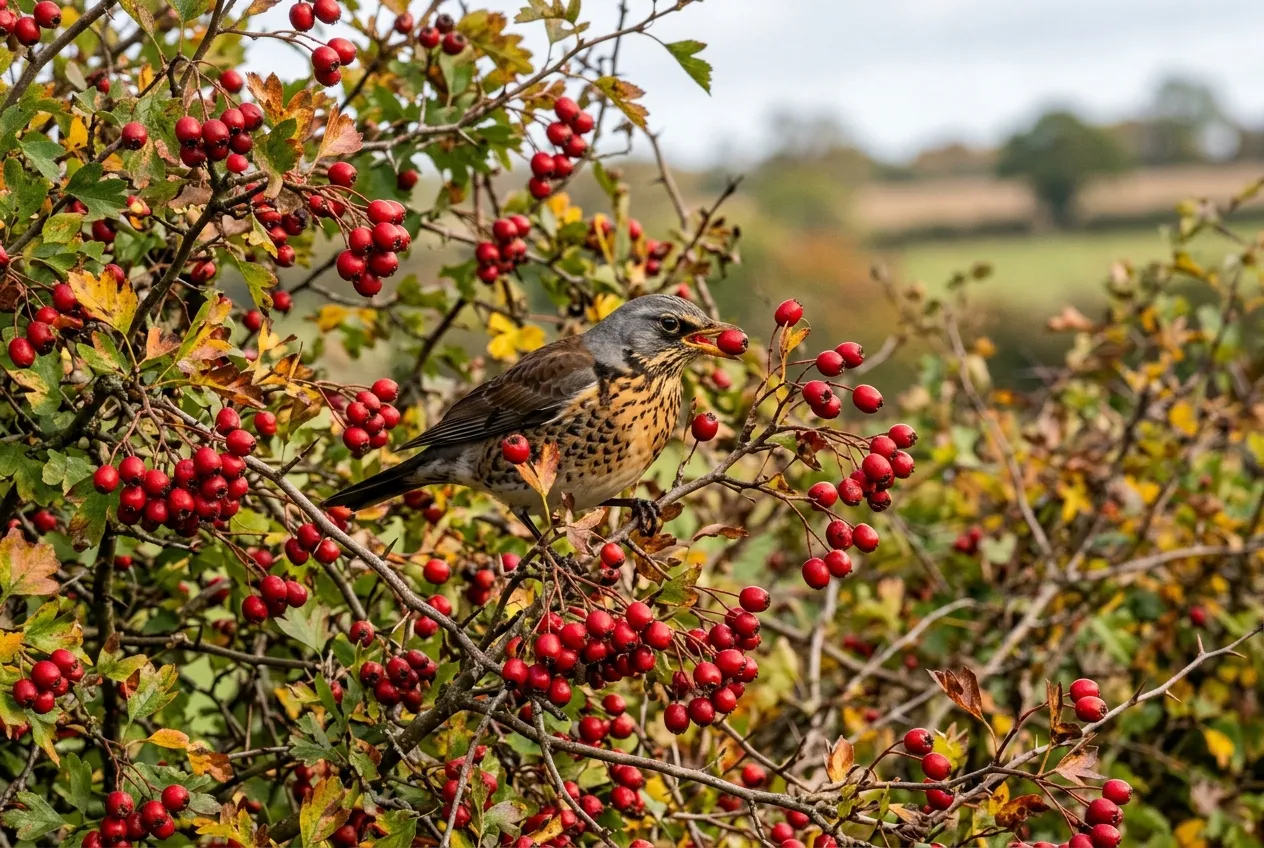
Red hawthorn haws in October. Fieldfares and redwings arriving from Scandinavia target haw-bearing hawthorn from September onwards.
Hawthorn and wildlife
No UK hedging plant approaches hawthorn for wildlife density. The wildlife value operates across all four seasons and multiple ecological roles simultaneously.
Insect diversity
Hawthorn supports over 300 insect species — research documented by the Woodland Trust and reviewed by wildlife ecologist Oliver Rackham places it second only to oak (Quercus robur, supporting 280-320 species depending on study) among native British trees. The key relationships are between hawthorn’s leaves, bark, and flowers, and the leaf-mining moths, gall wasps, aphids, beetles, and sawflies that have co-evolved with the plant over millennia.
These insects form the base of a food web that extends upward to nesting birds, bats, hedgehogs, and small mammals. A hawthorn hedge does not merely provide habitat — it creates and sustains an entire invertebrate community that supports other species.
For a full overview of creating insect-rich garden habitat, see our guide to creating a wildlife garden in the UK.
Blossom and pollinators
Hawthorn blossom is a major early-season resource for pollinators. The white flowers produce both nectar and pollen over a 3-4 week flowering window in April and May, bridging the gap between the main fruit blossom period (apple, cherry, pear) and the summer wildflower season. Bumblebees, honeybees, hoverflies, and numerous moth species feed from hawthorn flowers.
The flowers have a distinctive heavy scent — in warm weather, a hawthorn hedge in full blossom is unmistakable from some distance. The scent attracts pollinators from 50 metres or more. This makes hawthorn a critical resource in landscapes where other flowering plants are sparse in spring.
For more on designing for pollinators, see our guide to bee-friendly garden plants.
Nesting birds
The dense, thorny structure of a hawthorn hedge provides nesting cover for at least 34 UK bird species. The thorns are not merely protective — they allow birds to build nests in positions that predators find difficult to reach. Blackbirds, song thrushes, dunnocks, chaffinches, goldfinches, yellowhammers, and linnets nest regularly in hawthorn. In a well-maintained 40-metre boundary hedge on my Staffordshire garden, I have recorded nesting by blackbirds, dunnocks, and wrens in the same season.
Dense nesting cover is rare in urban and suburban gardens, where hard boundaries (fencing, walls, trellis) provide no nesting habitat. A single run of hawthorn hedge, even 10-15 metres long, immediately changes what species can use the garden. For more on supporting garden birds through habitat and feeding, see our bird feeding seasonal guide.
Haws and winter birds
Red haws are one of the most important winter food sources for migratory thrushes entering the UK from Scandinavia. Fieldfares and redwings arrive from October onwards and depend heavily on haw availability through November and into winter. In a severe winter, when other berries (holly, ivy, elderberry) have been stripped, a hawthorn hedge in berry is the difference between survival and starvation for these birds.
Resident blackbirds, mistle thrushes, and song thrushes also feed heavily on haws. In a garden setting, a well-berried hawthorn hedge actively visible from the house becomes a birdwatching resource as well as a wildlife habitat.
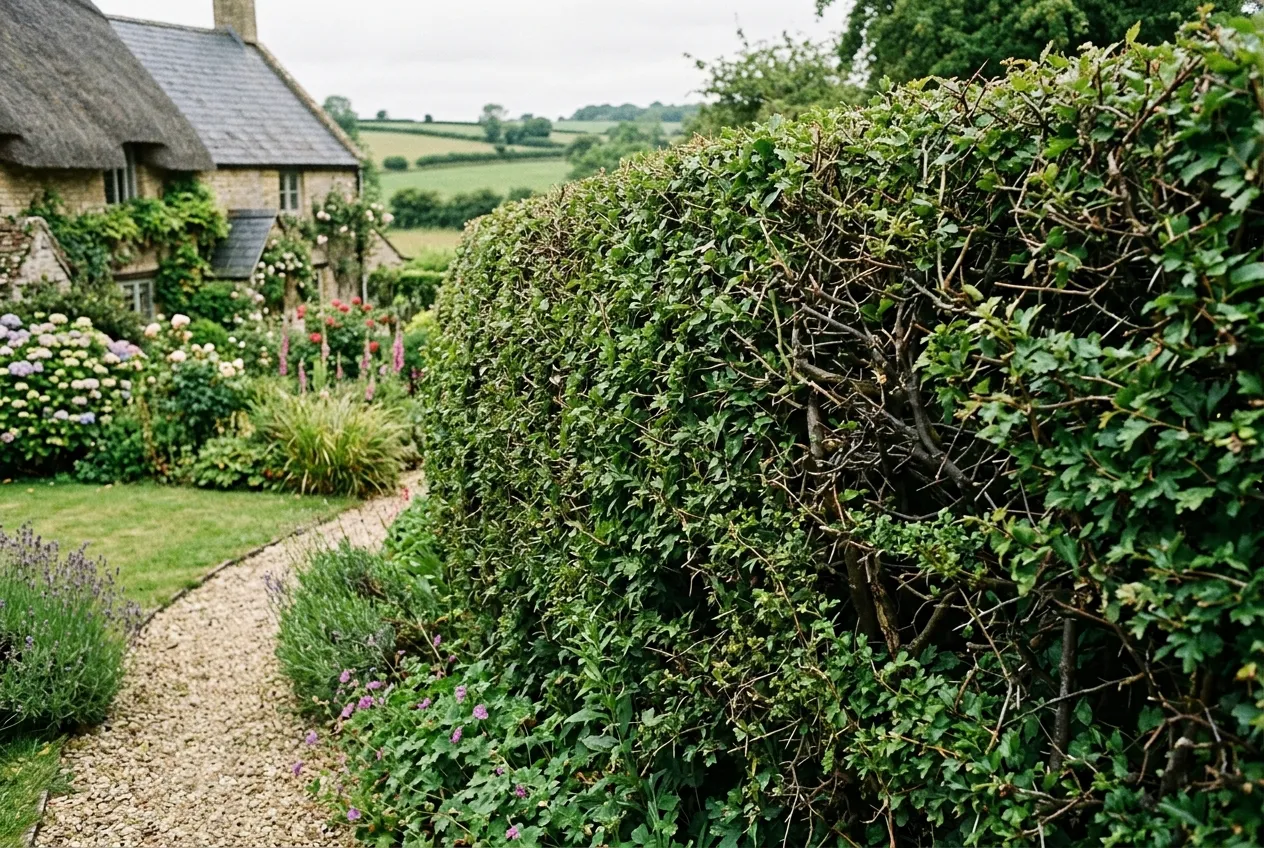
Hawthorn blossom in May. The flowers open for 3-4 weeks, providing nectar and pollen for bumblebees and early butterflies during a critical gap in the flowering calendar.
Pests and diseases
Hawthorn is remarkably healthy compared to most garden trees and hedging plants. In ten years of managing a hawthorn hedge in Staffordshire, I have encountered no significant disease problems. The following conditions are worth knowing, but should not deter planting.
Hawthorn leaf miner (Phyllonorycter species)
Tiny moths whose larvae mine the surface layer of hawthorn leaves, creating pale brown blotches. This is extremely common — in a good year, a significant proportion of leaves on a hawthorn hedge show mines. It is completely harmless to the plant’s health. No treatment is needed or appropriate. The mines are actually evidence of the insect biodiversity hawthorn supports — these moths are part of the 300+ species count.
Fire blight (Erwinia amylovora)
Fire blight causes blackened, wilting shoots that look as though they have been scorched. It is primarily a disease of commercial apple and pear orchards but can affect hawthorn, particularly during warm, humid springs. Cut out affected shoots at least 60cm below the visible damage, sterilising tools between cuts. Burn all prunings. The disease is notifiable in commercial orchards but not in private gardens.
In hedging hawthorn, fire blight rarely affects more than isolated shoots. It is not a reason to avoid planting.
Silver leaf (Chondrostereum purpureum)
Silver leaf infects through large pruning wounds, causing a silvering of the foliage and eventual dieback. The main prevention is pruning in late summer or dry winter conditions (August to September or January to February), when the fungal spores are least active. Avoid making large pruning cuts on specimen trees. Hedging hawthorn, cut with a trimmer, is not significantly affected.
Aphids
Several aphid species specialise on hawthorn. The most noticeable is hawthorn aphid (Dysaphis species), which can cause leaf curling and a reddish discolouration on young growth in spring. Natural predators — ladybird larvae, blue tit chicks, hoverfly larvae — control populations by June in most cases. Intervention is rarely needed. A garden with sufficient insect diversity, which a hawthorn hedge provides, largely self-regulates aphid populations.
Common hawthorn in hedgerow history
Hawthorn is inseparable from the British countryside in part because of its role in the enclosure era. The Enclosures Acts of the 18th and 19th centuries required the establishment of approximately 200,000 miles of hedgerow to mark newly enclosed fields — and hawthorn, for its speed, density, stock-proof thorns, and tolerance of any soil, was planted at greater scale than any other species. The result is the hedged patchwork landscape that still characterises large parts of England, Wales, and lowland Scotland.
This history matters because Britain’s hawthorn hedgerows are now among the most species-rich linear habitats in Europe. The combination of hawthorn’s structural complexity, insect support, and berry production is why ecologists treat intact hedgerows as a conservation priority. Planting hawthorn in a domestic garden participates in the same ecological system on a smaller scale.
The Woodland Trust’s hawthorn species guide and the RHS Crataegus entry both provide authoritative reference material on identification, ecology, and cultivation.
Common growing mistakes
Not cutting back hard at planting
The most consistent reason a new hawthorn hedge fails to develop a dense base is skipping the initial hard cutback. Cutting newly planted whips back by one-third to one-half looks brutal and feels counterintuitive. It is the most important thing you can do. Without it, whips grow tall and sparse at the base, and no amount of subsequent cutting recovers a good dense bottom.
Planting too late into spring
Container-grown hawthorn from a garden centre can be planted in April or May, and will probably survive. But the plant is already in active growth, root establishment is slower, and the risk of drought stress in the first summer is significantly higher. Buy bare-root whips in autumn and plant between November and January for the best results.
Cutting in the bird nesting season
Every year, gardeners cut hedges in spring or summer for tidiness reasons, unaware that the Wildlife and Countryside Act 1981 makes it a criminal offence. The legal window is 1 September to 28 February. Plan hedge maintenance into autumn and winter. If you are uncertain whether a nest is active, do not cut — the legal threshold is the presence of eggs or young, not whether you can see a bird sitting on the nest.
Choosing ‘Paul’s Scarlet’ for wildlife value
‘Paul’s Scarlet’ is a beautiful ornamental tree, but its double sterile flowers produce little nectar and no berries. If your primary motivation is wildlife, plant C. monogyna from hedging whips or a named single-flowered species. If your primary motivation is ornamental display in a small garden, ‘Paul’s Scarlet’ is the right choice — but be clear about the trade-off.
For more on native trees with high wildlife value, see our companion guide to growing crab apple trees in the UK, another species with documented 90+ insect species associations and exceptional wildlife credentials.
Frequently asked questions
When should I plant hawthorn?
Plant bare-root hawthorn whips from November to March during dormancy. November to January is ideal — the soil is still workable and autumn rain settles the roots before spring. Bare-root whips are 70-80% cheaper than container-grown plants (typically £1-2 per whip) and establish equally well when planted in the dormant season. Avoid planting into frozen or waterlogged ground. Container-grown hawthorn can be planted year-round, but dormant-season planting is always preferable.
How fast does hawthorn grow?
Hawthorn grows 30-60cm per year in most UK conditions. Growth rate depends on soil fertility and moisture: plants in rich loam on well-drained sites grow fastest. In poor, dry chalk or thin sandy soil, growth may be closer to 20-30cm per year. A hedge planted from bare-root whips at 3 per metre will be stock-proof by year 3-4 and at full height (2-3m maintained) by year 6-8. As a specimen tree with no pruning, hawthorn reaches 8-10m over 30-50 years.
Can I cut hawthorn hedge in summer?
No — cutting hawthorn between March and August is illegal if nesting birds are present. The Wildlife and Countryside Act 1981 makes it an offence to damage or destroy an active bird nest. The legal cutting window is 1 September to 28 February in England and Wales. In practice, wait until October when berry feeding is well underway — this maximises wildlife value before cutting. Scotland follows the same principle under the Nature Conservation (Scotland) Act 2004.
What is the difference between C. monogyna and C. laevigata?
Crataegus monogyna (common hawthorn) is the UK native species used for hedging, with single white flowers and single-seeded haws. C. laevigata (Midland hawthorn) is also native but less common, preferring woodland edge and heavier soils. C. laevigata has two or three seeds per berry and slightly earlier flowering. The ornamental cultivars most widely sold — including Paul’s Scarlet (double crimson) and Plena (double white) — are C. laevigata selections. Both species support equivalent wildlife.
Are hawthorn berries safe to eat?
Yes, hawthorn haws are edible and non-toxic. The flesh is mealy and mildly sweet, used in jams, jellies, sauces, and hedgerow wines. Do not eat the seeds — they contain amygdalin, which can release cyanide compounds if chewed and consumed in quantity, though the risk from occasional seed contact is minimal. Haws are most flavourful after the first frost. Wildlife consumes the berries heavily from September onwards, so harvest before October if you want a large quantity.
How many hawthorn plants per metre for a hedge?
Plant 3 bare-root whips per linear metre for a single-row hedge — this gives 33cm between plants and closes up within 3-4 years. For a double-row staggered hedge (the most stock-proof and wildlife-dense option), plant 5 per metre in a zigzag pattern 30-40cm apart. A 20-metre double-row hedge requires approximately 100 plants. At £1-2 per bare-root whip, material cost is £100-200 — considerably less than panel fencing of equivalent length.
Is hawthorn good for wildlife?
Hawthorn is the single most wildlife-valuable hedging plant in the UK. Research by the Woodland Trust identifies hawthorn as supporting over 300 insect species, making it second only to oak among British trees. It provides dense nesting cover for 34 bird species, including blackbirds, song thrushes, dunnocks, yellowhammers, and linnets. The May blossom feeds bees and early butterflies. The autumn haws are a critical food source for migrant fieldfares and redwings arriving from October onwards.
Related reading
- Native Trees for UK Gardens — field maple, dog rose, blackthorn, and other natives with high wildlife credentials
- How to Plant a Hedge in the UK — spacing, preparation, and first-year management for all hedging species
- Legal Hedge Cutting Dates UK — Wildlife and Countryside Act guidance and regional variations
- How to Grow Crab Apple Trees in the UK — another native-adjacent tree with 90+ insect species and outstanding berry value
- Creating a Wildlife Garden in the UK — habitat planning, native planting, and year-round wildlife strategies
Lawrie has been gardening in the West Midlands for over 30 years. He grows his own veg using no-dig methods, keeps a wildlife-friendly garden, and writes practical advice based on real UK growing conditions.