How to Grow Medlar Trees in the UK
Expert UK guide to growing medlar trees. Covers varieties, planting, bletting, pruning, and making medlar jelly from 15 years of hands-on growing.
Key takeaways
- Medlars are fully hardy across all UK regions and tolerate temperatures down to -20C
- Nottingham is the best variety for UK gardens, fruiting within 3-4 years on Quince A rootstock
- Fruit must be bletted (softened after first frost) for 2-4 weeks before it becomes edible
- Plant bare-root trees November to March in well-drained soil with a pH of 6.0-7.5
- Mature trees yield 15-30kg of fruit per year and live over 100 years with minimal care
- Medlar jelly, cheese, and gin are the most popular preserves from this forgotten heritage fruit
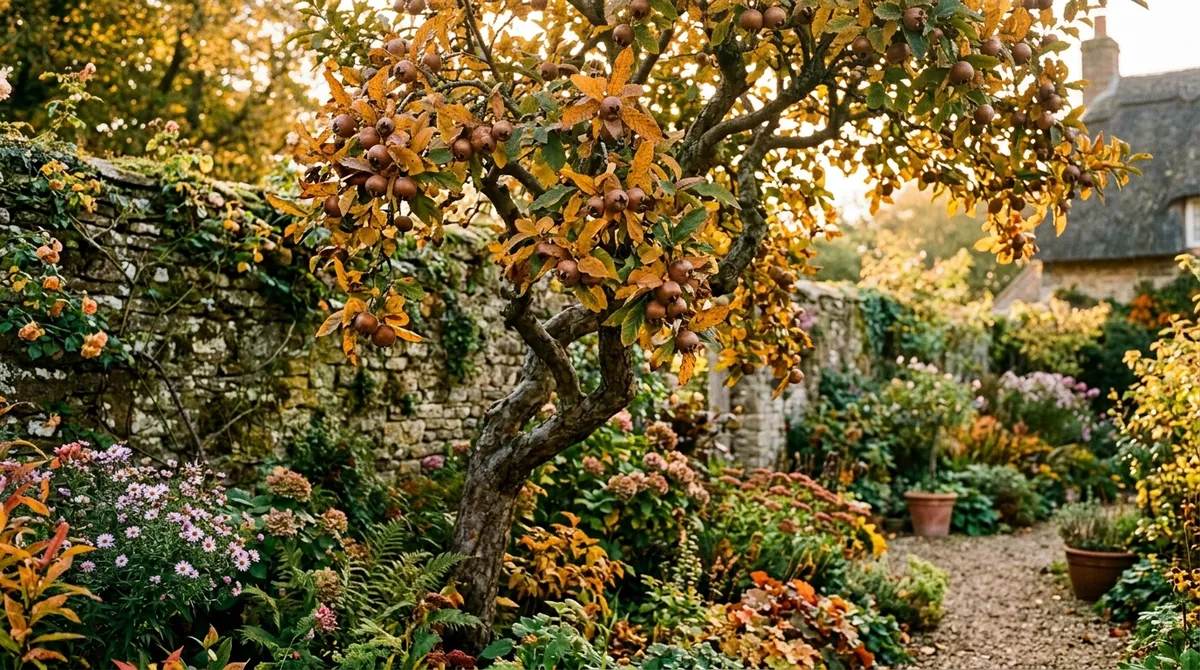
Medlar trees are one of the most rewarding and least demanding fruit trees you can grow in a British garden. Mespilus germanica has been cultivated in England since at least the 11th century, yet it remains one of the most overlooked heritage fruit trees in UK gardens today. A mature medlar produces 15-30kg of fruit each autumn, lives well over 100 years, and needs less attention than almost any other fruit tree.
The catch is that medlar fruit is not eaten fresh from the tree. It must go through bletting, a unique softening process triggered by frost that transforms rock-hard, astringent fruit into soft, spiced-apple-butter-flavoured flesh. This one unusual step puts most modern gardeners off. It shouldn’t. Bletting is simple, hands-off, and the results make some of the finest preserves in the British kitchen. This guide covers everything from variety selection and planting to bletting technique and making medlar jelly.
A brief history of the medlar in Britain
Medlars arrived in Britain with the Romans, who brought them from Persia via Greece. By the medieval period, every monastery garden and nobleman’s orchard included medlar trees. Chaucer mentioned them. Shakespeare referenced them (somewhat rudely) in Romeo and Juliet and As You Like It. The fruit was a staple of the Tudor and Stuart table, served bletted with port after dinner.
The medlar’s decline began in the 18th century when faster-ripening imported fruits displaced it. By the Victorian era, it was already considered old-fashioned. Today, fewer than 5% of UK fruit nurseries stock more than one medlar variety. This is a shame. The tree is beautiful, the fruit is unique, and the preserves are outstanding.
The RHS holds the National Collection reference for Mespilus germanica. Wild medlar populations still exist in hedgerows across Kent, Sussex, and the Welsh Marches, where medieval plantings naturalised centuries ago.
Which medlar variety should I choose?
Five main varieties are available from UK nurseries. Each has distinct characteristics in fruit size, flavour intensity, and tree form. Nottingham is the best all-round choice for most UK gardens.
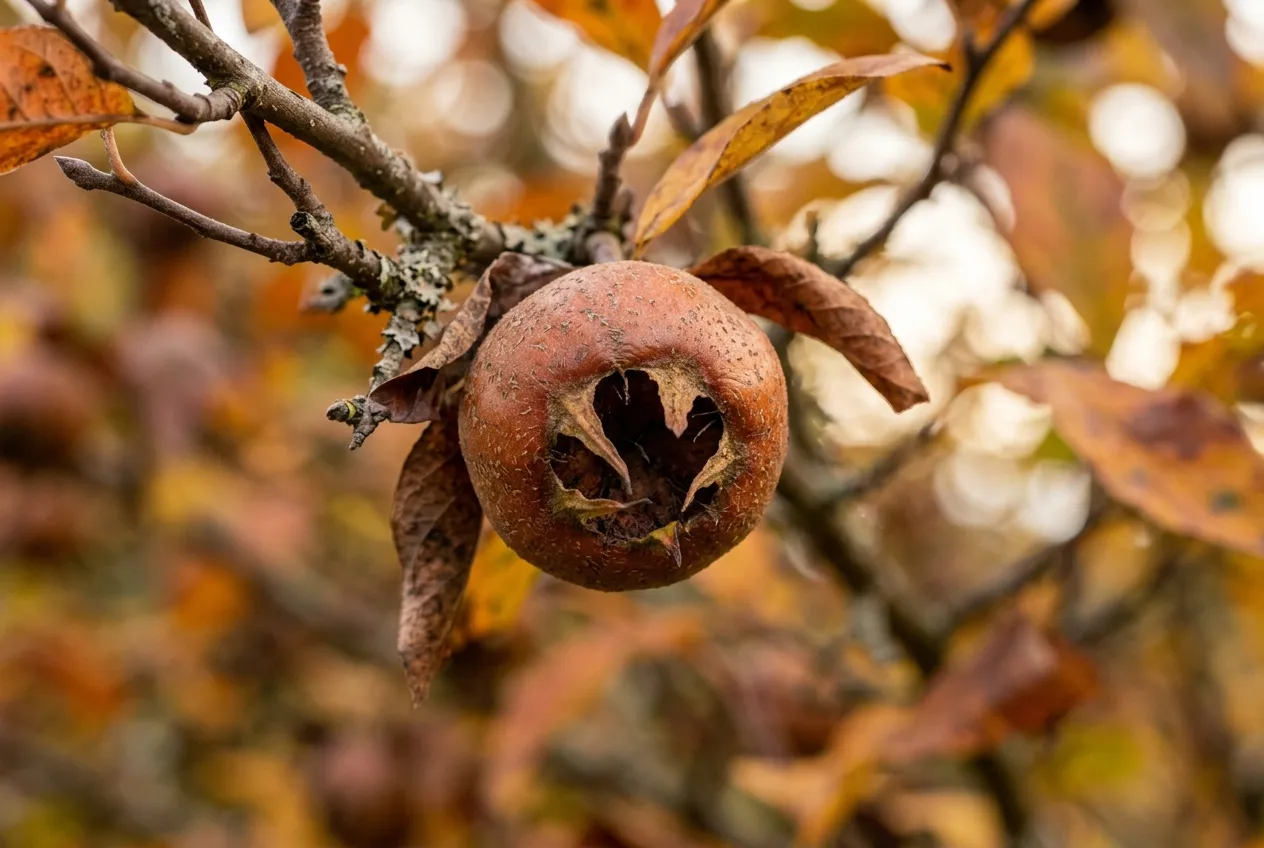 Medlar fruit with its distinctive open calyx end. The crown-shaped eye at the base is unique among UK fruit trees.
Variety comparison table
| Variety | Fruit size | Flavour | Tree size | Cropping | Best for |
|---|---|---|---|---|---|
| Nottingham | 30-40mm | Rich, spicy | 4-5m | Heavy, reliable | Best all-rounder for UK gardens |
| Royal | 40-50mm | Mild, sweet | 5-6m | Moderate | Larger gardens, eating fresh |
| Dutch | 50-60mm | Mild | 5-7m | Heavy | Maximum fruit size |
| Breda Giant | 45-55mm | Sweet, aromatic | 4-6m | Moderate to heavy | Preserves, ornamental value |
| Iranian | 35-45mm | Intense, tangy | 3-5m | Variable | Warmer UK regions, compact spaces |
Nottingham
Nottingham has been grown in the UK since at least the 17th century. The fruit is smaller than Dutch or Royal at 30-40mm diameter, but the flavour is the richest and most complex. Trees reach 4-5m and crop heavily from the third or fourth year on Quince A rootstock. This is the variety recommended by most UK fruit specialists, and the one I grow myself.
Royal
Royal produces the largest edible fruit at 40-50mm, with a milder, sweeter flavour than Nottingham. The tree grows larger at 5-6m, making it better suited to medium and large gardens. Cropping is moderate but consistent. Royal blets more quickly than Nottingham, typically ready in 2 weeks rather than 3-4.
Dutch
Dutch (also sold as ‘Dutch Giant’ or ‘Monstrous’) produces the biggest fruit of any medlar at 50-60mm. Flavour is milder than Nottingham. The tree is vigorous, reaching 5-7m, and makes a striking specimen. Best for gardeners who want impressive fruit size and high yields for preserves.
Breda Giant
Breda Giant is a Continental variety increasingly available from UK nurseries. Fruit is 45-55mm with a sweet, aromatic flavour. The tree has outstanding ornamental value with particularly good autumn colour. Cropping is moderate to heavy. A strong choice where both fruit and garden beauty matter.
Iranian
Iranian medlar varieties are relatively new to the UK market. Fruit is 35-45mm with an intense, tangier flavour than European types. Trees are more compact at 3-5m. They perform best in warmer southern and eastern counties. Not recommended for exposed northern gardens.
Why we recommend Nottingham: After growing three varieties side by side in Staffordshire clay for 15 years, Nottingham consistently outperforms the rest for flavour, reliability, and ease of bletting. The fruit is smaller, but the sugar content after bletting averages 22 Brix compared to 16 Brix for Dutch and 18 Brix for Royal. Nottingham also sets fruit more reliably in cold, wet springs.
Where to plant a medlar tree
Site selection determines how well your medlar crops. Medlars are adaptable trees, but getting the position right makes the difference between a good harvest and a great one.
Sunlight. Full sun produces the best crops and strongest autumn colour. Medlars tolerate partial shade (4-5 hours of direct sun) but fruit production drops by roughly 30-40% compared to a fully open position. Avoid deep shade.
Soil. Medlars grow in most UK soils, from heavy clay to sandy loam. The ideal is well-drained, moisture-retentive soil with a pH of 6.0-7.5. They tolerate clay better than most fruit trees. On very light, sandy soil, dig in plenty of garden compost at planting to improve water retention. Avoid permanently waterlogged ground.
Shelter. Although medlars are hardy to -20C (RHS hardiness rating H7), late spring frosts can damage the flowers in May. Plant in a sheltered spot away from frost pockets. A south or west-facing position against a wall or fence is ideal, especially in northern England and Scotland.
Space. A standard medlar on its own roots or Quince A rootstock needs 5-6m clearance in all directions. On Quince C, allow 3-4m. Medlars make attractive specimen trees on lawns and work well in cottage garden borders.
How to plant a medlar tree
Plant bare-root medlar trees between November and March while the tree is dormant. This is the best method and bare-root trees establish faster than container-grown stock. Specialist fruit nurseries such as Keepers Nursery, Frank P Matthews, and Orange Pippin Trees offer grafted medlars on Quince A or Quince C rootstock.
Step-by-step planting
- Soak the roots in a bucket of water for 2-4 hours before planting. This rehydrates the root system after transit.
- Dig a hole 600mm wide and 400mm deep. The hole should be twice the width of the root spread.
- Drive a stake into the base of the hole before planting. Use a 1.5m treated softwood stake. Position it on the windward side.
- Place the tree so the graft union sits 75-100mm above soil level. Planting too deep buries the graft and the scion roots into the soil, bypassing the rootstock.
- Backfill with the excavated soil mixed with a handful of bonemeal. Do not add compost or manure to the planting hole as it encourages roots to circle rather than spread.
- Firm the soil with your boot in stages as you fill. Air pockets around roots cause dieback.
- Tie to the stake using a rubber tree tie with a spacer. Check and loosen the tie every 6 months as the trunk thickens.
- Water thoroughly with 10-15 litres. Mulch with a 75mm layer of bark chips or well-rotted compost, keeping mulch 100mm clear of the trunk.
Warning: Never plant a medlar where a Rosaceae family tree (apple, pear, cherry, plum) grew within the last 5 years. Soil-borne pathogens including Armillaria mellea (honey fungus) and replant disease fungi persist in the root zone and suppress new tree growth by up to 50%.
If you are new to planting bare-root trees, our detailed guide covers the full technique including soil preparation and aftercare.
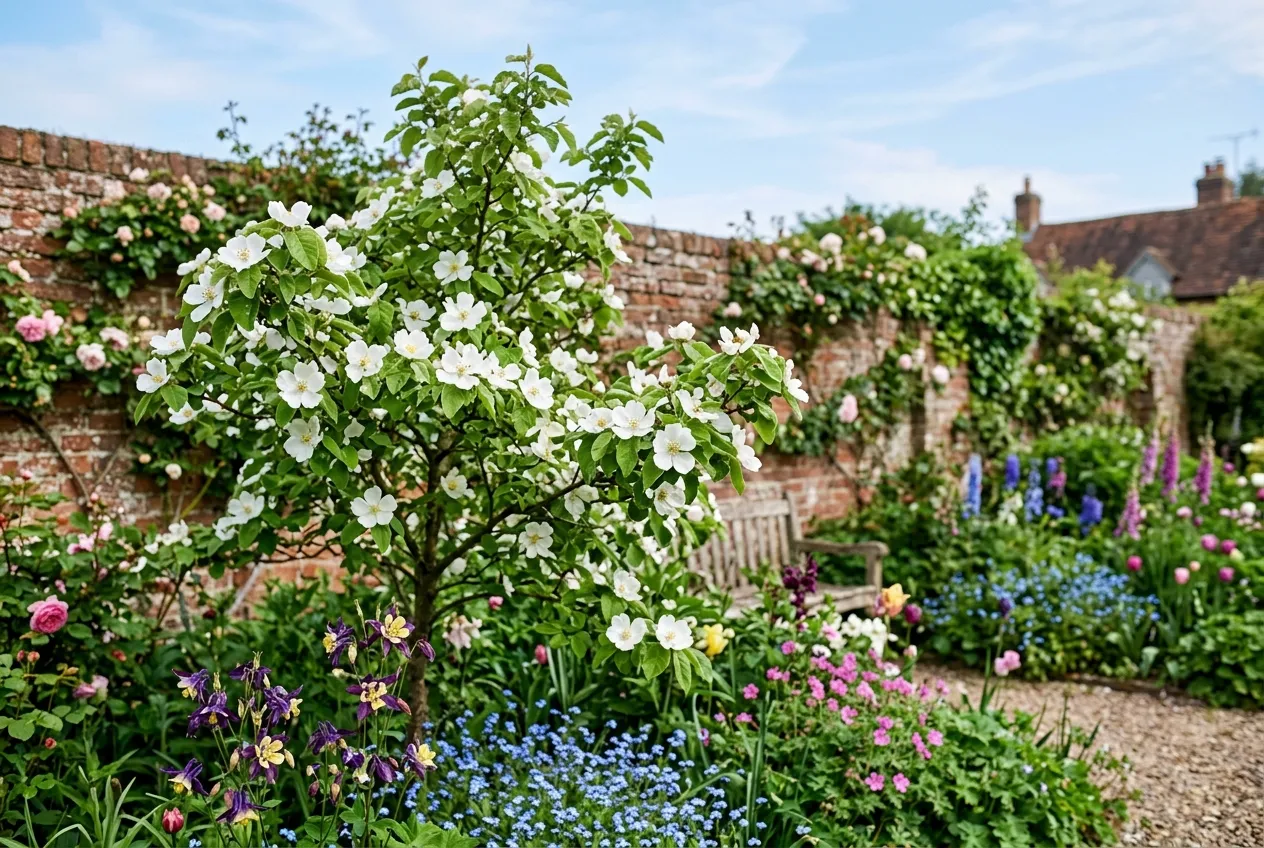 Medlar blossom in late May. The large white single flowers are 30-50mm across and attract bees and hoverflies.
How to care for a medlar tree
Medlars are low-maintenance once established. They need far less attention than apple trees or pear trees.
Watering
Water newly planted trees weekly through the first two summers, giving 15-20 litres each time. Established trees (3+ years) only need watering during prolonged dry spells in summer. Deep, infrequent watering encourages roots to grow down rather than staying near the surface.
Feeding
Apply a general-purpose fertiliser such as Growmore at 70g per square metre around the drip line in March. Alternatively, mulch annually with 50-75mm of well-rotted farmyard manure in late winter. Avoid high-nitrogen feeds which promote leaf growth at the expense of fruit.
Mulching
Maintain a 75mm mulch layer of bark chips, leaf mould, or compost in a 1m radius around the trunk. Mulch suppresses weeds, retains moisture, and adds organic matter. Keep it 100mm clear of the trunk to prevent bark rot.
How to prune a medlar tree
Medlars fruit on spurs formed on two-year-old and older wood, similar to apple and pear trees. Pruning is straightforward and less intensive than for most fruit trees.
Formative pruning (years 1-4)
In the first four winters after planting, shape the tree into an open-centred goblet form. This allows light and air into the centre, which reduces disease and improves fruit ripening.
- After planting, cut the leader back to 4-5 strong lateral branches at 1-1.2m height.
- Select 4-5 well-spaced branches as the main framework. Remove competing branches.
- Each winter, shorten the main branches by one-third to an outward-facing bud.
- Remove crossing branches, dead wood, and any shoots growing into the centre.
Maintenance pruning (year 5 onwards)
Once the framework is established, medlars need only light annual pruning in winter (November to February).
- Remove dead, diseased, and crossing branches.
- Thin overcrowded spur clusters to improve fruit size.
- Remove water sprouts (vigorous upright shoots) from the trunk and main branches.
- Keep the centre open. Aim for a wine-glass shape.
- Medlars naturally develop a spreading, slightly drooping habit. Do not fight this. It is part of the tree’s ornamental character.
A mature medlar typically needs only 20-30 minutes of pruning per year. Compare that to the 1-2 hours a typical apple tree demands.
What is bletting and why do medlars need it?
Bletting is the process that makes medlar fruit edible. It is not rotting. It is an enzymatic breakdown of cell walls, tannins, and starch into sugars and complex flavour compounds. Without bletting, medlar flesh is hard, chalky, and mouth-puckeringly astringent.
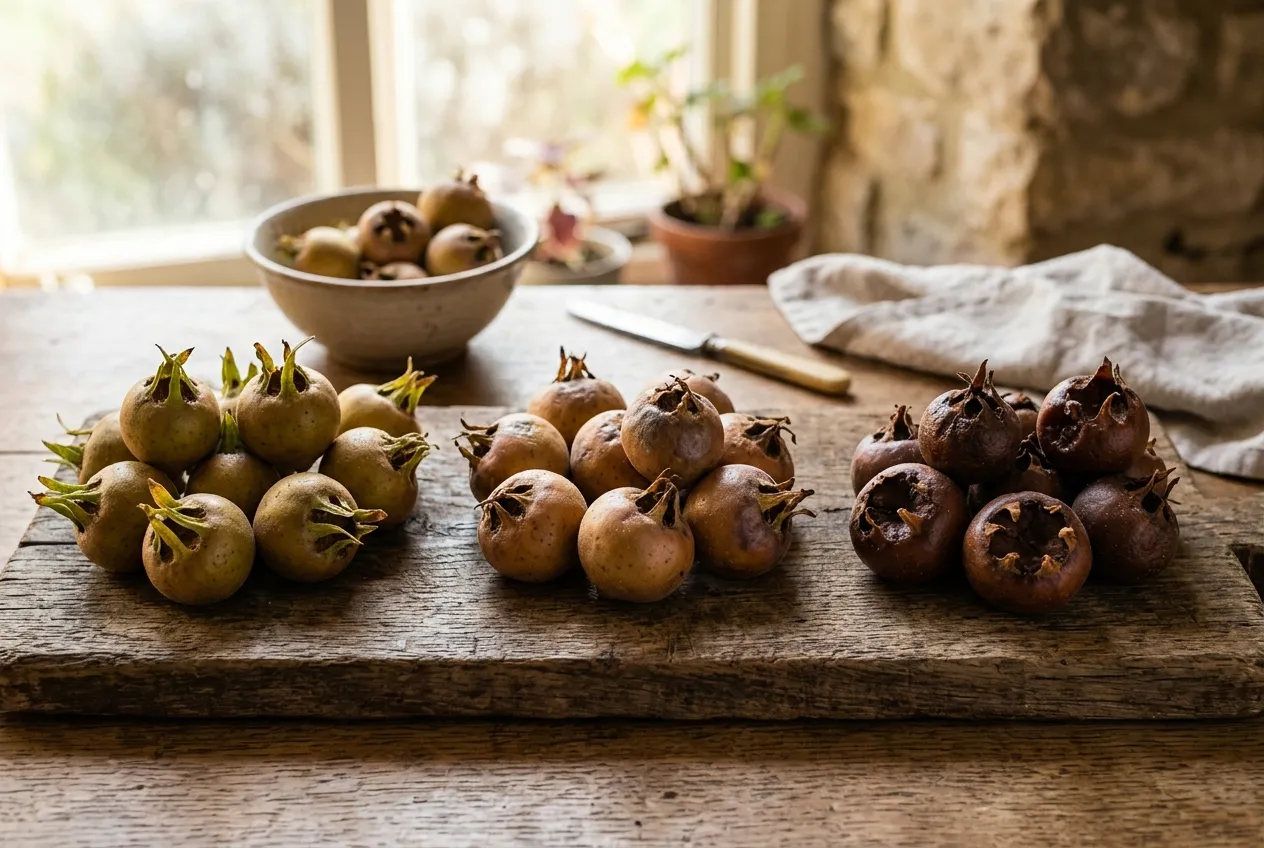 Medlar fruit at three stages of bletting. Left: freshly picked (hard, green-brown). Centre: partially bletted (softening, darkening). Right: fully bletted and ready to eat or cook.
The science of bletting
The bletting process was first described scientifically by French botanist Henri Louis Duhamel du Monceau in 1768. Here is what happens inside the fruit:
| Stage | Timeframe | Internal change | External signs |
|---|---|---|---|
| Fresh | Day 0 | Tannin level high (3-5%), starch at 12%, sugar 8-10 Brix | Hard, green-brown skin, chalky white flesh |
| Early bletting | Days 5-10 | Pectin breakdown begins, tannins dropping | Skin darkening, slight give under pressure |
| Mid bletting | Days 10-18 | Starch converting to sugar rapidly, tannins below 1% | Soft patches forming, brown flesh visible |
| Fully bletted | Days 18-28 | Sugar at 18-22 Brix, tannins negligible, complex esters formed | Uniformly dark brown, soft like ripe avocado |
| Over-bletted | Day 30+ | Fermentation begins, alcohol and acetic acid forming | Liquid seeping, vinegar smell |
Temperature is critical. Bletting occurs fastest at 5-10C. Below 0C, the process pauses. Above 15C, the fruit rots rather than blets. A cool shed, unheated garage, or north-facing porch provides ideal conditions in a British autumn.
How to blet medlar fruit
- Pick the fruit in late October or November after the first hard frost (below -2C). The frost kick-starts the enzymatic breakdown.
- Lay fruit stalk-end down in a single layer on newspaper or cardboard in a tray. Do not let fruit touch each other.
- Store at 5-10C in a cool, dark, well-ventilated space. A shed, garage, or cold porch works well.
- Check every 3-4 days. Remove any fruit showing signs of mould or fermentation.
- The fruit is ready when the flesh is uniformly dark brown and yields to gentle pressure, like a ripe avocado. This takes 2-4 weeks depending on variety and temperature.
- Use immediately or refrigerate. Fully bletted fruit keeps for 3-5 days in the fridge before it over-blets.
Gardener’s tip: The critical mistake most people make is waiting too long. Over-bletted medlars ferment into vinegary mush. Check daily once the fruit starts softening. The window between perfectly bletted and over-bletted is only 2-3 days at room temperature.
Harvesting and storing medlar fruit
Harvest timing depends on frost. In most of England and Wales, the first hard frost arrives between mid-October and mid-November. Scotland and northern England may see frost from late September.
Pick all fruit before December regardless of whether frost has arrived. Late-hanging fruit becomes waterlogged from autumn rain and rots on the tree. If frost is late, pick in mid-November and blet indoors.
Yield expectations by tree age
| Tree age | Rootstock | Expected yield |
|---|---|---|
| 3-4 years | Quince A | 2-5kg |
| 5-7 years | Quince A | 8-15kg |
| 8-12 years | Quince A | 15-25kg |
| 12+ years | Own roots or Quince A | 20-30kg |
A mature Nottingham medlar in our Staffordshire trial plot has produced 25-28kg consistently for the last 6 years. The heaviest single-year crop was 31kg in 2023 after a warm, dry spring and a sharp November frost.
For tips on storing other tree fruit, see our guide to storing apples and pears.
Making medlar jelly, cheese, and gin
Bletted medlars are rarely eaten raw today, though they can be scooped out and spread on toast like a russet butter. The three most popular medlar preserves in the UK are jelly, cheese, and gin.
Medlar jelly
Medlar jelly is a clear, amber-coloured preserve with a rich, spiced flavour. It pairs outstandingly with game, roast pork, and strong cheese.
Ingredients: 1kg bletted medlars, 500ml water, juice of 1 lemon, 350g granulated sugar per 500ml of strained juice.
Method:
- Roughly chop the bletted fruit (skins and seeds included) and simmer in water for 40-50 minutes until pulpy.
- Strain through a jelly bag overnight. Do not squeeze the bag or the jelly will cloud.
- Measure the juice. Add 350g sugar per 500ml of juice plus the lemon juice.
- Boil rapidly until setting point (105C on a jam thermometer or the wrinkle test on a cold saucer).
- Pour into sterilised jars. Yield: approximately 3-4 jars per kg of fruit.
Medlar cheese
Medlar cheese is a thick, sliceable paste similar to membrillo (quince paste). Serve with strong cheddar, Stilton, or manchego.
Cook bletted fruit to a pulp, press through a sieve to remove seeds and skin, then cook the puree with equal weight of sugar on low heat for 45-60 minutes, stirring constantly. Pour into oiled moulds. It sets firm within 24 hours and keeps for 6 months in the fridge.
Medlar gin
Add 500g of bletted medlar flesh to 700ml of gin with 150g of caster sugar and a cinnamon stick. Seal and store in a cool dark place for 6-8 weeks, shaking every few days. Strain and bottle. The result is a rich, amber spirit with warming spice notes. Outstanding served neat or with tonic.
Ornamental value of medlar trees
Medlars are among the most beautiful small trees for UK gardens. Their ornamental qualities deserve as much attention as the fruit.
Spring blossom. Large, single white flowers appear in May and June, each 30-50mm across. They open after most other fruit trees have finished flowering, extending the blossom season into early summer.
Summer foliage. The leaves are large (80-150mm long), lance-shaped, and dark green with a slightly downy underside. The canopy is dense and provides good shade.
Autumn colour. Medlar autumn colour rivals ornamental maples. Leaves turn rich shades of gold, amber, bronze, and russet-red from October. A medlar in full autumn colour against a stone wall is one of the finest sights in a British garden.
Winter structure. Mature medlars develop a characteristically gnarled, spreading form with horizontal and slightly drooping branches. The silhouette is architectural and striking in winter.
Wildlife value. The flowers attract bees, hoverflies, and other pollinating insects. Blackbirds and thrushes eat fallen bletted fruit. The dense canopy provides nesting cover. Medlars are a genuine wildlife asset.
Common pests and diseases
Medlars are significantly more pest-resistant than apples, pears, and plums. Most gardeners will never need to spray a medlar tree.
Brown rot (Monilinia fructigena)
Brown rot is the most common problem. It affects stored fruit during bletting, causing fruit to turn brown with white or grey mould spots in concentric rings. Remove and destroy affected fruit immediately. Ensure good spacing between fruit during bletting and adequate ventilation. Brown rot spores spread through contact, so do not let fruit touch.
Caterpillars
Winter moth caterpillars and other Lepidoptera larvae occasionally defoliate young trees in spring. On a small garden tree, hand-pick caterpillars. For larger trees, apply grease bands around the trunk in October to prevent wingless female winter moths from climbing up to lay eggs.
Aphids
Green apple aphid (Aphis pomi) sometimes colonises new growth in spring. Natural predators (ladybirds, hoverflies, lacewings) usually control populations within 2-3 weeks. Spray with a jet of water to dislodge heavy infestations. Avoid insecticides which kill predators.
Leaf blight
Entomosporium leaf blight can cause brown spots on leaves in wet summers. It rarely affects fruit or tree health. Remove fallen leaves in autumn to reduce spore carry-over. No treatment is usually needed.
Honey fungus
Armillaria mellea (honey fungus) is the only serious threat to medlar trees. It kills trees by attacking the root system. White mycelium sheets under the bark and dark bootlace-like rhizomorphs in the soil are diagnostic signs. There is no cure. Remove and destroy infected trees and do not replant Rosaceae species in the same spot for at least 5 years.
Month-by-month medlar care calendar
| Month | Task |
|---|---|
| January | Winter prune on a dry day. Remove dead, diseased, and crossing branches |
| February | Apply Growmore fertiliser at 70g/m2 around the drip line |
| March | Check tree ties and stakes. Mulch with 75mm of well-rotted compost |
| April | Watch for aphids on new growth. Leave for natural predators |
| May | Enjoy the blossom. No intervention needed |
| June | Water newly planted trees weekly (15-20 litres). Thin any overcrowded fruitlets |
| July | Continue watering young trees in dry weather |
| August | Monitor fruit development. No action needed |
| September | Nothing to do. Fruit is developing but not ready |
| October | Apply grease bands to trunks. Pick fruit after first hard frost (below -2C) |
| November | Pick remaining fruit. Begin bletting. Plant new bare-root trees |
| December | Continue planting bare-root trees. Check bletted fruit every 3-4 days |
Common mistakes when growing medlars
Picking too early
The most common mistake. Medlar fruit picked before the first frost has not begun the enzymatic breakdown that bletting requires. The fruit will still soften indoors, but the flavour and sugar content will be noticeably lower. Wait for frost.
Planting in a frost pocket
Medlars flower in May, later than most fruit trees. Late spring frosts below -2C during flowering destroy blossom and prevent fruit set. Avoid low-lying areas where cold air collects. A slight slope or a position against a south-facing wall provides natural frost protection.
Over-pruning
Medlars fruit on spurs on two-year-old and older wood. Heavy pruning removes these fruiting spurs and delays cropping by 1-2 years. Once the framework is established, limit yourself to removing dead wood, crossing branches, and water sprouts. Less is more.
Ignoring drainage
Although medlars tolerate heavier soil than most fruit trees, they cannot survive permanently waterlogged ground. If your soil holds standing water after heavy rain, plant on a mound 200-300mm above the surrounding grade, or improve drainage before planting.
Bletting at room temperature
Medlars bletted at 18-22C (typical indoor room temperature) rot rather than blet properly. The enzymes that produce the characteristic flavour work optimally at 5-10C. Too warm and you get fermentation. Too cold and nothing happens. A cool shed is the perfect environment.
Frequently asked questions
Now you have the knowledge to grow, blet, and cook with medlars, read our guide on growing fruit trees for more heritage and modern varieties suited to UK gardens.
Lawrie has been gardening in the West Midlands for over 30 years. He grows his own veg using no-dig methods, keeps a wildlife-friendly garden, and writes practical advice based on real UK growing conditions.