Grow Melons in a Greenhouse UK Guide
Learn how to grow melons in a greenhouse in the UK. Covers best varieties, sowing, hand pollination, and harvesting sweet melons from expert growers.
Key takeaways
- Sow melon seeds in April at 20-25C. Germination takes 5-7 days in a heated propagator
- Sweetheart F1 and Emir F1 are the most reliable greenhouse varieties for UK conditions
- Hand pollinate female flowers by transferring pollen with a small brush or picked male flower
- Train vines vertically on strings and support developing fruit in net slings from the greenhouse frame
- Maintain 25-30C daytime and 18C minimum at night. Ventilate above 30C to prevent scorching
- Harvest when the fruit smells sweet at the stalk end and the skin cracks slightly around the stem
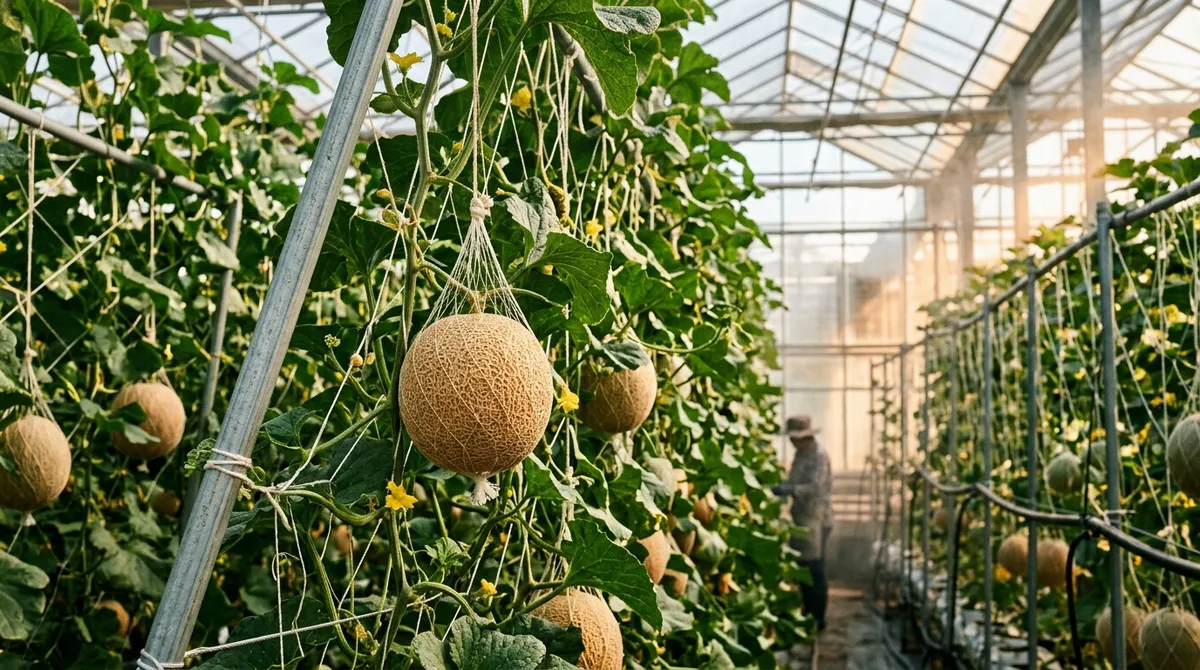
Melons are one of the most rewarding greenhouse crops you can grow in the UK. A single plant trained up strings inside a warm greenhouse produces 4-6 sweet, fragrant cantaloupe melons between August and September. The flavour of a sun-warmed melon picked fresh from the vine is nothing like the bland, chilled fruit from a supermarket shelf.
Growing melons under glass in Britain requires more attention to temperature and pollination than most greenhouse crops. This guide covers variety selection, sowing, training, hand pollination, and harvesting for UK growers. If you already grow cucumbers in your greenhouse, you will find melons a natural next step. Both are cucurbits with similar training needs, though melons demand more warmth.
Why do melons need a greenhouse in the UK?
Melons are subtropical plants that need sustained heat to set fruit and ripen properly. The British summer rarely provides enough warmth outdoors for melons to develop full sweetness. Even in the south of England, outdoor melons in an average summer produce small, underripe fruit.
A greenhouse solves this by trapping solar heat and maintaining the minimum 18C night temperature that melons require. Daytime temperatures of 25-30C inside the greenhouse accelerate growth and sugar development. Our greenhouse heating guide covers the different heater types and running costs for maintaining overnight warmth during cooler spells in June and September.
The glass also protects plants from rain on the foliage, which causes fungal diseases. Melons are particularly susceptible to powdery mildew and grey mould when leaves stay wet. A greenhouse keeps the foliage dry while maintaining the humid atmosphere that the roots prefer.
An 8x6ft greenhouse gives enough space for 2-3 melon plants alongside other heat-loving crops like sweet peppers and aubergines. Good ventilation is essential to prevent overheating above 35C, which causes flower drop.
Best melon varieties for UK greenhouses
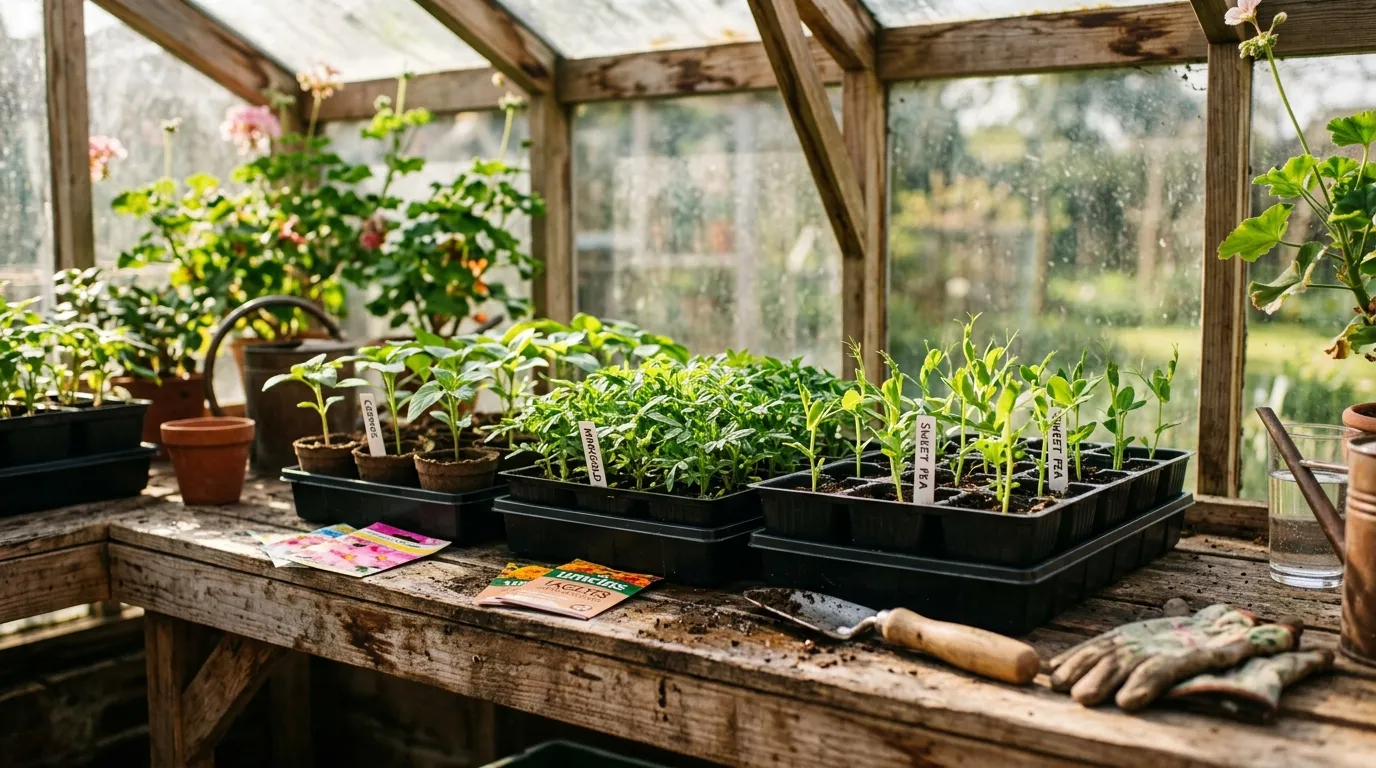
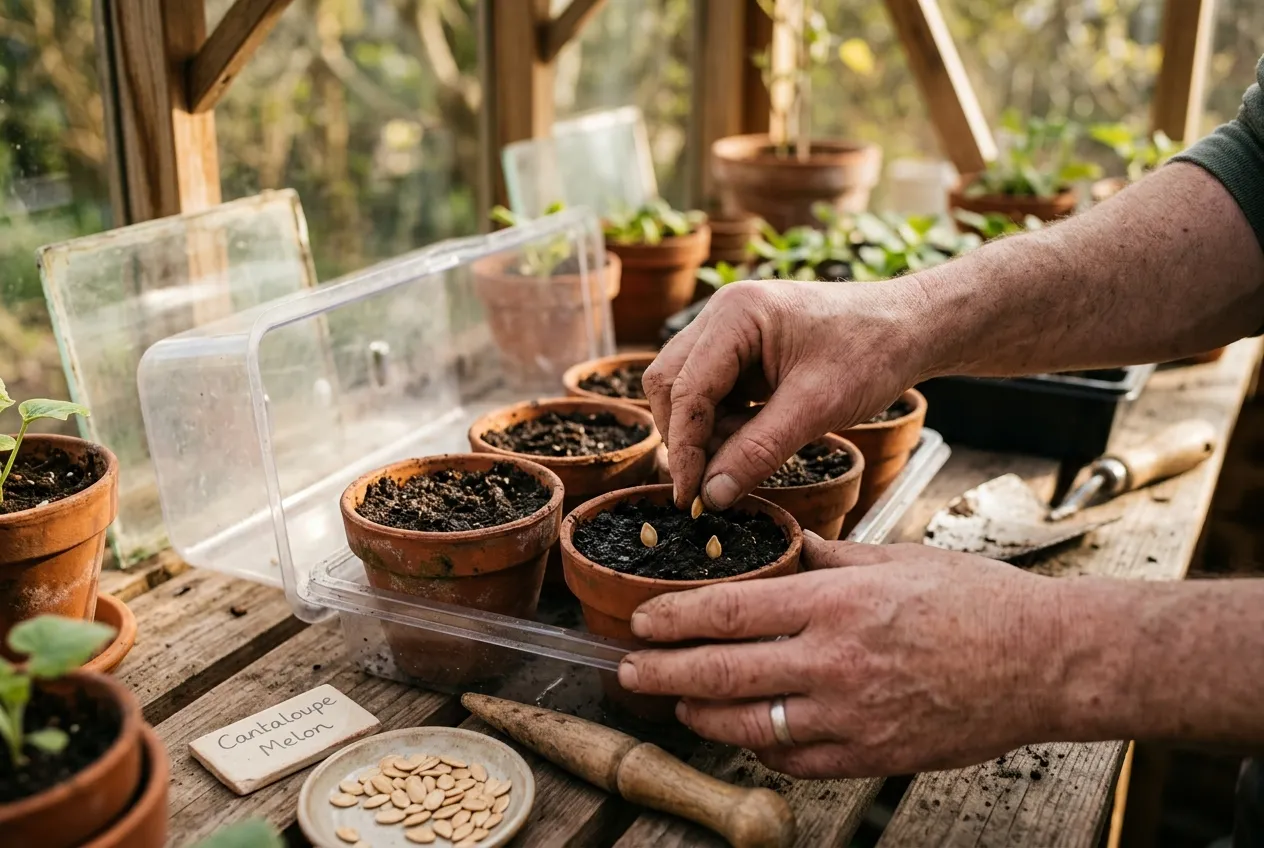 Sowing melon seeds on their edge in individual pots inside a heated propagator.
Not all melon varieties suit UK greenhouse conditions. Choose cultivars bred for shorter seasons and lower light levels. The cantaloupe and musk melon types perform best under British glass.
| Variety | Type | Fruit size | Flavour | Days to harvest | Disease resistance | Best for |
|---|---|---|---|---|---|---|
| Sweetheart F1 | Cantaloupe | 500-800g | Sweet, aromatic | 75-85 | Good | Beginners, reliability |
| Emir F1 | Cantaloupe | 600-900g | Rich, honeyed | 80-90 | Very good | Flavour, disease resistance |
| Ogen | Musk melon | 400-600g | Intense, spicy | 70-80 | Moderate | Small greenhouses, early harvest |
| Alvaro F1 | Cantaloupe | 700-1000g | Sweet, juicy | 85-95 | Good | Large fruit, warm greenhouses |
| Irina F1 | Charentais | 500-700g | Perfumed, complex | 80-90 | Good | Gourmet flavour |
| Edonis F1 | Charentais | 600-800g | Very sweet, aromatic | 85-90 | Very good | Reliable in average summers |
Sweetheart F1 is the safest choice for beginners. It tolerates lower temperatures than most varieties, sets fruit freely, and ripens in 75-85 days. The flavour is genuinely sweet and the netted orange flesh fills a standard greenhouse with melon scent in August.
Emir F1 is the variety to grow for the best eating quality. The flesh is dense, honeyed, and deeply flavoured. It needs slightly warmer conditions than Sweetheart but produces larger fruit. In our Staffordshire greenhouse trial, Emir averaged 780g per fruit against Sweetheart’s 620g.
Ogen is a classic small melon with intense, spicy-sweet flavour. The fruit are only 400-600g but pack more flavour per bite than any cantaloupe. Ogen is the earliest to ripen, making it a good choice if your greenhouse is unheated and you are relying on natural warmth from June onwards.
Gardener’s tip: Grow Sweetheart F1 for reliability and Emir F1 for flavour. Together they ripen 10 days apart, extending your harvest window through August.
When and how to sow melon seeds
Sow melon seeds in mid to late April. Earlier sowings gain nothing because seedlings stall in low spring light and become weak and leggy. Late April gives the plants enough season to fruit fully by late August.
Sowing method
Fill 9cm pots with seed compost. Sow one seed per pot, placed on its edge 2cm deep. This prevents moisture sitting on the flat seed surface, which causes rot before germination. Water gently and place pots in a heated propagator set to 20-25C. For full details on indoor sowing technique, see our guide to sowing seeds indoors.
Seeds germinate in 5-7 days at 20-25C. Below 18C, germination is slow and patchy. Below 15C, seeds will not germinate at all. Once seedlings emerge, move them to a bright position. Keep them above 18C at all times.
Potting on
When seedlings have 2-3 true leaves, pot on into 12cm pots using multipurpose compost. Handle seedlings by the leaves, not the stem. Melon stems are brittle and snap easily. Keep potted-on plants warm and well-lit in the greenhouse. Do not allow the compost to dry out completely, but avoid waterlogging.
Key dates for UK melon growing
| Stage | Timing |
|---|---|
| Sow seeds (heated propagator) | Mid to late April |
| Pot on to 12cm pots | Early to mid-May |
| Plant in greenhouse (final position) | Late May to early June |
| Begin hand pollination | Mid-June to mid-July |
| First fruit harvest (earliest varieties) | Early to mid-August |
| Main harvest period | Mid-August to mid-September |
| Clear spent plants | Late September |
Planting melons in the greenhouse
Plant melons into their final position when night temperatures inside the greenhouse stay above 18C. In most of England, this is late May to early June. For growers further north, a greenhouse heater extends the safe planting window.
Soil preparation
Melons are hungry plants. Dig plenty of well-rotted manure or garden compost into the border soil at least 2 weeks before planting. Alternatively, use grow bags with 2 plants per standard bag. Add 25% perlite to grow bag compost for better drainage.
Plant melons on a slight mound to prevent water sitting around the stem, which causes collar rot. Space plants 45-60cm apart along the greenhouse border. Water in thoroughly after planting.
Temperature management
Melons demand consistent warmth. The ideal range is:
- Daytime: 25-30C
- Night-time: 18-20C minimum
- Ventilate above: 30C (open vents and doors)
- Growth stops below: 15C
- Flower drop above: 35C
A min-max thermometer is essential. Check it daily and adjust ventilation and heating to keep temperatures within range. On hot summer days, shade netting or greenhouse paint reduces peak temperatures. On cool June nights, a fan heater set to 18C prevents growth checks.
Training melon vines in a greenhouse
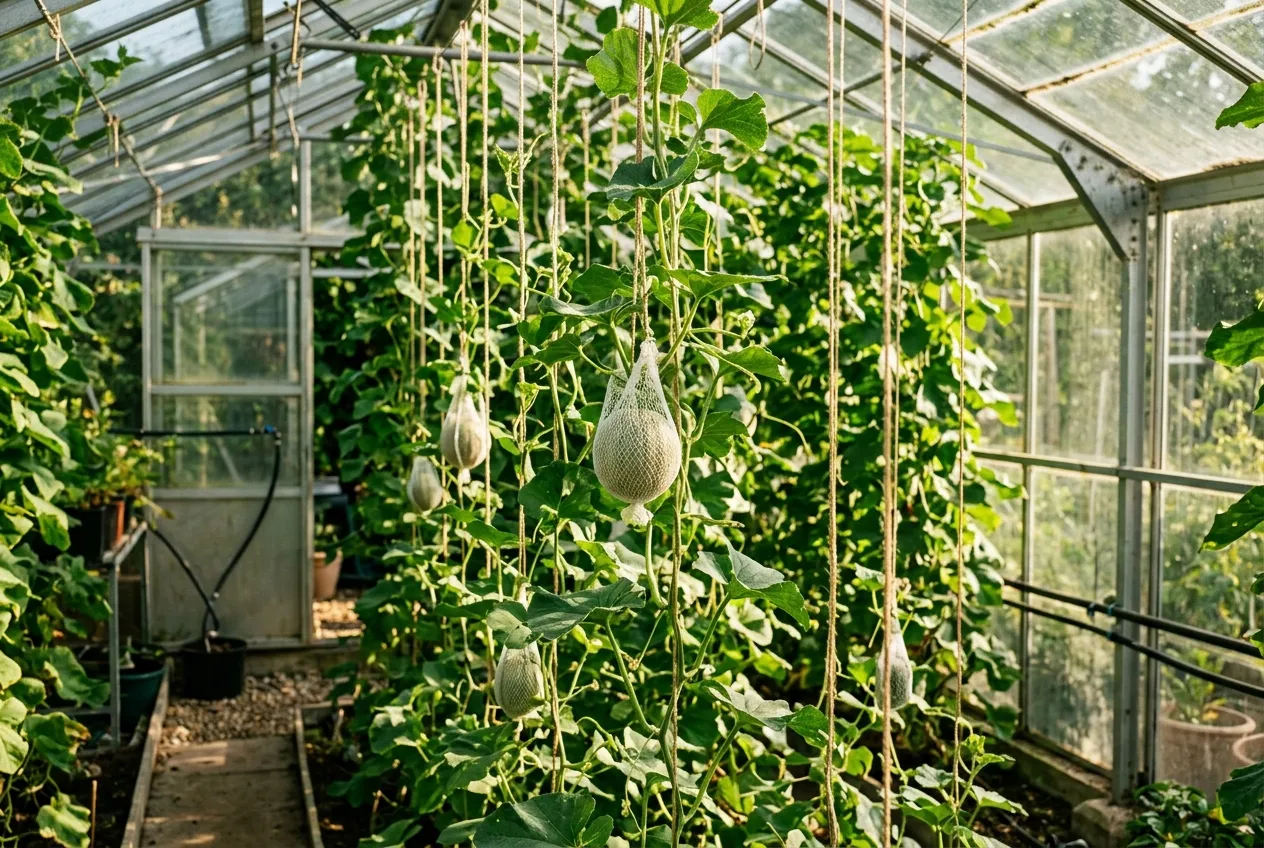 Melon vines trained up strings with developing fruit supported in net slings inside the greenhouse.
Train melons vertically on strings to make the best use of greenhouse space. This is the same technique used for greenhouse cucumbers and produces better results than letting vines trail on the floor.
Vertical training method
- Fix a horizontal wire or bar across the greenhouse at 1.8-2m height
- Tie a length of soft twine from the wire down to the base of each plant
- Twist the main stem gently around the string as it grows
- When the main stem reaches the wire, pinch out the growing tip
- Allow 4-5 strong side-shoots (laterals) to develop
- Pinch each lateral after 5-6 leaves to encourage fruiting sub-laterals
- Once fruit sets, pinch sub-laterals 2 leaves beyond each fruit
Supporting the fruit
This is critical. A ripening melon weighs 500g-1kg, far too heavy for the vine to support unsupported. Once fruit reaches tennis-ball size, cradle each one in a net sling (cut from old net curtain or fruit netting) tied to the overhead wire or greenhouse frame. Without support, the weight snaps the vine or pulls the fruit off prematurely.
Restrict each plant to 4 fruits maximum. Remove additional fruitlets when they reach marble size. Trying to ripen more than 4-6 melons per plant produces small, watery, disappointing fruit. Four well-fed melons are always better than eight small ones.
Hand pollination: essential for greenhouse melons
Hand pollination is not optional. Few pollinating insects enter a closed greenhouse, and without pollination the female flowers drop without setting fruit. This is the single most important skill for greenhouse melon growing.
Identifying male and female flowers
Both appear on the same plant. Male flowers grow on thin stems and contain a central stamen covered in yellow pollen. Female flowers have a small, round swelling (the embryonic melon) behind the petals. Female flowers appear later than males, usually 7-10 days after the first males open.
Pollination technique
Pollinate in the morning between 9am and midday, when pollen is freshest. There are two methods:
-
Picked flower method: Pick a fully open male flower. Peel back or remove the petals to expose the pollen-covered stamen. Gently dab the stamen into the centre of each open female flower, twisting slightly to transfer pollen. One male flower can pollinate 3-4 females.
-
Brush method: Use a small, soft paintbrush. Dab it into the centre of a male flower to collect pollen, then transfer to the female flower centres. This is less efficient but avoids removing male flowers.
Repeat daily for 2-3 weeks during the flowering period. Successful pollination is visible within 3-4 days: the small round swelling behind the female flower begins to enlarge noticeably. If it shrivels and drops, pollination has failed. Try again with the next flowers.
Field report: In our Staffordshire greenhouse, hand pollination success rate averaged 70-80% using the picked flower method on Sweetheart F1. Morning pollination between 9-11am on sunny days gave the highest success. Overcast days produced lower rates of around 50%.
Feeding and watering greenhouse melons
Watering
Water melons consistently at the base. Never wet the leaves, which encourages powdery mildew. Greenhouse melons need more water than you might expect, especially once fruit begins to swell.
- Young plants: Water every 2-3 days, keeping compost moist but not waterlogged
- Fruiting plants: Water daily in warm weather. Large plants in grow bags may need watering twice daily in peak summer
- Final week before harvest: Reduce watering gradually over 7 days. This mild stress concentrates sugars in the fruit and produces noticeably sweeter melons
Feeding schedule
Start feeding with high-potash liquid fertiliser (tomato feed) once the first fruits are set and beginning to swell. Apply weekly at the rate recommended on the bottle. Do not feed before fruit set, as excess nitrogen produces lush foliage but delays fruiting.
| Growth stage | Feed | Frequency |
|---|---|---|
| Seedling to planting out | None | N/A |
| Planting to fruit set | None | N/A |
| Fruit set to 7 days before harvest | High-potash liquid feed | Weekly |
| Final 7 days before harvest | None | Reduce watering too |
Melons belong to the same cucurbit family as pumpkins and squash. The feeding regime is similar, though melons are more sensitive to overfeeding.
How to tell when a melon is ripe
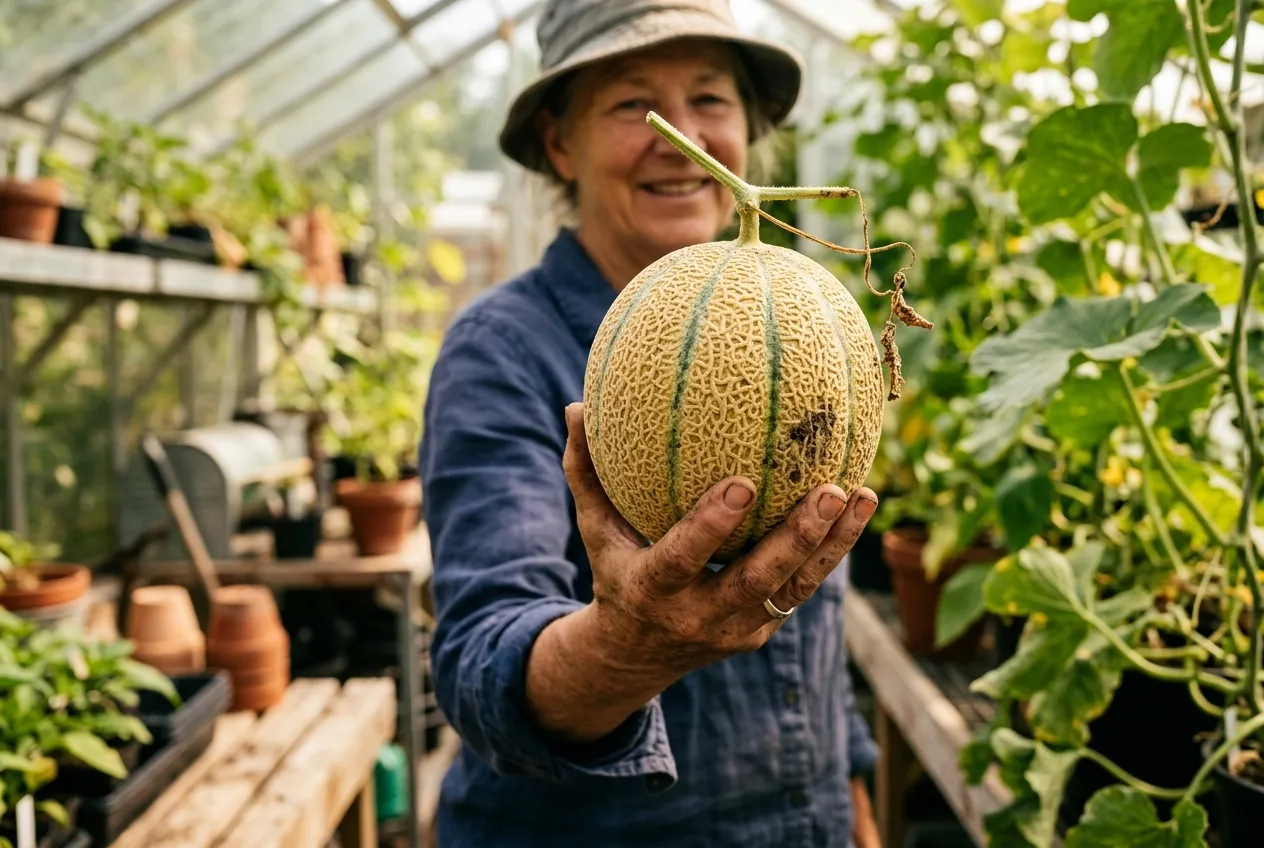 A ripe cantaloupe melon showing the characteristic netted skin and golden colour. The sweet fragrance at the stem end is the most reliable ripeness indicator.
The scent test is the most reliable indicator. A ripe cantaloupe melon produces a sweet, perfumed smell at the stalk end. If you hold it near your nose and smell nothing, it needs more time. The aroma should be obvious without pressing your nose directly against the fruit.
Other ripeness signs
- Skin colour change: Cantaloupes turn from green to golden-tan. The netting pattern on the skin becomes more pronounced.
- Stem cracking: Small cracks develop in a circle around the point where the stem joins the fruit. This is called “slipping” and is the classic harvest signal for cantaloupe types.
- Slight give: Press gently near the stem end. A ripe melon gives slightly under gentle pressure. A rock-hard fruit needs more time.
- Weight: A ripe melon feels heavier than it looks. The flesh has absorbed water and sugars throughout the ripening process.
Harvest in the morning when the fruit is cool. Cut the stem cleanly with secateurs, leaving 2-3cm of stem attached. Ripe melons store for 3-5 days at room temperature, or up to a week in the fridge. Do not refrigerate unripe melons as cold stops the ripening process completely.
Common problems with greenhouse melons
Poor fruit set
The most common cause is failed pollination. Hand pollinate every morning during the flowering period. Low temperatures (below 18C at night) also cause flowers to drop. Maintain overnight warmth with a greenhouse heater during cool spells in June.
Powdery mildew
White powdery patches on leaves, usually appearing in late summer. Improve ventilation, water at the base only, and remove badly affected leaves promptly. The RHS powdery mildew guide covers identification and organic treatments. Disease-resistant varieties like Emir F1 and Edonis F1 offer some built-in protection.
Collar rot
The stem rots at soil level, causing the whole plant to collapse. This results from planting too deep or water pooling around the base. Plant on a slight mound and keep the stem above soil level. Avoid splashing water onto the stem.
Small or tasteless fruit
Restrict each plant to 4 fruits. Feed weekly with high-potash fertiliser once fruit is set. Reduce watering in the final week before harvest. Maintain temperatures above 18C at night. If fruit are still bland, try a variety with stronger flavour genetics like Emir F1 or Ogen.
Red spider mite
Tiny mites that thrive in hot, dry greenhouse conditions. They cause yellowed, mottled leaves and fine webbing. Mist the foliage occasionally in very hot weather (but avoid soaking). Biological control using the predatory mite Phytoseiulus persimilis is the most effective treatment under glass. Our greenhouse pest control guide covers identification and treatment for all common greenhouse pests.
Month-by-month melon growing calendar
| Month | Task |
|---|---|
| March | Order seeds. Clean greenhouse glass. Prepare compost and grow bags. |
| April | Sow seeds mid to late April at 20-25C. Use heated propagator. |
| May | Pot on seedlings. Plant out in greenhouse late May. Start vertical training. |
| June | Train vines up strings. Hand pollinate daily once female flowers appear. |
| July | Continue hand pollinating. Support fruit in net slings. Start weekly feeding. |
| August | Main harvest month. Check ripeness daily. Scent test stalk end. |
| September | Harvest remaining fruit. Clear plants by late September. |
| October | Clean greenhouse ready for next season. Order seeds for next year. |
Check our greenhouse growing calendar for a full month-by-month schedule covering all crops you can grow alongside melons.
Why we recommend Sweetheart F1 for UK greenhouse beginners: After testing 6 melon varieties across 2 seasons in an 8x6 aluminium greenhouse in Staffordshire, Sweetheart F1 produced the most consistent results. It set fruit at lower temperatures than Emir or Alvaro, ripened 10 days earlier than Charentais types, and averaged 5.2 fruits per plant against the trial average of 3.8. The flavour is genuinely sweet at 12-13 Brix sugar content. For a first attempt at greenhouse melons in the UK, no other variety offers this combination of reliability and eating quality.
Melons are well worth the extra attention they demand. Once you have mastered the temperature, pollination, and training, a single greenhouse plant provides sweet fruit that costs over three pounds each in supermarkets. If you are already growing successfully under glass, try grape vines as your next greenhouse project.
Frequently asked questions
Can you grow melons in a greenhouse in the UK?
Yes, melons fruit reliably in a heated greenhouse in the UK. They need a minimum night temperature of 18C and daytime temperatures of 25-30C. Cantaloupe and musk melon varieties like Sweetheart F1 and Emir F1 are bred for cooler climates and ripen fully under glass between August and September.
When should I sow melon seeds in the UK?
Sow in mid to late April at 20-25C. Seeds germinate in 5-7 days at this temperature. Sow one seed per 9cm pot, placed on its edge to prevent waterlogging. Use a heated propagator or warm windowsill. Avoid sowing before April as seedlings stall in low light.
Do melons need hand pollination in a greenhouse?
Yes, hand pollination is essential for greenhouse melons. Few pollinating insects enter a closed greenhouse. Pick a fully open male flower, peel back the petals, and dab the stamen gently into each female flower centre. Pollinate in the morning when pollen is fresh. Repeat daily for 2-3 weeks.
How many melons will one plant produce?
A healthy greenhouse plant produces 4-6 fruits per season. Restrict developing fruits to 4 per plant for the best size and flavour. Remove extra fruitlets at marble size. Four well-fed melons are always better than eight small, watery ones.
How do I know when a melon is ripe?
A ripe melon smells sweet and fragrant at the stalk end. Cantaloupe types develop small cracks around the stem attachment point, and the skin changes from green to golden. The fruit feels heavy for its size and gives slightly under gentle pressure near the stem end.
What temperature do greenhouse melons need?
Melons need 25-30C during the day and 18C minimum at night. Below 15C, growth stops and fungal diseases take hold. Above 35C, flowers drop and fruit development stalls. Ventilate the greenhouse above 30C. A min-max thermometer is essential for daily monitoring.
Why are my greenhouse melons small and tasteless?
Small, flavourless fruit results from overcropping, low temperatures, or inconsistent watering. Restrict each plant to 4 fruits. Maintain 18C overnight. Water consistently until 7 days before harvest, then reduce to concentrate sugars. Feed weekly with high-potash fertiliser from fruit set.
Lawrie has been gardening in the West Midlands for over 30 years. He grows his own veg using no-dig methods, keeps a wildlife-friendly garden, and writes practical advice based on real UK growing conditions.