How to Grow Rocket in the UK
Grow rocket in the UK from seed with this practical guide. Covers salad and wild varieties, sowing, bolt prevention, flea beetle control, and harvesting.
Key takeaways
- Rocket germinates in 4-5 days and gives pickable leaves within 3-4 weeks of sowing
- Succession sow every 2-3 weeks from March to September for a continuous supply
- Wild rocket is perennial, slower to bolt, and has a stronger peppery flavour than salad rocket
- Grow in partial shade from June onwards to prevent bolting in summer heat
- Flea beetle is the biggest pest threat: cover with fine mesh netting from sowing day
- Cut-and-come-again harvesting gives 3-5 pickings from a single sowing
- Rocket grows well in containers, window boxes, and even on a kitchen windowsill
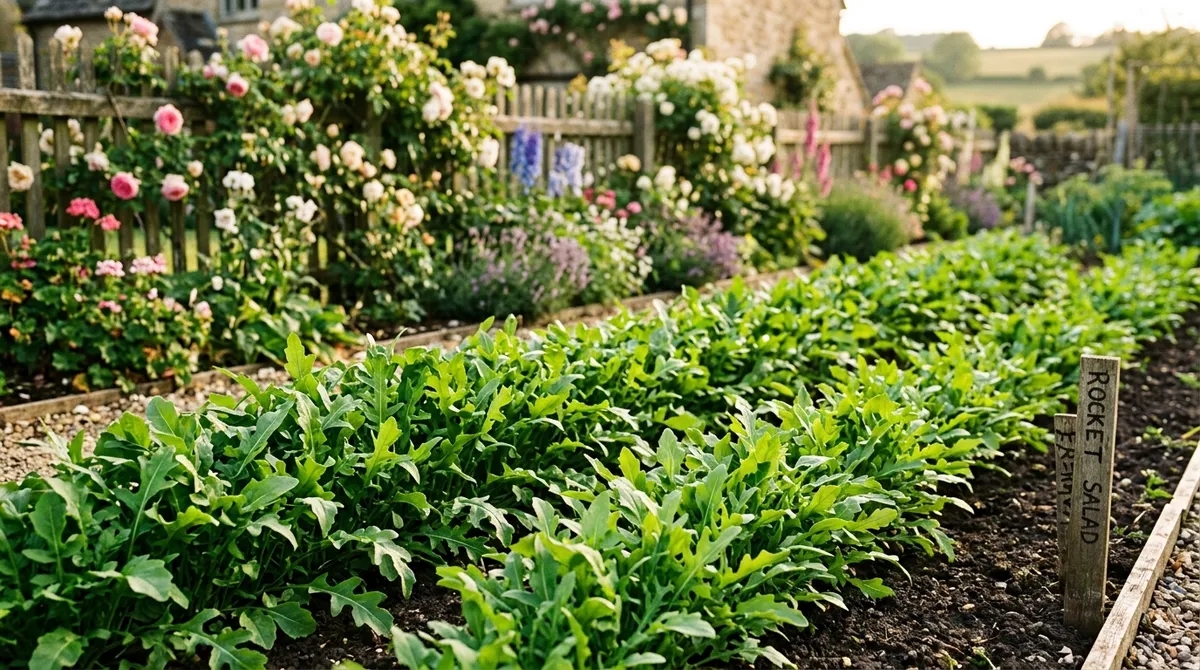
Rocket is the fastest salad leaf you can grow in a UK garden. From seed to plate in under four weeks, it outpaces every lettuce variety and rewards even the smallest growing space. Whether you have a full allotment, a few raised beds, or just a kitchen windowsill, rocket delivers peppery, fresh leaves with almost no effort.
This guide covers every stage of growing rocket in British conditions. You will learn which varieties to choose, when and how to sow, how to prevent bolting, how to deal with flea beetle, and how to harvest using the cut-and-come-again method for the longest possible season. If you already grow lettuce and salad leaves, rocket is the perfect companion crop.
Which rocket varieties grow best in the UK?
There are three main types of rocket suited to UK growing conditions. Each has different strengths, and growing at least two gives you the best spread of flavour and season.
Salad rocket (Eruca vesicaria)
Salad rocket is the fastest type, producing pickable leaves in 21-28 days from sowing. It has broad, rounded leaves with a mild peppery flavour that intensifies as the plant matures. Apollo, Runway, and Esmee are reliable named varieties, but any packet labelled “salad rocket” from a UK seed supplier will perform well. The main drawback is bolting. Salad rocket flowers quickly in hot weather, usually within 4-6 weeks of sowing. This makes succession sowing essential.
Wild rocket (Diplotaxis tenuifolia)
Wild rocket is a perennial with narrow, deeply lobed leaves and a much stronger, nuttier flavour than salad rocket. It takes 35-45 days to reach harvest size, so it is slower to get started. The trade-off is worth it. Wild rocket resists bolting far better than salad types and will crop from the same plant for 2-3 years. It survives mild UK winters and regrows each spring. Grazia and Voyager are good named varieties. The leaves are tougher and hold their shape better in salads, pasta, and pizzas.
Wasabi rocket (Diplotaxis erucoides)
Wasabi rocket has white flowers and a sharp, horseradish-like heat that goes beyond standard peppery rocket. It is sometimes sold as “white rocket” or “wall rocket.” The leaves are smaller and more deeply lobed than wild rocket. It grows fast, bolts readily, and is best treated as an annual cut-and-come-again crop. Use it sparingly as a garnish or mix it into milder salad leaves. It is worth growing a short row alongside standard varieties for flavour contrast.
Rocket variety comparison
Choosing the right variety depends on how quickly you want to harvest, how strong a flavour you prefer, and whether you want an annual or perennial crop.
| Feature | Salad rocket | Wild rocket | Wasabi rocket |
|---|---|---|---|
| Botanical name | Eruca vesicaria | Diplotaxis tenuifolia | Diplotaxis erucoides |
| Leaf shape | Broad, rounded | Narrow, deeply lobed | Small, deeply lobed |
| Flavour | Mild peppery | Strong, nutty, peppery | Hot, wasabi-like |
| Days to harvest | 21-28 | 35-45 | 25-35 |
| Bolt resistance | Poor | Good | Poor |
| Lifespan | Annual | Perennial (2-3 years) | Annual |
| Winter hardiness | Tender, dies at first frost | Hardy to minus 10C | Half-hardy |
| Best for | Quick salads, beginners | Long-season growing | Garnish, flavour punch |
| Cut-and-come-again cuts | 3-4 | 5-8 | 2-3 |
Lawrie’s growing tip: Grow salad rocket for speed and wild rocket for staying power. A 1-metre row of each gives a household of two enough rocket from April to October without buying a single bag from the supermarket.
When and how to sow rocket seeds
Rocket is one of the easiest crops to sow. The seeds are small but handle well, and germination is fast and reliable in almost any soil.
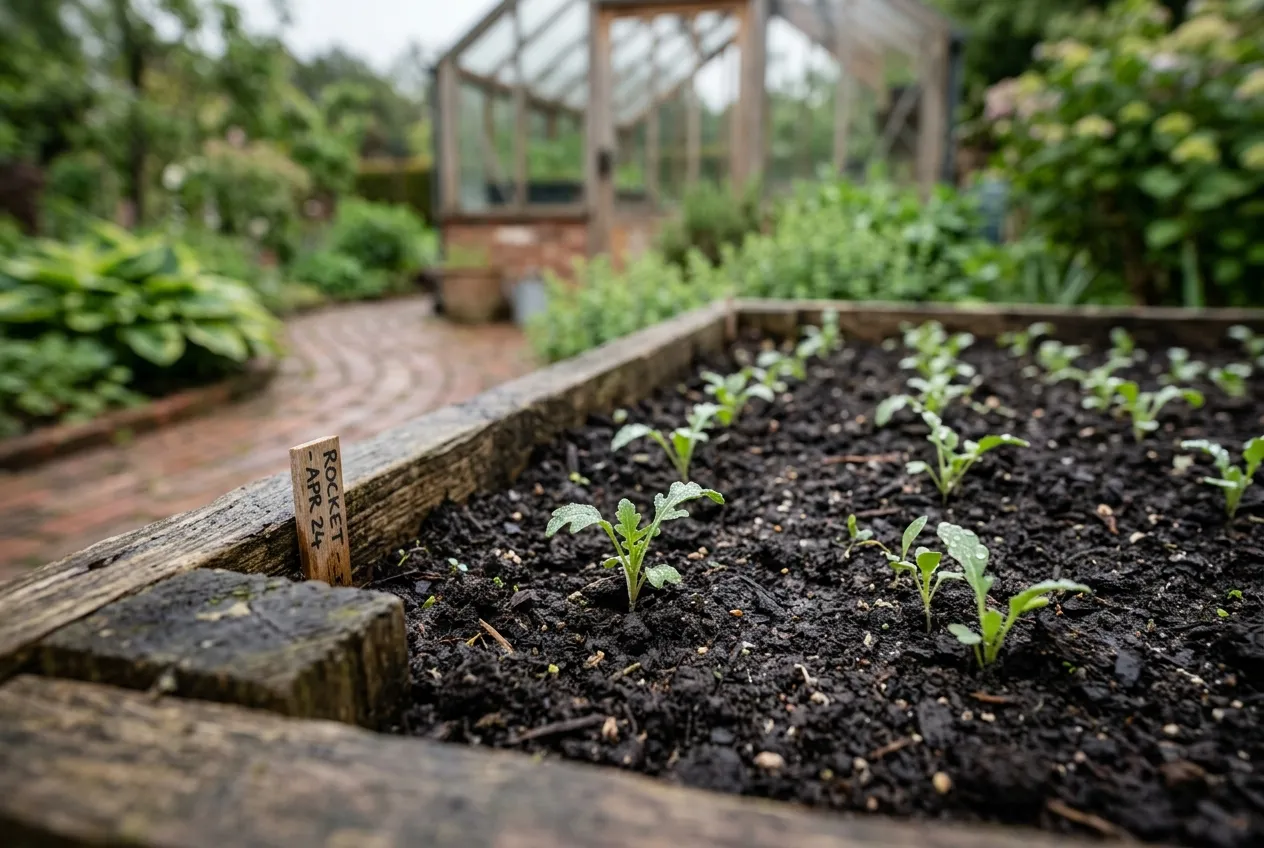 Young rocket seedlings emerging in a raised bed. Sow in rows 15cm apart for easy thinning and harvesting.
Sowing outdoors
Sow rocket seeds directly into prepared ground from March to September. Make a shallow drill 1cm deep. Water the drill before sowing, not after, to prevent washing the tiny seeds too deep. Sow thinly along the row and cover lightly with fine soil or compost. Seedlings emerge in 4-7 days. Thin to 10-15cm apart when they have two true leaves. Leave 15-20cm between rows.
Rocket is not fussy about soil. It grows in clay, loam, sand, and chalk. It prefers a pH between 6.0 and 7.0 but tolerates a wider range. The RHS lists rocket as one of the easiest salad crops for beginners. Dig in a bucket of garden compost per square metre before sowing if your soil is poor or compacted.
Sowing indoors
Start the earliest sowings on a bright windowsill or in a cold greenhouse from February. Sow in modules or small pots filled with peat-free seed compost. Rocket does not transplant brilliantly, so sow 3-4 seeds per module and thin to the strongest. Harden off for a week before planting outside from mid-March. Indoor sowings give you a 3-4 week head start on outdoor crops.
Succession sowing: the key to continuous rocket
Sow a short row every 2-3 weeks from March to September. This is the single most important technique for a constant rocket supply. A single sowing of salad rocket gives 3-5 weeks of picking before it bolts or becomes too peppery. Without succession sowing, you get one flush followed by nothing.
Each sowing only needs to be 30-60cm long for a household of two. That is a handful of seed and 5 minutes of work. Mark your calendar or set a phone reminder. Stagger sowings and you will always have young, tender leaves replacing older plants.
Month-by-month sowing and harvesting calendar
| Month | Sow | Harvest | Notes |
|---|---|---|---|
| February | Indoors on windowsill | - | Start early under cover |
| March | Outdoors under fleece | Indoor-sown seedlings | First outdoor sowings |
| April | Outdoors, open ground | Early outdoor sowings | Main season begins |
| May | Outdoors every 2-3 weeks | Salad and wild rocket | Peak growing conditions |
| June | Outdoors in partial shade | All types | Switch to shaded position |
| July | Outdoors in shade only | All types, frequent picking | Bolt risk highest |
| August | Outdoors, resume full sun | All types | Days shortening, bolt risk drops |
| September | Final outdoor sowing | Salad and wild rocket | Cover late sowings with fleece |
| October | - | Wild rocket, late sowings | Protect with cloches |
| November | - | Wild rocket under cover | Perennial wild rocket still cropping |
| December | Indoors on windowsill | Windowsill-grown leaves | Winter windowsill crop |
How to prevent rocket from bolting
Bolting is the biggest frustration when growing rocket. The plant sends up a flower stalk, the leaves turn bitter, and the crop is finished. Understanding why it happens gives you the tools to delay it.
Heat is the primary trigger. Rocket evolved as a cool-season crop in the Mediterranean. Temperatures above 25C cause salad rocket to bolt within days. Wild rocket tolerates heat much better because it has a deeper root system and slower growth rate.
Drought accelerates bolting. Dry soil stresses the plant and signals it to reproduce. Water every 2-3 days in dry weather. Mulch around plants with compost or straw to retain moisture.
Long days play a role. The longest days in June and July coincide with the highest temperatures, creating a double trigger. This is why midsummer rocket almost always bolts faster than spring or autumn sowings.
Five practical bolt prevention strategies
- Grow in partial shade from June to August. Position rocket where it gets morning sun but afternoon shade. The north side of a bean row, sweetcorn block, or garden fence works well.
- Pick leaves frequently. Regular harvesting removes the growing tips and delays flowering. Never let rocket grow beyond 15cm before cutting.
- Water consistently. Keep soil evenly moist. A 5cm mulch of compost reduces watering frequency by half.
- Choose wild rocket for summer. Swap to wild rocket from June onwards. It resists bolting 3-4 weeks longer than salad types.
- Succession sow. Even with the best care, salad rocket bolts eventually. Having fresh sowings ready means you always have young, tender plants to replace bolted ones.
Cut-and-come-again harvesting
Cut-and-come-again is the most productive way to harvest rocket. Instead of pulling the whole plant, you cut the outer leaves at 8-10cm tall and leave the central growing point intact. New leaves regrow within 10-14 days.
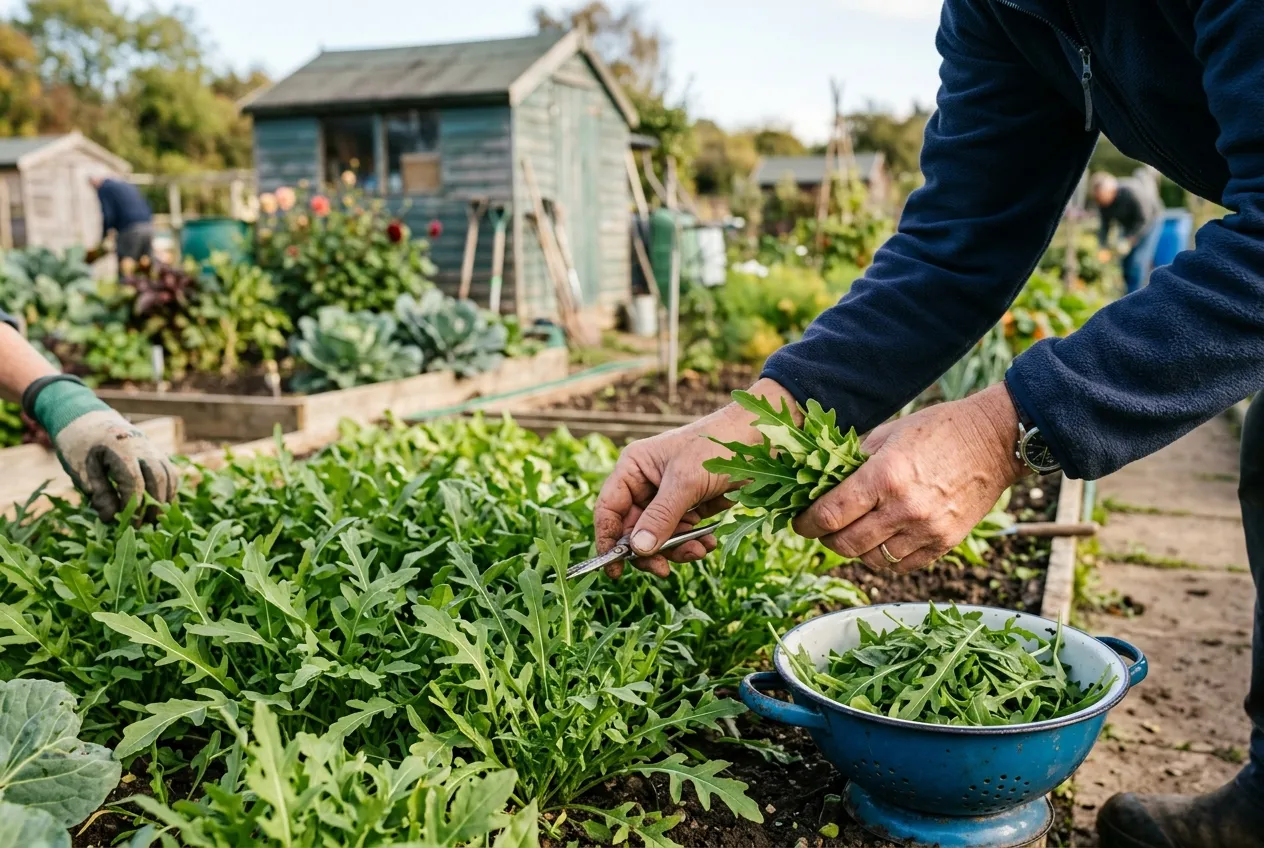 Cut leaves at 8-10cm tall with scissors or a sharp knife. Leave the central growing point intact for regrowth.
Salad rocket gives 3-4 cuts per sowing. Each successive cut produces slightly more peppery leaves as the plant matures. After the third or fourth cut, the plant usually begins to bolt. Pull it out and replace with the next succession sowing.
Wild rocket gives 5-8 cuts per sowing. Because it is perennial, wild rocket keeps producing through the season and returns the following spring. Cut back to 5cm in late autumn and mulch the crowns with compost. New growth appears in March.
How to cut correctly
Use sharp scissors or a clean knife. Cut across the row at 3-4cm above soil level, leaving enough stem for the plant to regrow. Avoid pulling leaves, as this damages the roots and slows recovery. Harvest in the morning when leaves are cool and turgid for the crispest texture.
If you enjoy growing spinach, you can use exactly the same cut-and-come-again technique for perpetual spinach and chard.
Growing rocket in containers and on windowsills
Rocket is one of the best salad crops for container growing. It has a shallow root system, grows fast, and does not need a large volume of compost. A window box, a standard pot, or even a recycled mushroom punnet will do.
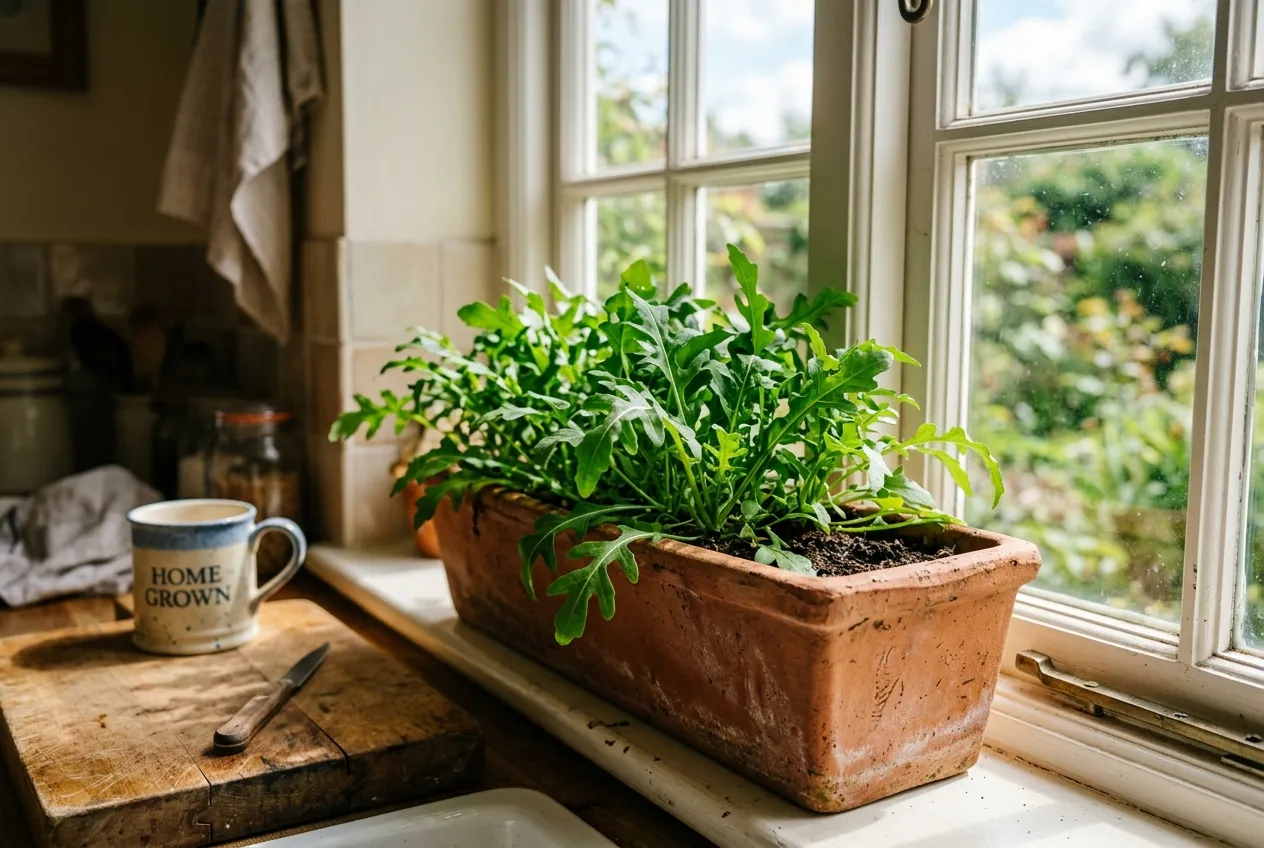 A window box of rocket on a kitchen windowsill provides fresh leaves year-round. Resow every 3 weeks.
Container growing
Use any container at least 10cm deep with drainage holes. Fill with peat-free multipurpose compost. Scatter seeds thinly across the surface, cover with 1cm of compost, and water gently. Thin seedlings to 5cm apart if they come up thick.
Place containers in full sun from March to May, then move to partial shade from June to August. Water daily in warm weather. Feed fortnightly with a half-strength liquid seaweed fertiliser after the first cut.
Windowsill growing
Rocket is one of the few crops that genuinely thrives on a kitchen windowsill. A south or west-facing window gives enough light from October to March. East-facing windows work in spring and summer.
Sow in a trough or long pot at least 10cm deep. Keep compost moist but not waterlogged. Turn the container 180 degrees every 2-3 days to prevent leggy growth. Harvest baby leaves at 8-10cm tall. Expect 2-3 cuts per sowing. Resow every 3 weeks for a continuous winter supply of fresh rocket without setting foot in the garden.
How to deal with flea beetle on rocket
Flea beetle is the single biggest pest problem when growing rocket. These tiny, shiny black beetles (1-3mm long) chew small round holes in the leaves, creating a shotgun-pellet pattern. Heavy infestations can destroy a sowing within days, especially in warm, dry weather from April to June.
Prevention is everything
Cover rocket with fine mesh netting from the day you sow. Use Enviromesh, Wondermesh, or any horticultural fleece with holes under 1mm. Drape it over hoops or lay it directly on the crop. Bury or weight the edges so beetles cannot crawl underneath. This simple barrier stops 95% of flea beetle damage.
Flea beetles are most active in hot, dry conditions. Watering the soil regularly makes the growing environment less attractive to them. Beetles jump when disturbed, so you can run a sticky yellow card just above the crop to catch them.
What not to do
Avoid growing rocket next to brassicas (cabbage, kale, broccoli). Flea beetles attack both families and a mixed planting creates a beetle buffet. Radishes are another brassica-family crop that attracts flea beetle, so keep them separate from your rocket rows.
Chemical sprays are unnecessary and counterproductive on a fast-growing salad crop that you eat raw. Physical barriers and cultural controls work better and leave no residue. Garden Organic recommends companion planting and physical barriers as the best organic flea beetle strategy.
Other pests and problems
Slugs and snails eat rocket seedlings, especially in damp weather. Evening patrols, beer traps, and nematode biological control (Nemaslug) all help. Aphids occasionally colonise the leaf undersides. Blast them off with a jet of water or squash by hand. Downy mildew can appear in wet autumns as yellow patches on the upper leaf surface with grey fuzz underneath. Improve airflow by thinning plants and avoid overhead watering.
Harvesting and storing rocket
Start picking rocket leaves at 8-10cm tall for baby leaf salads. These young leaves have the mildest, sweetest flavour. Leaving them to grow larger produces a hotter, more peppery taste. Both are useful in the kitchen.
Harvest in the morning when the leaves are cool. Use scissors and cut what you need for the next day or two. Rocket wilts quickly after picking. Store unwashed leaves in a sealed container or plastic bag in the fridge, where they keep for 3-4 days. Do not wash until you are ready to eat.
Using rocket flowers
When rocket does bolt, the flowers are edible. They have a concentrated peppery flavour and make an attractive garnish for salads, pasta, and pizza. Deadheading the flowers also extends leaf production by a week or two. If you let the flowers set seed, salad rocket will self-sow and give you volunteer seedlings the following spring.
Kitchen uses for home-grown rocket
Home-grown rocket has a deeper, more complex flavour than the washed bags in supermarkets. Those bags contain commercially grown salad rocket that has been bred for mild flavour and long shelf life. Your garden-grown leaves will be far more peppery and aromatic.
Classic uses: mixed green salads, pizza topping (add after baking), pasta tossed with olive oil and parmesan, sandwiches with mozzarella and tomato, pesto (blend with pine nuts, parmesan, olive oil, and garlic for a rocket pesto that beats basil in winter).
Matching varieties to dishes: Use mild salad rocket in mixed salads where you want pepper without heat. Use wild rocket on pizza and pasta where its stronger flavour can stand up to other bold ingredients. Use wasabi rocket sparingly as a garnish on fish, steak, or Asian-inspired dishes.
If you enjoy growing your own salad crops, combining rocket with winter salad leaves extends your harvesting season to almost year-round.
Month-by-month rocket growing guide
March-April: spring sowing
Sow the first outdoor rows under fleece from mid-March. Direct sow without protection from early April. Both salad and wild rocket can go in now. The cool, damp conditions are perfect for germination and early growth. Flea beetle pressure is low.
May-June: peak growing
The main succession sowing season. Sow every 2-3 weeks. Start moving sowings into partial shade from early June as temperatures rise. This is the highest-risk period for flea beetle, so keep mesh covers on from sowing day.
July-August: managing heat
The hardest months for rocket. Only sow in shaded positions. Water frequently. Pick leaves while small to delay bolting. Wild rocket is the better choice now. Consider pausing salad rocket sowings if temperatures stay above 25C and resuming in late August.
September-October: autumn flush
One of the best times to grow rocket. Cooling temperatures, shorter days, and autumn rain create ideal conditions. Sow the final outdoor row in early September. Protect with fleece from October for cropping into November.
November-February: winter windowsill
Move indoors. Sow on a bright windowsill for fresh leaves through the darkest months. Wild rocket in the garden may still produce a few leaves through mild winter spells, especially in southern England.
Further reading
- How to Grow Lettuce and Salad Leaves in the UK — companion salad crops and succession sowing schedules
- Succession Planting Guide for the UK — plan your sowings for continuous harvests all season
- Container Vegetable Gardening in the UK — growing food in pots, window boxes, and grow bags
- How to Grow Radishes in the UK — another fast brassica-family crop that pairs well with rocket
- Growing Vegetables on a Windowsill — year-round indoor salad growing
Lawrie has been gardening in the West Midlands for over 30 years. He grows his own veg using no-dig methods, keeps a wildlife-friendly garden, and writes practical advice based on real UK growing conditions.