How to Grow Silver Birch in the UK
Grow silver birch in UK gardens: pendula reaches 15-20m, jacquemontii 10-12m. Cultivar guide, multi-stem planting, underplanting, and care from UK trials.
Key takeaways
- Betula pendula reaches 15–20m; B. utilis 'Jacquemontii' stays smaller at 10–12m with brilliant white bark
- Plant bare-root birch between November and February for best establishment — autumn planting achieves 90%+ take rate
- Multi-stem birches suit gardens as small as 6m across; single-stem specimens need at least 10–12m clear space
- Birch roots are shallow and fibrous — do not plant within 5m of drains or 8m of building foundations on clay soil
- Underplant with bluebells, wood anemones, and ferns for a naturalistic effect that self-seeds over 3–5 years
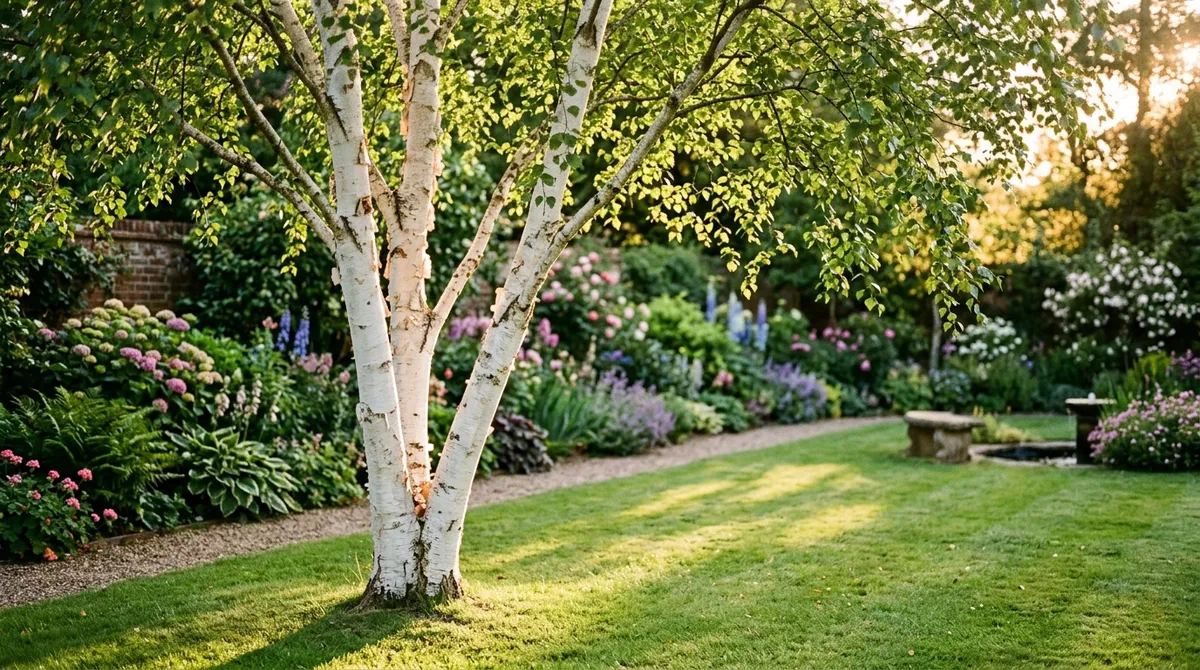
Silver birch is one of Britain’s most distinctive native trees, instantly recognised by its peeling white bark, delicate catkins, and golden autumn canopy. Growing silver birch in a UK garden gives you year-round structural interest, exceptional wildlife value, and an ornamental tree suited to a wider range of soils than most people realise.
This guide covers both Betula pendula (the fully native silver birch) and Betula utilis var. jacquemontii (the Himalayan white birch with the most brilliant winter bark), including how to plant bare root trees, how to manage multi-stem specimens in smaller gardens, which cultivars to choose, what to plant beneath them, and how to avoid the most common mistakes.
Which silver birch is right for your garden?
Two species dominate the UK garden scene: the native Betula pendula and the cultivated Betula utilis var. jacquemontii. They share the trademark white bark but differ in size, bark intensity, and ecological value.
Species and cultivar comparison
| Species / Cultivar | Height | Bark colour | Growth rate | Garden suitability | Notable quality |
|---|---|---|---|---|---|
| Betula pendula (silver birch) | 15–20m | White with black fissures | 40–60cm/year | Large gardens, countryside | Native; supports 334 insect species |
| Betula pendula ‘Youngii’ | 4–6m | White, develops with age | 20–30cm/year | Small gardens, weeping | Weeping habit; grafted onto standard stem |
| Betula pendula ‘Laciniata’ | 12–15m | White | 40–55cm/year | Medium-large gardens | Deeply cut leaves; elegant canopy |
| Betula utilis var. jacquemontii | 10–12m | Brilliant chalk white | 30–45cm/year | Small-medium gardens, urban | Whitest bark of any birch |
| Betula utilis ‘Silver Shadow’ | 8–10m | Pure white | 25–35cm/year | Small gardens | Most compact upright jacquemontii |
| Betula utilis ‘Grayswood Ghost’ | 10–12m | Brilliant white | 30–40cm/year | Medium gardens | Especially vivid bark in early years |
| Betula utilis ‘Doorenbos’ | 10–12m | Brilliant white | 30–40cm/year | Medium gardens | Strong bark colour from year 3 |
| Betula albosinensis ‘Fascination’ | 10–15m | Orange-pink to copper | 35–50cm/year | Medium-large gardens | Coppery bark; different ornamental angle |
RHS recommendation: Betula utilis var. jacquemontii holds the RHS Award of Garden Merit (AGM) for outstanding garden performance. The RHS Betula page lists over 40 birch cultivars with full hardiness and soil ratings. For ecological gardens, the Woodland Trust silver birch profile notes that Betula pendula supports more wildlife than any other British broadleaf tree after oak.
Native birch vs. ornamental birch: which to choose?
Choose Betula pendula if you want maximum wildlife value, have space for a larger tree, or are creating a naturalistic planting. Native silver birch supports 334 insect species — more than any UK tree except oak and willow. Its catkins feed blue tits and siskins in spring, its seeds feed finches through winter, and decaying birch logs are among the most valuable deadwood habitats in Britain.
Choose Betula utilis var. jacquemontii if you want the most dramatic white bark in the smallest space, or if you are planting in an urban garden where visual impact per square metre matters. The chalky white bark — far whiter than B. pendula’s grey-white — stands out in winter gardens and against dark backgrounds. It is slightly less vigorous, which helps with space management.
For gardens with room for both, planting a native B. pendula in the wilder, more open part of the plot alongside a multi-stem jacquemontii as a specimen near a path or patio gives you both ecological and ornamental value.
How to plant silver birch
Planting method determines long-term success more than any other factor. Birch is a pioneer species that grows fast but establishes shallow roots — meaning planting preparation and early aftercare matter greatly.
Bare-root planting (November to February)
Bare-root birch is the most cost-effective way to plant, and it establishes better than container-grown trees when planted correctly. A bare-root whip (60–90cm) costs £3–8 from specialist nurseries, versus £25–60 for a container tree of similar height.
Step 1: Dig the planting hole twice the width of the root system and no deeper than the root collar (where roots meet stem). The root collar must sit at ground level. Use a cane across the hole to check.
Step 2: On clay or compacted soils, add a 15cm layer of coarse horticultural grit to the base of the hole. This prevents waterlogging at the root zone in the first two winters. On free-draining sandy soil, grit is unnecessary.
Step 3: Check the roots. Any that are circling, kinked, or damaged should be pruned cleanly with secateurs before planting. Circling roots that are left in place restrict trunk development and can girdle the tree over 10–15 years.
Step 4: Place the tree, backfill with the excavated soil, and firm in layers using your foot. Do not add compost or fertiliser to the backfill — pioneer species like birch perform better in lean conditions and excess nitrogen promotes lush, pest-susceptible growth.
Step 5: Water in with 15–20 litres. Apply a 5cm mulch ring of composted bark or wood chip in a 60cm radius, kept 10cm from the stem. Mulch suppresses competing grass roots that would otherwise steal water and nutrients from the establishing tree.
Step 6: Stake only if on an exposed site. Use a low stake (30–40cm above ground) angled at 45° into the prevailing wind with a rubber tree tie. Remove after 12–18 months. Do not use a tall stake that immobilises the stem — stem flex builds root strength.
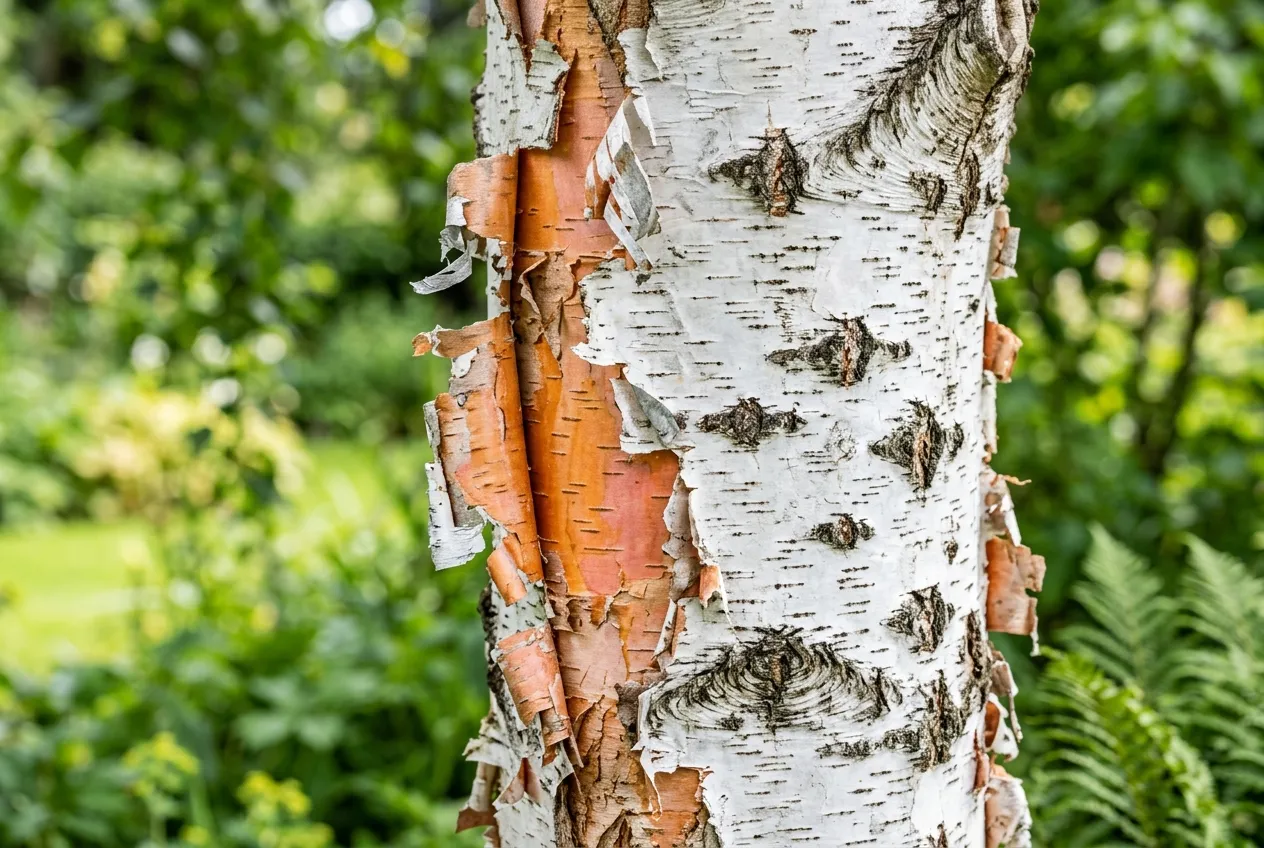 Betula utilis var. jacquemontii ‘Silver Shadow’ in a Staffordshire garden in January — the chalk-white bark is at its most vivid when the leaves have fallen.
Planting a multi-stem silver birch
Multi-stem birch specimens consist of three to five individual stems planted together, creating a natural clump effect that mimics how birch regenerates after coppicing in woodland. They are the most popular choice for modern gardens because the multiple trunks maximise white bark display per unit of ground space.
Multi-stem specimens at 1.5–2m height cost £80–180; at 2–2.5m they cost £150–400 depending on the number of stems and cultivar.
Key spacing rules for multi-stem birch:
- Allow 3–4m clearance around a three-stem specimen at maturity (canopy spread approximately 4–5m)
- Allow 1.5m from paths and hard surfaces to prevent surface root lifting
- Keep 8m from building foundations on clay soil; 5–6m on sandy or gravelly soil
- Plant in groups of three or five for a woodland grove effect in larger gardens
For guidance on planting bare-root trees generally, see our article on how to plant a bare-root tree in the UK.
Soil preparation and pH
Silver birch prefers free-draining, acidic to neutral soil (pH 4.5–6.5). It is one of the few ornamental trees classified as a calcifuge (lime-hater), meaning it performs poorly on chalk or alkaline soils above pH 7.0 — leaves become chlorotic and growth rate drops by 30–40%.
Test your soil pH with a basic kit before planting. If pH is above 7.0, birch is not the right choice. Consider our native trees guide for alternative native species that suit alkaline conditions, or see best plants for acid soil for companion planting ideas around your birch.
If pH is 6.5–7.0, lower it by digging in acidifying organic matter (pine bark, composted bracken, or ericaceous compost) in the planting area. A 10cm layer incorporated to 30cm depth reduces pH by approximately 0.3–0.5 units over the following 18 months.
Single-stem vs. multi-stem silver birch
The choice between single-stem and multi-stem birch is primarily about garden scale and visual intent.
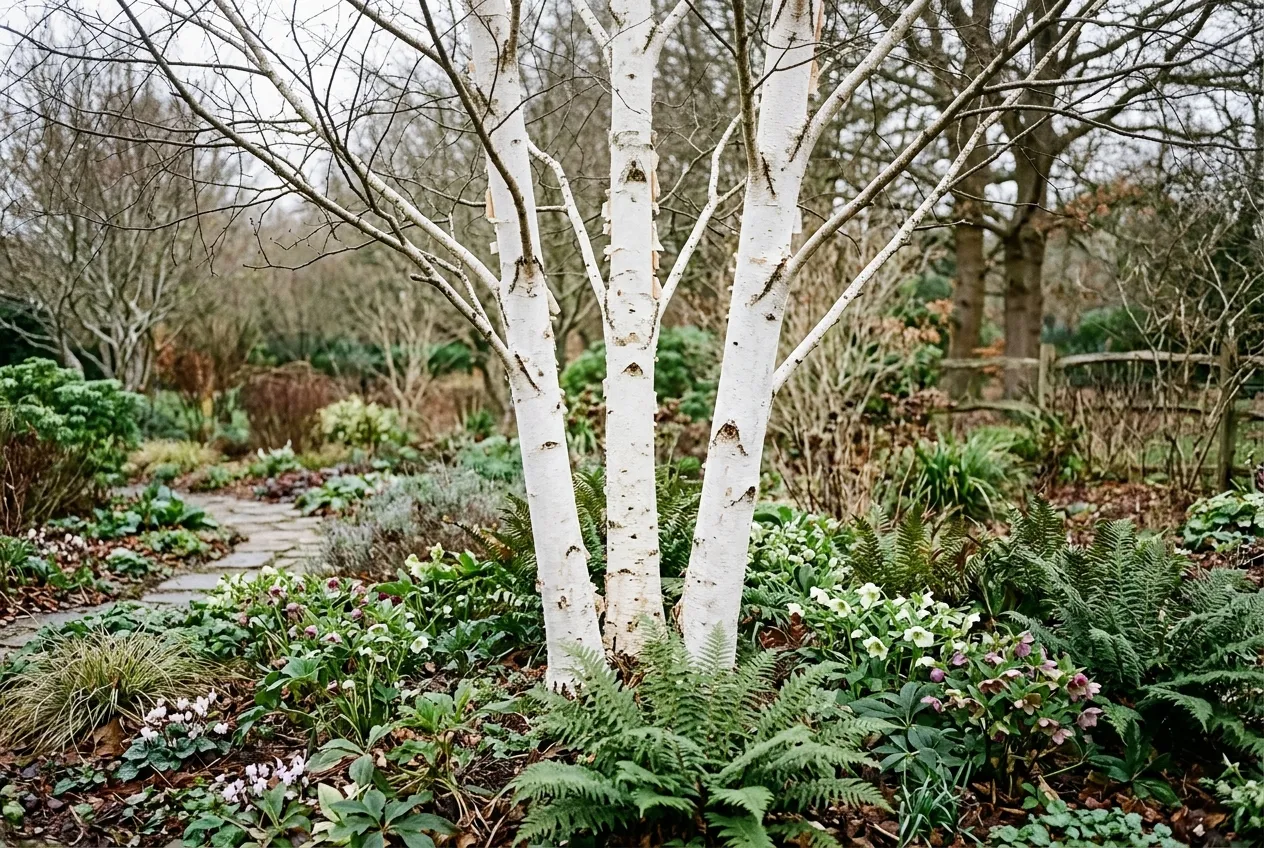 A three-stem Betula utilis var. jacquemontii planted as a specimen in a contemporary garden in Derbyshire, showing the dramatic white-bark winter display possible in a 3.5m canopy spread.
Single-stem birch
A single-stem birch develops into the classic woodland tree shape: one clean trunk rising to a light, airy canopy. It is the natural form of both B. pendula and B. utilis. Single-stem specimens suit:
- Large gardens (200sqm+) or rural settings where a full-sized tree is appropriate
- Planting in a lawn as a specimen tree with clear sightlines to the bark
- Wildlife planting, where maximum canopy cover supports more insect life
- Naturalistic woodland-edge planting alongside other native trees
At maturity, a single-stem B. pendula occupies approximately 5–7m canopy spread and 15–20m height. For gardens under 150sqm, this is too large.
Multi-stem birch
Multi-stem specimens are created by planting three to five individual whips close together (15–20cm apart), or by selecting nursery specimens that have been grown as multi-stem from the outset. The result is a sculptural clump of white trunks that reads as a single focal-point tree but stays significantly narrower at the base.
Multi-stem advantages:
- Canopy height of 8–12m versus 15–20m for a single stem
- Multiple white trunks visible from autumn through spring — double or triple the ornamental bark display
- More resistant to wind throw (multiple stems distribute load)
- Lower overall canopy means better views beneath and less root extension
Multi-stem disadvantages:
- More expensive to buy at a given height (£150–400 versus £40–120 for single stem)
- Slightly more complex to underplant around multiple stem bases
- Requires more clearance at ground level (3–5m versus 2–3m for single stem)
For small garden planting options more broadly, see best trees for small gardens in the UK.
Silver birch underplanting: what grows beneath birch trees
Birch creates dappled shade rather than dense shade. Its fine canopy filters light rather than blocking it, making it one of the best trees for underplanting in UK gardens. The dappled light at ground level beneath a mature birch in summer is typically 30–50% of full sun — enough for a wide range of shade-tolerant plants.
Birch also has shallow, fibrous roots that compete for surface moisture, which rules out deep-rooted, drought-sensitive plants within 2m of the trunk. The best underplanting choices tolerate both light shade and moderate summer moisture stress.
Underplanting combinations for silver birch
| Effect | Plants | Notes |
|---|---|---|
| British native woodland floor | Hyacinthoides non-scripta (bluebell), Anemone nemorosa (wood anemone), Primula vulgaris (primrose) | Self-seeds within 3–5 years; highest wildlife value |
| Fern and shade border | Dryopteris filix-mas (male fern), Polystichum setiferum (soft shield fern), Athyrium filix-femina (lady fern) | Semi-evergreen; tolerates dry shade once established |
| Ground cover with seasonal interest | Geranium macrorrhizum, Epimedium x perralchicum, Vinca minor | Suppresses weeds; low maintenance after year 2 |
| Bulbs for spring colour | Narcissus pseudonarcissus (wild daffodil), Galanthus nivalis (snowdrop), Erythronium dens-canis | Dormant in summer; no water competition |
| Acid-loving shrubs | Rhododendron ‘Praecox’, Gaultheria procumbens, Vaccinium corymbosum (blueberry) | Only if soil pH is 4.5–5.5; do not add lime |
| Wildlife-priority planting | Foxglove (Digitalis purpurea), wood dock (Rumex sanguineus), bramble (contained) | Bees, butterflies, and nesting birds; wilder aesthetic |
For ground cover options more broadly, see our guide to lawn alternatives and ground cover plants. For woodland-edge wildlife planting, see our wildlife garden creation guide.
Mulching the entire planting area beneath the canopy with a 5cm layer of composted bark or leaf mould each autumn achieves two things: it retains moisture for the underplanting during summer drought periods, and it gradually acidifies the soil to suit the ferns and shade plants.
Silver birch autumn colour
Silver birch is one of the earliest UK trees to turn in autumn. The leaves begin yellowing from mid-September in northern England and Scotland, reaching peak colour through October. The display lasts 3–4 weeks before leaves fall, typically finishing by early November.
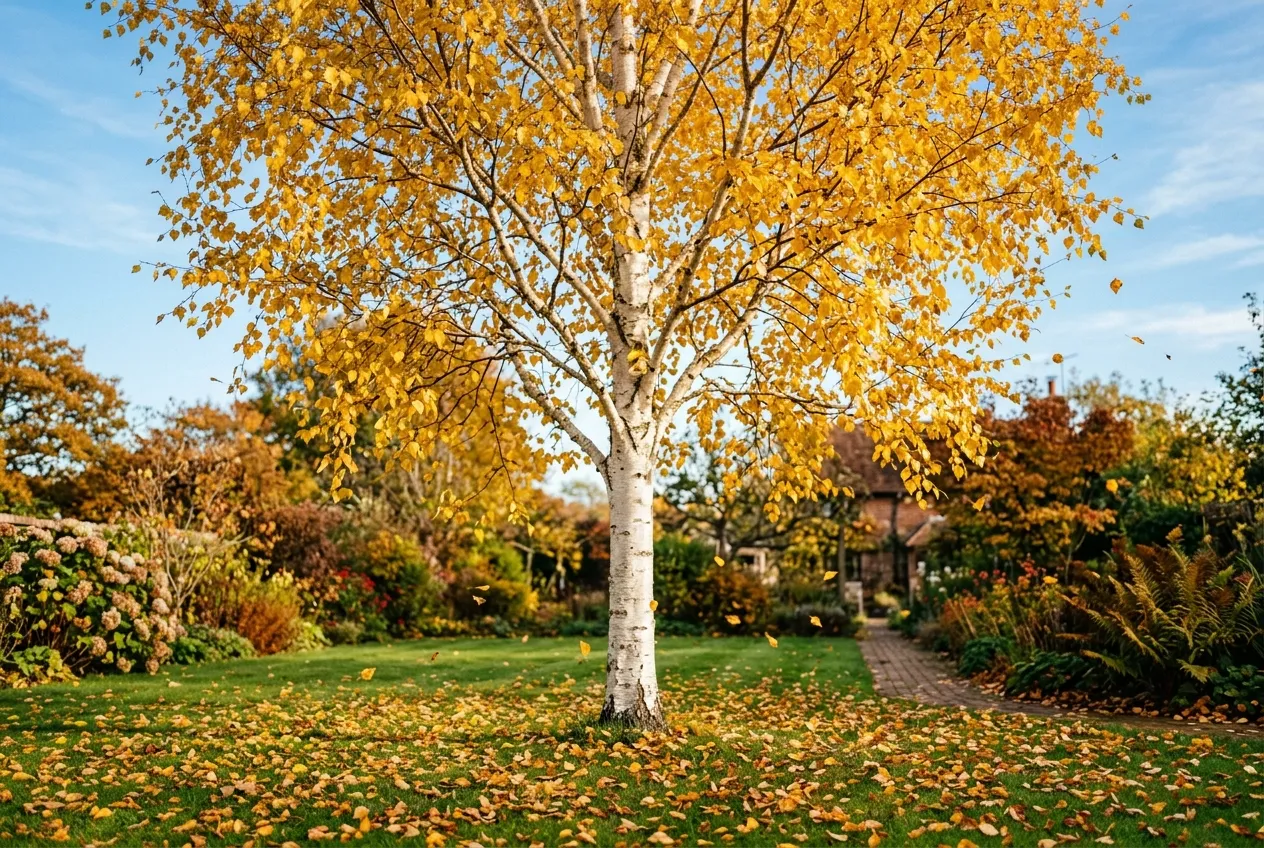 Betula pendula in full autumn colour in October in a Staffordshire garden. The yellow turns vivid gold before leaf fall.
The autumn colour on B. pendula is golden yellow to bright gold — among the cleanest yellow tones of any UK deciduous tree. B. utilis var. jacquemontii produces similar yellow tones but the display is slightly shorter-lived.
For maximum autumn colour impact, plant birch where the low October sun backlights the canopy — the translucent yellow leaves glow against a dark sky or evergreen background. A planting backed by a dark yew or holly hedge maximises the visual effect.
Birch autumn colour is also among the most consistent of UK trees. Unlike many ornamentals that only colour well in warm, dry autumns, birch colours reliably every year regardless of summer weather. This reliability makes it one of the best native trees for autumn interest — see our guide to best trees for autumn colour in the UK for further options.
Wildlife value of silver birch
Betula pendula is one of the most ecologically important trees you can plant in a UK garden. It supports approximately 334 species of insects — third only to oak (423 species) and willow (346 species) among British broadleaf trees. No other ornamental tree comes close to this figure.
The ecological value works across multiple layers:
Insects: The catkins that appear in March–April are among the earliest pollen sources of the year, critical for queen bumblebees emerging from hibernation and for early-flying butterflies including the comma and small tortoiseshell. Over 100 moth species use birch as a larval foodplant, including the buff-tip, pale prominent, and birch mocha.
Birds: Birch seeds — tiny winged nutlets released in August–September — are a primary food source for siskins, redpolls, and lesser redpolls. Blue tits hunt the canopy for aphids and caterpillars throughout the breeding season.
Deadwood habitats: Dying and dead birch wood supports specialist fungi including birch bracket fungus (Piptoporus betulinus) and fly agaric (Amanita muscaria). These fungi in turn support specialist beetles and invertebrates. Do not remove standing dead birch unless it is a safety hazard.
Autumn leaf fall: Birch leaves decompose rapidly (approximately 12 months versus 3–5 years for oak), creating a thin but mineral-rich leaf mould that benefits earthworms and the plants growing beneath. Annual leaf raking is rarely necessary — leave them to break down in place unless they are smothering evergreen underplanting.
For further reading on habitat gardening, see how to create a wildlife garden in the UK.
Birch tree problems and how to solve them
Silver birch is generally healthy and low-maintenance, but three issues are worth knowing about.
Birch leaf-mining moths and aphids
Two leaf-mining moth species — the birch leaf miner (Profenusa thomsoni) and the birch leaf-blotch miner (Eriocrania subpurpurella) — leave pale brown blotches in birch leaves from May onwards. The mines are visible as discoloured patches between the leaf veins. This is cosmetic damage only. Affected trees suffer no long-term harm, and the larvae are an important food source for blue tits and other small birds. No treatment is needed or recommended.
The birch aphid (Symydobius oblongus) colonises branches in summer, producing honeydew that causes sooty mould on leaves beneath. Heavy infestations can cause premature leaf yellowing. Natural predators — ladybirds, lacewings, and hoverfly larvae — control aphid numbers without intervention in most gardens. If severe, a forceful jet of water dislodges colonies from small trees without harming predators.
Birch bracket fungus (Piptoporus betulinus)
Bracket fungus appears on living or recently dead birch trunks as a pale, kidney-shaped shelf fungus. Its presence indicates the heartwood is decaying. The tree can continue growing for years once brackets appear, but structural stability declines. Monitor annually. A certified arborist can advise on whether removal is needed — in most cases, a tree with bracket fungus is safe for many years.
Chlorosis on alkaline soils
Yellowing between leaf veins (interveinal chlorosis) on birch indicates iron or manganese deficiency caused by alkaline soil above pH 6.5. This is the most common birch health problem in gardens on limestone or chalk. Treat in the short term with chelated iron sequestered feed applied in spring. Long-term: improve soil acidity with pine bark mulch and acidifying fertiliser (sulphate of ammonia at 15–20g per sqm). If the soil is above pH 7.0, consider replacing the tree with a species better suited to alkaline conditions.
For information on how to manage related structural issues, see our guide to how to prune shrubs in the UK which covers adjacent woody plants that often grow alongside birch.
Costs and where to buy silver birch
| Type | Size | Approx. cost | Best for |
|---|---|---|---|
| Bare-root whip (B. pendula) | 60–90cm | £3–8 each | Woodland planting, hedgerow, bulk orders |
| Container grown (B. pendula) | 1–1.5m | £15–35 | Garden specimen, flexible planting timing |
| Container grown (B. u. jacquemontii) | 1–1.5m | £30–60 | Ornamental garden specimen |
| Multi-stem (jacquemontii) | 1.5–2m | £80–180 | Contemporary garden focal point |
| Multi-stem (jacquemontii) | 2–2.5m | £150–400 | Instant impact, established specimen |
| Semi-mature single stem | 3–4m | £300–600 | Immediate screening or landmark planting |
The Woodland Trust’s Trees for Schools and MOREwoods schemes supply bare-root Betula pendula at subsidised prices for qualifying landowners and community groups (from £1.50 per tree for orders over 30). For ornamental jacquemontii specimens, specialist nurseries Hillier, Barcham Trees, and Majestic Trees stock the widest cultivar range.
Buy bare-root trees in September for October delivery, or between October and February direct from nurseries. Container-grown trees are available year-round but July–August is the least favourable planting time.
Silver birch in a privacy planting scheme
While not a privacy tree in the traditional sense — its open, dappled canopy offers no year-round screening — birch works well as part of a mixed planting scheme for screening. Three or five multi-stem specimens planted 2.5–3m apart create a woodland-edge screen that filters views without the hard, formal feel of a clipped hedge.
For effective visual screening, combine birch with evergreens: a back row of Prunus lusitanica or Osmanthus x burkwoodii, with multi-stem birch in front, delivers year-round privacy plus seasonal ornamental interest. For more on screening approaches, see best trees for privacy in UK gardens.
Care calendar for silver birch
| Month | Task |
|---|---|
| January–February | Final window for bare-root planting. Check stakes and ties on newly planted trees. |
| March | Apply or refresh mulch ring (5cm composted bark, 60cm radius, not touching stem). |
| April | Begin watering newly planted trees: 15–20 litres per week in dry spells. Apply chelated iron if chlorosis evident. |
| May | Birch catkins developing and releasing pollen. Note any leaf-mining damage — no action needed. |
| June | Continue watering. Monitor for aphid colonies. Avoid pruning until July. |
| July–August | Pruning window opens. Remove dead, damaged, or crossing branches. Avoid the bleeding season (February–June). |
| September | Birch seed release. Leave fallen seeds for finches. Check for bracket fungus on trunk. |
| October | Prime planting month for container trees. Peak autumn colour. Apply leaf mould beneath canopy. |
| November | Bare-root planting season begins. Clear structural leaves from beneath evergreen underplanting. |
| December | Check stakes. Avoid any pruning. Plan next season’s planting. |
Frequently asked questions
How fast does silver birch grow in the UK?
Silver birch grows 40–60cm per year under good conditions. On free-draining, acidic soil in full sun, Betula pendula reaches 5m within 8–10 years and 10m within 18 years. Growth slows after about 30 years as the tree approaches its mature height of 15–20m. Betula utilis var. jacquemontii grows slightly more slowly at 30–45cm per year, reaching a mature height of 10–12m.
What is the best silver birch for a small garden?
Betula utilis ‘Jacquemontii’ is the best silver birch for small gardens. It reaches 10–12m — roughly 3m less than Betula pendula — and is available as multi-stem specimens that suit plots as small as 6m across. The cultivar ‘Silver Shadow’ stays even more compact at 8–10m. All carry the same stunning white bark as the species.
Can silver birch grow in clay soil?
Yes, silver birch tolerates clay if drainage is improved at planting. Add a 15cm layer of coarse grit to the base of the planting hole and backfill with a 70:30 mix of excavated clay and horticultural grit. Avoid planting in waterlogged ground — birch roots need oxygen and will rot in permanently saturated soil. On well-prepared clay, birch establishes successfully in 80–85% of plantings.
How far from a house should I plant silver birch?
Plant silver birch at least 8m from building foundations on clay or loam soil. Birch roots are shallow and fibrous, extending 1–1.5x the canopy spread, but on shrinkable clay they can affect drainage patterns. Keep at least 5m from any drains or services. On sandy or gravelly soils, 5–6m is acceptable for smaller cultivars.
What can I plant under a silver birch tree?
The best plants under silver birch are shade-tolerant British natives: bluebells (Hyacinthoides non-scripta), wood anemones, foxgloves, and male fern (Dryopteris filix-mas). The dappled shade birch creates is lighter than that of oak or beech, allowing hostas, hardy geraniums, and epimediums to thrive within 2m of the trunk. Avoid planting acid-haters like lavender beneath birch, as leaf fall gradually acidifies the soil.
When should I plant silver birch?
Plant bare-root silver birch between November and February. This is the dormant season when root establishment is fastest and water stress is lowest. Container-grown birch can be planted year-round but achieves best results between October and March. Autumn planting achieves 90%+ establishment compared with 70% for late spring planting of the same size trees.
Does silver birch need pruning?
Silver birch requires minimal pruning. Remove any crossing, damaged, or dead branches in late summer (July–August) to avoid the birch bleeding season (February–June) when pruning cuts weep sap extensively. Never prune between February and June. For multi-stem specimens, remove any basal suckers that emerge in spring unless you want to add extra stems. Do not reduce the crown — birch responds poorly to heading back.
Related reading
- Native trees for UK gardens — a full guide to British native species for ecological planting
- Best trees for small gardens in the UK — compact trees for gardens under 100sqm
- Best trees for autumn colour in the UK — the top species for seasonal leaf colour
- How to plant a bare-root tree in the UK — step-by-step bare-root planting guide
- Best plants for acid soil in the UK — companion plants that thrive in the conditions birch creates
Lawrie has been gardening in the West Midlands for over 30 years. He grows his own veg using no-dig methods, keeps a wildlife-friendly garden, and writes practical advice based on real UK growing conditions.