How to Grow Spring Onions in the UK
Complete guide to growing spring onions in UK gardens. Covers varieties, succession sowing, overwintering, containers, intercropping, and harvesting.
Key takeaways
- Succession sow every 3-4 weeks from March to August for a continuous supply
- Most varieties are ready to harvest in 8-12 weeks, when stems reach pencil thickness
- White Lisbon is the fastest and most reliable UK variety, ready in 8 weeks
- Sow overwintering varieties in August or September for spring harvests
- No thinning needed when sown in clusters 10cm apart
- Spring onions grow well in containers, window boxes, and between rows of slower crops
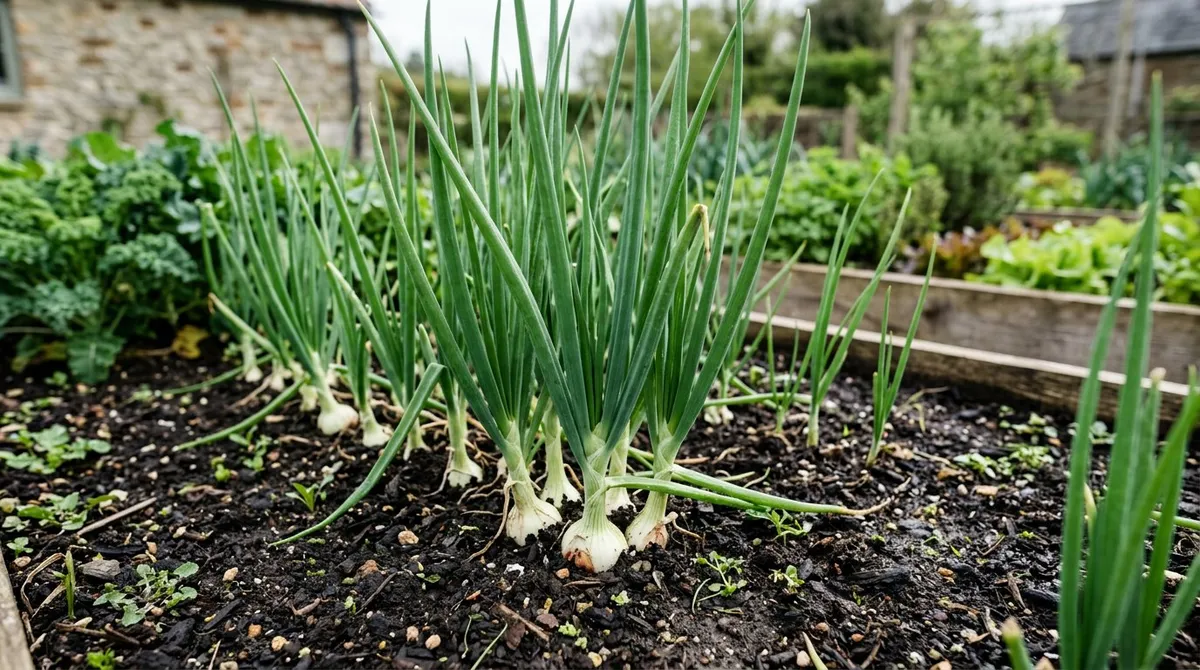
Spring onions are one of the quickest and easiest crops you can grow in a UK garden. From sowing to harvest takes just 8-12 weeks. They need almost no space, demand very little attention, and suffer fewer pest problems than their larger relatives. A single row 1 metre long, sown in March, produces roughly 40-50 spring onions by late May.
Unlike bulb onions, spring onions are harvested young before a proper bulb forms. They are eaten whole, green tops and all. This means no curing, no storage, and no waiting until autumn. If you are looking for your first crop as a new vegetable grower, spring onions are a strong choice. They fit into any garden, allotment, raised bed, or container. This guide covers every step from choosing varieties to pulling your harvest, written specifically for UK growing conditions.
What are spring onions and how do they differ from bulb onions?
Spring onions (also called salad onions or scallions) are immature onions harvested before they form a large bulb. They produce a small white base no wider than a pencil and long, hollow green leaves. Both parts are edible. The white section has a mild onion flavour, while the green tops taste fresher and more delicate.
The key difference from bulb onions is timing. Bulb onions need 14-20 weeks to mature and form a large, storable bulb. Spring onions are pulled at 8-12 weeks while still young and slender. Some varieties, particularly Japanese bunching onions, never form a bulb at all. They just produce thicker, taller stems.
Spring onions belong to the same species as regular onions (Allium cepa) and share similar growing requirements. They prefer the same soil, the same position, and the same watering routine. The difference is that you eat them quickly rather than storing them for months. This speed is what makes them so useful for succession sowing. You sow a short row, harvest it 8 weeks later, and sow the next batch in the gap left behind.
Best spring onion varieties for UK gardens
Choosing the right variety affects your harvest window, flavour, and winter hardiness. These five varieties cover every situation a UK gardener faces.
White Lisbon
White Lisbon is the standard spring onion variety in the UK and the one most gardeners start with. It matures in just 8 weeks, produces a mild, clean flavour, and germinates reliably in cool spring soil. Sow from March to August for harvests from May to October. It is widely available from every seed supplier and garden centre. If you only grow one variety, make it White Lisbon.
White Lisbon Winter Hardy
White Lisbon Winter Hardy is a cold-tolerant selection bred for autumn sowing and spring harvesting. Sow in August or September and harvest from March to May the following year. It tolerates frost down to minus 10C and overwinters in the ground without protection in most of England and Wales. In Scotland and exposed sites, a layer of fleece through the coldest months gives extra insurance.
Ishikura
Ishikura is a Japanese bunching onion that produces long, straight, white stems up to 30cm tall. It does not form a bulb, even if left in the ground for months. The flavour is milder and sweeter than White Lisbon. It takes 10-12 weeks to mature. Ishikura is the best choice if you want thick, leek-like stems for stir-fries, noodle dishes, and Asian cooking.
North Holland Blood Red
North Holland Blood Red produces striking crimson-skinned stems with a stronger, more peppery flavour than white varieties. It matures in 10-12 weeks. The red colour fades slightly when cooked but holds well in salads and pickles. Growing a red variety alongside a white one adds visual contrast to your harvest and your plate.
Performer
Performer is bred for overwintering and resists bolting better than most varieties. Sow from August to October for spring harvests. It produces longer stems than White Lisbon Winter Hardy and has excellent cold tolerance. Performer is the variety to choose if your plot sits in a frost pocket or an exposed northern site.
Spring onion variety comparison
This table compares the five main UK varieties at a glance. Use it to decide which suits your garden and your kitchen.
| Variety | Weeks to harvest | Best sowing months | Overwinters | Bulb formation | Flavour | Best for |
|---|---|---|---|---|---|---|
| White Lisbon | 8 | March-August | No | Slight | Mild, clean | Fast harvests, beginners |
| White Lisbon Winter Hardy | 8-10 (spring crop) | August-September | Yes (to -10C) | Slight | Mild | Overwintering, early spring |
| Ishikura | 10-12 | March-July | No | None | Sweet, mild | Long stems, Asian cooking |
| North Holland Blood Red | 10-12 | March-July | No | Slight | Peppery, strong | Salads, colour, pickling |
| Performer | 10-12 (spring crop) | August-October | Yes (to -12C) | Slight | Mild | Cold sites, overwintering |
Gardener’s tip: Grow White Lisbon for speed and Ishikura for size. Between them, they cover most kitchen needs. Add White Lisbon Winter Hardy or Performer for a spring crop that fills the gap before your first spring sowing is ready.
How to sow spring onions
Spring onions are always grown from seed. Unlike bulb onions, they are never sold as sets. Sowing is simple and suits beginners. If you have not sown seeds before, our guide on how to sow seeds indoors covers the basics for any crop.
Soil preparation
Spring onions prefer a sunny, open position in well-drained soil. They tolerate most soil types but perform best in loose, fertile ground. Dig in a bucketful of well-rotted compost per square metre a few weeks before sowing. Rake the surface to a fine tilth. Remove large stones and break up any clods. Spring onions have shallow roots and do not need deeply dug beds.
Avoid freshly manured ground. Too much nitrogen pushes soft, leggy top growth at the expense of the white stem. If you followed a manure-heavy crop like courgettes the previous year, the residual fertility is usually enough.
Sowing outdoors
Sow from March to August once soil temperature reaches 5C or above. Make shallow drills 1cm deep and 10-15cm apart. Sow seed thinly along the row, or drop clusters of 6-8 seeds every 10cm. Cover lightly with fine soil and water gently.
Cluster sowing is the most efficient method. Drop a pinch of seeds every 10cm rather than sowing in a continuous line. The plants grow upright and do not compete with each other. You harvest the entire cluster at once. There is no need to thin. This saves time and wastes fewer seeds.
Germination takes 12-18 days at soil temperatures between 10C and 20C. In March, when soil is still cold, germination may take up to 3 weeks. From May onwards, seedlings appear faster.
Sowing indoors for an early start
For the earliest harvest, sow indoors in February. Fill module trays with seed compost and sow 6-8 seeds per cell. Place on a bright windowsill or in an unheated greenhouse. Harden off the seedlings for a week in late March, then plant the entire cluster outside without separating the seedlings.
This method gives you spring onions 2-3 weeks earlier than direct outdoor sowings. It is particularly useful in northern England and Scotland, where March soil is still too cold for reliable germination.
Succession sowing: the key to a continuous supply
Succession sowing means sowing a new batch every 3-4 weeks so that one row is always approaching harvest. Without succession sowing, you end up with a single glut of spring onions in June and nothing for the rest of the summer.
A practical succession plan for the UK looks like this:
| Sowing date | Approximate harvest |
|---|---|
| Early March (indoors) | Late May |
| Late March (outdoors) | Mid-June |
| Mid-April | Early July |
| Early May | Late July |
| Late May | Mid-August |
| Mid-June | Early September |
| Early July | Late September |
| Late July | Mid-October |
| Mid-August (overwintering variety) | March-April |
| Early September (overwintering variety) | April-May |
That is 10 sowings across the year, producing fresh spring onions from late May through to the following May. You never need more than a 1-metre row for each sowing. A packet of seed costing under two pounds lasts the entire year.
For a broader plan covering all your vegetables, see the UK vegetable planting calendar.
Overwintering spring onions for an early spring harvest
One of the great advantages of spring onions is that certain varieties survive British winters in the ground. This gives you a harvest in March and April, when almost nothing else is ready to pick.
Which varieties to sow
White Lisbon Winter Hardy and Performer are the two main overwintering varieties available in the UK. Both tolerate frost down to minus 10C or below. Performer has slightly better cold tolerance and resists bolting in the longer days of spring.
When and how to sow
Sow overwintering varieties between late July and mid-September. August is the ideal month for most of England. In the far north and Scotland, sow in late July to give seedlings more time to establish before winter. Sow exactly as you would for a spring crop: shallow drills, clusters of seeds, 10cm spacing.
Winter care
The seedlings establish small, grass-like plants before winter arrives. Growth slows dramatically from November to February. There is little to do during this period. In prolonged cold spells below minus 10C, cover the rows with horticultural fleece or straw. Remove the covering once the worst passes. Do not water in winter unless the soil is unusually dry.
Growth resumes rapidly in late February and March as soil warms. Pull the first spring onions in March or early April. Overwintered spring onions can run to seed (bolt) in April or May as day length increases. Harvest them before the flower stalk appears. Once the stem thickens and hardens in the centre, the flavour turns strong and the texture becomes tough.
Growing spring onions in containers and on windowsills
Spring onions are among the best vegetables for container growing. Their shallow roots and compact habit make them ideal for pots, troughs, window boxes, and even recycled food containers.
Container requirements
Use any container at least 15cm deep with drainage holes. Width matters more than depth. A 30cm-wide pot holds 3-4 clusters of spring onions. A standard window box 60cm long holds 5-6 clusters, enough for regular picking over several weeks.
Fill with multipurpose compost. There is no need for specialist vegetable compost. Add a handful of perlite if your compost feels heavy, as good drainage prevents root rot.
Windowsill growing
Spring onions grow well on a bright kitchen windowsill all year round. Sow clusters in a pot at least 15cm deep and keep the compost moist. Growth is slower indoors than outdoors because of lower light levels, so expect 10-14 weeks to harvest rather than 8. Rotate the pot every few days so the stems grow straight rather than leaning towards the light.
Regrowing from root ends
You can regrow spring onions from shop-bought roots. Cut the spring onion 3-4cm above the root base. Place the root end in a small glass of water on a windowsill. Change the water every 2 days. New green shoots appear within a week. Once roots grow to 3-4cm long, plant the cutting into compost. Each root end regrows 2-3 times before the flavour fades. This is a useful trick for a quick supply, but growing from seed produces stronger, better-flavoured plants for ongoing harvests.
Intercropping: growing spring onions between slower crops
Intercropping means growing a fast crop in the gaps between slower-growing plants. Spring onions are perfect for this because they mature quickly, take up almost no space, and their upright growth does not shade neighbouring plants.
Effective intercropping combinations include:
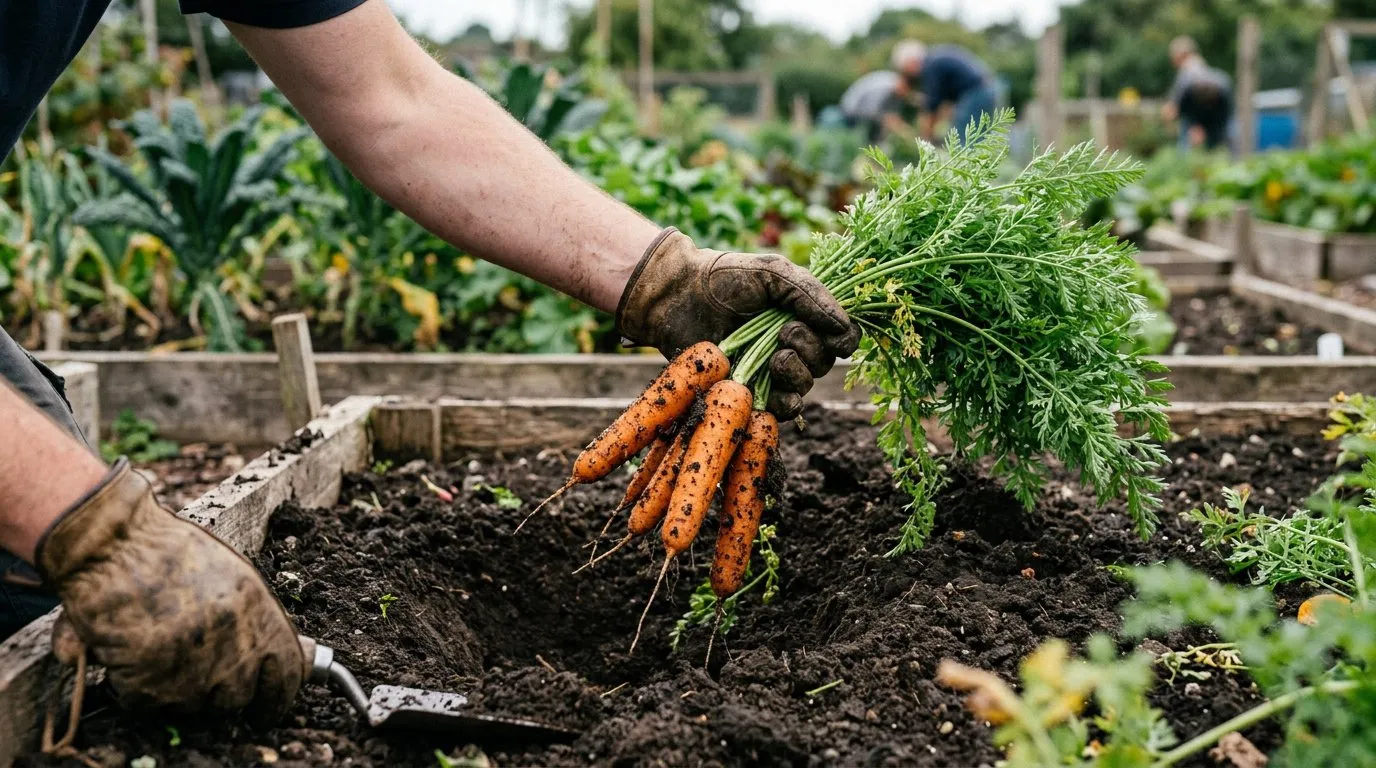
- Between rows of carrots — the onion scent helps mask the carrot smell that attracts carrot fly. Sow spring onions 10cm from each side of a carrot row. The spring onions are harvested before the carrots need the space. For more on companion planting with carrots, see our carrot growing guide.
- Between brassica transplants — cabbages, broccoli, and Brussels sprouts are widely spaced when first planted out. Sow spring onion clusters between the transplants. Pull them before the brassicas fill in.
- Along the edges of raised beds — sow a row of spring onions around the inside edge of a raised bed. They use space that would otherwise grow nothing.
- Between rows of lettuce or salad leaves — both crops mature quickly and are harvested together. The onion scent also deters aphids from the salad.
Intercropping is standard practice on allotments where space is limited. It effectively doubles the output from the same area. If you are planning a new vegetable garden, our guide to starting a vegetable garden covers space planning in more detail.
Caring for spring onions
Spring onions need very little ongoing care. They are one of the lowest-maintenance vegetable crops you can grow.
Watering
Water regularly to keep the soil consistently moist but never waterlogged. Spring onions have shallow roots and dry out faster than deep-rooted crops. In dry weather, water every 2-3 days. Container-grown plants may need daily watering in summer. Inconsistent watering causes tough, fibrous stems.
Feeding
Spring onions rarely need feeding. The compost or soil preparation you added before sowing provides enough nutrients for the short growing period. On very poor soil, a single liquid feed of a balanced fertiliser at 4 weeks gives a useful boost. Do not overfeed. Excess nitrogen causes floppy, dark green tops and weak stems.
Weeding
Keep the area around spring onions weed-free, especially in the first 3-4 weeks while seedlings are small. Their thin, upright leaves cast no shade and cannot compete with weeds. Hand-weed carefully to avoid disturbing the shallow roots. A thin layer of fine compost mulch helps suppress weeds and retain moisture.
Pests and diseases: why spring onions are trouble-free
Spring onions suffer far fewer pest and disease problems than bulb onions. Their fast growing cycle means they are harvested before most pests cause significant damage. This makes them one of the most reliable crops for organic growers and beginners.
Onion fly
Onion fly lays eggs at the base of allium plants from May to July. The larvae burrow into the stem and cause wilting. Spring onions are less affected than bulb onions because they grow and are harvested faster. Cover rows with fine mesh or fleece from May as a precaution. Crop rotation further reduces risk.
Slugs and snails
Young seedlings are vulnerable to slug damage, particularly in wet springs. Use organic slug pellets, beer traps, or nematode biological control (Nemaslug) applied to the soil in March. Copper tape around containers provides an effective barrier. Evening patrols with a torch catch slugs feeding on young shoots.
Downy mildew
Grey-purple patches on leaves in humid, wet weather. Improve airflow by spacing clusters at least 10cm apart. Remove badly affected leaves. This is rarely a serious problem for spring onions because they grow so quickly.
Bolting
Bolting (running to flower) is mainly a problem with overwintered crops in April and May. Harvest overwintered spring onions before the central stem thickens. Once a flower stalk forms, the flavour deteriorates and the base turns woody. Spring and summer sowings rarely bolt because they are harvested before day-length triggers flowering.
Why we recommend White Lisbon as the starting variety for all UK growers: After 30 seasons of succession sowing alliums, White Lisbon consistently proves the most forgiving variety in poor springs, cold soils, and by beginners. In direct comparisons sown on the same day in March, White Lisbon germinated 5-7 days earlier than Ishikura and reached harvest size 2 weeks ahead. The mild flavour suits children and adults alike, and the plants rarely bolt even if you leave them in the ground an extra week past their ideal picking point.
Month-by-month spring onion calendar
| Month | Task |
|---|---|
| January | Order seed. Plan succession sowing dates. Check stored seed is within its use-by date |
| February | Sow indoors on a bright windowsill for the earliest crop. Use module trays, 6-8 seeds per cell |
| March | First outdoor sowings once soil reaches 5C. Sow under cloches in cold regions. See the UK vegetable planting calendar for all crops |
| April | Continue succession sowing every 3-4 weeks. Plant out indoor-raised seedlings after hardening off |
| May | Harvest the first spring-sown crop (from March indoor sowings). Keep sowing outdoors |
| June | Main harvest period begins. Pull spring onions at pencil thickness. Continue sowing |
| July | Last outdoor sowing for autumn harvest. Harvest regularly to prevent bolting |
| August | Sow overwintering varieties (White Lisbon Winter Hardy, Performer). Harvest summer sowings |
| September | Final overwintering sowing by mid-month. Harvest late-summer sowings |
| October | Overwintering seedlings establish before cold weather. No action needed |
| November | Growth slows. Cover overwintering rows with fleece in harsh conditions |
| December | No action. Overwintering plants sit dormant until late February |
When and how to harvest spring onions
Harvest spring onions when the stems reach pencil thickness, roughly 1-1.5cm in diameter. This usually happens 8-12 weeks after sowing, depending on variety and weather.
How to harvest
Grasp the base of the plant firmly and pull straight upward. In loose, moist soil, they come out cleanly. In compacted or dry soil, loosen the ground first with a hand fork. Pull the entire cluster if you sowed in groups. This clears the space for your next sowing.
Harvest timing matters
Do not leave spring onions in the ground too long. Once the stem exceeds 2cm in diameter, the outer layers become tough and the flavour intensifies beyond what most people want in a salad. The white base also starts to form a small bulb, which changes the texture. Check your rows every few days during the main harvest period and pull any that are reaching pencil thickness.
Storing after harvest
Spring onions are best eaten fresh on the day of picking. If you need to store them, wrap the bases in a damp paper towel and place in a plastic bag in the fridge. They keep for 5-7 days this way. Do not freeze spring onions as the texture breaks down entirely. The green tops can be chopped and frozen for use in cooked dishes, though the texture will be soft.
Five common mistakes when growing spring onions
Avoid these errors and your spring onions will grow without any trouble.
1. Sowing everything at once
The most common mistake is sowing an entire packet in one go. You end up with 100 spring onions ready on the same day and nothing for the rest of the year. Succession sow every 3-4 weeks. One short row at a time is all you need.
2. Sowing too deep
Spring onion seed is small and should be covered with no more than 1cm of soil. Sowing too deep slows germination and weakens the seedlings. In heavy clay soil, cover seed with a thin layer of fine compost rather than the native soil.
3. Letting the soil dry out
Spring onions have shallow roots and cannot reach water deep in the soil. Dry conditions cause tough, stringy stems with a harsh flavour. Water regularly, especially in containers and during dry spells in May and June.
4. Forgetting to sow overwintering varieties
Many gardeners sow spring onions in spring but forget the August and September sowings that produce the earliest crop the following year. Overwintering varieties fill the gap between your last autumn harvest and the first spring-sown crop. Without them, you have no spring onions from November to June.
5. Harvesting too late
If spring onions stay in the ground past pencil thickness, the outer layers toughen and the flavour turns sharp. Check your rows twice a week during the harvest window. It is better to pull slightly early and enjoy tender, mild stems than to wait and end up with something closer to a small bulb onion.
Using spring onions in the kitchen
Spring onions are among the most versatile salad and cooking ingredients. The white base and green tops have different textures and flavours, and many recipes use them separately.
Raw — slice thinly into salads, scatter over soups as a garnish, mix into dips and dressings, or chop into sandwich fillings. The green tops are milder and work well as a fresh herb alternative.
Cooked — add to stir-fries in the last minute of cooking. Grill whole spring onions brushed with oil until charred. Fold into omelettes, frittatas, and savoury pancakes. The white section caramelises nicely when grilled or roasted.
Preserved — finely sliced spring onions mixed with salt, vinegar, and a pinch of sugar make a quick pickle that keeps in the fridge for a week. In Korean cooking, chopped spring onions are a key ingredient in kimchi and pancake batter.
Growing your own means you always have spring onions to hand. Pull four or five from the garden, rinse, chop, and use within minutes of picking. That freshness is something no supermarket can match. The RHS guide to growing spring onions provides additional variety suggestions and growing notes.
Now you’ve mastered spring onions, read our guide on how to grow onions in the UK for the full-size bulb crop that stores through winter.
Further reading
- How to grow onions in the UK — full guide to growing and storing bulb onions
- Starting a vegetable garden — everything you need to plan your first growing space
- How to sow seeds indoors — early sowing techniques for all vegetables
- UK vegetable planting calendar — month-by-month sowing and planting guide
- Raised bed gardening for beginners — building and filling raised beds for vegetables
Lawrie has been gardening in the West Midlands for over 30 years. He grows his own veg using no-dig methods, keeps a wildlife-friendly garden, and writes practical advice based on real UK growing conditions.