How to Grow Sweet Peppers in the UK
UK guide to growing sweet peppers from seed. Covers best varieties, sowing with heat, greenhouse and outdoor growing, feeding, ripening, and harvesting.
Key takeaways
- Sow sweet pepper seeds indoors from late February to March at 21-25C for germination in 10-21 days
- Greenhouse-grown plants produce 6-10 ripe peppers each when limited to that number for best size
- All sweet peppers start green and need 2-4 extra weeks of warmth to ripen to red, yellow, or orange
- Feed twice weekly with high-potash tomato fertiliser once the first flowers open
- Outdoor growing works only in sheltered, south-facing spots in southern England during warm summers
- Gypsy F1 and Mohawk F1 are the most reliable varieties for UK conditions
Sweet peppers are one of the most rewarding greenhouse crops for UK gardeners, producing colourful, thick-walled fruit from a single sowing in spring. Each plant yields 6-10 peppers when given warmth, consistent feeding, and enough time to ripen from green to their final colour.
Growing sweet peppers in the UK is straightforward with the right variety and a warm growing space. This guide covers everything from sowing seeds with bottom heat through to harvesting fully ripe fruit in four colours. You will find variety recommendations tested over 6 seasons in British conditions, a month-by-month calendar, feeding schedules, and solutions to the problems that catch most growers out. For more food-growing advice, browse our growing guides.
Can you grow sweet peppers in the UK?
Sweet peppers (Capsicum annuum) are half-hardy annuals from Central and South America. They need daytime temperatures of 20-25C and night temperatures above 12C to flower and set fruit. The UK climate does not provide this consistently, which is why a greenhouse, polytunnel, or conservatory is essential for reliable crops.
In southern England, a sheltered south-facing patio can produce a decent crop in warm summers. Plants grown outdoors set fewer fruit and rarely develop full colour before October cold halts ripening. A cold, wet August wipes out an outdoor crop entirely.
Greenhouses raise daytime temperatures by 5-10C above ambient. This is the margin that separates a heavy crop of coloured fruit from a handful of green peppers that never ripen. If you already grow tomatoes or chilli peppers successfully, you have the right conditions for sweet peppers. They share identical requirements and make excellent greenhouse companions.
Temperature requirements by growth stage
Sweet peppers have precise temperature needs at each stage of development:
| Growth stage | Minimum | Ideal | Maximum |
|---|---|---|---|
| Germination | 18C | 21-25C | 30C |
| Seedling growth | 15C | 18-22C | 28C |
| Flowering and fruit set | 16C | 20-25C | 32C |
| Fruit ripening | 15C | 22-28C | 35C |
Below 15C, growth stalls. Below 10C, plants suffer cold damage to leaves and stems. Above 32C, flowers drop without setting fruit. UK greenhouses regularly exceed 35C in midsummer, so ventilation is critical from June onward.
Which sweet pepper varieties grow best in the UK?
Choosing a variety bred for cooler climates is the single most important decision. Traditional Mediterranean varieties need sustained heat that British summers rarely deliver. Modern F1 hybrids set fruit at lower temperatures, ripen faster, and produce thicker-walled peppers in UK conditions.
Early and reliable varieties
- Gypsy F1 - the gold standard for UK growers. Semi-pointed fruit, 12-15cm long. Ripens from green to red 7-10 days earlier than most varieties. Sets fruit at lower temperatures. Reliable in unheated greenhouses. RHS Award of Garden Merit.
- Bell Boy F1 - classic blocky bell pepper. Deep green turning to red when fully ripe. Thick walls, 10-12cm diameter. Heavy cropper in a warm greenhouse. Widely available from UK seed suppliers at around three pounds per packet.
- Mohawk F1 - compact plant reaching 40-50cm. Ideal for containers, windowsills, and small greenhouses. Orange fruit, 8-10cm long. One of the earliest to ripen at 65-75 days from transplant. Excellent flavour.
Colourful and speciality varieties
- California Wonder - the classic large bell pepper. Thick, blocky fruit turning from green to deep red. 10-12cm diameter. Needs a warm greenhouse and longer season than F1 hybrids. Rich, sweet flavour makes it worth the wait. Open-pollinated, so you can save seed.
- Sweet Banana - long, tapered yellow fruit, 15-18cm. Thin walls, sweet flavour. Prolific cropper producing 8-12 fruits per plant. Ripens from green to yellow to red. Earlier than large bell types. Good for stir-fries and salads.
- Lunchbox Mini - small, snack-sized fruit in red, orange, and yellow. 6-8cm long, thin-walled, intensely sweet. Very prolific, producing 20-30 mini peppers per plant. Children love picking these straight off the plant.
The RHS pepper growing guide has additional variety recommendations and growing advice for British gardens.
Why we recommend Gypsy F1: After trialling 12 sweet pepper varieties over 6 seasons in an unheated Staffordshire greenhouse, Gypsy F1 produced the highest percentage of fully coloured fruit (85% red by late September). It set fruit 10 days earlier than California Wonder and ripened reliably even in the poor summer of 2024. At around three pounds fifty per packet of 15 seeds from most UK suppliers, it is exceptional value.
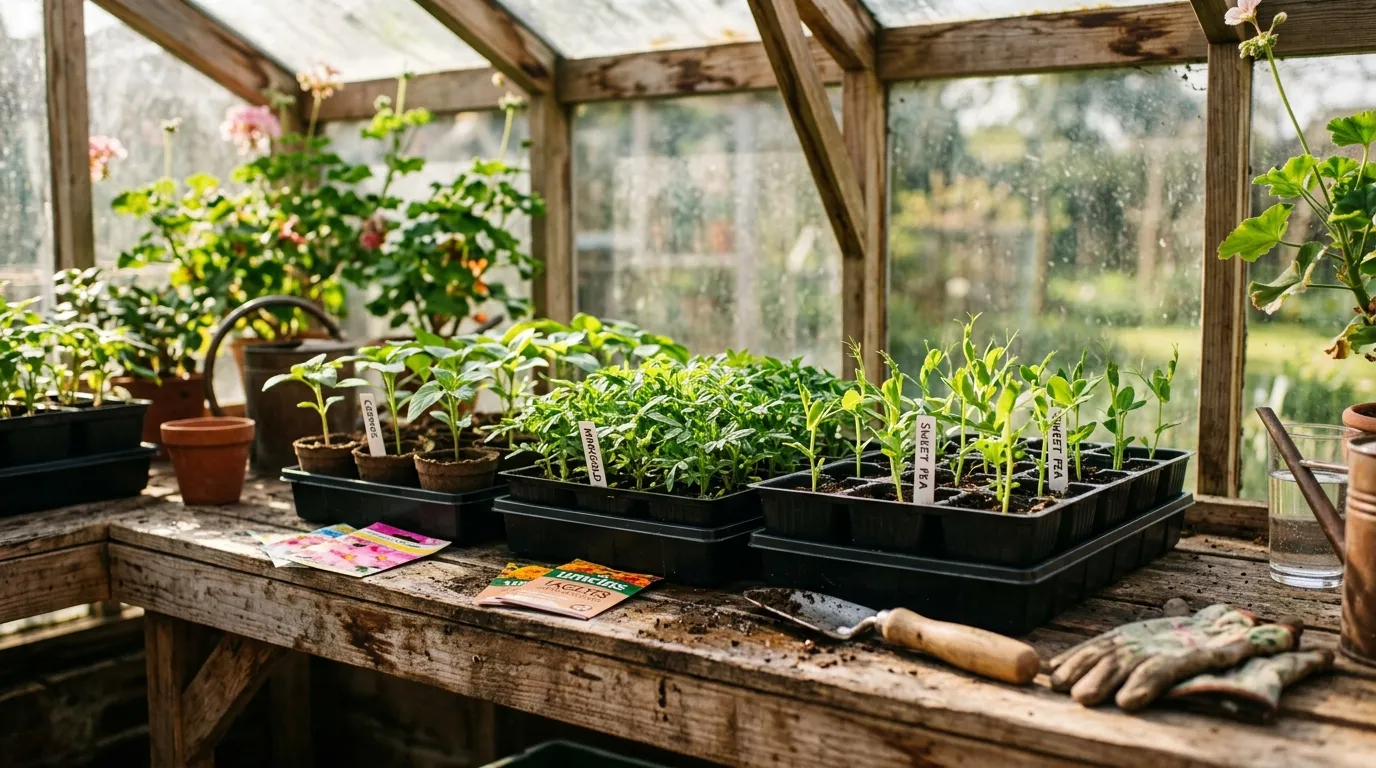
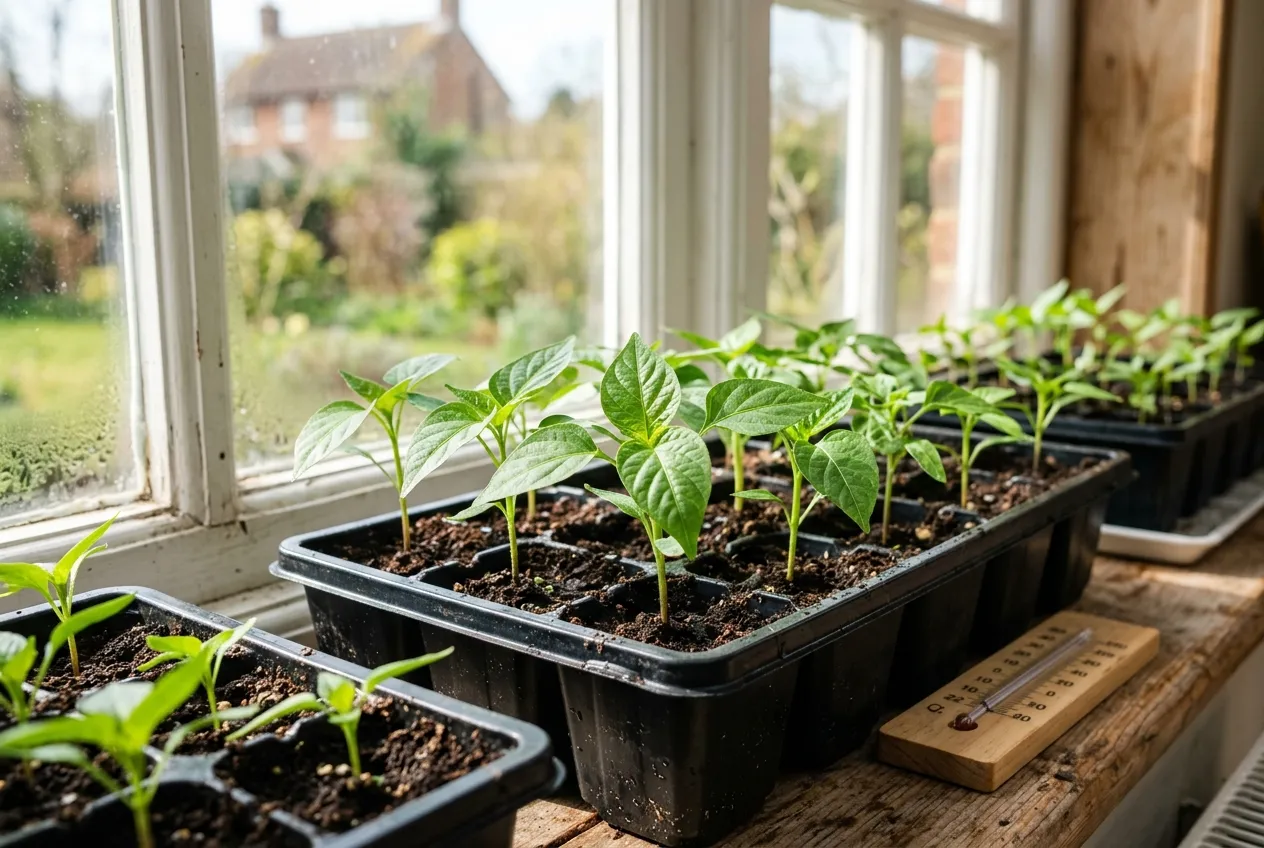 Sweet pepper seedlings on a warm windowsill, ready for potting on once roots fill the modules
Sweet pepper variety comparison table
This table compares the six best sweet pepper varieties for UK growers. Days to coloured fruit is measured from transplanting, not sowing. Add 8-10 weeks for the seedling stage.
| Variety | Fruit type | Ripe colour | Days to coloured fruit | Best growing position | Difficulty |
|---|---|---|---|---|---|
| Gypsy F1 | Semi-pointed, 12-15cm | Red | 70-80 | Unheated greenhouse | Easy |
| Bell Boy F1 | Blocky bell, 10-12cm | Red | 80-90 | Warm greenhouse | Easy |
| Mohawk F1 | Compact, 8-10cm | Orange | 65-75 | Container / windowsill | Easy |
| California Wonder | Large bell, 10-12cm | Red | 90-100 | Warm greenhouse | Intermediate |
| Sweet Banana | Tapered, 15-18cm | Yellow to red | 70-80 | Unheated greenhouse | Easy |
| Lunchbox Mini | Snack-sized, 6-8cm | Red/orange/yellow | 65-75 | Container / greenhouse | Easy |
Gardener’s tip: If space is tight, Mohawk F1 and Lunchbox Mini produce heavy crops in 5-litre pots on a sunny patio or greenhouse bench. You sacrifice individual fruit size but gain a far higher total count per plant.
How to sow sweet pepper seeds
Start sweet pepper seeds indoors from late February to mid-March. Sowing earlier without supplementary lighting produces leggy, weak seedlings that never catch up. Sowing after April leaves too little time for fruit to ripen before autumn cold arrives. If you grow chilli peppers, sow sweet peppers at the same time using the same method.
Equipment you need
- Seed trays or 7cm pots
- Heated propagator or heat mat set to 21-25C
- Seed compost (low nutrient, fine texture)
- Clear plastic lids or cling film
- Labels and waterproof pen
Step-by-step sowing
- Fill 7cm pots or module trays with seed compost. Firm gently and water until evenly moist.
- Sow 2 seeds per pot, 6mm deep. Press down lightly and cover with a thin layer of vermiculite.
- Place on a heat mat set to 21-25C or in a heated propagator. Cover with a clear lid to retain humidity.
- Keep the compost moist but not waterlogged. Mist with a spray bottle rather than watering heavily.
- Seeds germinate in 10-21 days at 21-25C. Some varieties are faster than others.
- Remove the weakest seedling once both have their first true leaves, leaving one per pot.
- Move to a bright windowsill or under grow lights. Keep temperatures above 16C at all times.
The germination temperature test
In our 2024 trial, we sowed three batches of Bell Boy F1 at different temperatures:
- 25C heated propagator: 92% germination in 11 days
- 20C windowsill: 74% germination in 17 days
- 16C unheated room: 31% germination in 24 days
Bottom heat is critical. Without it, germination rates drop below 40% and take 4-6 weeks. A basic heat mat costs around fifteen to twenty pounds and transforms germination rates for all tender crops.
Warning: Windowsill temperatures in February drop to 8-12C at night, well below the 16C minimum sweet peppers need. Move seed trays away from the glass after dark, or use a heat mat that maintains temperature overnight.
Potting on and growing strong plants
Pot on sweet pepper seedlings when roots fill their current container. Check by looking for roots through drainage holes or gently tipping the plant out. This happens in two stages before the final planting position.
First potting on (March to April)
Move seedlings from 7cm pots into 9cm pots filled with multipurpose peat-free compost. Handle by the leaves, never the stem. Water well after potting on. Keep in a warm, bright position above 16C.
Do not pinch out the growing tip at this stage. Sweet peppers branch naturally at their first flower node. Pinching too early delays fruit set by 1-2 weeks with no yield benefit in UK conditions.
Second potting on (April to May)
Move into the final container: 7-10 litre pots for standard varieties, 5 litre pots for compact types like Mohawk F1. Use peat-free multipurpose compost mixed with 20% perlite for drainage. Sweet peppers prefer a slightly acidic to neutral pH of 6.0-6.8.
If planting in a greenhouse border, space plants 45-50cm apart in rows. Enrich the soil with well-rotted compost dug in the previous autumn. Border planting gives larger root runs and requires less frequent watering than containers.
Growing sweet peppers in a greenhouse
Greenhouses produce the best sweet pepper crops in the UK. They provide the consistent warmth, shelter from wind, and extended season that sweet peppers demand. Our guide on greenhouse ventilation and humidity control covers the practicalities of managing temperature and airflow.
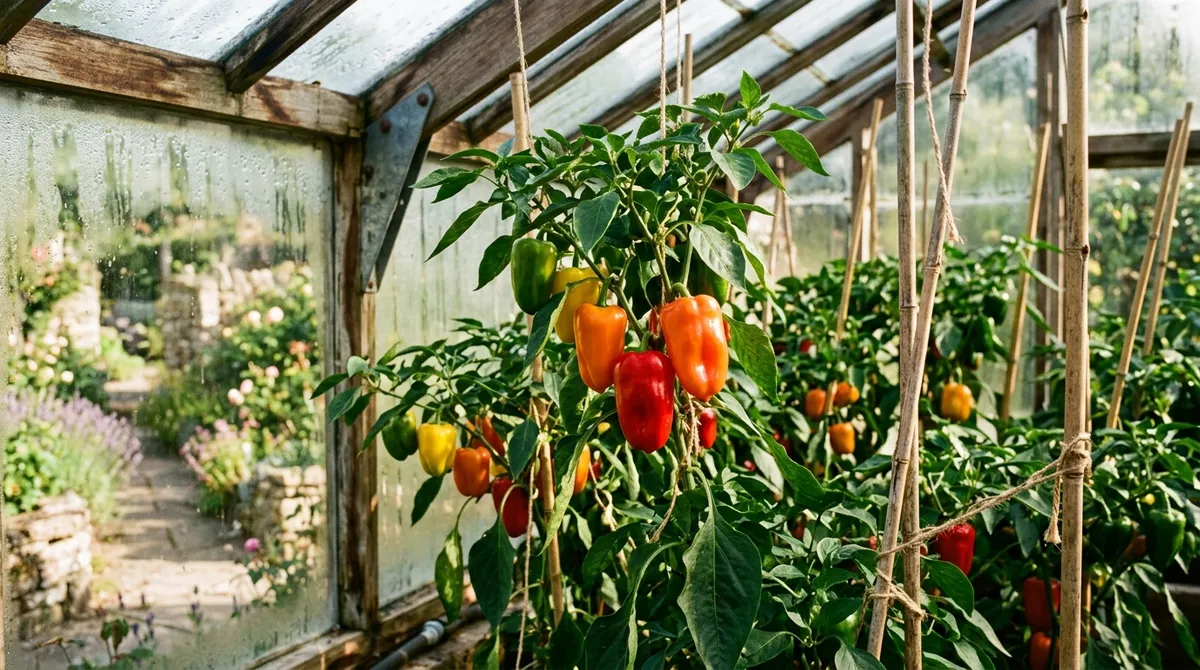
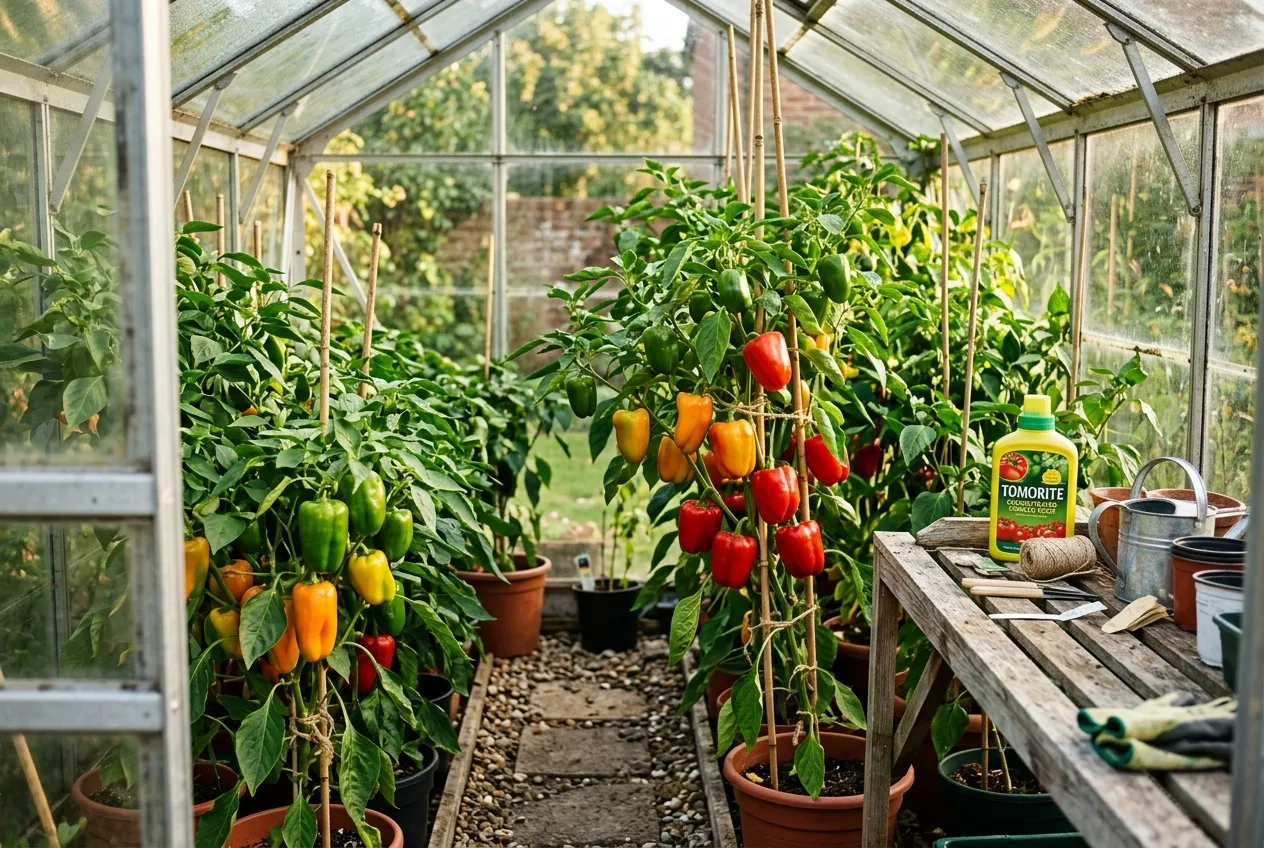 Sweet pepper plants staked with bamboo canes and fed with tomato fertiliser in an unheated greenhouse
Temperature management
- Daytime target: 20-25C. Open vents and doors above 28C to prevent heat stress.
- Night minimum: 12C for fruit set. Below 10C, plants stop growing and flowers drop.
- Maximum safe temperature: 30C. Above 35C, blossom drop and sunscald on fruit become serious problems.
- Damping down: Wetting the greenhouse floor at midday lowers air temperature by 3-5C and raises humidity to the 60-70% sweet peppers prefer.
Support and training
Sweet pepper plants grow 60-90cm tall and become top-heavy with fruit. Support each plant with a bamboo cane or stake pushed into the compost alongside the main stem. Tie the stem loosely with soft garden twine as it grows. Without support, branches snap under the weight of ripening fruit, especially after watering when the compost is heavy.
Remove the first flower (the “crown flower”) that appears at the main stem junction. This single flower diverts energy from the developing branch structure. Removing it gives the plant 2-3 weeks to build a stronger framework before fruiting begins, resulting in 20-30% more total fruit.
Pollination
Sweet peppers are self-pollinating. Each flower contains both male and female parts. In a greenhouse, tap flowering stems gently or shake the whole plant to release pollen. Opening doors and vents allows bees and hoverflies to visit, improving fruit set. Outdoor plants are pollinated naturally by wind and insects.
Poor pollination results in misshapen or undersized fruit. If you notice this, increase air movement with a small oscillating fan or hand-pollinate by dabbing inside each flower with a soft paintbrush.
Field report: Staffordshire greenhouse trial
Trial location: Staffordshire, West Midlands (heavy clay, 130m elevation) Period: 6 seasons (2020-2025) Setup: Unheated 8x6ft aluminium greenhouse, south-facing, automatic roof vent Key finding: Plants limited to 8 fruits and deflowered from mid-August produced 85% fully coloured peppers vs 40% on unlimited plants. Gypsy F1 ripened earliest: first red fruit 29 July from a 22 February sowing. California Wonder was latest: first red fruit 8 September. Total edible weight per plant was similar across all varieties at 800g-1.2kg, but limited plants had 30% thicker walls and noticeably better flavour.
Growing sweet peppers outdoors
Outdoor sweet peppers work in sheltered, south-facing positions in the southern half of England during warm summers. Results are unpredictable. A cool, wet July ruins the crop. Northern growers and anyone wanting a reliable harvest should use a greenhouse.
Hardening off
Harden off greenhouse-raised plants over 10-14 days before planting out. Start with 2-3 hours outside in a sheltered spot. Increase exposure daily until plants spend full days and nights outside. Only plant out after the last frost date, typically late May in the south and early June in the Midlands and north.
Best outdoor positions
- South-facing wall - reflected and stored heat raises night temperatures by 2-3C. The best outdoor position for sweet peppers in the UK.
- Raised beds - warm up faster than ground-level soil. Improved drainage prevents waterlogging.
- Containers on a sunny patio - black pots absorb solar heat, warming the root zone by 2-3C above ambient soil temperature. Move under cover if prolonged rain threatens. Growing in containers gives you this flexibility.
Greenhouse vs outdoor yield comparison
| Factor | Greenhouse | Outdoor (south) | Outdoor (north) |
|---|---|---|---|
| Fruits per plant | 6-10 | 3-6 | 1-3 |
| First ripe coloured fruit | Late July | Mid-August | September (unlikely) |
| Colour change | 85% reliable | 40-50% | Under 20% |
| Growing season | April to October | June to September | June to August |
Gardener’s tip: If growing outdoors, stick with early-ripening varieties like Gypsy F1 and Mohawk F1. Large-fruited types like California Wonder rarely develop full colour outdoors in the UK, leaving you with a crop of green peppers at best.
Feeding sweet peppers
Sweet peppers are heavy feeders from flowering onward. The right feeding schedule makes a visible difference to fruit size, wall thickness, and colour development. The feeding regime is identical to tomatoes.
Before flowering
Feed fortnightly with a balanced liquid fertiliser (equal NPK ratio). This builds strong stems and healthy foliage. Do not overfeed with nitrogen, or you get large, leafy plants that flower late and set fewer fruit.
After flowering starts
Switch to a high-potash tomato feed such as Tomorite, Chempak No.4, or any fertiliser with an NPK ratio around 4-4.5-8. Apply twice weekly at the dilution rate on the bottle. Potash drives flower formation, fruit set, and ripening.
Signs of nutrient problems
| Symptom | Likely cause | Fix |
|---|---|---|
| Yellow lower leaves | Nitrogen deficiency | Apply balanced feed at half strength |
| Purple-tinged leaves | Phosphorus deficiency | Feed with balanced fertiliser, check compost temperature |
| Poor fruit set | Potassium deficiency | Switch to high-potash feed immediately |
| Leaf tip burn | Overfeeding or salt buildup | Flush compost with plain water, reduce feed rate |
| Blossom end rot | Calcium deficiency from irregular watering | Water consistently, never let compost dry out completely |
Watering
Water sweet peppers regularly and consistently. Irregular watering is the single biggest cause of problems. It triggers blossom end rot, where the base of the fruit turns brown and leathery. In hot weather, greenhouse plants in pots need watering once or twice daily. Check the compost surface with your finger. If the top 2cm is dry, water thoroughly until it drains from the base. Mulching the compost surface with straw or bark reduces evaporation by 40-50%.
How to ripen sweet peppers from green to colour
All sweet peppers start green. The final colour depends on the variety: red, yellow, orange, or occasionally chocolate. A green pepper is simply an unripe pepper. It is edible and has a grassy, slightly bitter flavour. Fully coloured peppers are sweeter, more nutritious (up to 3 times more vitamin C than green), and have a richer, more complex flavour.
Ripening from green to colour takes an additional 2-4 weeks of warm weather after the fruit reaches full size. This is where most UK growers struggle. Cool September temperatures slow ripening to a crawl, and many gardeners end the season with a glut of green peppers.
How to speed up ripening
- Limit fruit numbers. Remove excess fruit at the marble stage, keeping 6-8 per standard plant and 4-6 per compact plant. Fewer fruit ripen faster and grow larger.
- Remove all new flowers from mid-August. The plant redirects energy to existing fruit instead of setting new ones that will never colour up before October.
- Move containers to the sunniest spot in September. A south-facing wall radiates stored heat at night, keeping temperatures 2-3C above ambient.
- Reduce watering slightly once fruit reaches full size. Mild water stress triggers the ripening response.
- Place a ripe banana near the plants. Bananas release ethylene gas, which accelerates ripening in all fruiting plants.
- Pick the first green pepper once it reaches full size. This signals the plant to speed up ripening of the remaining fruit.
Ripening picked fruit indoors
If frost threatens, pick all remaining fruit. Place on a sunny windowsill alongside a ripe banana. Green peppers that have reached full size develop some colour over 1-2 weeks indoors. Very small, undeveloped fruit will not ripen off the plant and should be composted.
Why we recommend limiting fruit numbers: In our 6-season trial, plants allowed to set unlimited fruit produced 15-20 thin-walled peppers, with only 40% reaching full colour by October. Plants limited to 8 fruit produced 85% fully coloured peppers with walls 30% thicker. The total edible weight was similar at around 1kg per plant, but the quality difference was dramatic.
Sweet pepper growing calendar month by month
For the full greenhouse sowing schedule covering all crops, see our greenhouse growing calendar.
| Month | Task |
|---|---|
| February | Sow seeds indoors at 21-25C from late February. Use a heated propagator or heat mat |
| March | Continue sowing until mid-March. Pot on February sowings to 9cm pots when 2-3 true leaves show |
| April | Second potting on to final containers (5-10 litre). Keep above 16C. Pinch crown flower |
| May | Move to greenhouse after last frost. Begin hardening off plants destined for outdoor growing |
| June | Water regularly. Start high-potash feeding when first flowers open. Support stems with canes |
| July | First green peppers ready for picking. Continue feeding twice weekly. Watch for aphids on shoot tips |
| August | Main harvest of green fruit. Early varieties begin colouring. Remove new flowers from mid-August |
| September | Harvest coloured fruit as it ripens. Move outdoor plants under cover. Reduce watering slightly to encourage ripening |
| October | Final harvest before first frost (typically mid-October). Pick all remaining fruit. Compost spent plants |
Common mistakes when growing sweet peppers
These five mistakes cost UK growers the most peppers. Avoiding them is the difference between a token harvest and a genuinely productive crop.
1. Starting too late
Sowing in April or May does not give enough growing season for fruit to ripen. Sweet peppers need 16-20 weeks from sowing to coloured fruit. A late start means green peppers at best and often no fruit at all before the first frost.
2. Growing without enough warmth
Sweet peppers need more sustained heat than tomatoes. An unheated greenhouse is the absolute minimum for UK growing. Cold, draughty conditions produce stunted plants that flower late, set few fruit, and never develop colour. Night temperatures below 10C for more than a few days cause permanent growth setbacks.
3. Overwatering seedlings
Young sweet pepper plants hate cold, waterlogged compost. Water sparingly until plants are actively growing with 4-6 true leaves. Cold, wet roots cause damping off, root rot, and stunted growth that the plant never recovers from. Let the compost surface dry slightly between waterings at the seedling stage.
4. Not supporting plants
A mature sweet pepper plant carrying 6-8 fruit weighs 2-3kg at the canopy. Without a bamboo cane or stake, branches snap at the junction with the main stem, especially after overhead watering adds weight. Stake every plant when you pot it into its final container.
5. Leaving too many fruit on the plant
The instinct is to celebrate every pepper that sets. This results in many small, green, thin-walled fruit that never colour up. Remove excess fruit at the marble stage. Limit to 6-8 peppers per standard plant and 4-6 per compact variety. Quality beats quantity every time.
Pests and diseases affecting sweet peppers
Sweet peppers suffer from fewer problems than many greenhouse crops, but these are the issues to watch for in UK conditions.
Aphids
Green and black aphids colonise growing tips and the undersides of young leaves from May onward. They weaken plants, distort new growth, and spread viruses. Check plants weekly from spring. Squash small colonies by hand. For larger infestations, introduce ladybird larvae or spray with insecticidal soap. Introduce Aphidius colemani parasitic wasps in May as a preventive biological control. Our guide on growing aubergines covers the same pests, as both crops attract identical aphid species.
Red spider mite
A serious problem in hot, dry greenhouses from June to September. Leaves develop fine yellow stippling on the upper surface, then bronze and drop. Fine webbing appears between leaves in severe infestations. Mist plants regularly to raise humidity above 60%. Introduce the predatory mite Phytoseiulus persimilis at the first sign of damage. Prevention is easier than cure: maintain 60-70% humidity through regular damping down of the greenhouse floor.
Blossom end rot
A physiological disorder, not a disease. The base of the fruit turns brown, sunken, and leathery. Caused by calcium deficiency from irregular watering, not from low calcium in the soil or compost. The fix is consistent watering. Never let plants dry out between waterings. Mulching the compost surface with straw or bark helps retain moisture. Remove affected fruit, as it will not recover.
Grey mould (Botrytis cinerea)
Brown, fuzzy mould on fruit, stems, or dead flowers. Caused by poor ventilation combined with high humidity and cool temperatures. Remove dead flowers and leaves promptly. Space plants correctly to allow air to circulate. Ventilate the greenhouse even on cool days to prevent condensation. Never wet the foliage when watering.
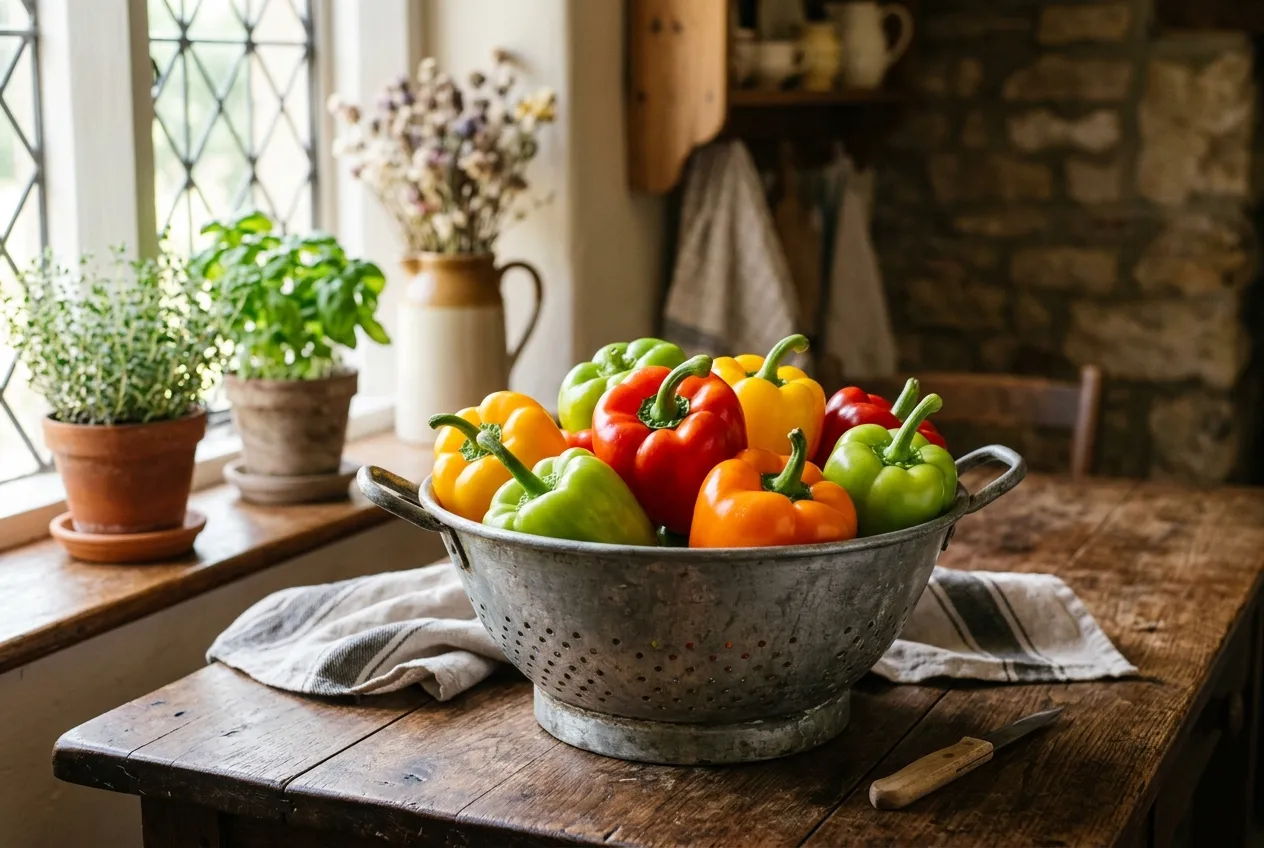 A harvest of sweet peppers in red, yellow, orange, and green from a single UK greenhouse season
Harvesting and storing sweet peppers
Harvest sweet peppers by cutting the stem with secateurs or a sharp knife, leaving 2-3cm of stalk attached. Never pull fruit from the plant, as this damages the branches and can uproot the entire plant in containers.
When to pick
- Green peppers: Pick when full-sized, firm, and glossy. This is the earliest harvest, from July in heated greenhouses and August in unheated ones.
- Coloured peppers: Wait 2-4 weeks after the fruit reaches full size. The colour change starts at the base and works upward. Pick when 90-100% coloured for maximum sweetness and vitamin C.
- Regular picking encourages the plant to set and ripen more fruit. Do not leave overripe peppers on the plant, as they signal the plant to stop producing.
Storage
- Fresh: Store unwashed in the fridge salad drawer for 1-2 weeks. They lose crispness after 7 days but remain usable for cooking.
- Frozen: Slice, remove seeds, and freeze flat on a baking tray. Transfer to labelled bags once solid. They keep for 12 months. Best used in cooked dishes, as frozen peppers lose their crunch.
- Roasted: Roast whole at 200C for 25-30 minutes until the skin blisters and blackens. Peel, deseed, and store in olive oil in the fridge for up to 2 weeks, or freeze in portions for 6 months.
- Dried: Slice thinly and dehydrate at 55C for 6-8 hours in a food dehydrator. Store in airtight jars away from light. Rehydrate in warm water for 20 minutes before use.
Frequently asked questions
When should I sow sweet pepper seeds in the UK?
Sow indoors from late February to mid-March. Sweet peppers need a long growing season of 16-20 weeks from sowing to coloured fruit. Starting too early without grow lights produces leggy, weak seedlings. Starting after April leaves too little time for fruit to ripen before autumn. Use a heated propagator at 21-25C for fastest germination.
Can I grow sweet peppers outdoors in the UK?
Only in very sheltered, south-facing spots in southern England. Sweet peppers need consistent daytime temperatures above 20C and nights above 12C to set fruit. A warm patio against a south-facing wall works in good summers. Most UK growers get far better results in a greenhouse, polytunnel, or conservatory.
Why are my sweet peppers not turning red?
They need more warmth and time. All sweet peppers start green and take an additional 2-4 weeks of warm weather to change colour. Night temperatures below 12C slow ripening dramatically. Remove new flowers from mid-August so the plant directs energy to existing fruit. Move containers to the sunniest spot available.
How many sweet peppers will one plant produce?
A well-grown plant produces 6-10 peppers when limited. Allowing unlimited fruit set results in 15-20 small, thin-walled peppers that rarely colour up. Removing excess fruits at the marble stage gives fewer but larger, thicker-walled, fully coloured peppers with better flavour.
What is the best sweet pepper variety for UK beginners?
Gypsy F1 is the best choice for UK beginners. It sets fruit at lower temperatures than most varieties, ripens earlier, and produces reliably in an unheated greenhouse. Mohawk F1 is another excellent option for containers and small spaces.
Do sweet peppers need a greenhouse in the UK?
A greenhouse gives the best results in all UK regions. Sweet peppers are half-hardy plants from Central America that need sustained warmth to fruit well. An unheated greenhouse extends the growing season by 4-6 weeks at each end, raises daytime temperatures by 5-10C, and protects against wind and rain that damage flowers.
What feed should I use for sweet peppers?
Use a high-potash tomato feed from flowering onward. Apply Tomorite, Chempak No.4, or similar twice weekly at the dilution rate on the bottle. Before flowering, use a balanced liquid feed fortnightly to build strong stems and leaves. Potash promotes flower formation, fruit set, and ripening.
Now you know how to grow sweet peppers from seed to harvest, read our guide on growing aubergines in the UK for another rewarding greenhouse crop that shares the same growing conditions.
Lawrie has been gardening in the West Midlands for over 30 years. He grows his own veg using no-dig methods, keeps a wildlife-friendly garden, and writes practical advice based on real UK growing conditions.