How to Grow Wild Garlic in the UK
Grow wild garlic (ramsons) in UK gardens from bulbs or seed. Planting guide, foraging rules, safe identification, and recipes from 6 years of trials.
Key takeaways
- Plant wild garlic bulbs 5cm deep in autumn in moist, shaded ground. They need minimal care once established
- Wild garlic spreads readily. A patch of 20 bulbs covers 1 square metre within 3-4 years
- Always crush a leaf before picking. Wild garlic smells strongly of garlic; toxic lily of the valley does not
- Leaves are best harvested in March and April before flowering. Flavour weakens once flowers open
- Growing from seed takes 18-24 months to produce usable leaves. Bulbs give a harvest in the first spring
- The Wildlife and Countryside Act 1981 protects wild garlic from uprooting on land you do not own
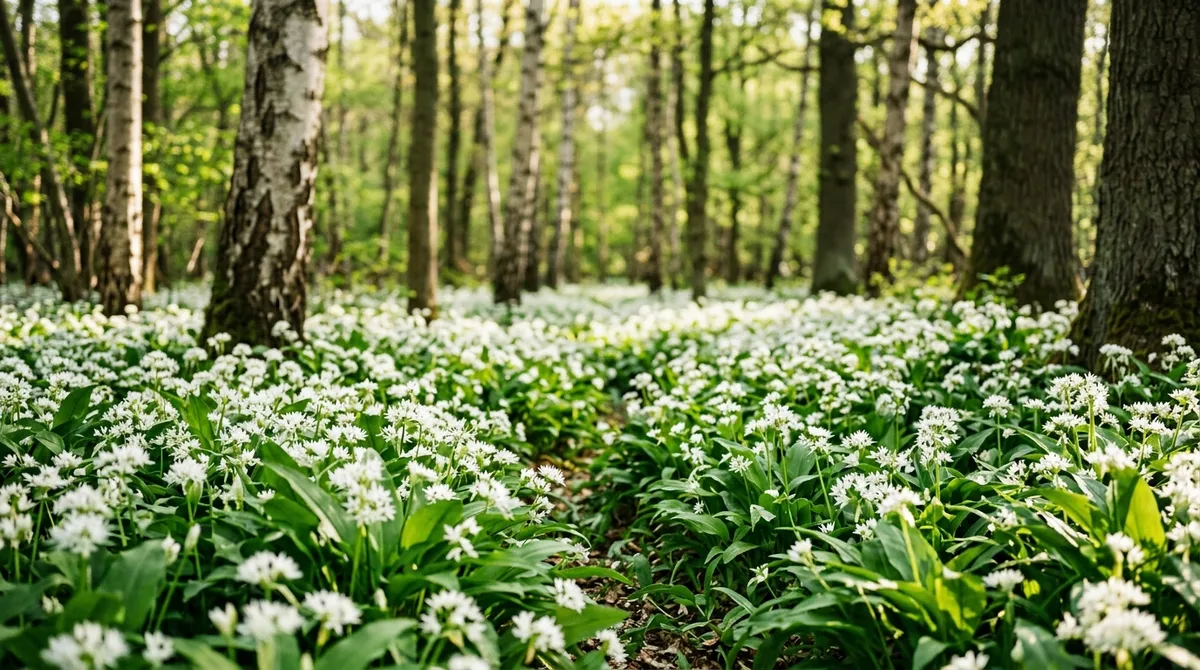
Wild garlic (Allium ursinum) is one of the easiest and most rewarding native plants to grow in a UK garden, producing pungent edible leaves from March and white star-shaped flowers from April. After 6 years of growing it under hazel and birch on my heavy Staffordshire clay, I can confirm it needs almost nothing from you once planted. It asks for shade, moisture, and to be left alone.
This guide covers everything from planting bulbs and growing from seed to safe identification, foraging law, and what to cook with your harvest. If you already grow garlic or other alliums, wild garlic is a natural addition to your plot.
What is wild garlic and where does it grow?
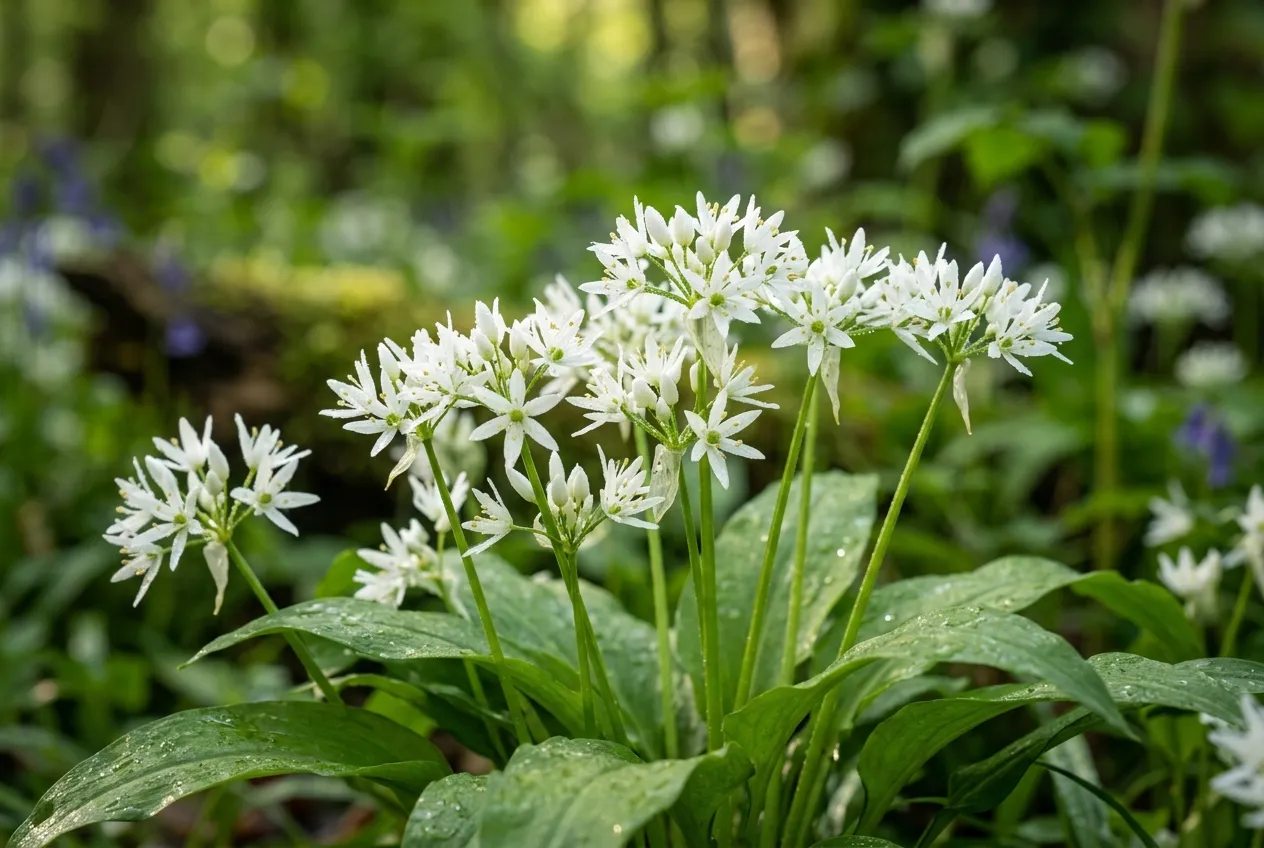
Wild garlic flowers appear from April to June. Each umbel carries 6-20 individual star-shaped white flowers.
Wild garlic (Allium ursinum), also called ramsons, is a native British woodland bulb in the same family as onions, leeks, and cultivated garlic. It grows naturally across most of the UK, from southern England to the Scottish Highlands. The Woodland Trust records it in the majority of ancient woodland sites surveyed.
The plant emerges in late February or early March. Broad, glossy green leaves appear first, growing 15-25cm tall from a slender white bulb. Flower stems follow in April, carrying umbels of white star-shaped flowers. Each flower has six petals and a sweet, garlicky scent. By late June, the leaves yellow and die back. The plant is completely dormant by July and invisible until the following spring.
Wild garlic thrives in damp, shaded conditions with humus-rich soil. It forms dense carpets on the floor of deciduous woodland, along stream banks, and in hedgerows. These conditions are straightforward to recreate in a garden. Any spot with shade and decent moisture will suit it.
Key characteristics
| Feature | Detail |
|---|---|
| Botanical name | Allium ursinum |
| Common names | Wild garlic, ramsons, bear’s garlic |
| Family | Amaryllidaceae (allium subfamily) |
| Height | 15-25cm (leaves), 20-30cm (flower stems) |
| Leaf type | Broad, lance-shaped, smooth, bright green |
| Flower colour | White, star-shaped, in rounded umbels |
| Flowering period | April-June |
| Hardiness | Fully hardy (RHS H7, to minus 20 degrees C) |
| Soil | Moist, humus-rich, pH 5.5-7.5 |
| Position | Full shade to partial shade |
| Dormancy | Completely dormant July-February |
How to identify wild garlic safely
The single most important identification rule is smell. Crush a leaf between your fingers. Wild garlic produces an unmistakable strong garlic odour. No other common British plant smells this way.
This matters because wild garlic can be confused with two poisonous plants.
Wild garlic vs lily of the valley
Lily of the valley (Convallaria majalis) is toxic. All parts of the plant contain cardiac glycosides that can cause vomiting, irregular heartbeat, and in severe cases, death. The leaves look superficially similar to wild garlic, but there are clear differences:
| Feature | Wild garlic | Lily of the valley |
|---|---|---|
| Smell | Strong garlic when crushed | No garlic smell |
| Leaves | Single leaf per stem, soft, matt underside | Two leaves per stem in a sheath, glossy both sides |
| Flowers | White stars in an umbel, April-June | White bells on a drooping stem, May |
| Habitat | Damp woodland, hedgerows | Dry woodland, gardens |
| Toxicity | Edible | Highly toxic |
Wild garlic vs lords-and-ladies
Lords-and-ladies (Arum maculatum) emerges at the same time and in the same habitats. Its arrow-shaped leaves are thicker, glossier, and often have dark spots. Again, crush a leaf. If there is no garlic scent, do not eat it. All parts of lords-and-ladies contain calcium oxalate crystals that burn the mouth and throat.
Safety rule: Never pick any leaf you have not positively identified by smell. If in doubt, leave it. The Royal Horticultural Society lists wild garlic with full identification photographs.
How to grow wild garlic from bulbs
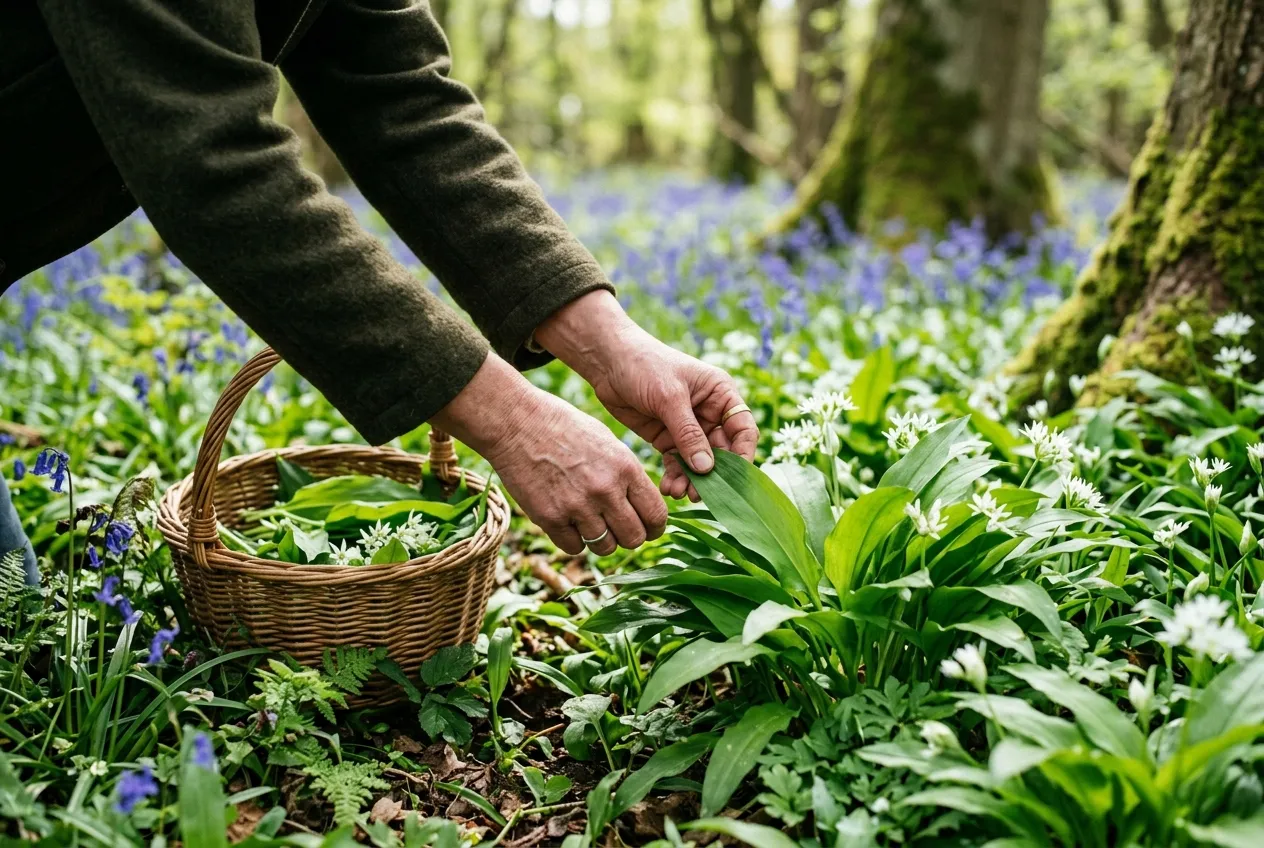
Harvest wild garlic leaves by picking one leaf per plant. Never strip a whole clump.
Planting bulbs in autumn is the fastest way to establish wild garlic. You get harvestable leaves the following March, just 5-6 months after planting.
Where to plant
Choose a shaded spot under deciduous trees, along a north-facing fence, or in the shadow of a building. Wild garlic grows naturally in woodland where the canopy shades it from strong summer sun. Full sun dries the soil and weakens the plants. Dappled shade under birch, hazel, or apple trees is ideal.
The soil should be moist and rich in organic matter. Wild garlic grows on clay, loam, and chalk in the wild. If your soil is sandy and dry, dig in plenty of leaf mould or well-rotted compost before planting. A pH between 5.5 and 7.5 suits it.
When and how to plant
Plant dormant bulbs in September or October. You can also buy plants “in the green” (with leaves attached) in March from specialist nurseries.
- Prepare the soil by removing weeds and working in leaf mould or compost
- Plant each bulb 5cm deep and 10-15cm apart
- Water in well after planting
- Mulch with leaf mould to retain moisture and mimic the woodland floor
- Leave undisturbed. No feeding or further watering is needed in most years
A patch of 20-30 bulbs is enough to start a colony. Within 3-4 years, it will cover roughly 1 square metre through bulb division and self-seeding.
Buying bulbs
Buy from specialist wildflower nurseries such as Naturescape or British Wildflower Plants. Look for UK-grown stock. Never dig up wild bulbs from the countryside. This is illegal under the Wildlife and Countryside Act 1981 and damages wild populations. Expect to pay 5-10 pounds for 20 bulbs.
How to grow wild garlic from seed
Growing from seed is slower but produces genetically diverse plants that naturalise well. Seed-grown colonies tend to be healthier long-term because they avoid the narrow gene pool of repeated bulb division.
Seed collection and sowing
Wild garlic seed ripens in June when the green seed capsules turn brown and split open. Collect seed as soon as capsules begin to crack. Sow immediately. Wild garlic seed loses viability fast. Seed that has dried out for more than a few weeks rarely germinates.
Sow fresh seed directly onto prepared moist soil in a shaded spot. Press seeds gently into the surface. Do not cover with more than 5mm of fine compost. Water lightly. Seeds need a winter cold period (stratification) to break dormancy. Germination happens the following March or April.
First-year seedlings produce a single, grass-thin leaf. They look fragile but are tougher than they appear. By the second spring, plants have a proper broad leaf and a small bulb. By year three, they begin to flower and self-seed.
| Method | Time to first harvest | Cost (20 plants) | Spread rate |
|---|---|---|---|
| Autumn bulbs | 5-6 months | 5-10 pounds | Fast (bulb division plus seed) |
| In the green (March) | 12 months | 8-15 pounds | Fast |
| Fresh seed (June) | 18-24 months | Free if collected | Moderate (seed only at first) |
For the quickest results, combine both methods. Plant bulbs in autumn for an immediate harvest, and scatter seed around the edges for long-term naturalisation.
Where to plant wild garlic in your garden
Wild garlic is not fussy about position provided it has shade and moisture. Use it to fill those damp, dark corners where most edible plants fail.
Best positions:
- Under deciduous trees (birch, hazel, oak, apple, cherry)
- Along north-facing hedges and fences
- In a woodland garden or wildlife area
- On a shady bank or slope
- In containers (large pots, at least 30cm deep, in shade)
Avoid:
- Full sun (leaves scorch and plants weaken)
- Very dry, sandy soil without amendment
- Raised beds in exposed, sunny positions
Wild garlic makes excellent ground cover in the shade and works well alongside other woodland plants like bluebells, primroses, and ferns. It also grows happily among herbs in a shaded herb bed. Just be aware it will spread.
How to contain wild garlic spread
Wild garlic is not invasive, but it does spread steadily. A well-established patch expands by roughly 30cm per year through a combination of bulb offsets and self-sown seed.
To control spread:
- Remove flower heads before seed sets in late May or early June. This prevents self-seeding while still allowing the bulbs to multiply at a controlled rate
- Plant within physical boundaries. Paths, paving, lawn edges, or buried root barriers all work. Wild garlic bulbs sit only 5-10cm deep, so a 15cm barrier is enough
- Grow in containers. A large pot (30cm or wider) in shade works well. Use a moisture-retentive compost and keep well watered
The plant dies back completely by July. Unlike mint or horseradish, it does not send runners into neighbouring beds. The spread is predictable and manageable.
Foraging rules and UK law
Picking wild garlic leaves for personal use is legal in England and Wales, but uprooting the bulb without permission is not.
The key legislation:
- Wildlife and Countryside Act 1981: Uprooting any wild plant without the landowner’s permission is an offence. You can pick leaves and flowers, but you cannot dig up bulbs
- Countryside and Rights of Way Act 2000: On access land, you may pick plant material for personal use, not commercial sale
- SSSIs: Never pick anything from a Site of Special Scientific Interest. Fines apply
The Botanical Society of Britain and Ireland recommends the forager’s rule: take no more than one-third of any patch, and never strip all the leaves from a single plant. Spread your picking across a wide area.
This is one strong reason to grow your own. A garden patch gives you unrestricted access to as many leaves as you need without any legal or ecological concern. For more on what you can harvest from the garden and hedgerow, see our guide to foraging in your garden.
When and how to harvest wild garlic
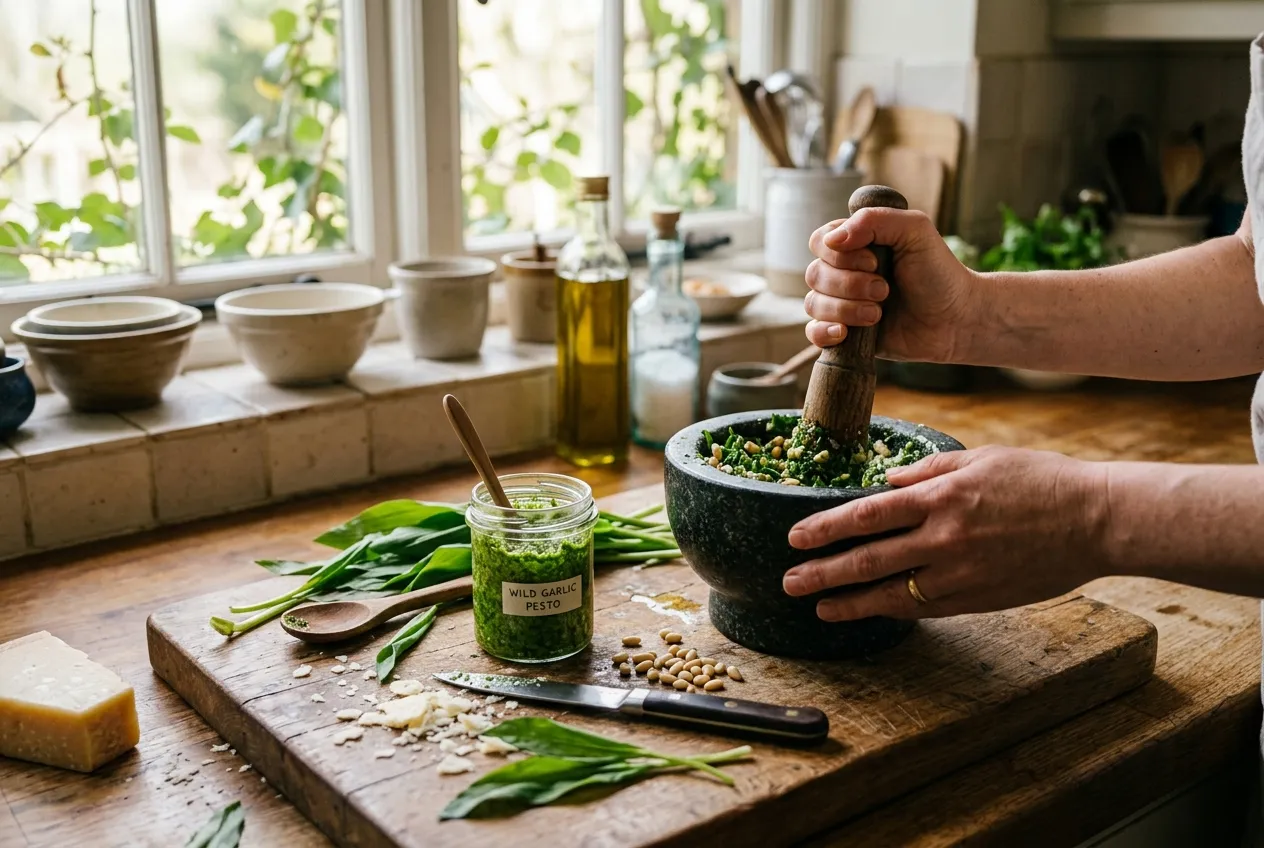
Fresh wild garlic pesto. Blend leaves with pine nuts, parmesan, and olive oil for a vibrant spring condiment.
Harvest leaves from March to early May for the strongest flavour. Once the flowers open fully in April, the leaves become less pungent and slightly bitter. The flowers themselves are edible and milder than the leaves.
Picking technique
Pick one leaf per plant by grasping the stem near the base and pulling gently upward. Never cut with scissors at ground level, as this can damage the growing point. Take no more than a third of any clump. This allows the plant to photosynthesise enough to recharge the bulb for next year.
Storing fresh leaves
Wild garlic wilts fast. Use leaves within 2-3 days of picking. Store in a damp cloth or plastic bag in the fridge. For longer storage, blanch leaves for 10 seconds in boiling water, plunge into iced water, pat dry, and freeze flat in bags. Frozen leaves keep for 6 months and work well in soups and pesto. For more preservation methods, see our guide to pickling and fermenting garden produce.
What to cook with wild garlic
Wild garlic leaves, stems, and flowers are all edible. The flavour is milder than cultivated garlic but carries a fresh, peppery heat that softens with cooking.
Wild garlic pesto
The most popular use. Blend 100g of wild garlic leaves with 50g pine nuts (or walnuts), 50g parmesan, juice of half a lemon, and 100ml olive oil. Season with salt. This keeps in the fridge for a week or freezes well for 3 months. Stir through pasta, spread on sourdough, or use as a marinade for lamb.
Other uses
- Soup: Sweat an onion, add 200g wild garlic leaves and 500ml vegetable stock. Simmer 5 minutes. Blend. Finish with cream
- Compound butter: Chop leaves finely and mix into softened butter with lemon zest and black pepper. Roll in cling film and chill. Slice rounds onto grilled fish, steaks, or new potatoes
- Stir-fry: Add whole leaves in the last 30 seconds of cooking. They wilt like spinach
- Flower garnish: Scatter flowers over salads, risottos, and finished dishes. The flowers have a mild, sweet garlic taste
Wild garlic pairs well with other spring ingredients like asparagus, new potatoes, broad beans, and goats cheese. Our guide to edible flowers covers more ways to use blossoms in cooking.
Common problems and pests
Wild garlic is remarkably trouble-free. In 6 years of growing it, I have encountered only two issues.
Slugs and snails. They eat young leaves in early spring, especially in mild, wet weather. The damage is cosmetic rather than fatal. A few ragged holes in the leaves do not harm the plant. If damage is severe, scatter organic slug pellets (ferric phosphate) around the patch in February before the leaves emerge.
Rust. Orange-brown pustules on the leaves, caused by the fungus Puccinia sessilis. This usually appears late in the season (May-June) and is worse in warm, humid conditions. Pick and compost affected leaves. It rarely kills the plant and does not return every year. Do not eat heavily rusted leaves.
No serious diseases affect wild garlic in UK gardens. Rabbits and deer occasionally graze the leaves, but the strong flavour deters most animals.
Wild garlic for wildlife
Wild garlic is an important early food source for pollinators. The flowers produce nectar from April onwards, attracting hoverflies, bees, and beetles. Mining bees and early-emerging bumblebee queens are particularly drawn to the dense flower carpets.
The leaves provide cover for ground beetles, frogs, and slow worms through spring. A wild garlic patch fits well in a wildlife garden alongside edible hedgerow plants and native wildflowers.
Field Report: GardenUK Trial Plot, Midlands (Heavy Clay) Trial period: October 2020 to present (6 seasons). 30 bulbs planted under hazel on heavy clay at pH 6.8. No feeding, no watering after the first autumn. By year 3, the patch covered 2 square metres. By year 6, approximately 4 square metres. Leaf yield: roughly 500g per season from selective picking. Seed-sown plants (started 2022) first flowered in 2025. Slug damage moderate in 2023 (wet spring), negligible in other years. Rust appeared once in May 2024, did not recur.
Month-by-month care calendar
| Month | What to do |
|---|---|
| January | Dormant. No action needed |
| February | First leaf tips appear in mild areas. Do not disturb |
| March | Leaves unfurling. Begin light harvesting once leaves reach 10cm |
| April | Peak leaf season. Flowers opening. Harvest leaves before flowering for best flavour |
| May | Flowers fading. Seed capsules forming. Deadhead to prevent seeding if containing spread |
| June | Collect seed if wanted. Foliage yellowing and dying back naturally |
| July-August | Completely dormant. Mark the position so you do not accidentally dig the spot |
| September | Plant new bulbs. Prepare planting sites with leaf mould |
| October | Continue planting bulbs. Sow bought seed onto moist soil |
| November | Final month for bulb planting. Mulch with leaf litter |
| December | Dormant. Plan your companion planting for spring |
Biosecurity and ethical note
Wild garlic is a native species and poses no biosecurity risk in the UK. Always buy bulbs from certified wildflower nurseries. Avoid plants of unknown origin that may carry soil-borne pathogens like Phytophthora.
Never uproot wild plants to transplant into your garden. This is illegal and damages wild populations. Wild garlic is an indicator species for ancient woodland and its presence increases the ecological value of any site. If you find it growing naturally on land you manage, protect it.
Frequently asked questions
Can I grow wild garlic in my garden?
Wild garlic grows well in any UK garden with shade and moist soil. Plant bulbs 5cm deep and 10-15cm apart in autumn under deciduous trees or along a north-facing fence. It thrives in heavy clay and tolerates poor soil. Once established, it returns every spring with no maintenance. The only requirement is shade during summer. Full sun dries the soil and weakens the colony.
How long does wild garlic take to grow from seed?
Wild garlic seed takes 18-24 months to produce harvestable leaves. Seeds need a cold winter period (stratification) to germinate, so sow fresh seed in autumn directly onto moist soil. Germination happens the following spring. The first year produces a single thin leaf. By the second spring, plants are large enough to pick sparingly. Bulbs planted in autumn give a full harvest within 5-6 months.
Is wild garlic the same as lily of the valley?
Wild garlic and lily of the valley are completely different plants. Lily of the valley (Convallaria majalis) is poisonous and contains cardiac glycosides. The key difference is smell. Crush a leaf between your fingers. Wild garlic smells strongly of garlic. Lily of the valley has no garlic scent at all. Wild garlic leaves also grow singly from a stem, while lily of the valley leaves grow in pairs from a sheath.
When should I plant wild garlic bulbs?
Plant wild garlic bulbs in September or October when dormant. Autumn planting gives bulbs time to establish roots before winter cold. Plant 5cm deep and 10-15cm apart in moist, shaded soil enriched with leaf mould. You can also plant “in the green” in March from freshly lifted nursery plants. Autumn-planted bulbs establish faster and produce a stronger first harvest the following spring.
Is it legal to pick wild garlic in the UK?
Picking wild garlic leaves for personal use is legal in England and Wales. You may pick leaves and flowers from public land under common law. Uprooting the bulb is illegal without the landowner’s permission under the Wildlife and Countryside Act 1981. Never pick from Sites of Special Scientific Interest (SSSIs). Always take no more than a third of any patch and spread your picking across a wide area.
Can wild garlic become invasive?
Wild garlic spreads steadily but is not classified as invasive. A patch expands by roughly 30cm per year through bulb division and self-seeding. It dies back completely by July, leaving bare ground through summer. Contain it by removing seed heads before they ripen in June, or plant within physical boundaries like paths or paving. A 15cm buried root barrier also works, since bulbs sit only 5-10cm deep.
What can I make with wild garlic?
Wild garlic leaves make pesto, soup, compound butter, and stir-fries. For pesto, blend 100g leaves with pine nuts, parmesan, lemon juice, and olive oil. The flowers are edible and work as a garnish or stirred into soft cheese. Harvest leaves between March and May for the strongest flavour. Blanch and freeze surplus leaves for use through the year. Fresh leaves keep 2-3 days in the fridge.
Lawrie has been gardening in the West Midlands for over 30 years. He grows his own veg using no-dig methods, keeps a wildlife-friendly garden, and writes practical advice based on real UK growing conditions.