Hydroponics for Beginners UK Guide
Start growing with hydroponics in the UK. Covers DWC, NFT, wick and drip systems, nutrient mixing, pH control and the best crops for first-time growers.
Key takeaways
- A DIY deep water culture system costs 30-50 pounds and takes under an hour to build
- Hydroponic lettuce grows 30-50% faster than soil-grown, harvesting in 25-30 days
- Keep pH between 5.5 and 6.5 and EC between 1.2 and 2.0 mS/cm for leafy greens
- UK tap water averages pH 7.2-7.8, so you will almost always need pH-down solution
- LED grow lights use 20-40 watts for a small setup, costing under 5 pounds per month
- Lettuce, basil, pak choi and spinach are the four best starter crops for beginners
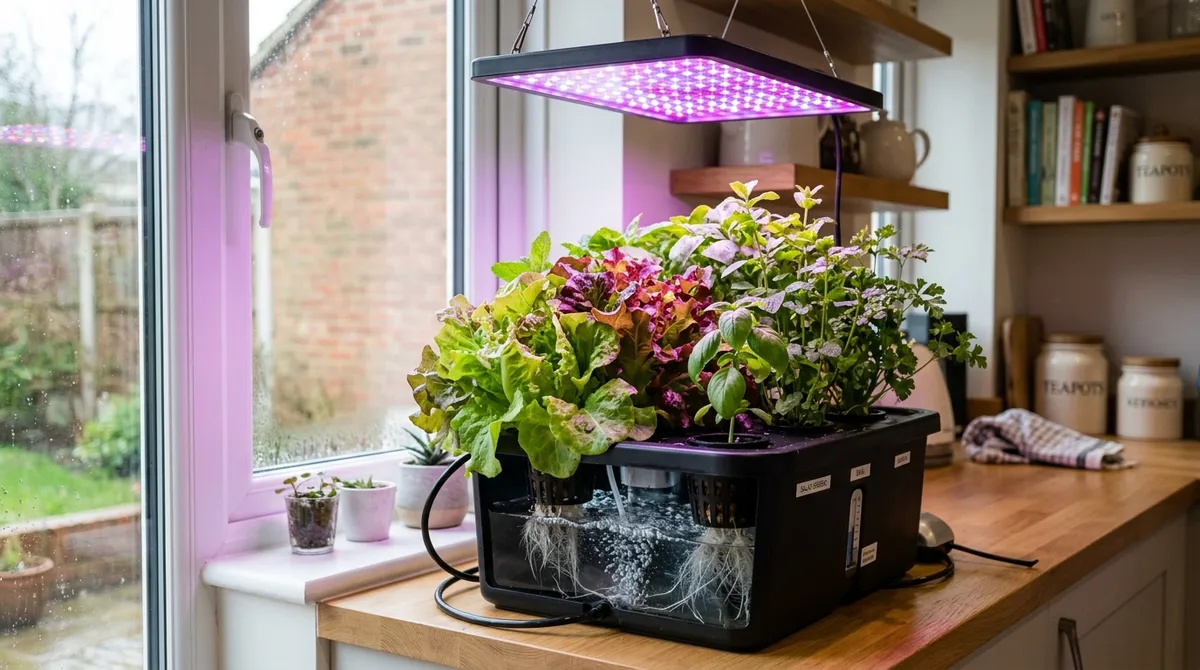
Hydroponics for beginners starts with one fact: plants do not need soil. They need water, nutrients, oxygen and light. Remove the soil and deliver those four things directly to the roots, and plants grow 30-50% faster with less water and no weeding. A basic deep water culture system costs 30-50 pounds to build from parts available on eBay and at any UK garden centre.
I have been running hydroponic systems in my garage and unheated greenhouse since 2023. Over three years and 12 crop varieties, I have tested DWC, wick, and NFT setups. This guide covers what actually works for UK beginners, not what looks good on YouTube. The climate, water chemistry and available kit in Britain are different from the US-focused guides that dominate search results.
What is hydroponics and how does it work?
Hydroponics is growing plants in nutrient-rich water instead of soil. Plant roots sit in or receive a flowing solution containing dissolved minerals. An air pump or water flow provides oxygen. The plants still need light, either from a window or LED grow panel.
The principle is straightforward. In soil, roots spend energy searching for water and nutrients. In hydroponics, roots access everything they need immediately. That saved energy goes into leaf and fruit production instead. The result is faster growth, higher yields, and earlier harvests. The RHS notes that hydroponic systems also use up to 90% less water than conventional soil growing.
UK water quality matters here. Most mains water in England and Wales is hard, with a pH of 7.2-7.8 and calcium levels of 100-300 mg/L. Scottish water tends to be softer, around pH 6.5-7.0. You will need to adjust pH downward for almost any hydroponic system in the UK. More on this in the nutrients section below.
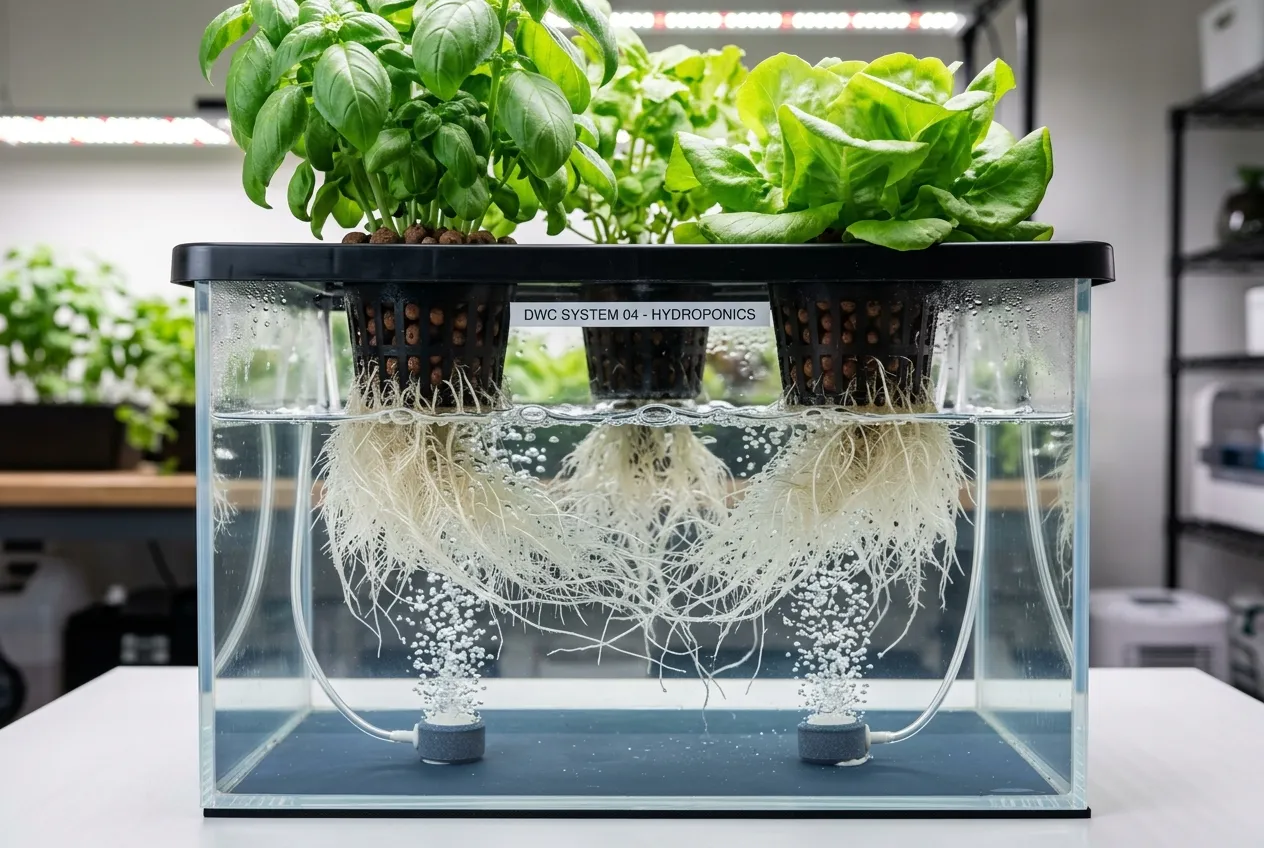 A deep water culture system. Roots hang in oxygenated nutrient solution while the plant grows above in a net pot filled with clay pebbles.
Which hydroponic system should a beginner choose?
Five main hydroponic systems exist. Each suits different crops, budgets, and experience levels. For your first system, I recommend DWC without hesitation.
| System | How it works | Best crops | Cost (DIY) | Difficulty |
|---|---|---|---|---|
| Deep Water Culture (DWC) | Roots sit in aerated nutrient solution | Lettuce, herbs, leafy greens | 30-50 pounds | Very easy |
| Wick System | Fabric wick draws solution to roots | Herbs, small lettuce | 15-25 pounds | Very easy |
| Nutrient Film Technique (NFT) | Thin film of solution flows over roots in channels | Lettuce, strawberries, herbs | 80-150 pounds | Moderate |
| Drip System | Solution drips onto growing medium from above | Tomatoes, peppers, cucumbers | 60-120 pounds | Moderate |
| Ebb and Flow (Flood & Drain) | Tray floods periodically then drains back | Mixed crops, herbs | 70-130 pounds | Moderate |
Deep water culture: the best starter system
DWC is the system I recommend to every beginner. Plant roots hang in a reservoir of nutrient solution. An air pump and air stone keep the water oxygenated. There are no water pumps, timers, or channels to block.
What you need for a basic DWC build:
- 30-litre opaque storage box with lid (5-10 pounds)
- Aquarium air pump, 4W minimum (5-8 pounds)
- Air stone and airline tubing (2-3 pounds)
- Net pots, 50-80mm diameter (3-5 pounds for 6-10)
- Clay pebbles or perlite growing medium (5-8 pounds)
- Hydroponic nutrients, A+B formula (8-12 pounds)
- pH test kit or digital meter (5-10 pounds)
Drill or cut holes in the lid to fit your net pots. Fill pots with clay pebbles, place seedlings in, and fill the reservoir to just below the base of the net pots. Add nutrients, adjust pH, switch on the air pump. That is it.
Total build time: under one hour. Total cost: 35-55 pounds.
Wick system: even simpler but limited
A wick system uses cotton or nylon rope to draw nutrient solution from a reservoir up to a pot of growing medium. No electricity needed. It works for small herbs like basil, mint, and parsley, but larger plants drink faster than the wick can deliver.
I use wick systems on my kitchen windowsill for single herb pots. They cost under 5 pounds each to make from a plastic bottle, a cotton shoelace, and some perlite.
NFT and drip systems: the next step up
Once you have a harvest or two under your belt, NFT and drip systems offer more capacity. NFT runs a thin film of nutrient solution along a sloped channel. Drip systems pump solution to individual plants from a central reservoir.
Both need a water pump and timer, which adds cost and points of failure. Save these for when you understand pH management and nutrient mixing. If you grow tomatoes or peppers hydroponically, a drip system is the practical choice for those taller, heavier crops.
How to mix hydroponic nutrients correctly
Hydroponic nutrients replace everything soil normally provides. Buy a two-part (A+B) liquid concentrate designed for hydroponics. General Hydroponics Flora Series, Ionic, and Growth Technology are all available from UK suppliers and work well.
Never mix concentrates together before diluting. Add Part A to water first, stir, then add Part B. Mixing concentrates directly causes nutrient lockout where calcium and sulphate form an insoluble precipitate.
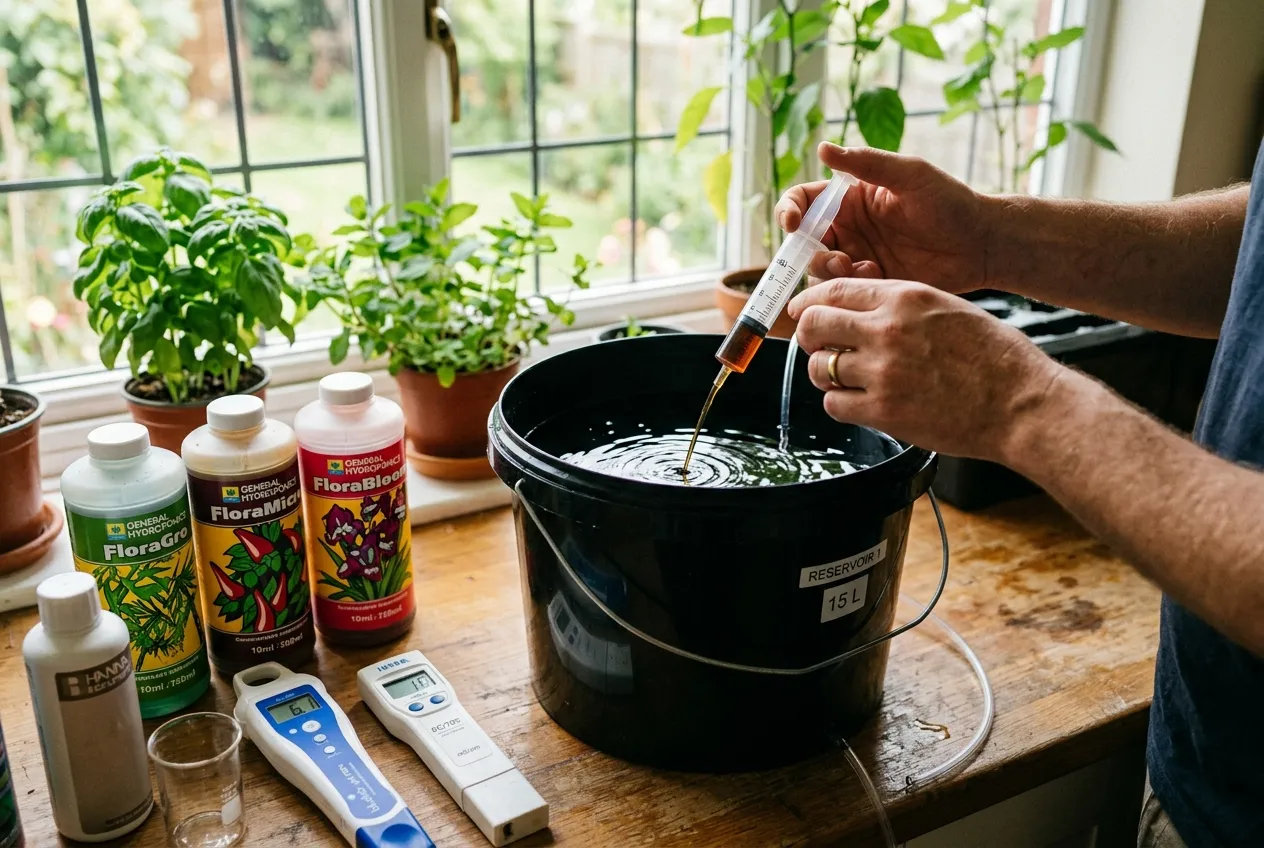 Mixing nutrients for a DWC reservoir. Add Part A to water first, stir thoroughly, then add Part B. A digital pH meter and EC meter are the two essential tools for any hydroponic grower.
Nutrient strength by crop type
Measure strength using electrical conductivity (EC), expressed in milliSiemens per centimetre (mS/cm). An EC meter costs 10-15 pounds and is worth every penny.
| Crop type | Target EC (mS/cm) | Nutrient dose (typical) |
|---|---|---|
| Lettuce, salad leaves | 1.2-1.6 | 2-3ml per litre (each part) |
| Herbs (basil, mint, coriander) | 1.0-1.6 | 2-3ml per litre |
| Spinach, pak choi, rocket | 1.8-2.2 | 3-4ml per litre |
| Tomatoes (fruiting stage) | 2.0-3.5 | 4-5ml per litre |
| Peppers and chillies | 2.0-2.8 | 3-5ml per litre |
| Strawberries | 1.2-1.6 | 2-3ml per litre |
Start at the lower end and increase over 2-3 weeks. Seedlings and young plants need half the EC of mature plants. Burnt leaf tips mean you have gone too high.
pH management for UK water
Target pH: 5.5-6.5 for all hydroponic crops. Outside this range, plants cannot absorb certain nutrients even when they are present in the solution. This is called nutrient lockout.
UK mains water pH varies by region:
- South and East England: pH 7.5-8.2 (very hard, high calcium)
- Midlands: pH 7.0-7.8 (moderately hard)
- North England: pH 6.8-7.5 (variable)
- Scotland: pH 6.2-7.0 (soft, often close to target already)
- Wales: pH 6.5-7.5 (variable, generally softer)
Check your local water quality report on your supplier’s website. The Drinking Water Inspectorate publishes annual quality data by region. You can also test your tap water directly with your pH meter.
To lower pH, use phosphoric acid pH-down solution (available from hydroponic suppliers for about 5 pounds per 250ml). Add 1ml at a time to your reservoir, stir, wait 5 minutes, then test again. A 250ml bottle lasts most small systems 6-12 months.
Check pH twice per week minimum. pH drifts upward as plants absorb nutrients. In my experience, a 30-litre DWC reservoir drifts from 5.8 to 6.5 within 3-4 days. Twice-weekly checks catch this before it causes problems.
What are the best crops to grow hydroponically?
Start with fast-growing leafy greens. They are forgiving of beginner mistakes, harvest quickly, and the taste difference from shop-bought is dramatic. If you already grow lettuce in soil, you will be surprised how much faster it matures in a DWC system.
Lettuce
The single best first crop. Butterhead varieties like All Year Round and Tom Thumb reach harvest size in 25-30 days from transplant. Loose-leaf types like Salad Bowl produce cut-and-come-again leaves within 20 days.
DWC settings: EC 1.2-1.6, pH 5.5-6.5, 12-16 hours light daily.
Basil
Grows prolifically in hydroponics. A single plant produces enough leaves to replace a weekly supermarket purchase. Genovese and Sweet Green are the most reliable varieties. Pinch growing tips regularly to encourage bushy growth.
DWC settings: EC 1.0-1.4, pH 5.5-6.5, 14-16 hours light daily.
Pak choi
Fast-growing and well-suited to UK conditions. Matures in 30-40 days. Canton Dwarf is the best compact variety for DWC. Pak choi tolerates lower light levels than most crops, making it ideal for British winters.
DWC settings: EC 1.5-2.0, pH 6.0-6.5, 10-14 hours light daily.
Spinach
Baby spinach leaves are ready in 25-35 days. Perpetual spinach varieties produce over a longer period. Spinach prefers cooler nutrient temperatures (15-20C), which suits unheated UK indoor spaces.
DWC settings: EC 1.8-2.2, pH 6.0-6.5, 10-14 hours light daily.
Moving beyond leafy greens
Once you are confident with pH and nutrient management, try herbs like mint, coriander, and dill. Strawberries grow well in NFT systems. Larger fruiting crops like chillies and cucumbers need deeper reservoirs, stronger nutrients, and support structures, but the principles remain the same.
What lighting do hydroponic plants need?
Natural light from a south-facing window works from April to September for most leafy greens. During the darker months (October to March), supplemental LED lighting makes the difference between healthy growth and weak, leggy plants.
LED grow lights for beginners
A full-spectrum LED panel rated at 20-40 watts covers a single DWC system. Expect to pay 20-40 pounds for a decent panel. Avoid cheap blurple (blue-purple) LEDs from marketplace sellers. Full-spectrum white LEDs produce better growth and are far less annoying to live with.
Recommended light schedule:
| Crop | Hours of light per day |
|---|---|
| Lettuce and salad | 12-16 |
| Basil and herbs | 14-16 |
| Spinach and pak choi | 10-14 |
| Tomatoes and peppers | 14-18 |
| Strawberries | 12-16 |
Running costs: A 30-watt LED panel running 14 hours per day uses about 12.6 kWh per month. At the current UK average electricity rate of 24.5p per kWh, that costs approximately 3.09 pounds per month. Even a 40-watt panel stays under 5 pounds monthly.
If you have a greenhouse, you can run hydroponic systems with natural light for most of the year. A greenhouse provides higher light levels than any windowsill and the enclosed environment makes temperature management easier.
How to build your first DWC system step by step
This is the exact system I built in 2023. It still runs today producing lettuce every month.
Materials list:
- 30-litre opaque plastic storage box with snap-on lid
- Aquarium air pump (Hailea ACO-208 or similar, 4W)
- 100mm disc air stone
- 2 metres of 4mm silicone airline tubing
- Six 50mm net pots
- 5 litres of expanded clay pebbles (Hydroton or similar)
- Hydroponic nutrients (two-part A+B liquid)
- pH-down solution (phosphoric acid)
- Digital pH meter
- EC meter (optional but recommended)
- Hole saw or craft knife
Build steps:
- Mark six evenly spaced circles on the lid using a net pot as a template
- Cut or drill the holes so net pots sit snugly with the rim resting on the lid
- Drill a small hole in the lid for the airline tubing
- Place the air stone in the bottom of the box and thread the airline through the lid hole
- Connect the airline to the air pump
- Fill the box with tap water to 2cm below the base of the net pots
- Add nutrients (Part A first, stir, then Part B) to your target EC
- Adjust pH to 5.8 using pH-down
- Fill net pots with rinsed clay pebbles
- Place seedlings or rooted cuttings into the net pots
- Switch on the air pump and keep it running 24 hours a day
Starting your plants: Either germinate seeds in damp rockwool cubes or root plugs, then transplant into net pots when roots emerge from the bottom. Or take cuttings from existing herbs and root them in water before transferring. Supermarket living lettuce and basil plants transplant directly into net pots after gently washing soil from the roots.
Common hydroponic problems and how to fix them
Every beginner hits these issues. Knowing the cause saves you replacing plants unnecessarily.
| Problem | Cause | Fix |
|---|---|---|
| Yellow lower leaves | pH too high, nutrient lockout | Adjust pH to 5.5-6.5 |
| Burnt leaf tips | EC too high (over-feeding) | Dilute solution, reduce nutrient dose |
| Slimy brown roots | Root rot from low oxygen or warm water | Clean reservoir, check air pump, keep water below 22C |
| Slow growth, pale leaves | Light deficiency | Increase light hours or move closer to window |
| Algae in reservoir | Light reaching nutrient solution | Use opaque container, cover any light gaps |
| Wilting despite wet roots | Root rot or oxygen starvation | Replace solution, add stronger air pump |
Root rot is the most common killer for beginners. It happens when water temperature exceeds 22C and dissolved oxygen drops. In summer, move your reservoir to the coolest spot in the room. Freeze water bottles and float them in the reservoir if temperatures climb.
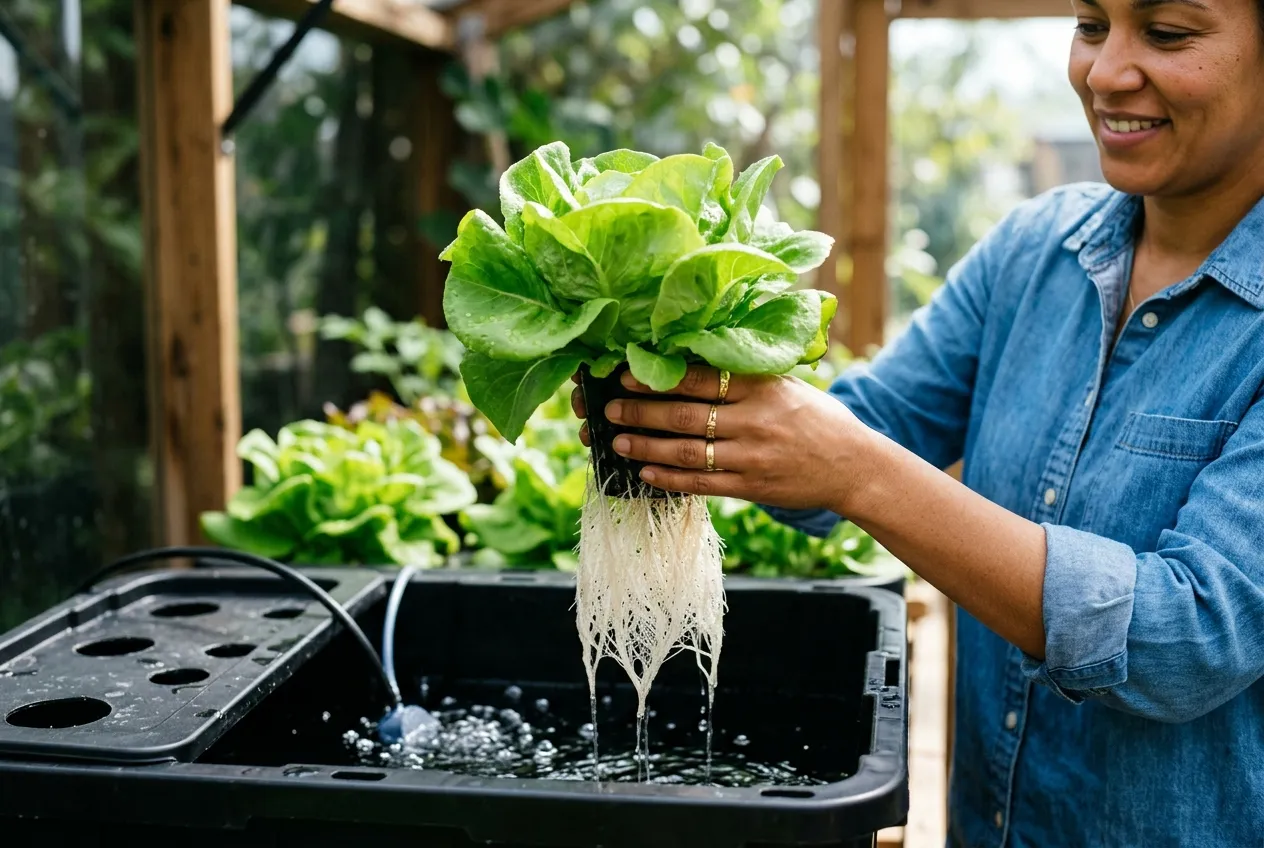 Harvesting hydroponic butterhead lettuce from a DWC system. Healthy white roots indicate good oxygen levels and correct pH. Brown or slimy roots signal a problem.
How much does it cost to run hydroponics at home?
The financial case for home hydroponics is strong if you grow the right crops. High-value leafy greens and herbs offer the best return.
Monthly running costs (single DWC system):
| Item | Monthly cost |
|---|---|
| LED electricity (30W, 14hrs/day) | 3.09 pounds |
| Nutrients (A+B concentrate) | 2-3 pounds |
| pH-down solution | 0.50 pounds |
| Replacement growing medium | 0.50 pounds |
| Air pump electricity (4W, 24hrs) | 0.72 pounds |
| Total | 6.81-7.81 pounds |
Monthly harvest value (typical):
- 4 butterhead lettuces: 4-6 pounds (Tesco price: 1-1.50 pounds each)
- Weekly basil harvest: 4-8 pounds (supermarket pots: 1-2 pounds each, last 1 week)
- Continuous spinach/rocket: 3-5 pounds
A single DWC system breaks even within 2-3 months and saves 60-100 pounds per year after that. Scale to two or three systems and the savings grow proportionally.
If you already grow vegetables at home, see our container vegetable gardening guide for comparing soil-based and soilless approaches side by side.
Hydroponics vs soil growing: when does each make sense?
Hydroponics is not a replacement for soil gardening. It fills specific gaps.
Choose hydroponics when:
- You have no outdoor growing space (flats, north-facing gardens)
- You want fresh salad greens in winter without a heated greenhouse
- You want faster harvests from a small footprint
- You grow herbs that you currently buy weekly from supermarkets
Stick with soil when:
- You grow root vegetables (carrots, parsnips, potatoes)
- You have plenty of outdoor growing space
- You want large yields of fruiting crops at low cost
- You prefer a low-maintenance approach with less monitoring
Many growers, myself included, run both. Hydroponics handles winter lettuce and herbs indoors. The outdoor veg beds and greenhouse take over from May to October. Together they provide fresh produce year-round. For more on growing your own, combine both approaches based on the season.
Where to buy hydroponic supplies in the UK
You do not need a specialist shop for a basic setup.
- Net pots, clay pebbles, rockwool cubes: eBay and Amazon. Order from UK sellers to avoid long shipping times.
- Air pumps and air stones: Any aquarium supplier. Maidenhead Aquatics, Pets at Home, or eBay. Hailea and Eheim are reliable brands.
- Nutrients: Growth Technology (Ionic range), General Hydroponics (Flora series), or Shogun are all UK-stocked. Available from GroWell, Nutriculture, or Amazon.
- pH meters: Bluelab or Apera instruments offer lab-grade accuracy for 30-50 pounds. Cheaper pen meters (10-15 pounds) work but need calibrating monthly.
- EC meters: Bluelab Truncheon is the industry standard (30-40 pounds). Budget pens work for beginners.
For those growing microgreens alongside hydroponics, you likely already have most of the kit. The crossover between indoor growing methods saves money on lighting and growing medium.
Further reading
- How to grow lettuce and salad leaves - the most popular hydroponic crop
- Growing basil in the UK - thrives in DWC systems year-round
- Greenhouse growing calendar - combine with hydroponic growing under glass
- Best fertilisers for gardens - understanding plant nutrition
- Container vegetable gardening - soil-based alternative for small spaces
Lawrie has been gardening in the West Midlands for over 30 years. He grows his own veg using no-dig methods, keeps a wildlife-friendly garden, and writes practical advice based on real UK growing conditions.